
Judge, 1922-09-23 · page 9 of 36
Judge — September 23, 1922 — page 9: what you’re looking at
What you’re looking at
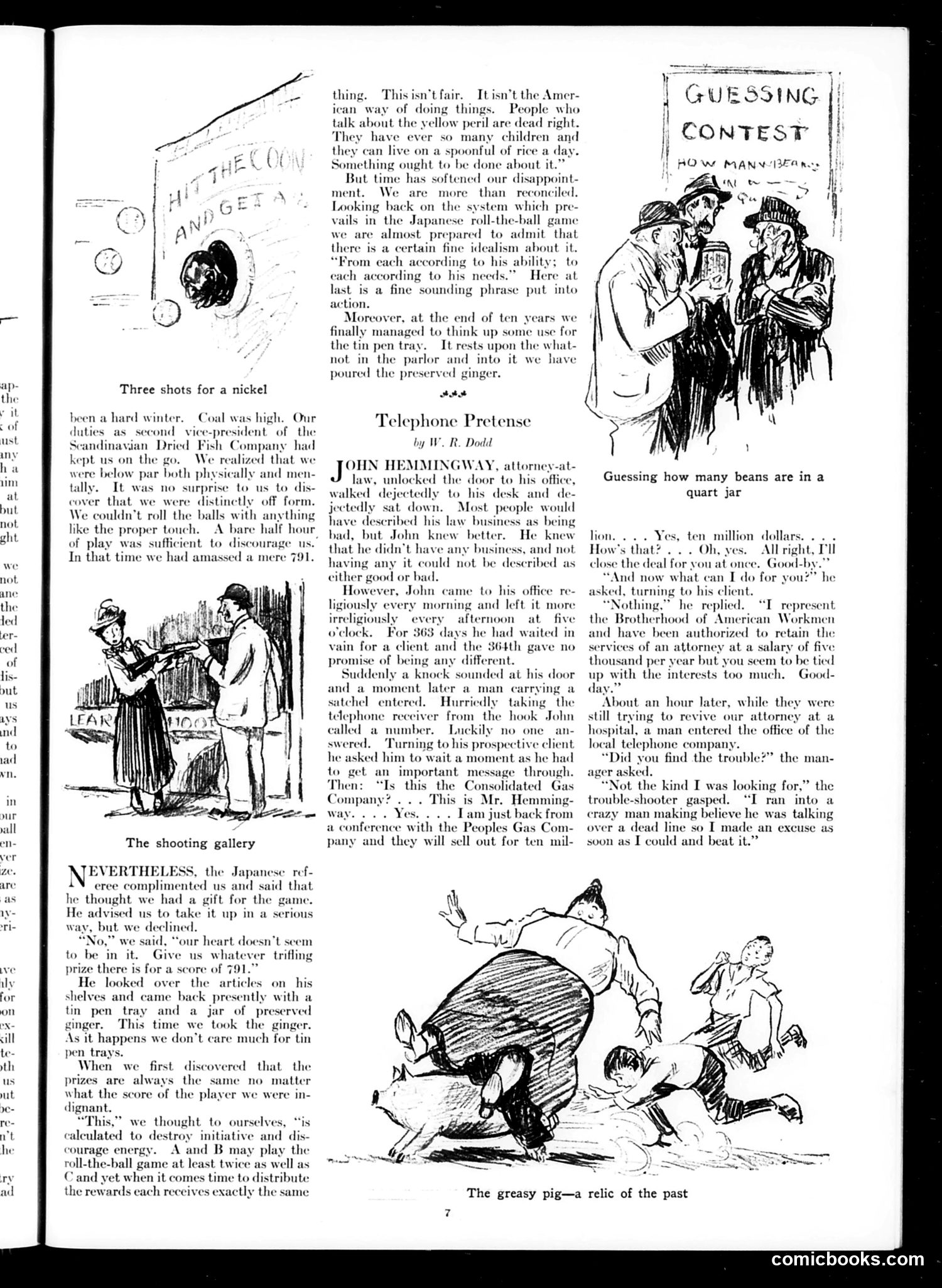
This page contains two distinct pieces of satire: **"Three Shots for a Nickel"** critiques Japanese cultural practices through the lens of an American shooting gallery. The author visits a Japanese-run arcade and receives identical prizes regardless of skill level, initially outraged at this "unfair" system. However, he eventually recognizes the philosophy as idealistic—paraphrasing Marx's "from each according to his ability, to each according to his needs." The satire mocks both American competitive capitalism and the author's gradual, bemused acceptance of communist-adjacent principles in an unexpected context. **"Telephone Pretense"** depicts an unemployed lawyer, John Hemmingway, faking a lucrative business call to impress a potential client who enters his empty office. The joke exposes the performance of success—he fabricates deals and importance through theatrical phone conversation to appear professionally established, revealing the gap between appearance and reality in business. Both pieces use humor to critique American values: competitiveness, status-seeking, and the performance of success.
📄 Transcribed text from this page (OCR, searchable)
Machine-transcribed from the original scan — historical spelling and the odd misread are preserved.
Three shots for a nickel been a hard winter. Coal was high. Our duties as second vice-president. of the Scandinavian Dried Fish Company had kept us on the go. We realized that we were below par both physically and men- tally. It was no surprise to us to dis- cover that we were distinctly off form. We couldn't roll the balls with anything like the proper touch. A bare half hour of play was sufficient to discourage us. In that time we had amassed a mere 791. The shooting gallery EVERTHELESS, the Japanese ref- AN cree complimented us and said that he thought we had a gift for the game. He advised us to take it up in a serious w but we declined. we said, “our heart doesn’t seem to be in it. Give us whatever trifling prize there is for a score of i He looked over the articles on his shelves and came back presently with a tin pen tray and a jar of preserved ginger. This time we took the ginger. As it happens we don’t care much for tin pen trays. When we first discovered that the prizes are always the same no matter what the score of the player we were in- dignant. “This,” we thought to ourselves, “is calculated to destroy initiative and dis- courage energy. A and B may play the roll-the-ball game at least twice as well as Cand yet when it comes time to distribute the rewards each receives exactly the same thing. Thisisn’t fair. Tt isn’t the Amer- ican way of doing things. People who talk about the yellow peril are dead right. have ever so many children and n live on a spoonful of rice i thing ought to be done about it. But time has softened our disappoint- ment. We are more than reconciled. Looking back on the system which pre- vails in the Japanese roll-the-ball game we are almost prepared to admit that there is a certain fine idealism about it. “From each according to his ability; to each according to his needs.” Here at last is a fine sounding phrase put into action, More finally ha t the end of ten years we d to think up some use f the tin pen tray. It rests upon the wl not in the parlor and into it we have poured the preserved ginger. ned Telephone Pretense by W. R. Dodd OHN HEMMINGWAY, attorney-a law, unlocked the door to his office, walked dejectedly to his desk and de- jectedly sat down. Most people would have described his law business as being bad, but John knew better. He knew that he didn’t have any business, and not having any it could not be described as cither good or bad. However, John came to his office re- ligiously every morning and left it more irreligiously ‘every afternoon at five o'clock, For 363 days he had waited in vain for a client and the 364th gave no promise of being any different. Sudde a kno sounded at his door and a moment later a man carrying a satchel entered. Hurriedly taking the telephone receiver from the hook John number. Luckily no one an- Turning to his prospective client him to wait a moment as he had to get an important message through. Then: “Is this the Consolidated Gas Company? . . . This is Mr. Hemming- way... . Yes... . Lam just back from a conference with the Peoples Gas Com- pany and they will sell out for ten mil- GUESSING {| CONTEST | POW MANWIREARS | I Guessing how many beans are in a quart jar lion... . Yes, ten million dollars... . How's that? . .. Oh, yes. All right, Pll close the deal for you at once. Good-by.” ‘And now what can I do for you?” he 1, turning to his client. Nothing,” he replied. “I represent the Brotherhood of American Workmen and have been authorized to retain the services of an attorney at a salary of five thousand per year but you seem to be tied up with the interests too much. Good- day.” About an hour later, while the still trying to re’ our attorne hospital, a man entered the office of the cal telephone company. Did you find the trouble?” the man- ager asked. “Not the kind I was looking for,” the trouble-shooter gasped. “I ran into a man making believe he was talking dead line so T made an excuse as soon as I could and beat it.” The greasy pig—a relic of the past comicbooks.com