
Judge, 1922-09-23 · page 8 of 36
Judge — September 23, 1922 — page 8: what you’re looking at
What you’re looking at
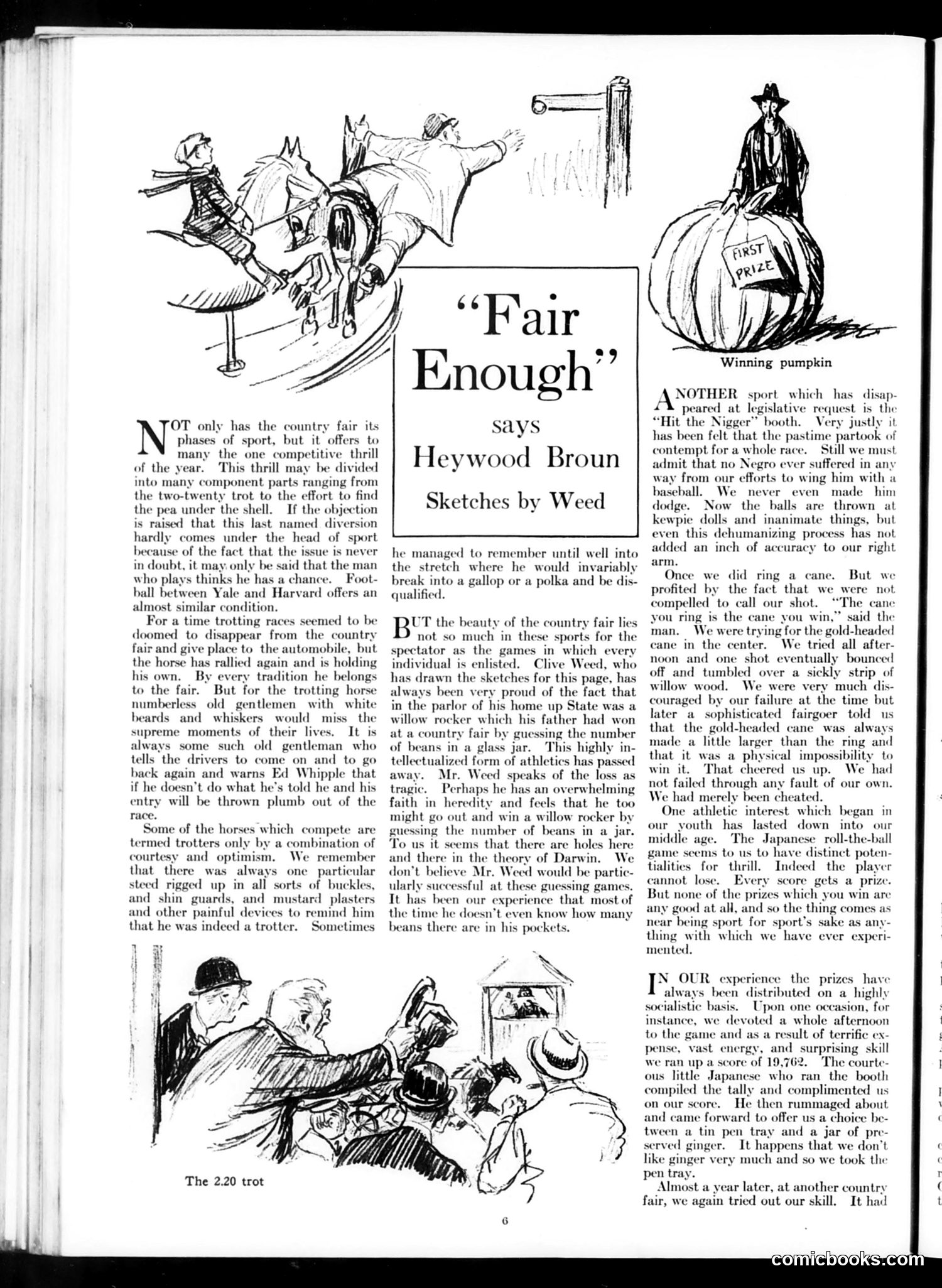
This 1920s *Judge* magazine article by Heywood Broun celebrates country fairs as authentic American entertainment, with illustrations by Clive Weed. The piece humorously describes fair competitions: trotting races (where poorly-trained horses comically break into gallops), carnival games like guessing beans in jars, and ring-toss contests. Most strikingly to modern readers, Broun openly discusses the now-infamous "Hit the Nigger" booth—a racist carnival game where fairgoers threw balls at Black targets. He acknowledges its removal as "justly" requested by legislators, claiming no one was actually hit. He then trivializes this racist entertainment by comparing it favorably to safer modern alternatives like throwing balls at Kewpie dolls. The casual tone normalizing racial violence reflects the era's casual racism, even among ostensibly progressive publications. The piece unwittingly documents how dehumanizing entertainment was standard fair fare, presented as innocent fun rather than the racist violence it represented.
📄 Transcribed text from this page (OCR, searchable)
Machine-transcribed from the original scan — historical spelling and the odd misread are preserved.
OT only has the country fair its phases of sport, but it’ offers to many the one competitive thrill year. This thrill may be divided ny component parts ranging from wenty trot to the effort to find the pea under the shell. If the objection is raised that this last named diversion hardly comes under the head of sport because of the fact that the issue is never in doubt, it may: only be said that the man who plays thinks he has a chance. Foot- ball between Yale and Harvard offers an almost similar condition. For a time trotting races seemed to be doomed to disappear from the country and give place to the automobile, but the horse has rallied again and is holding his own. By every tradition he belongs to the fair. But for the trotting horse numberless old gentlemen with’ white beards and whiskers would miss the supreme moments of their lives. It is always some such old gentler who tells the drivers to come on and to go back again and warns Ed Whipple that if he doesn’t do what he’s told he and his entry will be thrown plumb out of the race. Some of the horses which compete are termed trotters only by a combination of courtesy and optimism. We remember that there was always one particular steed rigged up in all sorts of buckles, and shin guards, and mustard plasters and other painful devices to remind him that he was indeed a trotter. Sometimes The 2.20 trot Heywood Broun Sketches by Weed he managed to remember until well into the stretch where he would invariably break into a gallop or a polka and be dis- qualified. UT the beauty of the country fair lies not so much in these sports for the spectator as the games in which every individual is enlisted. Clive Weed, who has drawn the sketches for this page, has always been very proud of the fact that in the parlor of his home up State was a willow rocker which his father had won at a country fair by guessing the number of beans in a glass jar. This highly in- tellectualized form of athletics has passed away. Mr. Weed speaks of the loss as tragic. Perhaps he has an overwhelming faith in heredity and feels that he too might go out and win a willow rocker by essing the number of beans in a jar. ‘To us it seems that there are holes here and there in the theory of Darwii We don’t believe Mr. Weed would be partic- ularly successful at these guessing games. It has been our experience that most of the time he doesn’t even know how many beans there are in his pockets. Winning pumpkin OTHER sport which has disap- LY peared at legislative request is the “Hit the Nigger” booth. Very justly it has been felt that the pastime partook of contempt for a whole race. Still we must admit that no Negro ever suffered in any : from our efforts to wing him with a w baseball. We never even made him dodge. Now the balls are thrown at kewpie dolls and inanimate things, but even this dehumanizing process has not added an inch of accuracy to our right arm. Once profited by we did ring a cane. But we the fact that we were not compelled to call our shot. “The cane you ring is the cane you win,” said the man. We were trying for the gold-headed cane in the ce We tried all after- noon and one shot eventually bounced off and tumbled over a sickly strip of willow wood. We were very ‘much dis- couraged by our failure at the time but later a sophisticated fairgoer told us that the gold-headed cane was alway: made a little larger than the ring and that it was a physical impossibility to win it. That cheered us up. We had not failed through any fault of our own. We had merely t cheated. athletic interest which began in our youth has lasted down into. our middle age. The Japanese roll-the-ball game seems to us to have distinct poten- tialities for thrill. Indeed the pl cannot lose. Every score gets a But none of the prizes which you wit any good at all, and so the thing com near being sport for sport’s sake as any- thing with which we have ever experi- mented. N_ OUR experic the prizes have always been distributed on a highly socialistic bs Upon one occasion, for instance, we devoted a whole afternoon to the result of terrific ex- pense ing skill we ran up a score of 19,762. The courte- ous little Japanese who ran the booth compiled the tally and complimented us on our score. He then rummaged about and came forward to offer us a choice be- tween a tin pen tray and a jar of pre- served ginger. It happens that we don’t like ginger very much and so we took the pen tray. Almost fair, we ag: r later, at another country tried out our skill. It had