
A complete issue · 36 pages · 1922
Judge — June 17, 1922
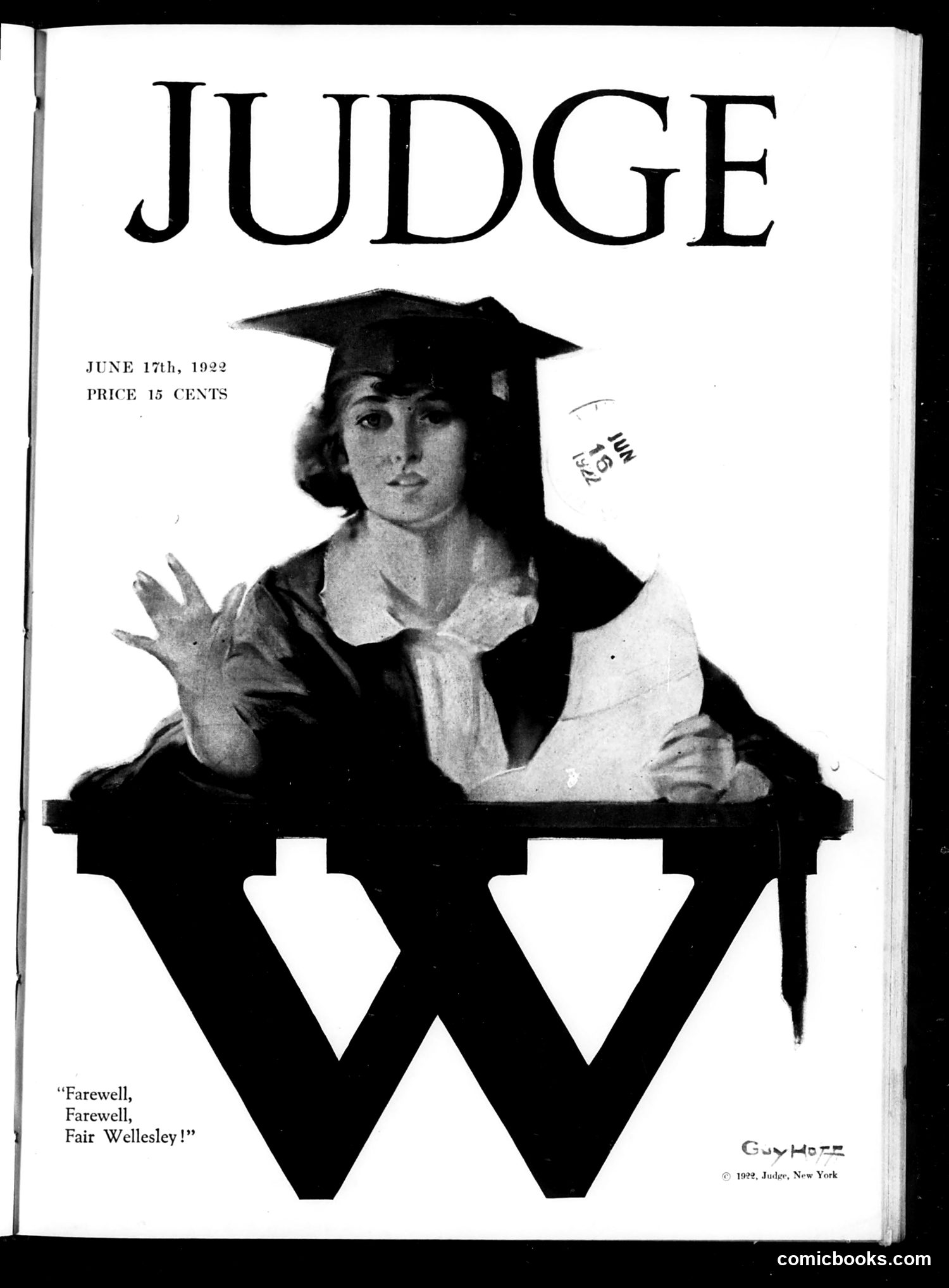
This cover depicts a young woman in academic regalia (mortarboard and gown) positioned within a large "W" shape, likely representing Wellesley College. The caption "Farewell, Farewell, Fair Wellesley!" suggests a graduation theme. The satire appears to reference the departure of female graduates from an all-women's institution. The 1920s context—the era of "flappers" and changing women's roles—suggests the joke may concern what awaits these educated women after leaving college: presumably marriage, domestic life, or social expectations that would constrain their newfound independence and education. The formal academic dress contrasts with the somewhat irreverent tone, typical of Judge's satirical approach to social change.
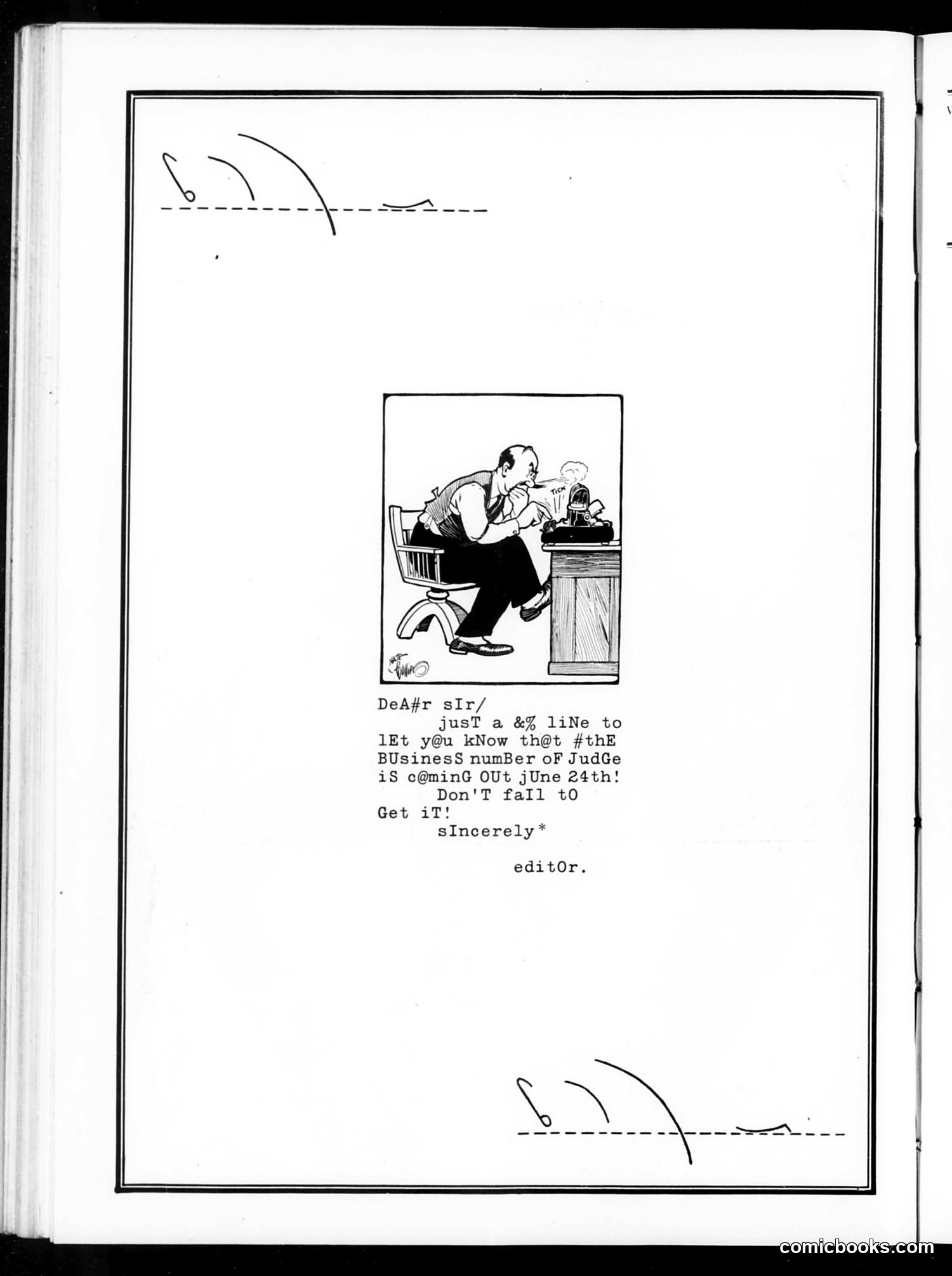
This page contains an editorial letter to the magazine's editor. A man sits at a desk typing, addressing "Dear Sir" with instructions about publishing business information for "Judge" by June 24th. The letter uses intentionally garbled typewriter-style text (mixing uppercase, lowercase, and symbols) to suggest either mechanical error or deliberate obfuscation. The satire appears to mock either: - Someone trying to hide information through unclear communication - Bureaucratic or legal language designed to confuse readers - A specific historical event or scandal requiring coded messaging Without additional context about Judge magazine's publication date and current events, the precise target remains unclear. The cartoon's humor relies on the contrast between the formal "Dear Sir" opening and the incomprehensible message that follows.
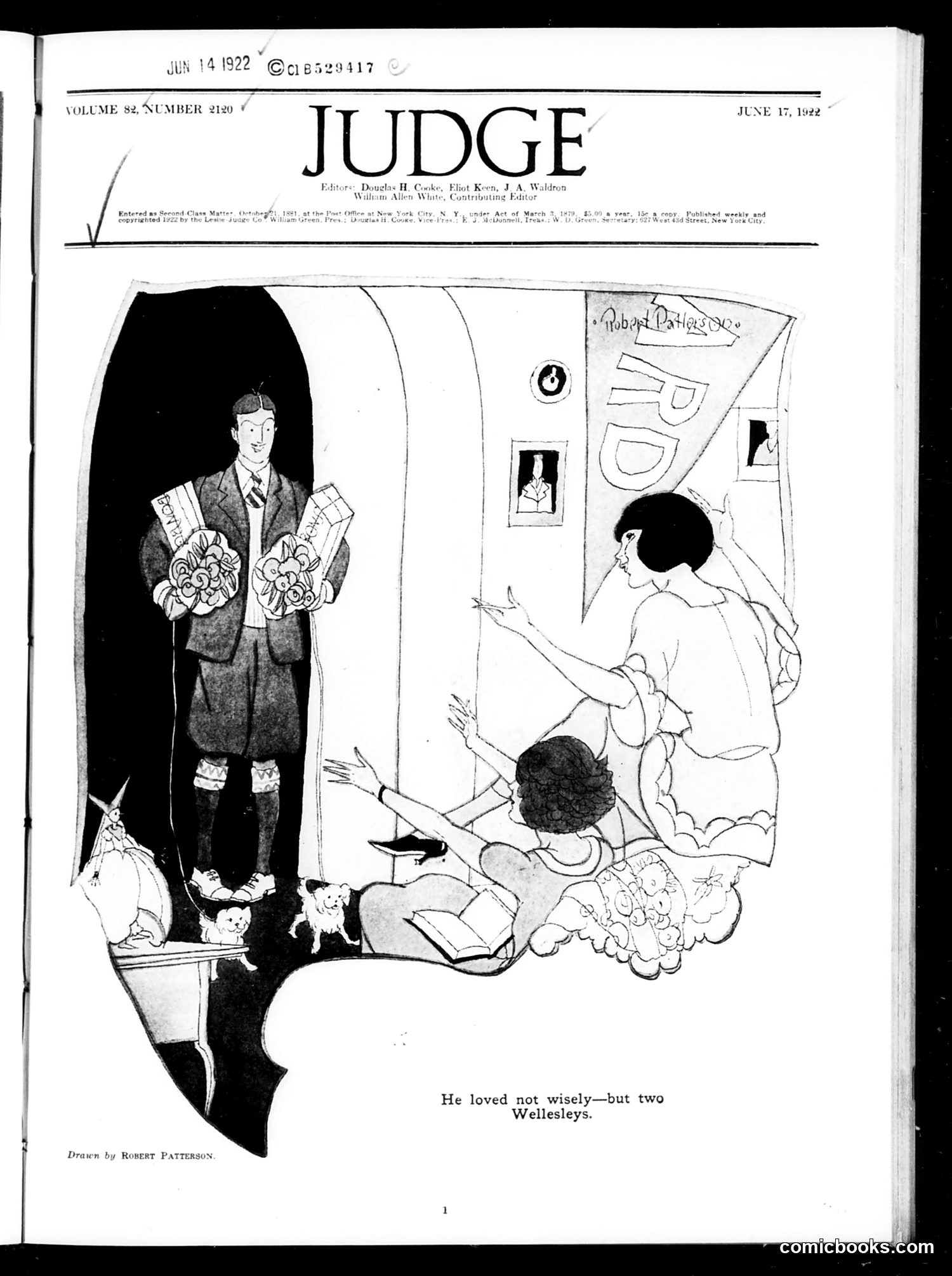
This cartoon by Robert Patterson depicts a domestic scene satirizing infidelity. A well-dressed man stands in a doorway holding bouquets, while a woman inside frantically hides evidence of another man's presence—visible through a doorway where a second man appears. The caption reads: "He loved not wisely—but two Wellesleys." The joke references the Wellesley name, likely implying two women of that surname or social circle. The satire mocks a man attempting to maintain simultaneous romantic relationships, with the cartoon showing the comedic chaos that ensues when both women are present. This reflects 1920s social humor about infidelity and the "new morality" debates of the Jazz Age.
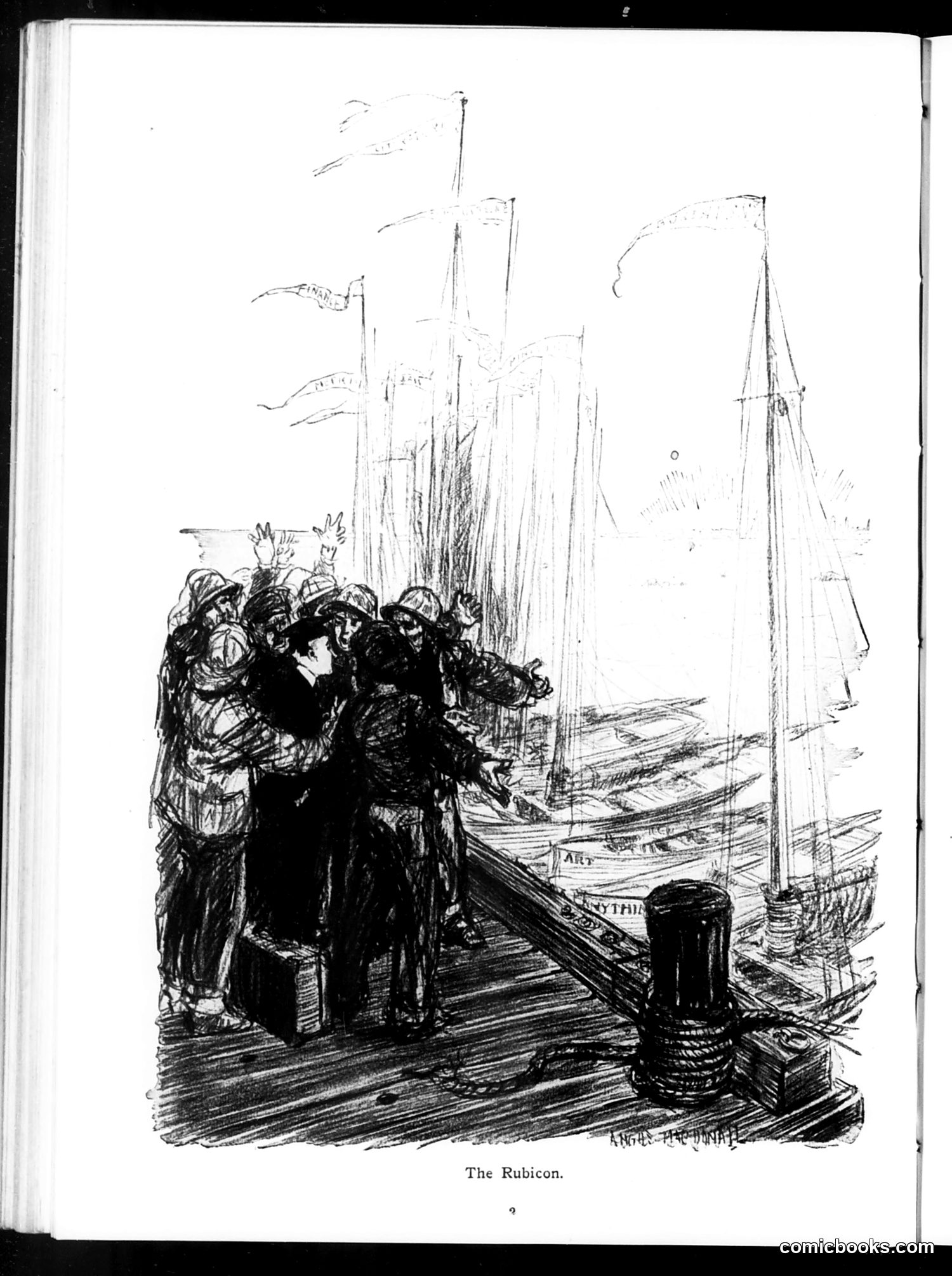
This sketch depicts a group of figures on a dock, gathered around a mooring post, with sailing vessels in the background. The title "The Rubicon" references the famous river Caesar crossed to start a civil war—a metaphor for crossing a point of no return. The drawing appears to be political satire, likely referencing a consequential decision or commitment by a political figure or group. The clustered, agitated figures suggest debate or tension over a momentous choice. The maritime setting—with boats ready to depart—reinforces the metaphor of embarking on a decisive course of action. Without additional context about Judge magazine's publication date, the specific political figures depicted remain unclear, though the composition suggests this concerns a significant American political crisis or decision point.
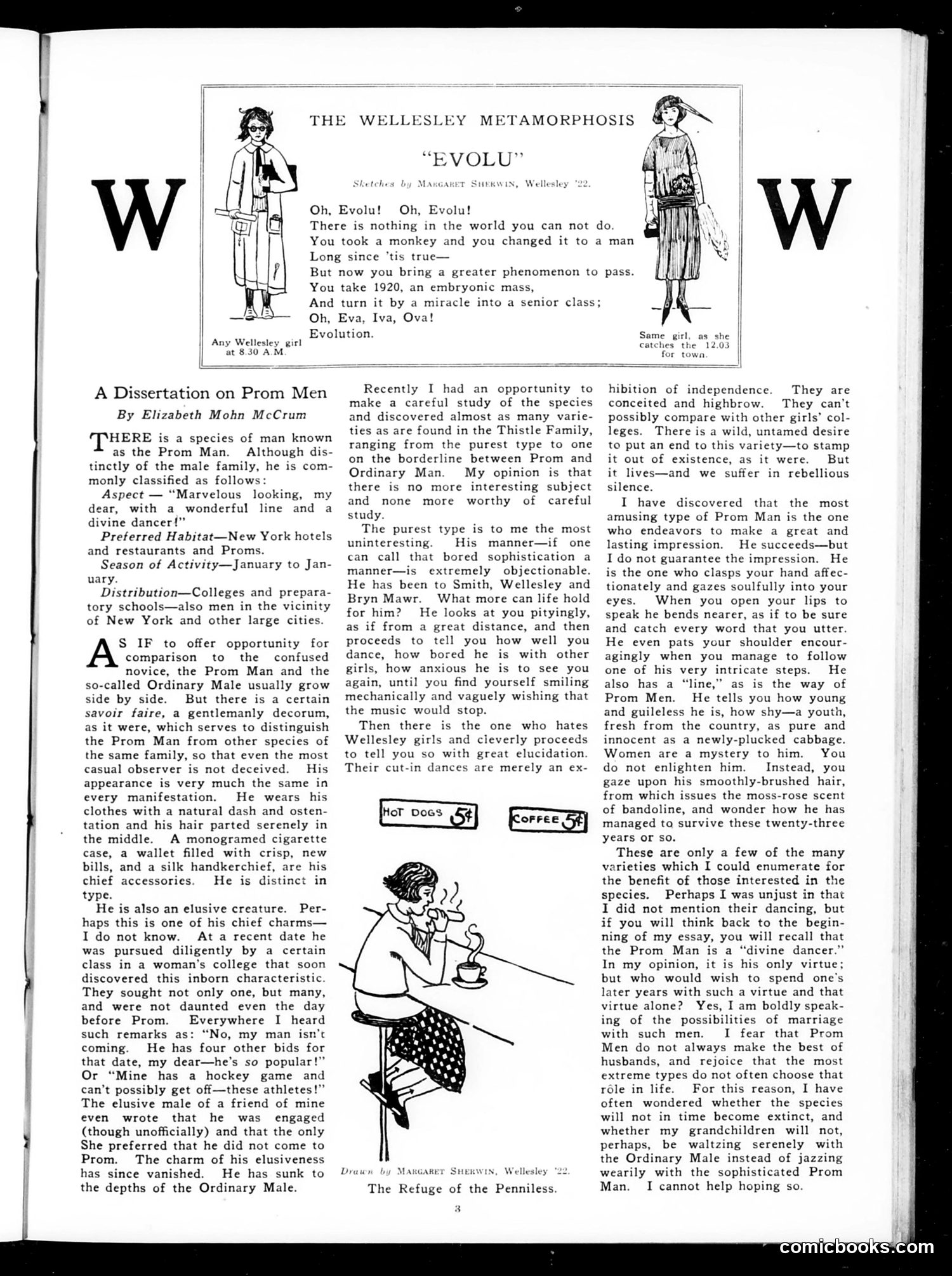
This page contains two distinct pieces: **"EVOLU" (top)**: A humorous poem by Margaret Sherwin (Wellesley '22) satirizing women's evolution and social progress. It jokes about transforming "an embryonic mass" (a 1920 freshman) into a refined "senior class" member—essentially mocking how college supposedly civilizes young women. **"A Dissertation on Prom Men" (main article)**: A satirical essay by Elizabeth Mohn McCrum that humorously catalogs "the Prom Man" as a distinct species, distinguishing him from "Ordinary Men." The piece mocks his affected mannerisms, pretentious behavior, and romantic posturing—portraying him as an insufferable type who frequents upscale New York hotels and affects sophistication while being fundamentally shallow and boring. Both pieces target early 1920s college social culture and gender dynamics through comedic anthropological framing.
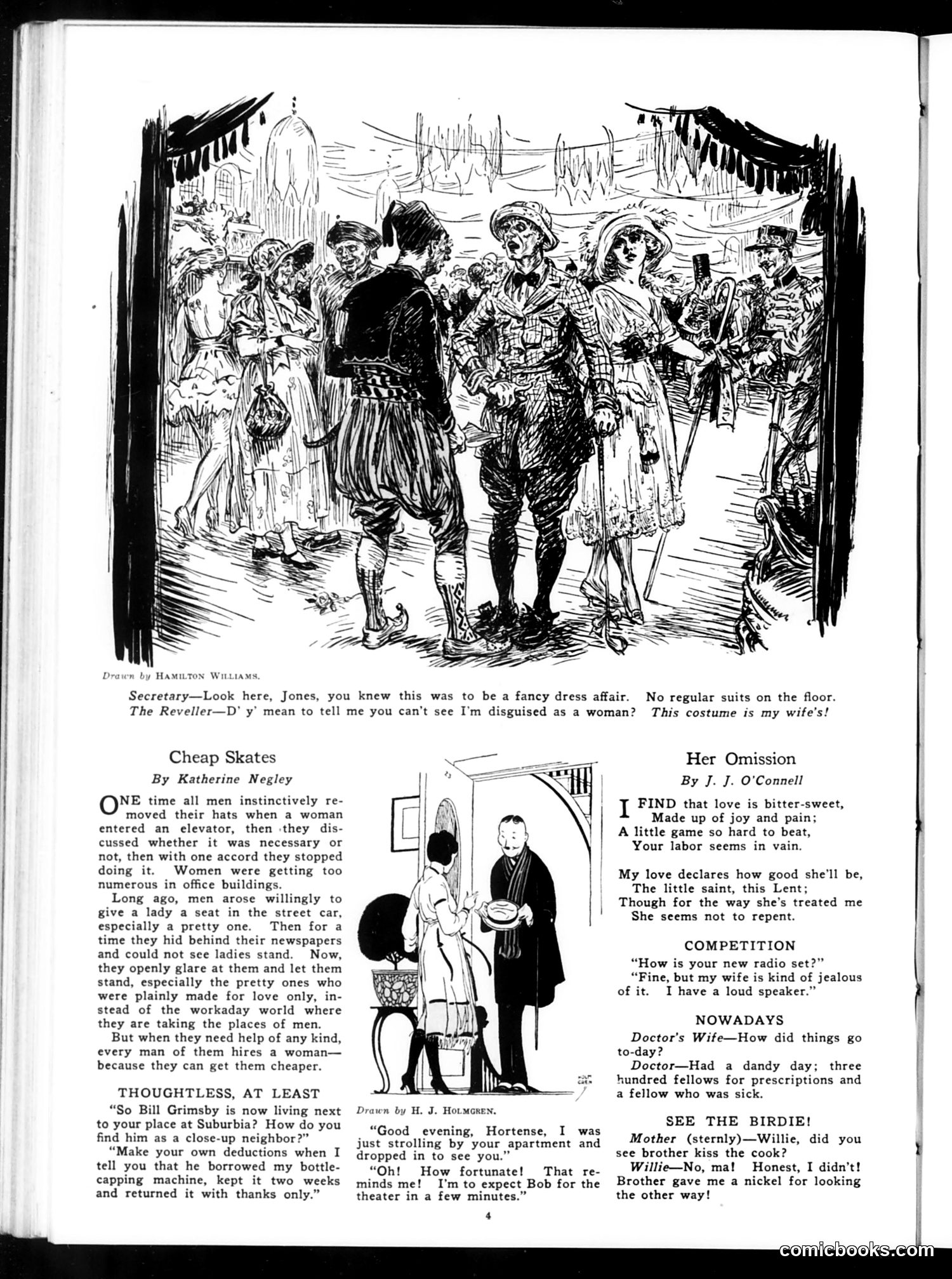
The top cartoon, drawn by Hamilton Williams, depicts a fancy dress ball. A man in military costume confronts organizers, claiming his outfit isn't a disguise—it's his actual wife's costume. The joke plays on period gender anxieties: women wearing "masculine" military dress at social events was apparently scandalous enough to warrant satire about blurred gender presentation. The page also contains several short humorous stories and poems ("Cheap Skates," "Her Omission," "Competition," "Nowadays," "See the Birdie!") that appear to satirize modern domestic life—wives' jealousy over radio sets, doctors' harried schedules, and family dynamics. The lower cartoon by H.J. Holmgren shows a woman at a man's apartment door, presenting herself as having been "strolling by." The humor depends on period assumptions about unmarried women's propriety and reputation.
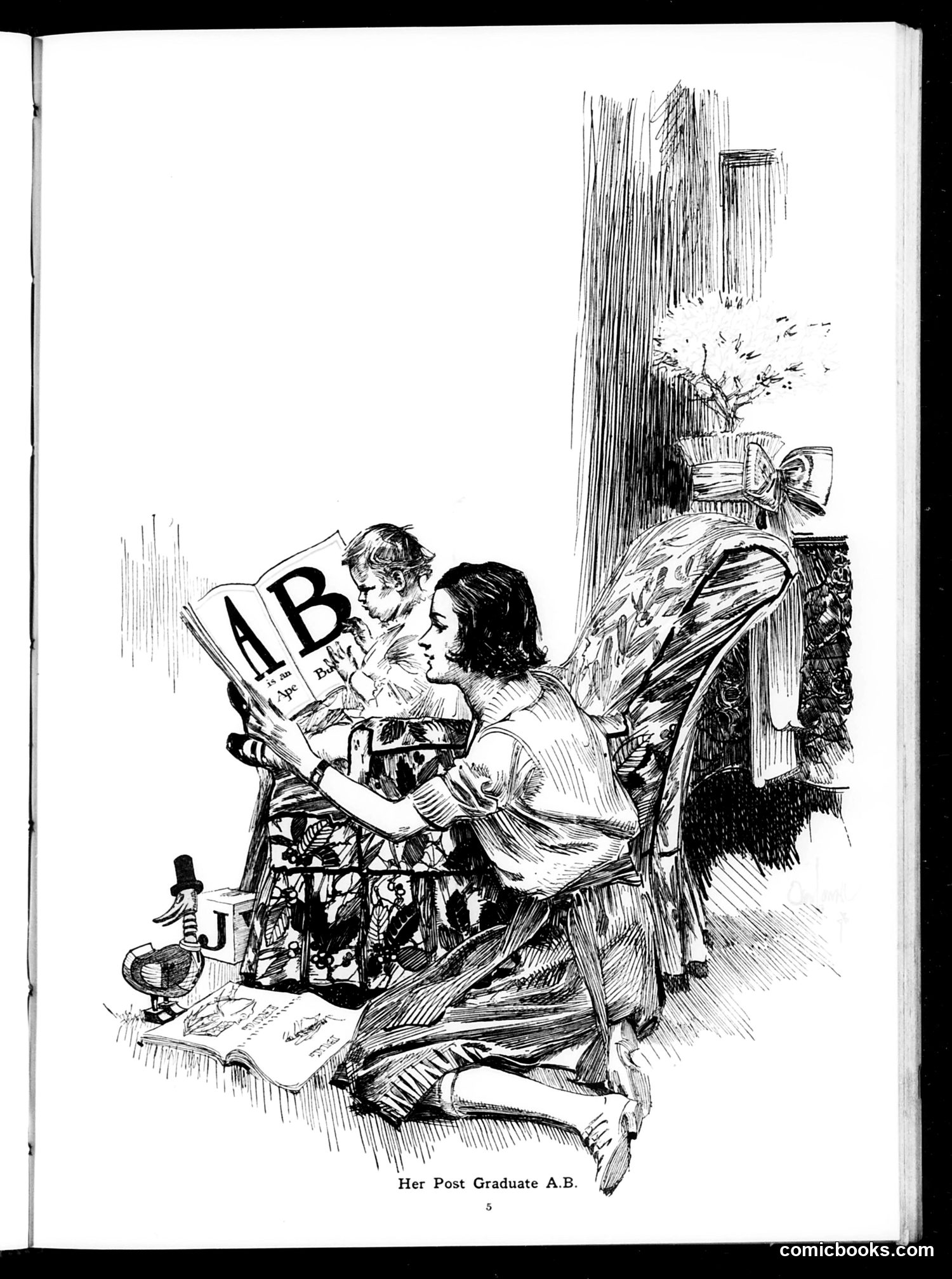
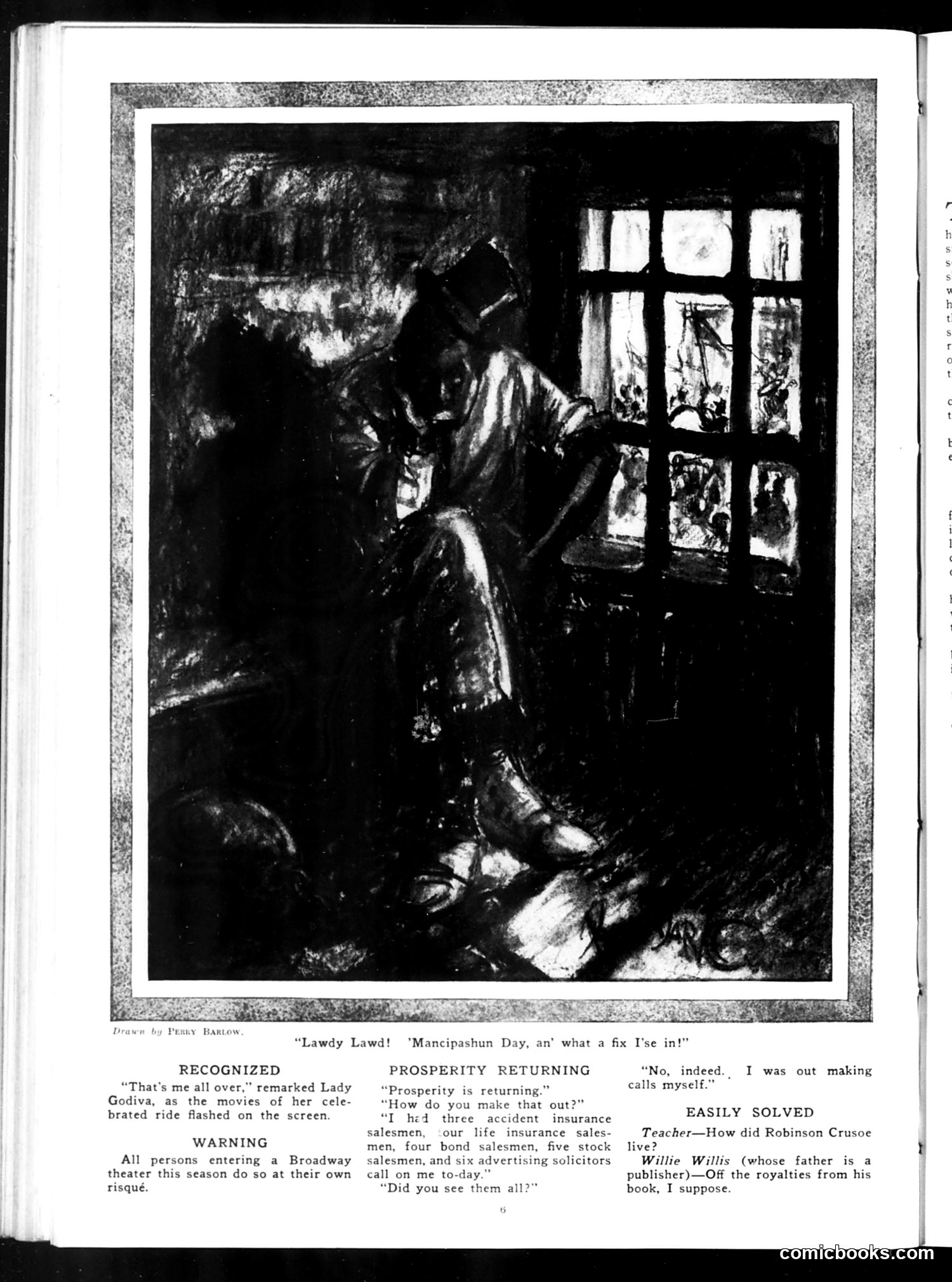
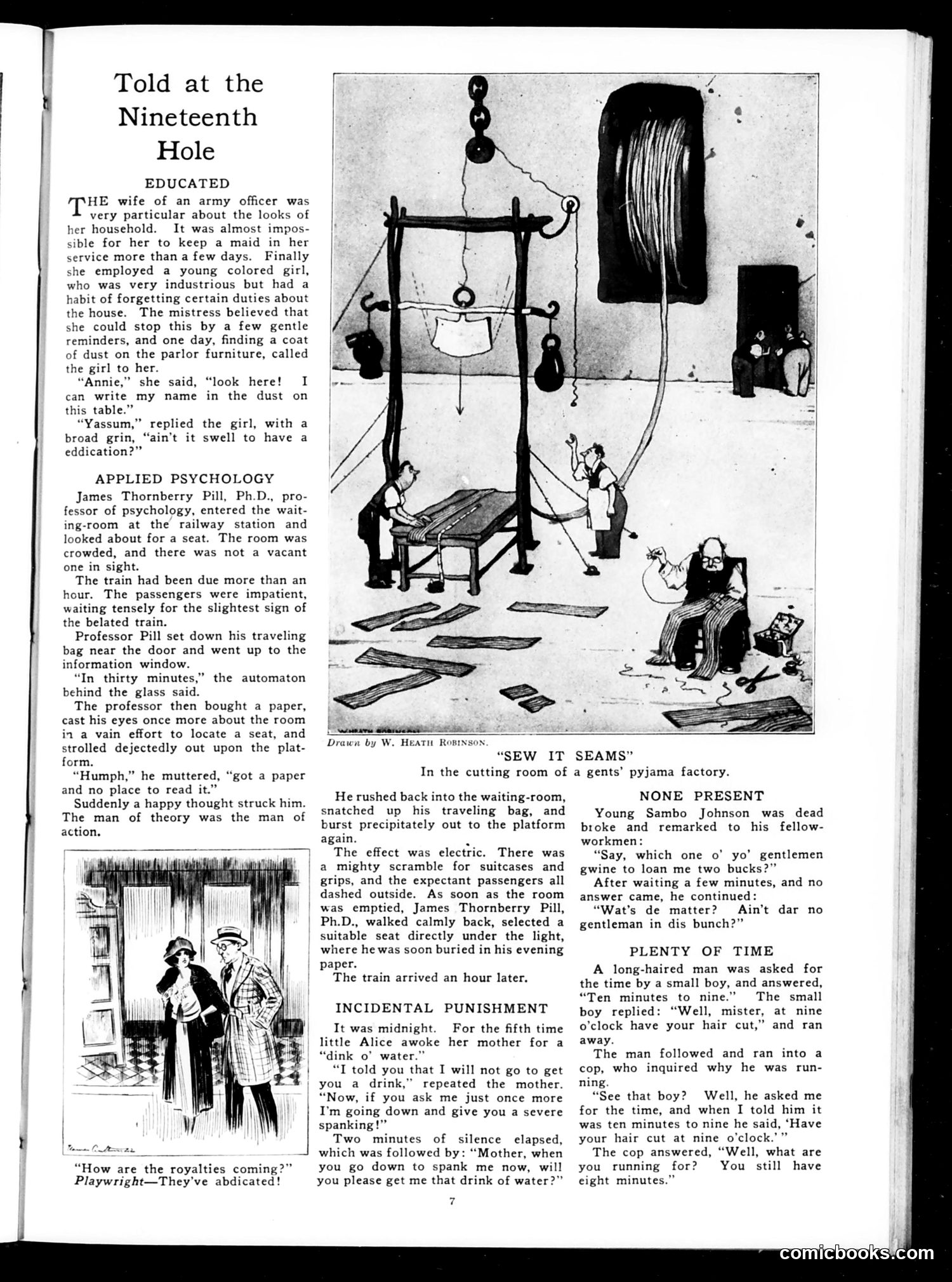
This page collects brief humorous anecdotes typical of early 20th-century American magazines. The humor reflects period attitudes: **"Educated"**: A white mistress points out dust on furniture to her Black maid "Annie." The joke relies on a racial stereotype—the maid's response ("ain't it swell to have a eddication?") uses dialect to suggest she's foolishly proud of minimal literacy, or misunderstands the mistress's complaint as a compliment about her education. **"Applied Psychology"**: Professor Thornberry Pill finds a crowded waiting room. He cleverly rushes back with his traveling bag, causing other passengers to panic-exit, thinking the train has arrived. He then sits undisturbed. **The cartoon** (drawn by W. Heath Robinson) illustrates a pyjama factory cutting room with exaggerated mechanical apparatus—satirizing industrial manufacturing efficiency. **Other sketches** ("None Present," "Plenty of Time," "Incidental Punishment") are brief jokes about dialect humor, childhood logic, and witty retorts—standard magazine filler emphasizing cleverness or foolishness. The racial humor now reads as offensive; contemporary readers found it entertainment.
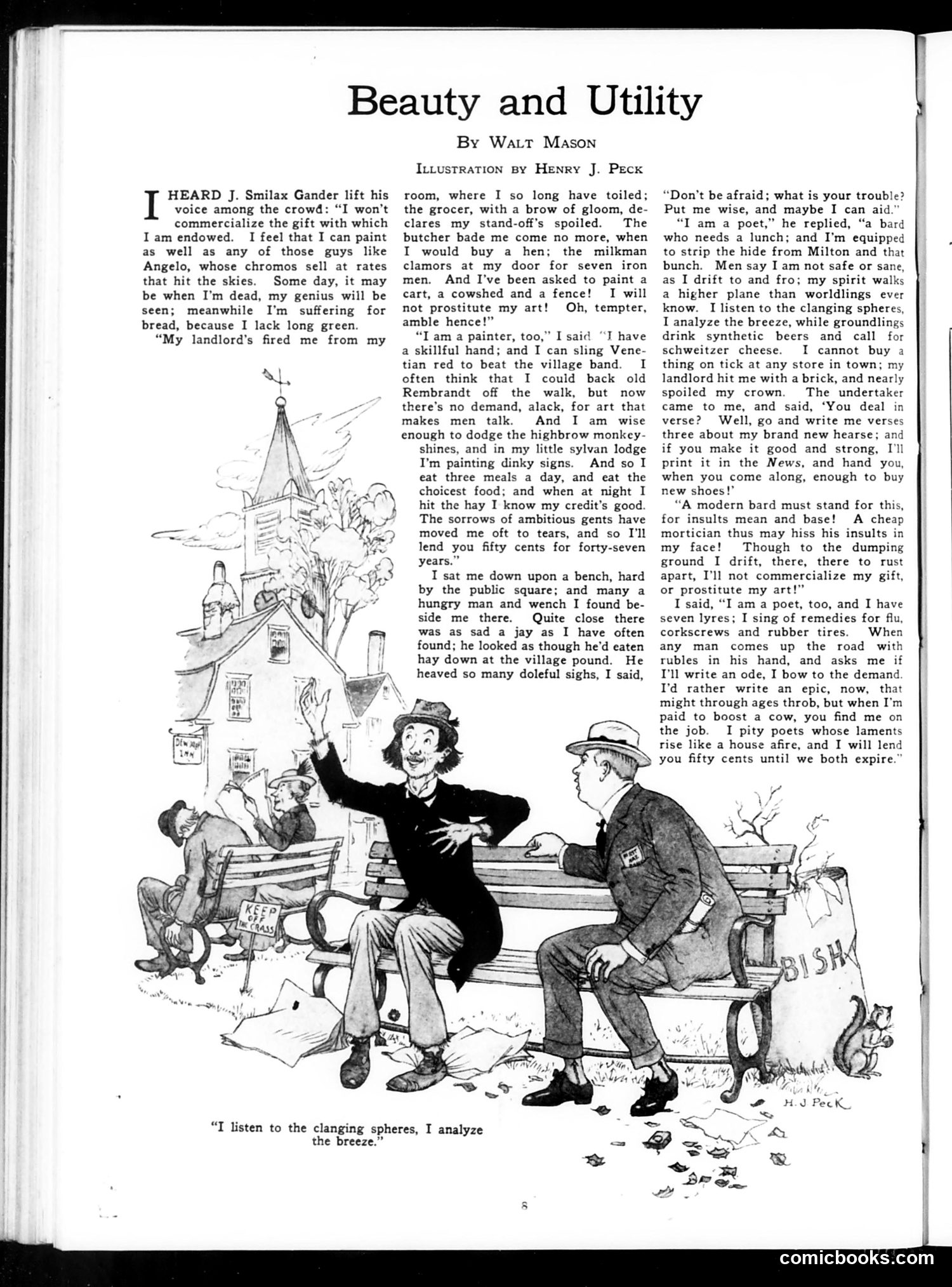
This is a satirical story about artistic integrity versus practical survival, illustrated by a park bench conversation between two struggling artists and a pragmatic narrator. **The figures**: A self-described "poet" (appearing disheveled and desperate) encounters the narrator, who is also an artist but takes commercial work—writing advertising jingles and commercial verses for corkscrews and rubber tires. **The satire's point**: The poet refuses to "prostitute" his art, maintaining lofty principles about listening to "clanging spheres" and analyzing breezes, yet he's starving, evicted, and reduced to begging. The narrator, meanwhile, writes pedestrian commercial content but eats well, pays rent, and can lend money. **Social commentary**: This mocks both Bohemian artistic pretension and American commercialism. The joke is that the idealistic poet's refusal to compromise leaves him destitute, while the pragmatist thrives. The story questions whether artistic purity has value when it produces only suffering, or whether "selling out" to commercial demands is actually the wiser, more honest choice. It's essentially Depression-era commentary on struggling artists' economic futility.
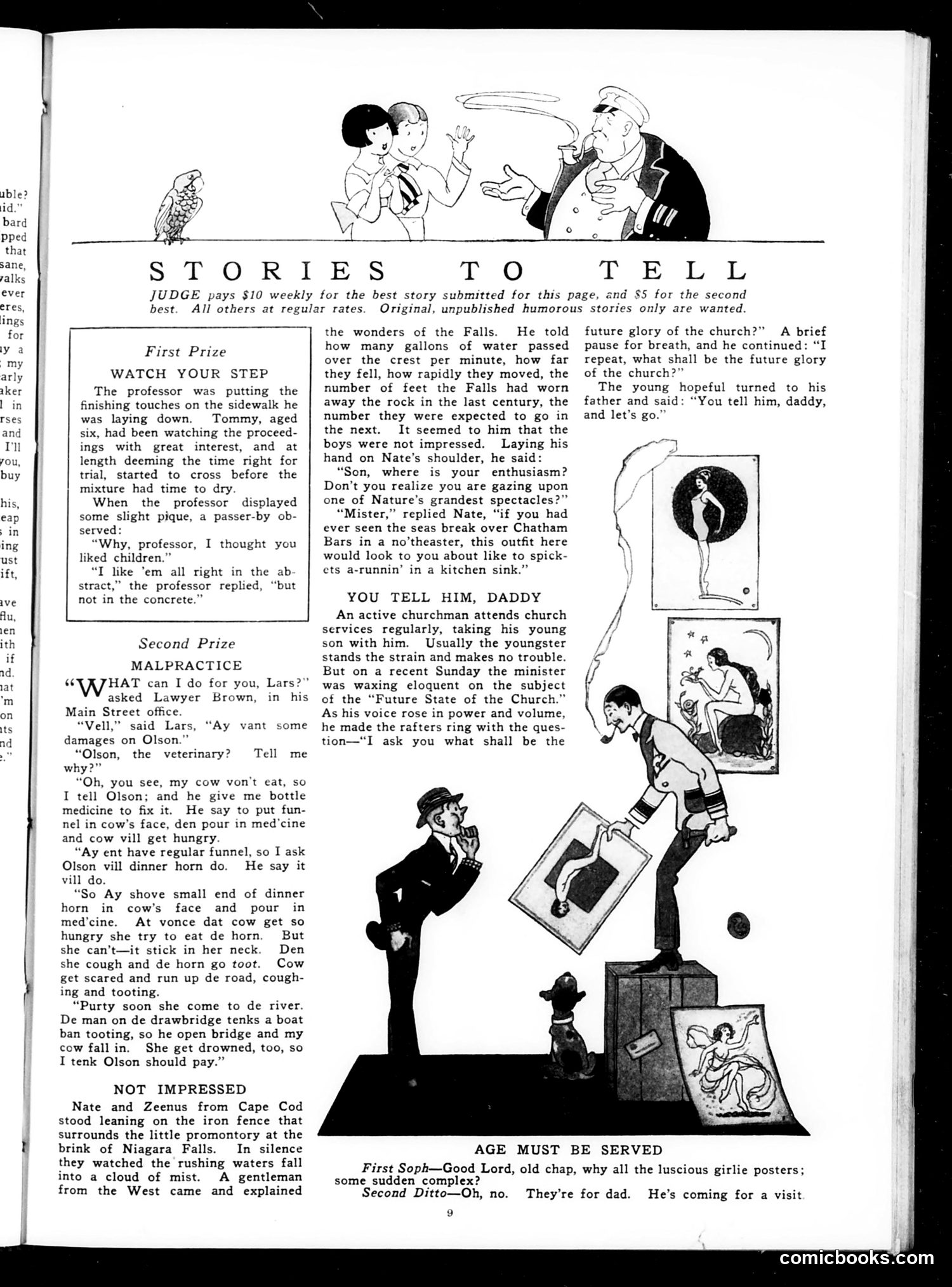
This page contains humorous short stories typical of Judge magazine's "Stories to Tell" section, which paid writers for original jokes. The content reflects early-20th-century American humor: **"Watch Your Step"** is a pun-based joke: a professor laying concrete sidewalk complains about a child crossing it, saying he likes children "in the abstract, but not in the concrete." **"Malpractice"** uses ethnic humor (a Scandinavian-accented farmer character, "Lars") in a shaggy-dog story where a veterinarian's bad advice about administering medicine via dinner horn causes a cow to panic and drown, leading to a lawsuit. **"Not Impressed"** features two Cape Cod locals unmoved by Niagara Falls' statistics, comparing it unfavorably to local storm conditions—humor based on regional pride and understatement. **"You Tell Him, Daddy"** jokes about a young boy's impatience during a church sermon about the church's future, asking his father to answer the minister so they can leave. These represent typical Judge-era humor: wordplay, ethnic caricature, and gentle social observation rather than sharp political satire.
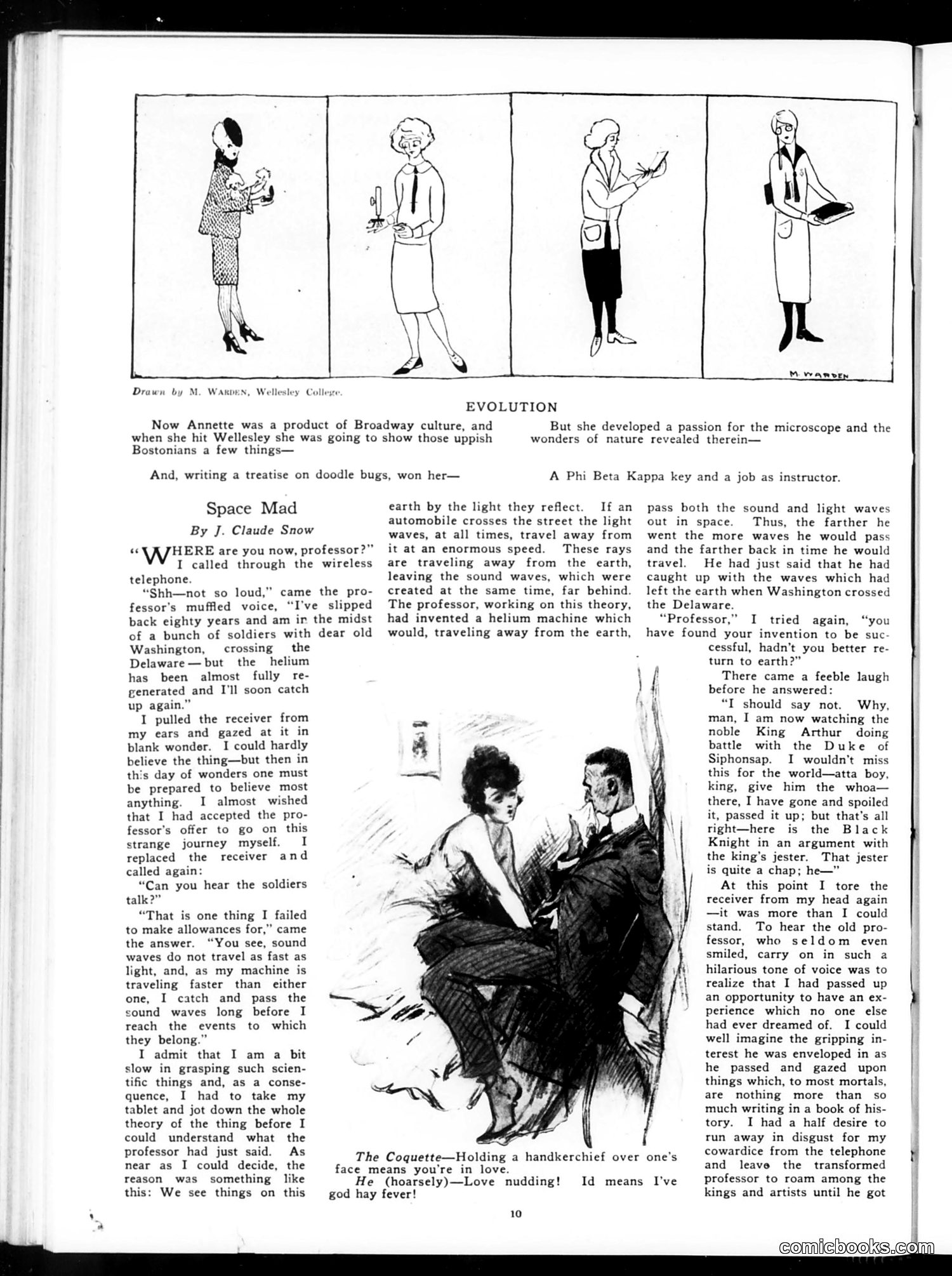
## The "Evolution" Cartoon The four-panel strip shows a woman's professional progression: from a Broadway showgirl in a patterned dress, to a simple worker, to a scientist in a lab coat, to an educated professional. The accompanying text explains that "Annette," a product of Broadway culture, came to Wellesley College to impress "uppish Bostonians" but instead developed a passion for microscopy and nature study, earning a Phi Beta Kappa key and an instructor position. **The satire**: This gently mocks the transformation of a frivolous young woman into a serious academic through education, satirizing both Broadway culture and suggesting that even superficial people can become scholars—or praising women's educational advancement, depending on the reader's perspective. ## "Space Mad" Story A science fiction tale about a professor who invented a helium machine traveling faster than light waves, allowing him to witness historical events (Washington crossing the Delaware, King Arthur). The ironic twist: he's so entranced by past events he refuses to return to earth. **The humor**: Absurdist fiction poking fun at scientific theorizing and professorial absent-mindedness.
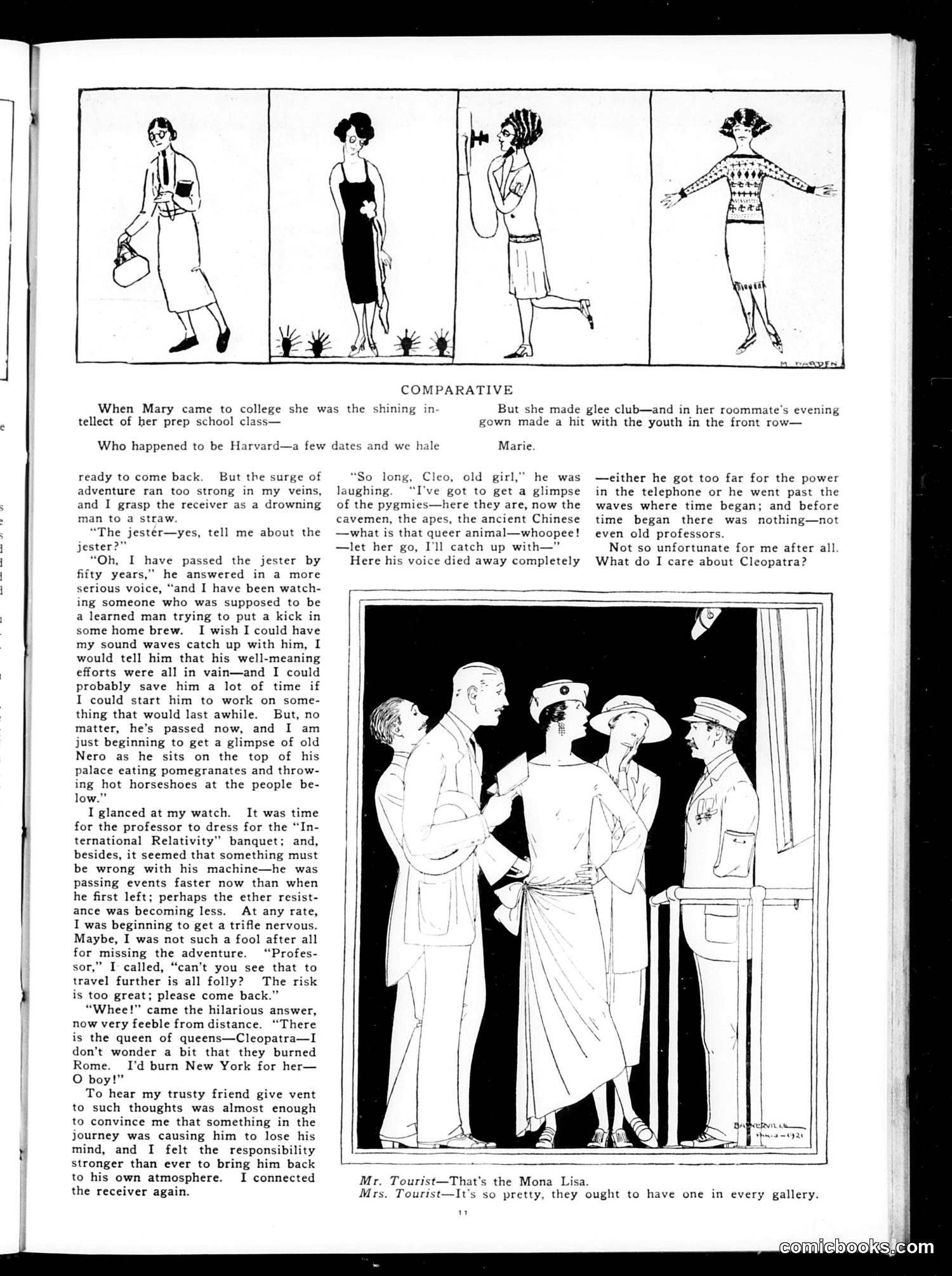
This page contains a science-fiction story titled "Comparative" about a professor who invents a time-travel device. The narrative satirizes academic eccentricity and the pursuit of adventure: a professor becomes obsessed with witnessing historical figures (Cleopatra, Nero, ancient civilizations) and eventually travels so far into the past that he disappears beyond "where time began." The accompanying illustration shows tourists viewing the Mona Lisa, with one remarking they should have copies "in every gallery"—mocking American cultural philistinism and tourist superficiality. The upper "Comparative" panel contrasts a girl's transformation from serious prep-school intellectual to frivolous college socialite (trading intellect for popularity through glee club and borrowed evening gowns). The satire targets intellectual pretension, the absurdity of endless historical obsession, and American tourist ignorance of high culture—common Judge magazine themes from the early 20th century.
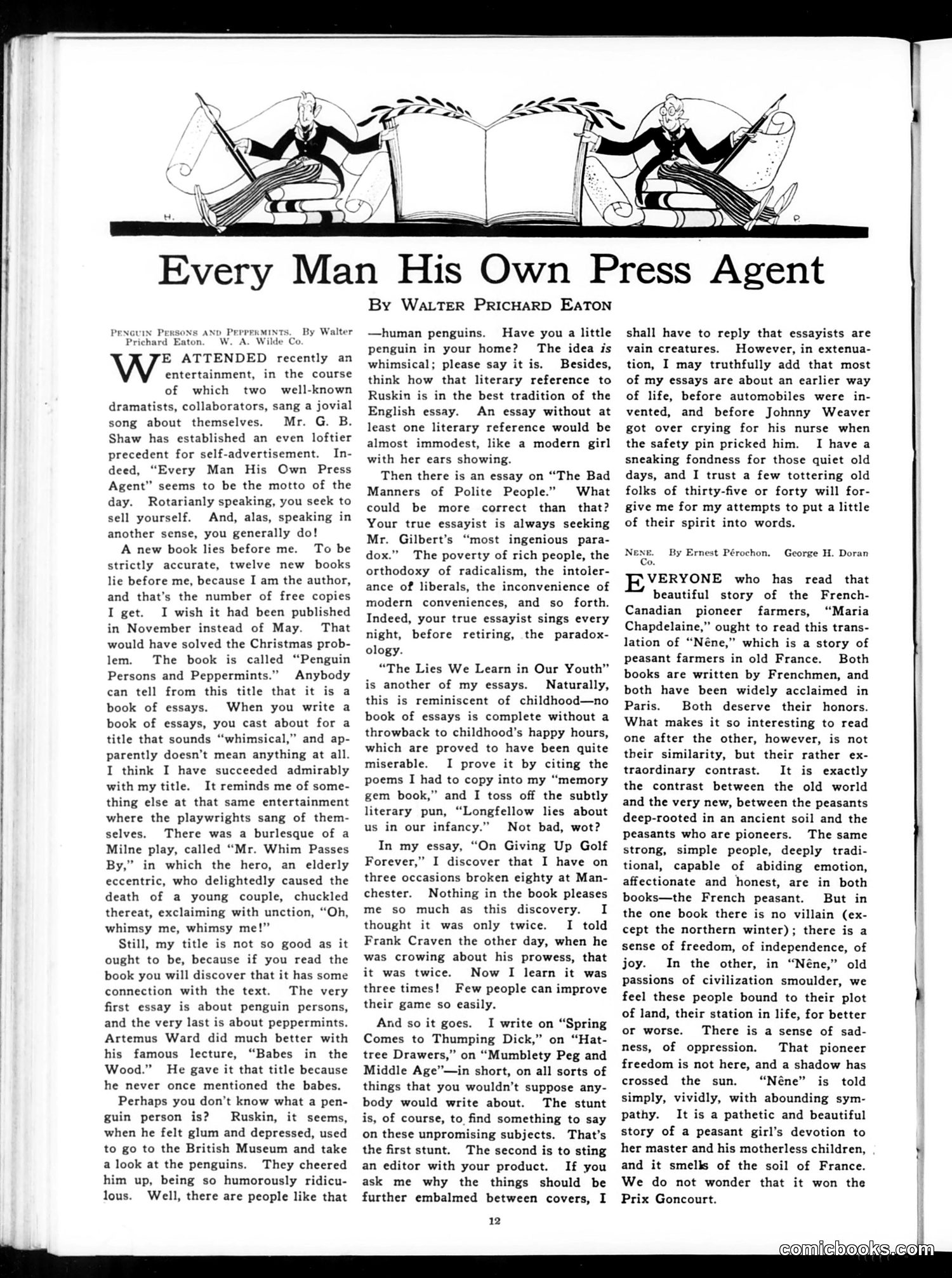
This page is primarily **satirical literary criticism** by Walter Prichard Eaton reviewing his own essay collection titled *Penguin Persons and Peppermints*. **The Satire:** Eaton mocks the pretentious conventions of essay-writing and self-promotion. He deliberately violates essay traditions he's simultaneously describing—using a deliberately nonsensical title ("Penguin Persons and Peppermints"), including literary references to Ruskin, adopting paradoxical positions, and inserting nostalgic childhood reminiscences. He's essentially demonstrating the artificiality and self-serving nature of the essay genre. **Key Targets:** - Self-promotional behavior (mentioning G.B. Shaw's self-advertisement) - Essay conventions: whimsical titles, obligatory literary allusions, paradox-seeking, childhood nostalgia - The pretentiousness of modern writers The cartoon header shows figures with open books, visualizing this "every man his own press agent" theme—suggesting that modern writers are their own publicists, undermining genuine criticism.
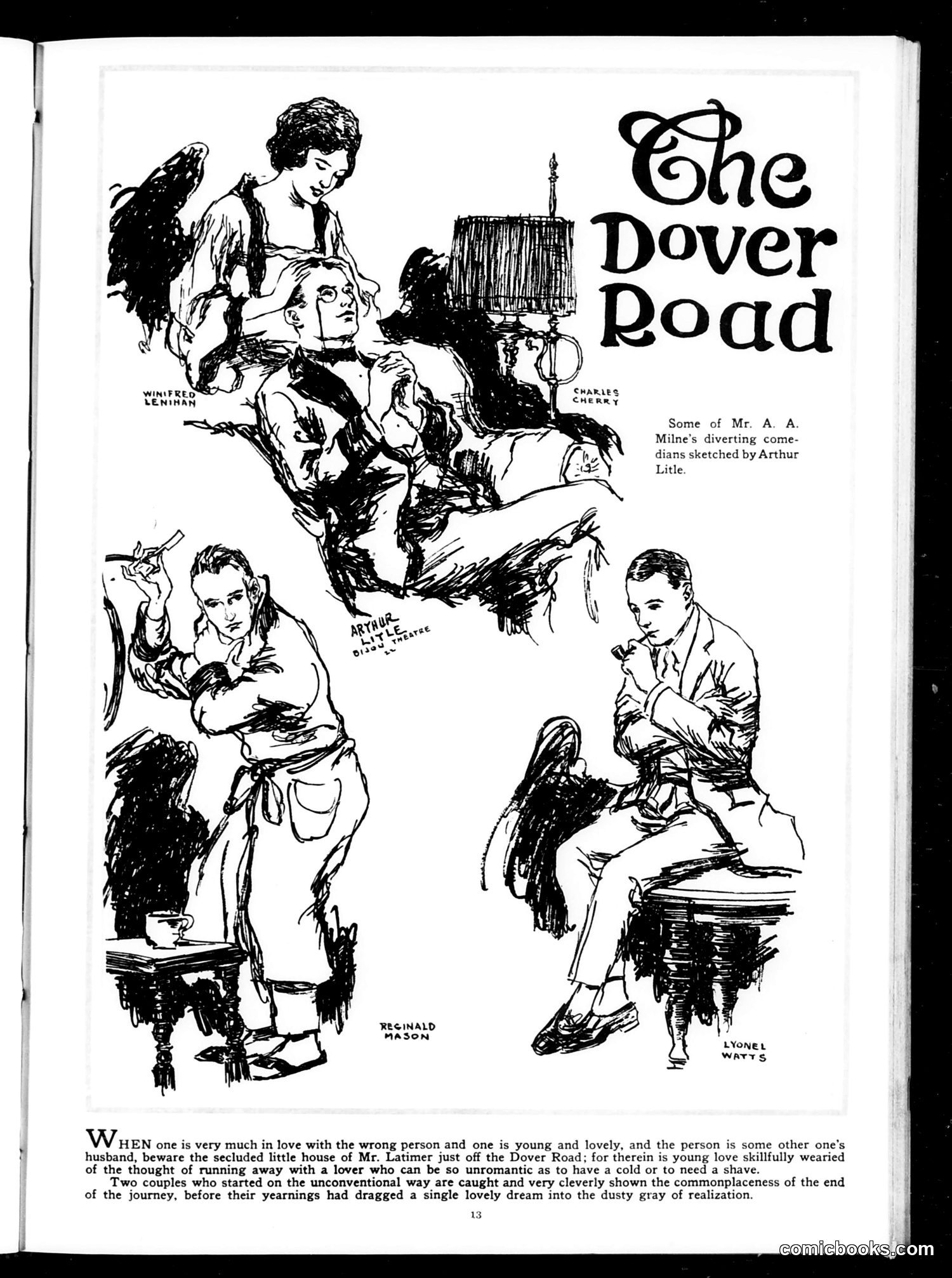
This page promotes a theatrical work by A.A. Milne (author of Winnie-the-Pooh), featuring character sketches by Arthur Little. The illustrated figures—labeled Winifred Lenihan, Reginald Mason, and Lionel Watts—appear to be actors in the production. The accompanying text describes the play's plot: a satirical examination of romantic elopement. Two couples attempt to run away together in an affair, but are intercepted at Mr. Latimer's house near Dover Road. Rather than celebrating their passion, the play deflates their romantic ideals by showing the mundane reality—one lover has a cold, needs a shave—revealing how quickly "lovely dreams" collapse into ordinary, disappointing reality. This is essentially a showcase/advertisement for the theatrical production, using Milne's comedic premise to appeal to Judge's readers: the satire undercuts romantic escapism by emphasizing prosaic human imperfection.
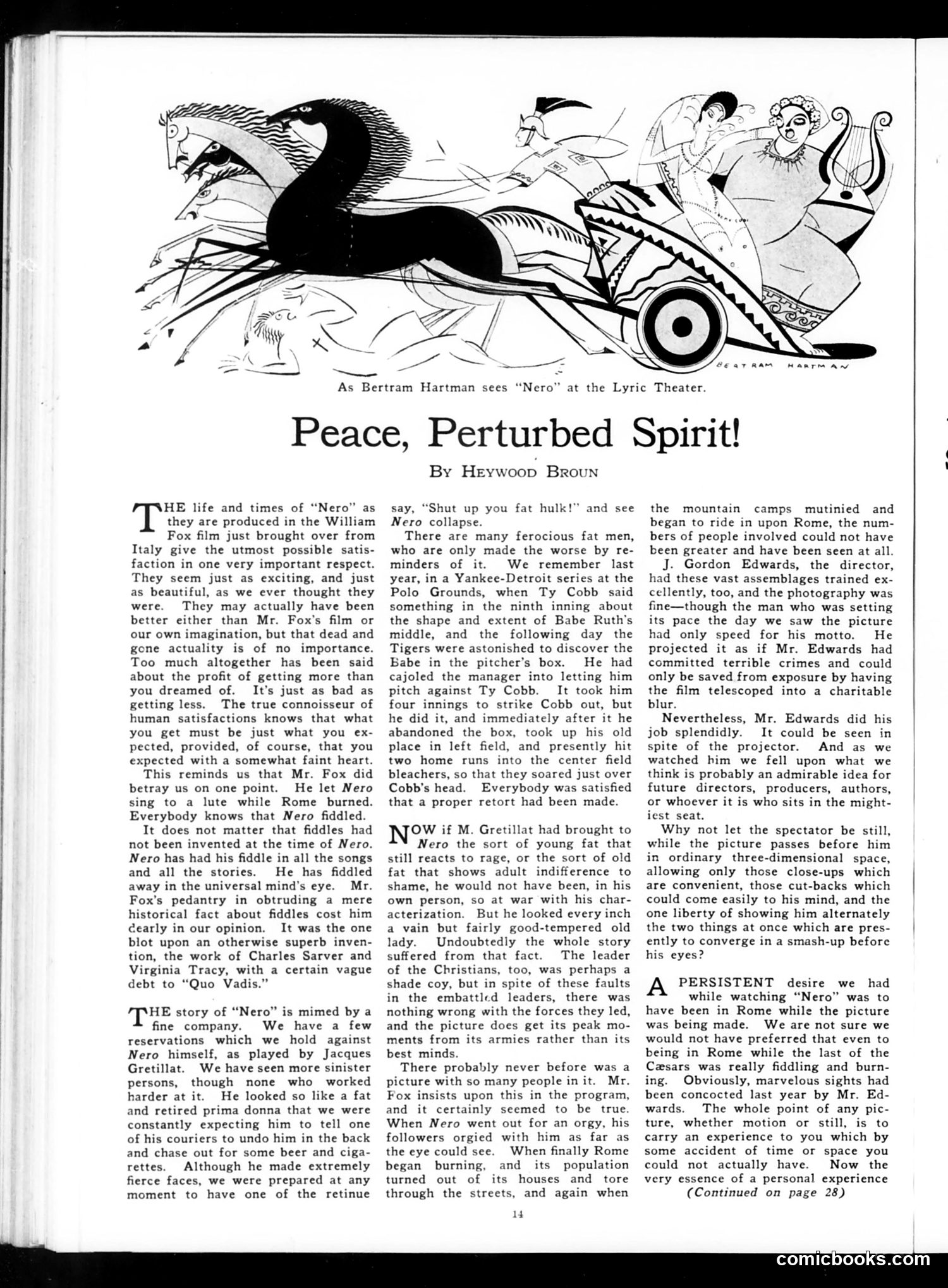
This page reviews the William Fox film *Nero*, a historical epic imported from Italy. The cartoon depicts Bertram Hartman (a Judge cartoonist) watching the film's chariot scene at the Lyric Theater. Heywood Broun's critique praises the film's spectacle while critiquing its historical accuracy and casting. His main complaint: Fox showed Nero playing a *lute* while Rome burned, when popular legend established that Nero *fiddled*—despite fiddles not existing in ancient Rome. Broun argues Fox's pedantry sacrificed entertainment for historical fact. The review also mocks actor Jacques Gretillat's portrayal of Nero as resembling "a fat and retired prima donna," comparing him unfavorably to Babe Ruth's fierce response to Ty Cobb's insult at the Polo Grounds. The critique suggests Nero should embody either youthful rage or indifferent old-age callousness—not vain complacency. The piece celebrates the film's massive crowds and production scale while emphasizing that spectacle, not character nuance, drives the narrative's power.
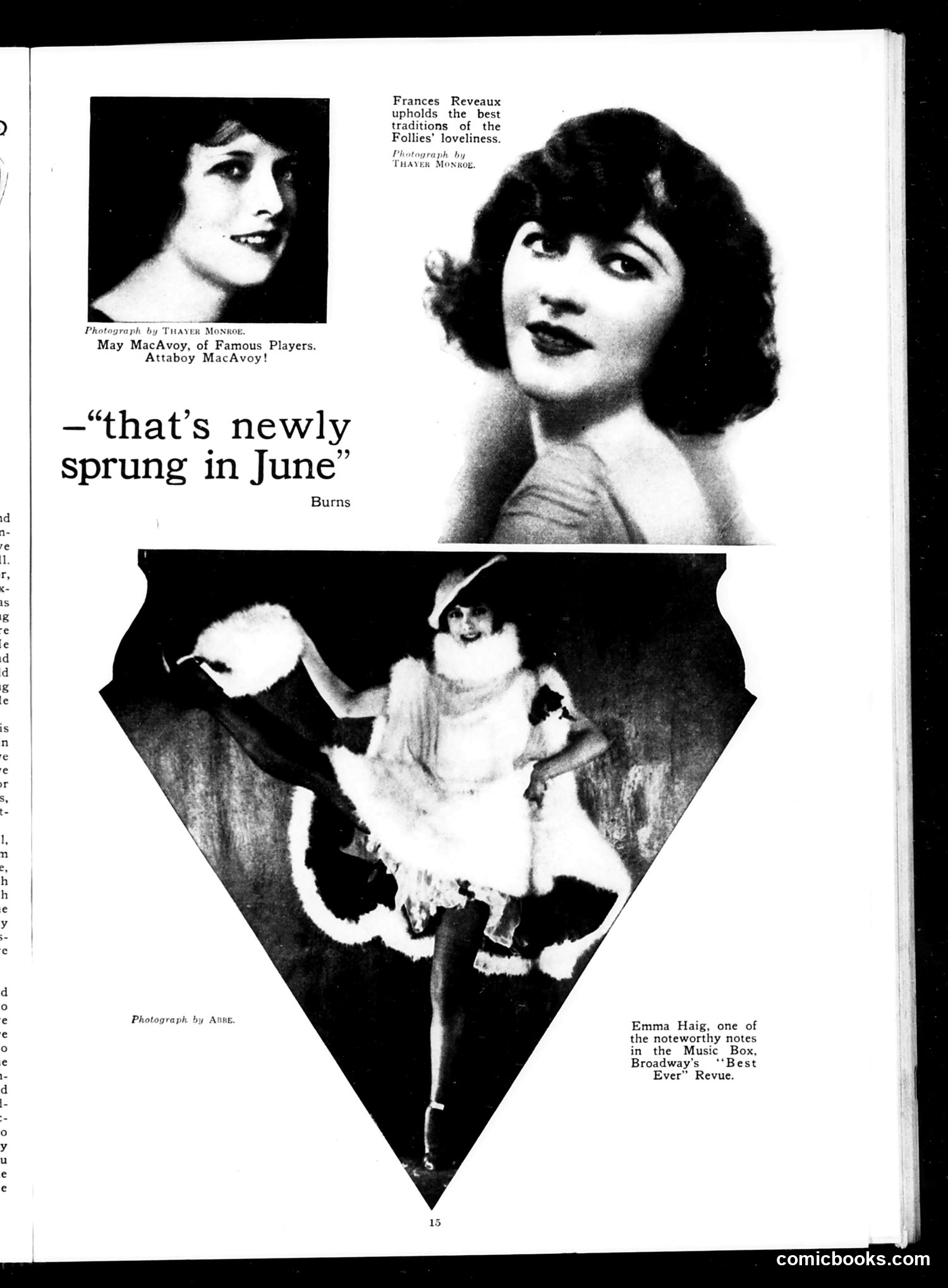
This page from *Judge* magazine features theatrical photographs rather than a cartoon. It showcases three Broadway performers from the early 1920s: **May MacAvoy** (Famous Players studio actress), **Frances Reveaux** (Ziegfeld Follies performer), and **Emma Haig** (from Broadway's "Music Box" revue) are presented with admiring captions. The Burns quote—"that's newly sprung in June"—appears to be a poetic reference to springtime romance, likely praising MacAvoy's youthful appeal. The page functions as **entertainment coverage and celebrity promotion** rather than satire. The phrase "Attaboy MacAvoy!" conveys casual enthusiasm. This reflects *Judge*'s mixed content: while primarily a satirical publication, it regularly featured entertainment industry coverage and pinup-style photographs of popular actresses and performers, appealing to readers interested in Broadway and silent cinema during the Jazz Age.
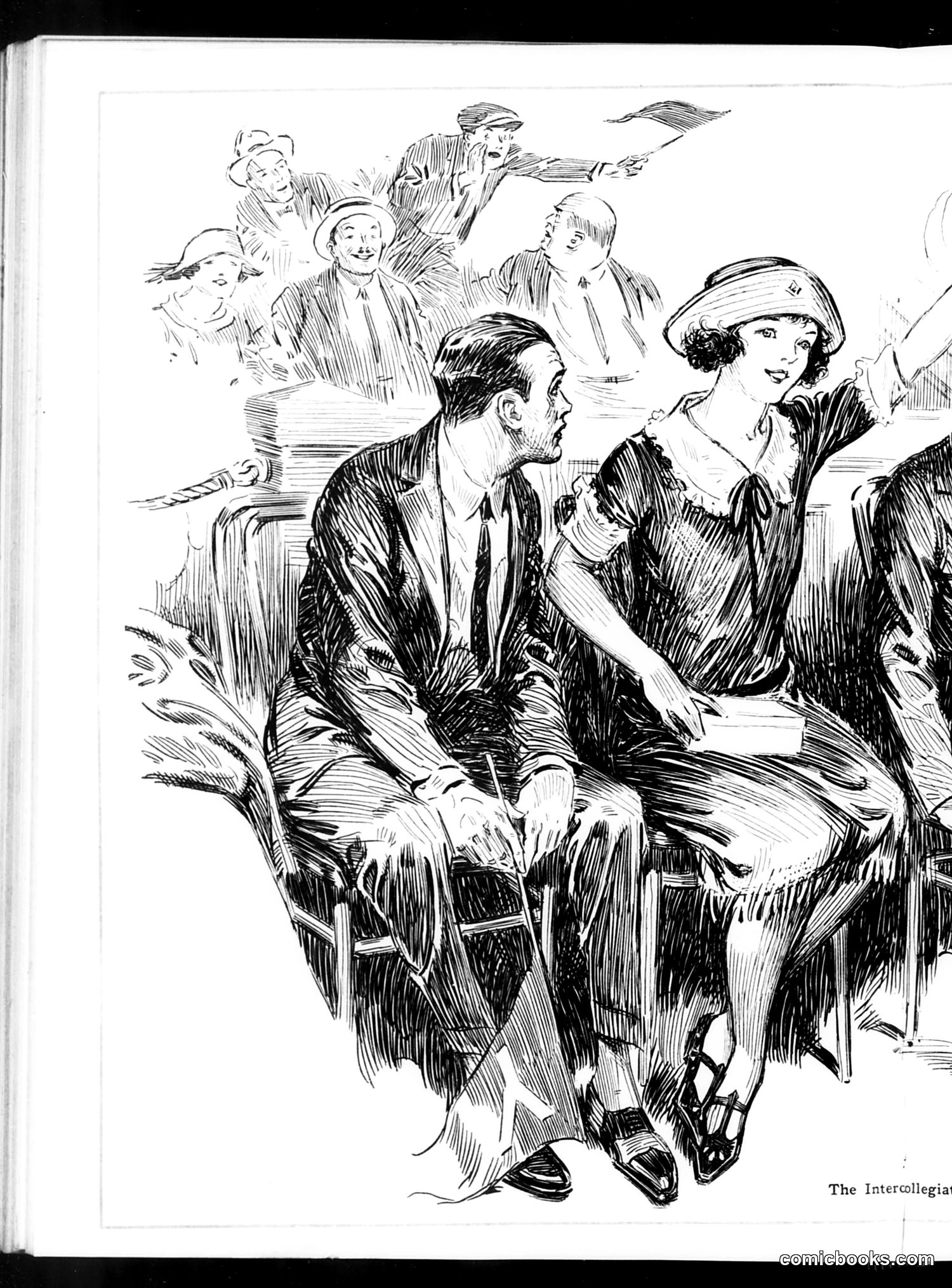
This appears to be an illustration from *Judge* magazine depicting what the caption calls "The Intercollegial" scene. The drawing shows a well-dressed couple (man in suit and tie, woman in fashionable hat and dress) seated together, with several rowdy figures in the background appearing to celebrate or cause commotion—suggesting a lively social gathering, possibly at a college or university event. The satire likely targets collegiate social life or student behavior of the era. The contrast between the composed couple in the foreground and the chaotic group behind them suggests commentary on social propriety, generational differences, or the boisterous nature of college gatherings. The specific political or social message remains unclear from the visible text alone, though the formal dress and collegiate reference suggest this satirizes upper-class educational institutions and their social customs during the early-to-mid 20th century.
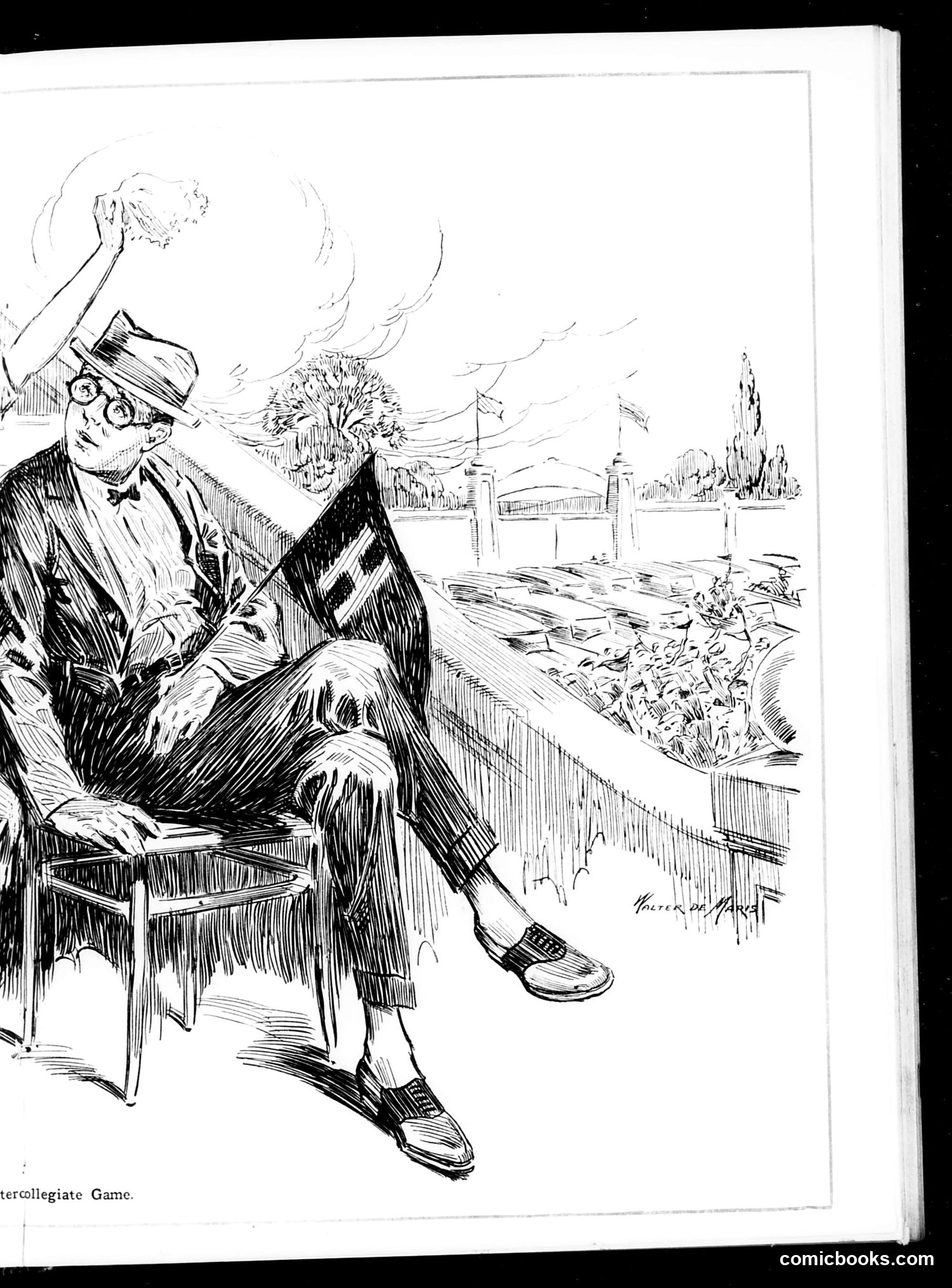
This appears to be a pen-and-ink illustration from *Judge* magazine showing a well-dressed gentleman in formal attire (top hat, suit) sitting on a chair near a waterfront, holding what looks like a program or pamphlet. He's gazing toward a distant cityscape with buildings and water features. The caption references an "Intercollegiate Game," suggesting this depicts someone attending a collegiate sporting event. The figure's dignified posture and formal dress contrast with his apparent leisure activity, possibly satirizing the pretensions or social attitudes of the upper classes attending such events. The artist's signature appears to read "Holden" or similar. Without additional context or full page text, the specific satirical point remains somewhat unclear—whether it mocks spectators, college athletics culture, or social pretension generally.
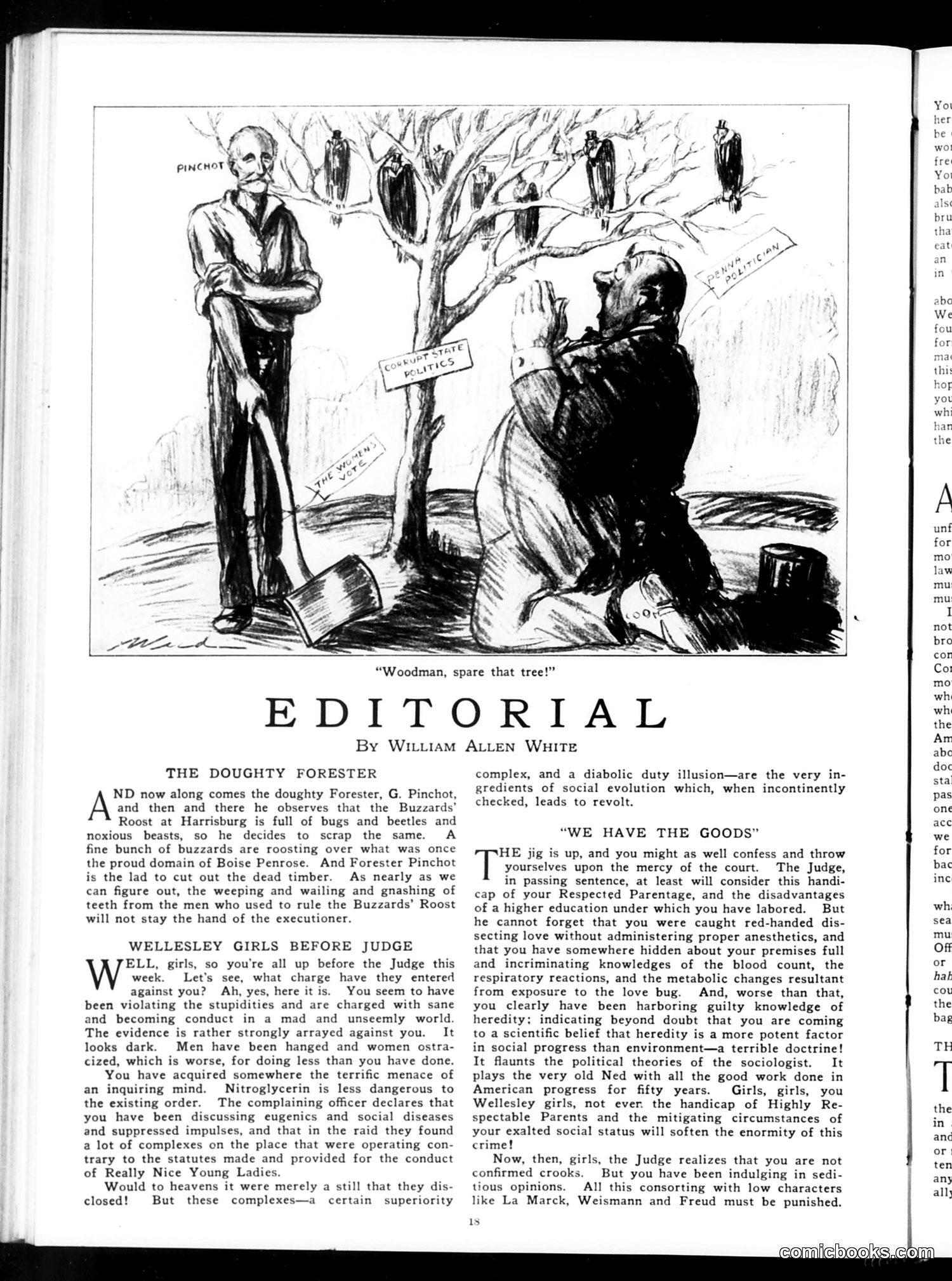
This editorial cartoon and accompanying text satirize early 20th-century anxieties about progressive reform and educated women. **The Cartoon:** Shows a woodman (labeled "Pinchot") about to fell a dead tree full of vultures (labeled "political state machine"). The title "Woodman, spare that tree!" is ironic—the editorial argues the tree *should* be cut down. G. Pinchot was Theodore Roosevelt's Chief Forester, famous for conservation reform. **"The Doughty Forester":** Celebrates Pinchot's willingness to clean up corrupt Pennsylvania politics centered in Harrisburg (the "Buzzards' Roost"). **"Wellesley Girls Before Judge":** Satirizes society's horror at educated women discussing modern science—eugenics, psychology (Freud), heredity, sexuality—rather than remaining decorously ignorant. The author mocks authorities for treating scientific curiosity as dangerous sedition, while defending these women's right to intellectual inquiry as necessary for social progress. The piece exemplifies early-20th-century Progressive Era debates about reform, expertise, and women's education.
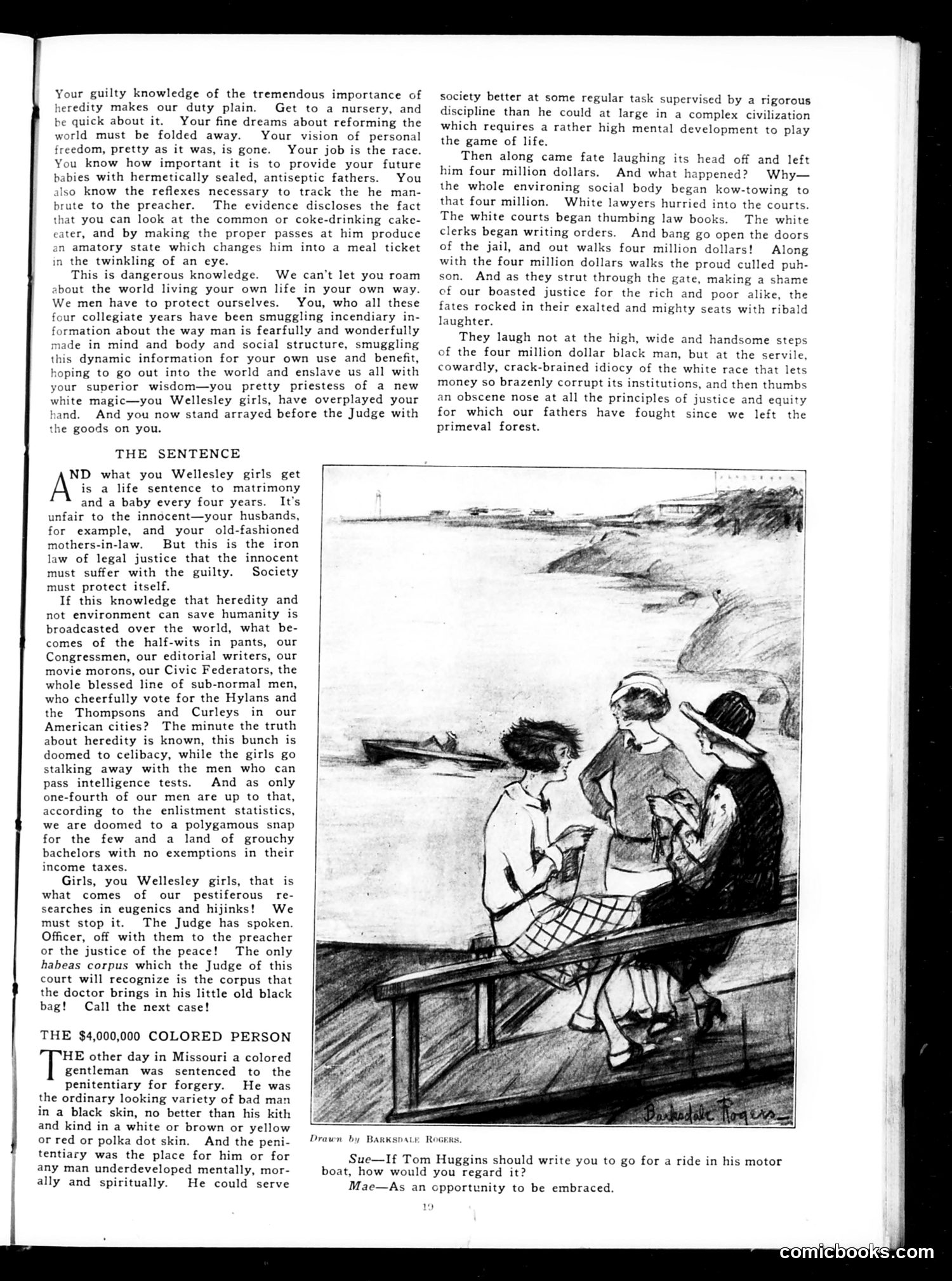
This page contains two distinct satirical pieces attacking eugenics ideology and racial injustice in early 20th-century America. **"The Sentence"** mocks Wellesley College women educated in heredity science, warning they'll be confined to motherhood to "protect" society from their "dangerous knowledge." The satire targets male anxiety about educated women and pseudo-scientific hereditarian arguments used to control women's lives. **"The $4,000,000 Colored Person"** critiques systemic racism and judicial corruption through the story of a Black man imprisoned for forgery who becomes wealthy. The satirical point: white courts and lawyers instantly reversed his sentence upon learning of his fortune, exposing how "justice" in America is corrupted by money and racial prejudice. The passage mocks white society's hypocrisy—they claim racial and hereditary superiority while their institutions brazenly serve wealth over principle, "thumbing an obscene nose" at actual justice. Together, these pieces attack both eugenics pseudoscience and racial corruption in American law.
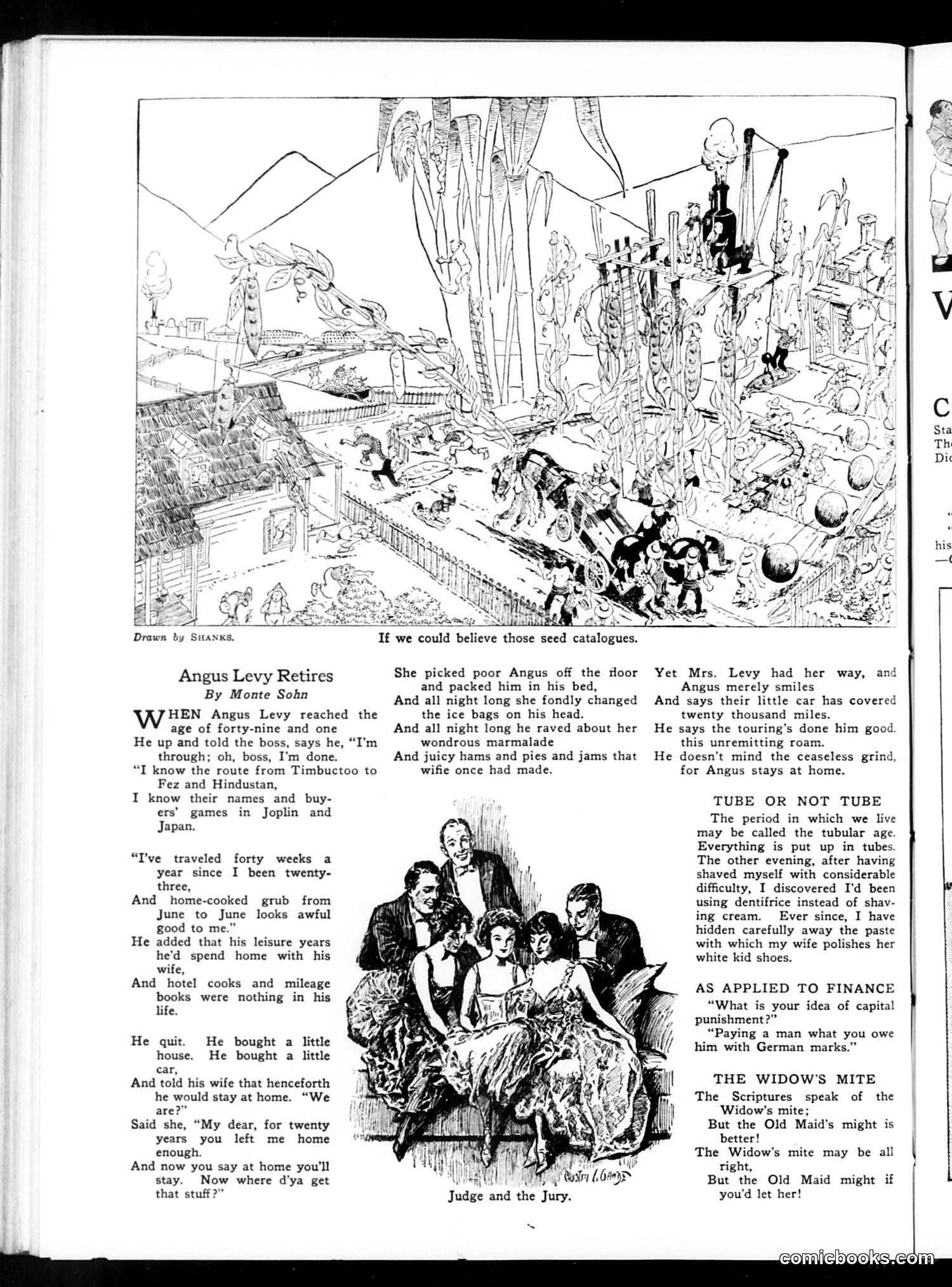
This humorous story satirizes retirement fantasies versus domestic reality. Angus Levy, a traveling salesman who spent forty years on the road, retires planning peaceful home life with his wife. He buys a house and car, declaring he'll "stay at home." His wife, however, has other plans. After twenty years of his absence, she's not interested in domestic togetherness—she promptly packs him back into the car for constant touring. The irony: Angus ends up traveling constantly anyway, but now claims to enjoy it and says the "touring's done him good." The satire targets both male retirement dreams (imagining wives want them home) and female independence (the wife refuses the traditional domestic role). The accompanying illustration shows Angus reluctantly packed into an automobile while his determined wife supervises. The joke assumes readers recognize the common marital tension between husbands' romantic notions of retirement and wives' actual preferences.
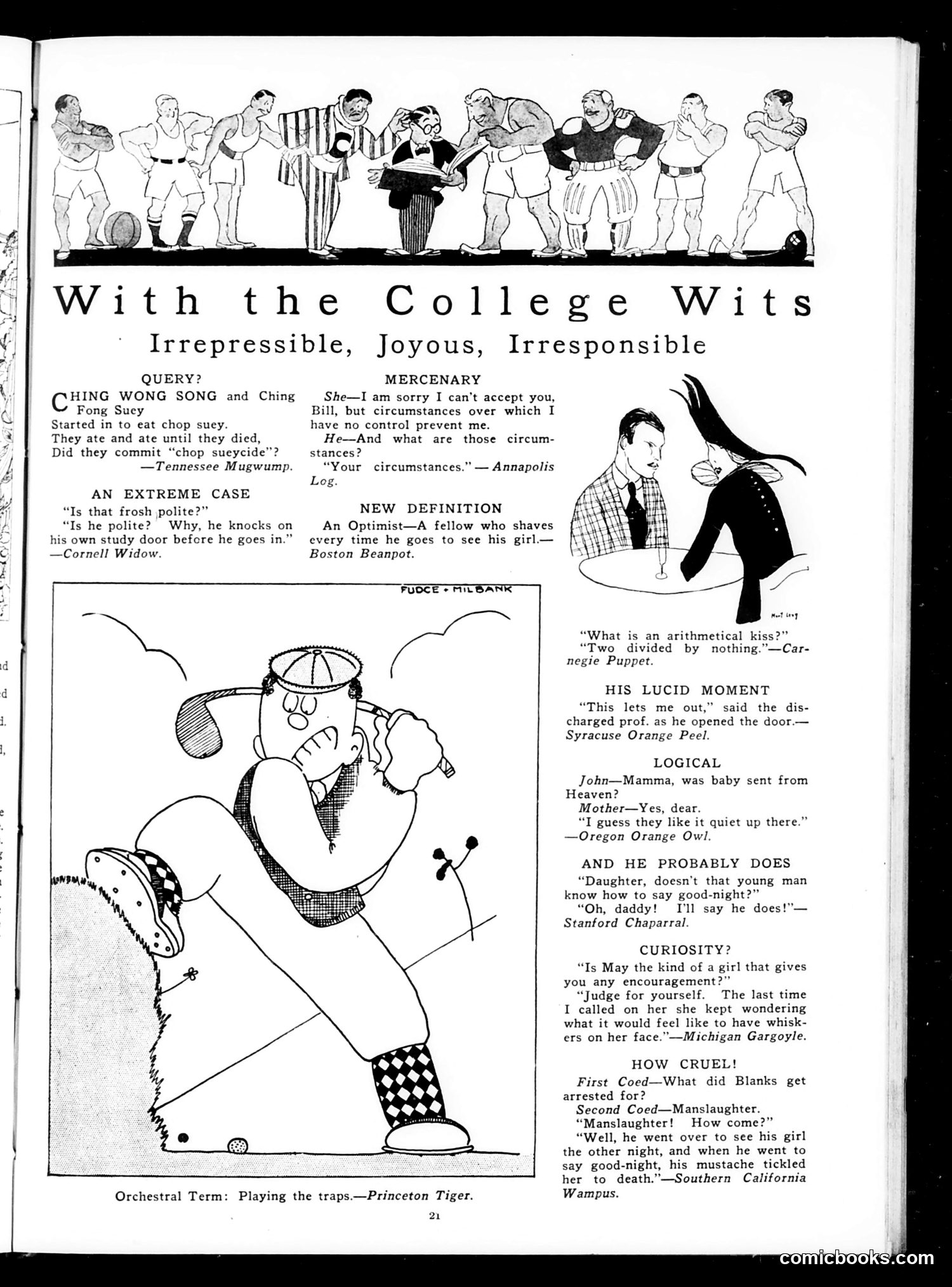
This page collects humorous quips from college newspapers, a common Judge feature. The content reflects early-20th-century college humor focused on dating, student life, and romance. The jokes include: - Ethnic humor ("Ching Wong Song" pun about "chop suey-cide") - Dating etiquette jokes (an overly polite freshman, a girl judging suitors by their shaving habits) - Academic humor (a discharged professor, an optimist definition) - Romance and courtship gags (mathematical kiss jokes, a girl's romantic encouragement, a girl curious about whiskers, a mustache tickling a girl "to death") The large cartoon by Fouce & Milbank depicts "playing the traps" (drums in orchestral/jazz contexts), likely a visual pun or commentary on college social dynamics. The page's appeal lay in its relatable college-culture references and risqué-for-the-era romantic humor. The ethnic jokes reflect period attitudes now considered offensive.
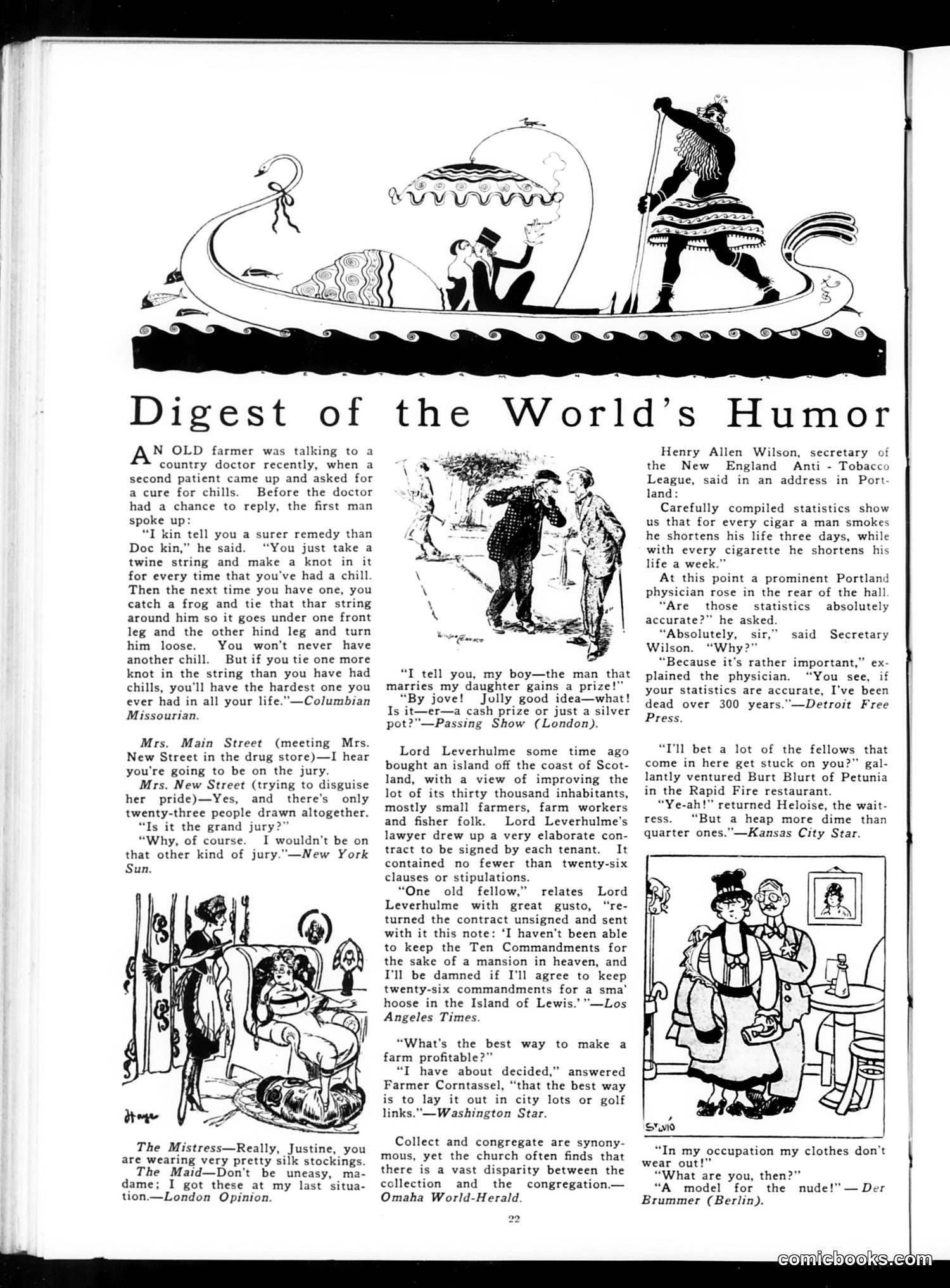
This page collects international humorous anecdotes and jokes typical of early 20th-century satirical magazines. Key pieces include: **The tobacco statistics joke**: A New England Anti-Tobacco League secretary claims cigars shorten life by three days each, cigarettes by a week. A physician challenges this, revealing he'd be dead 300+ years by those calculations—mocking exaggerated health claims and zealous reformers. **Lord Leverhulme anecdote**: A Scottish tenant rejects an elaborate 26-clause contract for farm improvement, claiming he couldn't keep Ten Commandments for heaven, so won't keep 26 for a small house—satirizing excessive legalism and industrial reformers imposing their will on rural communities. **Other jokes** target class pretension (a maid's silk stockings), jury pride, farm economics (measuring profitability by city lots), and social customs (waitress dating habits). The illustrations show period dress and domestic scenes. Overall, the page exemplifies Judge's satirical approach: deflating pomposity, mocking reformers and authority figures, and celebrating common-sense rural wisdom.
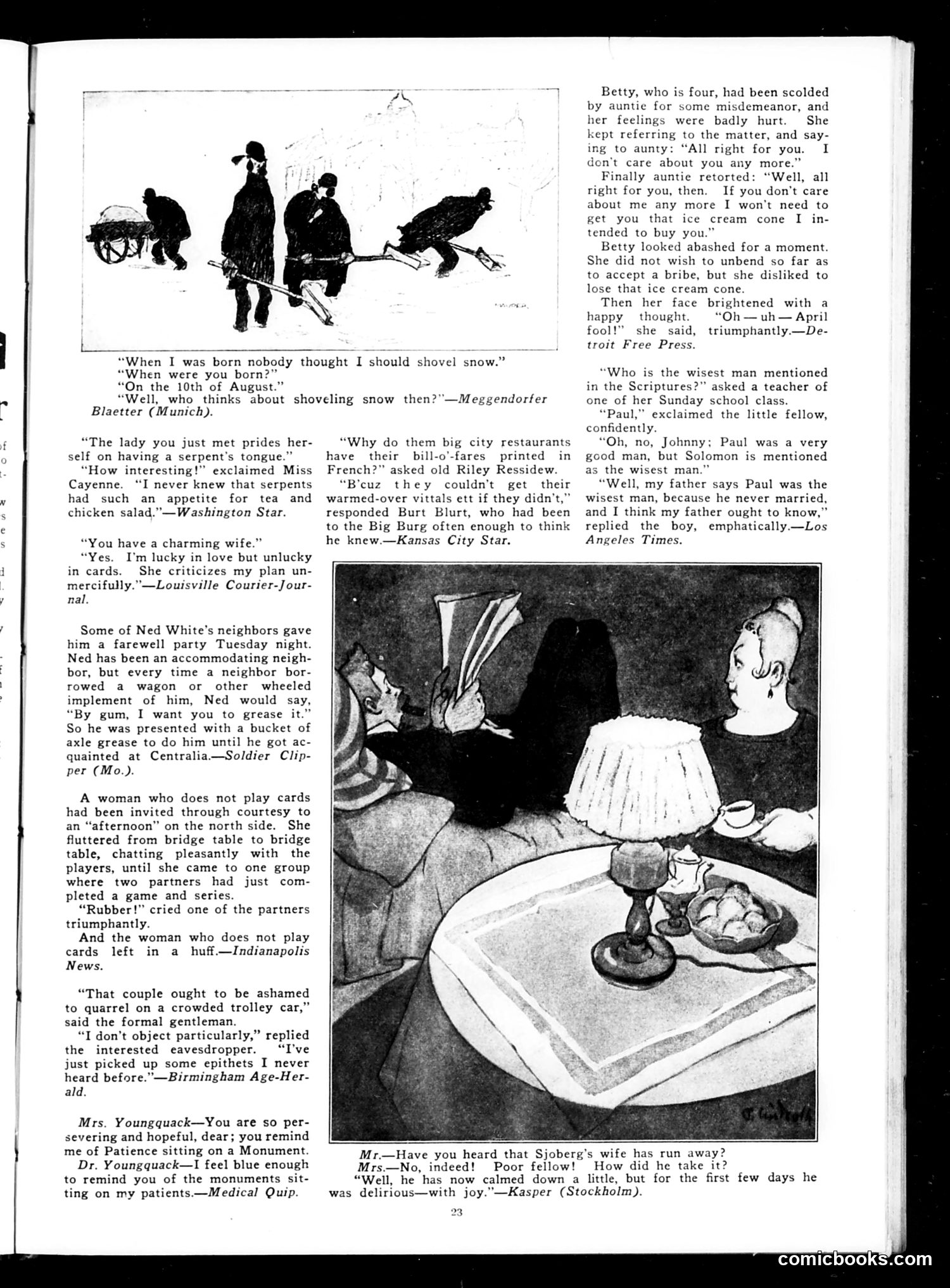
This page collects humorous anecdotes and jokes reflecting early 20th-century American social attitudes. The top illustration depicts working-class men shoveling snow, introducing a joke about a man born in August (when snow is irrelevant) being mocked for complaining about winter labor—satire of impractical complaints. The anecdotes mock various social groups: women who criticize card-playing ("She criticizes my plan unmercifully"), working-class dialectal speech ("B'cuz they couldn't get their warmed-over vittals"), and marital discord. One joke implies men prefer bachelorhood to marriage. Another depicts a child's manipulation through an "April Fool" ploy—treating innocent childish cunning as clever. The lower cartoon shows a man and woman at a dining table, illustrating a joke about a man delighted his wife ran away ("delirious—with joy"), normalizing marital unhappiness as comedic fodder. Collectively, the page represents Judge's brand of genteel satire aimed at middle-class readers: poking fun at lower classes, women, marriage, and social pretension while reinforcing conventional values.
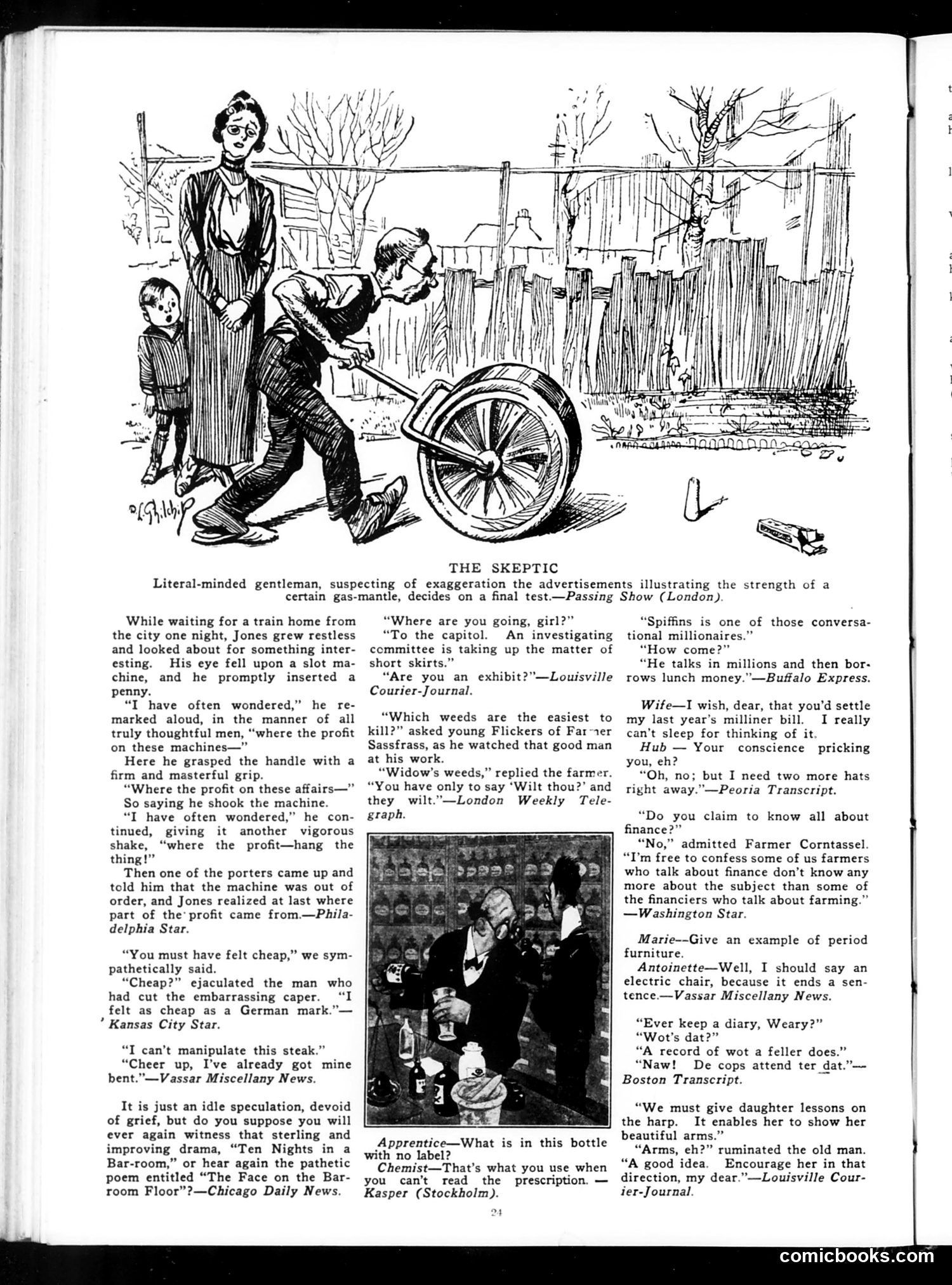
The main cartoon depicts a man testing a gas-mantle advertisement's claims about strength by inserting a penny into a slot machine and then aggressively shaking it. The humor lies in his literal-minded skepticism: he suspects the advertisement exaggerates the mantle's durability, so he conducts a "final test" on an unrelated machine to validate his doubt. The satire targets both consumer gullibility toward advertising claims and the absurdity of the skeptic's reasoning. He finds his answer when a porter reveals the machine is broken—proving that profits come from mechanical failures, not advertised strength. The accompanying jokes continue this theme of wordplay and ironic social commentary, including references to short skirts, widow's weeds, and farmer ignorance about finance—typical early 20th-century satirical fare mocking contemporary concerns and class pretensions.
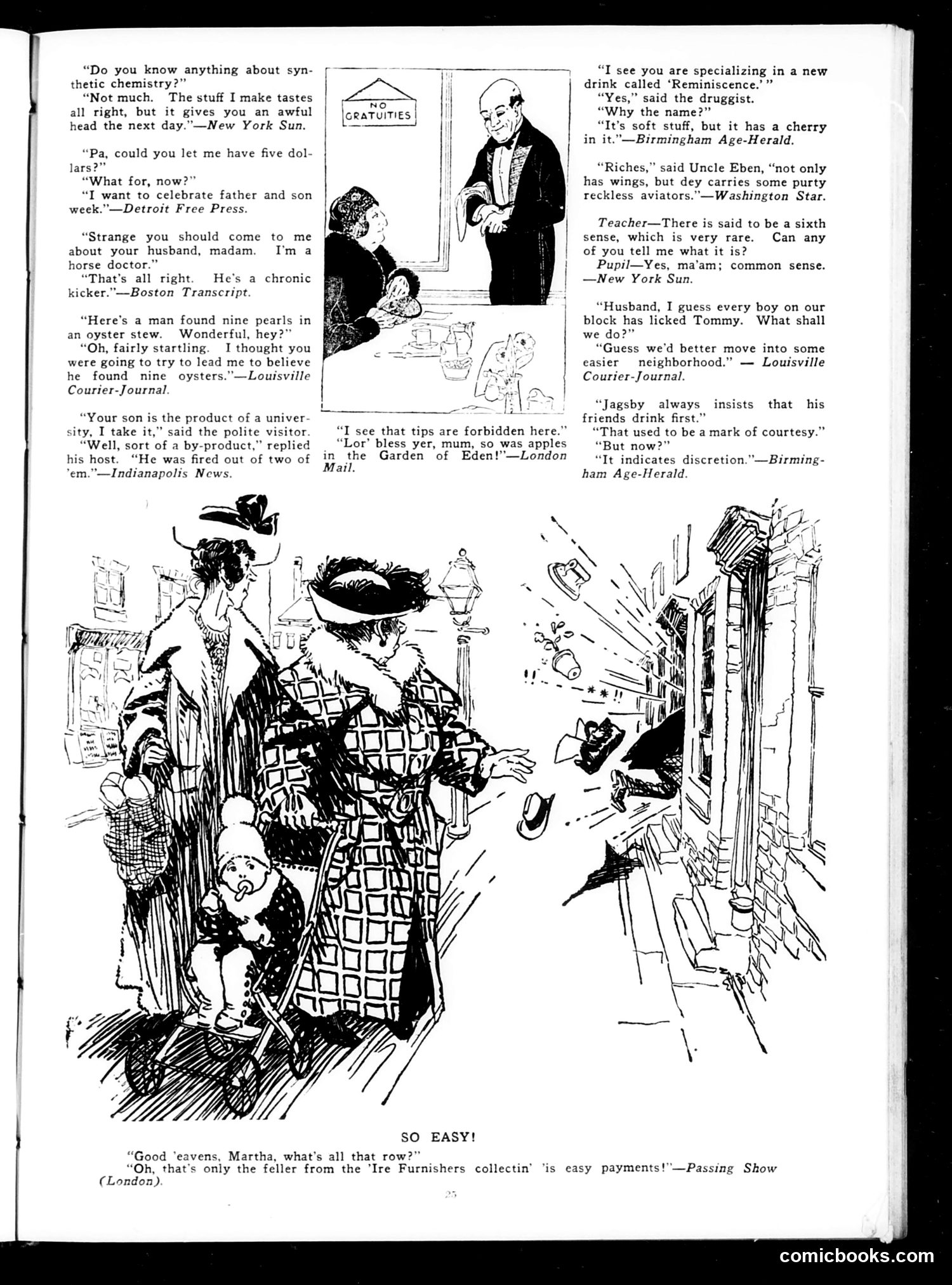
This page collects short humorous anecdotes and jokes from various newspapers, typical of Judge's format. The satire targets early-20th-century social issues: **Key themes:** - **Prohibition era**: References to synthetic alcohol and bootleg drinks ("Reminiscence" with a cherry) mock the attempt to ban alcohol - **Class and economics**: Jokes about installment payments, tipping etiquette, and working-class struggles (the furniture collector) - **Family dynamics**: Complaints about chronic kickers (husbands), moving neighborhoods to escape social embarrassment - **Education**: A quip that "common sense" is the rarest sense, satirizing university education's disconnect from practicality - **Changing manners**: A joke about drinking customs shifting from courtesy to "discretion"—suggesting Prohibition has made sharing drinks socially suspicious The large cartoon (bottom) depicts a chaotic debt collection scene, illustrating the "easy payments" problem referenced in the caption. Overall, the page reflects anxieties about modern life, changing social codes, and economic pressures of the era.
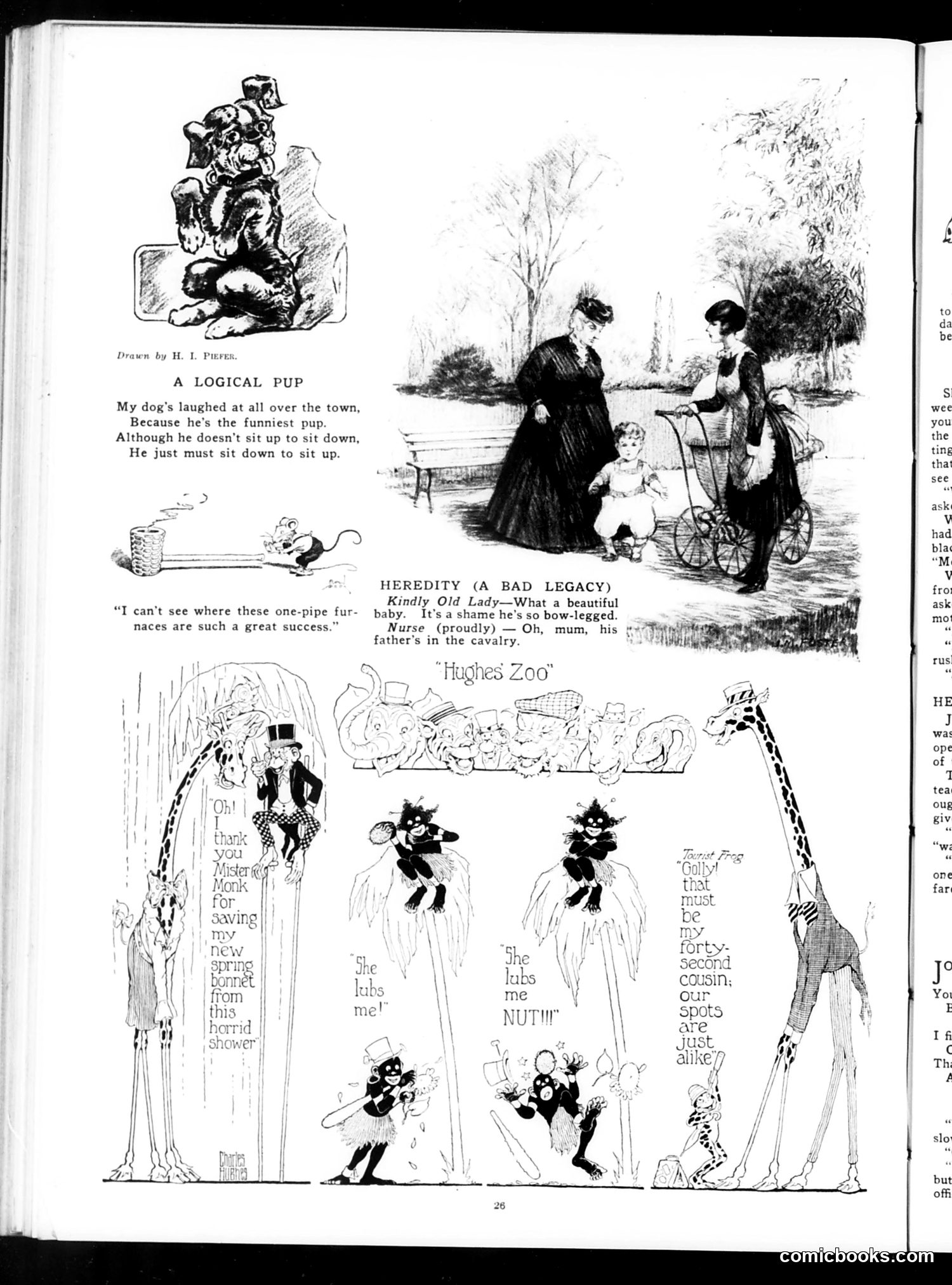
This page contains three distinct humorous pieces from an early 20th-century American satirical magazine: **"A Logical Pup"** is a simple visual joke about a dog's contradictory sitting behavior, drawn by H.I. Peres. **"Heredity (A Bad Legacy)"** satirizes inherited traits and social class. A wealthy lady compliments a baby's appearance, but notes his bow-legs (a physical deformity). The nurse's proud response—that his father serves in the cavalry—implies cavalry soldiers' bow-legged appearance from horseback riding is so pronounced it's now hereditary. The joke mocks both inherited physical defects and the lower-class nurse's misplaced pride in this "legacy." **"Hughes Zoo"** appears to be a comic strip featuring giraffes and small human figures. While partially illegible, it seems to play on animals' unusual physical characteristics or social interactions, likely satirizing human behavior through animal analogues—a common Judge format. These pieces reflect Judge's focus on domestic humor, social commentary, and gentle mockery of class distinctions and human folly.
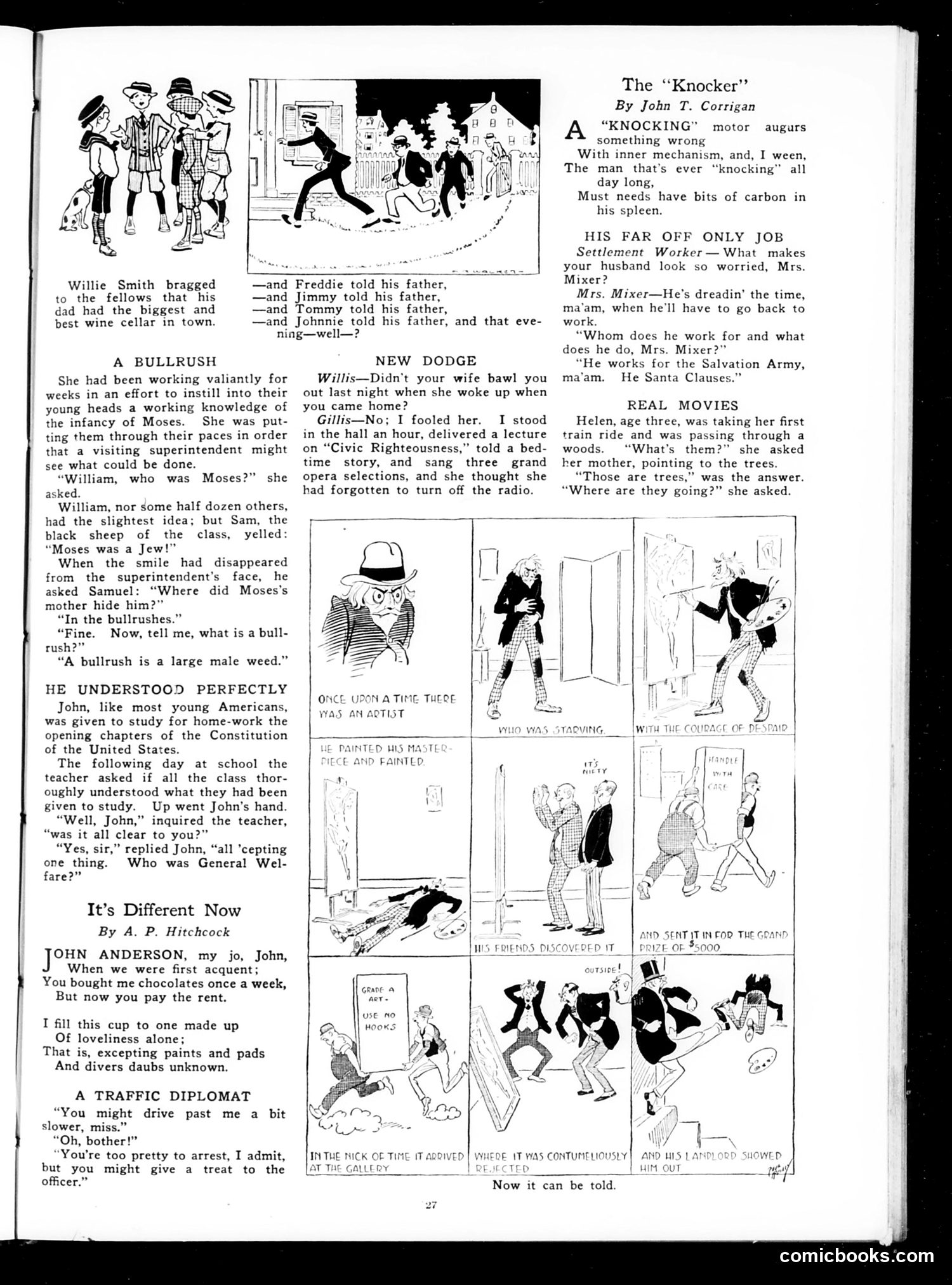
This page contains several brief humorous anecdotes typical of early 20th-century American humor magazines: **"A Bullrush"** mocks a schoolteacher's attempt to educate students about Biblical history. A student humorously defines "bullrush" (the plant where Moses was hidden) as "a large male weed"—confusing botanical terminology with gender. **"He Understood Perfectly"** jokes about a student's literal misreading of the Constitution, asking who "General Welfare" is—treating it as a person's name rather than recognizing it from the Constitutional preamble. **The remaining sketches** are domestic humor: a wife discovering her husband's deception about arriving home late, a policeman flirting with a speeding woman driver, and a small child asking where trees are "going" during a train ride. **"The Knocker"** is a poem criticizing chronic complainers as having "bits of carbon in [their] spleen." These are gentle, family-friendly jokes about domestic life, education, and relationships—typical middle-class American humor of the era.
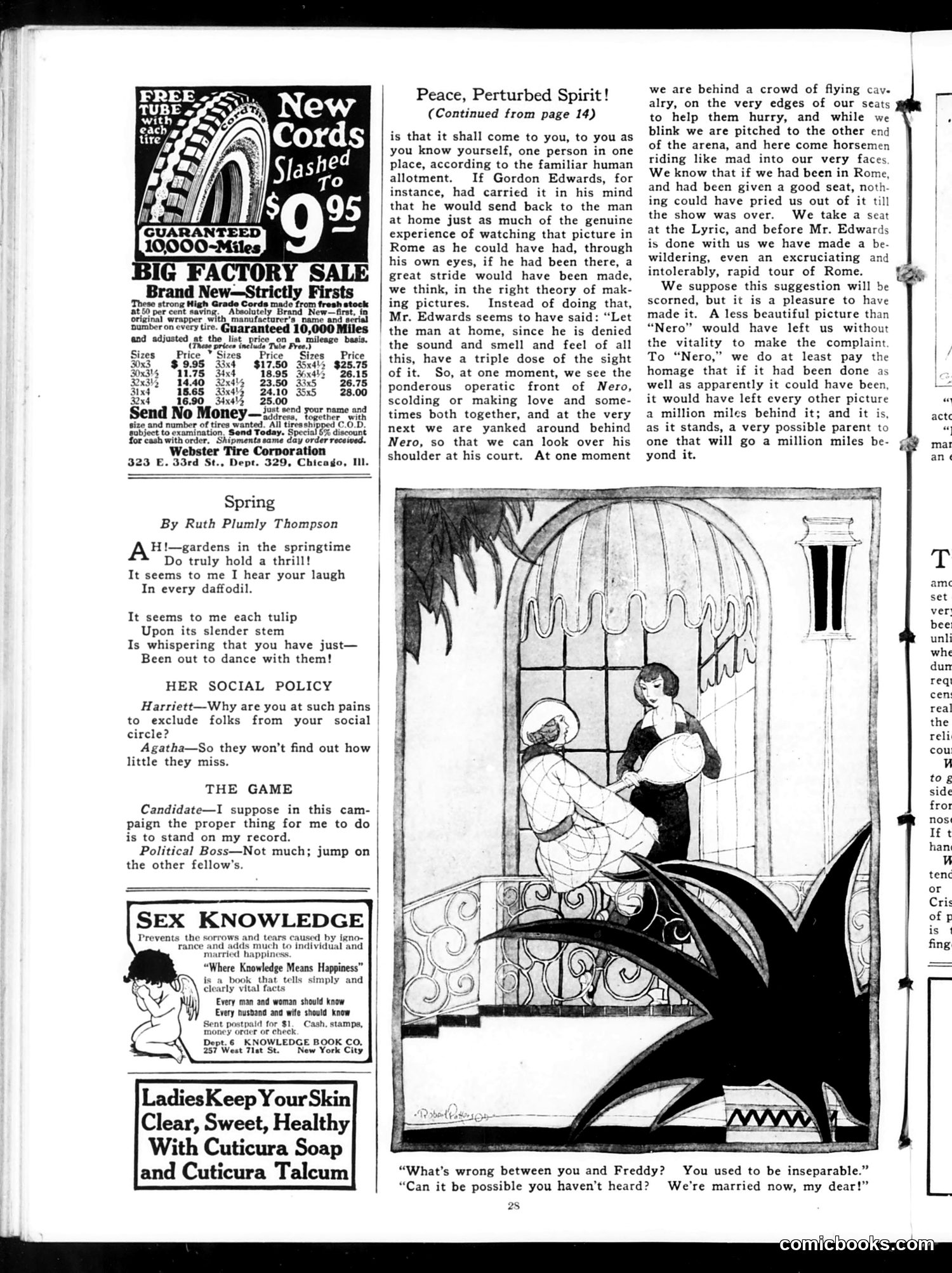
This page contains satirical commentary on the film *Nero* (likely the 1922 Italian epic). The main article critiques director Gordon Edwards's excessive camera movement and editing choices. The author argues that Edwards artificially multiplies visual perspectives—jumping from front to back of scenes, cutting between close-ups and wide shots—creating exhausting, disorienting viewing rather than immersive storytelling. The implicit critique: theatrical experience demands singular, sustained perspective, not cinematic fragmentation. The cartoon below illustrates marital discord: a wife confronts her husband "Freddy" about their changed intimacy since marriage. It's a conventional joke about how romantic couples become estranged after wedding. The page also contains period advertisements (tire sales, "Sex Knowledge" books on marital relations, skin care) and poetry by Ruth Plumly Thompson about spring romance. The overall tone reflects 1920s debates about emerging film technique and its psychological effects on audiences.
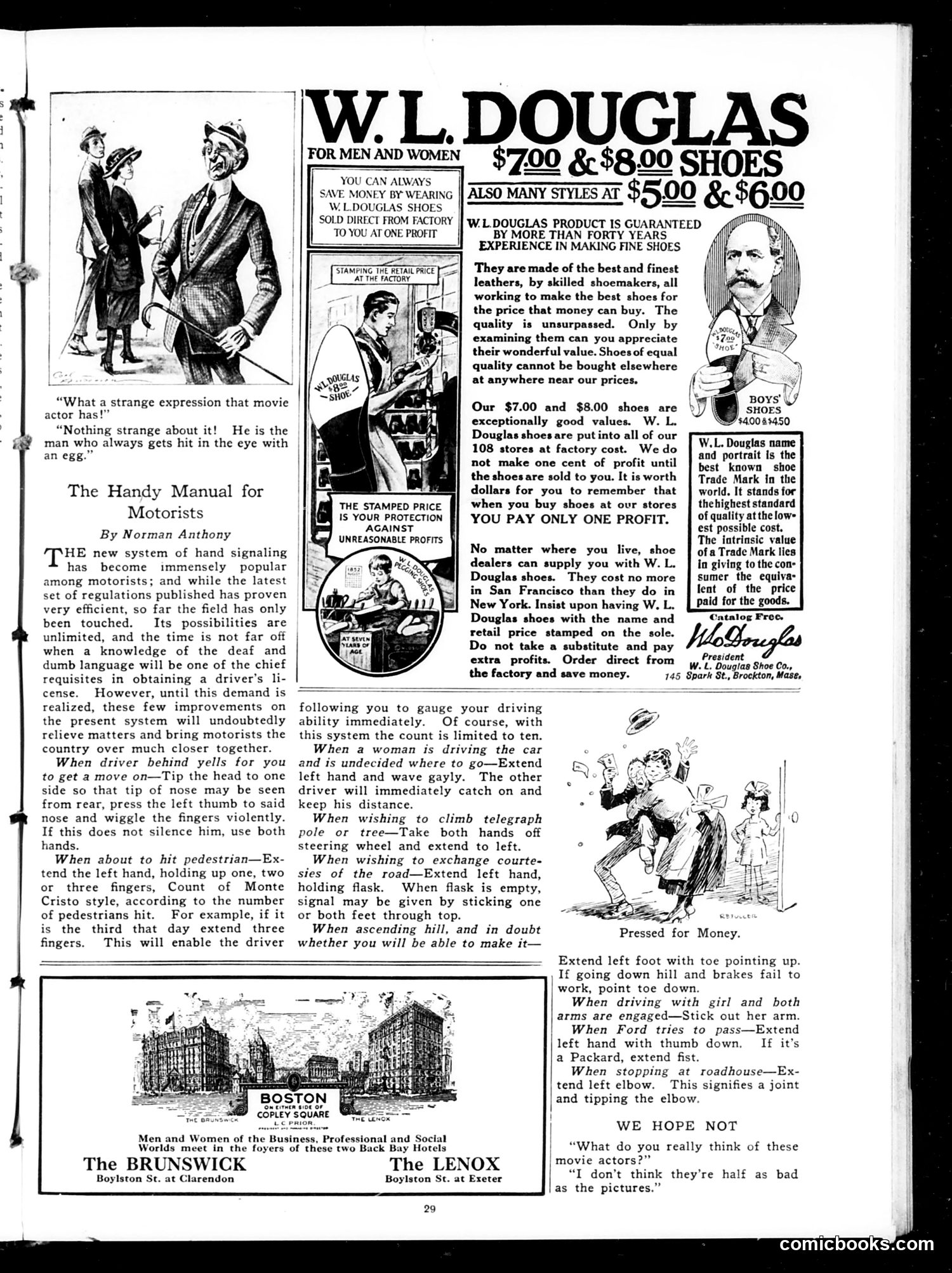
This page contains mostly **advertising** (W.L. Douglas shoes dominates) alongside a humorous satirical piece called "The Handy Manual for Motorists" by Norman Anthony. The satire mocks **early 1920s hand-signal driving customs**—newly standardized traffic regulations for automobiles. Anthony proposes absurd "improvements" to official hand signals, treating dangerous or rude driving behaviors as if they were legitimate communication methods: signaling pedestrians you've hit them by holding up fingers (counting incidents), making obscene gestures at aggressive drivers, and drinking alcohol while driving (the "flask" signal). The opening joke about a movie actor with a "strange expression" references silent-film slapstick comedy tropes where pie-in-the-face gags were common entertainment. The satire critiques both **dangerous early automotive culture** (drinking while driving, hitting pedestrians casually) and the absurdity of relying on hand signals before modern traffic infrastructure existed. It's darkly humorous commentary on traffic chaos in an era when cars were still novel and dangerous.
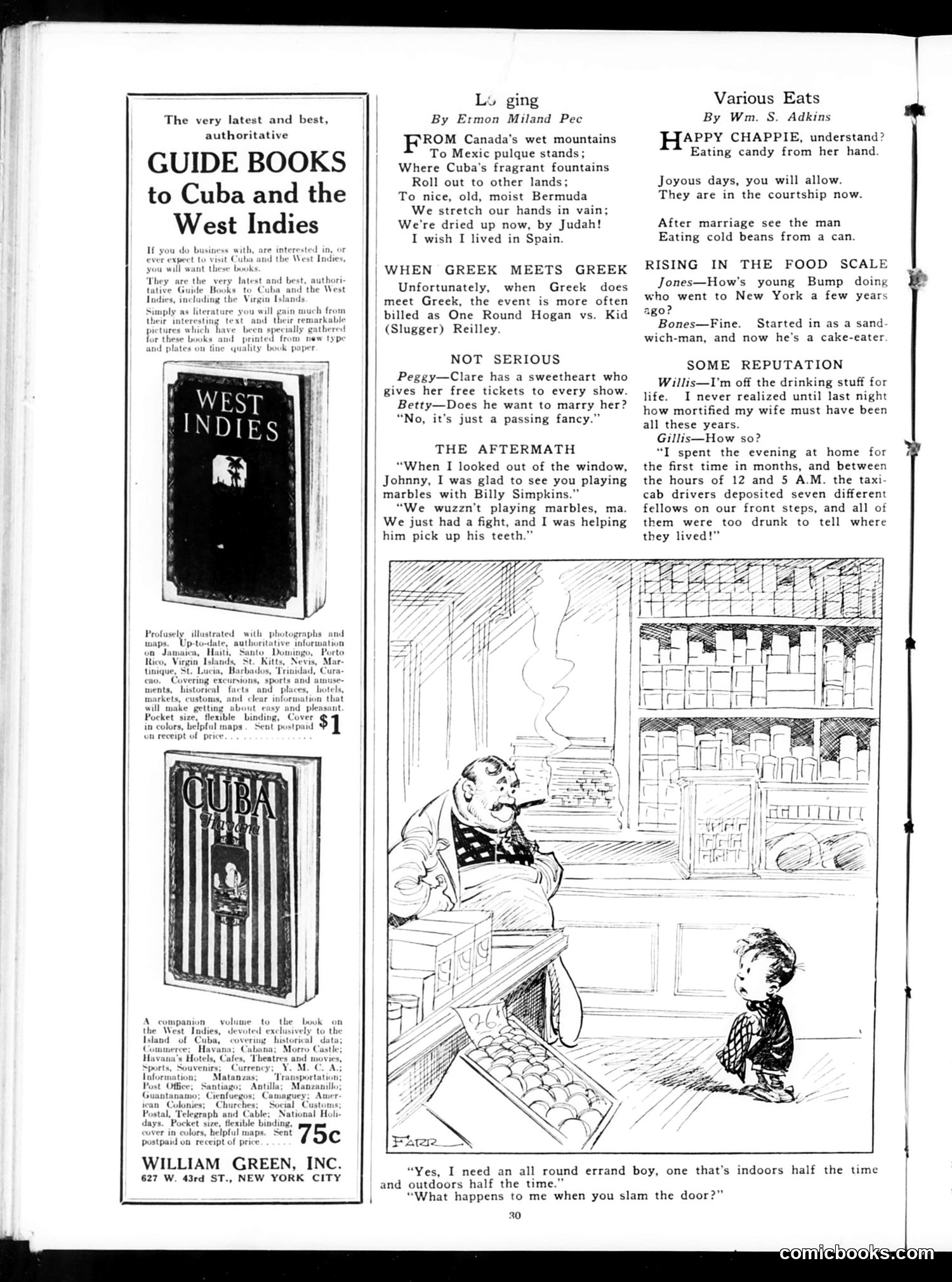
This Judge magazine page (circa Prohibition era, based on references to drinking) contains several short humorous pieces and advertisements. The main cartoon depicts a portly man at a desk interviewing a young boy for an errand-boy position. The joke's punchline—"What happens to me when you slam the door?"—plays on the absurd job description of being "indoors half the time and outdoors half the time," suggesting the boy would be literally caught in the door. The text pieces are brief comedic sketches: "Not Serious" jokes about dating and courtship; "The Aftermath" uses dialect humor about a child's fight; "When Greek Meets Greek" references boxing matches (likely referencing the famous phrase about competitive encounters); and "Some Reputation" satirizes a man's drinking problem revealed through drunk visitors appearing at his home. The advertisements promote travel guides to Cuba and the West Indies, appealing to readers planning vacations to these destinations. The humor is gentle, domestic, and relies on wordplay and situational comedy typical of early 20th-century American magazines.
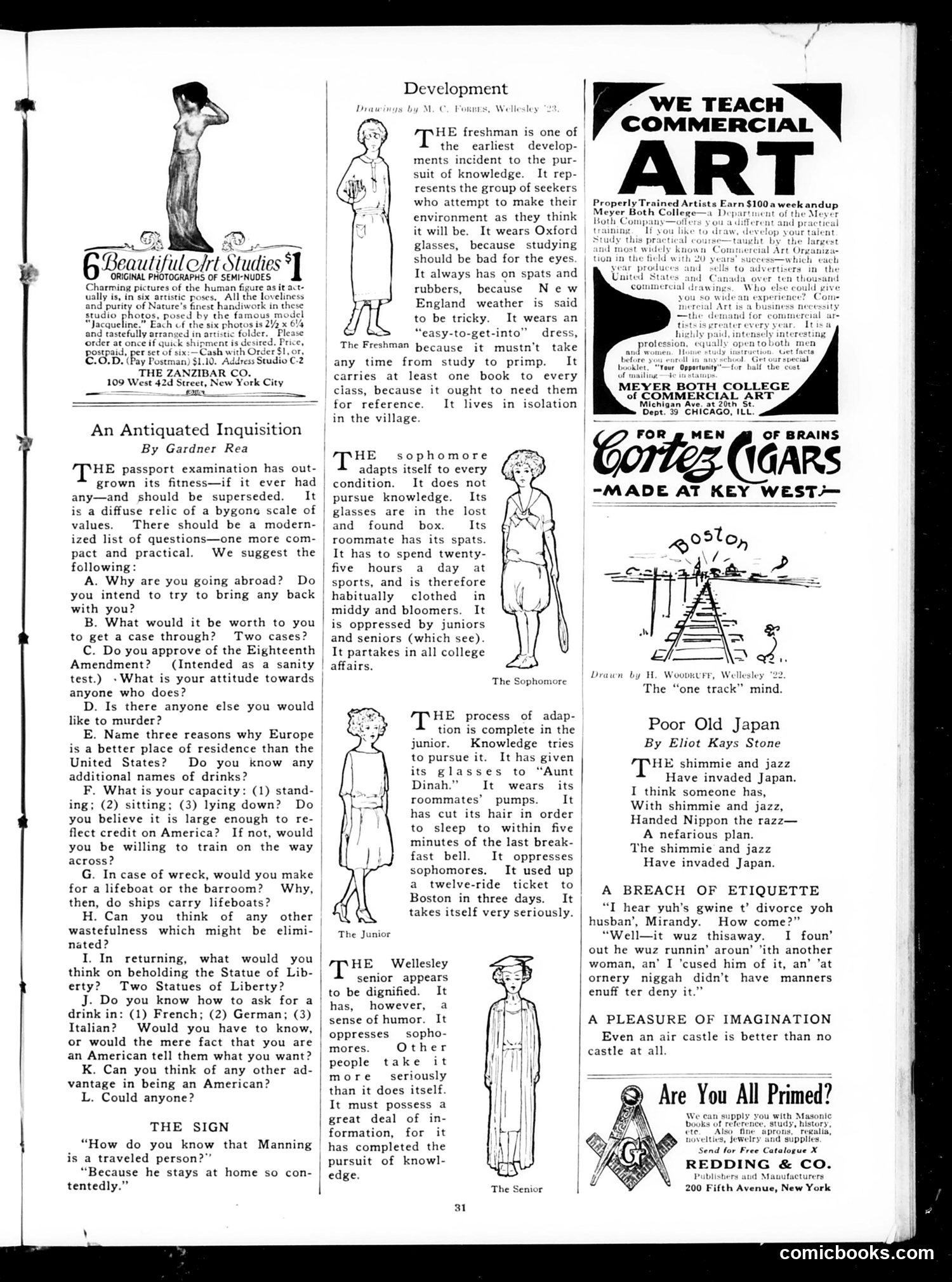
This page from Judge magazine features multiple satirical commentaries on American college life and society in the early 20th century. **Main Content: "Development"** - A four-panel satirical progression showing college students at different educational stages. Each figure (Freshman, Sophomore, Junior, Senior) is described with exaggerated stereotypes. The satire mocks how students' behavior, interests, and appearance supposedly shift as they advance: freshmen dress formally for studying; sophomores dress in "middy and bloomers" for sports; juniors become disheveled and focused on travel; seniors become pretentious and serious. The humor plays on the assumed transformation of young collegians through their academic years. **Side content includes**: - "An Antiquated Inquisition" - satire on 1920s passport examination procedures, through absurdist questions mocking Prohibition era drinking culture and American attitudes - Short humorous observations about travel and urban life The overall tone reflects post-WWI-era American magazine satire targeting college culture, immigration policy, and social conventions.
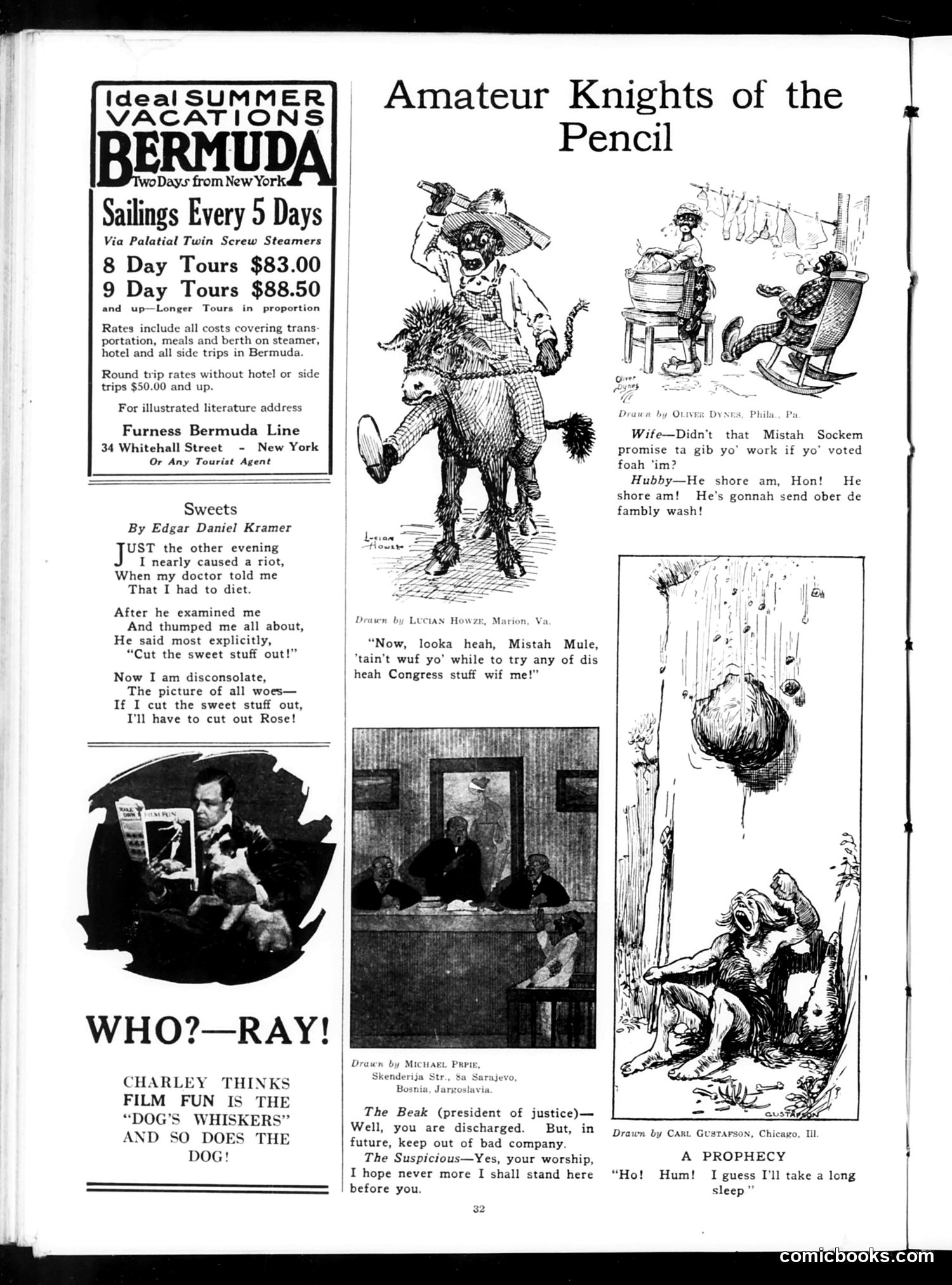
This page showcases humorous cartoon submissions from amateur artists to *Judge* magazine. The main satirical content depicts African American characters in dialect, reflecting early 20th-century racist stereotyping common to the era. Two cartoons mock Black voters and politics: one shows a husband who was promised work by a politician but received only laundry instead—satirizing broken campaign promises and political corruption. Another depicts a mule rejecting Congressional matters, likely commentary on perceived political foolishness. The page also includes "Sweets," a poem about dietary restriction, and a courtroom scene with legal humor. The "Prophecy" cartoon shows a sleeping figure. The *Judge* masthead at top references the magazine's role as a forum for amateur cartoonists' submissions ("Knights of the Pencil"). The Bermuda vacation advertisement is standard period travel marketing unrelated to the satirical content.
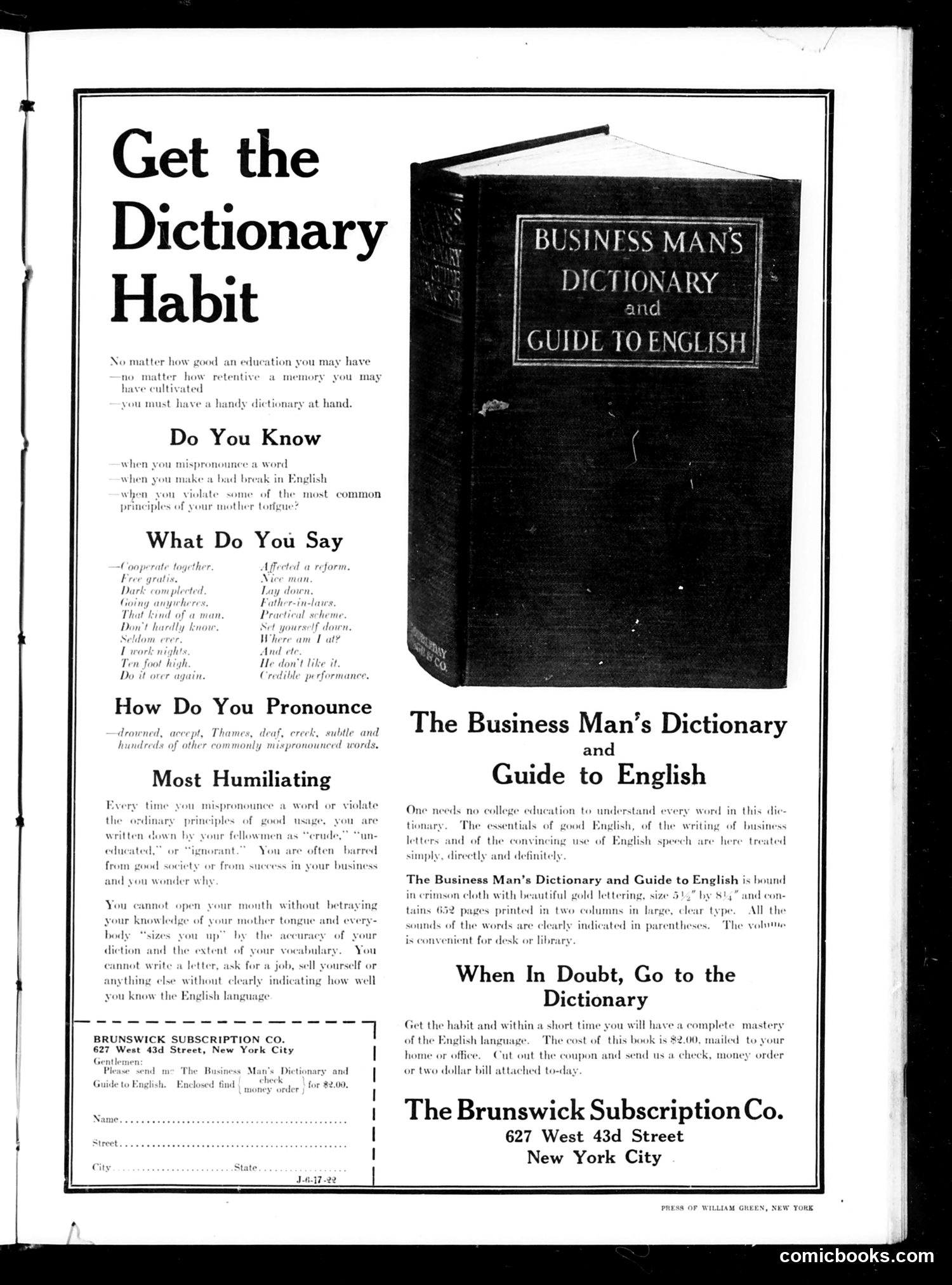
This is **not a cartoon page but rather a full-page advertisement** for "The Business Man's Dictionary and Guide to English," published by the Brunswick Subscription Co. The ad employs a social anxiety appeal common to early 20th-century advertising. It targets businessmen by emphasizing embarrassment: mispronouncing words, making "bad breaks in English," and betraying ignorance of proper grammar will damage professional reputation and social standing. The repeated phrase "Most Humiliating" underscores this shame-based marketing. The left column lists common speech errors ("cooperate together," "lay down," "where am I at?"), positioning the dictionary as a solution to class anxiety—suggesting that without it, one risks exposure as uneducated despite business success. The product itself appears legitimate: a 632-page reference bound in crimson cloth. At $2.00 (with coupon), it's positioned as essential professional equipment. This reflects broader early-20th-century concerns about standardizing American English and maintaining social hierarchy through linguistic correctness.
This page is **primarily a cigarette advertisement**, not a political cartoon. It's a Chesterfield cigarettes ad from Liggett & Myers Tobacco Co. The image shows a man reading a newspaper with the quoted phrase "I like 'em" appearing above him in the smoke/shadow. The accompanying text claims Chesterfield tobacco is of finer quality than competitors at the same price point. The "joke" or sales pitch is simple: the satisfied reader's casual endorsement ("I like 'em") serves as testimonial advertising. This was standard advertising practice of the era—using relatable figures to suggest product satisfaction. There is no political satire or social commentary visible here. This is straightforward product marketing from an early 20th-century magazine, exploiting the then-common practice of cigarette advertising with casual endorsements and quality claims that would later become heavily regulated or banned.