
Judge, 1922-06-17 · page 12 of 36
Judge — June 17, 1922 — page 12: what you’re looking at
What you’re looking at
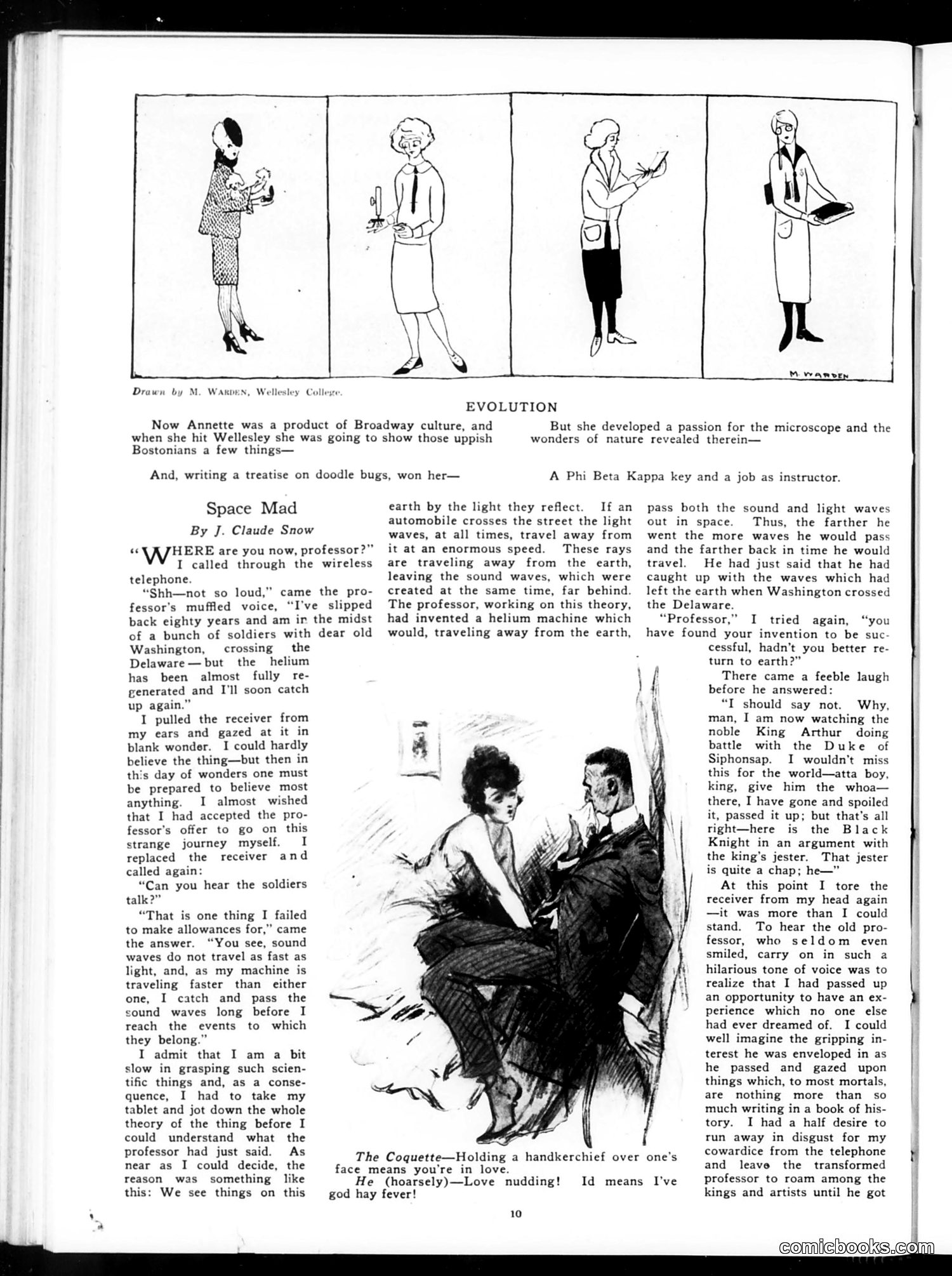
## The "Evolution" Cartoon The four-panel strip shows a woman's professional progression: from a Broadway showgirl in a patterned dress, to a simple worker, to a scientist in a lab coat, to an educated professional. The accompanying text explains that "Annette," a product of Broadway culture, came to Wellesley College to impress "uppish Bostonians" but instead developed a passion for microscopy and nature study, earning a Phi Beta Kappa key and an instructor position. **The satire**: This gently mocks the transformation of a frivolous young woman into a serious academic through education, satirizing both Broadway culture and suggesting that even superficial people can become scholars—or praising women's educational advancement, depending on the reader's perspective. ## "Space Mad" Story A science fiction tale about a professor who invented a helium machine traveling faster than light waves, allowing him to witness historical events (Washington crossing the Delaware, King Arthur). The ironic twist: he's so entranced by past events he refuses to return to earth. **The humor**: Absurdist fiction poking fun at scientific theorizing and professorial absent-mindedness.
📄 Transcribed text from this page (OCR, searchable)
Machine-transcribed from the original scan — historical spelling and the odd misread are preserved.
M wanven Drawn by M. Wanven, Wellesley Coll Now Annette was a product of Broadway culture, and when she hit Wellesley she was going to show those uppish Bostonians a few things— And, writing a treatise on doodle bugs, won her— Space Mad By J. Claude Snow “ VWHERE are you now, professor?” I called through the wireless telephone. “Shh—not so loud,” came the pro- fessor’s muffled voice, “I've slipped back eighty years and am ir the midst of a bunch of soldiers with dear old Washington, crossing the Delaware— but the helium has been almost fully re- generated and I'll soon catch up again.” I pulled the receiver from my ears and gazed at it in blank wonder. I could hardly believe the thing—but then in this day of wonders one must be prepared to believe most anything. I almost wished that I had accepted the pro- fessor’s offer to go on this strange journey myself. I replaced the receiver and called again: “Can you hear the soldiers talk?” “That is one thing I failed to make allowances for,” came the answer. “You see, sound waves do not travel as fast as light, and, as my machine is traveling faster than either one, I catch and pass the sound waves long before I reach the events to which they belong.” I admit that I am a bit slow in grasping such scien- tific things and, as a conse- quence, I had to take my tablet and jot down the whole theory of the thing before I could understand what the professor had just said. As near as I could decide, the reason was something like this: We see things on this EVOLUTION earth by the light they reflect. If an automobile crosses the street the light waves, at all times, travel away from it at an enormous speed. These rays are traveling away from the earth, leaving the sound waves, which were created at the same time, far behind. The professor, working on this theory, had invented a helium machine which would, traveling away from the earth, The Coquette—Holding a handkerchief over one's face means you're in love. He (hoarsely)—Love nudding! god hay fever! 10 | 1 Id means I've But she developed a passion for the microscope and the wonders of nature revealed therein— A Phi Beta Kappa key and a job as instructor. pass both the sound and light waves out in space. Thus, the farther he went the more waves he would pass and the farther back in time he would travel. He had just said that he had caught up with the waves which had left the earth when Washington crossed the Delaware. “Professor,” I tried again, “you have found your invention to be suc- cessful, hadn’t you better re- turn to earth?” There came a feeble laugh before he answered: “I should say not. Why, man, I am now watching the noble King Arthur doing battle with the Duke of Siphonsap. I wouldn't miss this for the world—atta boy, king, give him the whoa— there, I have gone and spoiled it, passed it up; but that's all right—here is the Black Knight in an argument with the king's jester. That jester is quite a chap; he—” At this point I tore the receiver from my head again —it was more than I could stand. To hear the old pro- fessor, who seldom even smiled, carry on in such a hilarious tone of voice was to realize that I had passed up an opportunity to have an ex- perience which no one else had ever dreamed of. I could well imagine the gripping in- terest he was enveloped in as he passed and gazed upon things which, to most mortals, are nothing more than so much writing in a book of his- tory. I had a half desire to run away in disgust for my cowardice from the telephone and leave the transformed professor to roam among the kings and artists until he got =