
Judge, 1922-06-17 · page 10 of 36
Judge — June 17, 1922 — page 10: what you’re looking at
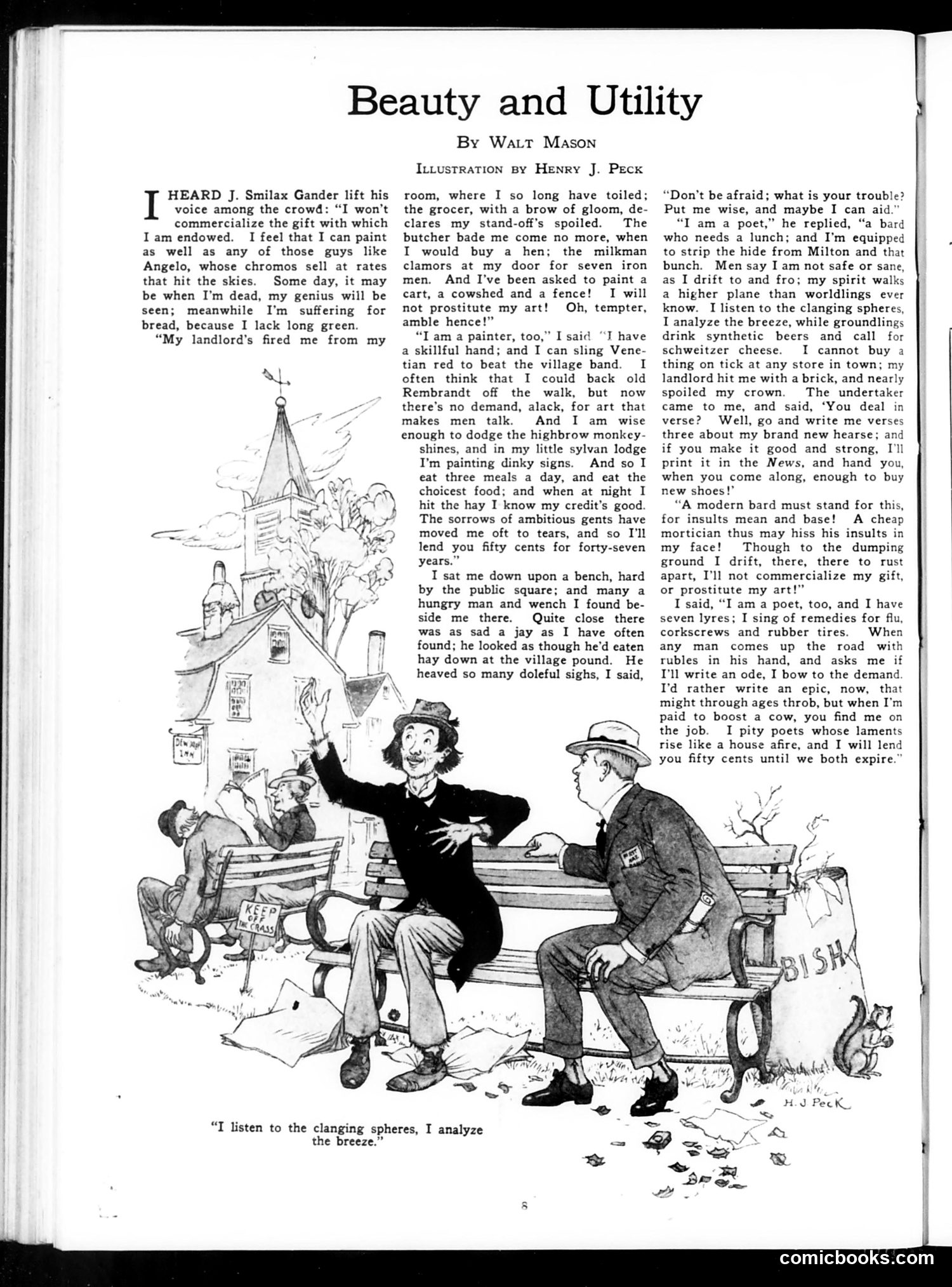
What you’re looking at
This is a satirical story about artistic integrity versus practical survival, illustrated by a park bench conversation between two struggling artists and a pragmatic narrator. **The figures**: A self-described "poet" (appearing disheveled and desperate) encounters the narrator, who is also an artist but takes commercial work—writing advertising jingles and commercial verses for corkscrews and rubber tires. **The satire's point**: The poet refuses to "prostitute" his art, maintaining lofty principles about listening to "clanging spheres" and analyzing breezes, yet he's starving, evicted, and reduced to begging. The narrator, meanwhile, writes pedestrian commercial content but eats well, pays rent, and can lend money. **Social commentary**: This mocks both Bohemian artistic pretension and American commercialism. The joke is that the idealistic poet's refusal to compromise leaves him destitute, while the pragmatist thrives. The story questions whether artistic purity has value when it produces only suffering, or whether "selling out" to commercial demands is actually the wiser, more honest choice. It's essentially Depression-era commentary on struggling artists' economic futility.
📄 Transcribed text from this page (OCR, searchable)
Machine-transcribed from the original scan — historical spelling and the odd misread are preserved.
Beauty and Utility By Watt Mason IttustRaTION By Henry J. Peck HEARD J. Smilax Gander lift his voice among the crowd: “I won't commercialize the gift with which I am endowed. I feel that I can paint as well as any of those guys like Angelo, whose chromos sell at rates that hit the skies. Some day, it may be when I’m dead, my genius will be seen; meanwhile I’m suffering for bread, because I lack long green. “My landlord’s fired me from my room, where I so long have toiled; the grocer, with a brow of gloom, de- clares my stand-off’s spoiled. The butcher bade me come no more, when I would buy a hen; the milkman clamors at my door for seven iron men. And I’ve been asked to paint a cart, a cowshed and a fence! I will not prostitute my art! Oh, tempter, amble hence!” “I am a painter, too,” I said “I have a skillful hand; and I can sling Vene- tian red to beat the village band. I often think that I could back old Rembrandt off the walk, but now there’s no demand, alack, for art that makes men talk. And I am wise enough to dodge the highbrow monkcy- shines, and in my little sylvan lodge I'm painting dinky signs. And so I eat three meals a day, and eat the choicest food; and when at night I hit the hay I know my credit’s good. The sorrows of ambitious gents have moved me oft to tears, and so I'll lend you fifty cents for forty-seven years.” I sat me down upon a bench, hard by the public square; and many a hungry man and wench I found be- side me there. Quite close there was as sad a jay as I have often found; he looked as though he'd eaten hay down at the village pound. He heaved so many doleful sighs, I said, “Don't be afraid; what is your trouble? Put me wise, and maybe I can aid.” “Iam a poet,” he replied, “a bard who needs a lunch; and I’m equipped to strip the hide from Milton and that bunch. Men say I am not safe or sane, as I drift to and fro; my spirit walks a higher plane than worldlings ever know. I listen to the clanging spheres, I analyze the breeze, while groundlings drink synthetic beers and call for schweitzer cheese. I cannot buy a thing on tick at any store in town; my landlord hit me with a brick, and nearly spoiled my crown. The undertaker came to me, and said, ‘You deal in verse? Well, go and write me verses three about my brand new hearse; and if you make it good and strong, I'll print it in the News, and hand you, when you come along, enough to buy new shoes!’ “A modern bard must stand for this, for insults mean and base! A cheap mortician thus may hiss his insults in my face! Though to the dumping ground I drift, there, there to rust apart, I'll not commercialize my gift, or prostitute my art!” I said, “I am a poet, too, and I have seven lyres; I sing of remedies for flu, corkscrews and rubber tires. When any man comes up the road with rubles in his hand, and asks me if I'll write an ode, I bow to the demand. I'd rather write an epic, now, that might through ages throb, but when I'm paid to boost a cow, you find me on the job. I pity poets whose laments rise like a house afire, and I will lend Sy you fifty cents until we both expire.” “I listen to the clanging spheres, I analyze the breeze.” comicbooks.com