
Judge, 1922-06-17 · page 13 of 36
Judge — June 17, 1922 — page 13: what you’re looking at
What you’re looking at
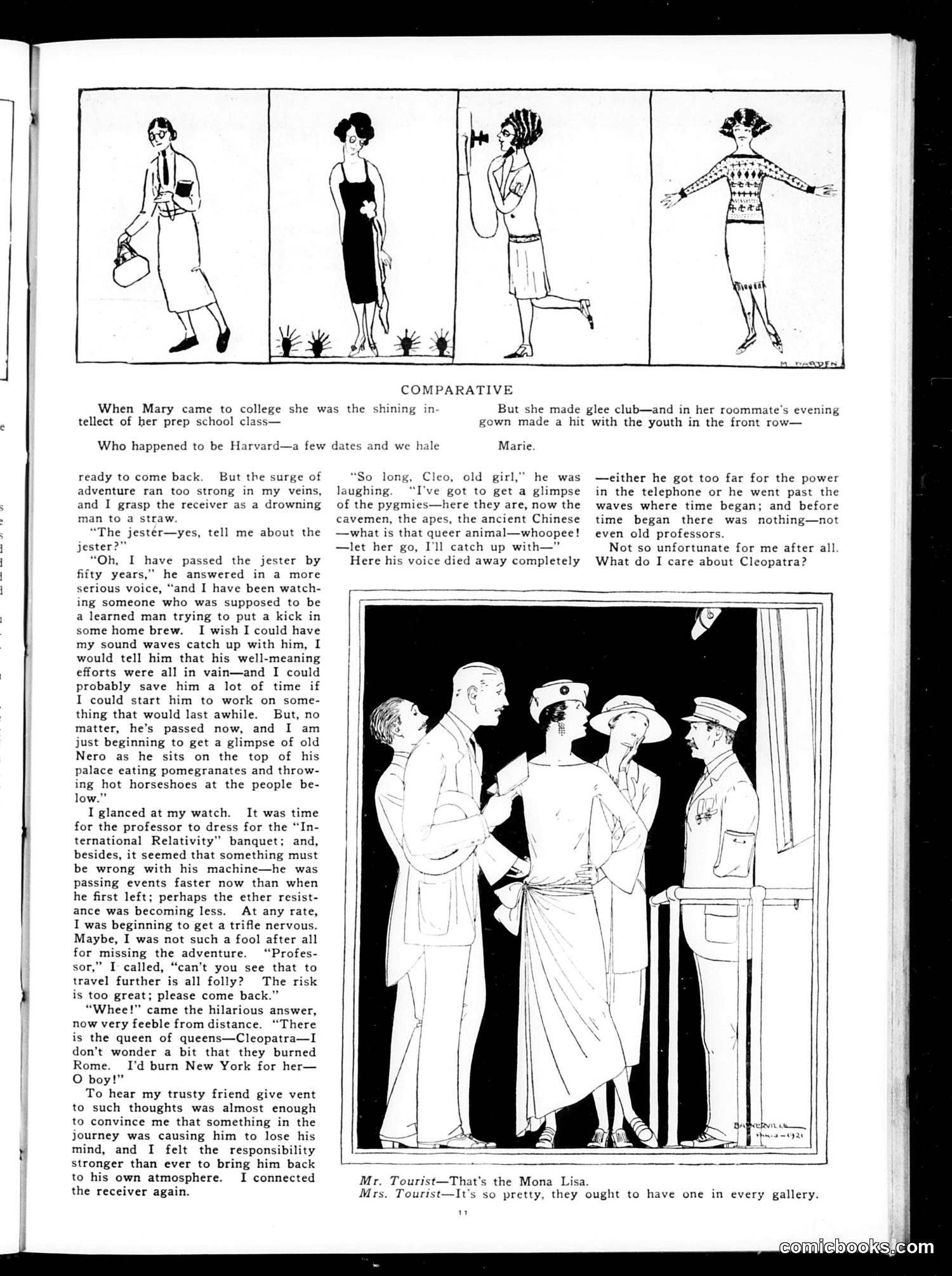
This page contains a science-fiction story titled "Comparative" about a professor who invents a time-travel device. The narrative satirizes academic eccentricity and the pursuit of adventure: a professor becomes obsessed with witnessing historical figures (Cleopatra, Nero, ancient civilizations) and eventually travels so far into the past that he disappears beyond "where time began." The accompanying illustration shows tourists viewing the Mona Lisa, with one remarking they should have copies "in every gallery"—mocking American cultural philistinism and tourist superficiality. The upper "Comparative" panel contrasts a girl's transformation from serious prep-school intellectual to frivolous college socialite (trading intellect for popularity through glee club and borrowed evening gowns). The satire targets intellectual pretension, the absurdity of endless historical obsession, and American tourist ignorance of high culture—common Judge magazine themes from the early 20th century.
📄 Transcribed text from this page (OCR, searchable)
Machine-transcribed from the original scan — historical spelling and the odd misread are preserved.
When Mary came to college she was the shining in tellect of her prep school class— Who happened to be Harvard—a few dates and we hale ready to come back But the surge of adventure ran too strong in my veins, and I grasp the receiver as a drowning man to a straw. “The jester—yes, tell me about the jester?” “Oh, I have passed the jester by fifty years,” he answered in a more serious voice, “and I have been watch- ing someone who was supposed to be a learned man trying to put a kick in some home brew. I wish I could have my sound waves catch up with him, I would tell him that his well-meaning efforts were all in vain—and I could probably save him a lot of time if I could start him to work on some- thing that would last awhile. But, no matter, he’s passed now, and I am just beginning to get a glimpse of old Nero as he sits on the top of his palace eating pomegranates and throw- ing hot horseshoes at the people be- low.” I glanced at my watch. It was time for the professor to dress for the “In- ternational Relativity” banquet; and, besides, it seemed that something must be wrong with his machine—he was passing events faster now than when he first left; perhaps the ether resist- ance was becoming less. At any rate, I was beginning to get a trifle nervous. Maybe, I was not such a fool after all for missing the adventure. “Profes- sor,” I called, “can’t you see that to travel further is all folly? The risk is too great; please come back.” “Whee!” came the hilarious answer, now very feeble from distance. “There is the queen of queens—Cleopatra—I don’t wonder a bit that they burned Rome. I'd burn New York for her— O boy!” To hear my trusty friend give vent to such thoughts was almost enough to convince me that something in the journey was causing him to lose his mind, and I felt the responsibility stronger than ever to bring him back to his own atmosphere. I connected the receiver again. COMPARATIVE But she made glee club—and in her roommate's evening gown made a hit with the youth in the front row— Marie. “So long, Cleo, old girl,” he was laughing. “I've got to get a glimpse of the pygmies—here they are, now the cavemen, the apes, the ancient Chinese —what is that queer animal—whoopee! —let her go, I'll catch up with—” Here his voice died away completely —either he got too far for the power in the telephone or he went past the waves where time began; and before time began there was nothing—not even old professors. Not so unfortunate for me after all What do I care about Cleopatra? Mr. Tourist—That's the Mona Lisa. Mrs. Tourist—It’s so pretty, they ought to have one in every gallery.