
Judge, 1922-06-17 · page 16 of 36
Judge — June 17, 1922 — page 16: what you’re looking at
What you’re looking at
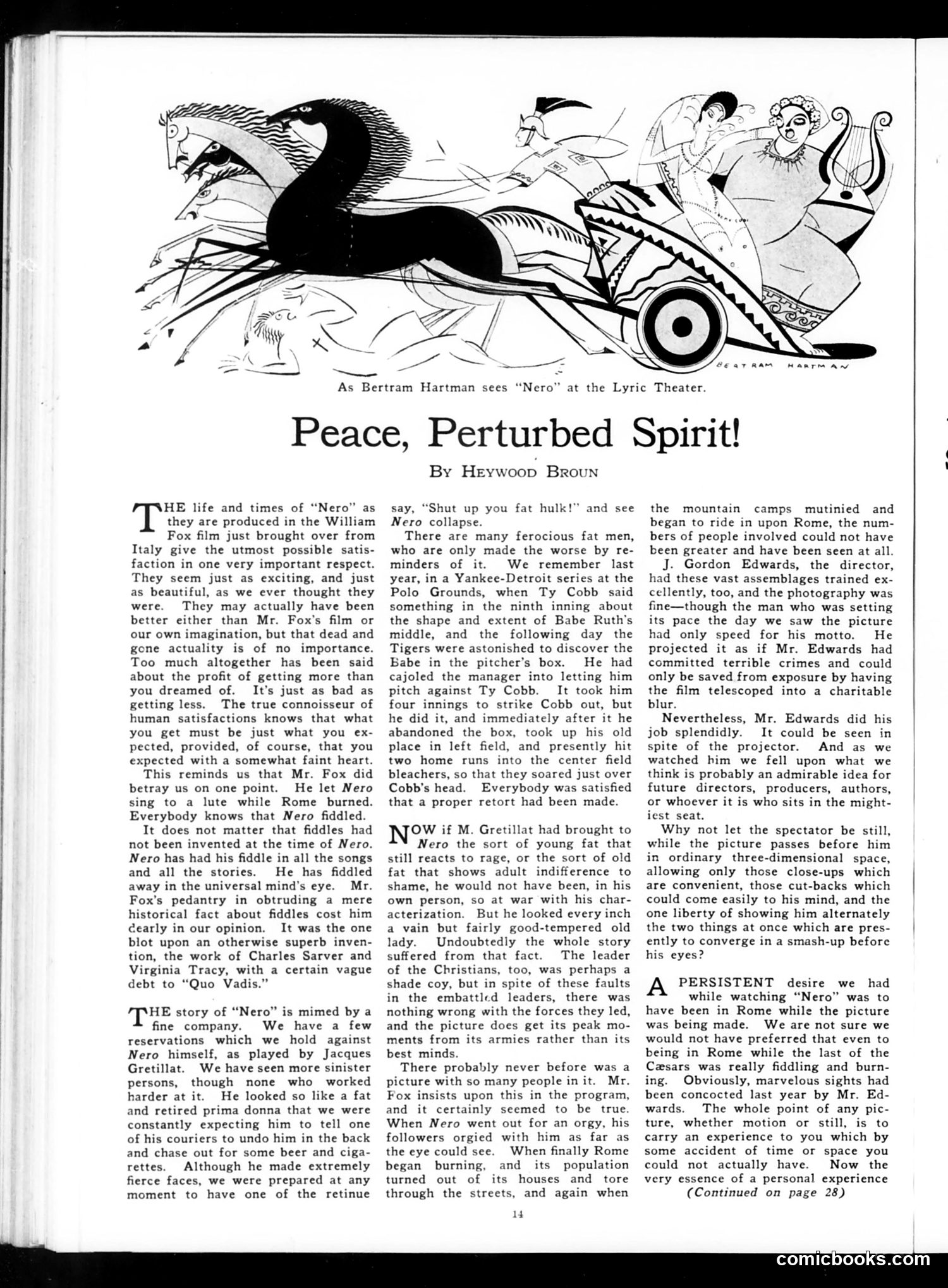
This page reviews the William Fox film *Nero*, a historical epic imported from Italy. The cartoon depicts Bertram Hartman (a Judge cartoonist) watching the film's chariot scene at the Lyric Theater. Heywood Broun's critique praises the film's spectacle while critiquing its historical accuracy and casting. His main complaint: Fox showed Nero playing a *lute* while Rome burned, when popular legend established that Nero *fiddled*—despite fiddles not existing in ancient Rome. Broun argues Fox's pedantry sacrificed entertainment for historical fact. The review also mocks actor Jacques Gretillat's portrayal of Nero as resembling "a fat and retired prima donna," comparing him unfavorably to Babe Ruth's fierce response to Ty Cobb's insult at the Polo Grounds. The critique suggests Nero should embody either youthful rage or indifferent old-age callousness—not vain complacency. The piece celebrates the film's massive crowds and production scale while emphasizing that spectacle, not character nuance, drives the narrative's power.
📄 Transcribed text from this page (OCR, searchable)
Machine-transcribed from the original scan — historical spelling and the odd misread are preserved.
As Bertram Hartman sees “Nero” at the Lyric Theater. Peace, Perturbed Spirit! HE life and times of “Nero” as they are produced in the William Fox film just brought over from Italy give the utmost possible satis- faction in one very important respect. They seem just as exciting, and just as beautiful, as we ever thought they were. They may actually have been better either than Mr. Fox's film or our own imagination, but that dead and gone actuality is of no importance. Too much altogether has been said about the profit of getting more than you dreamed of. It’s just as bad as getting less. The true connoisseur of human satisfactions knows that what you get must be just what you ex- pected, provided, of course, that you expected with a somewhat faint heart. This reminds us that Mr. Fox did betray us on one point. He let Nero sing to a lute while Rome burned. Everybody knows that Nero fiddled. It does not matter that fiddles had not been invented at the time of Nero. Nero has had his fiddle in all the songs and all the stories. He has fiddled away in the universal mind's eye. Mr. Fox’s pedantry in obtruding a mere historical fact about fiddles cost him cearly in our opinion. It was the one blot upon an otherwise superb inven- tion, the work of Charles Sarver and Virginia Tracy, with a certain vague debt to “Quo Vadis.” "THE story of “Nero” is mimed by a fine company. We have a few reservations which we hold against Nero himself, as played by Jacques Gretillat. We have seen more sinister persons, though none who worked harder at it. He looked so like a fat and retired prima donna that we were constantly expecting him to tell one of his couriers to undo him in the back and chase out for some beer and ciga- rettes. Although he made extremely fierce faces, we were prepared at any moment to have one of the retinue By Heywoop Broun say, “Shut up you fat hulk!" and see Nero collapse. There are many ferocious fat men, who are only made the worse by re- minders of it. We remember last year, in a Yankee-Detroit series at the Polo Grounds, when Ty Cobb said something in the ninth inning about the shape and extent of Babe Ruth's middle, and the following day the Tigers were astonished to discover the Babe in the pitcher’s box. He had cajoled the manager into letting him pitch against Ty Cobb. It took him four innings to strike Cobb out, but he did it, and immediately after it he abandoned the box, took up his old place in left field, and presently hit two home runs into the center field bleachers, so that they soared just over Cobb’s head. Everybody was satisfied that a proper retort had been made. Now if M. Gretillat had brought to Nero the sort of young fat that still reacts to rage, or the sort of old fat that shows adult indifference to shame, he would not have been, in his own person, so at war with his char- acterization. But he looked every inch a vain but fairly good-tempered old lady. Undoubtedly the whole story suffered from that fact. The leader of the Christians, too, was perhaps a shade coy, but in spite of these faults in the embattled leaders, there was nothing wrong with the forces they led, and the picture does get its peak mo- ments from its armies rather than its best minds. There probably never before was a picture with so many people init. Mr. Fox insists upon this in the program, and it certainly seemed to be true. When Nero went out for an orgy, his followers orgied with him as far as the eye could see. When finally Rome began burning, and its population turned out of its houses and tore through the streets, and again when 14 the mountain camps mutinied and began to ride in upon Rome, the num- bers of people involved could not have been greater and have been seen at all. J. Gordon Edwards, the director, had these vast assemblages trained ex- cellently, too, and the photography was fine—though the man who was setting its pace the day we saw the picture had only speed for his motto. He projected it as if Mr. Edwards had committed terrible crimes and could only be saved from exposure by having the film telescoped into a charitable blur. Nevertheless, Mr. Edwards did his job splendidly. It could be seen in spite of the projector. And as we watched him we fell upon what we think is probably an admirable idea for future directors, producers, authors, or whoever it is who sits in the might- iest seat. Why not let the spectator be still, while the picture passes before him in ordinary three-dimensional space, allowing only those close-ups which are convenient, those cut-backs which could come easily to his mind, and the one liberty of showing him alternately the two things at once which are pres- ently to converge in a smash-up before his eyes? PERSISTENT desire we had while watching “Nero” was to have been in Rome while the picture was being made. We are not sure we would not have preferred that even to being in Rome while the last of the Czsars was really fiddling and burn- ing. Obviously, marvelous sights had been concocted last year by Mr. Ed- wards. The whole point of any pic- ture, whether motion or still, is to carry an experience to you which by some accident of time or space you could not actually have. Now the very essence of a personal experience (Continued on page 28) comicbooks.com