
Judge, 1922-06-17 · page 5 of 36
Judge — June 17, 1922 — page 5: what you’re looking at
What you’re looking at
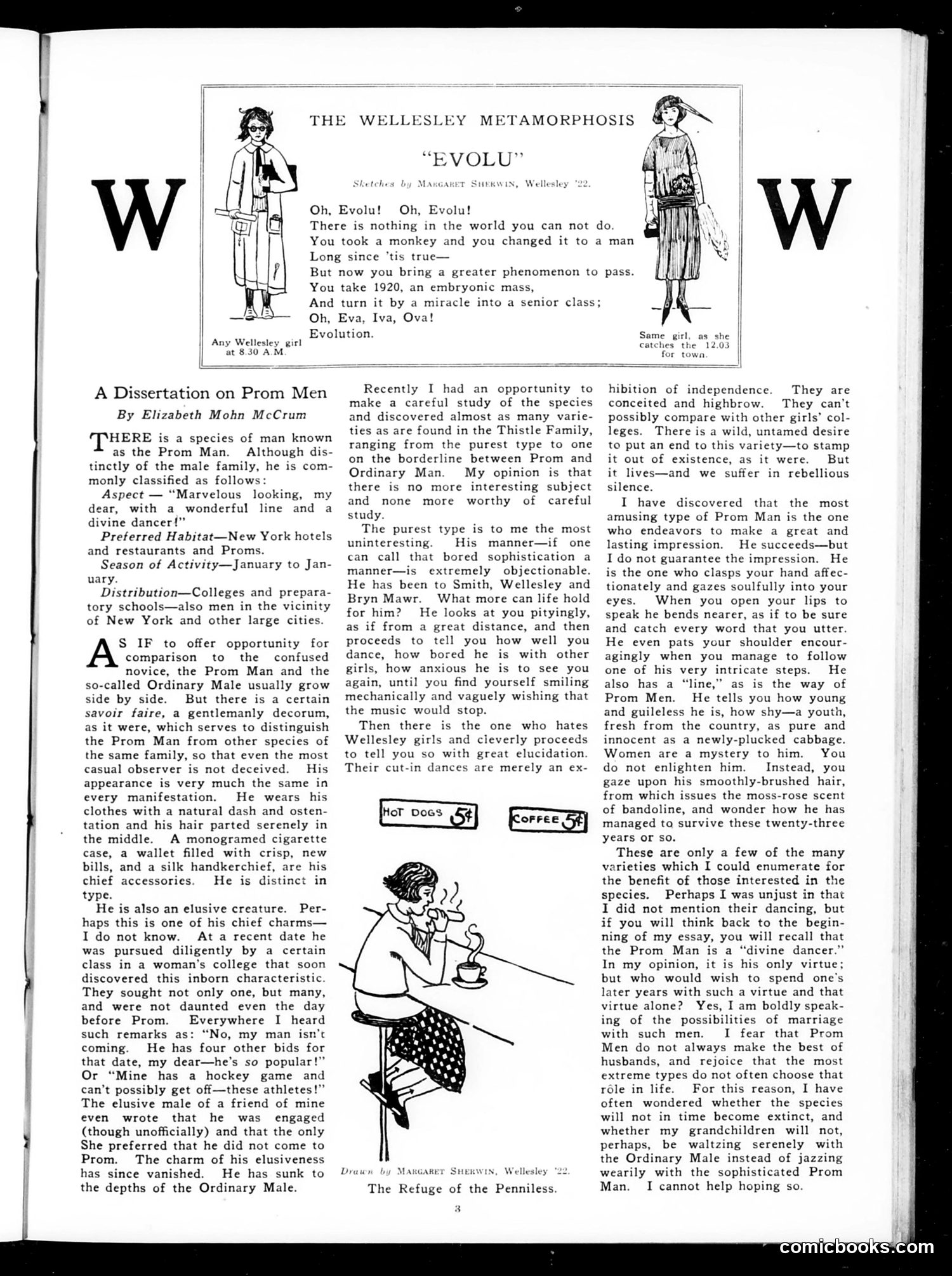
This page contains two distinct pieces: **"EVOLU" (top)**: A humorous poem by Margaret Sherwin (Wellesley '22) satirizing women's evolution and social progress. It jokes about transforming "an embryonic mass" (a 1920 freshman) into a refined "senior class" member—essentially mocking how college supposedly civilizes young women. **"A Dissertation on Prom Men" (main article)**: A satirical essay by Elizabeth Mohn McCrum that humorously catalogs "the Prom Man" as a distinct species, distinguishing him from "Ordinary Men." The piece mocks his affected mannerisms, pretentious behavior, and romantic posturing—portraying him as an insufferable type who frequents upscale New York hotels and affects sophistication while being fundamentally shallow and boring. Both pieces target early 1920s college social culture and gender dynamics through comedic anthropological framing.
📄 Transcribed text from this page (OCR, searchable)
Machine-transcribed from the original scan — historical spelling and the odd misread are preserved.
You Any Wellesley girl at 8.30 A.M THE WELLESLEY METAMORPHOSIS “EVOLU” Sketches by MAxcanet SHERWIN, Wellesley Oh, Evolu! Oh, Evolu! There is nothing in the world you can not do. You took a monkey and you changed it to a man Long since ‘tis true— But now you bring a greater phenomenon to pass. take 1920, an embryonic mass, And turn it by a miracle into a senior class; Oh, Eva, Iva, Ova! Evolution. Same girl catches the for towa | as she |} 12.03 A Dissertation on Prom Men By Elizabeth Mohn McCrum (THERE is a species of man known as the Prom Man. Although dis- tinctly of the male family, he is com- monly classified as follows: Aspect — “Marvelous looking, my dear, with a wonderful line and a divine dancer!” Preterred Habitat—New York hotels and restaurants and Proms. Season of Activity—January to Jan- uary. Distribution—Colleges and prepara- tory schools—also men in the vicinity of New York and other large cities. S IF to offer opportunity for A comparison to the confused novice, the Prom Man and the so-called Ordinary Male usually grow side by side. But there is a certain savoir faire, a gentlemanly decorum, as it were, which serves to distinguish the Prom Man from other species of the same family, so that even the most casual observer is not deceived. His appearance is very much the same in every manifestation. He wears his clothes with a natural dash and osten- tation and his hair parted serenely in the middle. A monogramed cigarette case, a wallet filled with crisp, new bills, and a silk handkerchief, are his chief accessories. He is distinct in type. He is also an elusive creature. Per- haps this is one of his chief charms— I do not know. Ata recent date he was pursued diligently by a certain class in a woman's college that soon discovered this inborn characteristic They sought not only one, but many, and were not daunted even the day before Prom. Everywhere I heard such remarks as: “No, my man isn’t coming. He has four other bids for that date, my dear—he’s so popular!” Or “Mine has a hockey game and can’t possibly get off—these athletes!” The elusive male of a friend of mine even wrote that he was engaged (though unofficially) and that the only She preferred that he did not come to Prom. The charm of his elusiveness has since vanished. He has sunk to the depths of the Ordinary Male. Recently I had an opportunity to make a careful study of the species and discovered almost as many varie- ties as are found in the Thistle Family, ranging from the purest type to one on the borderline between Prom and Ordinary Man My opinion is that there is no more interesting subject and none more worthy of careful study. The purest type is to me the most uninteresting. His manner—if one can call that bored sophistication a manner—is extremely objectionable. He has been to Smith, Wellesley and Bryn Mawr. What more can life hold for him? He looks at you pityingly, as if from a great distance, and then proceeds to tell you how well you dance, how bored he is with other girls, how anxious he is to see you again, until you find yourself smiling mechanically and vaguely wishing that the music would stop. Then there is the one who hates Wellesley girls and cleverly proceeds to tell you so with great elucidation. Their cut-in dances are merely an ex- ars Wellesley "22 Drawn by MaxGarer Suewin The Refuge of the Penniless. 3 hibition of independence. They are conceited and highbrow. They can’t possibly compare with other girls’ col- leges. There is a wild, untamed desire to put an end to this variety—to stamp it out of existence, as it were. But it lives—and we suffer in rebellious silence. I have discovered that the most amusing type of Prom Man is the one who endeavors to make a great and lasting impression. He succeeds—but I do not guarantee the impression. He is the one who clasps your hand affec- tionately and gazes soulfully into your eyes. When you open your lips to speak he bends nearer, as if to be sure and catch every word that you utter. He even pats your shoulder encour- agingly when you manage to follow one of his very intricate steps. He also has a “line,” as is the way of Prom Men. He tells you how young and guileless he is, how shy—a youth, fresh from the country, as pure and innocent as a newly-plucked cabbage. Women are a mystery to him. You do not enlighten him. Instead, you gaze upon his smoothly-brushed hair, from which issues the moss-rose scent of bandoline, and wonder how he has managed ta survive these twenty-three years or so. These are only a few of the many varieties which I could enumerate for the benefit of those interested in the species. Perhaps I was unjust in that I did not mention their dancing, but if you will think back to the begin- ning of my essay, you will recall that the Prom Man is a “divine dancer.” In my opinion, it is his only virtue; but who would wish to spend one’s later years with such a virtue and that virtue alone? Yes, I am boldly speak- ing of the possibilities of marriage with such men. I fear that Prom Men do not always make the best of husbands, and rejoice that the most extreme types do not often choose that role in life. For this reason, I have often wondered whether the species will not in time become extinct, and whether my grandchildren will not, perhaps, be waltzing serenely with the Ordinary Male instead of jazzing wearily with the sophisticated Prom Man. I cannot help hoping so.