
Judge, 1922-06-17 · page 14 of 36
Judge — June 17, 1922 — page 14: what you’re looking at
What you’re looking at
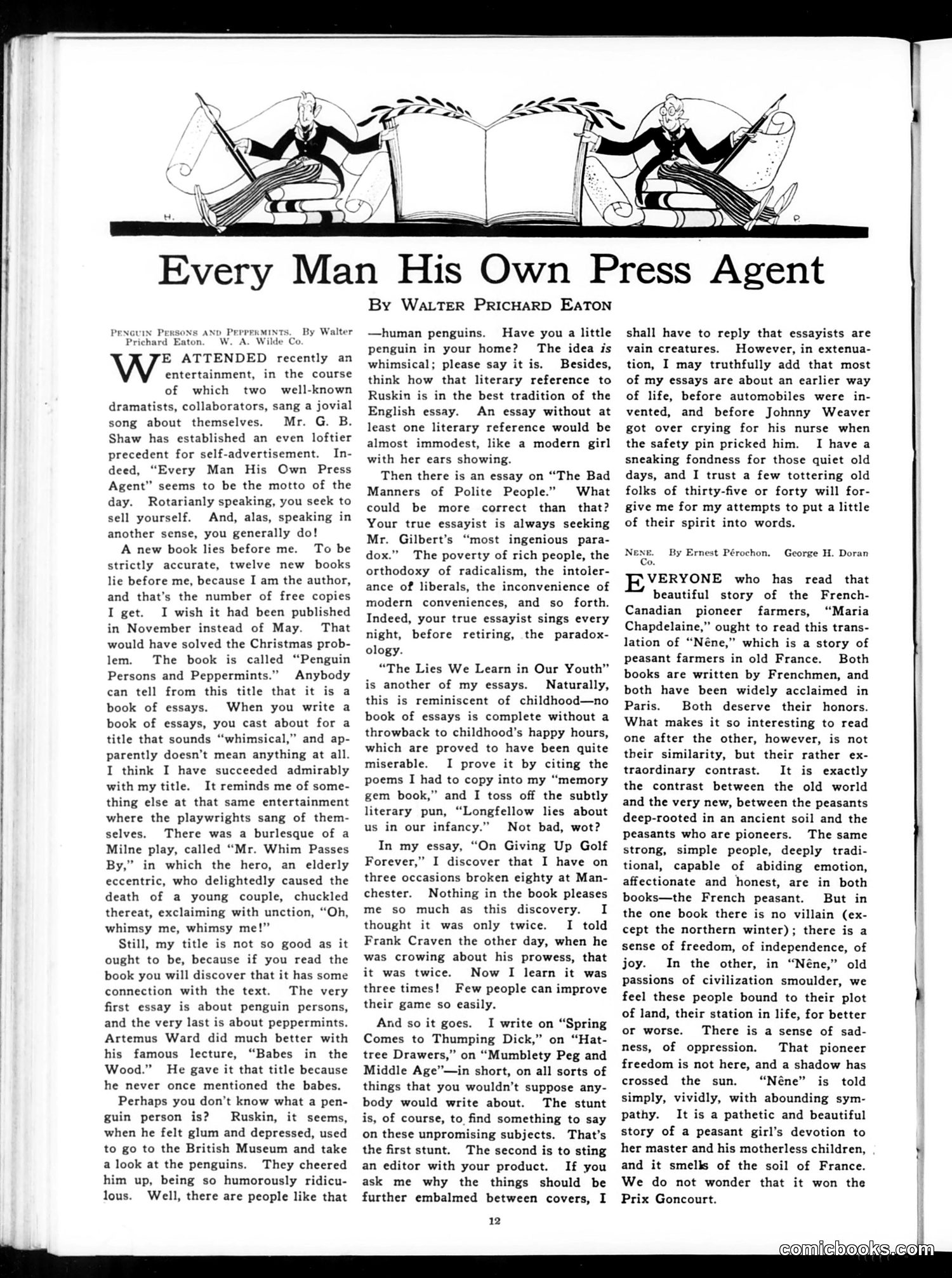
This page is primarily **satirical literary criticism** by Walter Prichard Eaton reviewing his own essay collection titled *Penguin Persons and Peppermints*. **The Satire:** Eaton mocks the pretentious conventions of essay-writing and self-promotion. He deliberately violates essay traditions he's simultaneously describing—using a deliberately nonsensical title ("Penguin Persons and Peppermints"), including literary references to Ruskin, adopting paradoxical positions, and inserting nostalgic childhood reminiscences. He's essentially demonstrating the artificiality and self-serving nature of the essay genre. **Key Targets:** - Self-promotional behavior (mentioning G.B. Shaw's self-advertisement) - Essay conventions: whimsical titles, obligatory literary allusions, paradox-seeking, childhood nostalgia - The pretentiousness of modern writers The cartoon header shows figures with open books, visualizing this "every man his own press agent" theme—suggesting that modern writers are their own publicists, undermining genuine criticism.
📄 Transcribed text from this page (OCR, searchable)
Machine-transcribed from the original scan — historical spelling and the odd misread are preserved.
PENGUIN PERSONS AND Perpermints. By Walter Prichard Eaton. W. A. Wilde Co. E ATTENDED recently an WY vecntcece in the course of which two well-known dramatists, collaborators, sang a jovial song about themselves. Mr. G. B. Shaw has established an even loftier precedent for self-advertisement. In- deed, “Every Man His Own Press Agent” seems to be the motto of the day. Rotarianly speaking, you seek to sell yourself. And, alas, speaking in another sense, you generally do! A new book lies before me. To be strictly accurate, twelve new books lie before me, because I am the author, and that’s the number of free copies I get. I wish it had been published in November instead of May. That would have solved the Christmas prob- lem. The book is called “Penguin Persons and Peppermints.” Anybody can tell from this title that it is a book of essays. When you write a book of essays, you cast about for a title that sounds “whimsical,” and ap- parently doesn’t mean anything at all. I think I have succeeded admirably with my title. It reminds me of some- thing else at that same entertainment where the playwrights sang of them- selves. There was a burlesque of a Milne play, called “Mr. Whim Passes By,” in which the hero, an elderly eccentric, who delightedly caused the death of a young couple, chuckled thereat, exclaiming with unction, “Oh, whimsy me, whimsy me!” Still, my title is not so good as it ought to be, because if you read the book you will discover that it has some connection with the text. The very first essay is about penguin persons, and the very last is about peppermints. Artemus Ward did much better with his famous lecture, “Babes in the Wood.” He gave it that title because he never once mentioned the babes. Perhaps you don’t know what a pen- guin person is? Ruskin, it seems, when he felt glum and depressed, used to go to the British Museum and take a look at the penguins. They cheered him up, being so humorously ridicu- lous. Well, there are people like that Every Man His Own By WALTER PRICHARD EaTON —human penguins. Have you a little penguin in your home? The idea is whimsical; please say it is. Besides, think how that literary reference to Ruskin is in the best tradition of the English essay. An essay without at least one literary reference would be almost immodest, like a modern girl with her ears showing. Then there is an essay on “The Bad Manners of Polite People.” What could be more correct than that? Your true essayist is always seeking Mr. Gilbert’s “most ingenious para- dox.” The poverty of rich people, the orthodoxy of radicalism, the intoler- ance of liberals, the inconvenience of modern conveniences, and so forth. Indeed, your true essayist sings every night, before retiring, the paradox- ology. “The Lies We Learn in Our Youth” is another of my essays. Naturally, this is reminiscent of childhood—no book of essays is complete without a throwback to childhood’s happy hours, which are proved to have been quite miserable. I prove it by citing the poems I had to copy into my “memory gem book,” and I toss off the subtly literary pun, “Longfellow lies about us in our infancy.” Not bad, wot? In my essay, “On Giving Up Golf Forever,” I discover that I have on three occasions broken eighty at Man- chester. Nothing in the book pleases me so much as this discovery. I thought it was only twice. I told Frank Craven the other day, when he was crowing about his prowess, that it was twice. Now I learn it was three times! Few people can improve their game so easily. And so it goes. I write on “Spring Comes to Thumping Dick,” on “Hat- tree Drawers,” on “Mumblety Peg and Middle Age”—in short, on all sorts of things that you wouldn’t suppose any- body would write about. The stunt is, of course, to find something to say on these unpromising subjects. That’s the first stunt. The second is to sting an editor with your product. If you ask me why the things should be further embalmed between covers, I 12 Press Agent shall have to reply that essayists are vain creatures. However, in extenua- tion, I may truthfully add that most of my essays are about an earlier way of life, before automobiles were in- vented, and before Johnny Weaver got over crying for his nurse when the safety pin pricked him. I have a sneaking fondness for those quiet old days, and I trust a few tottering old folks of thirty-five or forty will for- give me for my attempts to put a little of their spirit into words. By Ernest Pérochon. George H. Doran VERYONE who has read that beautiful story of the French- Canadian pioneer farmers, “Maria Chapdelaine,” ought to read this trans- lation of “Néne,” which is a story of peasant farmers in old France. Both books are written by Frenchmen, and both have been widely acclaimed in Paris. Both deserve their honors. What makes it so interesting to read one after the other, however, is not their similarity, but their rather ex- traordinary contrast. It is exactly the contrast between the old world and the very new, between the peasants deep-rooted in an ancient soil and the peasants who are pioneers. The same strong, simple people, deeply tradi- tional, capable of abiding emotion, affectionate and honest, are in both books—the French peasant. But in the one book there is no villain (ex- cept the northern winter); there is a sense of freedom, of independence, of joy. In the other, in “Néne,” old passions of civilization smoulder, we feel these people bound to their plot of land, their station in life, for better or worse. There is a sense of sad- ness, of oppression. That pioneer freedom is not here, and a shadow has crossed the sun. “Néne” is told simply, vividly, with abounding sym- pathy. It is a pathetic and beautiful story of a peasant girl’s devotion to her master and his motherless children, and it smells of the soil of France. We do not wonder that it won the Prix Goncourt. Comics