
A complete issue · 36 pages · 1922
Judge — June 3, 1922
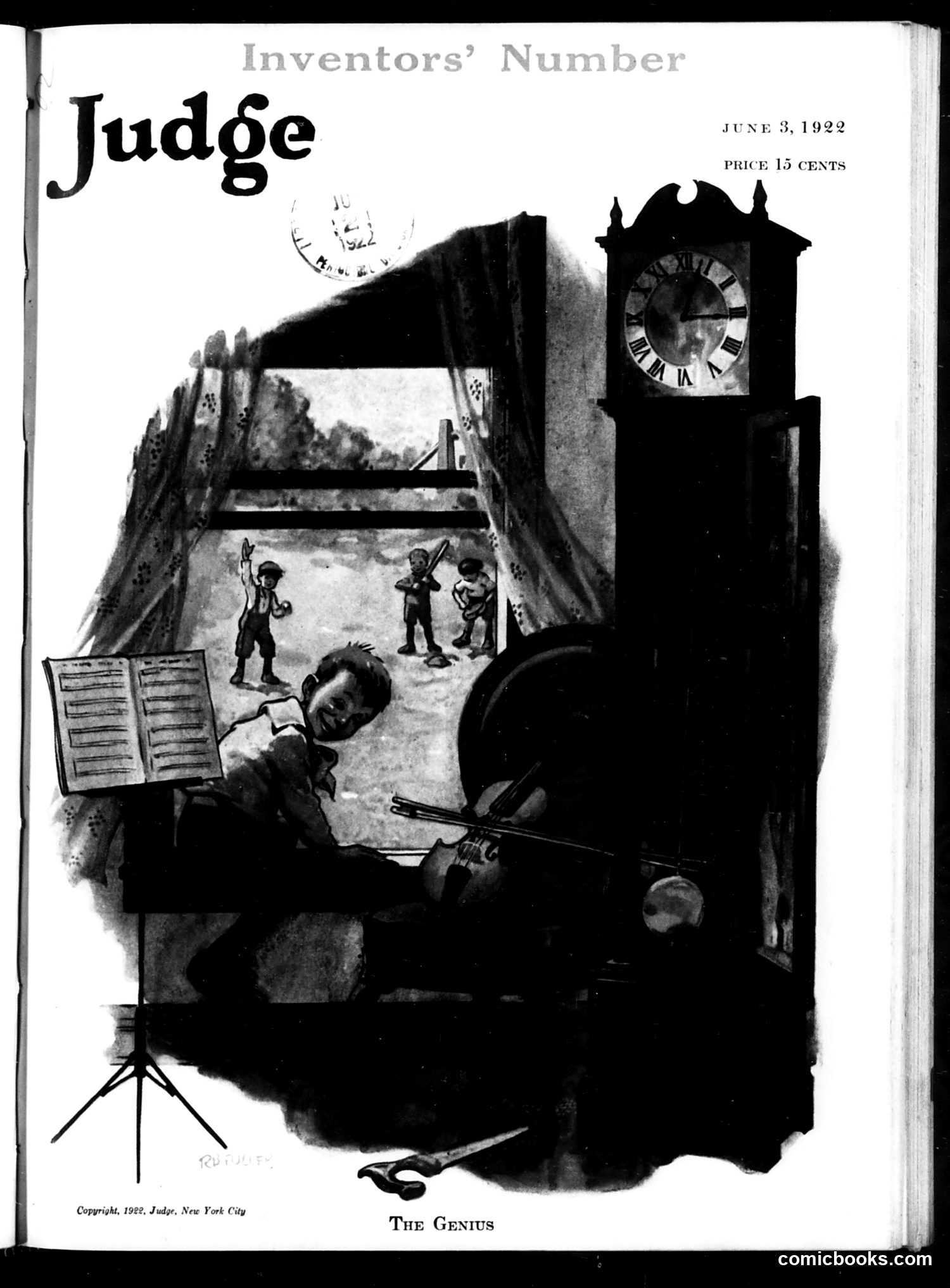
This cartoon satirizes a composer or musician conducting an orchestra. The silhouetted conductor stands before a grand clock and sheet music, directing what appears to be chaotic activity—small figures visible through a window seem to be engaging in disorderly behavior rather than making music. The joke likely plays on the gap between a conductor's pretensions to "genius" and actual results: despite his authoritative gestures and formal setting, the musicians (or organization) produce only chaos. The title "The Genius" is ironic mockery. Without additional context, the specific target remains unclear—it could reference a particular famous conductor, or broadly satirize pretentious artistic figures. The composition emphasizes the conductor's self-importance against evident incompetence.
This page is primarily **advertising copy**, not political satire. It promotes a book called *Caricature*—a 150-page illustrated collection of jokes, humorous stories, and drawings. The advertisement emphasizes the book's entertainment value for social gatherings and family occasions, promising "over 500 pictures" including eight full-color pages. It lists numerous contributors, including prominent cartoonists and writers of the era like Grant E. Hamilton and Walt Mason. The publisher, Brunswick Subscription Co. (627 West 43rd Street, New York City), is selling the book for 50 cents with postage prepaid. The diagonal text on the left appears to be a decorative design element rather than readable content. This represents Judge magazine's commercial sideline selling illustrated humor books to readers seeking entertainment and social amusement.
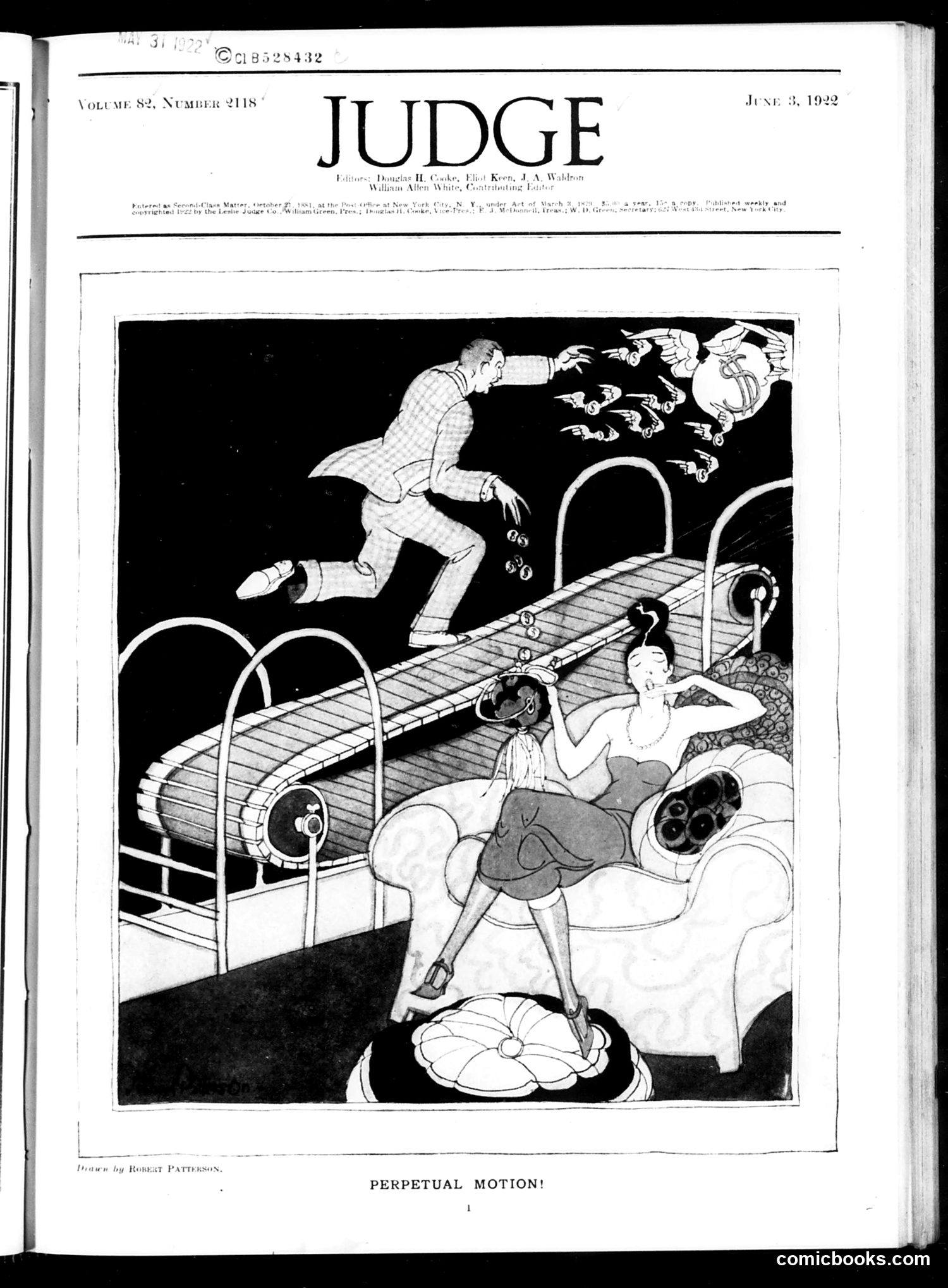
This illustration by Robert Patterson depicts a humorous domestic scene titled "Perpetual Motion." A man in a checkered suit leaps energetically over a bed where a woman reclines, while cherubs or cupids hover above. The scene appears to satirize married life and sexual vigor—playing on the period's fascination with perpetual motion machines (impossible devices that run forever without external energy). The joke likely mocks the contradiction between marital exhaustion and idealized romantic expectations, or perhaps pokes fun at husbands' attempts to maintain youthful energy and desire within marriage. The cartoon reflects 1920s attitudes toward marriage, leisure, and domesticity for a middle-class audience.
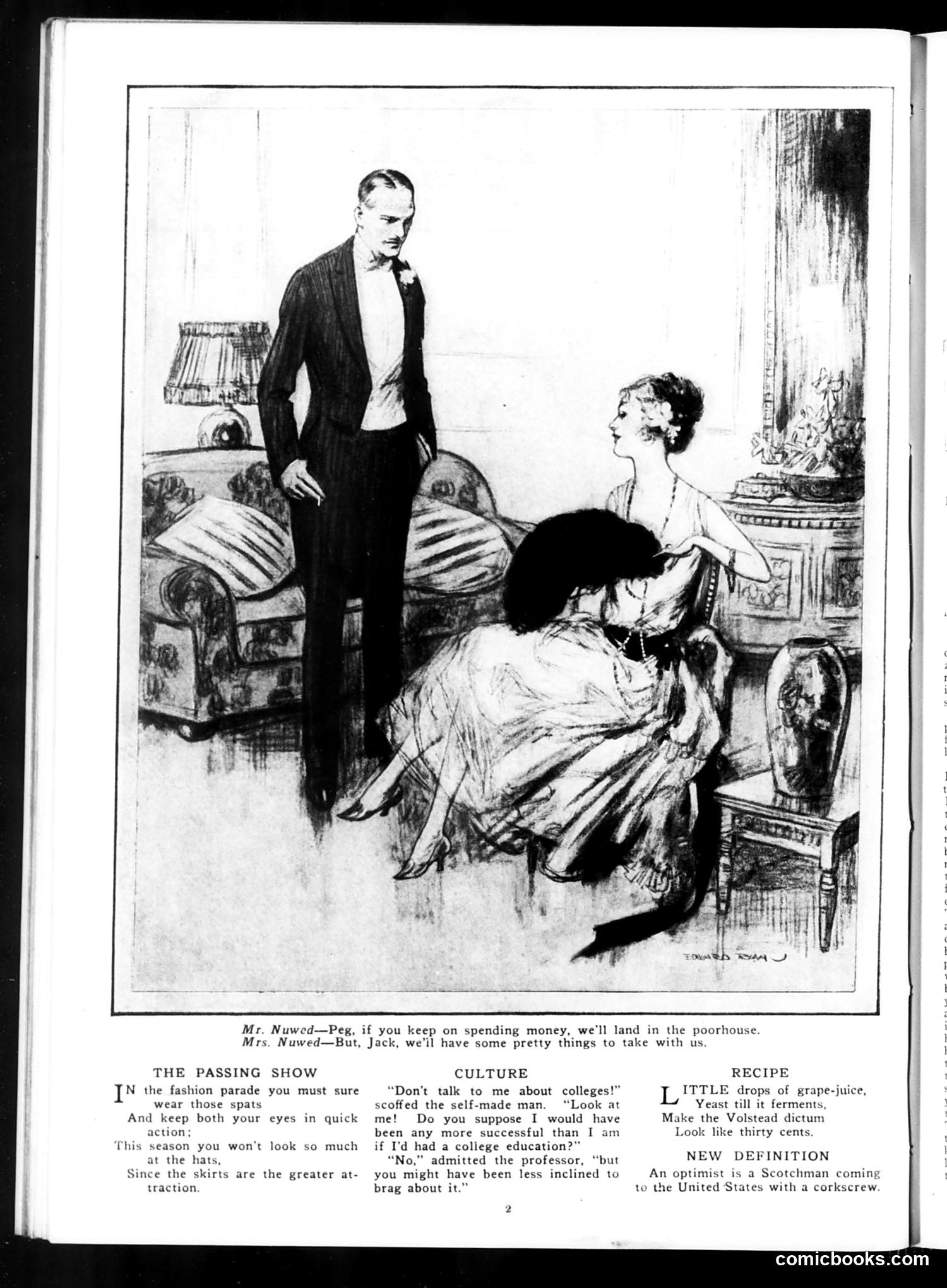
This page contains a satirical cartoon about marital finances and class anxiety. The scene depicts "Mr. Nuwed" (a newly married man) standing while his wife sits, discussing household spending. She warns that if he continues spending money, they'll "land in the poorhouse," while he counters they'll have "pretty things to take with us." The satire mocks the tension between maintaining genteel appearances and actual financial responsibility—a common concern among middle-class Americans of this era. The accompanying text snippets on fashion, education, and recipes suggest this appeared in a lifestyle-focused section. The cartoon reflects early 20th-century anxieties about consumerism, marriage, and economic instability, satirizing how couples navigated status maintenance despite financial constraints.
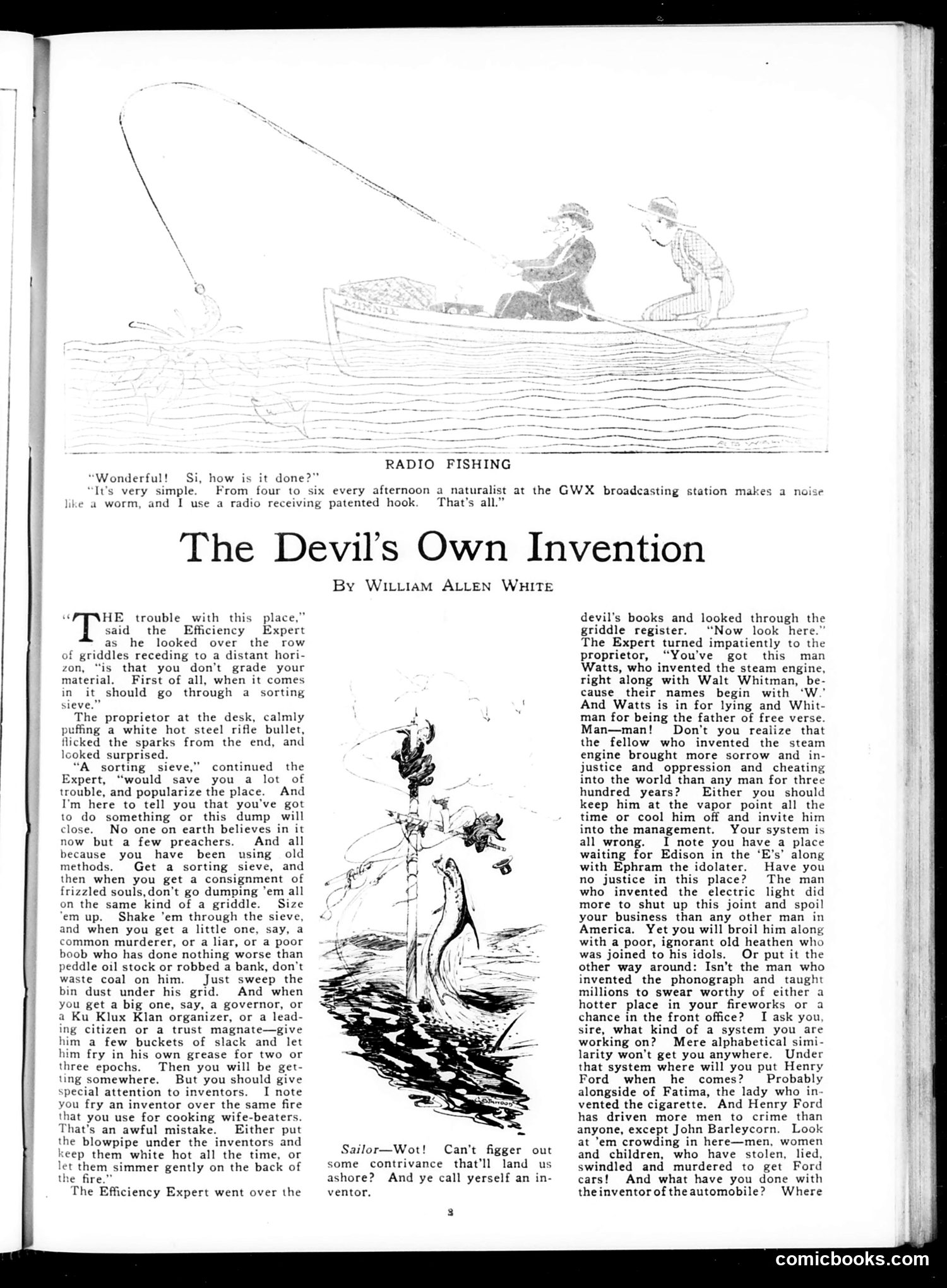
This page contains two distinct items: **Top**: A joke titled "Radio Fishing" about catching fish using radio broadcasts—a humorous take on early 1920s radio technology as a novelty. **Main Story**: "The Devil's Own Invention" by William Allen White is a satirical critique of business inefficiency. An "Efficiency Expert" visits a struggling business and proposes harsh measures: grinding workers down, installing dictatorial systems, and dismissing humanitarian concerns. The expert mockingly compares the proprietor to a KKK organizer and references famous inventors (Edison, Fatima cigarettes, Ford) to highlight how modern "efficient" systems create suffering rather than progress. The implicit satire: aggressive efficiency experts of the era, while claiming to modernize business, actually introduced inhumane labor practices and worker oppression—hence calling such "invention" the "devil's own."
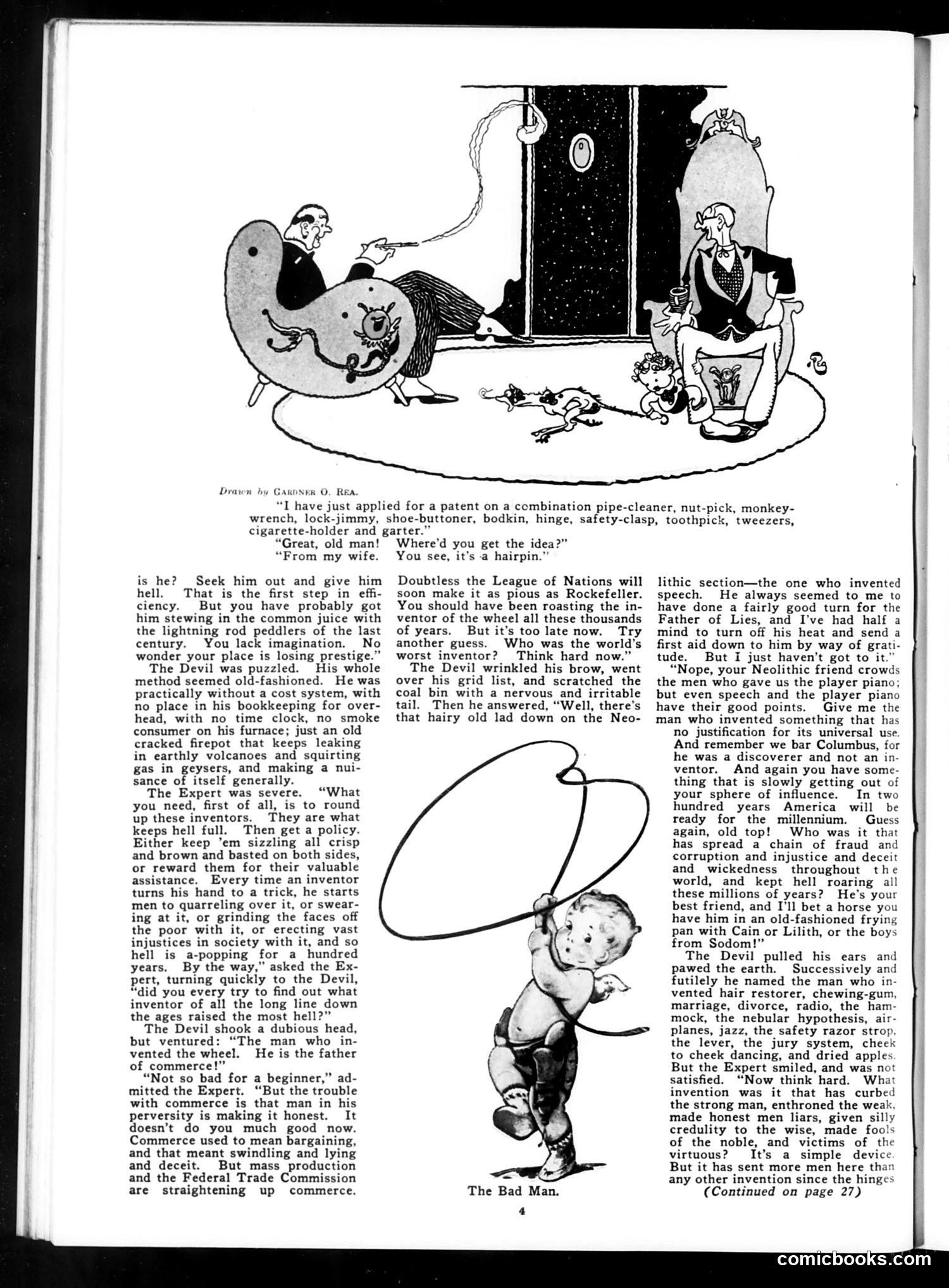
This page satirizes the culture of invention and patent-seeking in early 20th-century America. The top cartoon shows a man pitching an absurdly over-complicated "combination" tool to a skeptical listener—combining pipe-cleaner, nut-pick, monkey wrench, lock-jimmy, shoe-buttoner, bodkin, hinge, safety-clasp, toothpick, tweezers, cigarette-holder, and garter into one device. The accompanying text mocks inventors as self-delusional: they're praised as heroes while actually creating useless gadgets. The satire targets both the inventor's inflated self-importance and society's uncritical celebration of innovation. The Devil figure ("The Bad Man") represents how such inventions—despite pretensions of progress—actually serve deception and fraud, spreading "corruption and injustice" rather than genuine improvement. The piece critiques American commercialism's glorification of invention regardless of actual utility.
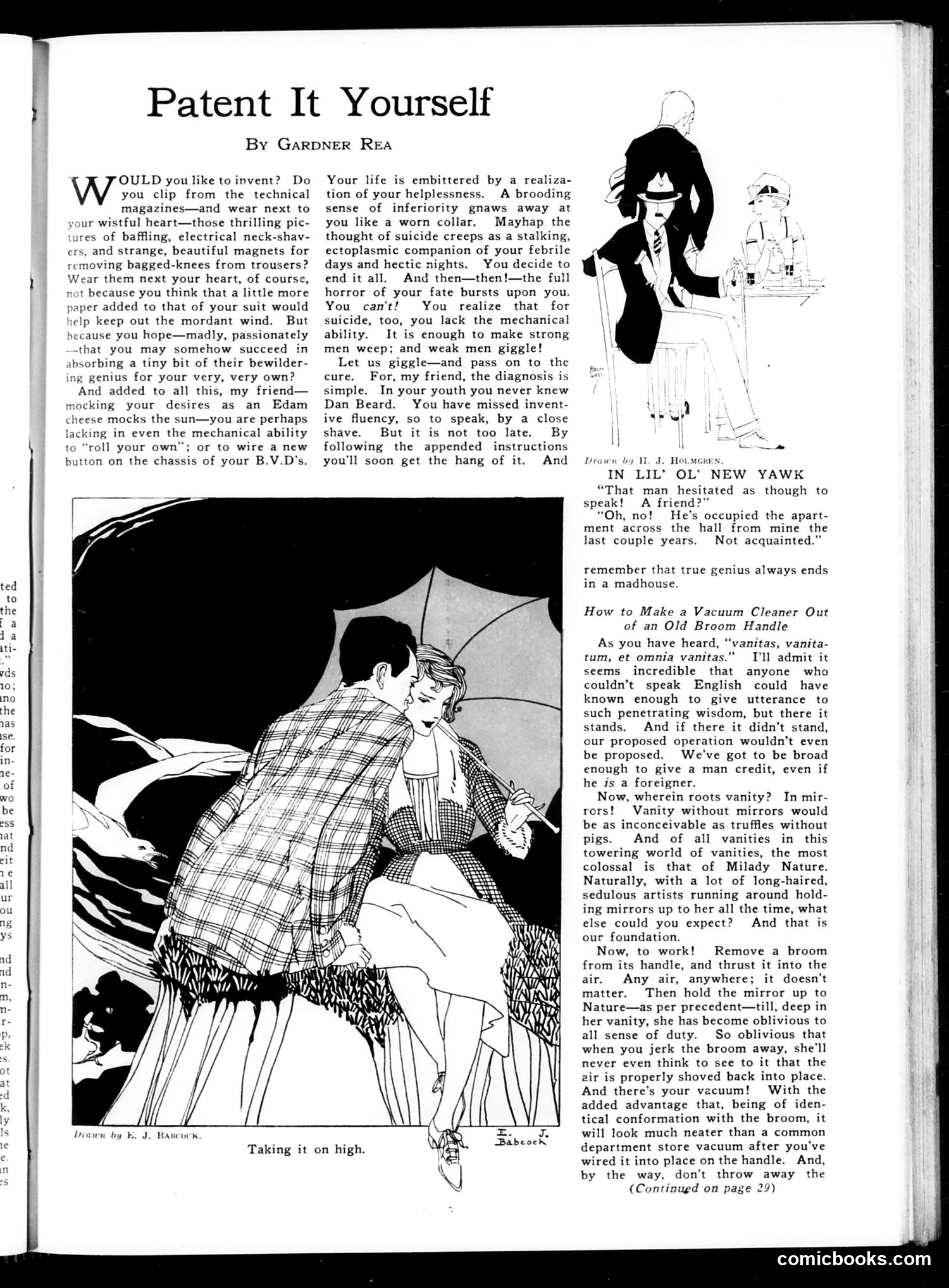
This is a humorous advice column satirizing American middle-class anxieties and incompetence. The author mocks readers who fantasize about inventing gadgets (electrical shavers, magnetic devices) while lacking any actual mechanical ability—even struggling to wire a button or roll their own cigarettes. The satire deepens darkly: the author suggests this mechanical helplessness breeds such inferiority that men contemplate suicide, only to realize they lack the competence for *that* either. The column then pivots to absurdist "DIY" instructions (making a vacuum from a broom handle) that mock the era's growing consumer culture and self-help mentality. The accompanying cartoons illustrate incompetent inventors and urban social alienation (the "New York" vignette about apartment-dwelling strangers). Overall, Judge uses exaggerated mockery to critique American consumer desires, masculine insecurity, and the gap between aspirations and actual abilities in early 20th-century middle-class life.
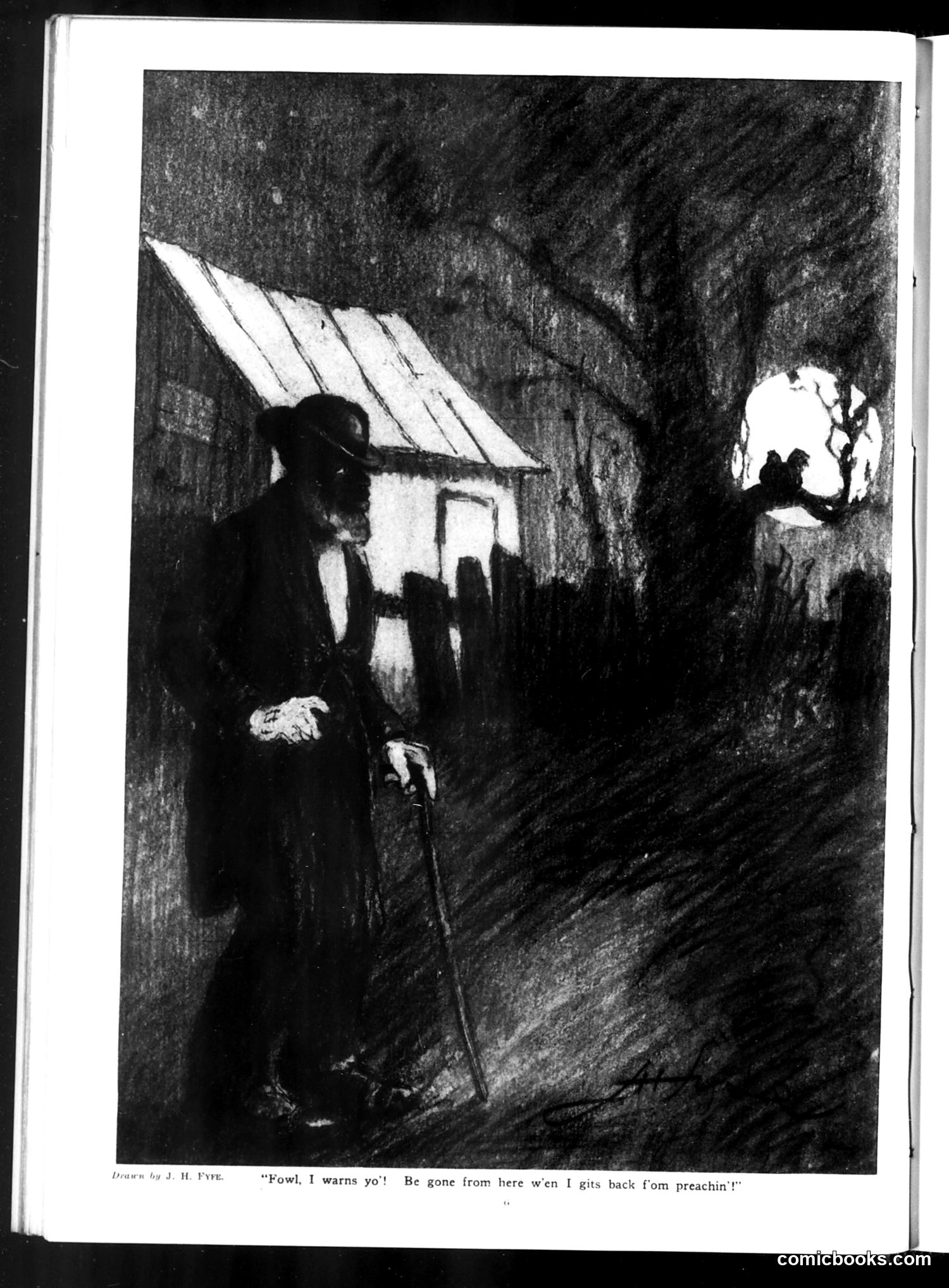
This illustration by J. H. Fyfe depicts a nighttime scene with a figure in dark clothing confronting what appears to be a rooster or fowl near a small house. The speaker uses exaggerated dialect ("I warns yo," "w'en I gits back f'om preachin'"), which appears designed to represent a rural or working-class African American character. The joke likely plays on the stereotype of theft—specifically the racist trope that Black people steal chickens. The character warns the fowl away before returning from church, implying he'll take it if it remains. The satire seems to mock both the character and racial prejudices of the era, though the execution relies on demeaning dialect and stereotypes typical of late 19th/early 20th-century American satirical publications.
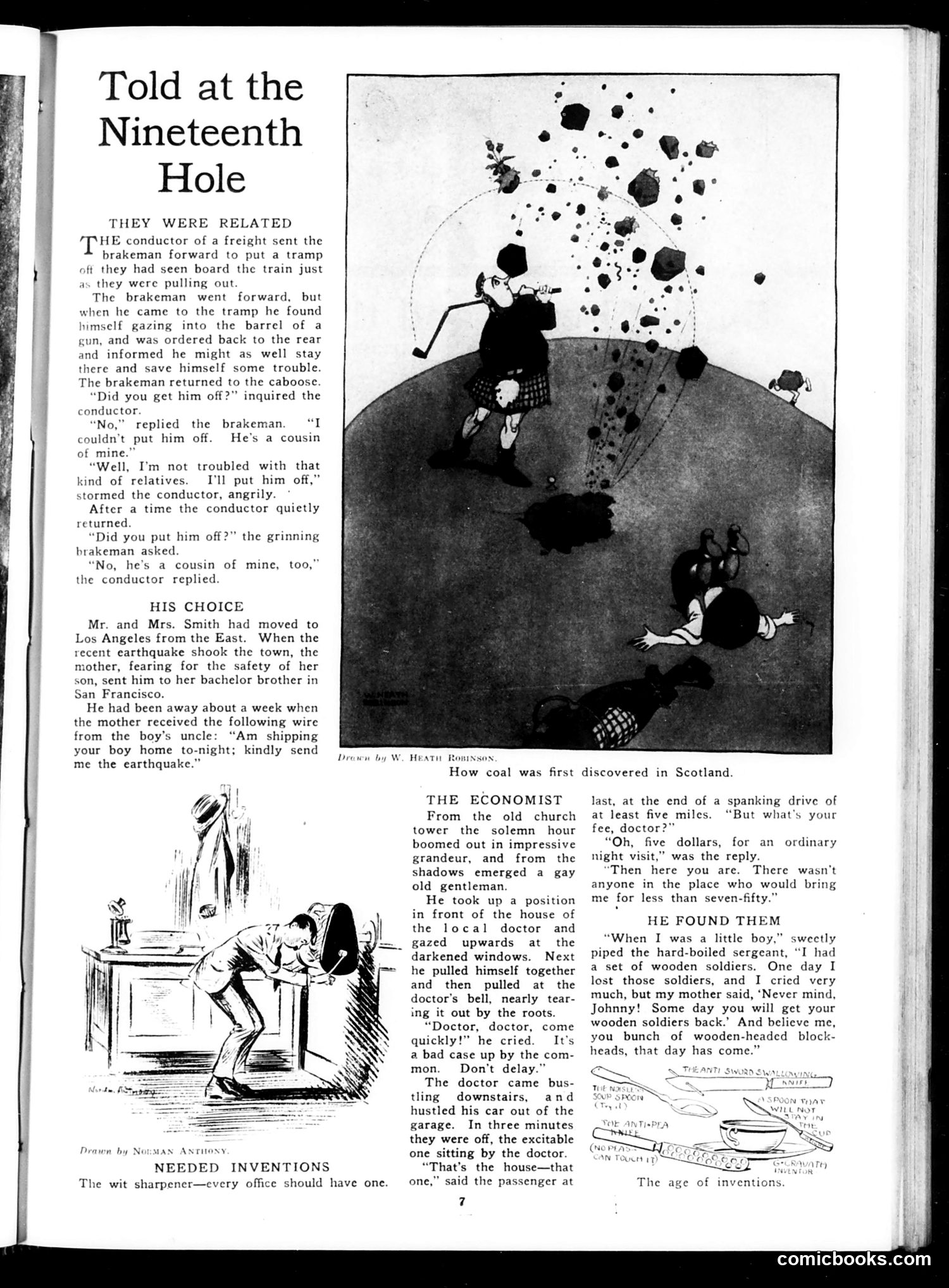
This page contains three humorous short stories typical of early 20th-century American humor magazines: **"Told at the Nineteenth Hole"** (golf-themed jokes): Two anecdotes about relatives—one where a conductor and brakeman each discover an armed tramp is their relative and neither can remove him; another where a mother, fearing California's 1906 earthquake, sends her son to San Francisco (then also earthquake-prone), and the uncle wires back asking her to send *him* the earthquake instead. **"His Choice"**: A doctor scams an anxious elderly man by charging five dollars for a false emergency call, revealing he collected "wooden soldiers" (soldiers/young men) from desperate situations at inflated rates. **"The Economist"**: A sergeant motivates his troops by claiming he's finally recovered the wooden soldiers he lost as a boy—implying his recruits are wooden-headed blockheads. The cartoons satirize middle-class foibles: family obligations, urban dangers, medical fraud, and military discipline. The humor relies on puns, irony, and stereotypes typical of the era.
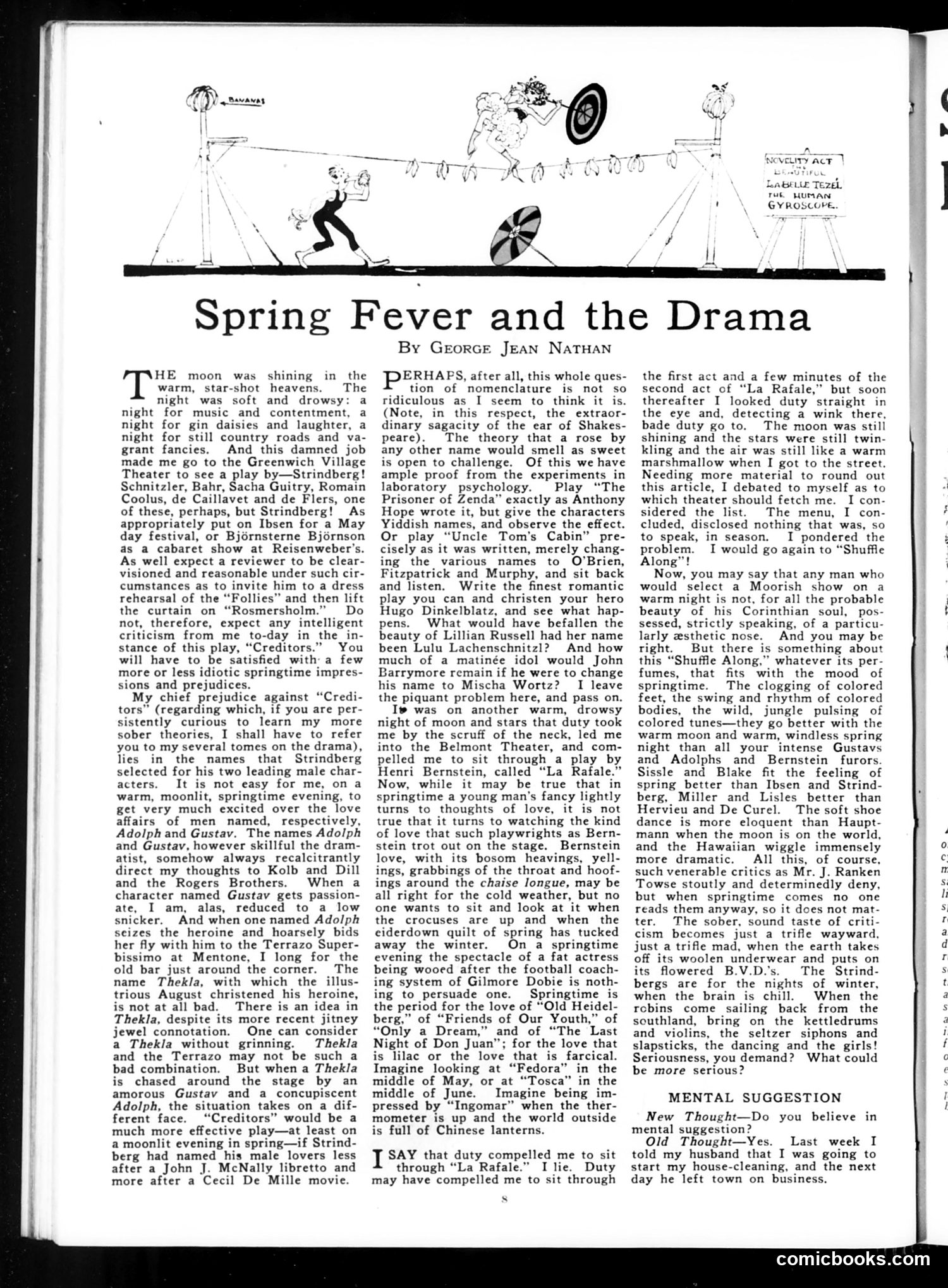
This is a satirical essay by theater critic George Jean Nathan, not a political cartoon. The illustration above depicts a circus/vaudeville scene but doesn't directly illustrate the article. Nathan humorously attacks playwright August Strindberg's play "Creditors," arguing that unsuitable character names—specifically "Adolph" and "Gustav"—undermine dramatic effectiveness on a romantic spring evening. He finds these names evoke cheap vaudeville (the Rogers Brothers, John J. McNally libretti) rather than serious theater. Nathan argues nomenclature matters genuinely—citing laboratory psychology—and supports this by imagining how famous works would suffer with different names: "Uncle Tom's Cabin" with Irish names, or star Lillian Russell renamed "Lulu Lachenschnitzl." The satire targets both Strindberg's theatrical choices and broader American theater conventions. It's essentially a sophisticated complaint: serious European drama loses emotional impact when filtered through unsuitable naming conventions that trigger unintended comic associations for American audiences.
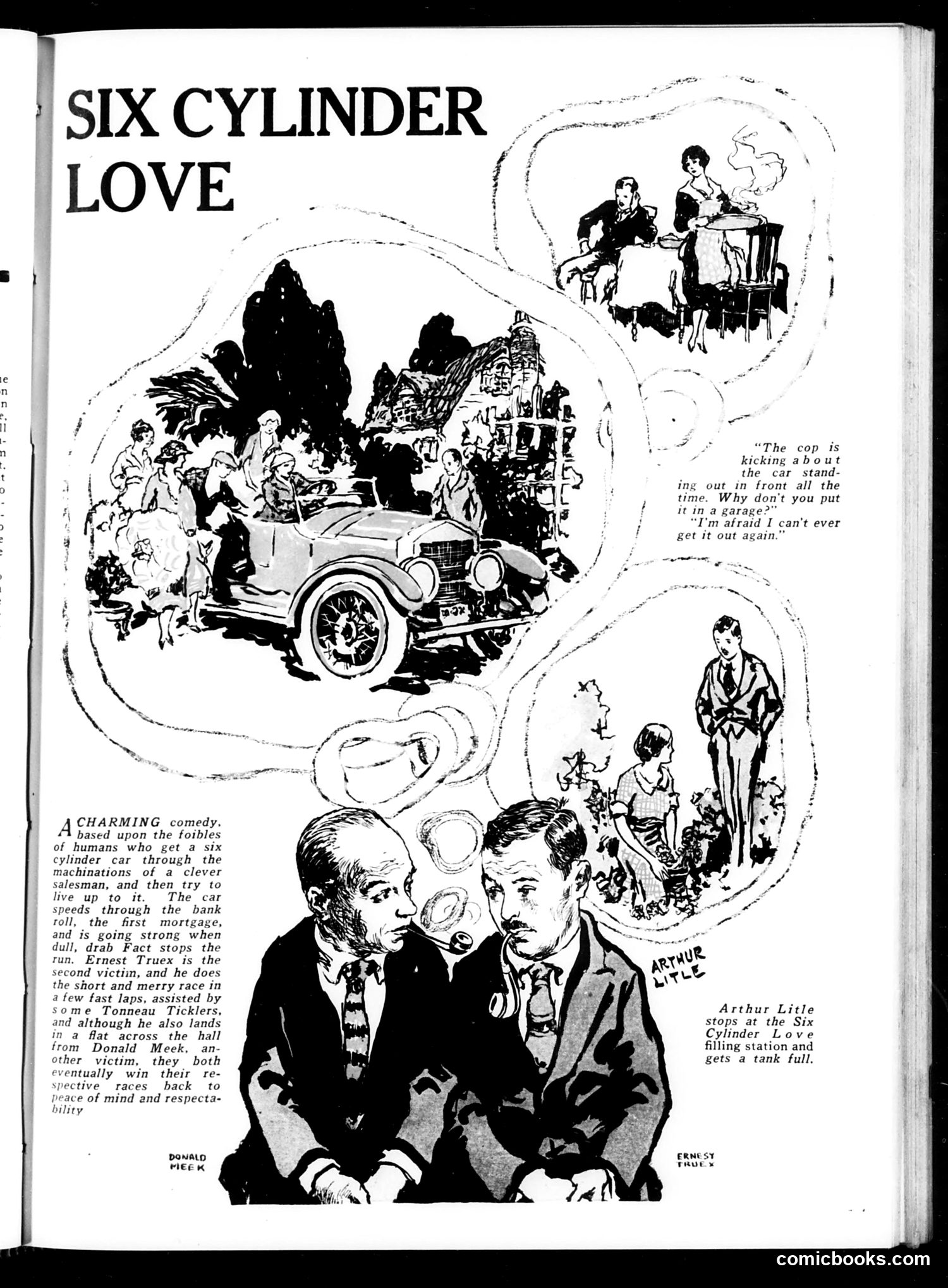
This page advertises a silent film comedy about the social problems created by automobile ownership during the early automotive era (likely 1920s). The satire targets the gap between aspiration and financial reality: ordinary people purchase fancy six-cylinder cars they cannot afford, and the vehicles consume their finances ("speeds through the bank roll, the first mortgage"). The humor derives from the characters' predicament: one owner jokes he cannot remove his car from the street because he fears never getting it out of a garage again—implying he'll lose it to repossession. Actors Ernest Truex and Donald Meek play victims caught in this financial trap, eventually finding redemption ("peace of mind and respectability"). The film mocks consumerism and keeping-up-with-the-Joneses mentality through the specific symbol of the automobile—then a luxury item representing modern aspiration and status anxiety.
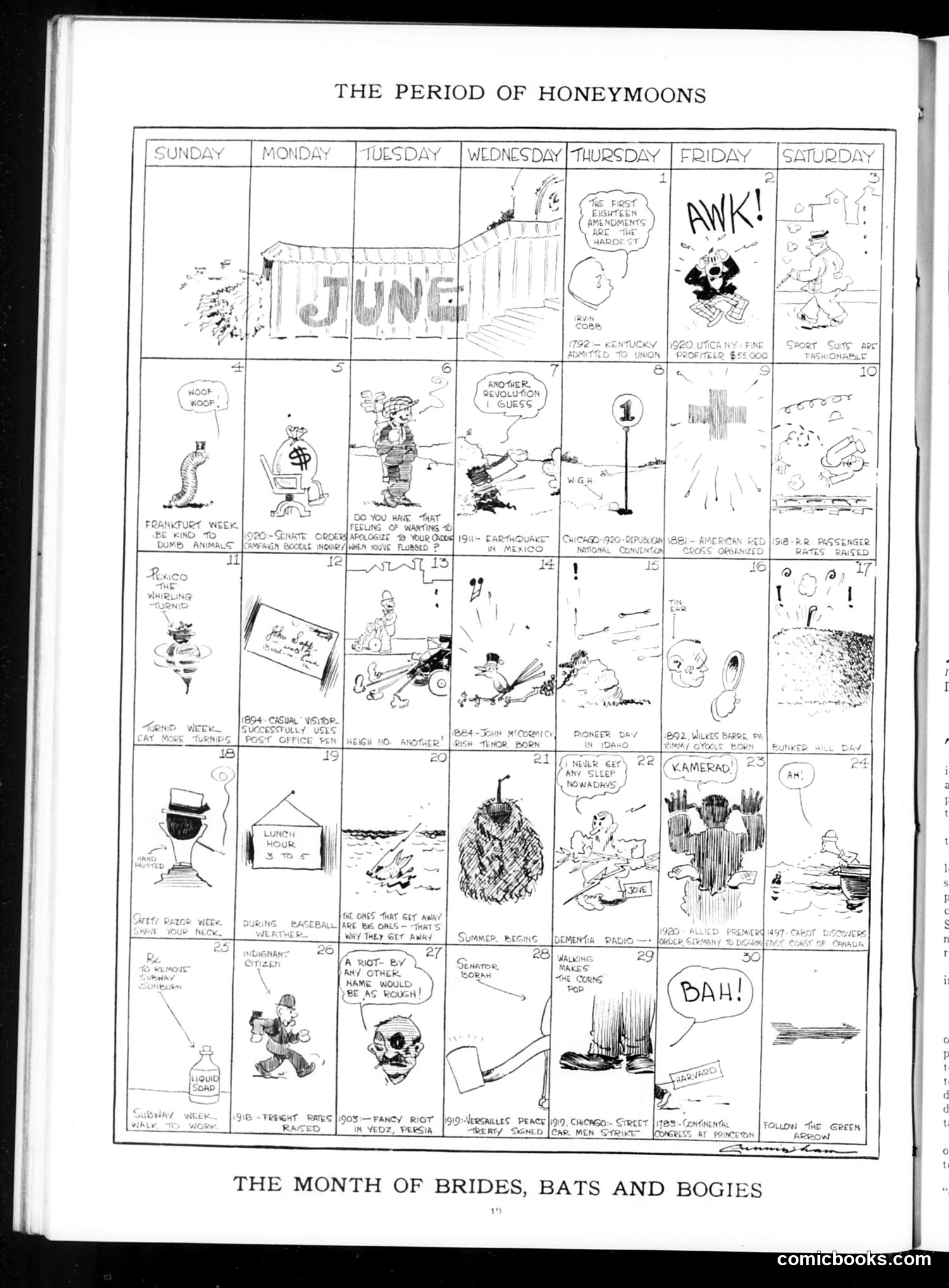
This is a weekly comic strip calendar spanning seven days, with two rows of panels per day. The humor relies on visual gags and wordplay rather than political content. The "honeymoon" title appears to reference the romantic vacation period following marriage. Individual panels depict various domestic and social mishaps—financial troubles (visible "$" signs), sporting activities, weather events, and marital chaos. The bottom section subtitle mentions "brides, bats and bogies," suggesting golf references (a "bogey" in golf) mixed with romantic complications. The strip uses slapstick situations and exaggerated character reactions typical of early-to-mid 20th century American comic humor, focusing on everyday domestic comedy rather than satire of specific political figures or events.
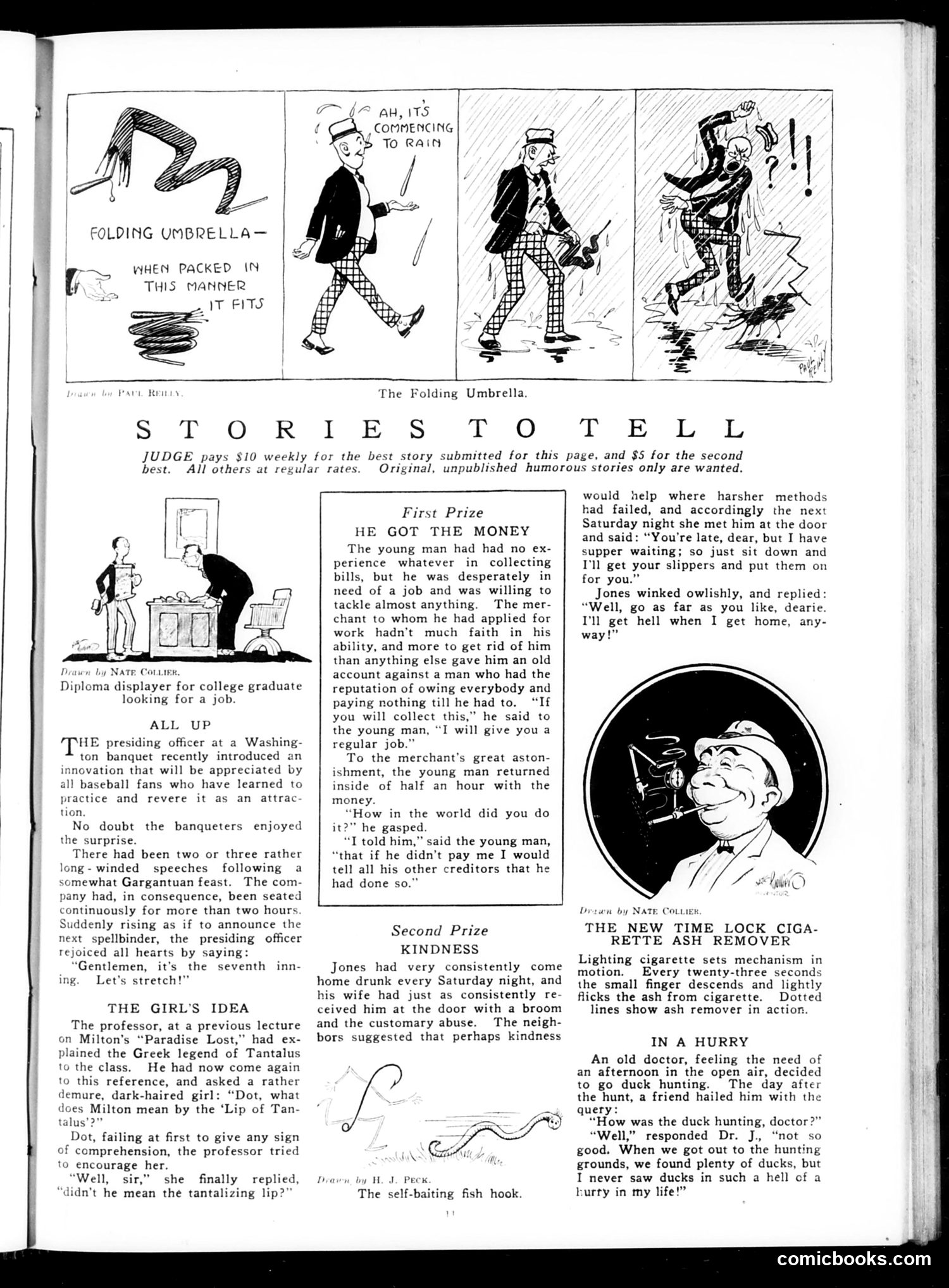
**The Folding Umbrella (top):** A practical joke cartoon showing how to pack an umbrella by folding it accordion-style. The humor escalates as the man attempts to use it in rain—the umbrella's compact folds spring open chaotically, comically defeating its purpose. **"Stories to Tell" Section:** This page solicits humorous anecdotes from readers ($10 for best, $5 for second-best). The three published stories exemplify early 20th-century workplace and domestic humor: 1. **"He Got the Money"**: A young bill-collector uses bluff psychology—threatening to tell creditors the debtor already paid—to collect from someone notorious for avoiding payment. 2. **"Kindness"**: A drunk husband's wife tries kindness instead of scolding; he cynically notes she'll still be criticized later anyway. 3. **"In a Hurry"**: A doctor complains that ducks during hunting moved too quickly—simple wordplay about the birds' speed. The page also includes minor comic items about banquet etiquette ("seventh inning stretch"), a girl misinterpreting Milton's "lip of Tantalus," and advertisements for novelty items (cigarette ash remover, fish hook). The overall tone reflects turn-of-century American middle-class humor.
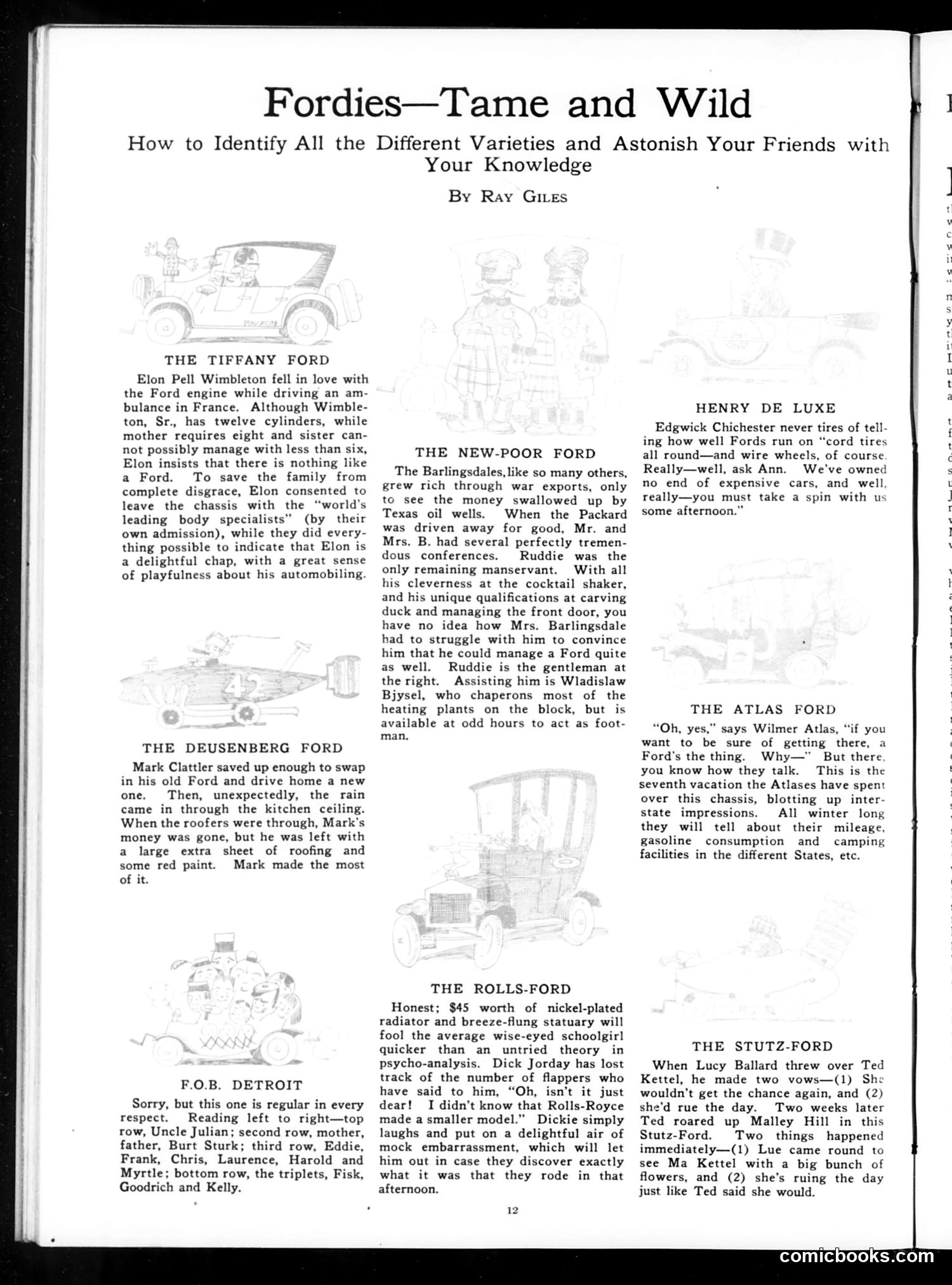
This humor piece mocks wealthy Americans' pretensions by cataloging fake "varieties" of Ford automobiles, each representing different social circumstances. The satire targets the stark class divisions of 1920s America. The joke: the Ford Model T was the mass-produced, affordable "everyman's car," yet wealthy people tried to make theirs appear luxurious or exclusive. "The Tiffany Ford" shows a rich family customizing their chassis with expensive bodywork to disguise its modest origins. "The New-Poor Ford" depicts formerly wealthy people (the Barlingsdales) humiliated by economic decline, forced to drive a Ford after losing their Packard to oil speculation—their servant struggling to accept this indignity. "The Rolls-Ford" reveals social climbing: attaching fancy radiators and statuary to fool people into thinking it's an expensive Rolls-Royce. The satire critiques both the wealthy's social anxiety and their transparent attempts at maintaining appearances during economic upheaval.
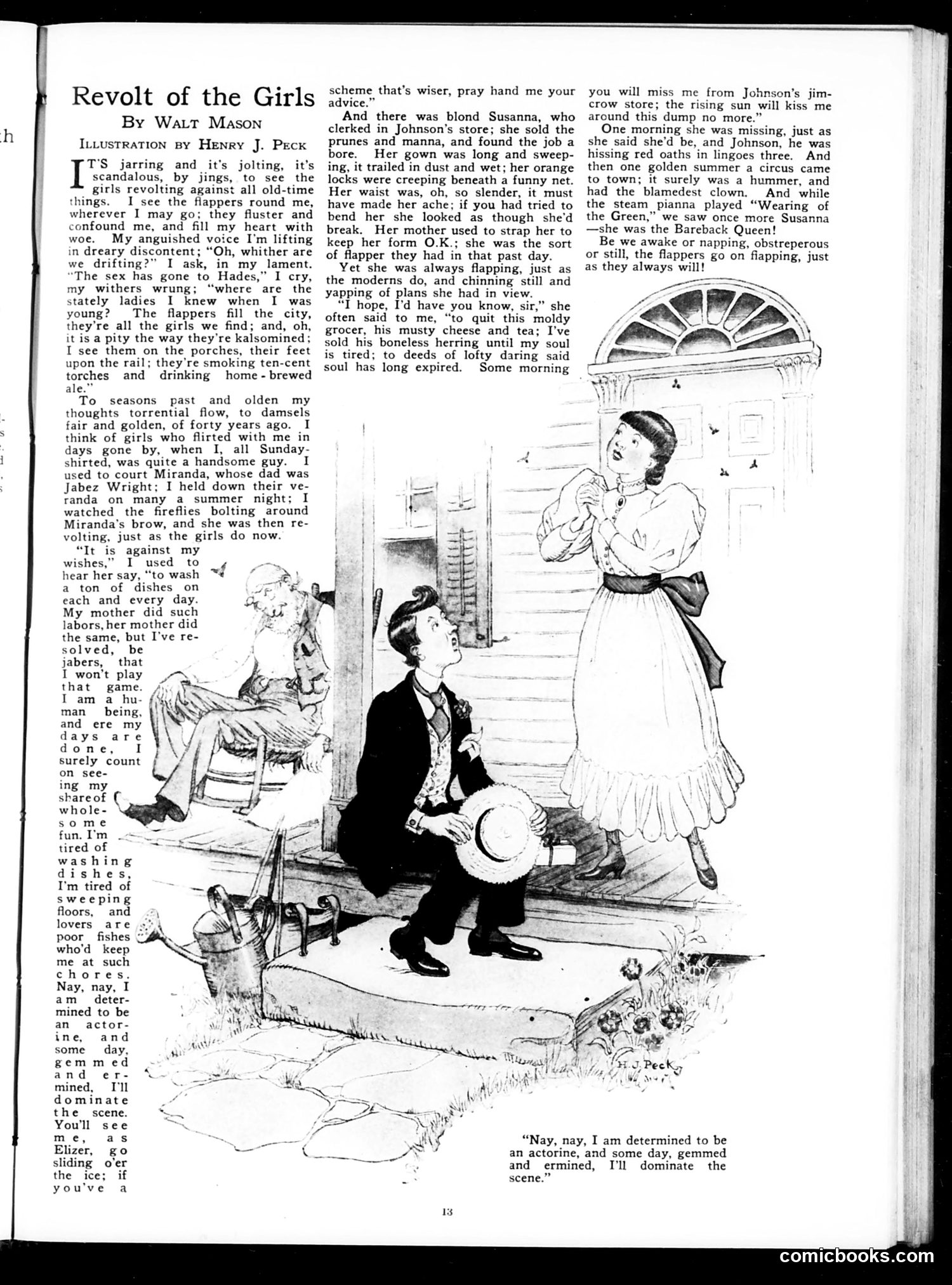
This is a nostalgic complaint poem illustrated by Henry J. Peck about young women's changing social roles. The unnamed narrator, an older man, laments the "flappers" (1920s-era young women rejecting traditional constraints) as a departure from proper femininity. The cartoon depicts two scenes: a young woman gesturing dramatically while a man in a straw hat looks on, likely representing a flapper's theatrical ambitions. The text includes two anecdotes—Miranda and Susanna—both of whom rejected domestic drudgery (dish-washing, store clerking) to pursue entertainment careers, despite the narrator's disapproval. The satire targets old-fashioned masculine anxiety about female independence. The women's aspirations to be "actorine[s]" and their refusal of unpaid domestic labor are framed as scandalous rebellion, yet the poem inadvertently reveals that such desires existed generations earlier too. The ending—Susanna succeeds as a circus performer—suggests the revolt will continue regardless of male disapproval.
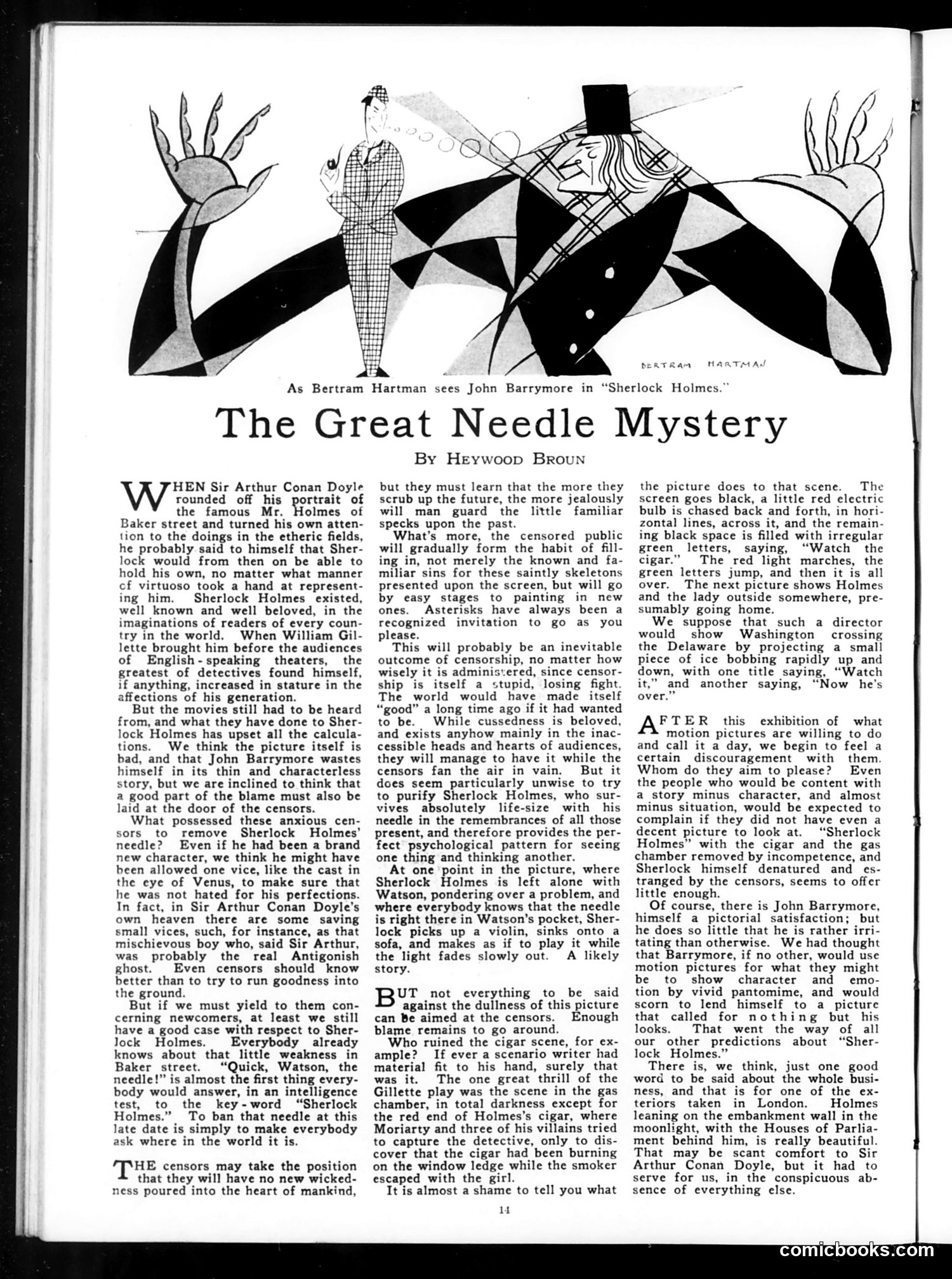
This article critiques film censors for removing Sherlock Holmes' cocaine use from John Barrymore's movie adaptation of the detective stories. The illustration shows caricaturist Bertram Hartman's exaggerated vision of Barrymore as Holmes. The satire argues that censorship backfires: by scrubbing known character details from beloved literary figures, censors actually draw MORE attention to what's been removed. The article claims audiences will inevitably "fill in" the banned elements themselves—making the censorship counterproductive. The "needle" references Holmes's famous drug habit, well-established in Arthur Conan Doyle's original stories and public memory. The author (Heywood Broun) contends that removing this defining trait from an iconic character is both futile and foolish, since everyone already knows about it. The piece uses this specific case to argue against excessive film censorship more broadly.
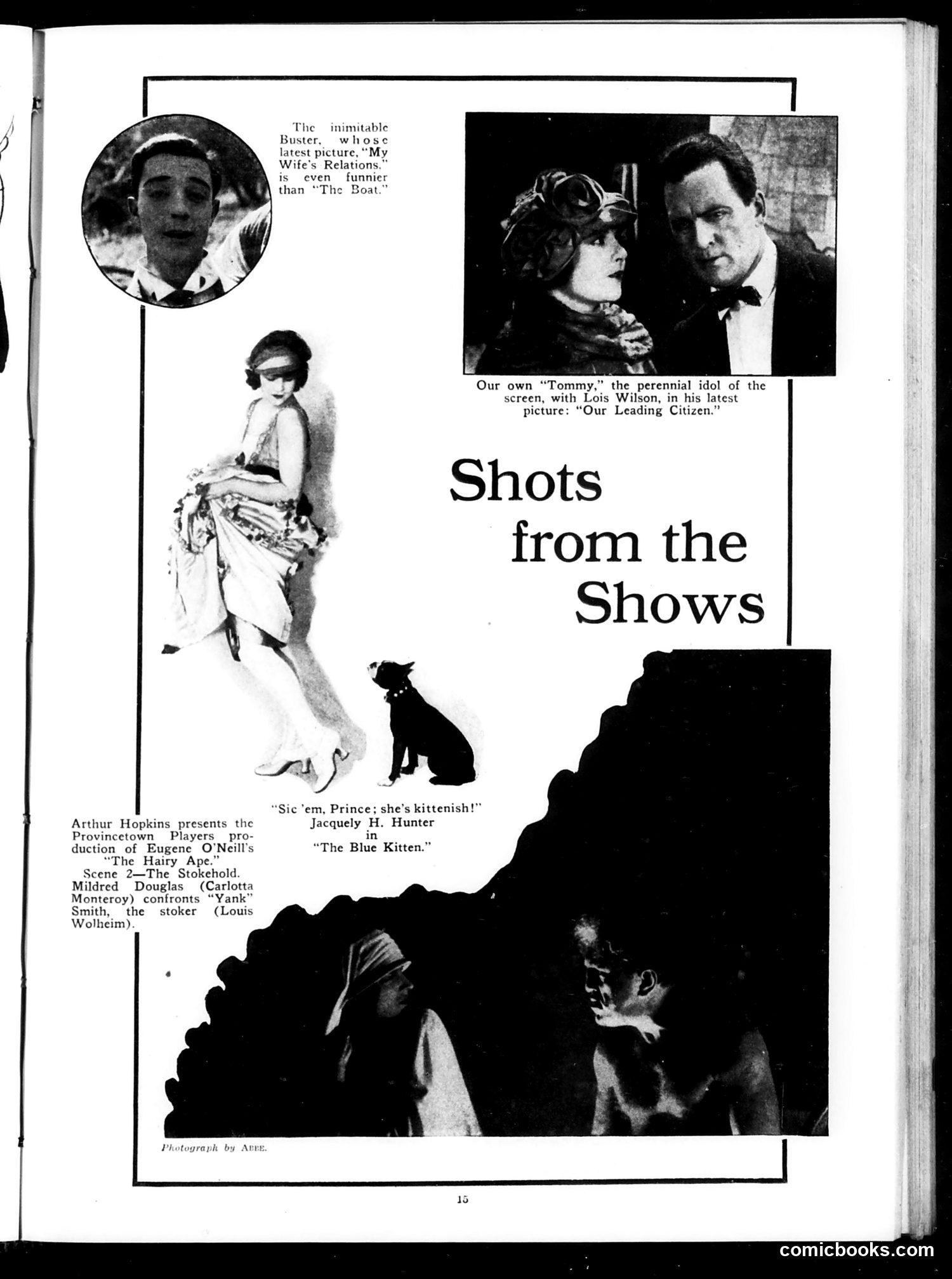
This is an entertainment coverage page featuring film and theater reviews from the early 1920s. It showcases contemporary movies and stage productions: **Films mentioned:** - Buster Keaton's "My Wife's Relations" and "The Boat" (silent comedies) - "Tommy" (likely referring to a popular actor) in "Our Leading Citizen" with actress Lois Wilson **Theater:** - Arthur Hopkins' production of Eugene O'Neill's "The Hairy Ape" at the Provincetown Players, featuring actors Carlotta Monterey and Louis Wolheim in a scene from the stokehold **"The Blue Kitten"** play, featuring Jacquely H. Hunter The page is straightforward entertainment journalism—essentially a celebrity gossip/preview section. The circular Buster Keaton photo and other images serve as visual promotion for these shows, typical of how Judge magazine mixed satire with popular culture coverage.
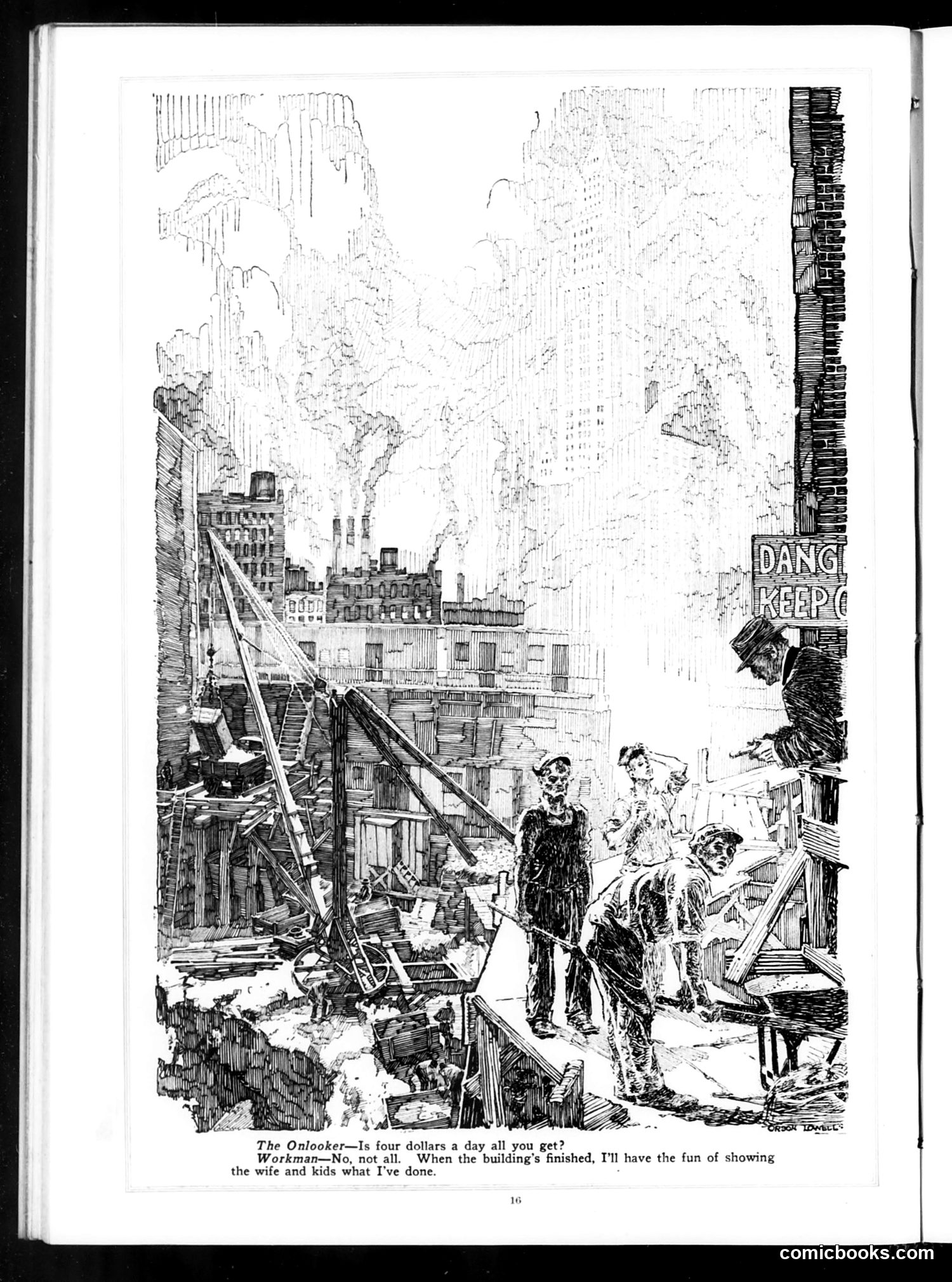
This single-panel cartoon satirizes working-class pride and delayed gratification. An onlooker questions a construction worker about his meager four-dollar daily wage—already modest compensation. The worker's response reveals the satire's target: he claims his *real* reward comes later, when he can show his family the completed building. The joke critiques how workers accept low pay by romanticizing their labor's end product. Rather than demanding fair wages now, the worker finds satisfaction in future pride of accomplishment. This reflects early 20th-century attitudes about manual labor, where personal dignity and family recognition supposedly compensated for economic exploitation. The detailed urban construction scene emphasizes the scale of the work versus the worker's meager compensation, sharpening the satirical contrast between labor invested and reward received.
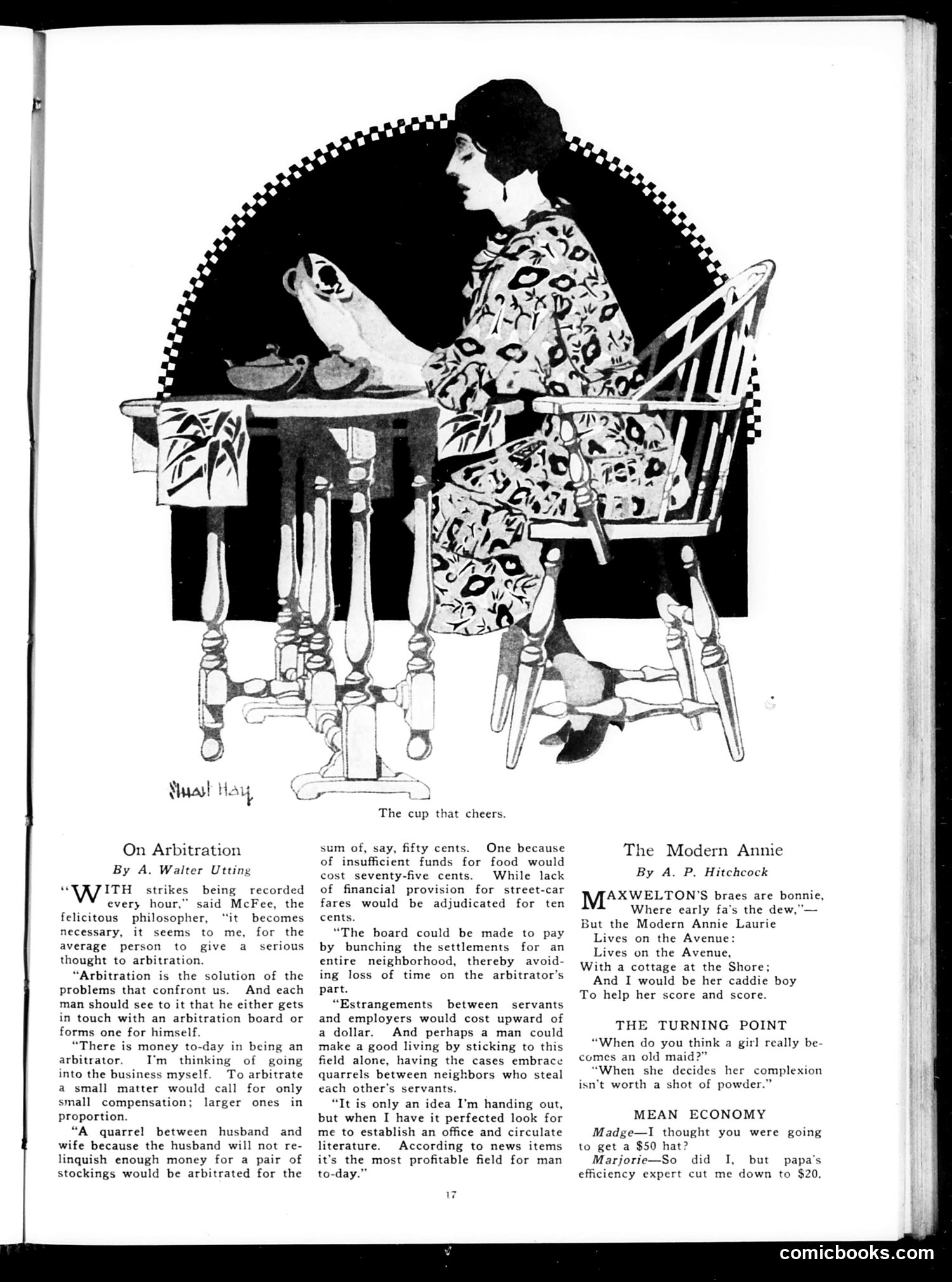
The top illustration, "The Cup That Cheers," shows a woman seated at a small table with teacups, accompanied by commentary on arbitration. The satire mocks a character named McFee, a "felicitous philosopher" proposing to make money as a professional arbitrator for trivial domestic disputes—charging fifty cents to resolve husband-wife quarrels over stockings, seventy-five cents for food disputes, ten cents for streetcar fare disagreements. The joke targets the era's arbitration movement (popular in early 20th-century labor disputes) by absurdly applying it to petty personal matters. McFee envisions a profitable business by bundling neighborhood disputes, even arbitrating servant-stealing quarrels between neighbors. The satire ridicules both the commercialization of arbitration and the triviality of the complaints being discussed. The smaller text items are brief humor pieces on unrelated topics: courtship, aging, and wartime economy (a woman's hat purchase reduced by her father's "efficiency expert").
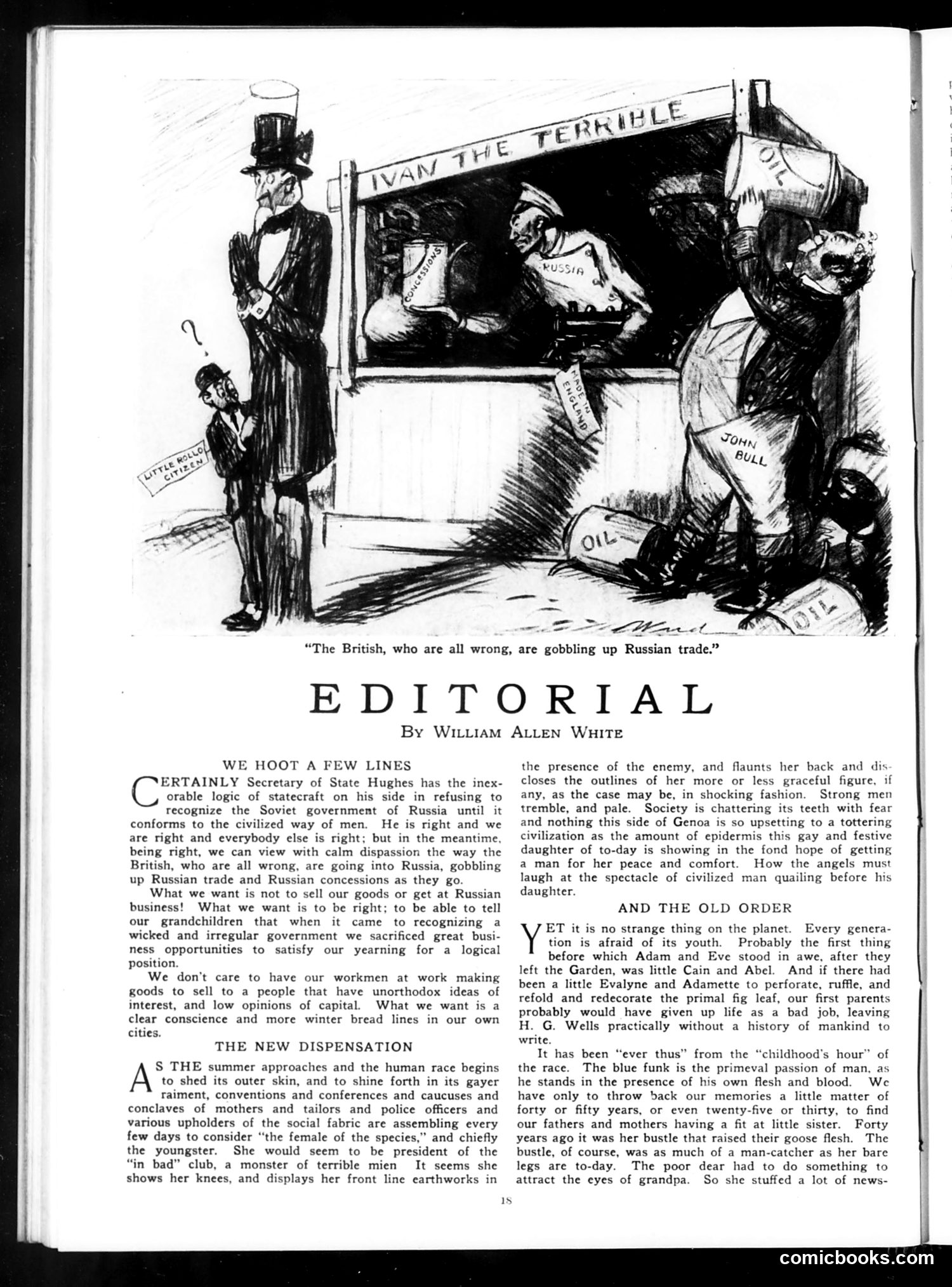
The cartoon depicts **"Ivan the Terrible"** as a storefront where Britain is eagerly trading with Soviet Russia, while a small figure labeled **"Little Belgium"** stands rejected outside. The caption mocks American moral superiority. **The satire:** William Allen White criticizes U.S. Secretary of State Hughes's refusal to recognize the Soviet government on principle—claiming America takes the "right" position while Britain pragmatically gobbles up Russian trade. White argues this self-righteousness is hollow: America prioritizes moral correctness over economic opportunity and workers' jobs, preferring "winter bread lines" to compromising its conscience by trading with ideologically "wicked" communists. The second piece satirizes societal panic over young women's fashion—particularly hemlines and exposed legs. White uses historical parallel (bustles of previous generations caused equal alarm) to mock contemporary moral outrage as cyclical generational anxiety. Both editorials employ sarcasm to critique rigid positions that ignore practical consequences.
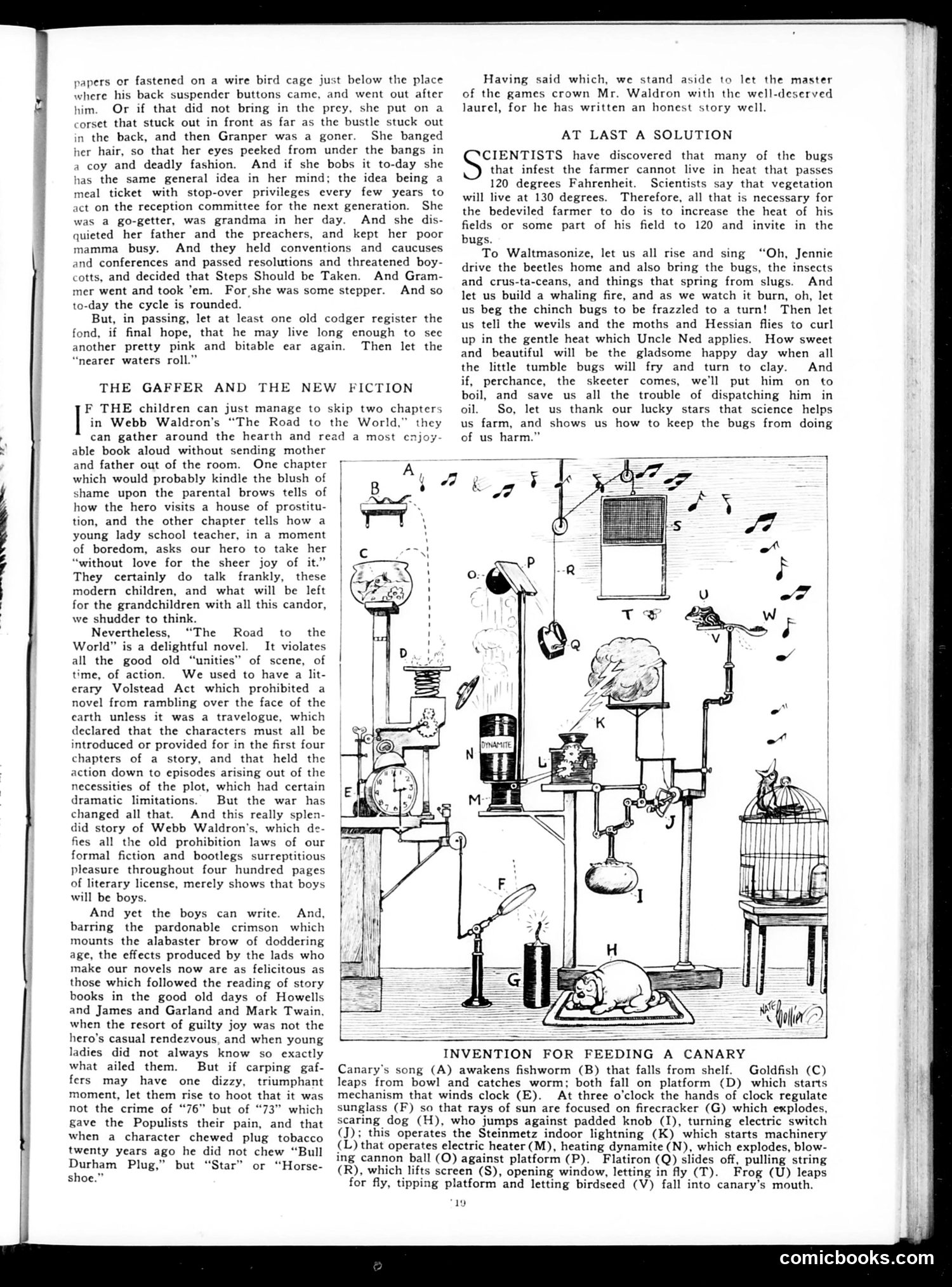
This page contains two distinct pieces of satirical commentary: **"The Gaffer and the New Fiction"** critiques modern literature's moral frankness. The author notes that Webb Waldron's novel "The Road to the World" contains scenes of prostitution and extramarital relations that would shock previous generations. The satire compares pre-war fiction's strict rules (the "literary Volstead Act"—a Prohibition reference) to current "bootleg" literary license. The writer simultaneously praises the novel's quality while lamenting that modern writers can discuss such candid topics, joking "boys will be boys." This reflects 1920s anxiety about post-WWI cultural shifts and loosening moral standards in literature. **"At Last a Solution"** satirizes pseudo-scientific farming advice, likely referencing a real proposal to heat farmland to kill pests while preserving crops. The deadpan suggestion—that farmers simply raise their field temperature to 120 degrees—mocks impractical or absurd agricultural "innovations" being marketed to farmers. **The illustration** at bottom shows a Rube Goldberg-style "Invention for Feeding a Canary," typical Judge fare: elaborate mechanical absurdity.
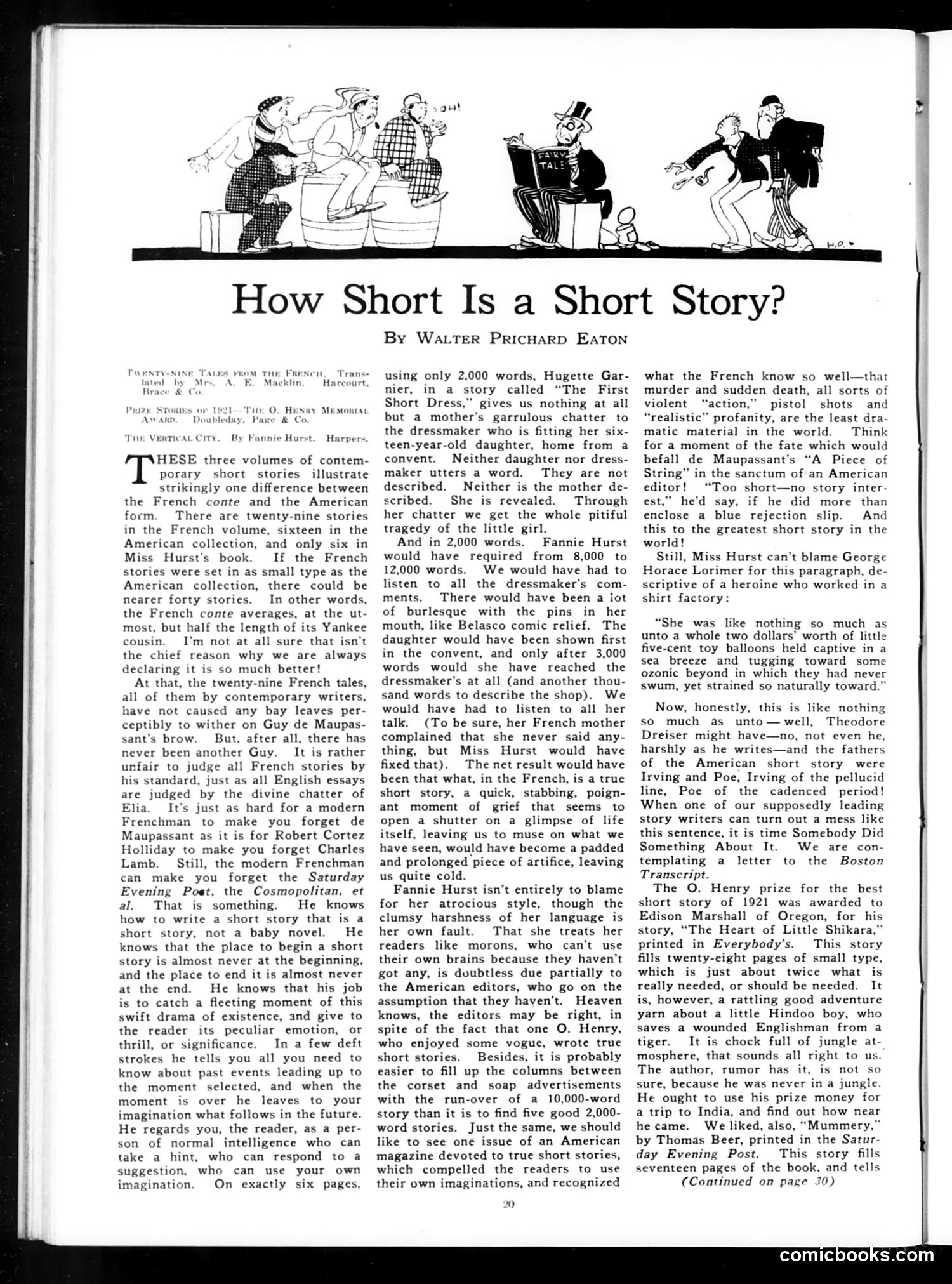
This is a **literary criticism article**, not political satire. Walter Prichard Eaton reviews three contemporary short story collections, comparing French and American writing styles. The illustrated header shows cartoon figures in various poses—likely representing different narrative approaches or writing styles, though specific identities aren't clear from the image alone. **The main point**: Eaton argues French short stories excel because they're genuinely *short*—averaging half the length of American versions—and employ restraint. French writers like those in this collection understand that effective short fiction requires: - Beginning near the end, not the beginning - Suggesting rather than describing everything - Trusting readers' intelligence He criticizes American writers (particularly **Fannie Hurst**) for padding stories with unnecessary detail, comic relief, and excessive exposition that transforms short stories into "baby novels." The satirical dig: American magazines accept bloated stories partly because editors need filler between advertisements.
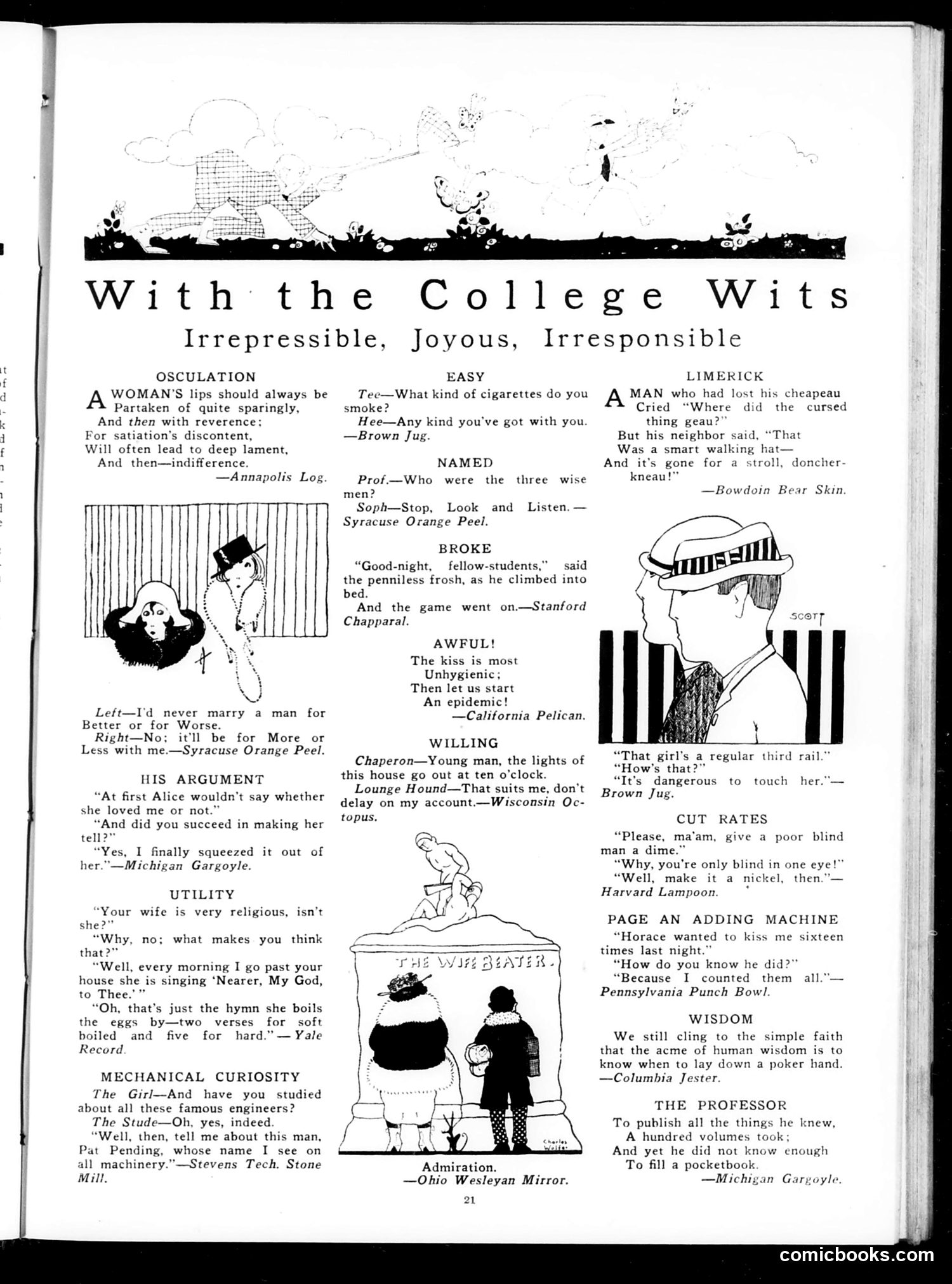
This page collects humorous quips and cartoons from college humor magazines, organized around dating, romance, and student life. The content reflects early 20th-century college culture and attitudes. **Key themes:** **Romance/Kissing**: Multiple jokes treat kissing as both desirable and problematic—one warns against oversaturation in romance, another humorously proposes starting a "kissing epidemic" for hygiene reasons. **Gender dynamics**: A woman refuses to marry "for better or worse" but rather "for more or less," reflecting anxieties about marriage's financial implications. **Student stereotypes**: References to "froshs" (freshmen) broke and penniless, fraternity life ("lounge hounds"), and professors publishing prolifically without practical knowledge. **Wordplay**: Jokes rely on puns ("pat pending" for machinery patents) and mishearing (three wise men = "Stop, Look, and Listen"). The cartoons feature simple line drawings—a couple in an embrace, a woman with an admirer—illustrating the jokes' romantic themes.
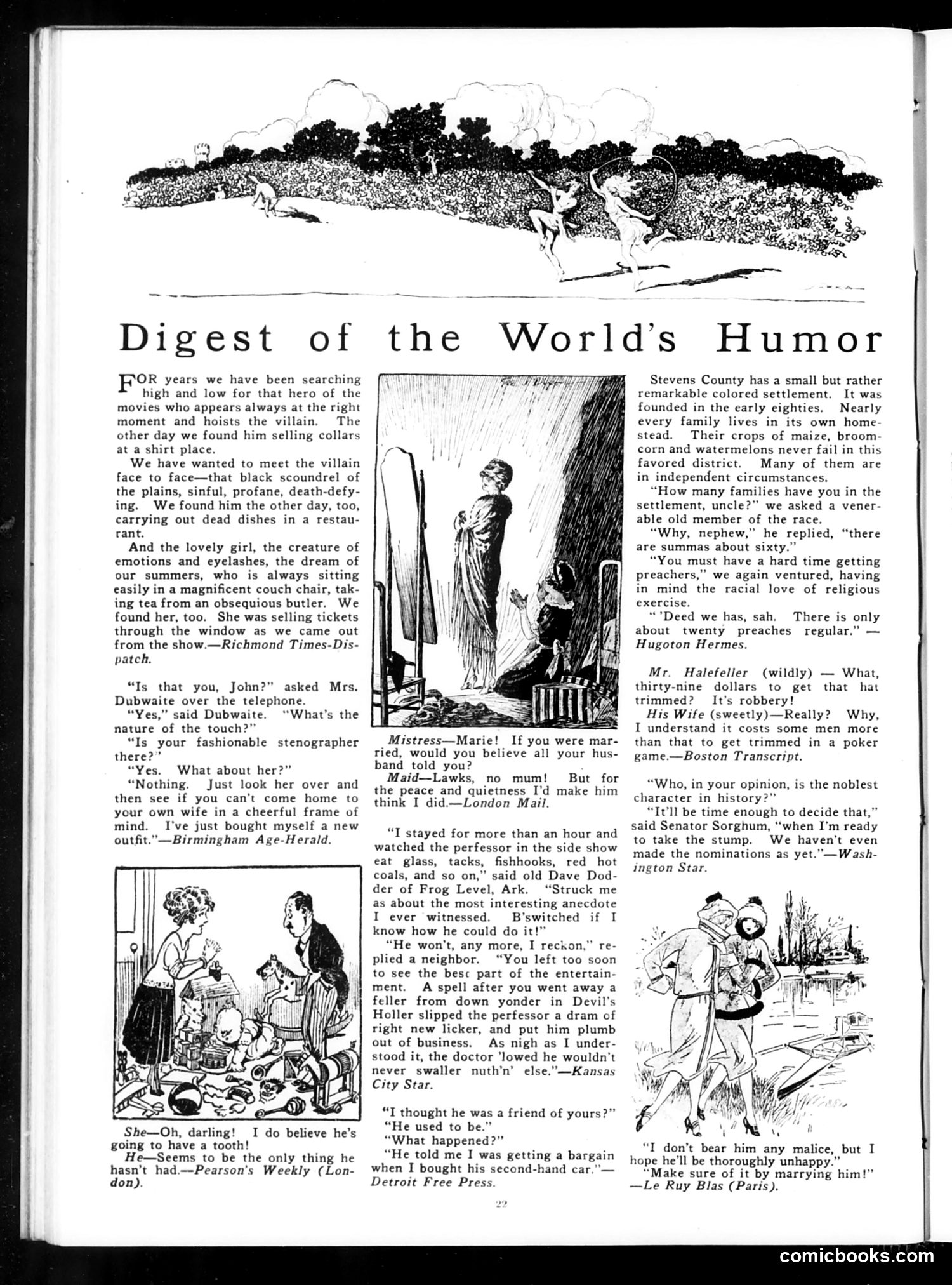
This page collects brief humorous anecdotes and jokes from various newspapers. Key satirical observations include: **Movie Industry Critique**: The opening piece mocks the gap between cinema's glamorous archetypes (heroic leading man, villainous scoundrel, beautiful ingénue) and reality—these actors work ordinary jobs (selling collars, washing dishes, selling tickets). **Marriage/Gender Humor**: Multiple jokes target marital dynamics, with wives outwitting or managing husbands—suggesting domestic power struggles and female skepticism about male fidelity or honesty. **Racial Stereotypes**: A piece about a Black settlement in Stevens County presents dialect humor ("'Deed we has, sah") typical of early-20th-century American publications; the humor depends on exaggerated speech patterns. **Class Commentary**: References to con artists, second-hand car dealers, and carnival performers suggest skepticism toward commercial transactions and working-class entertainment. The overall tone reflects 1920s-era popular humor emphasizing marital conflict, occupational ironies, and social pretense exposed as artifice.
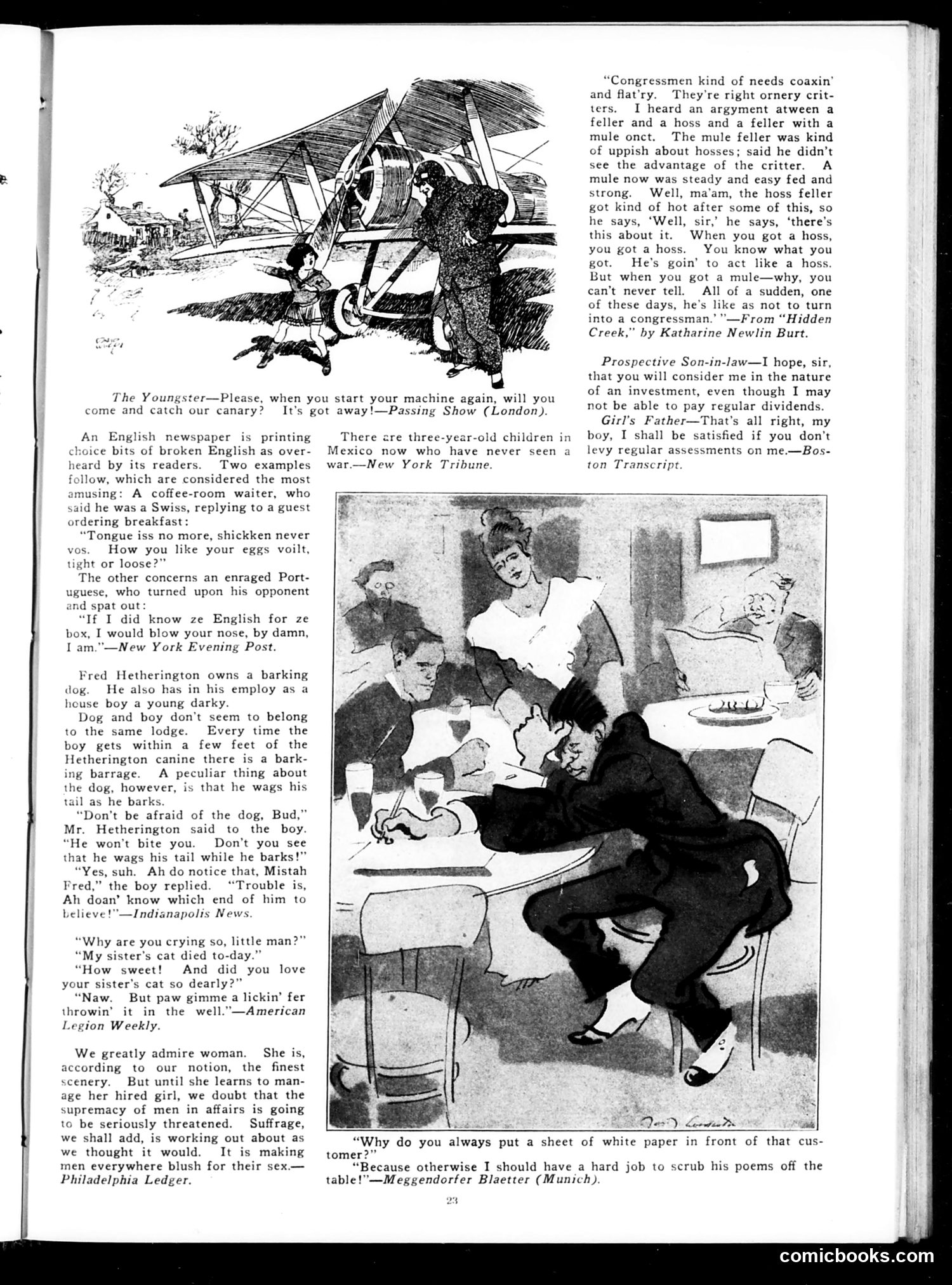
This page collects brief humorous anecdotes and satirical observations typical of early-20th-century Judge magazine. The content includes: **Linguistic humor**: Jokes about immigrants' broken English (a Swiss waiter, Portuguese man) reflecting contemporary attitudes toward foreigners. **Racial humor**: A story about a Black house boy and a barking dog uses period-appropriate racist dialect ("suh," "doan'"). **Political satire**: A congressman is compared unfavorably to a mule—unpredictable and untrustworthy, suggesting contempt for elected officials. **Social commentary**: A final editorial criticizes women's suffrage, claiming it hasn't advanced women's status and makes men "blush for their sex"—reflecting anti-suffrage sentiment. The cartoon (lower right) shows a woman at a table with a customer, humorously suggesting she hides offensive poems behind white paper—a joke about protecting decorum or censoring crude material. Overall, the page reflects Judge's satirical approach to contemporary social issues, though much of the humor relies on stereotypes considered offensive today.
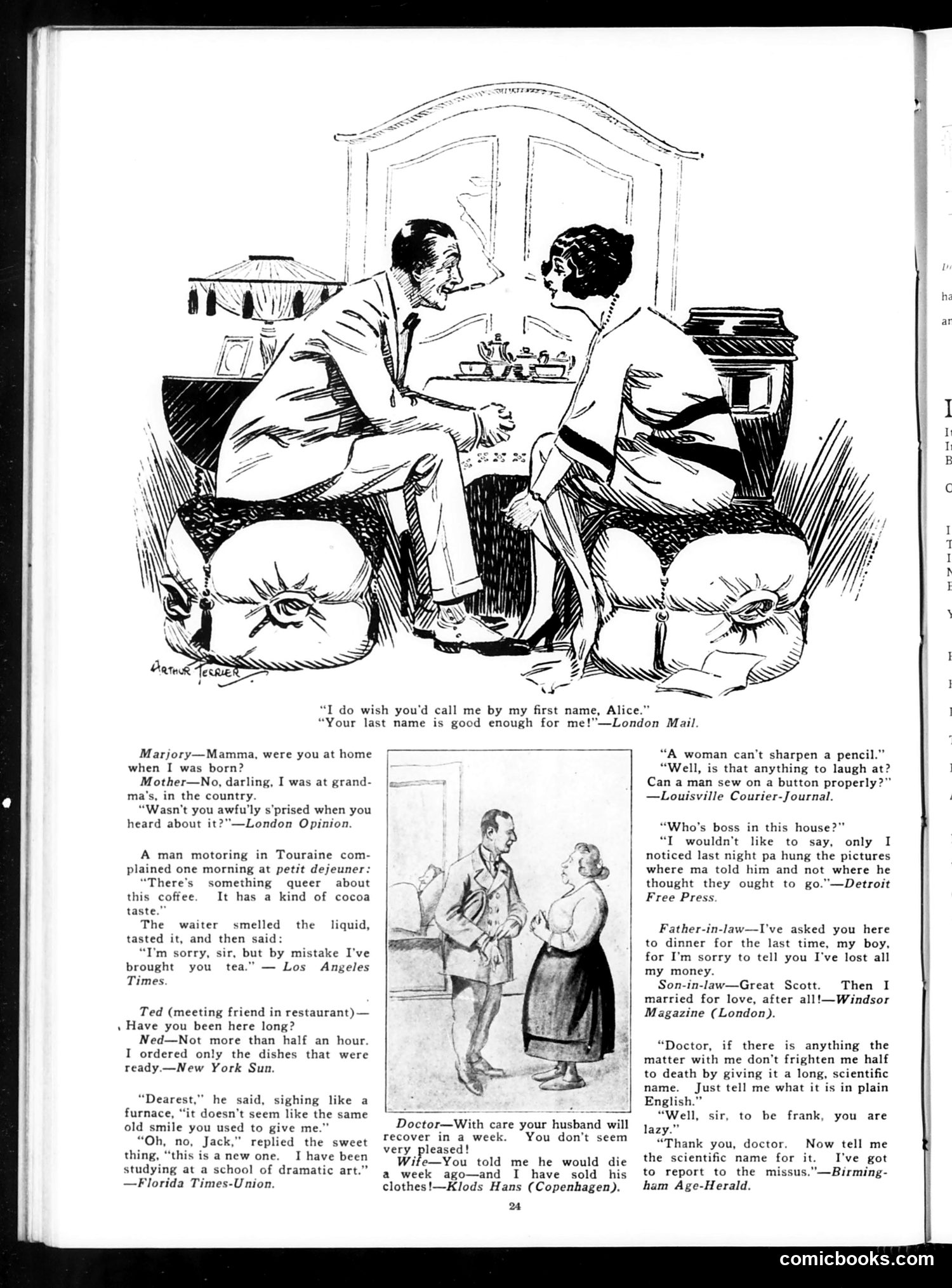
This page from *Judge* (a major American satirical weekly) contains a mix of humor pieces satirizing early 20th-century gender dynamics and domestic life. The main cartoon depicts a couple in an intimate moment; the caption jokes about formality in marriage—she wants affection ("call me by my first name"), he insists on maintaining distance ("Your last name is good enough"). The accompanying text anecdotes mock: - **Gender role expectations**: A woman's surprise at not attending her own birth; jokes about women sharpening pencils and men sewing buttons (implying incompetence across gender lines) - **Marriage dynamics**: A wife selling her husband's clothes after being told he'd die, then delighted he'll recover (suggesting mercenary motivations); a son-in-law admitting he married for love only after the father-in-law loses money - **Class/marital power**: A husband hanging pictures where his wife directs, suggesting she holds domestic authority despite traditional hierarchies The humor targets the gap between Victorian propriety and actual domestic behavior—wives with hidden agency, marriages based on calculation rather than romance, and the comedy of unstated power structures.
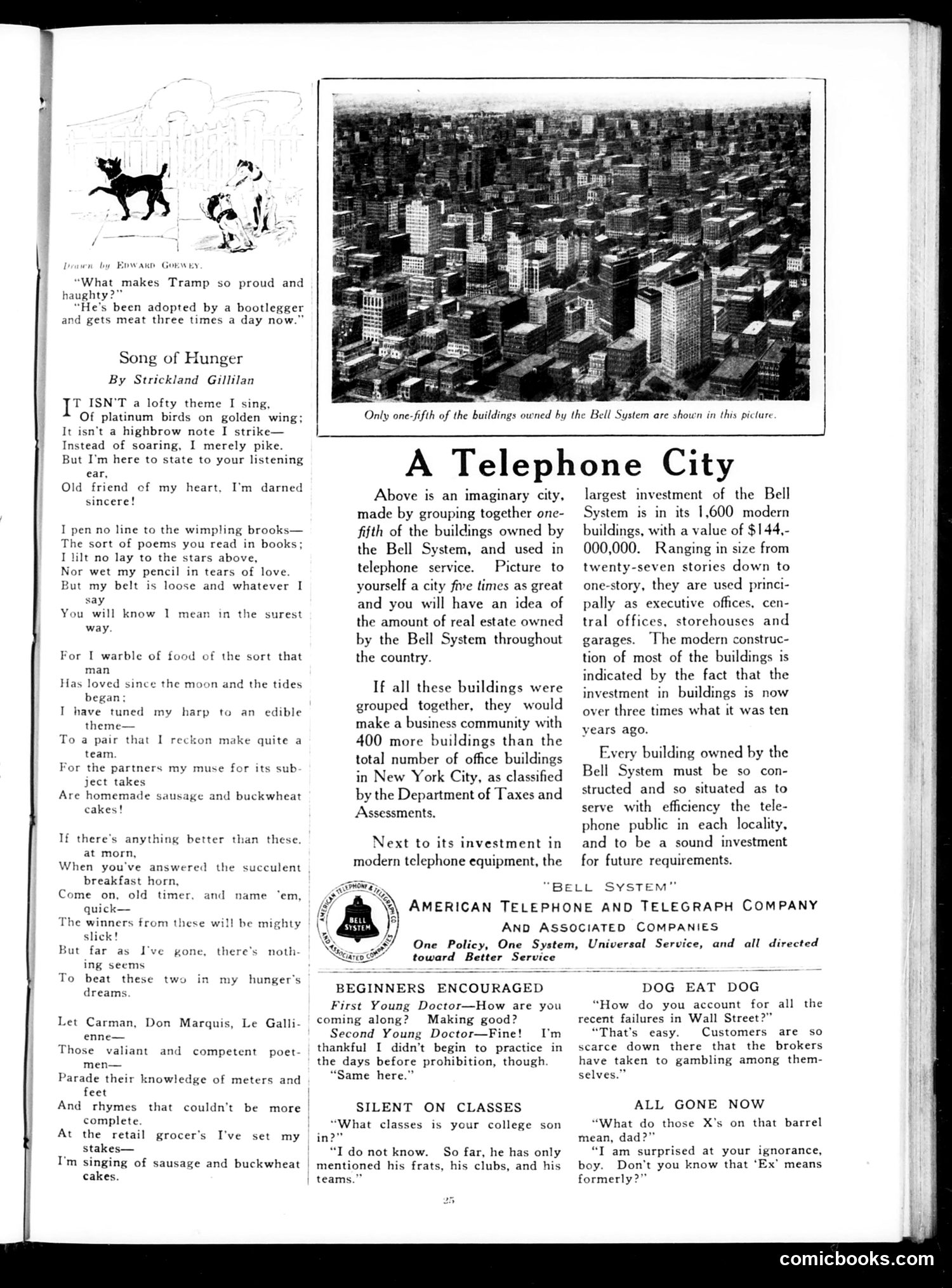
This page contains multiple satirical items reflecting 1920s American concerns: **Top cartoon**: A dog labeled "Tramp" appears proud because a bootlegger adopted him, providing meat three times daily. This satirizes Prohibition's consequences—bootleggers were criminals who profited from illegal alcohol sales, yet the cartoon jokes that even criminals ate well, contrasting with ordinary citizens' food scarcity. **"Song of Hunger"**: Strickland Gillilan's poem celebrates humble foods (sausage, buckwheat cakes) over highbrow poetry, reflecting post-WWI economic hardship and working-class struggles. **Remaining jokes** reference Prohibition ("days before prohibition"), college frivolity during economic difficulty, and Wall Street's 1920s gambling culture. The **Bell System advertisement** occupies significant space, promoting corporate infrastructure investment—a counterpoint to the page's satire about ordinary Americans' financial struggles. Together, these elements capture Judge's typical blend: mocking social problems while hosting advertisements from corporations thriving during the same period.
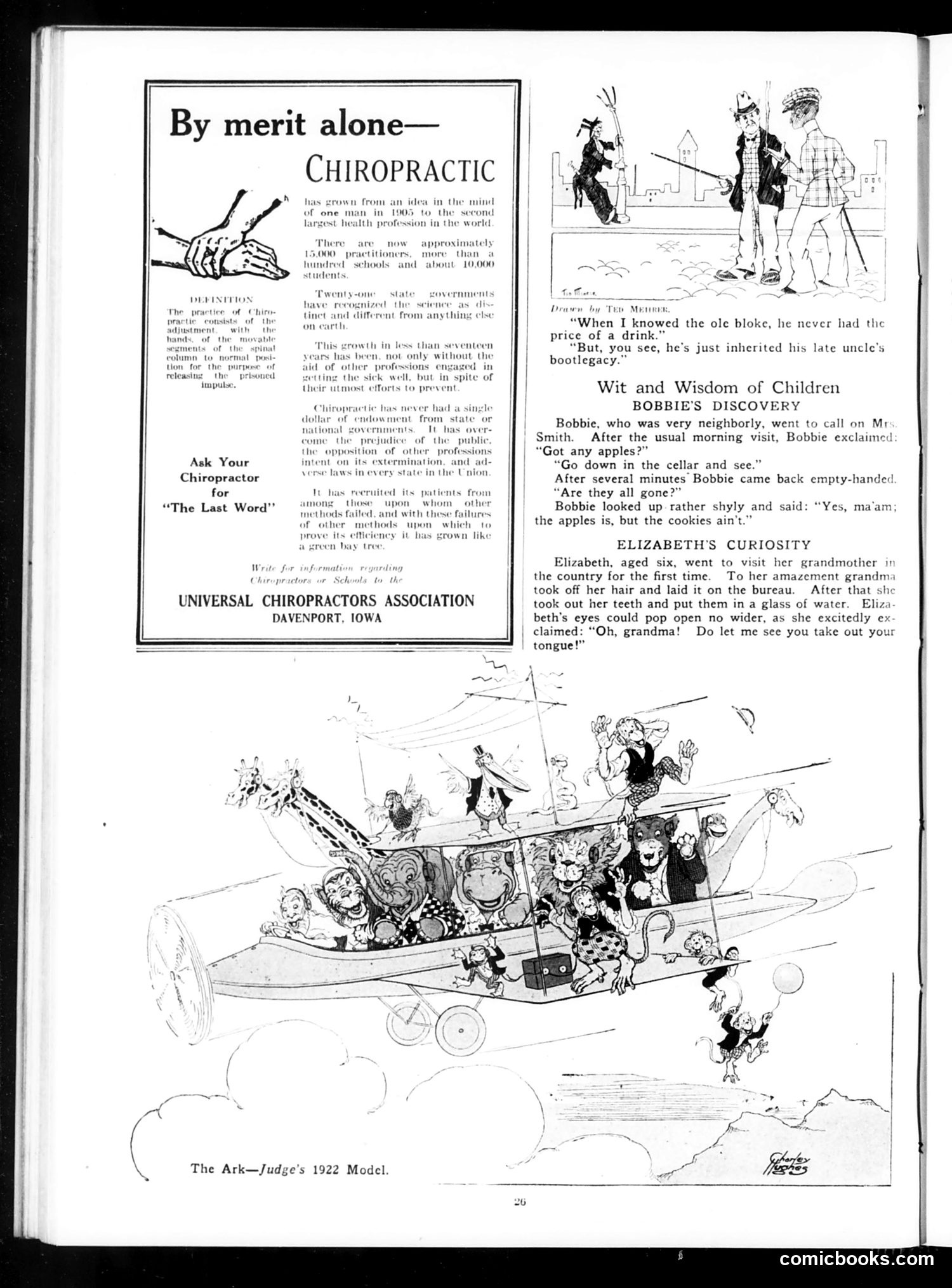
This page contains a **chiropractic trade advertisement** and three brief humorous anecdotes. **The Main Advertisement:** The left side promotes chiropractic as a rapidly growing profession (15,000 practitioners in less than 17 years). It claims chiropractors have succeeded despite opposition from state governments and other medical professions—a pointed defense against the widespread skepticism and legal challenges the profession faced in the early 1920s. Chiropractors were largely unregulated and viewed as quacks by mainstream medicine. **The Humor Sections:** Three short jokes follow—"The Bootlegacy" references Prohibition-era illegal alcohol; "Bobbie's Discovery" and "Elizabeth's Curiosity" are gentle children's anecdotes playing on naïveté and innocence. **Historical Context:** This reflects the era when chiropractic was fighting for legitimacy and legal recognition, positioning itself as a self-made success despite establishment opposition. The page juxtaposes this serious advocacy with light satire typical of Judge magazine's mixed editorial content.
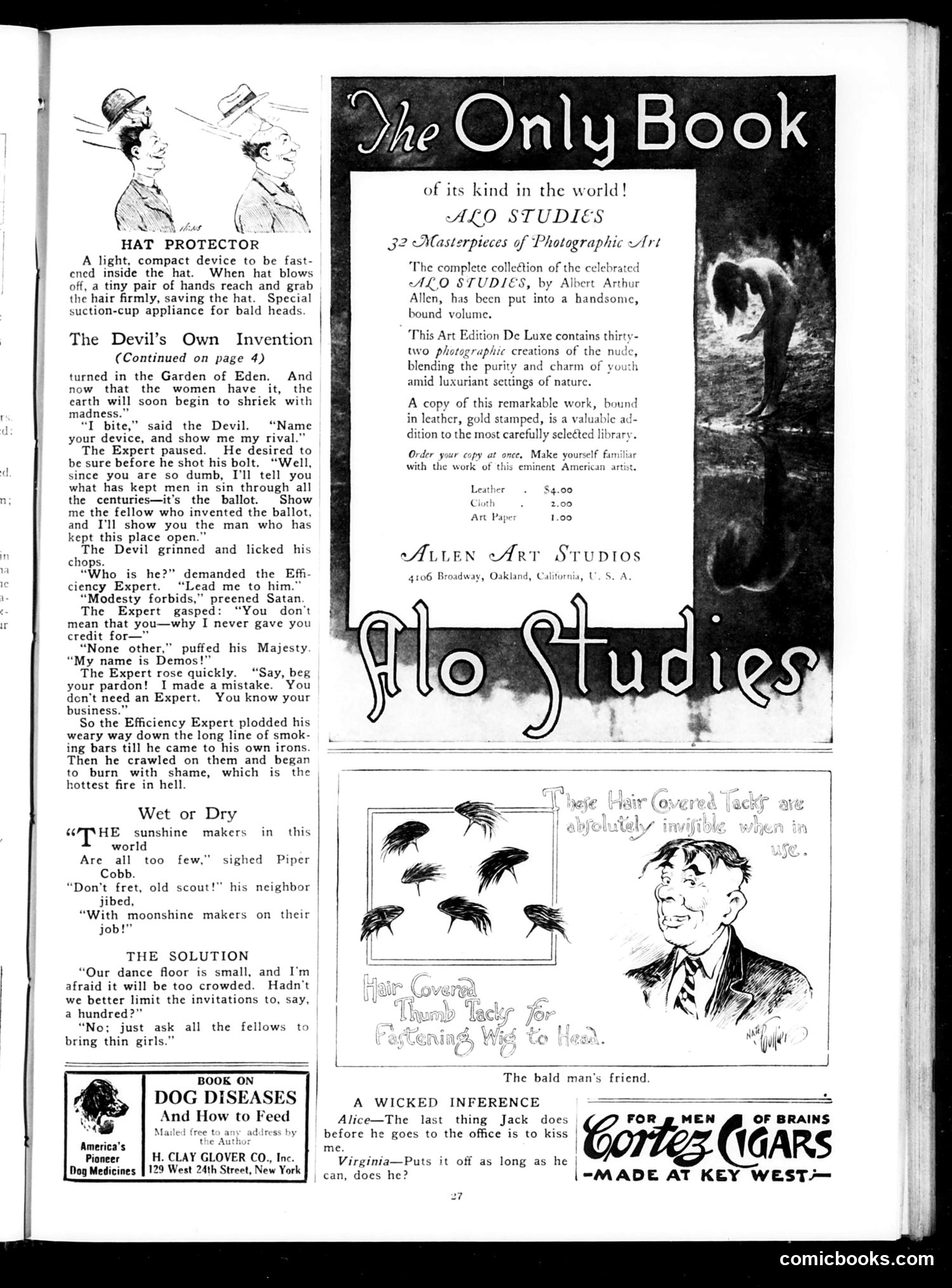
This page combines humor pieces with advertisements typical of early 20th-century Judge magazine. **Main Content:** The featured story, "The Devil's Own Invention," is a satirical allegory where Satan credits the **ballot (voting system)** as his greatest tool for corrupting humanity through the ages. An "Efficiency Expert" visits Hell seeking to learn Satan's secrets, only to realize Satan—identified as "Demos" (democracy)—needs no advice. The joke satirizes democratic processes and voter behavior as fundamentally corrupt or foolish. **Shorter Jokes:** Include wordplay about "moonshine makers" (Prohibition-era reference), a dance-floor logistics problem, and a married couple's domestic habits. **Visual Elements:** A cartoon of a bald man accompanies a caption about invisible hair coverage—absurdist humor typical of the era. **Advertisements:** Include ALO photographic art studies, dog disease remedies, and Corley cigars—standard period advertising. The page primarily mocks democratic institutions rather than specific political figures.
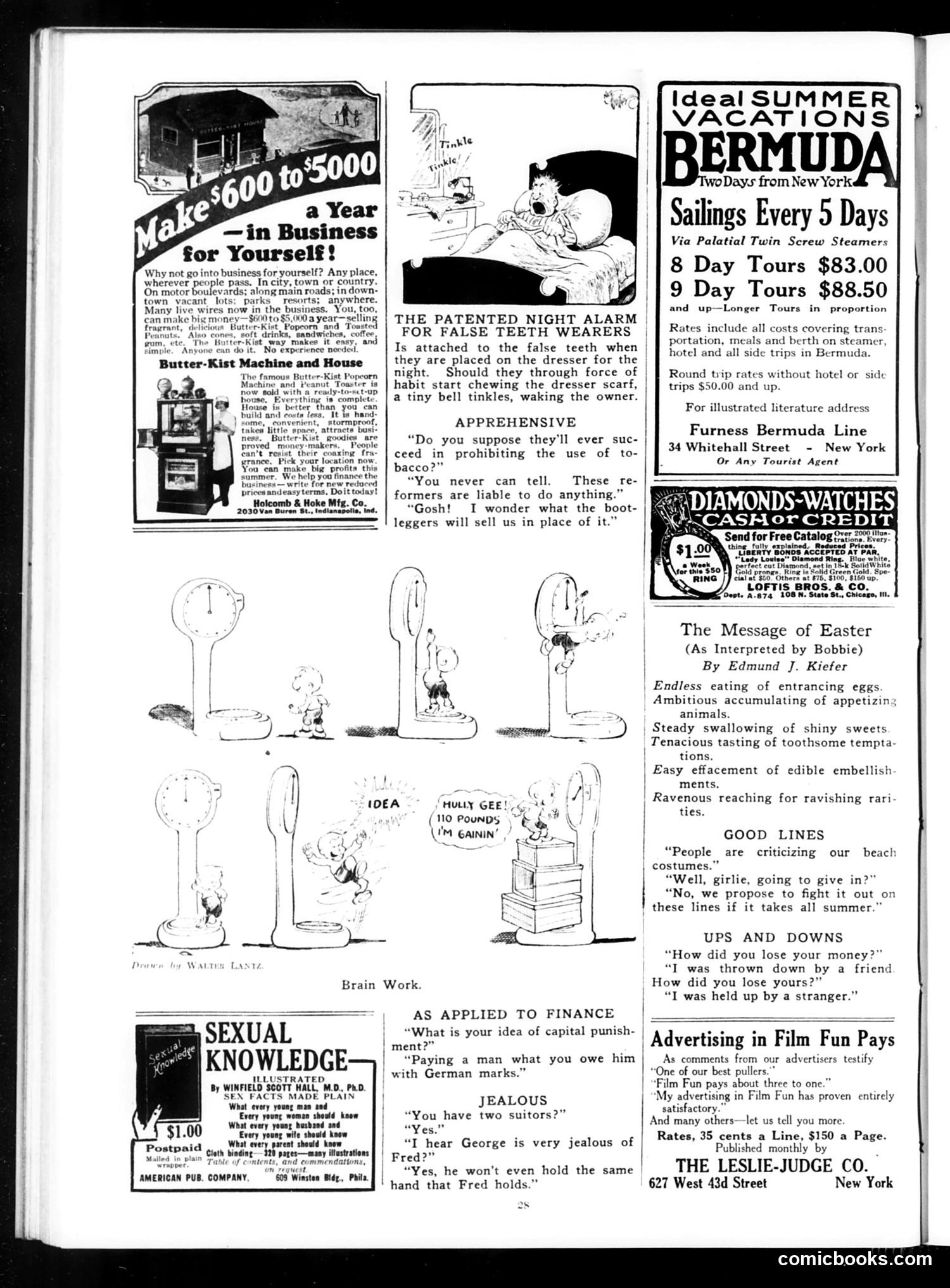
This page contains **primarily advertisements and brief humor pieces** rather than political cartoons. Key content: **Main Cartoons/Jokes:** - "Brain Work" shows a figure repeatedly hitting themselves with a mallet—visual gag about hard thinking - Several short comedic exchanges, including one satirizing **Prohibition**: reformers threaten to ban tobacco, and a bootlegger jokes about selling contraband instead—reflecting 1920s anxieties about alcohol bans and black markets - A "German marks" joke references **post-WWI economic collapse**, when German currency became worthless due to hyperinflation - "The Message of Easter (As Interpreted by Bobbie)" is innocent children's humor about overindulgence **Advertisements:** Notable ads include a "Sexual Knowledge" book, Bermuda vacation packages, and various business opportunities—typical of 1920s magazine advertising. **Historical Context:** The Prohibition reference and German currency joke place this in the early 1920s. The humor reflects contemporary anxieties: economic instability, Prohibition enforcement, and reformist movements. The tone is lighthearted, not overtly political.
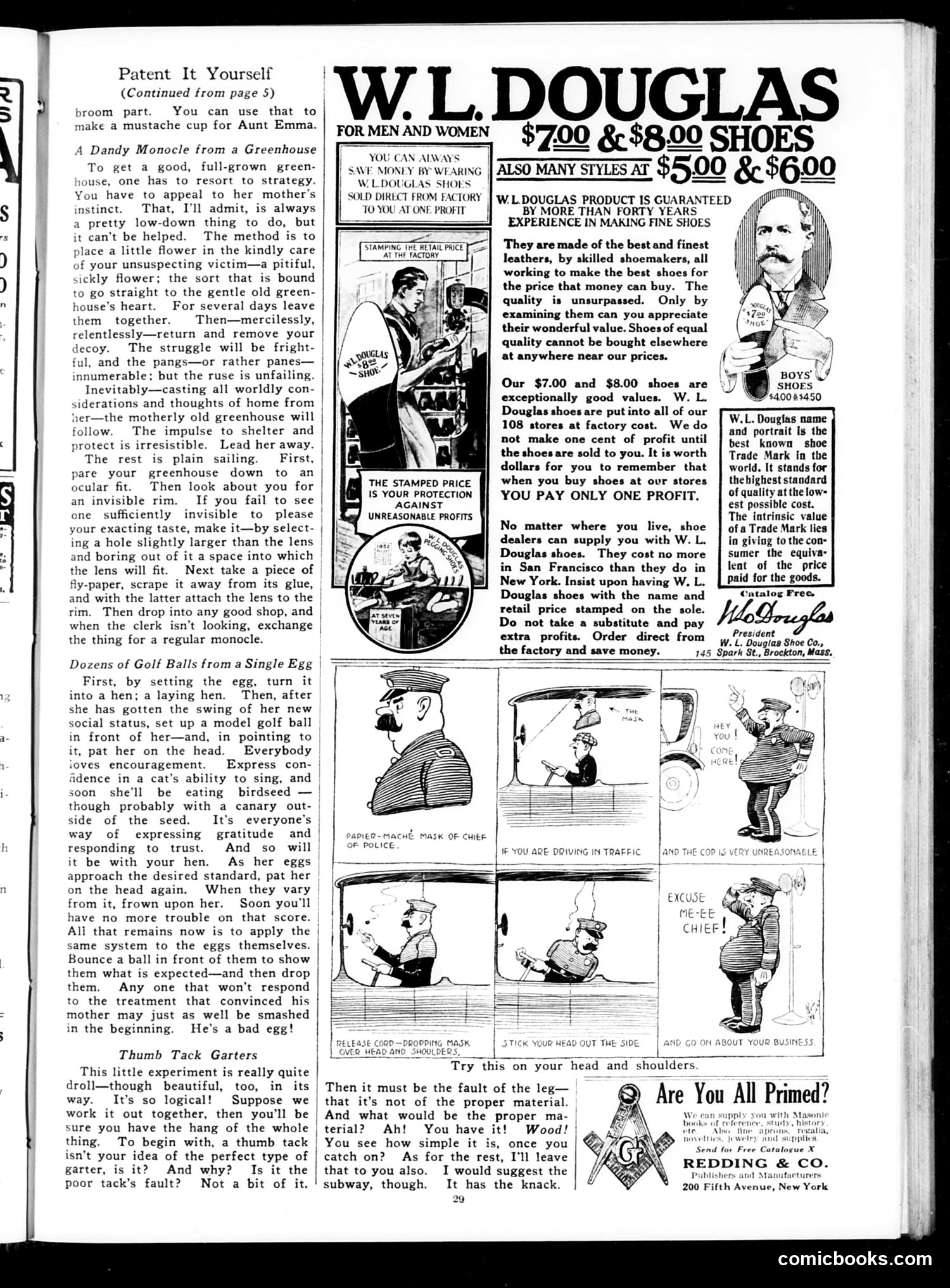
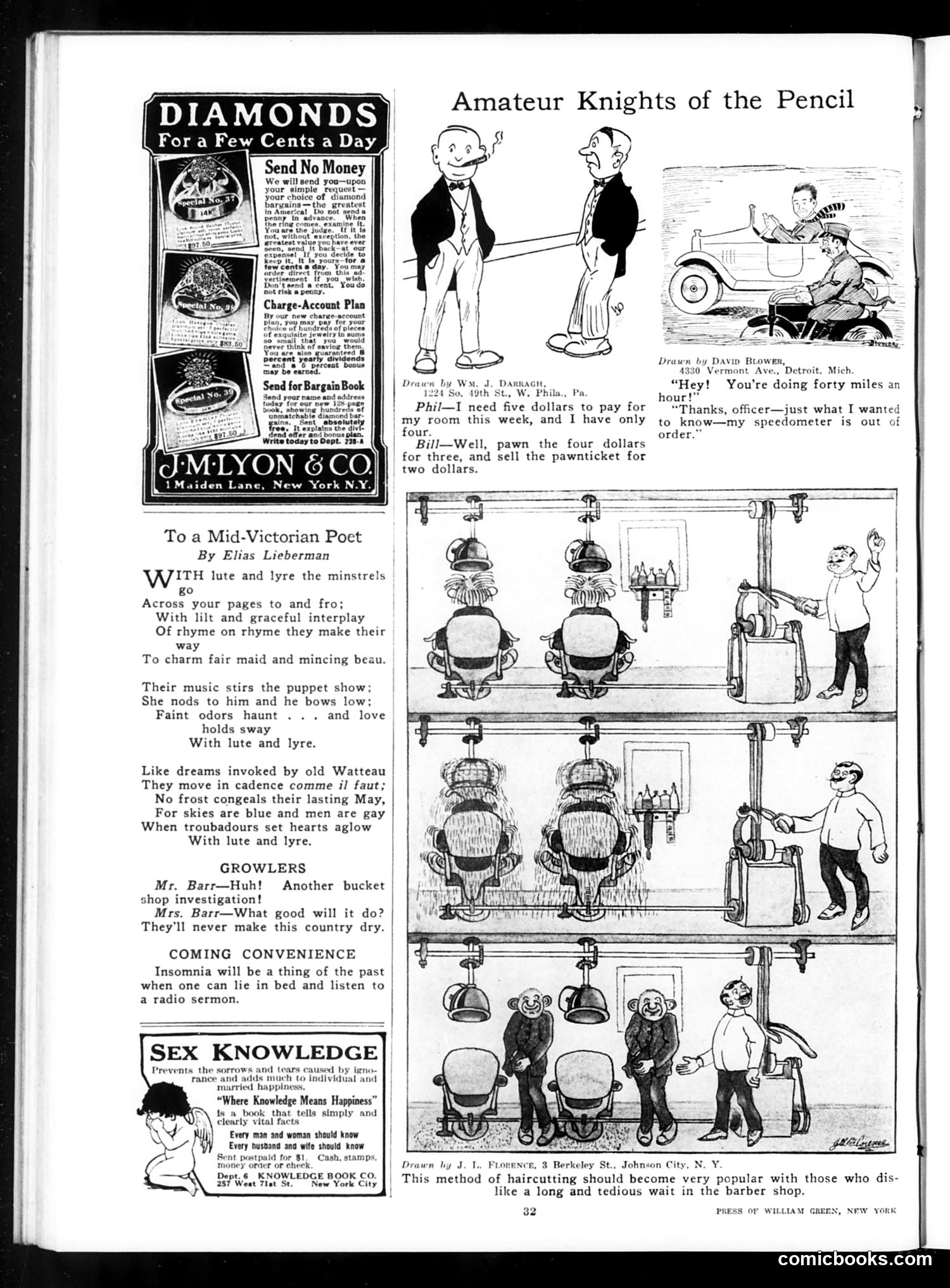
This page mixes humor with advertising. The left side contains three absurdist "Patent It Yourself" DIY projects—creating a monocle from a greenhouse, golf balls from a hen's eggs, and thumb tack garters—all presented with deadpan pseudo-scientific logic. The jokes satirize both amateur inventors and the era's proliferation of dubious DIY schemes and patent claims. The right side is dominated by a W.L. Douglas Shoes advertisement, featuring the company's founder and emphasizing direct-factory sales to undercut "unreasonable profits" from middlemen. The small comic strip at bottom mockingly depicts various social scenarios (traffic stops, police encounters) with the caption "Try this on your head and shoulders"—likely advertising a hat or cap. The page reflects early 20th-century concerns: consumer skepticism about retail markups and enthusiasm for mail-order factory sales as cost-saving measures.
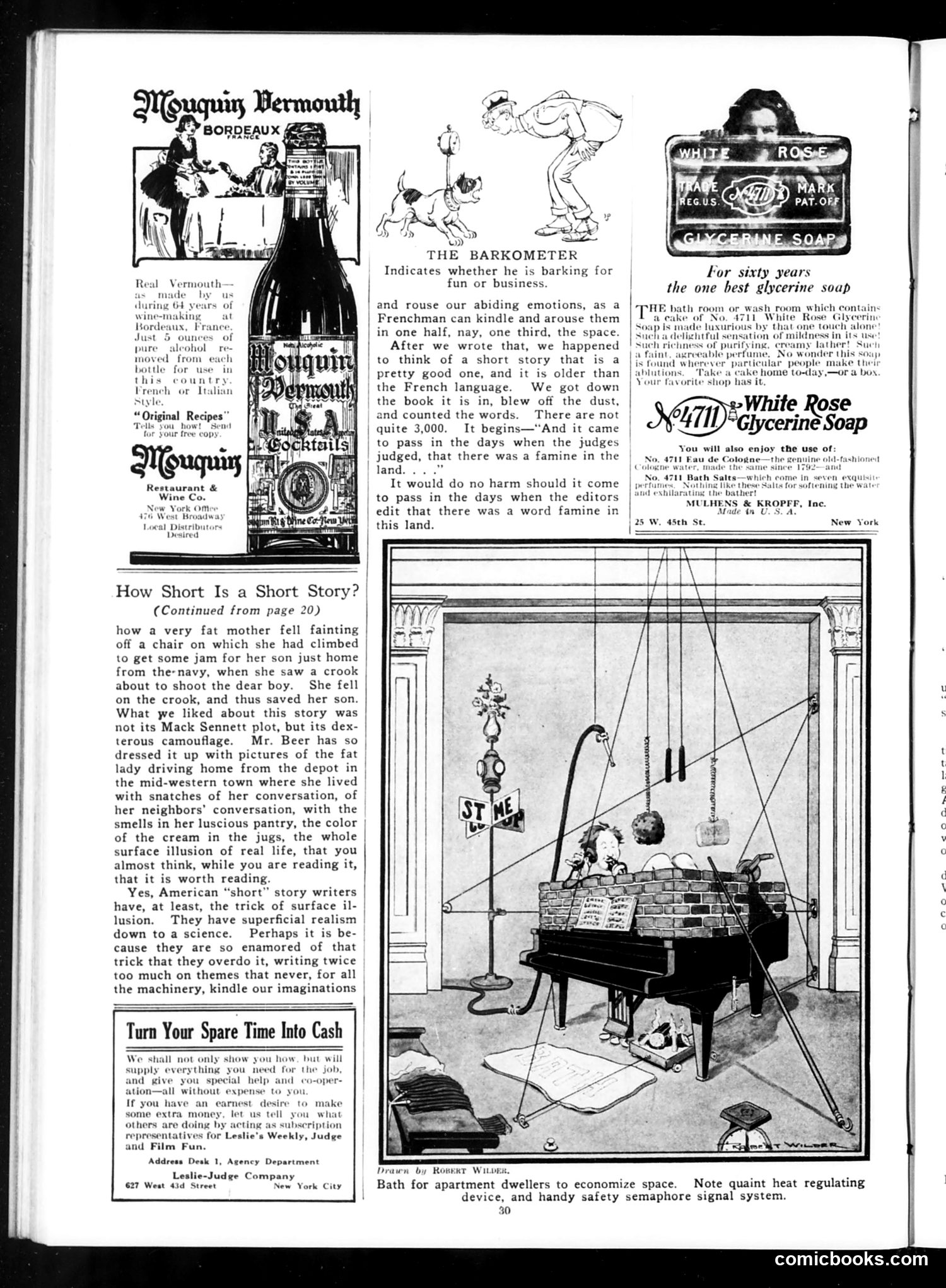
This page contains mostly **advertisements and editorial content** rather than political satire. The main cartoon by Robert Wilder depicts a humorous **bathtub setup for cramped apartment living**—showing elaborate pulleys, signals, and contraptions to regulate heat and save space. The caption notes these are practical solutions for urban dwellers economizing on space, a relevant concern during this era of apartment-living expansion. The editorial piece "How Short Is a Short Story?" critiques American short-story writers for over-reliance on superficial realism and excessive detail, contrasting their approach with French writers' economy of language. The author uses the Biblical book of Judges (approximately 3,000 words) as an example of effective storytelling, then sarcastically calls for "a word famine" among editors—suggesting they publish too much verbose mediocrity. The remaining content consists of advertisements for Monmouth Vermouth, White Rose Glycerine Soap, and a subscription opportunity with Leslie-Judge Company—typical of magazine pages from this period.
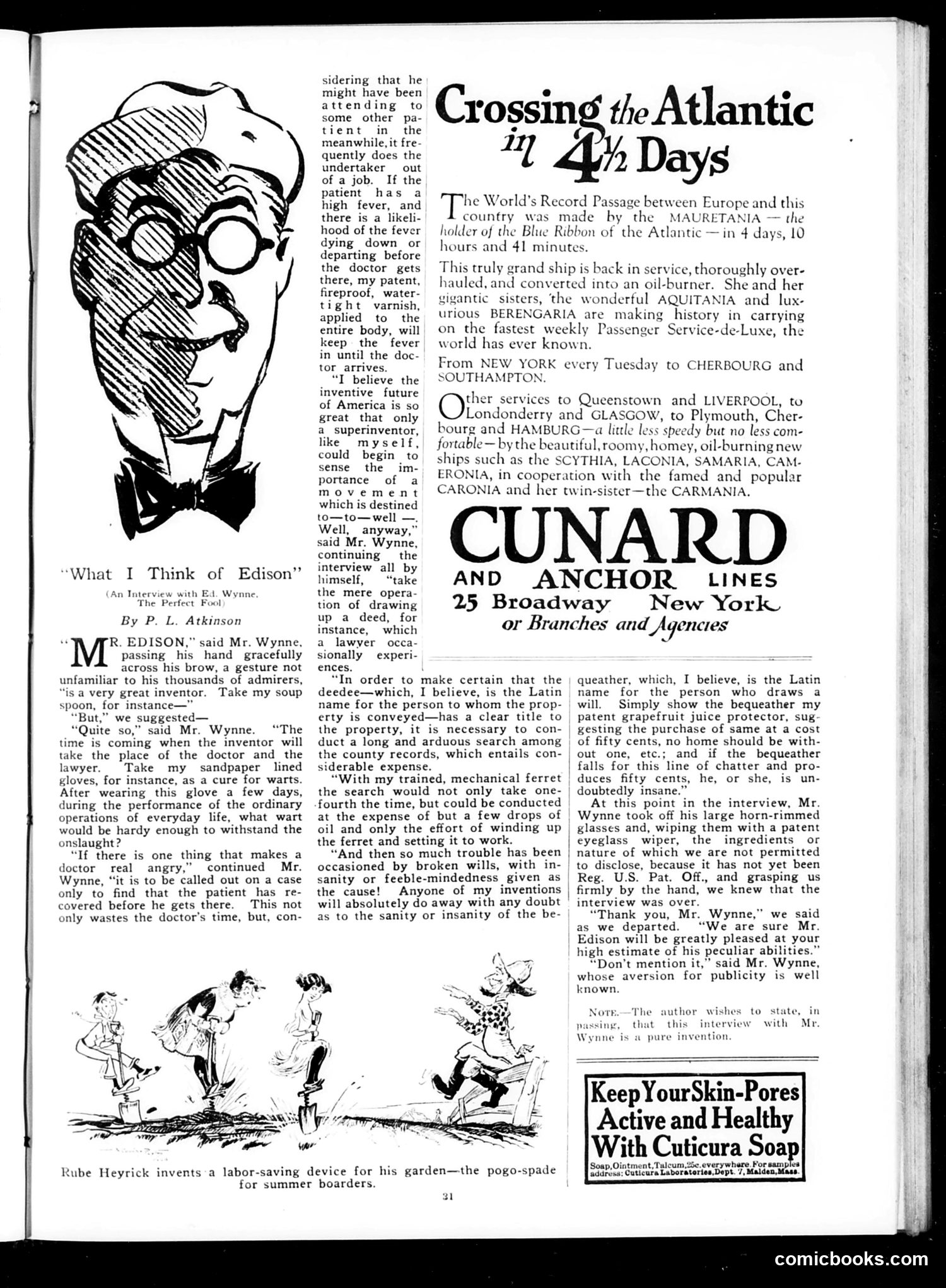
This page features an interview with **Ed Wynn**, a popular vaudeville comedian known as "The Perfect Fool," discussing Thomas Edison's inventive genius through absurdist humor. Wynn praises Edison while proposing ridiculous "inventions" that mock both Edison's prolific patenting and society's blind faith in technological solutions. His examples—sandpaper gloves to cure warts, fireproof varnish to keep fevers active until doctors arrive, mechanical ferrets for legal searches—are deliberately nonsensical, designed to satirize the era's invention-mania. The cartoon's joke: Americans were so enamored with Edison and innovation that they'd accept any absurd contraption as progress. Wynn's pompous delivery ("a superinventor like myself") and self-interview parody how earnestly such inventions were promoted. The page also contains a **Cunard shipping advertisement** and a cartoon about "Rube Heyrick's pogo-spade," continuing the theme of silly labor-saving devices.
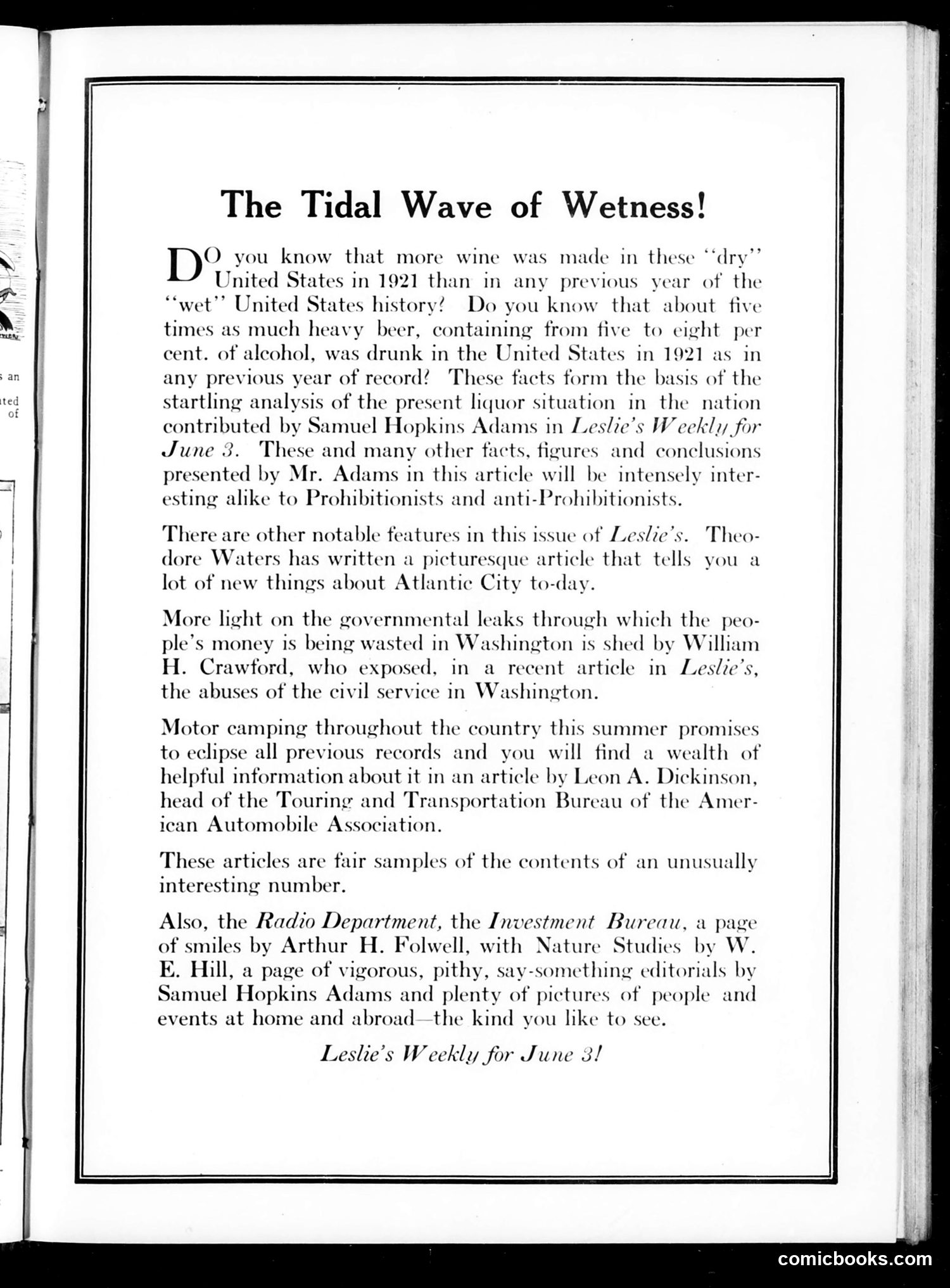
This is an advertisement for *Leslie's Weekly* magazine, not a cartoon. It promotes an article by Samuel Hopkins Adams analyzing Prohibition's failure during the early 1920s. The "tidal wave of wetness" is satirical irony: despite national Prohibition (enacted 1920), Americans were actually consuming *more* alcohol than ever—more wine, more heavy beer. The piece highlights this paradox to interest both Prohibitionists (who'd be alarmed) and anti-Prohibitionists (who'd feel vindicated). The ad also promotes other articles covering government waste, Atlantic City tourism, and motor camping. Samuel Hopkins Adams, a prominent muckraker journalist, contributed editorials. The satire targets Prohibition's obvious ineffectiveness—a major political debate of the era. The "wetness" metaphor mocks the law's unintended consequence of driving increased underground drinking.
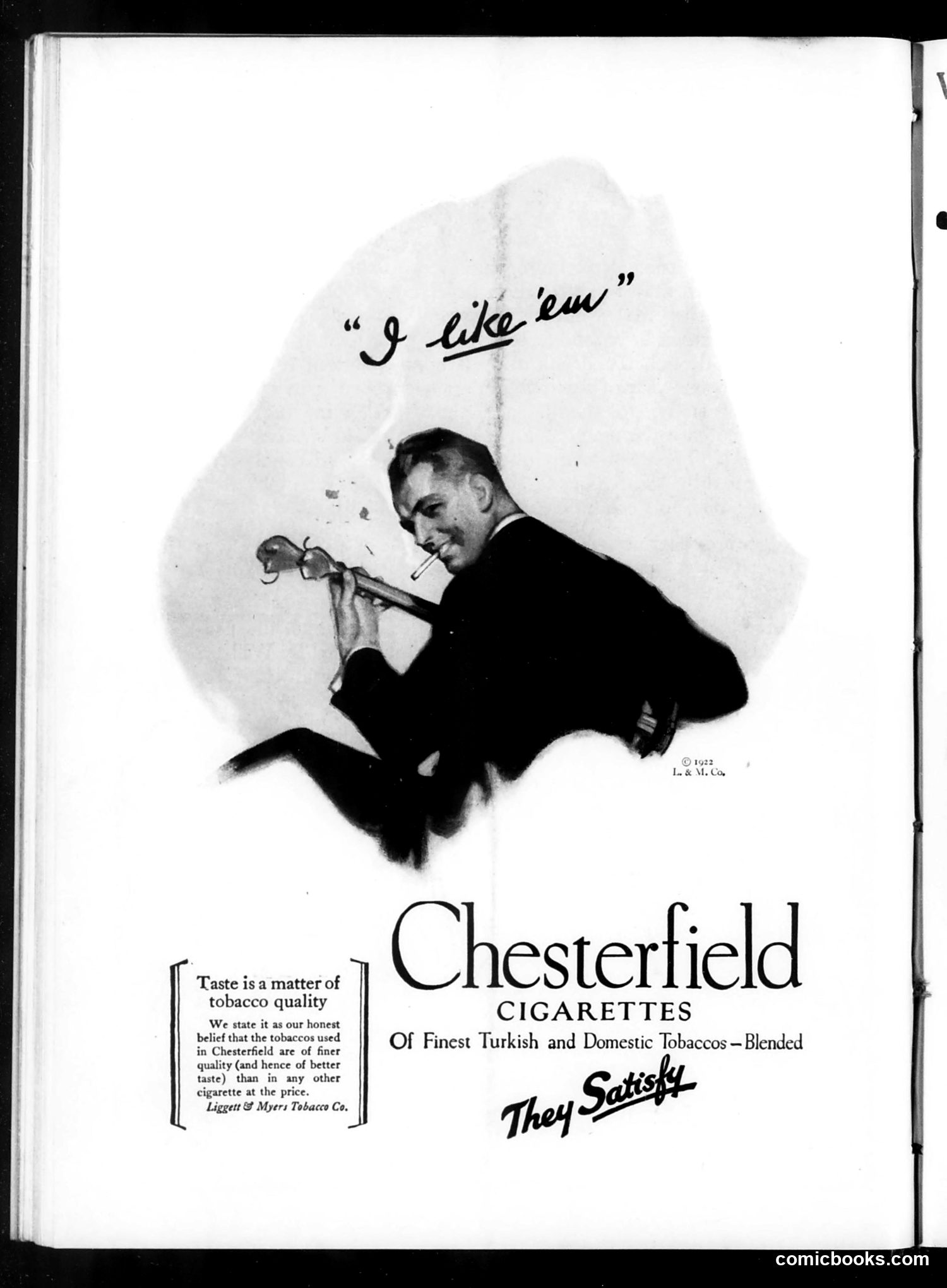
This is a **cigarette advertisement**, not political satire. It features a man in formal attire playing a flute, with the quoted phrase "I like 'em" positioned above him. The ad emphasizes tobacco quality as the basis for taste preference, with a statement from Liggett & Myers Tobacco Co. claiming Chesterfield uses finer tobaccos than competitors at the same price point. The illustration style and the man's refined appearance were typical marketing strategies of the era, suggesting sophistication and discernment. The flute-playing may subtly evoke cultural refinement to appeal to aspirational consumers. This represents vintage tobacco marketing before modern health warnings—a period when cigarette advertising prominently featured in mainstream magazines like Judge.