
Judge, 1922-06-03 · page 16 of 36
Judge — June 3, 1922 — page 16: what you’re looking at
What you’re looking at
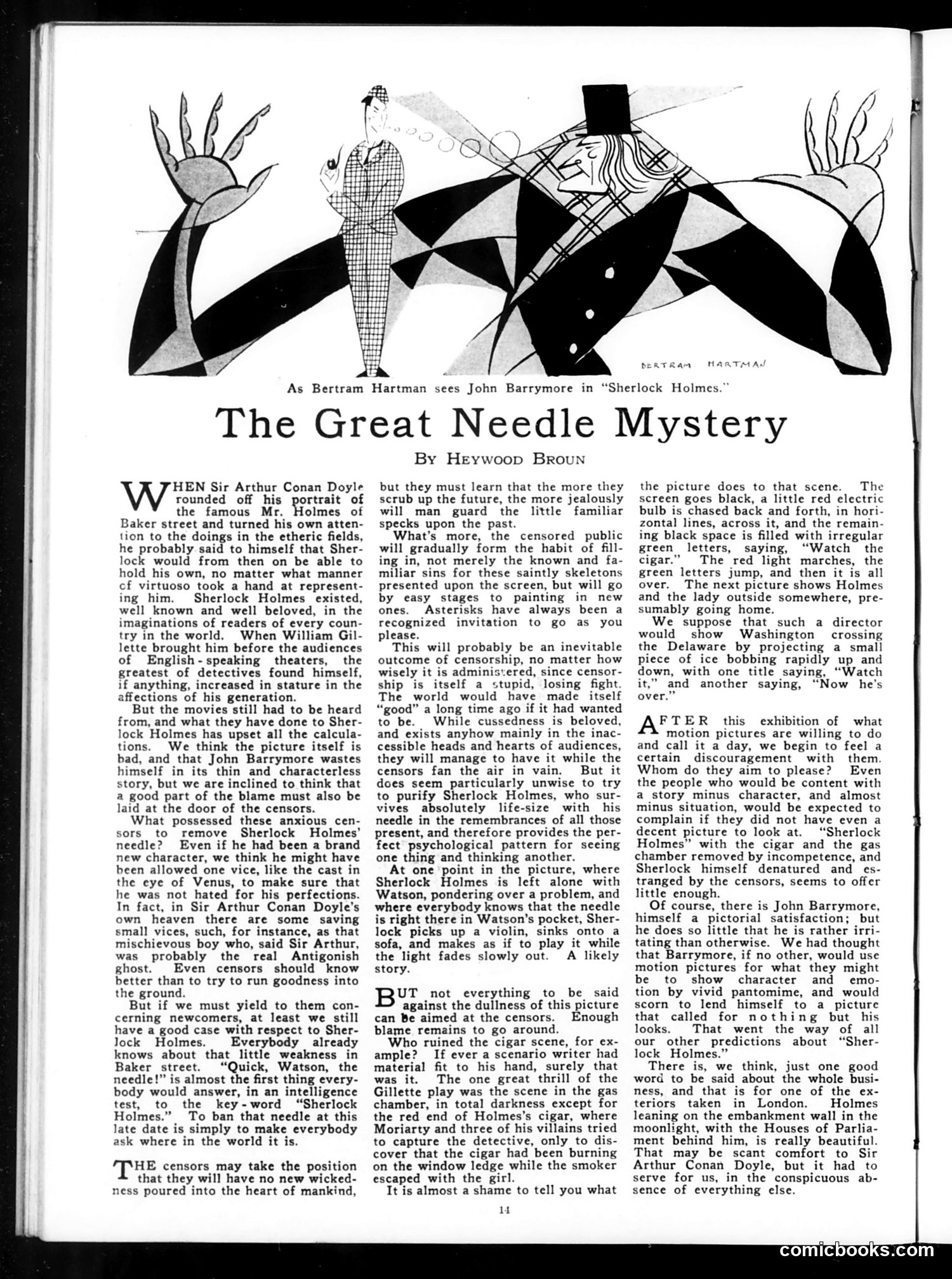
This article critiques film censors for removing Sherlock Holmes' cocaine use from John Barrymore's movie adaptation of the detective stories. The illustration shows caricaturist Bertram Hartman's exaggerated vision of Barrymore as Holmes. The satire argues that censorship backfires: by scrubbing known character details from beloved literary figures, censors actually draw MORE attention to what's been removed. The article claims audiences will inevitably "fill in" the banned elements themselves—making the censorship counterproductive. The "needle" references Holmes's famous drug habit, well-established in Arthur Conan Doyle's original stories and public memory. The author (Heywood Broun) contends that removing this defining trait from an iconic character is both futile and foolish, since everyone already knows about it. The piece uses this specific case to argue against excessive film censorship more broadly.
📄 Transcribed text from this page (OCR, searchable)
Machine-transcribed from the original scan — historical spelling and the odd misread are preserved.
As Bertram Hartman sees John Barrymore in “Sherlock peRTRam MARTA AY Holmes.” The Great Needle Mystery HEN Sir Arthur Conan Doyle rounded off his portrait of the famous Mr. Holmes of Baker street and turned his own atten- tion to the doings in the etheric fields, he probably said to himself that Sher- lock would from then on be able to hold his own, no matter what manner cf virtuoso took a hand at represent- ing him. Sherlock Holmes existed, well known and well beloved, in the imaginations of readers of every coun- try in the world. When William Gil- lette brought him before the audiences of English-speaking theaters, the greatest of detectives found himself, if anything, increased in stature in the affections of his generation. But the movies still had to be heard from, and what they have done to Sher- lock Holmes has upset all the calcula- tions. We think the picture itself is bad, and that John Barrymore wastes himself in its thin and characterless story, but we are inclined to think that a good part of the blame must also be laid at the door of the censors. What possessed these anxious cen- sors to remove Sherlock Holmes’ needle? Even if he had been a brand new character, we think he might have been allowed one vice, like the cast in the eye of Venus, to make sure that he was not hated for his perfections. In fact, in Sir Arthur Conan Doyle's own heaven there are some saving small vices, such, for instance, as that mischievous boy who, said Sir Arthur, was probably the real Antigonish ghost. Even censors should know better than to try to run goodness into the ground. But if we must yield to them con- cerning newcomers, at least we still have a good case with respect to Sher- lock Holmes. Everybody already knows about that little weakness in Baker street. “Quick, Watson, the needle!” is almost the first thing every- body would answer, in an intelligence test, to the key-word “Sherlock Holmes.” To ban that needle at this late date is simply to make everybody ask where in the world it is. ‘THE censors may take the position that they will have no new wicked- ness poured into the heart of mankind, By Heywoop Broun but they must learn that the more they scrub up the future, the more jealously will man guard the little familiar specks upon the past. What's more, the censored public will gradually form the habit of fill- ing in, not merely the known and fa- miliar sins for these saintly skeletons presented upon the screen, but will go by easy stages to painting in new ones. Asterisks have always been a recognized to go as you please. This will probably be an inevitable outcome of censorship, no matter how wisely it is administered, since censor- ship is itself a stupid, losing fight The world would have made itself “good” a long time ago if it had wanted to be. While cussedness is beloved, and exists anyhow mainly in the inac- cessible heads and hearts of audiences, they will manage to have it while the censors fan the air in vain. But it does seem particularly unwise to try to purify Sherlock Holmes, who sur- vives absolutely life-size with his needle in the remembrances of all those present, and therefore provides the per- fect psychological pattern for seeing one thing and thinking another. At one point in the picture, where Sherlock Holmes is left alone with Watson, pondering over a problem, and where everybody knows that the needle is right there in Watson's pocket, Sher- lock picks up a violin, sinks onto a sofa, and makes as if to play it while the light fades slowly out. A likely story. invitation UT not everything to be said against the dullness of this picture can Be aimed at the censors. Enough blame remains to go around. Who ruined the cigar scene, for ex- ample? If ever a scenario writer had material fit to his hand, surely that was it. The one great thrill of the Gillette play was the scene in the gas chamber, in total darkness except for the red end of Holmes’s cigar, where Moriarty and three of his villains tried to capture the detective, only to dis- cover that the cigar had been burning on the window ledge while the smoker escaped with the girl. It is almost a shame to tell you what ret the picture does to that scene. The screen goes black, a little red electric bulb is chased back and forth, in hori- zontal lines, across it, and the remain- ing black space is filled with irregular green letters, saying, “Watch the cigar.” The red light marches, the green letters jump, and then it is all over. The next picture shows Holmes and the lady outside somewhere, pre- sumably going home. We suppose that such a director would show Washington crossing the Delaware by projecting a small piece of ice bobbing rapidly up and down, with one title saying, “Watch it,” and another saying, “Now he’s over.” FTER this exhibition of what motion pictures are willing to do and call it a day, we begin to feel a certain discouragement with them Whom do they aim to please? Even the people who would be content with a story minus character, and almost minus situation, would be expected to complain if they did not have even a decent picture to look at. “Sherlock Holmes” with the cigar and the gas chamber removed by incompetence, and Sherlock himself denatured and es- tranged by the censors, seems to offer little enough. Of course, there is John Barrymore, himself a pictorial satisfaction; but he does so little that he is rather irri- tating than otherwise. We had thought that Barrymore, if no other, would use motion pictures for what they might be to show character and emo- tion by vivid pantomime, and would scorn to lend himself to a picture that called for nothing but his looks. That went the way of all our other predictions about “Sher- lock Holmes.” There is, we think, just one good word to be said about the whole busi- ness, and that is for one of the ex- teriors taken in London. Holmes leaning on the embankment wall in the moonlight, with the Houses of Parlia- ment behind him, is really beautiful. That may be scant comfort to Sir Arthur Conan Doyle, but it had to serve for us, in the conspicuous ab- sence of everything else. comicbooks.com