
Judge, 1922-06-03 · page 10 of 36
Judge — June 3, 1922 — page 10: what you’re looking at
What you’re looking at
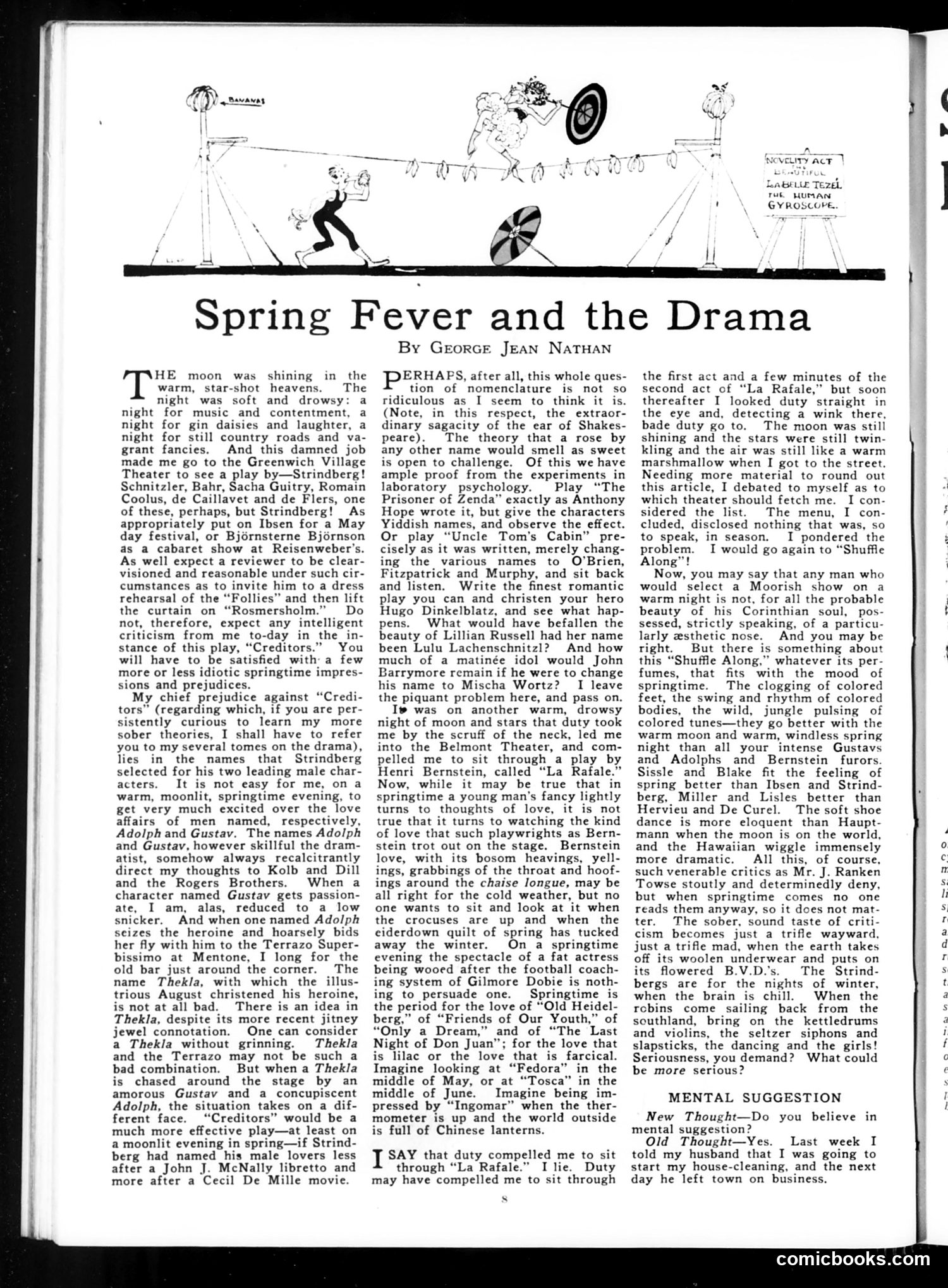
This is a satirical essay by theater critic George Jean Nathan, not a political cartoon. The illustration above depicts a circus/vaudeville scene but doesn't directly illustrate the article. Nathan humorously attacks playwright August Strindberg's play "Creditors," arguing that unsuitable character names—specifically "Adolph" and "Gustav"—undermine dramatic effectiveness on a romantic spring evening. He finds these names evoke cheap vaudeville (the Rogers Brothers, John J. McNally libretti) rather than serious theater. Nathan argues nomenclature matters genuinely—citing laboratory psychology—and supports this by imagining how famous works would suffer with different names: "Uncle Tom's Cabin" with Irish names, or star Lillian Russell renamed "Lulu Lachenschnitzl." The satire targets both Strindberg's theatrical choices and broader American theater conventions. It's essentially a sophisticated complaint: serious European drama loses emotional impact when filtered through unsuitable naming conventions that trigger unintended comic associations for American audiences.
📄 Transcribed text from this page (OCR, searchable)
Machine-transcribed from the original scan — historical spelling and the odd misread are preserved.
noveLity act | LabeLur TezeL THe MUM ARN GYROSCOPE. Spring Fever and the Drama HE moon was shining in the warm, star-shot heavens. The night was soft and drowsy: a night for music and contentment, a night for gin daisies and laughter, a night for still country roads and va- grant fancies. And this damned job made me go to the Greenwich Village Theater to see a play by—Strindberg! Schnitzler, Bahr, Sacha Guitry, Romain Coolus, de Caillavet and de Flers, one of these, perhaps, but Strindberg! As appropriately put on Ibsen for a May day festival, or Bjérnsterne Bjérnson as a cabaret show at Reisenweber’s. As well expect a reviewer to be clear- visioned and reasonable under such cir- cumstances as to invite him to a dress rehearsal of the “Follies” and then lift the curtain on “Rosmersholm.” Do not, therefore, expect any intelligent criticism from me to-day in the in- stance of this play, “Creditors.” You will have to be satisfied with a few more or less idiotic springtime impres- sions and prejudices. My chief prejudice against “Credi- tors” (regarding which, if you are per- sistently curious to learn my more sober theories, I shall have to refer you to my several tomes on the drama), lies in the names that Strindberg selected for his two leading male char- acters. It is not easy for me, on a warm, moonlit, springtime evening, to get very much excited over the love affairs of men named, respectively, Adolph and Gustav. The names Adolph and Gustav, however skillful the dram- atist, somehow always recalcitrantly direct my thoughts to Kolb and Dill and the Rogers Brothers. When a character named Gustav gets passion- ate, I am, alas, reduced to a low snicker. And when one named Adolph seizes the heroine and _hoarsely bids her fly with him to the Terrazo Super- bissimo at Mentone, I long for the old bar just around the corner. The name Thekla, with which the illus- trious August christened his heroine, is not at all bad. There is an idea in Thekla, despite its more recent jitney jewel connotation. One can consider a Thekla without grinning. Thekla and the Terrazo may not be such a bad combination. But when a Thekla is chased around the stage by an amorous Gustav and a _ concupiscent Adolph, the situation takes on a dif- ferent face. “Creditors” would be a much more effective play—at least on a moonlit evening in spring—if Strind- berg had named his male lovers less after a John J. McNally libretto and more after a Cecil De Mille movie. By GeorcE Jean NATHAN PERHAPS, after all, this whole ques- tion of nomenclature is not so ridiculous as I seem to think it is. (Note, in this respect, the extraor- dinary sagacity of the ear of Shakes- peare). The theory that a rose by any other name would smell as sweet is open to challenge. Of this we have ample proof from the experiments in laboratory psychology. Play “The Prisoner of Zenda” exactly as Anthony Hope wrote it, but give the characters Yiddish names, and observe the effect. Or play “Uncle Tom's Cabin” pre- cisely as it was written, merely chang- ing the various names to O’Brien, Fitzpatrick and Murphy, and sit back and listen. Write the finest romantic play you can and christen your hero Hugo Dinkelblatz, and see what hap- pens. What would have befallen the beauty of Lillian Russell had her name been Lulu Lachenschnitzl? And how much of a matinée idol would John Barrymore remain if he were to change his name to Mischa Wortz?_ I leave the piquant problem here, and pass on. Ie was on another warm, drowsy night of moon and stars that duty took me by the scruff of the neck, led me into the Belmont Theater, and com- pelled me to sit through a play by Henri Bernstein, called “La Rafale.” Now, while it may be true that in springtime a young man’s fancy lightly turns to thoughts of love, it is not true that it turns to watching the kind of love that such playwrights as Bern- stein trot out on the stage. Bernstein love, with its bosom heavings, yell- ings, grabbings of the throat and hoof- ings around the chaise longue, may be all right for the cold weather, but no one wants to sit and look at it when the crocuses are up and when the eiderdown quilt of spring has tucked away the winter. On a springtime evening the spectacle of a fat actress being wooed after the football coach- ing system of Gilmore Dobie is noth- ing to persuade one. Springtime is the period for the love of “Old Heidel- berg,” of “Friends of Our Youth,” of “Only a Dream,” and of “The Last Night of Don Juan”; for the love that is lilac or the love that is farcical. Imagine looking at “Fedora” in the middle of May, or at “Tosca” in the middle of June. Imagine being im- pressed by “Ingomar” when the ther- mometer is up and the world outside is full of Chinese lanterns. I SAY that duty compelled me to sit through “La Rafale.” I lie. Duty may have compelled me to sit through the first act and a few minutes of the second act of “La Rafale,” but soon thereafter I looked duty straight in the eye and, detecting a wink there, bade duty go to. The moon was still shining and the stars were still twin- kling and the air was still like a warm marshmallow when I got to the street. Needing more material to round out this article, I debated to myself as to which theater should fetch me. I con- sidered the list. The menu, I con- cluded, disclosed nothing that was, so to speak, in season. I pondered the problem. I would go again to “Shuffle Along”! Now, you may say that any man who would select a Moorish show on a warm night is not, for all the probable beauty of his Corinthian soul, pos- sessed, strictly speaking, of a particu- larly esthetic nose. And you may be right. But there is something about this “Shuffle Along,” whatever its per- fumes, that fits with the mood of springtime. The clogging of colored feet, the swing and rhythm of colored bodies, the wild, jungle pulsing of colored tunes—they go better with the warm moon and warm, windless spring night than all your intense Gustavs and Adolphs and Bernstein furors. Sissle and Blake fit the feeling of spring better than Ibsen and Strind- berg, Miller and Lisles better than Hervieu and De Curel. The soft shoe dance is more eloquent than Haupt- mann when the moon is on the world, and the Hawaiian wiggle immensely more dramatic. All this, of course, such venerable critics as Mr. J. Ranken Towse stoutly and determinedly deny, but when springtime comes no one reads them anyway, so it does not mat- ter. The sober, sound taste of criti- cism becomes just a trifle wayward, just a trifle mad, when the earth takes off its woolen underwear and puts on its flowered B.V.D. The Strind- bergs are for the nights of winter, when the brain is chill. When the rebins come sailing back from the southland, bring on the kettledrums and violins, the seltzer siphons and slapsticks, the dancing and the girls! Seriousness, you demand? What could be more serious? MENTAL SUGGESTION New Thought—Do you believe in mental suggestion? Old Thought—Yes. Last week I told my husband that I was going to start my house-cleaning, and the next day he left town on business. comicbooks.com