
Judge, 1922-06-03 · page 22 of 36
Judge — June 3, 1922 — page 22: what you’re looking at
What you’re looking at
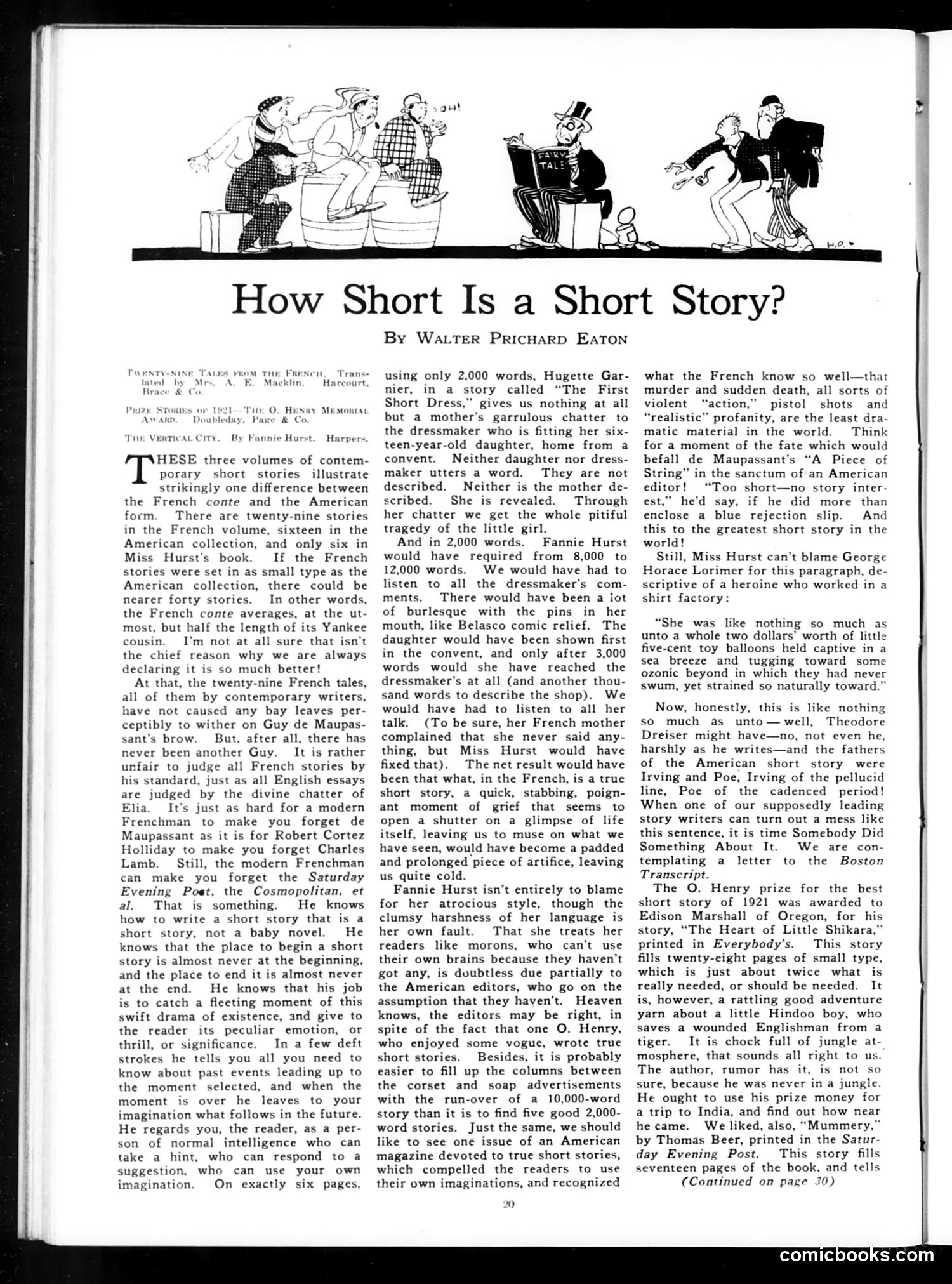
This is a **literary criticism article**, not political satire. Walter Prichard Eaton reviews three contemporary short story collections, comparing French and American writing styles. The illustrated header shows cartoon figures in various poses—likely representing different narrative approaches or writing styles, though specific identities aren't clear from the image alone. **The main point**: Eaton argues French short stories excel because they're genuinely *short*—averaging half the length of American versions—and employ restraint. French writers like those in this collection understand that effective short fiction requires: - Beginning near the end, not the beginning - Suggesting rather than describing everything - Trusting readers' intelligence He criticizes American writers (particularly **Fannie Hurst**) for padding stories with unnecessary detail, comic relief, and excessive exposition that transforms short stories into "baby novels." The satirical dig: American magazines accept bloated stories partly because editors need filler between advertisements.
📄 Transcribed text from this page (OCR, searchable)
Machine-transcribed from the original scan — historical spelling and the odd misread are preserved.
How Short Is a Short Story? Trans Harcourt PWENTY-NINE lated by Mr Brace & Co TALES FROM THE FRENCH. A. E. Macklin Tin: O. HENKY Mr Montat ay, Page & Co. Tue Vertical Crry, By Fannie Hurst. Harpers. HESE three volumes of contem- porary short stories illustrate strikingly one difference between the French conte and the American form. There are twenty-nine stories in the French volume, sixteen in the American collection, and only six in Miss Hurst's book. If the French stories were set in as small type as the American collection, there could be nearer forty stories. In other words, the French conte averages, at the ut- most, but half the length of its Yankee cousin. I'm not at all sure that isn't the chief reason why we are always declaring it is so much better! At that, the twenty-nine French tales, all of them by contemporary writers, have not caused any bay leaves per- ceptibly to wither on Guy de Maupas- sant’s brow. But. after all, there has never been another Guy. It is rather unfair to judge all French stories by his standard, just as all English essays are judged by the divine chatter of Elia. It's just as hard for a modern Frenchman to make you forget de Maupassant as it is for Robert Cortez Holliday to make you forget Charles Lamb. Still, the modern Frenchman can make you forget the Saturday Evening Poet, the Cosmopolitan, et al. That is something. He knows how to write a short story that is a short story, not a baby novel. He knows that the place to begin a short story is almost never at the beginning, and the place to end it is almost never at the end. He knows that his job is to catch a fleeting moment of this swift drama of existence, and give to the reader its peculiar emotion, or thrill, or significance. In a few deft strokes he tells you all you need to know about past events leading up to the moment selected, and when the moment is over he leaves to your imagination what follows in the future. He regards you, the reader, as a per- son of normal intelligence who can take a hint, who can respond to a suggestion, who can use your own imagination. On exactly six pages, By WALTER PRICHARD EaTON using only 2,000 words, Hugette Gar- nier, in a story called “The First Short Dress,” gives us nothing at all but a mother’s garrulous chatter to the dressmaker who is fitting her six- teen-year-old daughter, home from a convent. Neither daughter nor dress- maker utters a word. They are not described. Neither is the mother de- scribed. She is revealed. Through her chatter we get the whole pitiful tragedy of the little girl. And in 2,000 words. Fannie Hurst would have required from 8,000 to 12,000 words. We would have had to listen to all the dressmaker’s com- ments. There would have been a lot of burlesque with the pins in her mouth, like Belasco comic relief. The daughter would have been shown first in the convent, and only after 3,000 words would she have reached the dressmaker's at all (and another thou- sand words to describe the shop). We would have had to listen to all her talk. (To be sure, her French mother complained that she never said any- thing, but Miss Hurst would have fixed that). The net result would have been that what, in the French, is a true short story, a quick, stabbing, poign- ant moment of grief that seems to open a shutter on a glimpse of life itself, leaving us to muse on what we have seen, would have become a padded and prolonged piece of artifice, leaving us quite cold. Fannie Hurst isn’t entirely to blame for her atrocious style, though the clumsy harshness of her language is her own fault. That she treats her readers like morons, who can’t use their own brains because they haven't got any, is doubtless due partially to the American editors, who go on the assumption that they haven't. Heaven knows, the editors may be right, in spite of the fact that one O. Henry, who enjoyed some vogue, wrote true short stories. Besides, it is probably easier to fill up the columns between the corset and soap advertisements with the run-over of a 10,000-word story than it is to find five good 2,000- word stories. Just the same, we should like to see one issue of an American magazine devoted to true short stories, which compelled the readers to use their own imaginations, and recognized 2 what the French know so well—that murder and sudden death, all sorts of violent “action,” pistol shots and “realistic” profanity, are the least dra- matic material in the world. Think for a moment of the fate which would befall de Maupassant’s “A Piece of String” in the sanctum of an American editor! “Too short—no story inter- est,” he'd say, if he did more than enclose a blue rejection slip. And this to the greatest short story in the world! Still, Miss Hurst can’t blame George Horace Lorimer for this paragraph, de- scriptive of a heroine who worked in a shirt factory: “She was like nothing so much as unto a whole two dollars’ worth of little five-cent toy balloons held captive in a sea breeze and tugging toward some ozonic beyond in which they had never swum, yet strained so naturally toward.” Now, honestly, this is like nothing so much as unto—well, Theodore Dreiser might have—no, not even he, harshly as he writes—and the fathers of the American short story were Irving and Poe, Irving of the pellucid line, Poe of the cadenced period! When one of our supposedly leading story writers can turn out a mess like this sentence, it is time Somebody Did Something About It. We are con- templating a letter to the Boston Transcript. The O. Henry prize for the best short story of 1921 was awarded to Edison Marshall of Oregon, for his story, “The Heart of Little Shikara,” printed in Everybody's. This story fills twenty-eight pages of small type, which is just about twice what is really needed, or should be needed. It is, however, a rattling good adventure yarn about a little Hindoo boy, who saves a wounded Englishman from a tiger. It is chock full of jungle at- mosphere, that sounds all right to us The author, rumor has it, is not so sure, because he was never in a jungle He ought to use his prize money for a trip to India, and find out how near he came. We liked, also, “Mummery,” by Thomas Beer, printed in the Satur- day Evening Post. This story fills seventeen pages of the book, and tells (Continued on page 30) comicbooks.com