
Judge, 1922-06-03 · page 21 of 36
Judge — June 3, 1922 — page 21: what you’re looking at
What you’re looking at
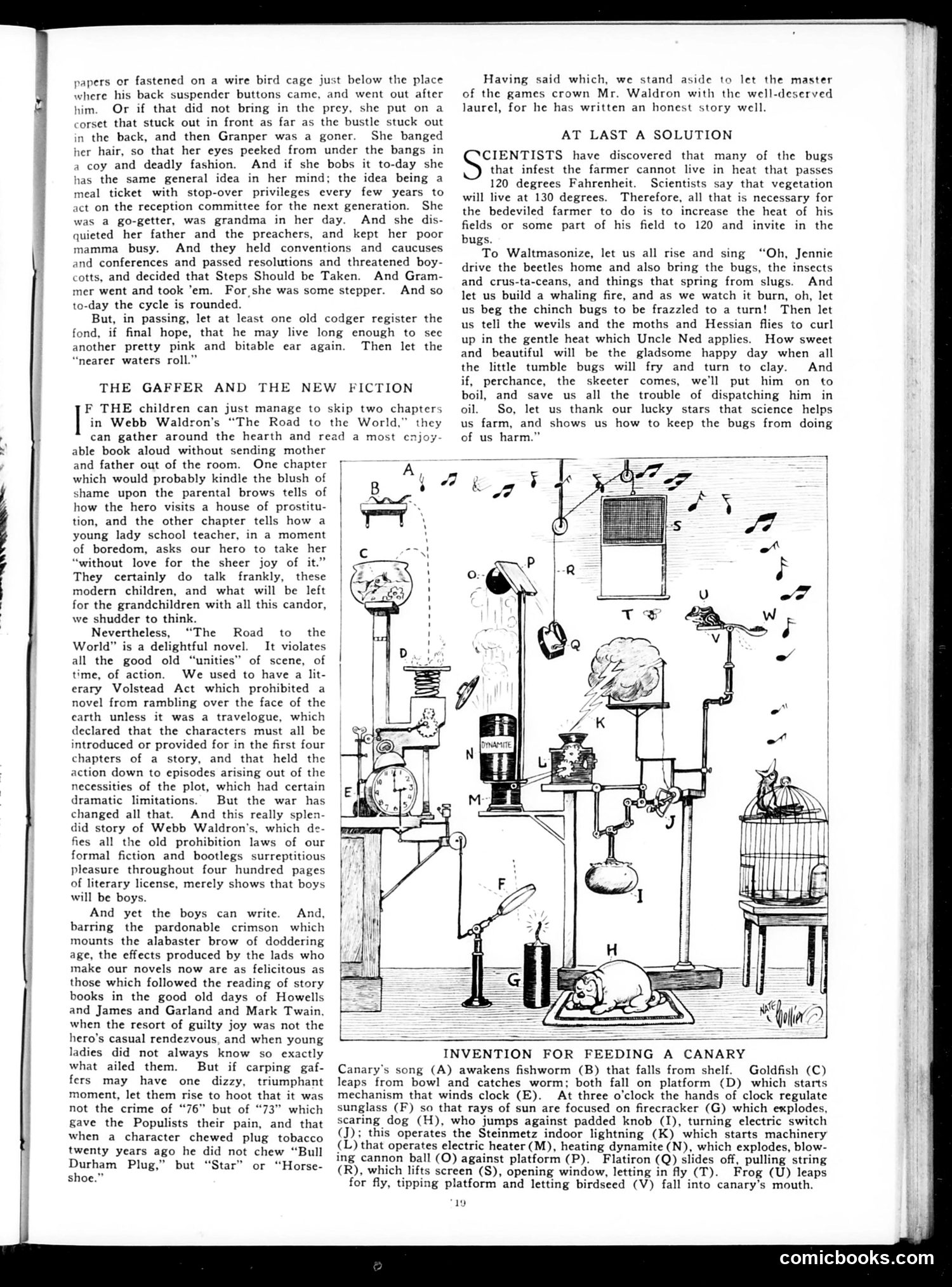
This page contains two distinct pieces of satirical commentary: **"The Gaffer and the New Fiction"** critiques modern literature's moral frankness. The author notes that Webb Waldron's novel "The Road to the World" contains scenes of prostitution and extramarital relations that would shock previous generations. The satire compares pre-war fiction's strict rules (the "literary Volstead Act"—a Prohibition reference) to current "bootleg" literary license. The writer simultaneously praises the novel's quality while lamenting that modern writers can discuss such candid topics, joking "boys will be boys." This reflects 1920s anxiety about post-WWI cultural shifts and loosening moral standards in literature. **"At Last a Solution"** satirizes pseudo-scientific farming advice, likely referencing a real proposal to heat farmland to kill pests while preserving crops. The deadpan suggestion—that farmers simply raise their field temperature to 120 degrees—mocks impractical or absurd agricultural "innovations" being marketed to farmers. **The illustration** at bottom shows a Rube Goldberg-style "Invention for Feeding a Canary," typical Judge fare: elaborate mechanical absurdity.
📄 Transcribed text from this page (OCR, searchable)
Machine-transcribed from the original scan — historical spelling and the odd misread are preserved.
SO ——— papers or fastened on a wire bird cage just below the place where his back suspender buttons came, and went out after him. Or if that did not bring in the prey, she put on a corset that stuck out in front as far as the bustle stuck out in the back, and then Granper was a goner. She banged her hair, so that her eyes peeked from under the bangs in a coy and deadly fashion. And if she bobs it to-day she has the same general idea in her mind; the idea being a meal ticket with stop-over privileges every few years to act on the reception committee for the next generation. She was a go-getter, was grandma in her day. And she dis- quieted her father and the preachers, and kept her poor mamma busy. And they held conventions and caucuses and conferences and passed resolutions and threatened boy- cotts, and decided that Steps Should be Taken. And Gram- mer went and took ’em. For she was some stepper. And so to-day the cycle is rounded. But, in passing, let at least one old codger register the fond, if final hope, that he may live long enough to sec another pretty pink and bitable ear again. Then let the “nearer waters roll.” THE GAFFER AND THE NEW FICTION F THE children can just manage to skip two chapters in Webb Waldron’s “The Road to the World,” they can gather around the hearth and read a most enjoy able book aloud without sending mother and father out of the room. One chapter which would probably kindle the blush of shame upon the parental brows tells of how the hero visits a house of prostitu- tion, and the other chapter tells how a young lady school teacher, in a moment of boredom, asks our hero to take her “without love for the sheer joy of it.” They certainly do talk frankly, these modern children, and what will be left for the grandchildren with all this candor, we shudder to think. Nevertheless, “The Road to the World” is a delightful novel. It violates all the good old “unities” of scene, of time, of action. We used to have a lit- erary Volstead Act which prohibited a novel from rambling over the face of the earth unless it was a travelogue, which declared that the characters must all be introduced or provided for in the first four chapters of a story, and that held the action down to episodes arising out of the necessities of the plot, which had certain dramatic limitations. But the war has changed all that. And this really splen- did story of Webb Waldron’s, which de- fies all the old prohibition laws of our formal fiction and bootlegs surreptitious pleasure throughout four hundred pages of literary license, merely shows that boys will be boys. And yet the boys can write. And, barring the pardonable crimson which mounts the alabaster brow of doddering age, the effects produced by the lads who make our novels now are as felicitous as those which followed the reading of story books in the good old days of Howells and James and Garland and Mark Twain, when the resort of guilty joy was not the Having said which, we stand aside to let the master of the games crown Mr. Waldron with the well-deserved laurel, for he has written an honest story well. AT LAST A SOLUTION CIENTISTS have discovered that many of the bugs that infest the farmer cannot live in heat that passes 120 degrees Fahrenheit. Scientists say that vegetation will live at 130 degrees. Therefore, all that is necessary for the bedeviled farmer to do is to increase the heat of his fields or some part of his field to 120 and invite in the bugs. To Waltmasonize, let us all rise and sing “Oh, Jennie drive the beetles home and also bring the bugs, the insects and crus-ta-ceans, and things that spring from slugs. And let us build a whaling fire, and as we watch it burn, oh, let us beg the chinch bugs to be frazzled to a turn! Then let us tell the wevils and the moths and Hessian flies to curl up in the gentle heat which Uncle Ned applies. How sweet and beautiful will be the gladsome happy day when all the little tumble bugs will fry and turn to clay. And if, perchance, the skeeter comes, we'll put him on to boil, and save us all the trouble of dispatching him in oil. So, let us thank our lucky stars that science helps us farm, and shows us how to keep the bugs from doing of us harm.” hero’s casual rendezvous, and when young ladies did not always know so exactly what ailed them. But if carping gaf- fers may have one dizzy, triumphant moment, let them rise to hoot that it was not the crime of “76” but of “73” which gave the Populists their pain, and that when a character chewed plug tobacco twenty years ago he did not chew “Bull Durham Plug,” but “Star” or ‘Horse- shoe.” INVENTION FOR FEEDING A CANARY Canary’s song (A) awakens fishworm (B) that falls from shelf. leaps from bowl and catches worm; both fall on platform (D) which starts mechanism that winds clock (E). sunglass (F) so that rays of sun are focused on firecracker (G) which explodes, scaring dog (H), who jumps against padded knob (I), turning electric switch (J); this operates the Steinmetz indoor lightning (K) which starts machinery (L) that operates electric heater (M), heating dynamite (N), which explodes, blow- ing cannon ball (O) against platform (P). (R), which lifts screen (S), opening window, letting in fly (T). for fly, tipping platform and letting birdseed (V) fall into canary’s mouth. Goldfish (C) At three o'clock the hands of clock regulate Flatiron (Q) slides off, pulling string Frog (U) leaps 9 comicbooks.com