
A complete issue · 36 pages · 1922
Judge — May 27, 1922
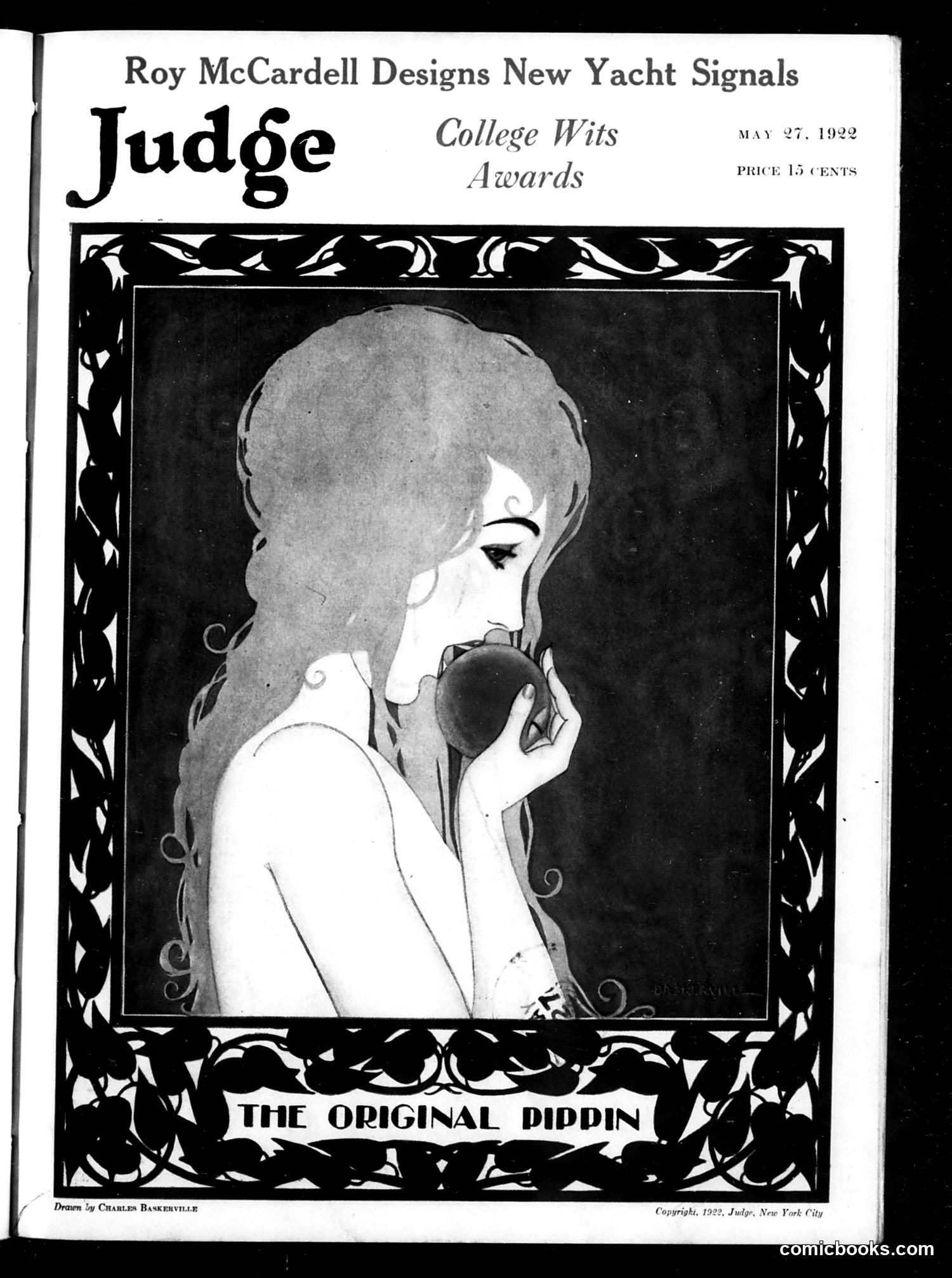
This is a **Judge magazine cover from May 27, 1922**. The main illustration, titled "The Original Biddin'," shows a woman in profile eating an apple, with decorative art deco-style borders. The title appears to reference **"The Original Sin"** (the biblical reference to Eve eating the forbidden fruit), making a visual pun with "biddin'" (bidding/auction terminology). The joke likely satirizes contemporary courtship or marriage practices—perhaps commenting on women's newfound independence and dating choices in the 1920s Jazz Age. The cover also advertises "Roy McCardell Designs New Yacht Signals" and "College Wits Awards," suggesting the magazine contained various satirical articles on contemporary culture and society.
This page is **primarily advertising and editorial promotion** rather than political satire or cartoon content. The headline "Does Your Handwriting Spell Success?" introduces an article about chirography (handwriting analysis) by William Leslie French, a graphology expert who claimed to predict success from penmanship. The bulk of the text promotes various features in that week's Judge magazine, including articles on China's civil war by Guy Morrison Walker, swimming advancement, Kentucky caverns, and Theodore Waters' consumer-warning series "Brokers and Breakers." The page concludes with promotional language encouraging readers to subscribe to Leslie's weekly publication. There is **no visible political cartoon or satirical illustration** on this particular page—it functions as a table of contents/advertisement hybrid.
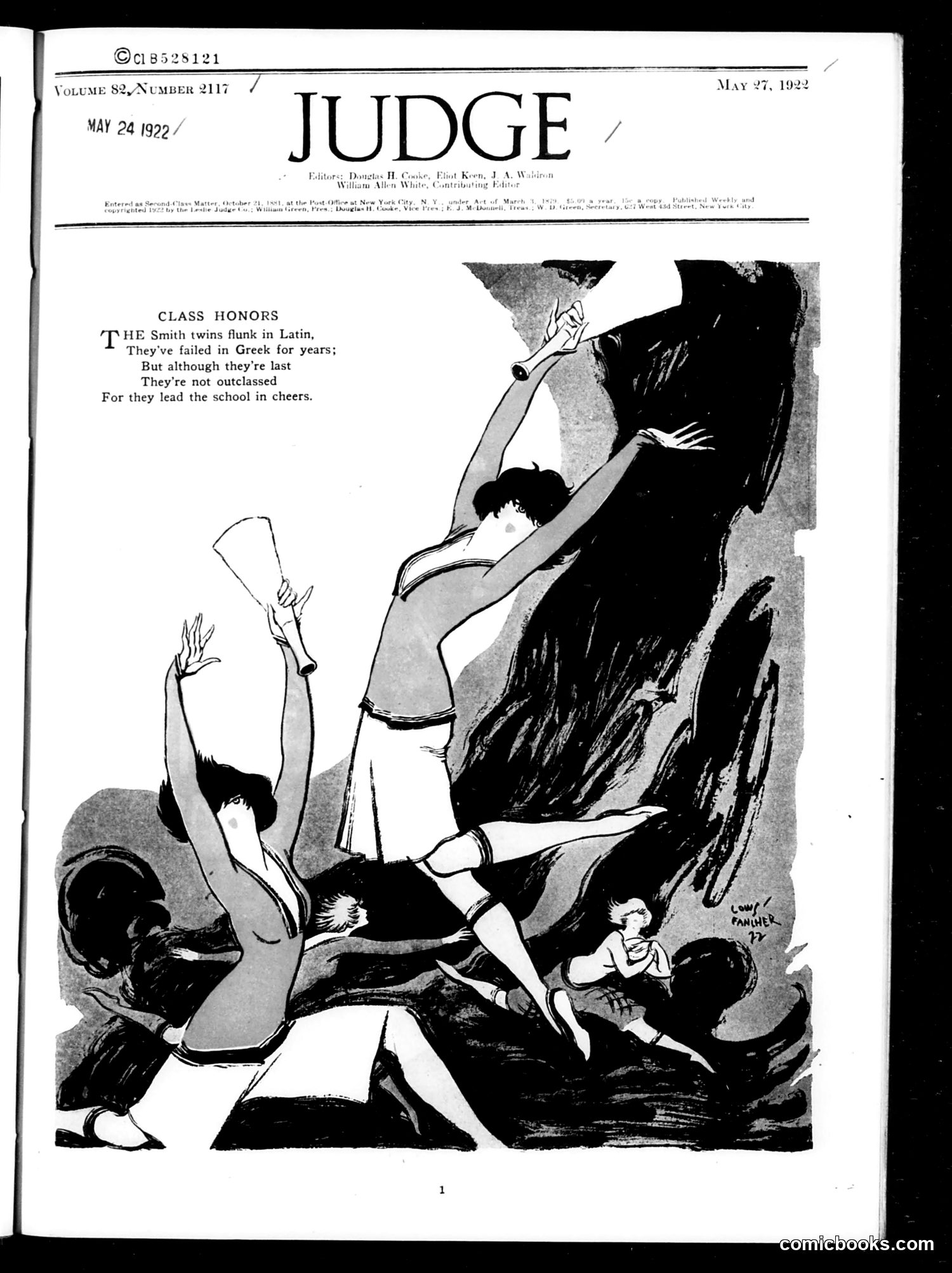
This satirical cartoon mocks students who excel at school spirit and cheerleading despite academic failure. The poem text reveals the joke: the Smith twins "flunk in Latin" and "failed in Greek for years," yet they lead school cheers and are honored for it. The illustration shows exuberant cheerleaders in dynamic poses with cherub-like figures, emphasizing the frivolous nature of their achievement. The satire criticizes an educational system that rewards social popularity and extracurricular enthusiasm over actual academic performance. This reflects 1920s concerns about American education priorities—the tension between academic rigor and student social life. The cartoon suggests schools were celebrating the wrong accomplishments.
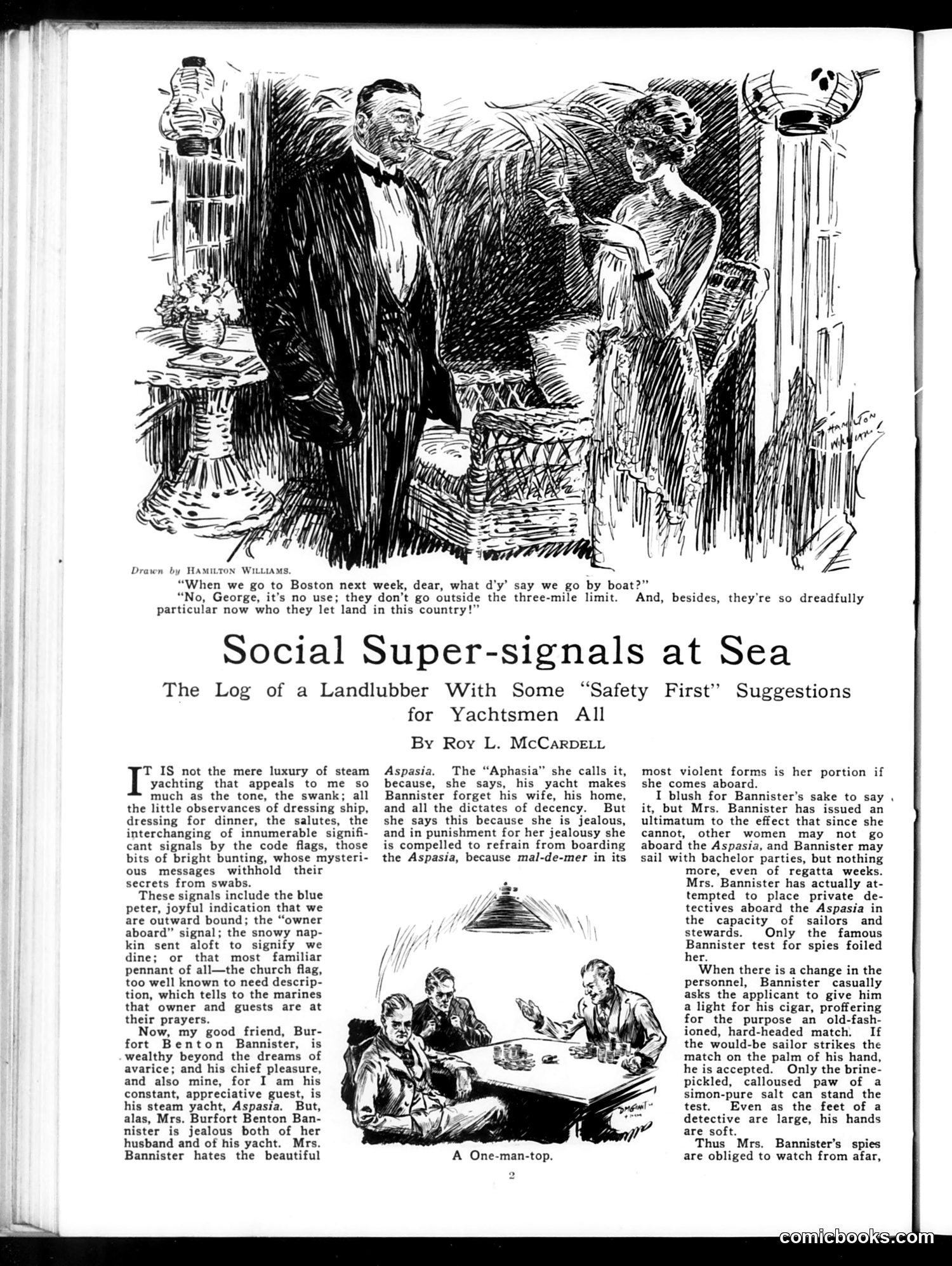
This satirical article by Roy L. McCardell mocks wealthy yachtsmen's social pretensions. The top cartoon depicts a gentleman explaining maritime etiquette to a woman, referencing a yacht owner's jealous wife who forbids boarding his vessel *Aspasia* (likely alluding to the historical Aspasia, mistress of Pericles). The humor targets how wealthy leisure-class men use yachts as exclusive social clubs while their spouses resent exclusion. McCardell satirizes the absurd "signals" and rituals—flag codes, cigar-lighting tests, physical examinations—that yacht captains employ to screen crew and guests, treating yacht society as ridiculously pretentious. The lower illustration showing men at a table depicts yacht life's supposed refinement. The satire suggests wealthy yachtsmen create elaborate, snobbish protocols to maintain social hierarchies among the leisure elite.
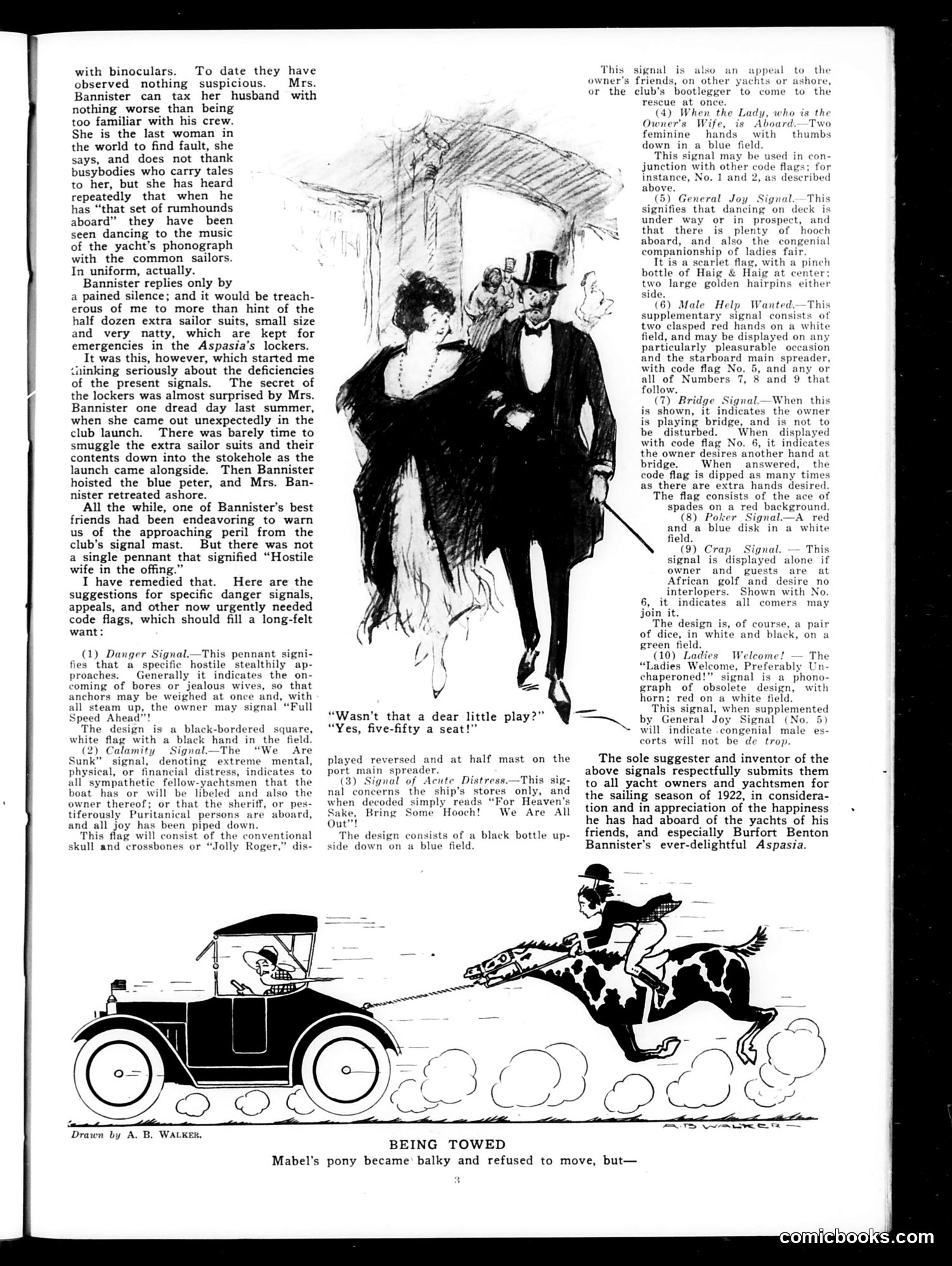
This page satirizes yacht-club society and nautical signaling. The main narrative describes Mrs. Bannister, a wealthy yacht owner, who uses various flag signals to communicate dangers and social situations to other vessels—including codes for approaching threats, mental distress, and social emergencies. The upper illustration shows a fashionable woman in an elaborate fur coat being helped aboard a yacht, captioned "Wasn't that a dear little play? Yes, five-fifty a seat!" The lower cartoon by A.B. Walker depicts a woman on a bucking cow being towed behind an automobile, captioned "Mabel's pony became balky and refused to move, but—" The satire targets upper-class pretension, absurd signaling systems for trivial social matters, and the comic misadventures of the wealthy leisure class.
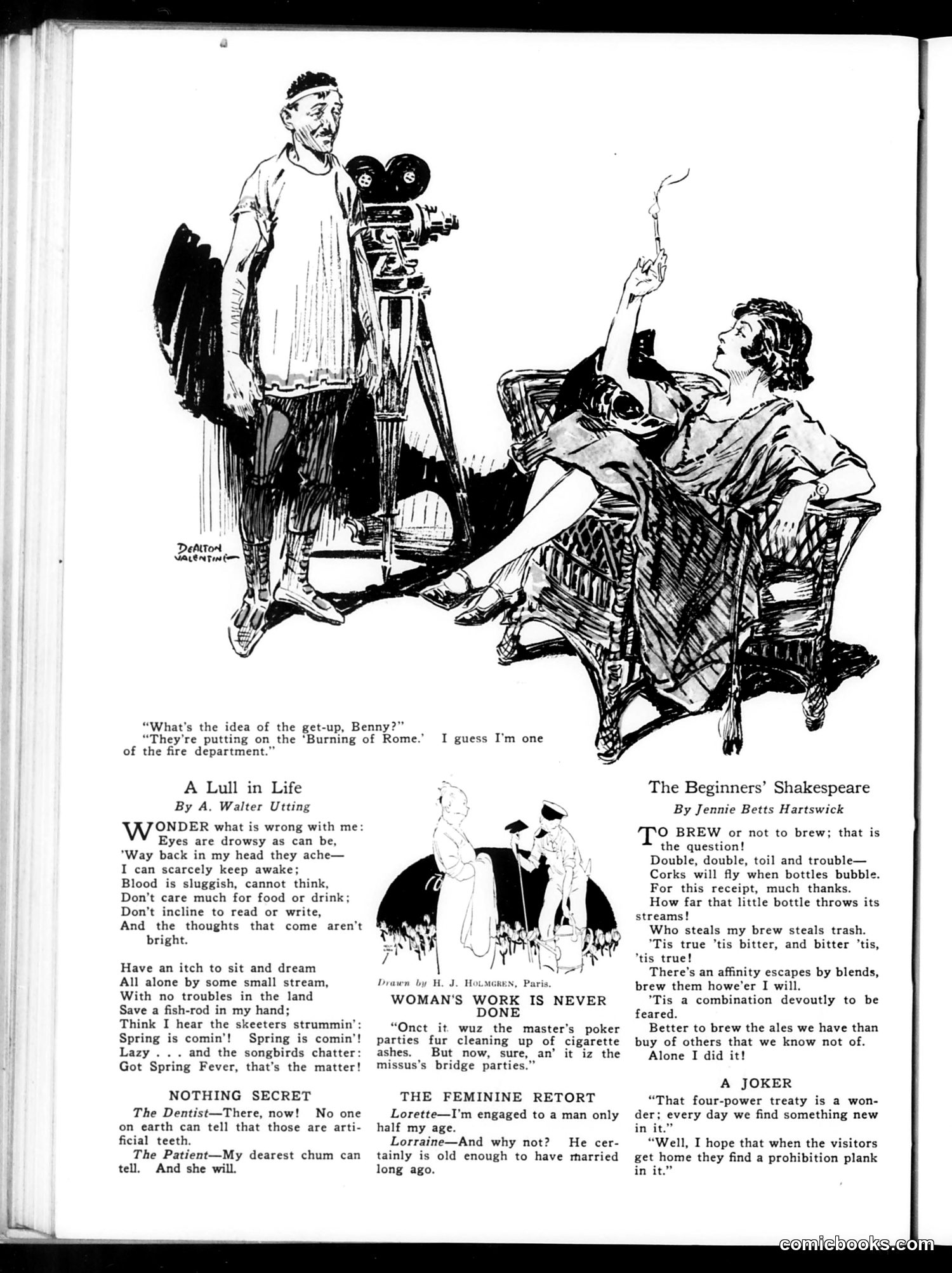
The top cartoon shows a film director operating a movie camera while speaking to an actress. The dialogue references "the get-up, Benny" and "Burning of Rome," suggesting they're filming a historical epic. The director notes he's "one of the fire department"—likely satirizing how early cinema productions created spectacles, sometimes with dangerous or questionable methods. The remaining content consists of humorous poetry and brief comedic sketches unrelated to the cartoon, including "A Lull in Life," "Nothing Secret," "The Feminine Retort," and "A Joker." These appear to be typical magazine filler humor rather than political satire. The page overall reflects early 20th-century attitudes toward the emerging film industry and domestic life humor.
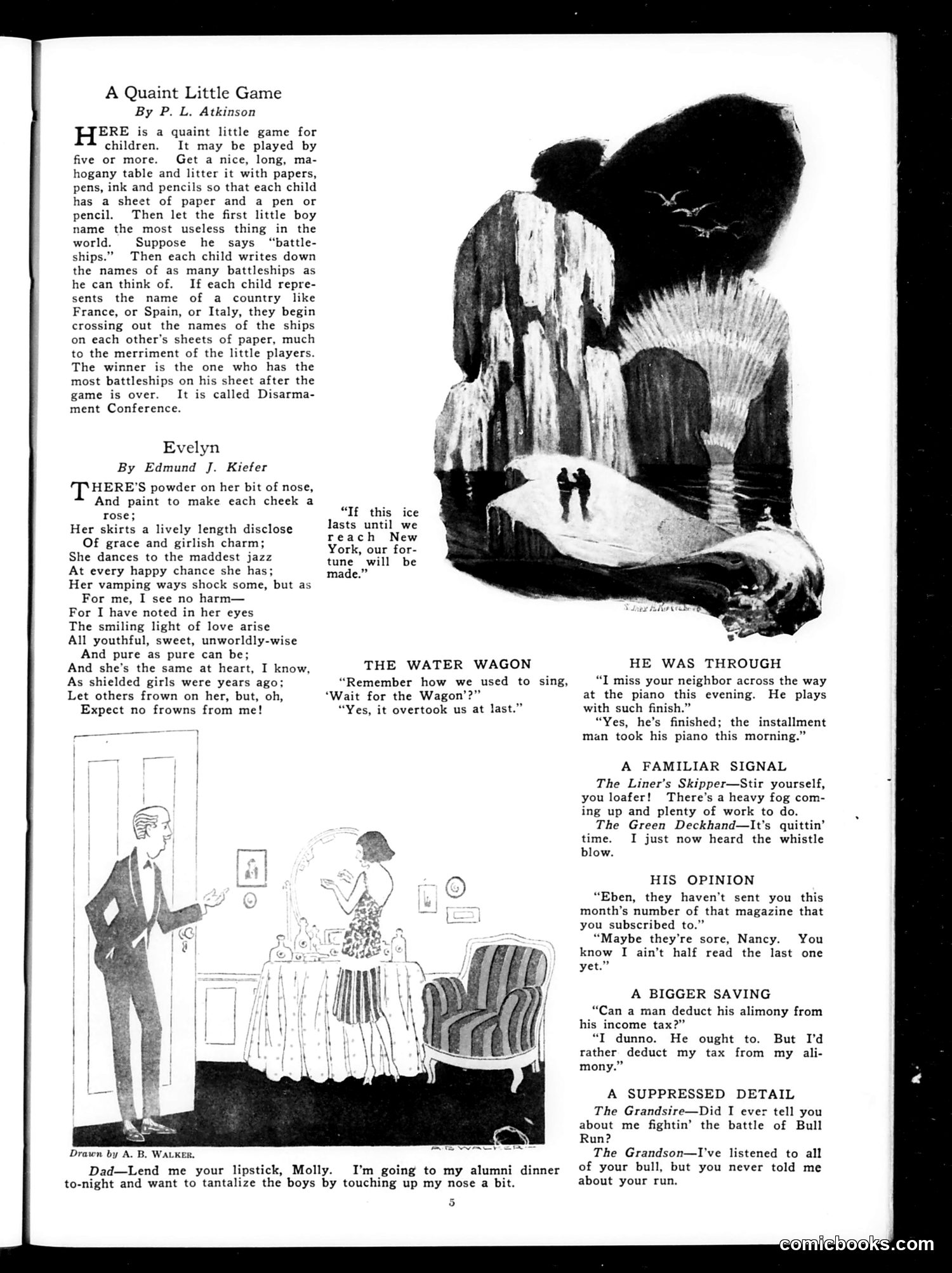
This page contains satirical commentary on 1920s American society through multiple short pieces: **"A Quaint Little Game"** mocks the League of Nations' Disarmament Conference through a children's game metaphor. The "game" involves countries (represented as children) competing to eliminate each other's battleships—satirizing the period's peace efforts as naive child's play unlikely to achieve real disarmament. **"Evelyn"** celebrates modern flapper culture—the short skirts, makeup, and jazz dancing scandalized older generations—while defending young women as fundamentally unchanged in virtue beneath their contemporary style. The remaining vignettes are domestic humor about modern marriage, alimony taxes, piano repossession, and work ethic—typical light satirical fare of the era. The illustrated cartoon shows a man borrowing cosmetics before a social dinner, referencing appearance-obsession among the social elite. Overall, the page reflects Jazz Age anxieties about modernity, generational change, and international politics.
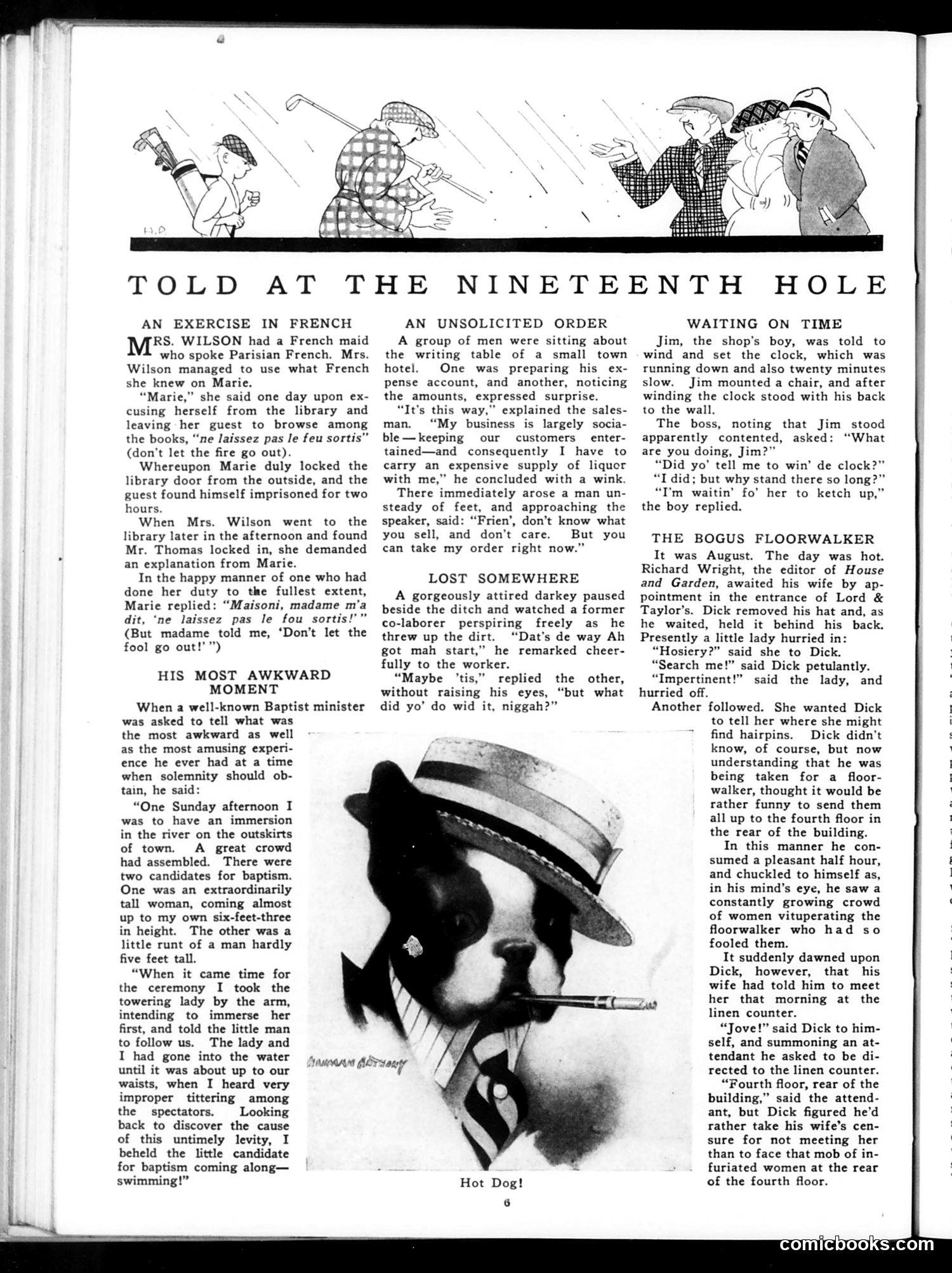
This page collects humorous anecdotes typical of *Judge* magazine's satirical style. The title references golf's nineteenth hole—a bar where golfers tell stories. The cartoons and stories employ period stereotypes: a French maid mishears English as French, resulting in locking away a "fool" instead of preventing fire from escaping. A Baptist minister's baptism is undermined when a short man candidate must swim rather than walk. A traveling salesman drinks heavily under the guise of business entertaining. The final story features a crude racial slur in dialogue between two Black laborers about work and money. The "Bogus Floorwalker" anecdote mocks mistaken identity when a well-dressed man waiting for his wife is repeatedly approached by female shoppers assuming he works at Lord & Taylor's. These pieces target pretension, miscommunication, and social awkwardness—standard *Judge* fare satirizing American middle-class life and contemporary attitudes.
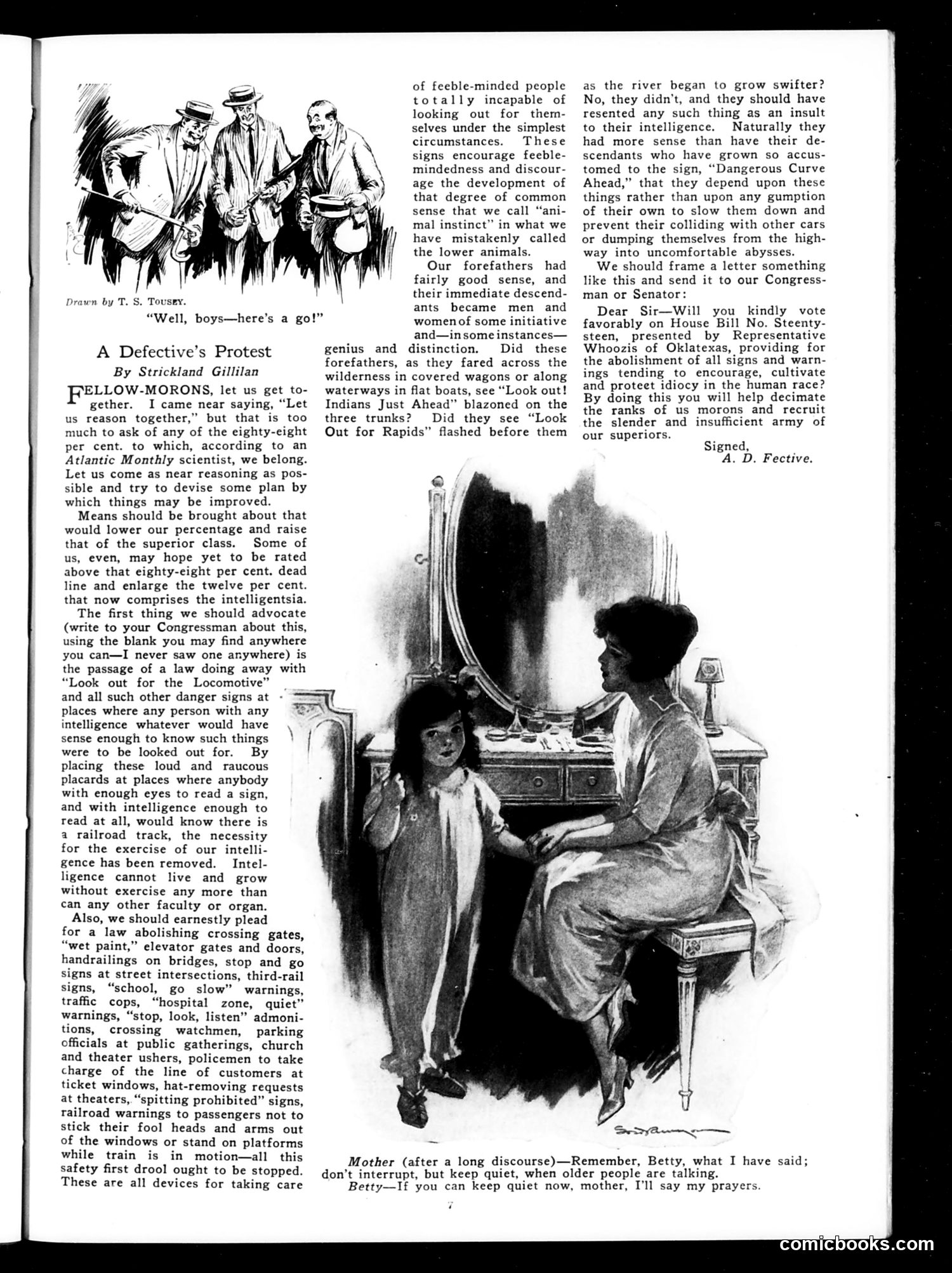
This page satirizes American attitudes toward public safety and intelligence through a sardonic argument attributed to "A Defective's Protest." **The Satire:** The author (Strickland Gillilan) proposes eliminating all safety warnings—railroad crossing signs, "wet paint" notices, handrails, traffic signals, etc.—claiming they cater to the "feeble-minded" and atrophy our natural intelligence. He argues our ancestors survived without such signs, so modern warnings insult our capabilities. **The Point:** This is **ironic mockery**. The piece ridicules people who resent safety regulations as paternalistic infantilization, yet simultaneously reveals how dangerous such thinking is. By framing safety devices as insulting to intelligence, Gillilan exposes the illogical pride and stubbornness behind resistance to public safety measures—showing that rejecting helpful warnings actually demonstrates *lack* of sense, not abundance of it. **The Illustration:** Shows a mother attempting to teach her daughter restraint while visiting (social etiquette), illustrating the tension between supervision/guidance and independence—reinforcing the essay's theme about necessary safeguards. The satire targets Progressive-era debates over government regulation and individual responsibility.
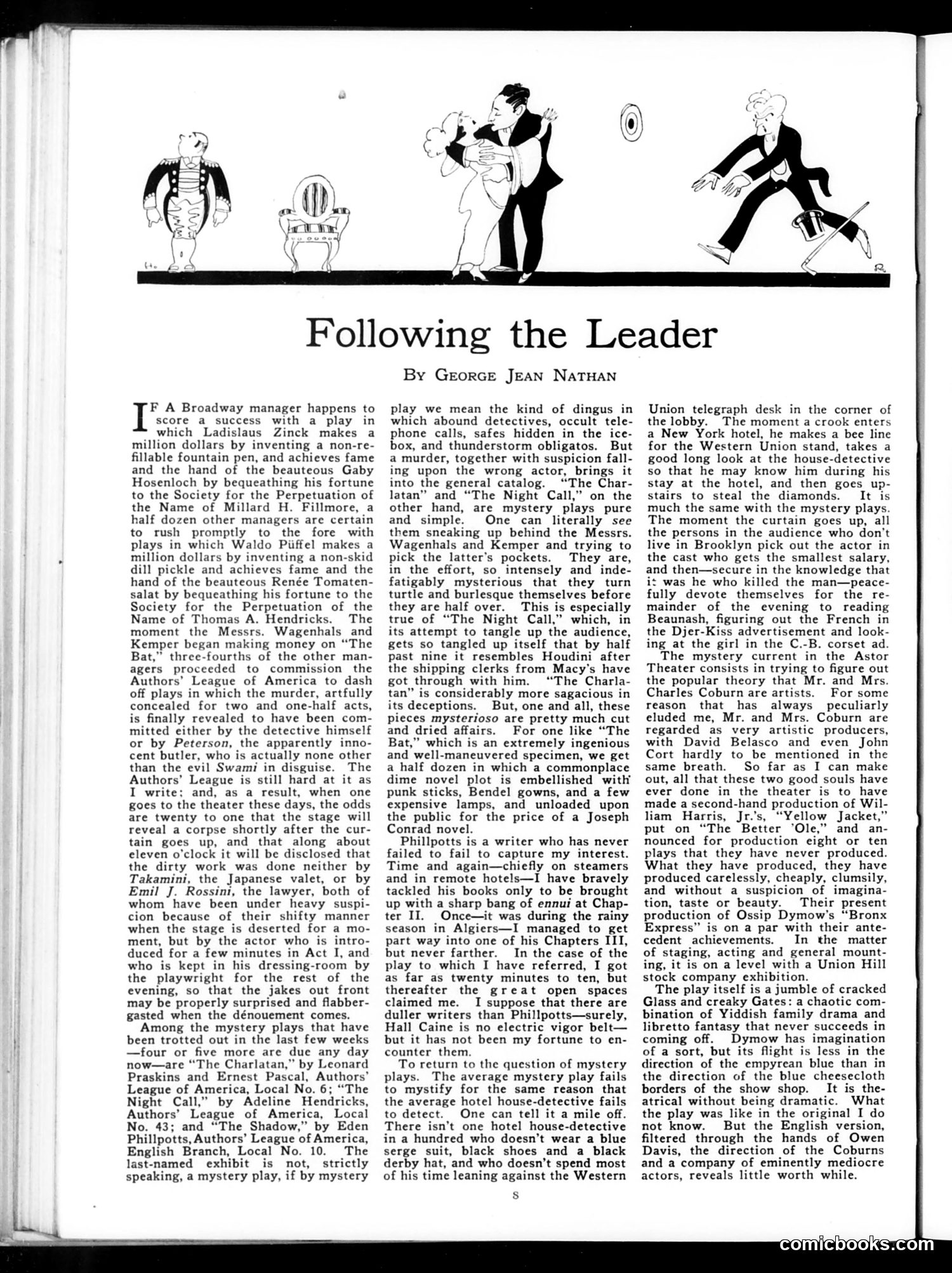
This article by George Jean Nathan satirizes Broadway's herd mentality. Nathan argues that when one play succeeds—using absurdly specific examples like a fountain-pen inventor named Ladislaus Zinck—dozens of competing managers immediately rush to produce nearly identical plays with interchangeable plots (pickle inventors, lawyer characters, mysterious butlers). His primary target is the mystery-play craze. Nathan mocks how productions like "The Bat," "The Charlatan," and "The Night Call" follow a tired formula: murders, false suspects (Japanese valets, shifty lawyers, innocent butlers), and predictable reveal scenes. He particularly skewers "The Night Call" for becoming so convoluted it "resembles Houdini after the shipping clerks from Macy's have got through with him." The cartoon above depicts this "following the leader" concept visually—each figure mimics the previous one's posture and behavior, illustrating Nathan's point about Broadway's lack of originality and creative independence.
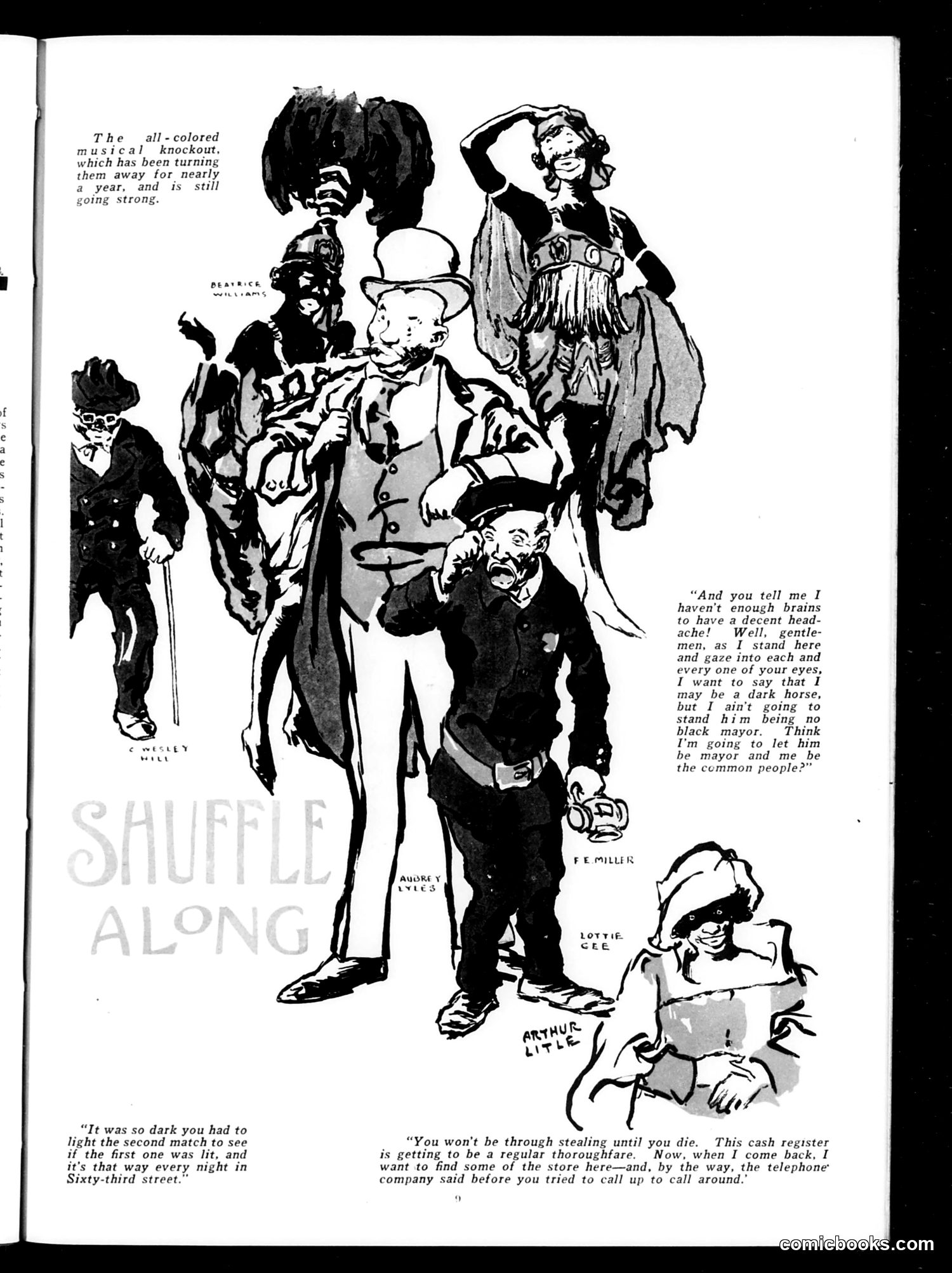
This page from *Judge* magazine satirizes an all-Black musical revue that has been running successfully for nearly a year. The main cartoon depicts characters from this show alongside figures discussing politics and crime in early 20th-century urban America. The speech bubble references a "dark horse" candidate refusing to accept a "black mayor," reflecting racist anxieties about Black political participation. Other dialogue jokes about crime on "Sixty-third street" and a character's habitual theft from a cash register, using stereotypical caricatures common to the era's racist humor. The caption credits artists including "Shuffle Along" cast members (Aubrey Lyles, F.E. Miller, Lottie Gee, Arthur Little visible as labels), referencing the famous 1921 Broadway show. The satire conflates entertainment success with criminal stereotypes and political resistance, reflecting the period's casual racial mockery presented as humor in mainstream publications.
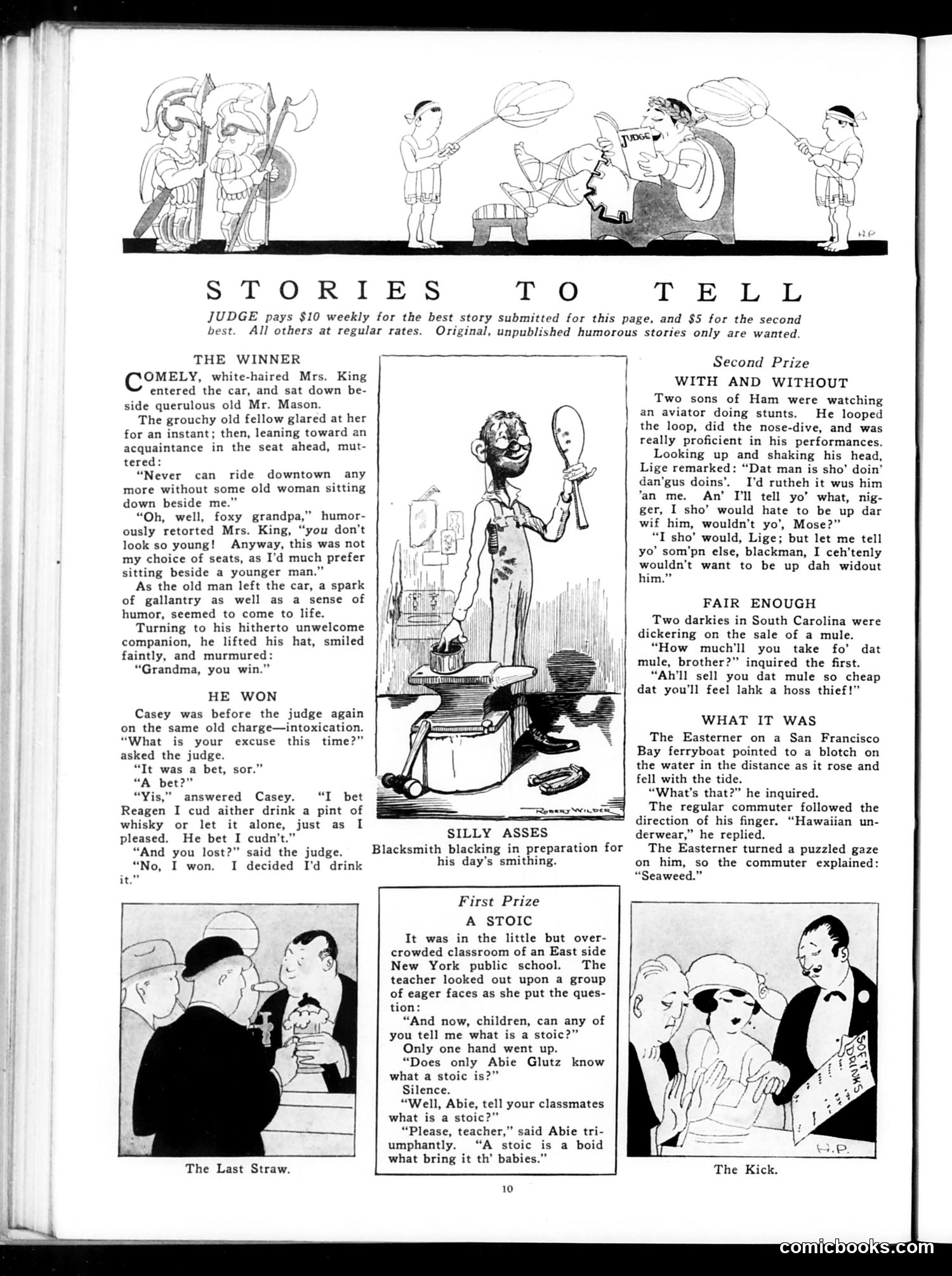
This is a humor submission page from *Judge* magazine featuring six short comedic stories competing for cash prizes ($10 for first place, $5 for second). **The winning story**, "The Winner," depicts a gentle class-conflict joke: a working-class woman (Mrs. King) boards a streetcar and sits beside a grouchy elderly man (Mr. Mason) who mutters complaints about "old women." She retorts with good humor, and his gallantry awakens—he tips his hat and concedes "Grandma, you win." **Other notable stories include**: - "He Won": An Irish immigrant (Casey) wins a bet by choosing to drink whisky - "With and Without": Uses racist dialect to depict Black men discussing an aviator - "Fair Enough": Similar racist content about mule-trading - "A Stoic": A joke about an East Side Jewish schoolboy (Abie Glutz) misidentifying a stork as a "stoic" The page reflects early 20th-century *Judge* content: gentle class humor alongside casual ethnic and racial stereotyping presented as entertainment. The stereotypical dialects and caricatures reflect period attitudes toward immigrants and Black Americans.
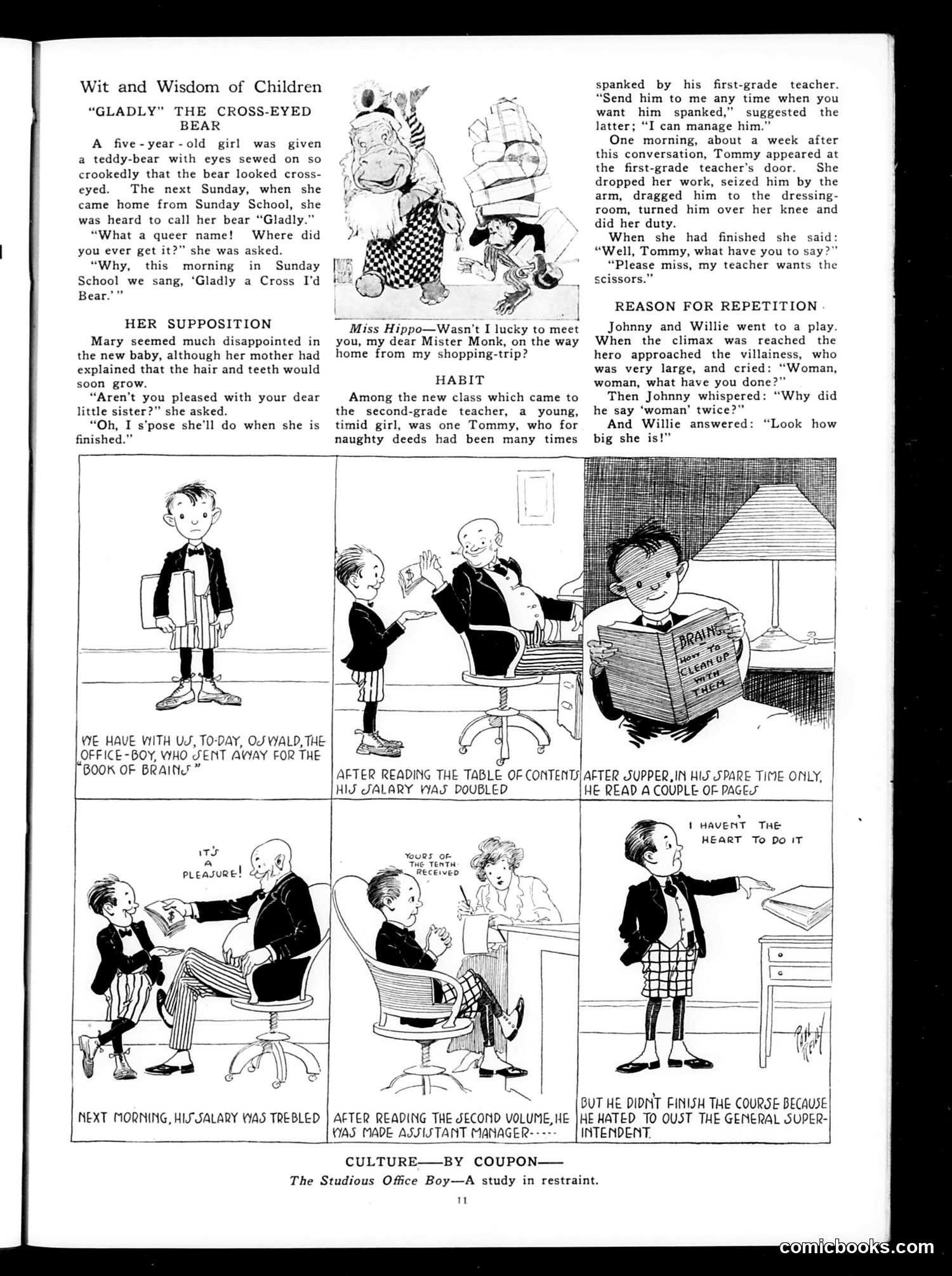
This Judge magazine page satirizes early-20th-century self-improvement culture through comic anecdotes. The main cartoon, "The Studious Office Boy," mocks the popular "mail-order self-help" industry. An office boy orders a correspondence "Book of Brains," and his workplace rewards escalate absurdly (salary doubled, then tripled) based merely on reading a table of contents and a couple pages. The final panel undercuts the satire: he abandons the course because completing it would require firing his boss, the general superintendent—revealing the real barrier to ambition isn't education but workplace hierarchy and loyalty. The surrounding short jokes about children play on linguistic misunderstandings: a girl names her teddy bear "Gladly" after mishearing the hymn "Gladly the Cross I'd Bear"; a disappointed sister expects her newborn sibling to improve once "finished." The implicit critique: quick-fix educational products promise self-advancement, yet actual progress in rigid hierarchies remains impossible regardless of learning.
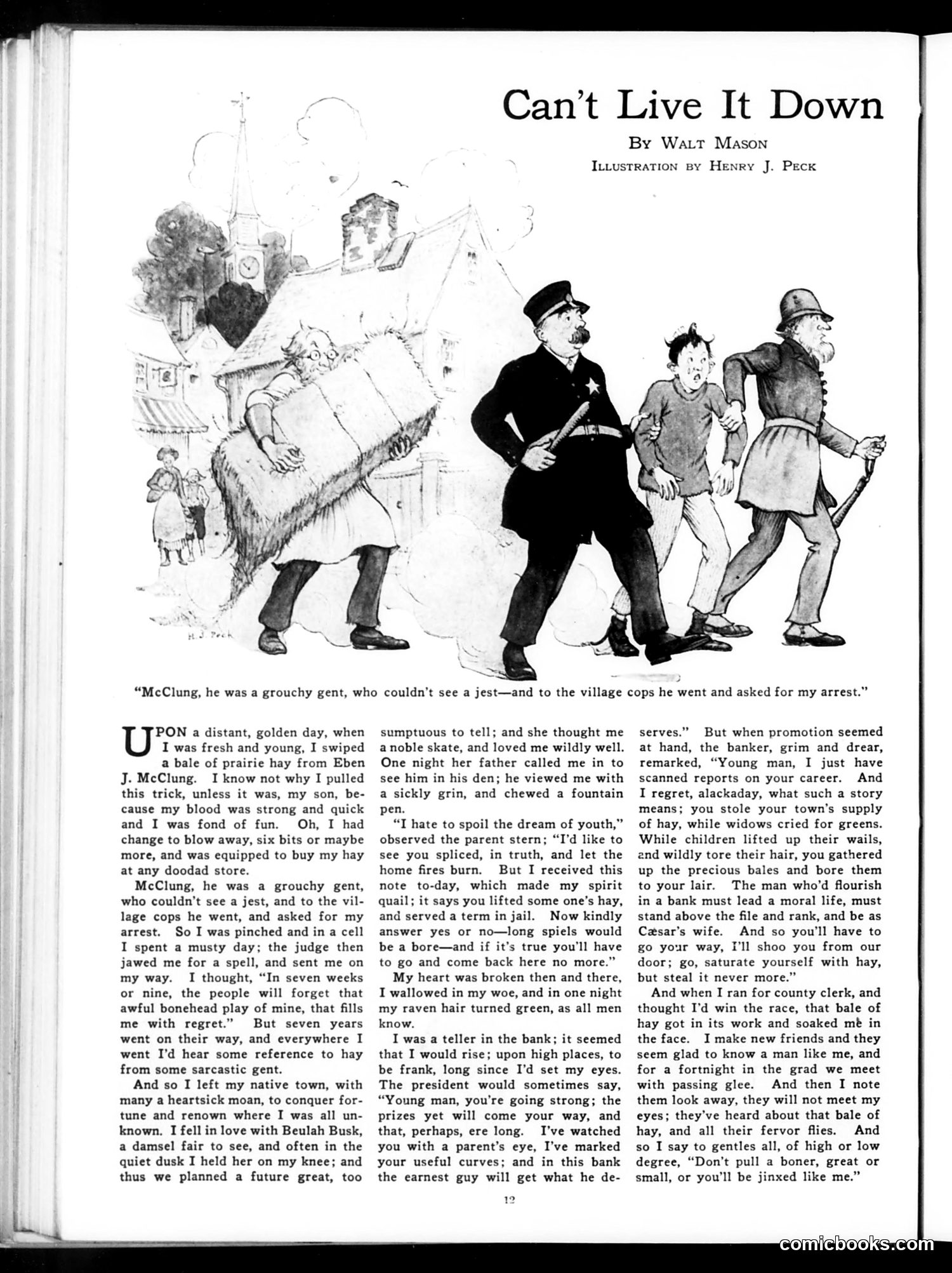
This is a cautionary tale illustrated by Henry J. Peck, presenting a moral lesson about youthful pranks having lifelong consequences. The protagonist steals a bale of hay as a young, mischievous man from farmer Eben J. McClung. Though arrested and briefly jailed, he assumes the incident will be forgotten. However, the theft becomes a permanent stain on his reputation that follows him for seven years and beyond, derailing his life prospects. The story documents three specific moments where the old incident resurfaces: when seeking to marry Beulah Busk (her father refuses him), when pursuing a bank promotion (the banker denies advancement), and when running for county clerk (voters reject him). Each time, the remembered hay theft undermines his aspirations. The satire critiques both small-town gossip culture—which obsessively preserves and repeats social transgressions—and the rigid moral standards of the era, where a minor youthful indiscretion becomes permanently disqualifying. The moral: "Don't pull a boner...or you'll be jinxed like me."
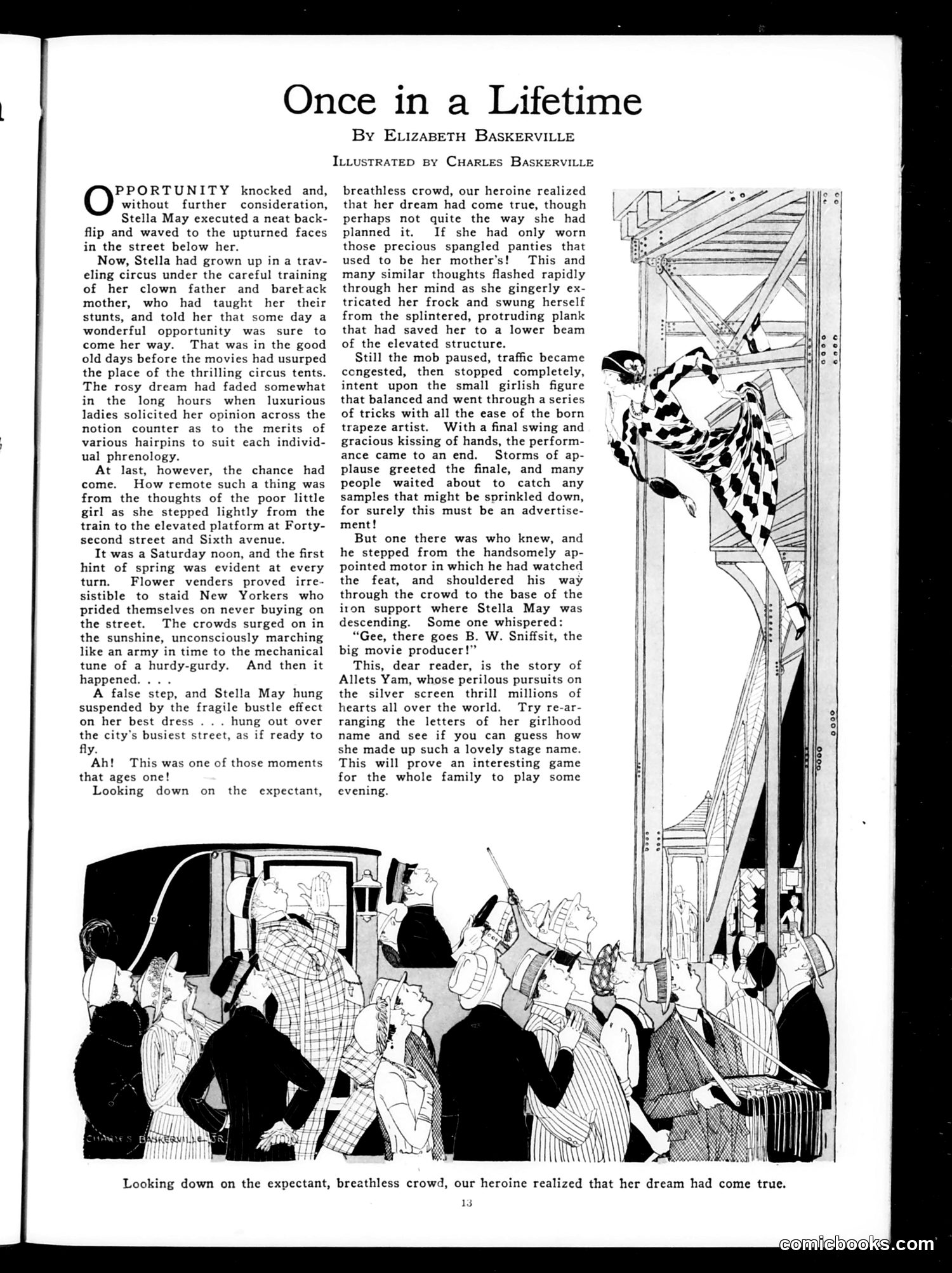
This story satirizes Hollywood's emergence as entertainment competition against traditional circus performance. Stella May, a circus performer's daughter working mundane retail, accidentally performs acrobatic tricks while dangling from a broken elevated train platform in Manhattan. A crowd gathers, assuming it's a movie advertisement—reflecting how thoroughly cinema had saturated public consciousness by the 1920s. The satire targets: (1) Hollywood's manufactured "discovery" narratives, (2) how movie producers could spot talent anywhere, turning accidents into publicity, and (3) the era's obsession with cinema as spectacle replacing live performance. The "B.W. Sniffsit" producer character represents the ruthless industry scouts. The final puzzle—rearranging "Allets Yam" into a stage name—mocks how studios fabricated exotic identities for starlets. The joke emphasizes how thoroughly cinema had colonized American dreams and public attention by this period.
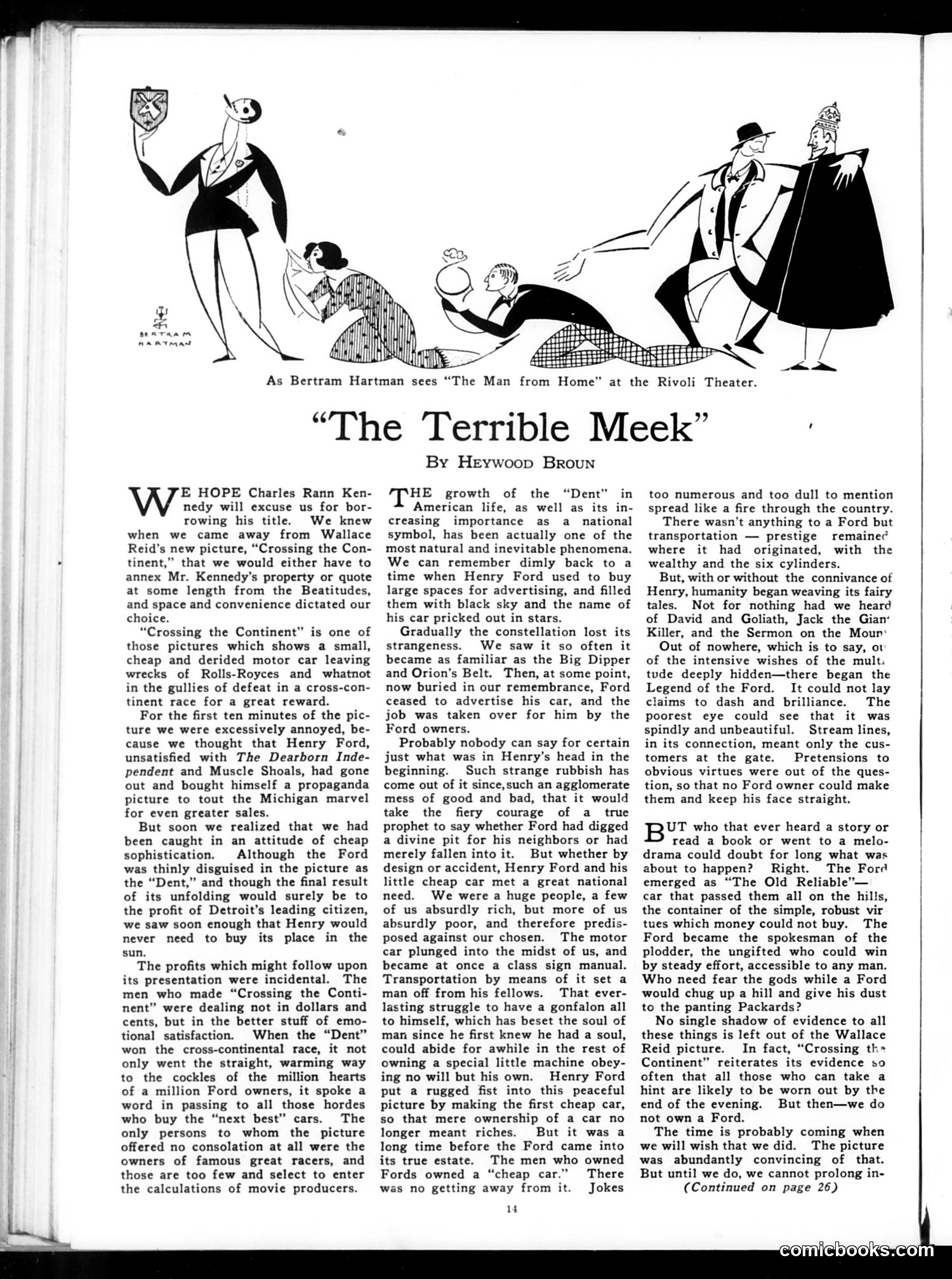
**The cartoon** at top depicts the film "The Man from Home" at the Rivoli Theater, showing elegantly dressed figures in exaggerated poses—likely mocking theatrical melodrama or social pretension. **The article** by Heywood Broun analyzes the film "Crossing the Continent," which features a cheap car (the "Dent," thinly disguised Ford) defeating luxury vehicles in a cross-continental race. **The satire's point:** Broun praises this film not as propaganda for Henry Ford, but as emotionally satisfying populist storytelling. The article celebrates how Ford's affordable automobile democratized transportation for America's poor majority, breaking through rigid class distinctions. By making cars accessible beyond the wealthy elite, Ford unknowingly created a national symbol of mobility and social equality. **The joke:** Even if Ford didn't intend this social commentary, his cheap car accomplished what propaganda couldn't—it spoke to ordinary Americans' desires for dignity and independence, making wealthy competitors' expensive vehicles seem obsolete.
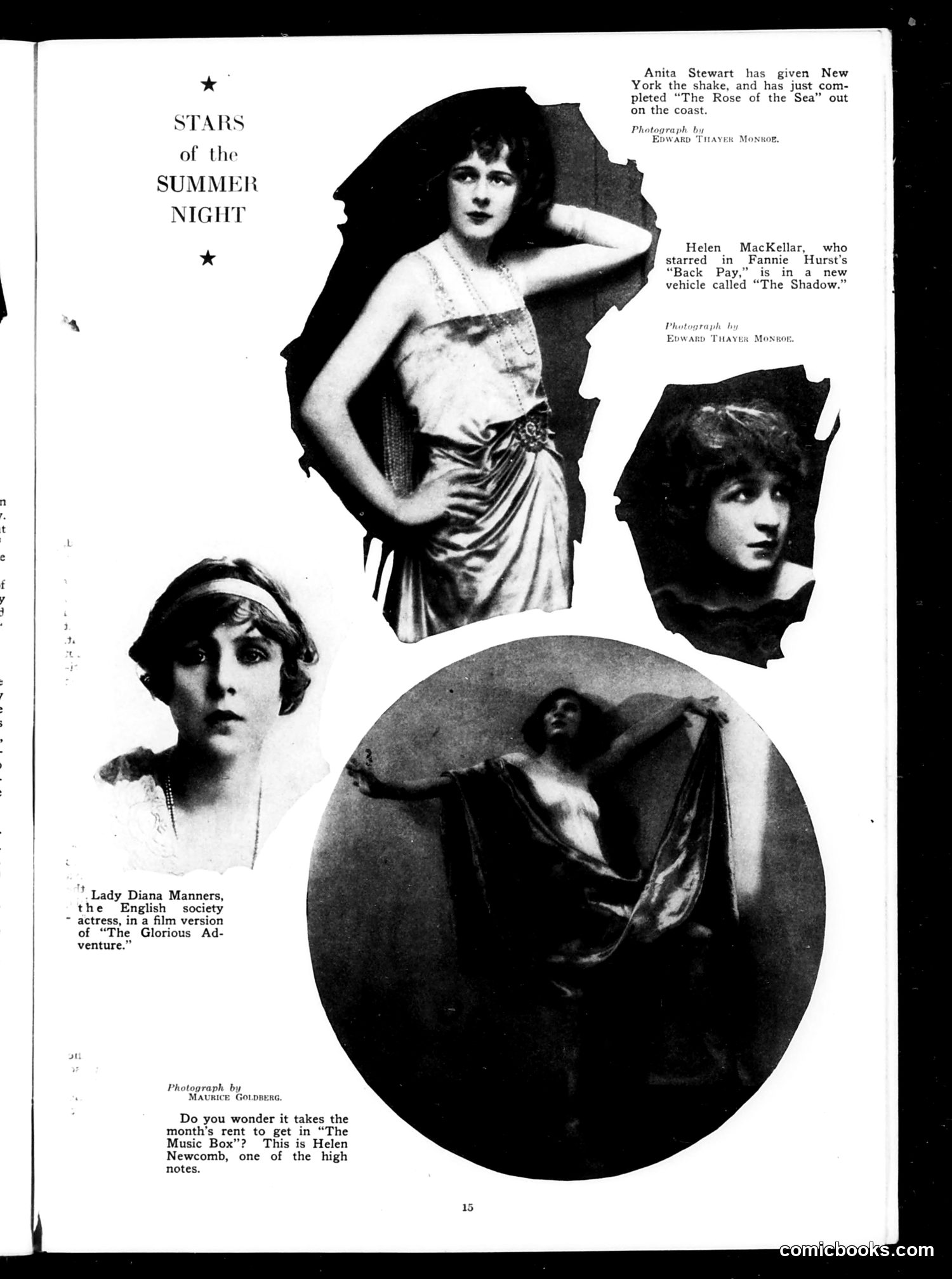
This page is NOT satirical—it's a straightforward celebrity feature showcasing film and stage actresses of the era. The heading "Stars of the Summer Night" introduces five prominent entertainers: - **Anita Stewart**, who relocated from New York to California to film "The Rose of the Sea" - **Helen MacKellar**, starring in a film called "The Shadow" (based on Fannie Hurst's story "Back Pay") - **Lady Diana Manners**, a British society figure appearing in "The Glorious Adventure" - **Helen Newcomb**, a stage performer in the musical "The Music Box" The brief captions are promotional, not satirical. The page simply showcases current Hollywood and Broadway talent through photographs credited to professional photographers (Edward Thayer Monroe, Maurice Goldberg). This was typical Judge magazine content—entertainment coverage alongside political satire.
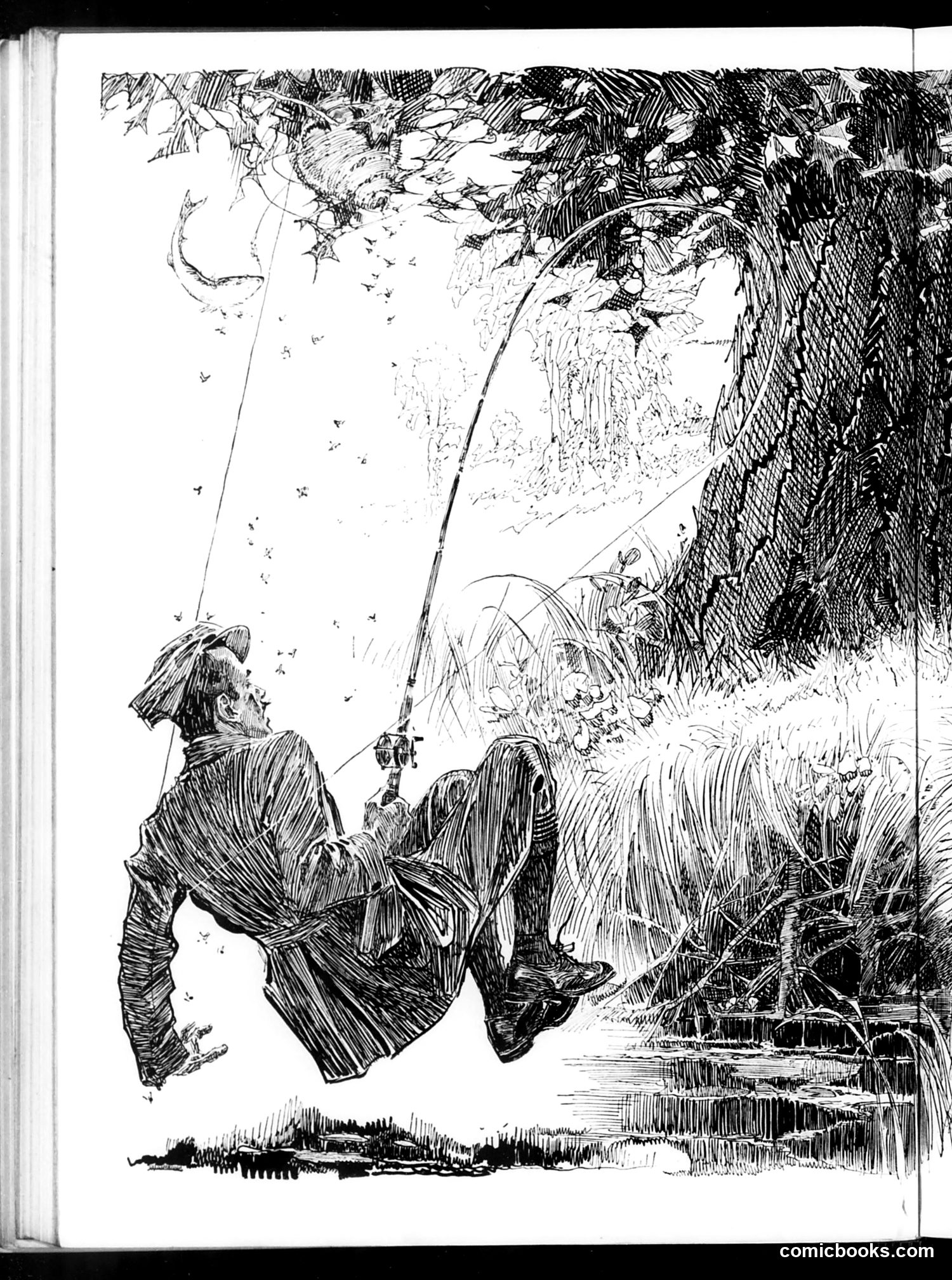
This pen-and-ink illustration depicts a figure in late 19th-century dress fishing from what appears to be a riverbank or shoreline, with rocky cliffs above. The fisherman holds a long rod with line extended into the water, where small fish are visible. The detailed cross-hatching technique and composition suggest this is likely an editorial cartoon from *Judge* magazine. However, without visible text, captions, or labels identifying the figure or the specific political/social context, I cannot definitively explain what this cartoon satirizes. The fishing scene could be metaphorical commentary on a political figure "fishing" for support, votes, or some other objective, but without corroborating text or historical dating, I cannot specify the reference with confidence.
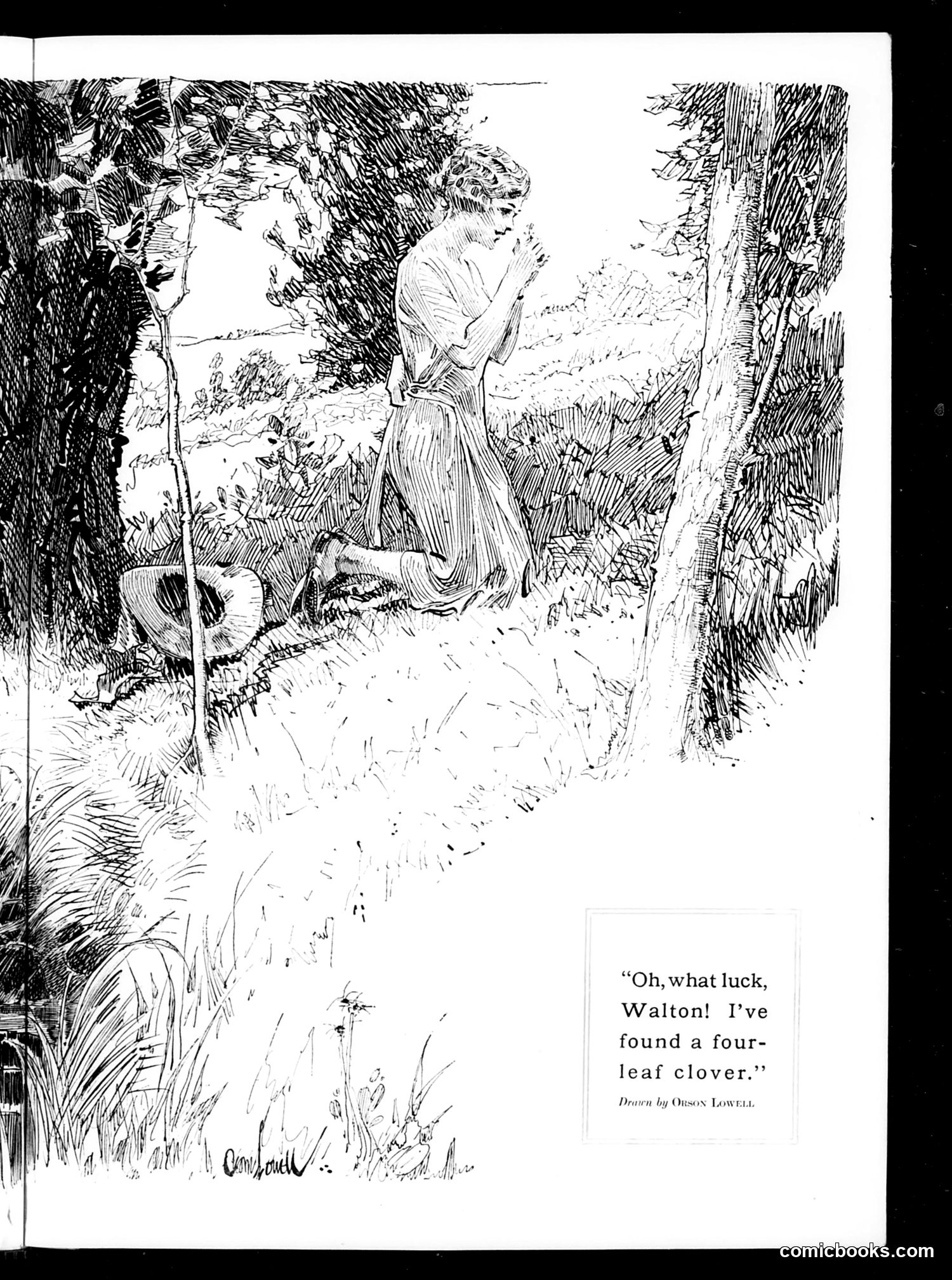
This is a simple joke cartoon rather than political satire. The illustration shows a woman in a garden or wooded setting who has discovered a four-leaf clover—traditionally considered a lucky charm in Western folklore. She excitedly addresses someone named Walton about her find. The humor likely relies on situational irony or wordplay typical of Judge magazine's light comedy style, though the specific joke is unclear from the image alone. Without additional context about "Walton" or contemporary references, the cartoon appears to be gentle domestic humor aimed at the magazine's middle-class readership. The artwork is credited to Orson Lowell (or "Orsos Lowe" per OCR).
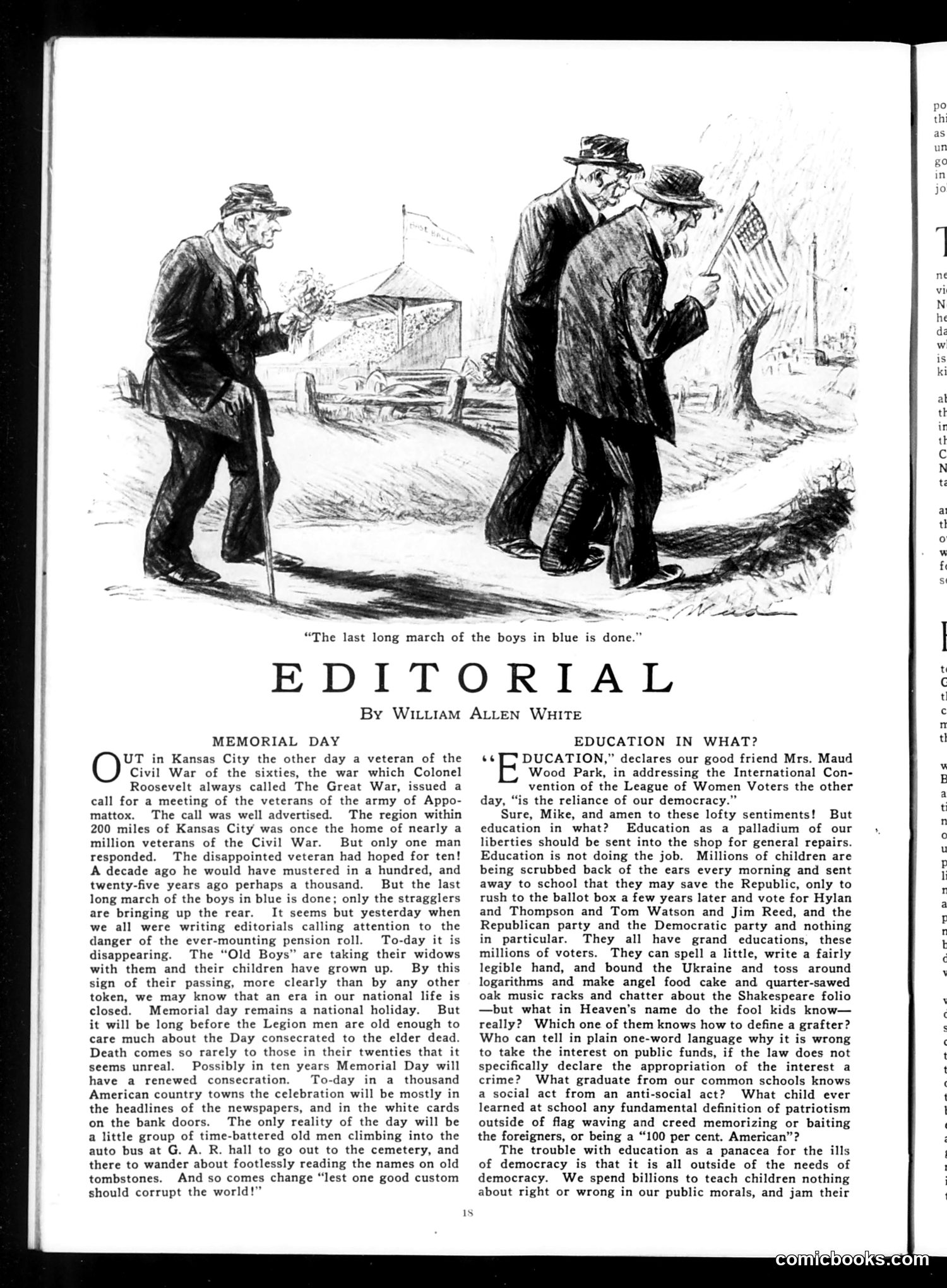
The cartoon depicts Civil War veterans ("boys in blue") at what appears to be a Memorial Day gathering, illustrating White's editorial lament about the aging and dying generation of Union soldiers. **The Satire:** White mourns how few Civil War veterans remain—only one showed up to a Kansas City reunion that once drew hundreds. He uses this as a metaphor for a closing era in American life. **The Second Editorial's Point:** White attacks the gap between educational ideals and reality. He agrees education supports democracy (echoing a League of Women Voters speaker), but argues schools teach only technical skills—spelling, math, literature—while failing to teach *civic morality*. Students memorize patriotic rhetoric but can't define graft or understand why stealing public funds is wrong. White critiques education that produces technically literate citizens who still vote for corrupt politicians and exhibit no genuine understanding of ethics or genuine patriotism beyond flag-waving. The piece argues democracy's survival requires moral education, not just curriculum completion.
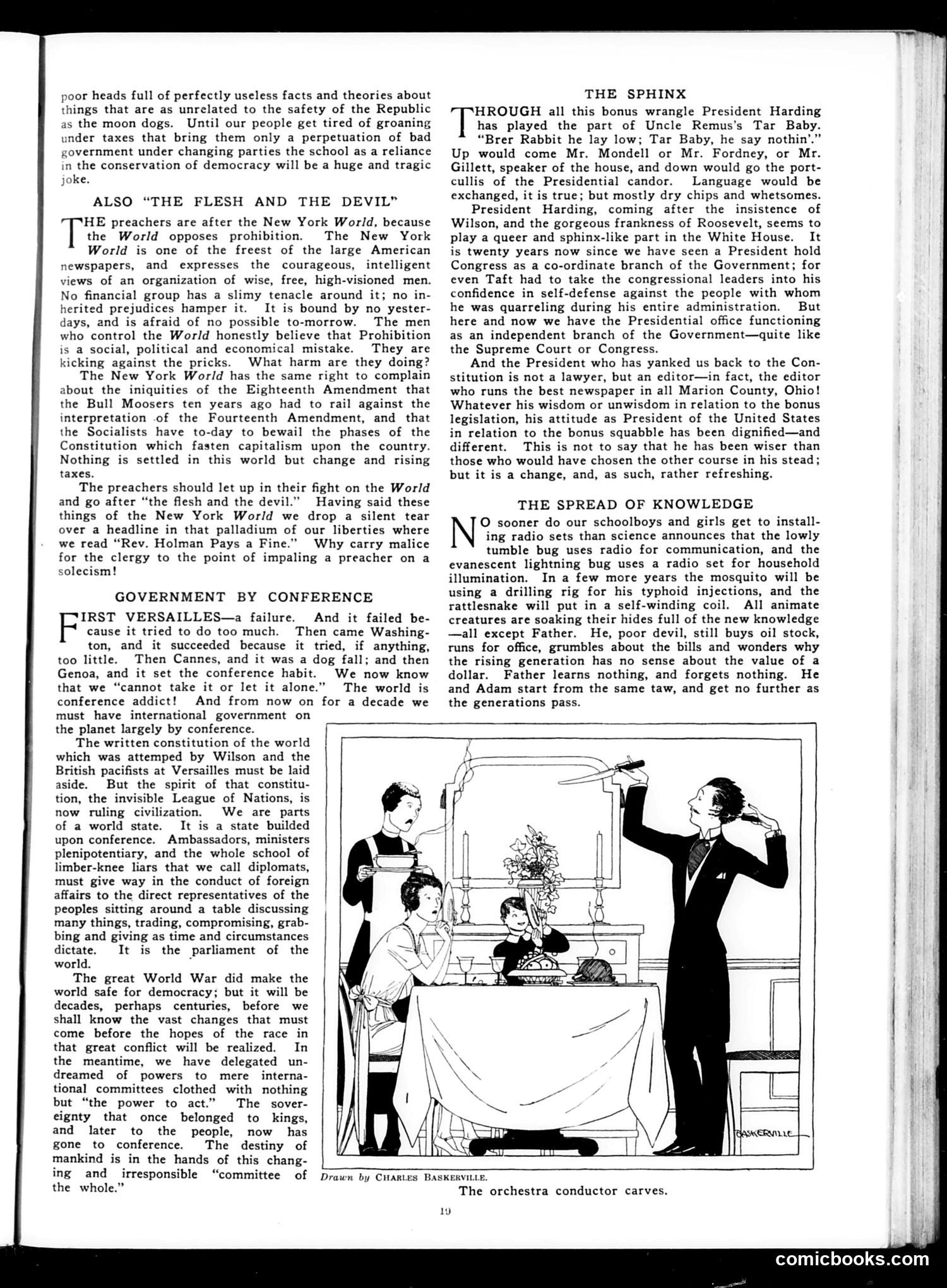
**The Main Cartoon** (bottom): Captioned "The orchestra conductor carves," it depicts a conductor at a dining table with a family, wielding his baton like a carving knife. This illustrates the article "The Sphinx" about President Harding's reserved demeanor during bonus legislation debates in Congress. **"The Sphinx" Article**: References the Uncle Remus folktale of "Tar Baby"—Harding stays silent ("lay low") while congressmen like Mondell, Fordney, and Gillett make demands. The satire praises Harding's dignified distance from Congress, contrasting him favorably with Wilson's pushiness and Roosevelt's frankness. Notably, the author admires that Harding—a newspaper editor from Marion County, Ohio (not a lawyer)—maintains presidential independence like the Supreme Court. **Context**: This reflects 1920s debates over executive power and the veterans' bonus bill. The satire celebrates Harding's constitutional restraint as refreshingly different from recent predecessors.
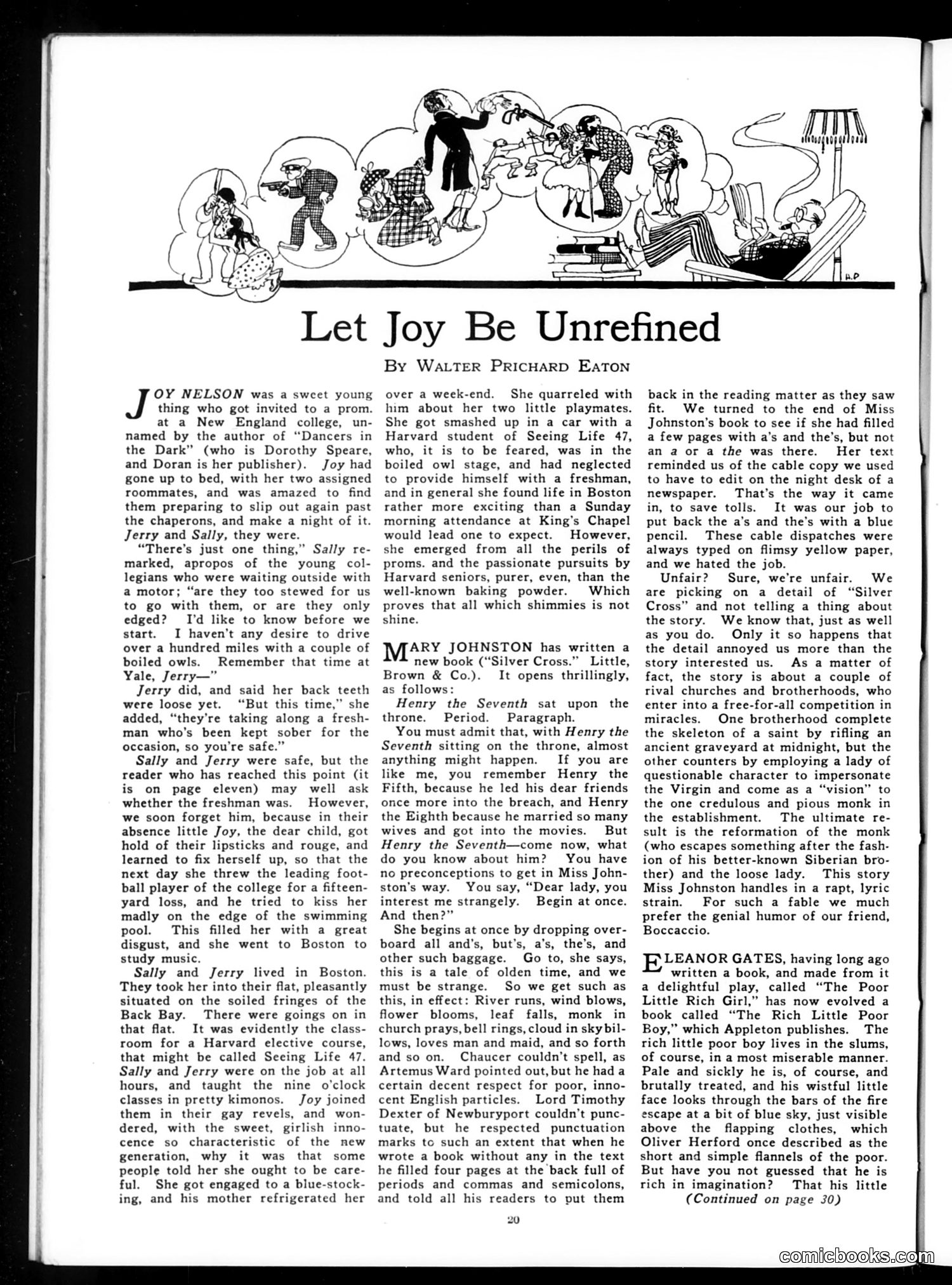
This article satirizes 1920s college culture and young women's liberation. The illustration shows various scenes of modern youth entertainment—dancing, socializing, leisure activities—representing the new freedoms available to the "flapper" generation. The story follows Joy Nelson, a naive college girl who befriends two worldly roommates, Sally and Jerry, who teach her to use makeup and engage in unsupervised socializing. The satire targets the moral panic surrounding young women's independence: Joy attends wild parties, rides in cars with drunk drivers, gets "smashed" (intoxicated), and moves to Boston to live an exciting urban life—yet emerges "purer...than well-known baking powder." The piece mockingly suggests that despite parental fears about modern girls' behavior, they remain fundamentally virtuous. The title's irony—"Let Joy Be Unrefined"—captures this tension between conservative anxiety about youth morality and the apparent harmlessness of their actual conduct. Judge here gently ridicules both the rebellious younger generation and the older generation's overblown concerns.
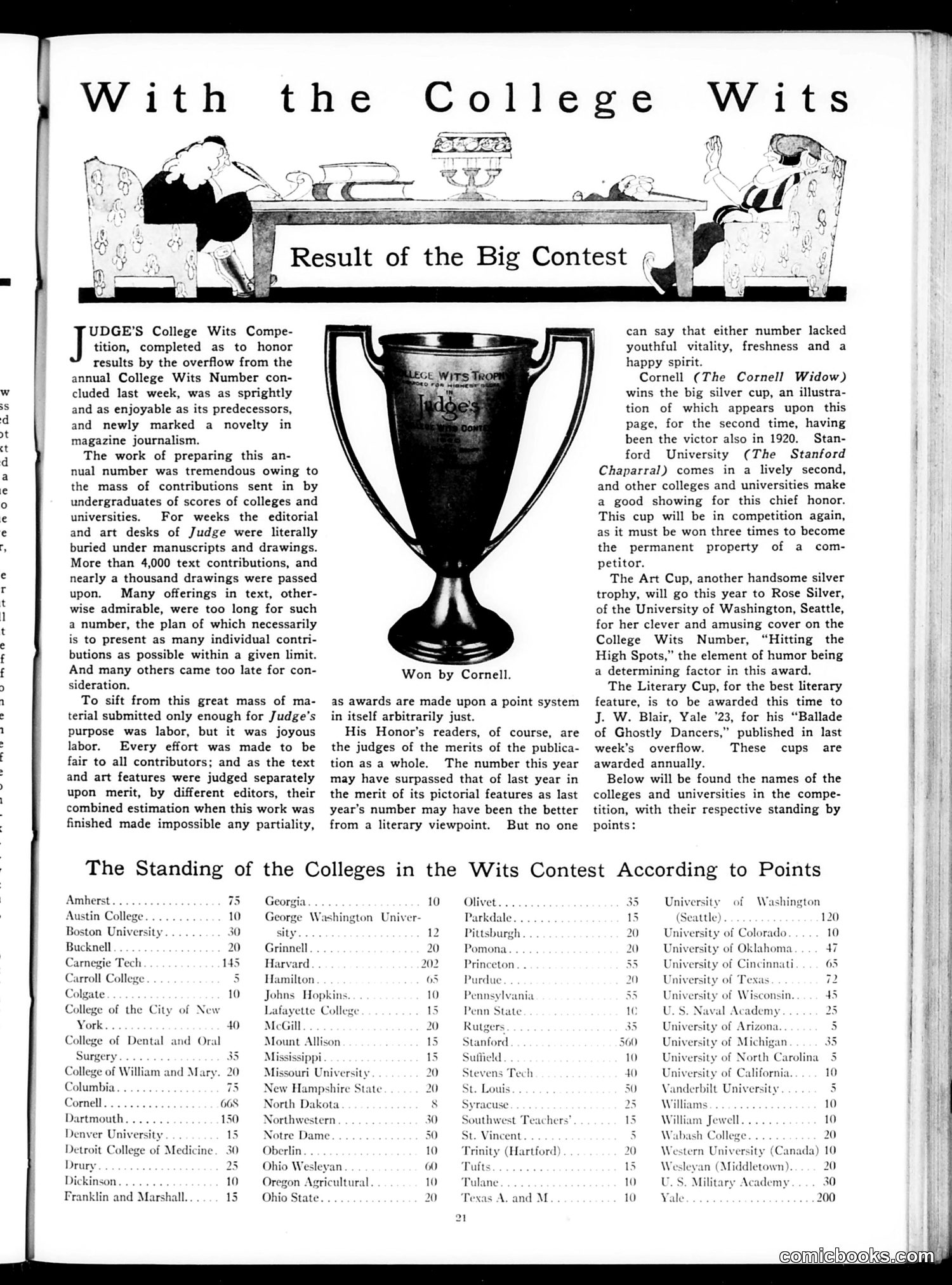
This page announces Judge magazine's annual "College Wits" competition—a nationwide contest soliciting humor contributions from college undergraduates. The trophy image shows the winning silver cup. **The Contest**: Judge received over 4,000 text submissions and nearly 1,000 drawings from scores of colleges, which editors had to carefully evaluate using a point system designed to be "arbitrarily just." **The Results**: Cornell University won the grand trophy for the second time (having previously won in 1920). Stanford came second. Additional awards went to Rose Silver of University of Washington for best art cover ("Hitting the High Spots") and J.W. Blair of Yale '23 for best literary piece ("Ballade of Ghostly Dancers"). **The Satire**: The cartoon at top humorously depicts the editorial chaos—drowning under massive submissions—reflecting the magazine's self-deprecating joke about the overwhelming task of judging collegiate humor contributions. The standings table lists participating colleges with their point totals, establishing this as a significant national competition among American universities.
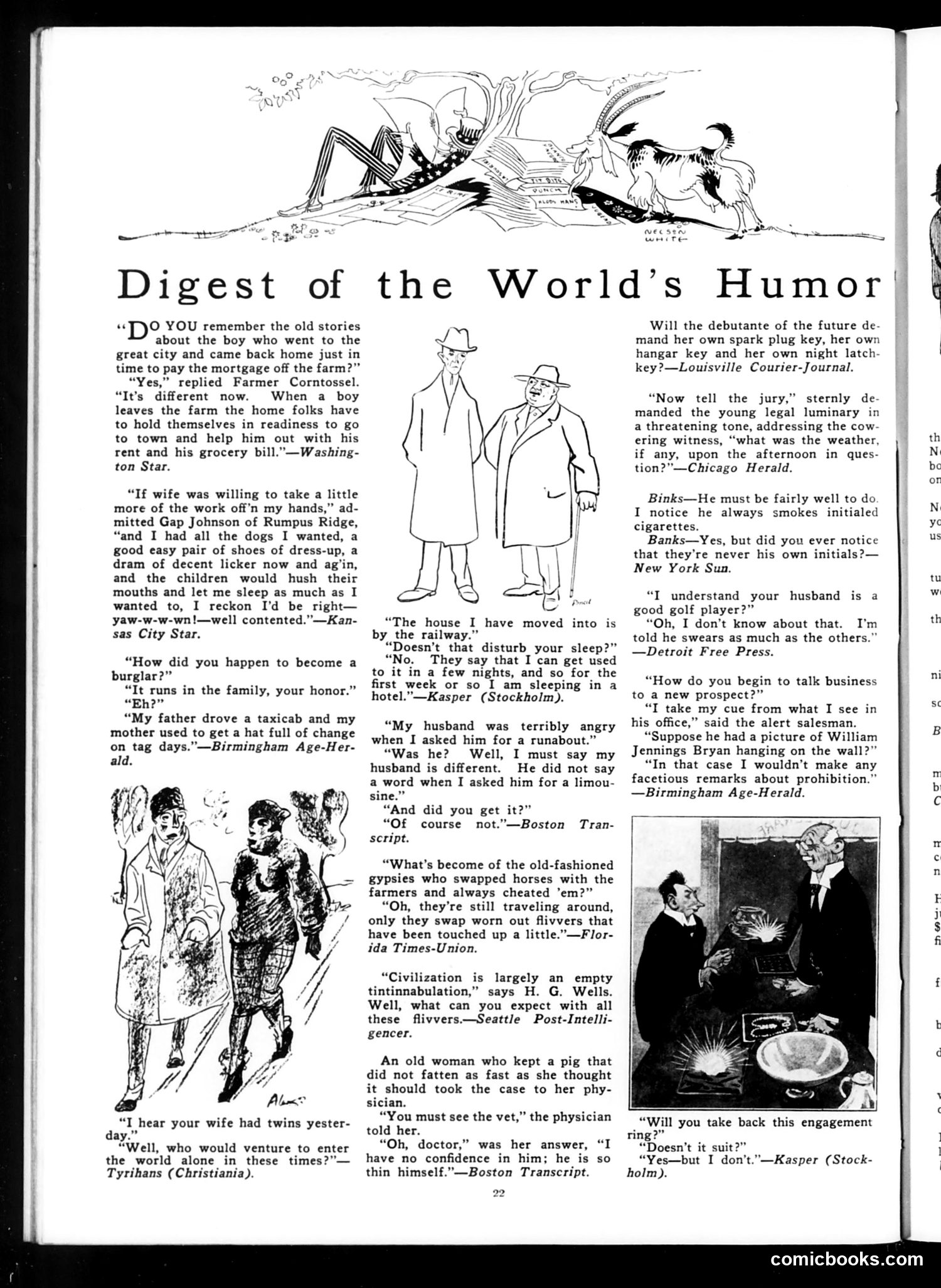
This page collects humorous anecdotes from various American and international newspapers, reflecting early 20th-century social concerns. The jokes mock modern anxieties: young men leaving farms now need financial support (reversing the old "success story"), urban congestion and noise, automobile culture replacing horses, and marital tensions over consumer goods like cars and jewelry. Several jokes target prohibition-era sensitivities and gender roles—wives demanding luxury automobiles, debates over whether husbands are "good" (at golf or fidelity). The burglar joke references taxi drivers and street vendors as occupational hazards of modernity. The cartoon illustrations show ordinary citizens in contemporary dress. The humor reflects a transitional society adjusting to automobiles, urban living, and changing family economics—topics resonating with Judge's middle-class readership grappling with rapid modernization.
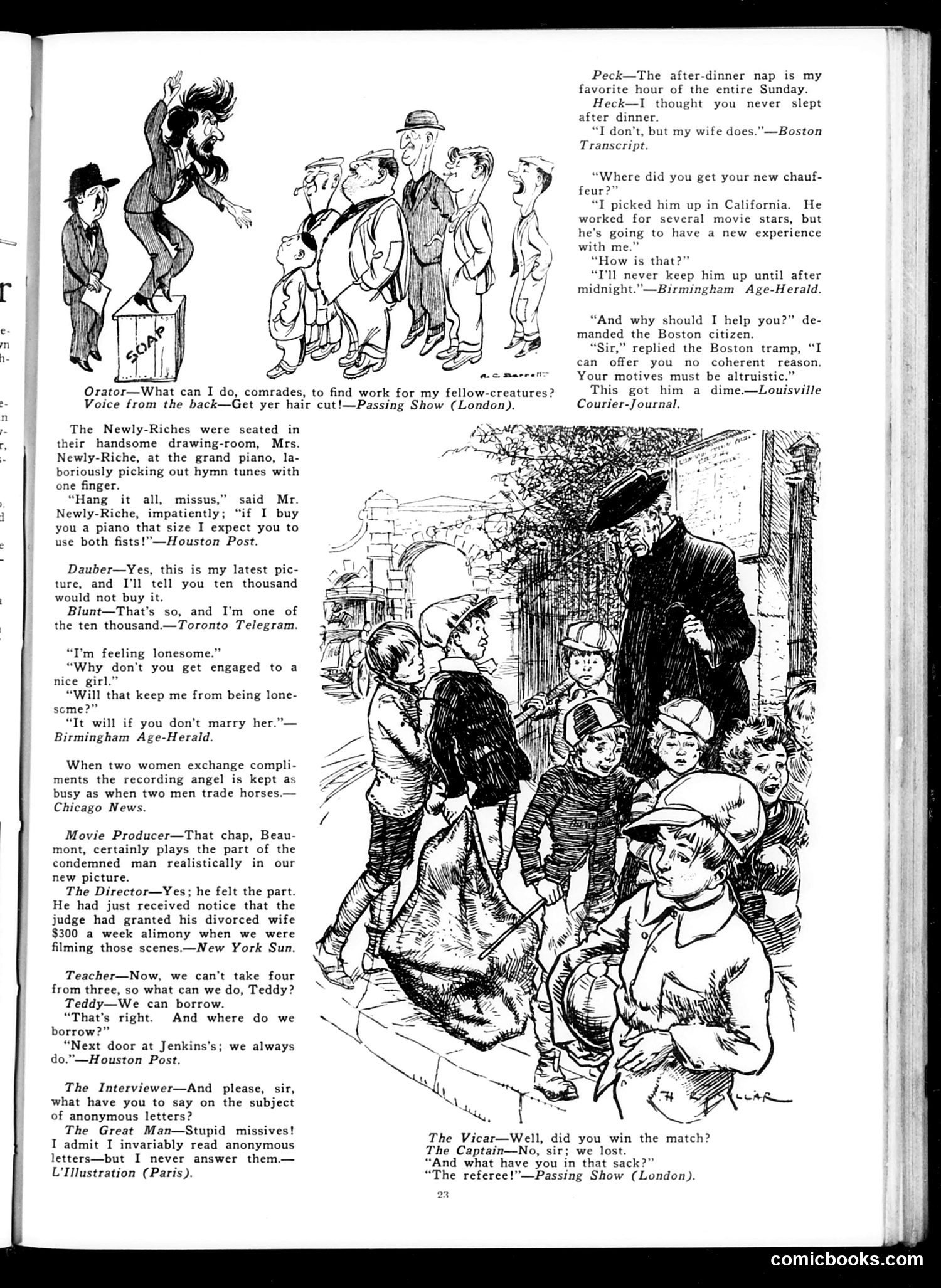
This page from *Judge* (a turn-of-the-century American satirical magazine) contains multiple brief humorous quips rather than sustained political cartoons. The jokes target social pretension and emerging modern anxieties: **Key targets:** - **Newly-Rich nouveaux riches** mocking their cultural ignorance (wife playing piano badly despite expensive instrument) - **Movie industry** satirizing both producers and actors as artificial/shallow - **Class commentary** on tramps, beggars, and working-class desperation (the tramp's articulate pitch for money) - **Gender relations** through marriage jokes emphasizing women's domesticity and men's exasperation - **Materialism** critiquing consumerism and status-seeking The cartoons (top left and center-right) depict social scenes with exaggerated character types common to the era. The humor relies on observational comedy about American social climbing, marital dynamics, and emerging consumer culture rather than explicit political satire. The overall tone reflects early-1900s middle-class anxieties about rapid social change and wealth inequality.
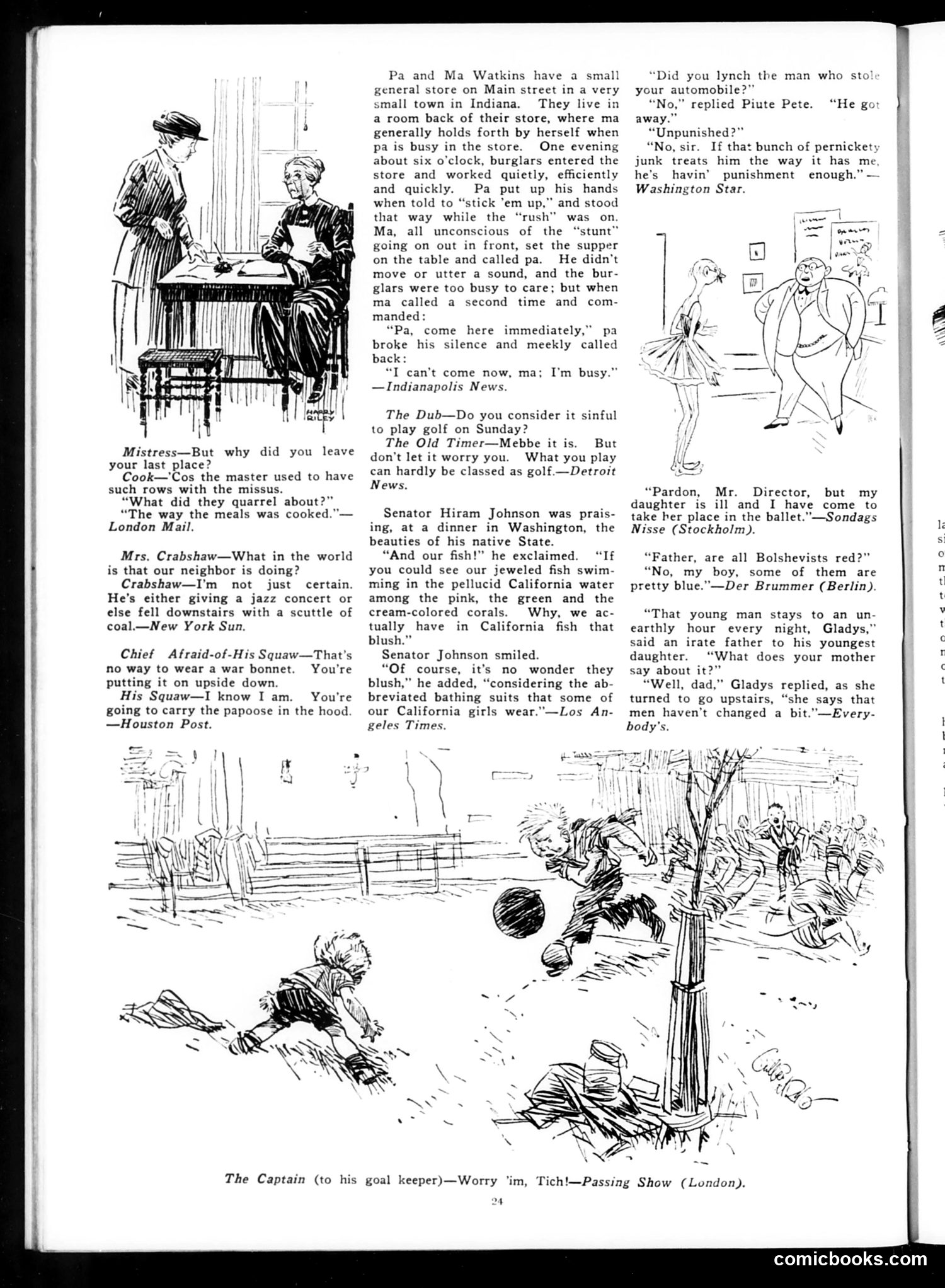
This page contains multiple brief humor anecdotes and cartoon jokes typical of early 20th-century satirical magazines, arranged by source publication. **Key content:** The anecdotes are domestic and social comedy—a cook defending poorly cooked meals, a neighbor's noise, and a henpecked husband. One longer story depicts Pa Watkins during a burglary: when his wife calls him to dinner, he obeys her command despite standing before armed robbers, highlighting marital dynamics where the wife's authority supersedes even criminal threat. **Historical context worth noting:** References to "Bolshevists" (appearing red/blue) reflect anti-communist sentiment following the Russian Revolution. Allusions to "California girls" in abbreviated bathing suits reference 1920s-era social anxieties about loosening moral standards. Senator Hiram Johnson's fish anecdote is genteel mockery of California boosterism. **The overall point:** These are light, self-contained gags about gender relations, modern life, and regional American character—humor designed for middle-class readers amused by domestic quarrels and social pretension.
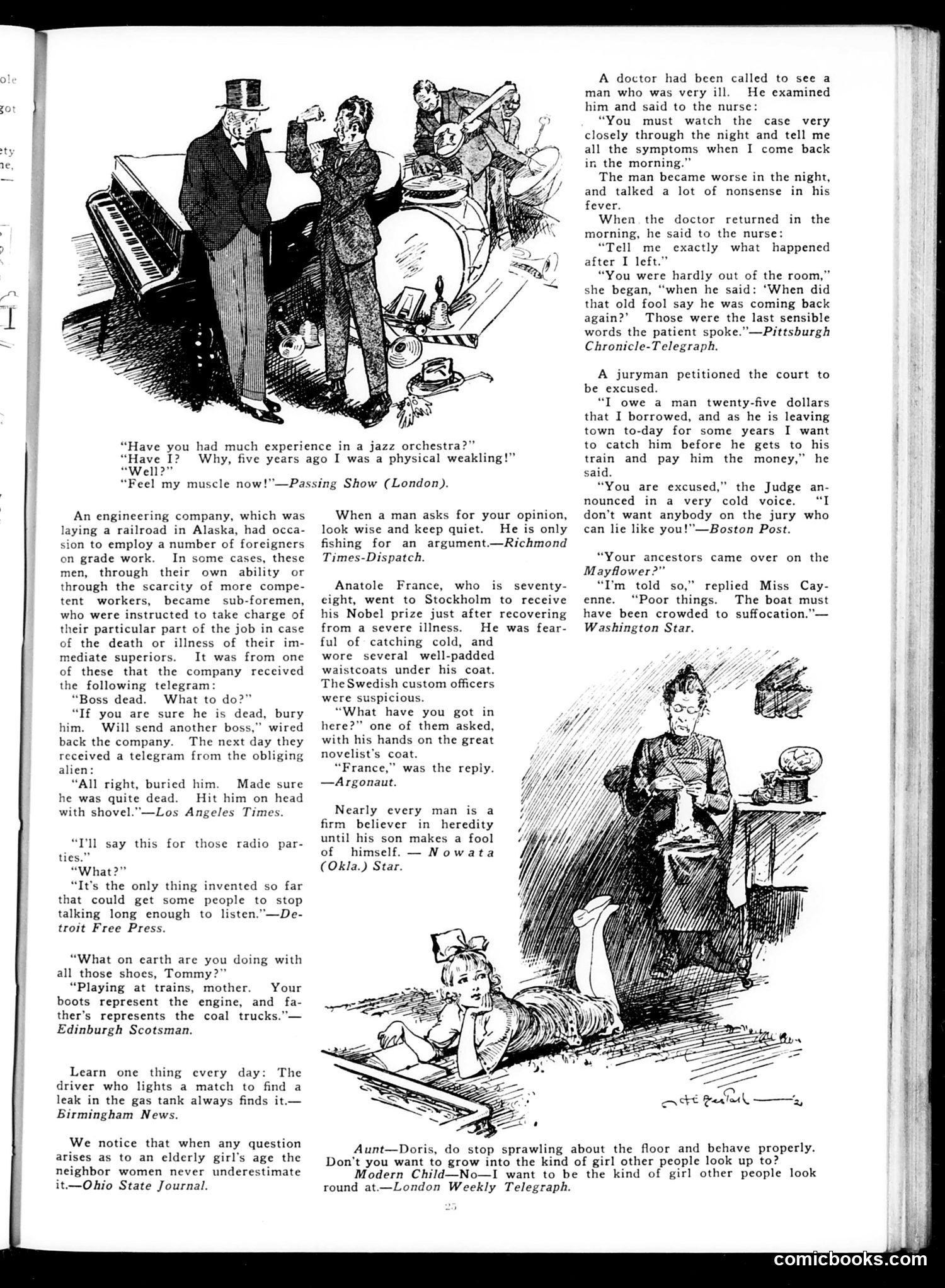
This page collects humorous anecdotes and jokes reflecting early 20th-century American attitudes. The top cartoon shows a jazz orchestra musician claiming five years in the band transformed him from "physical weakling" to muscular—satire on jazz music's perceived crude, vigorous nature and its working-class associations. The text includes several joke categories: **Immigration/Class humor**: A foreign railroad worker in Alaska kills his boss to confirm he's dead before burying him—playing on stereotypes about immigrants' supposed ignorance and brutality. **Modern technology satire**: Radio parties are mocked as the only way to silence talkative people. **Gender stereotypes**: Women allegedly never underestimate elderly women's ages; a modern girl wants to be looked "round at" rather than "up to"—suggesting vanity and impropriety. **Social hypocrisy**: A juror lying about owing money is excused because the judge assumes anyone that dishonest can't be trusted. The overall tone is gentle mockery of contemporary social types, immigrant populations, and changing modern manners.
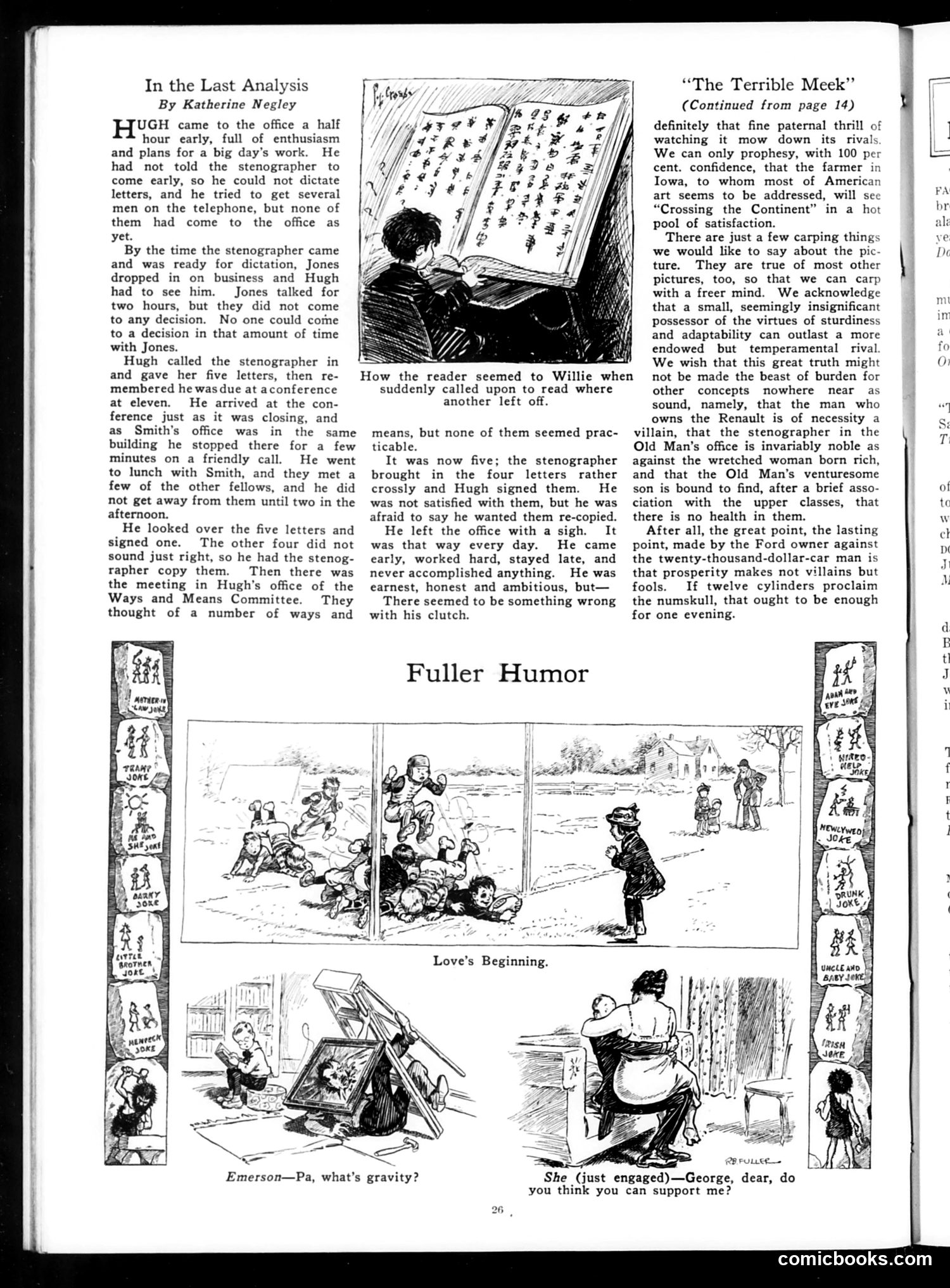
This page contains two separate humor pieces: **"Love's Beginning"** depicts a courtship scenario typical of early 20th-century American life. The top panel shows children playing outdoors (establishing innocent romance), while the bottom panels present domestic humor: a father struggling with gravity/physics (Emerson reference, likely a pun on the philosopher), and an engaged couple where the woman asks her fiancé if he can support her financially—a standard joke about marriage expectations of the era, playing on women's economic dependence on husbands. **"In the Last Analysis"** (upper section) is a satirical office story about Hugh, an ambitious but ineffectual office worker who arrives early and works late yet accomplishes nothing. The story criticizes modern workplace inefficiency: constant interruptions, meetings, and social obligations prevent actual productivity. The accompanying illustration shows a teacher calling on a student unprepared to read—a metaphor for being caught unprepared, reflecting Hugh's perpetual unpreparedness. The satire targets both individual weakness ("something wrong with his clutch") and the emerging corporate culture that fragments focus.
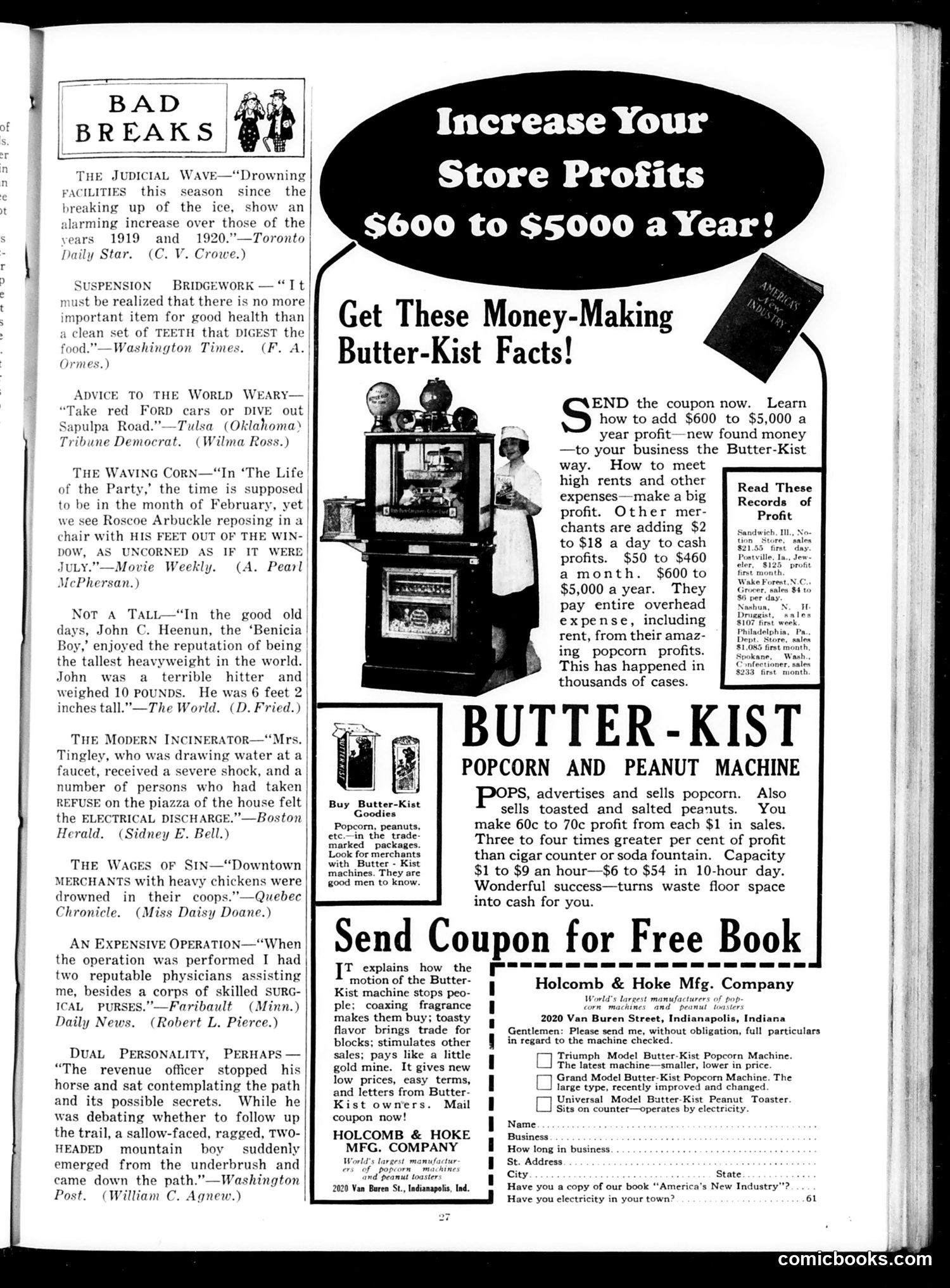
This page is primarily **advertising**, not political satire. The dominant content is a large advertisement for the "Butter-Kist Popcorn and Peanut Machine," a vending machine promising store owners $600-$5,000 annual profits. The "Bad Breaks" section consists of brief, humorous newspaper clippings—short items satirizing absurdities from other publications. Examples include: a judicial system where more ice-breaking drownings occur; advice to drive Ford cars off roads; an actor keeping his feet out a window in February; and a heavyweight boxer weighing only 10 pounds. These are mild observational jokes exploiting logical inconsistencies and typos in source material. There are no identified political figures or sophisticated satire here. The page reflects early 1920s advertising culture, where magazines mixed editorial content with lucrative commercial pitches targeting small business owners seeking entrepreneurial opportunities.
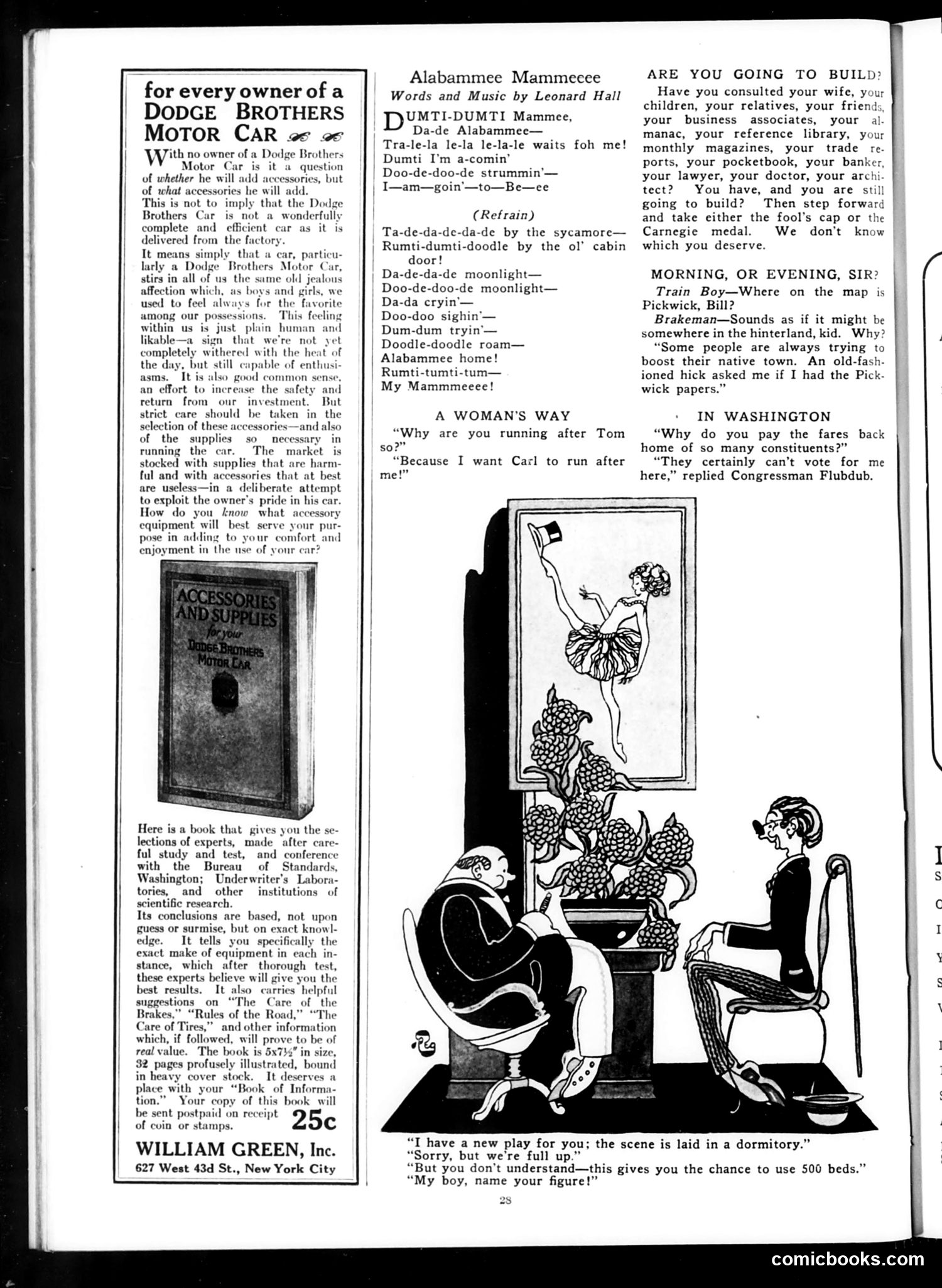
This page combines advertisements with humor sections typical of early 20th-century satirical magazines. **Main Advertisement:** Dodge Brothers Motor Car promotes an "Accessories and Supplies" guide book (25¢), positioned as expert-vetted advice for car owners wanting to customize their vehicles safely—appealing to the growing automobile market and consumer pride. **Humor Sections:** 1. **"Alabammee Mammeee"**: A novelty song about Southern romance, using exaggerated dialect and nonsense syllables typical of period entertainment. 2. **"A Woman's Way"**: A brief joke about romantic competition—a woman pursues one man to make another jealous. 3. **"Morning or Evening, Sir?"**: Mocks small-town boosters and traveling salesmen who exaggerate their hometowns' importance. 4. **"In Washington"**: Political satire about Congressman Flubdub admitting constituents can't vote for him if they've left his district—cynical commentary on politicians' self-interest. The page reflects early 1900s consumer culture, racial stereotypes in entertainment, and skepticism toward politicians.
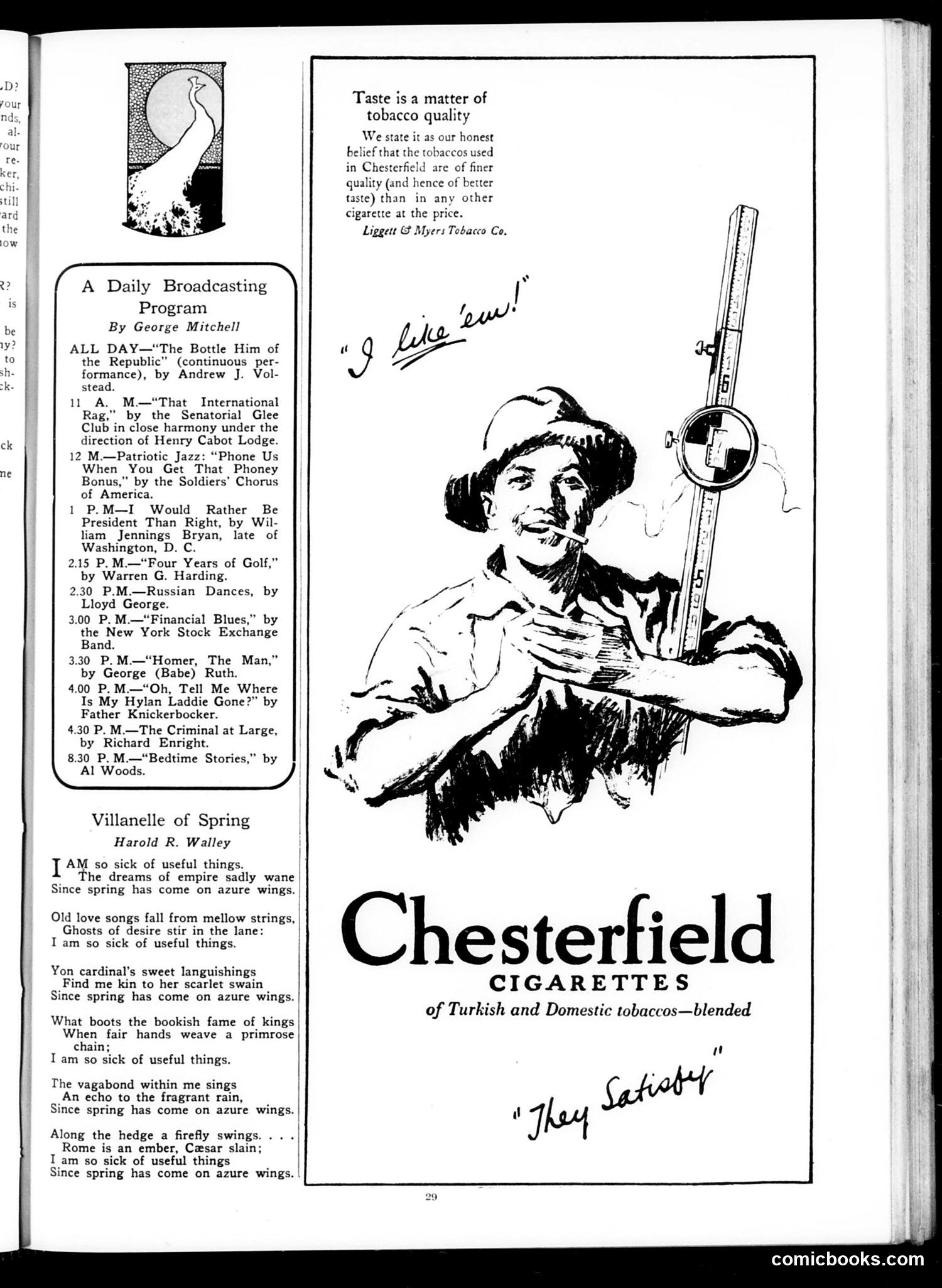
This page contains two distinct elements: **Left side:** A satirical "radio program" by George Mitchell mocking early 1920s political figures and events. References include Prohibition (Andrew Volstead), isolationist senators (Henry Cabot Lodge), the delayed WWI veterans' bonus, William Jennings Bryan, President Warren G. Harding's golf habits, British PM Lloyd George, stock market volatility, baseball star Babe Ruth, NYC Mayor Hylan, and Police Commissioner Enright. The humor derives from presenting serious political figures as entertainment acts. **Right side:** A Chesterfield cigarette advertisement featuring a man with a surveying instrument (unclear if meant to represent a specific person—possibly Babe Ruth based on adjacent text). The handwritten "I like 'em!" and "They satisfy!" are endorsement-style signatures. The page juxtaposes political satire with commercial advertising, typical of Judge magazine's format. A modern reader would need historical knowledge of 1920s American politics and personalities to fully appreciate the satirical barbs.
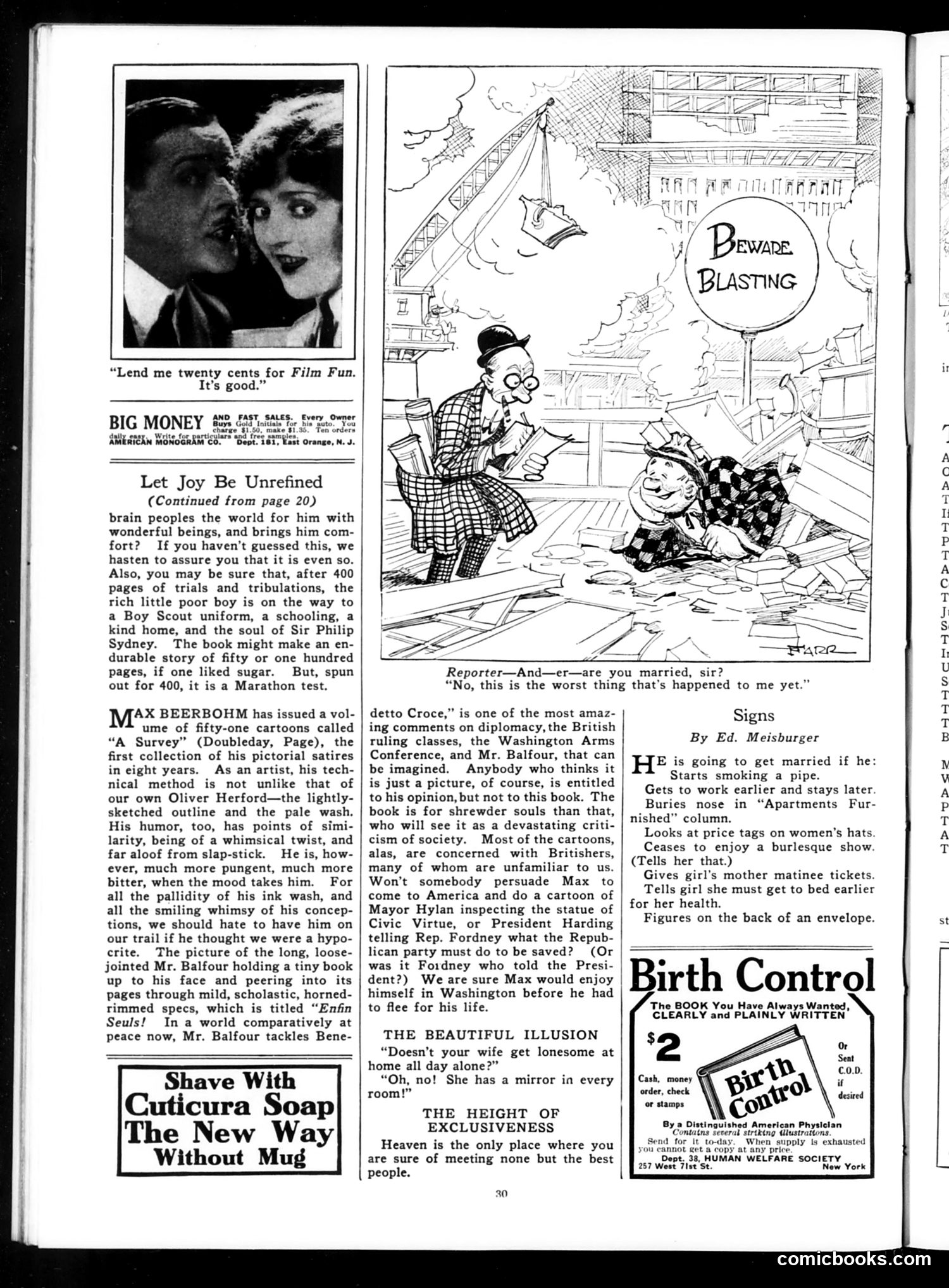
This page combines satirical cartoons with advertisements typical of 1920s Judge magazine content. **Main Cartoon**: The "Beware Blasting" illustration satirizes construction or urban development. A bewildered man reads a newspaper while a worker operates machinery nearby, creating chaos. The caption jokes that marriage is "the worst thing that's happened to me yet"—comparing marital disruption to literal blasting and destruction. **Text Sections**: The page reviews Max Beerbohm's cartoon collection "A Survey," praising his satirical wit while noting his subjects are largely unfamiliar British figures. It mentions Arthur Balfour (British statesman) and references American political figures (Mayor Hylan, President Harding, Rep. Fordney) the reviewer wishes Beerbohm would satirize. **Other Content**: Brief humorous observations ("Signs") about marriage indicators, and advertisements for Cuticura Soap and a Birth Control guide—the latter indicating progressive publishing for the era. The page reflects Judge's focus on sophisticated, urbane humor targeting educated readers familiar with contemporary politics and social commentary.
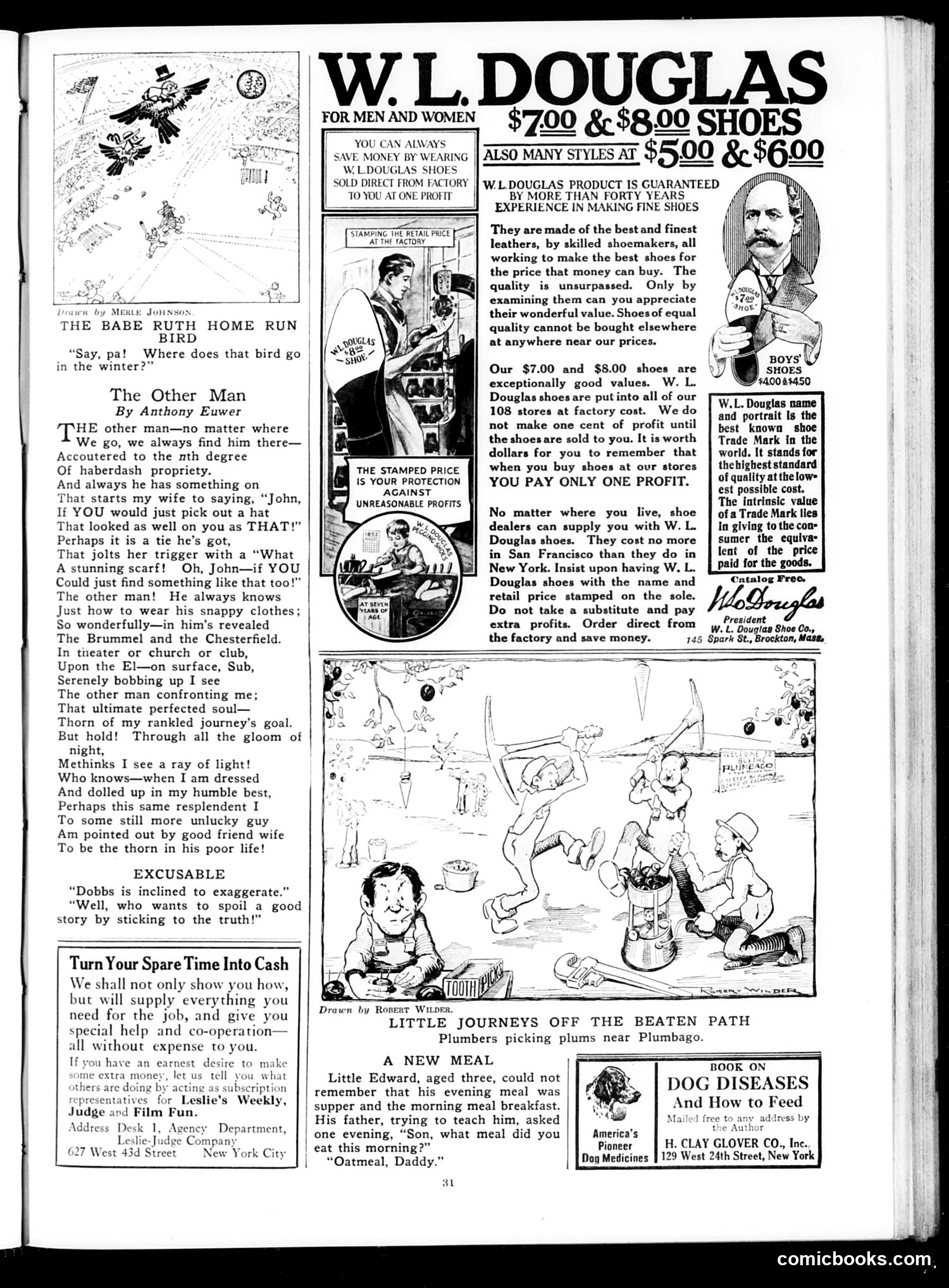
This page is primarily **advertising with modest literary content**, typical of early-20th-century magazines that funded themselves through prominent ads. ## Main Content: **"The Babe Ruth Home Run Bird"** — A brief poem by Merle Johnson accompanying a whimsical illustration about a bird, likely referencing the famous baseball player Babe Ruth (known for home runs). The illustration shows fantastical, dreamlike imagery. **"The Other Man"** — A humorous poem about male vanity and jealousy: a husband perpetually compared unfavorably by his wife to some better-dressed man she encounters. The satire reverses at the end—perhaps he *is* "the other man" to someone else. ## Notable Advertisements: The **W.L. Douglas Shoes** advertisement dominates the right side, emphasizing factory-direct sales and "one profit" pricing—a progressive early-1900s marketing strategy positioning the company as anti-middleman. **Bottom illustrations** feature comic domestic scenes with children and minor gags about plumbers and meals. This reflects Judge's target audience: middle-class men concerned with fashion, business, and domestic life.
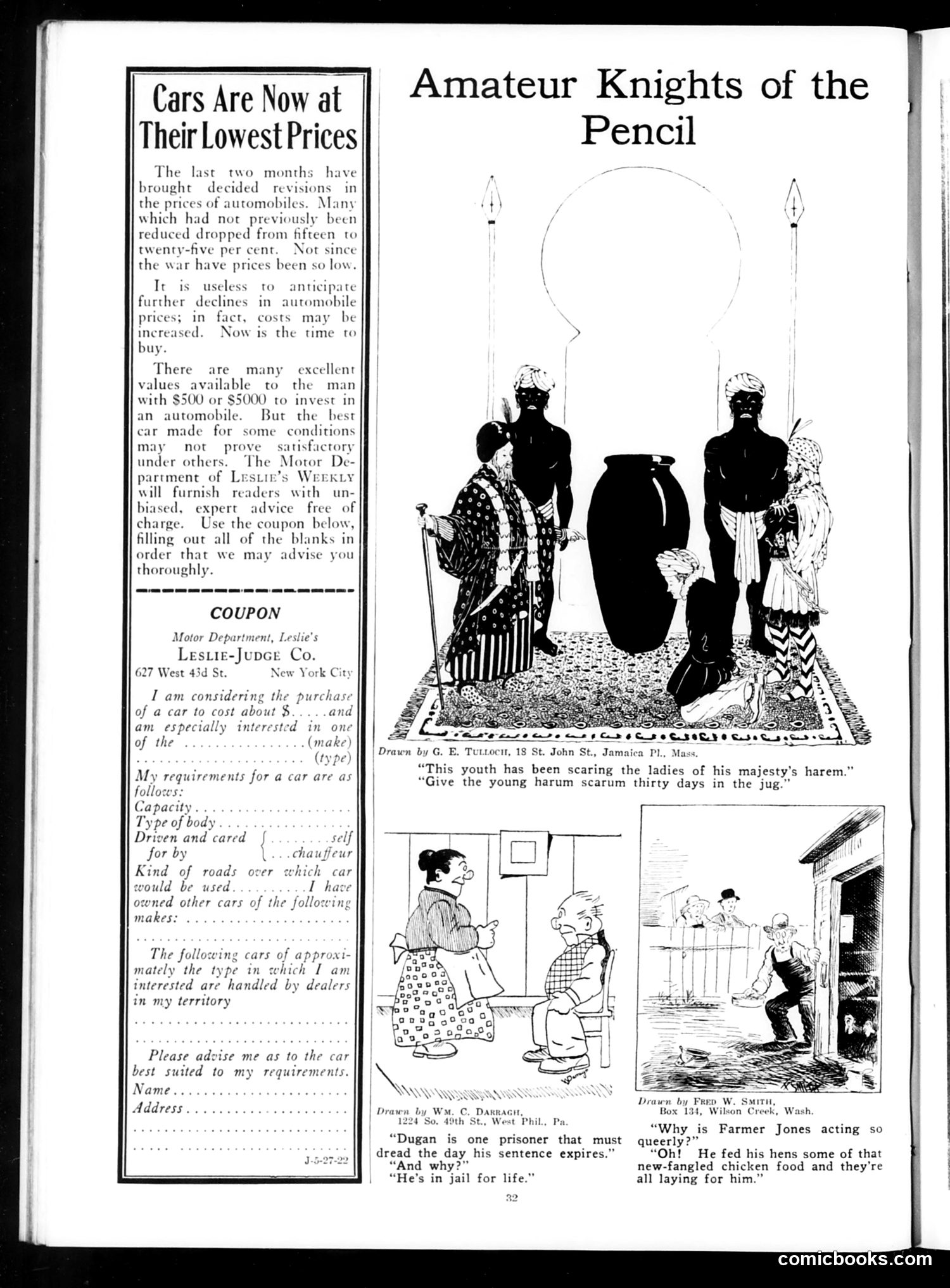
This page from *Judge* magazine contains a car advertisement and three separate humor cartoons drawn by readers in an "Amateur Knights of the Pencil" contest. **The Advertisement** promotes discounted automobiles (prices down 15-25%) post-war, encouraging purchases while prices are low. It offers free expert advice via coupon. **The Three Cartoons:** 1. A colonial-era scene: A youth has frightened the sultan's harem women; authorities sentence him to jail, using "harum scarum" (reckless youth) as wordplay. 2. A domestic scene: A prisoner dreads his sentence expiring because he's serving a life sentence—the joke being jail is preferable to his outside life. 3. A farmer scene: Jones acts strangely because he fed his hens "new-fangled chicken food," leading to the pun "they're all laying for him" (both literal egg-laying and seeking revenge). These are reader-submitted amateur cartoons relying on puns and situational humor typical of 1920s Judge magazine content.
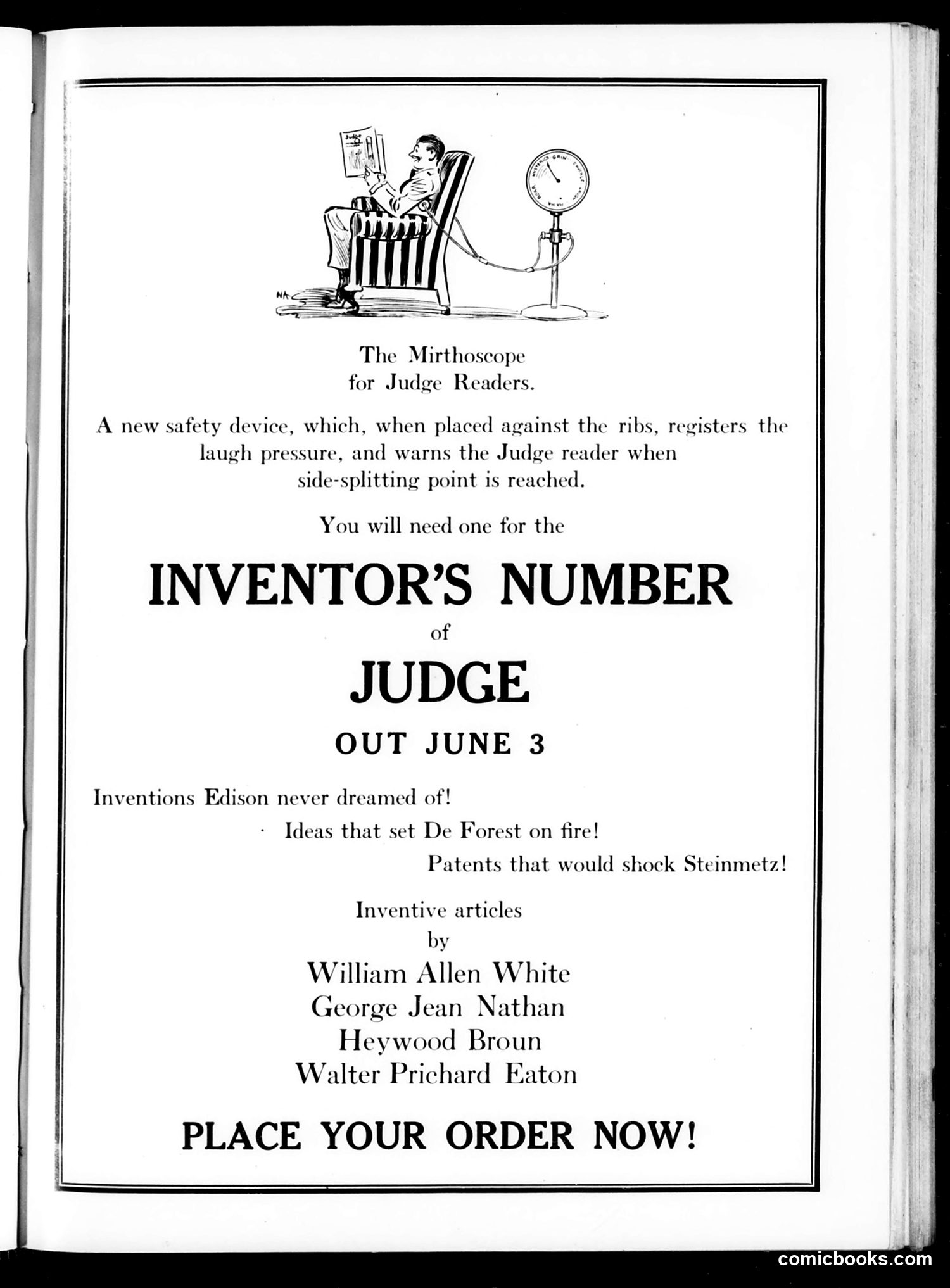
This is a satirical advertisement for a specific issue of *Judge* magazine (June 3, undated but likely early 20th century). The "Mirthoscope" is a fictional device—a humorous fake invention depicted in the cartoon as a gauge measuring "laugh pressure" to warn readers when they're laughing too hard ("side-splitting"). The ad promotes an upcoming "Inventor's Number" featuring comic articles by notable humorists and critics (William Allen White, George Jean Nathan, Heywood Broun, Walter Prichard Eaton). It references real inventors and scientists—Edison, Lee De Forest (radio pioneer), and Charles Steinmetz (electrical engineer)—to humorously suggest the upcoming articles contain ingenious or shocking ideas comparable to their actual inventions. The joke: readers will laugh so hard they'll need the protective "Mirthoscope" device. It's self-promotional satire typical of *Judge's* advertising strategy.
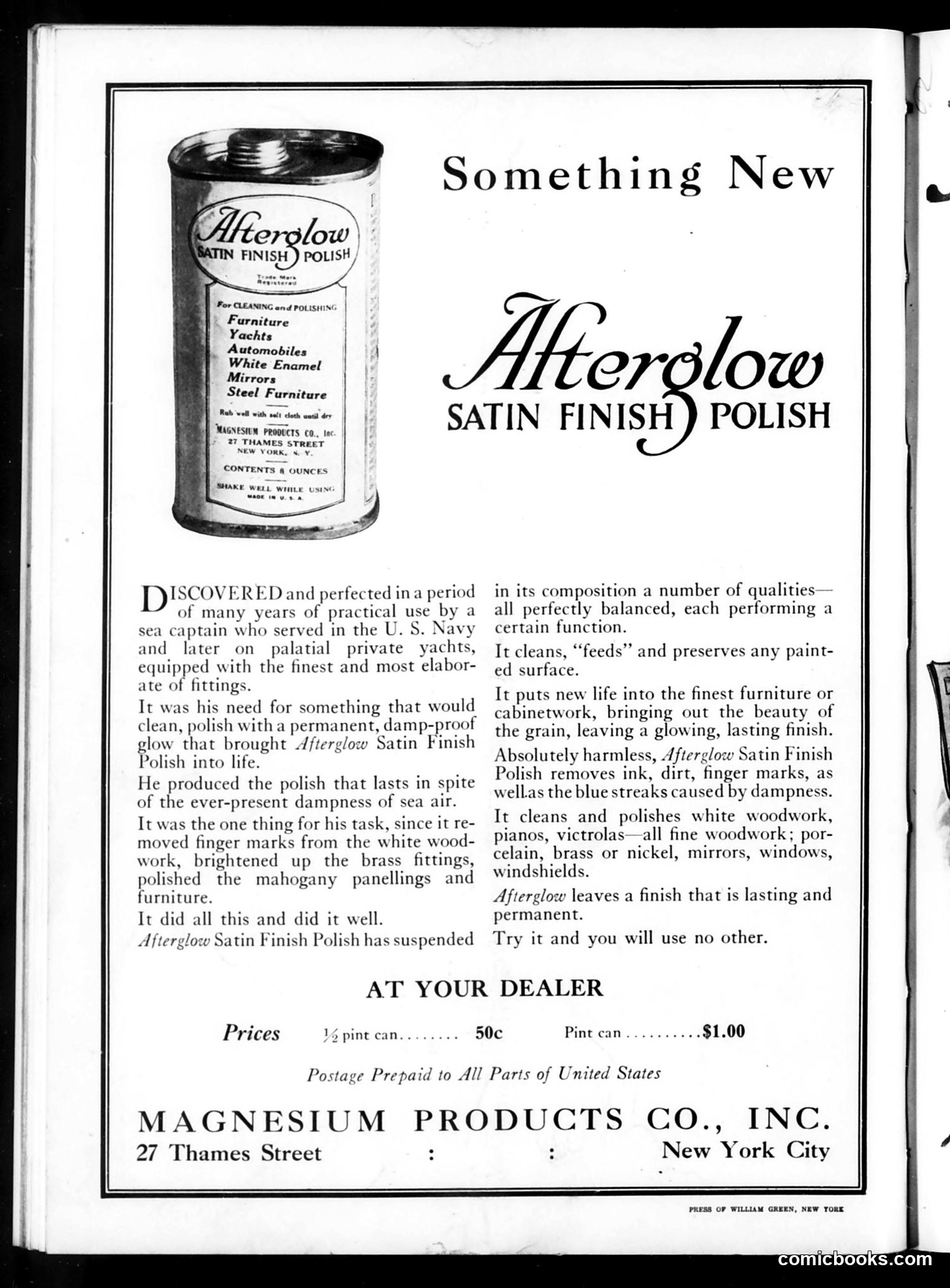
This page is entirely a **product advertisement**, not political satire or editorial content. It promotes "Afterglow Satin Finish Polish," a cleaning and polishing product made by Magnesium Products Co., Inc. in New York City. The ad uses a origin narrative common to vintage advertising: a U.S. Navy sea captain developed the polish to combat the challenges of maintaining ships and yachts in damp conditions. This backstory lends credibility and prestige to the product. The advertisement emphasizes the polish's versatility—suitable for furniture, automobiles, mirrors, brass, and white enamelware—and its durability against moisture and fingerprints. Pricing is listed as 50¢ for a half-pint and $1.00 for a pint. There are **no cartoons, political references, or satirical content** on this page. It appears Judge magazine included straightforward commercial advertisements alongside editorial material.