
Judge, 1922-05-27 · page 28 of 36
Judge — May 27, 1922 — page 28: what you’re looking at
What you’re looking at
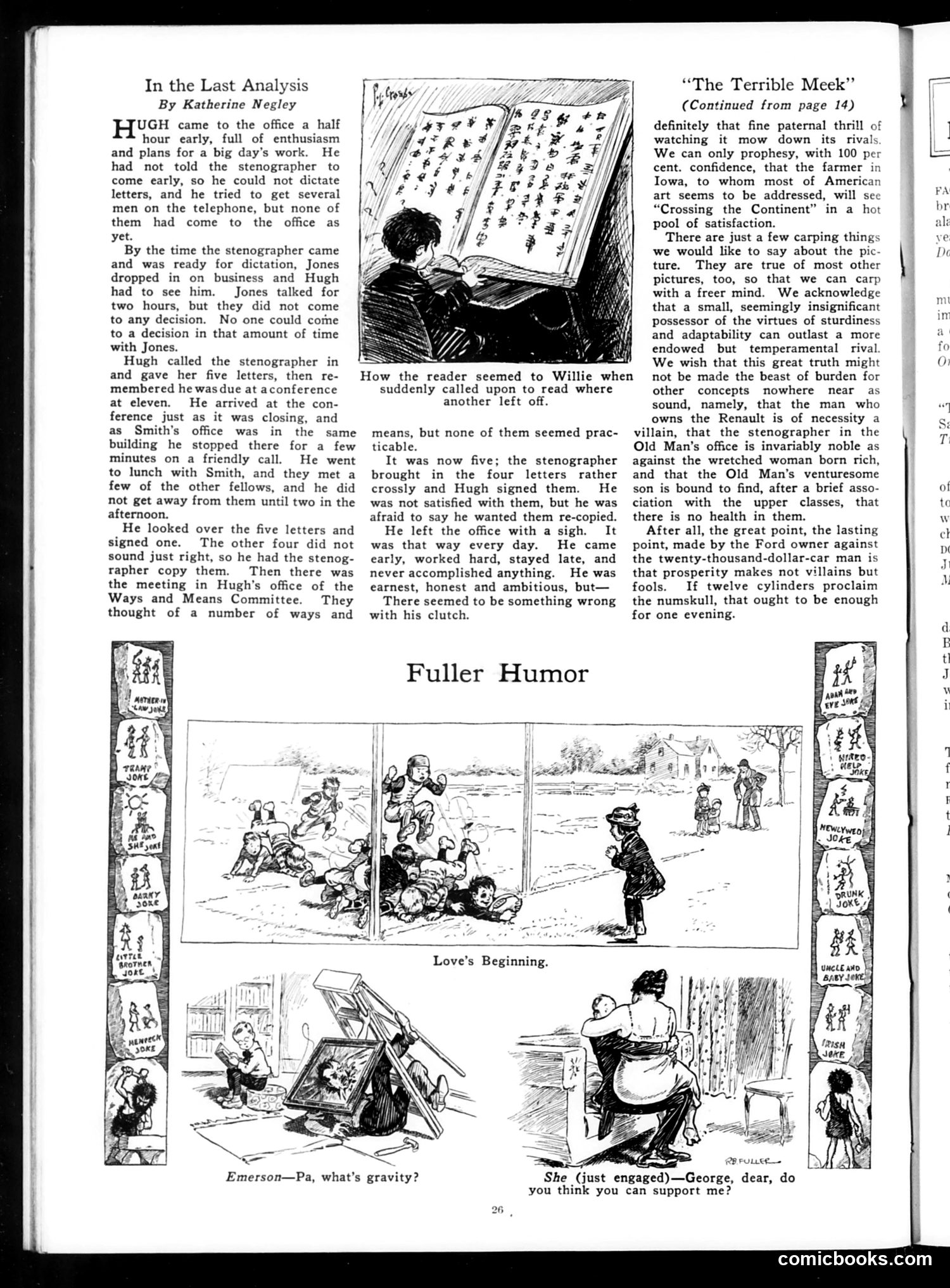
This page contains two separate humor pieces: **"Love's Beginning"** depicts a courtship scenario typical of early 20th-century American life. The top panel shows children playing outdoors (establishing innocent romance), while the bottom panels present domestic humor: a father struggling with gravity/physics (Emerson reference, likely a pun on the philosopher), and an engaged couple where the woman asks her fiancé if he can support her financially—a standard joke about marriage expectations of the era, playing on women's economic dependence on husbands. **"In the Last Analysis"** (upper section) is a satirical office story about Hugh, an ambitious but ineffectual office worker who arrives early and works late yet accomplishes nothing. The story criticizes modern workplace inefficiency: constant interruptions, meetings, and social obligations prevent actual productivity. The accompanying illustration shows a teacher calling on a student unprepared to read—a metaphor for being caught unprepared, reflecting Hugh's perpetual unpreparedness. The satire targets both individual weakness ("something wrong with his clutch") and the emerging corporate culture that fragments focus.
📄 Transcribed text from this page (OCR, searchable)
Machine-transcribed from the original scan — historical spelling and the odd misread are preserved.
In the Last Analysis By Katherine Negley UGH came to the office a half hour early, full of enthusiasm and plans for a big day’s work. He had not told the stenographer to come early, so he could not dictate letters, and he tried to get several men on the telephone, but none of them had come to the office as yet. By the time the stenographer came and was ready for dictation, Jones dropped in on business and Hugh had to see him. Jones talked for two hours, but they did not come to any decision. No one could come to a decision in that amount of time with Jones. Hugh called the stenographer in and gave her five letters, then re- membered he was due at aconference at eleven. He arrived at the con- ference just as it was closing, and as Smith's office was in the same building he stopped there for a few minutes on a friendly call. He went to lunch with Smith, and they met a few of the other fellows, and he did not get away from them until two in the afternoon. He looked over the five letters and signed one. The other four did not sound just right, so he had the stenog- tapher copy them. Then there was the meeting in Hugh's office of the Ways and Means Committee. They thought of a number of ways and How the reader seemed to Willie when suddenly called upon to read where another left off. means, but none of them seemed prac- ticable. It was now five; the stenographer brought in the four letters rather crossly and Hugh signed them. He was not satisfied with them, but he was afraid to say he wanted them re-copied. He left the office with a sigh. It was that way every day. He came early, worked hard, stayed late, and never accomplished anything. He was earnest, honest and ambitious, but— There seemed to be something wrong with his clutch. Fuller Humor “The Terrible Meek” (Continued from page 14) definitely that fine paternal thrill of watching it mow down its rivals. We can only prophesy, with 100 per cent. confidence, that the farmer in Iowa, to whom most of American art seems to be addressed, will see “Crossing the Continent” in a hot pool of satisfaction. There are just a few carping things we would like to say about the pic- ture. They are true of most other pictures, too, so that we can carp with a freer mind. We acknowledge that a small, seemingly insignificant possessor of the virtues of sturdiness and adaptability can outlast a more endowed but temperamental rival. We wish that this great truth might not be made the beast of burden for other concepts nowhere near as sound, namely, that the man who owns the Renault is of necessity a villain, that the stenographer in the Old Man's office is invariably noble as against the wretched woman born rich, and that the Old Man’s venturesome son is bound to find, after a brief asso- ciation with the upper classes, that there is no health in them. After all, the great point, the lasting point, made by the Ford owner against the twenty-thousand-dollar-car man is that prosperity makes not villains but fools. If twelve cylinders proclaim the numskull, that ought to be enough for one evening. Emerson—Pa, what "s gravity? She (just engaged)—George, dear, do you think you can support me? comicbooks.com