
Judge, 1922-05-27 · page 27 of 36
Judge — May 27, 1922 — page 27: what you’re looking at
What you’re looking at
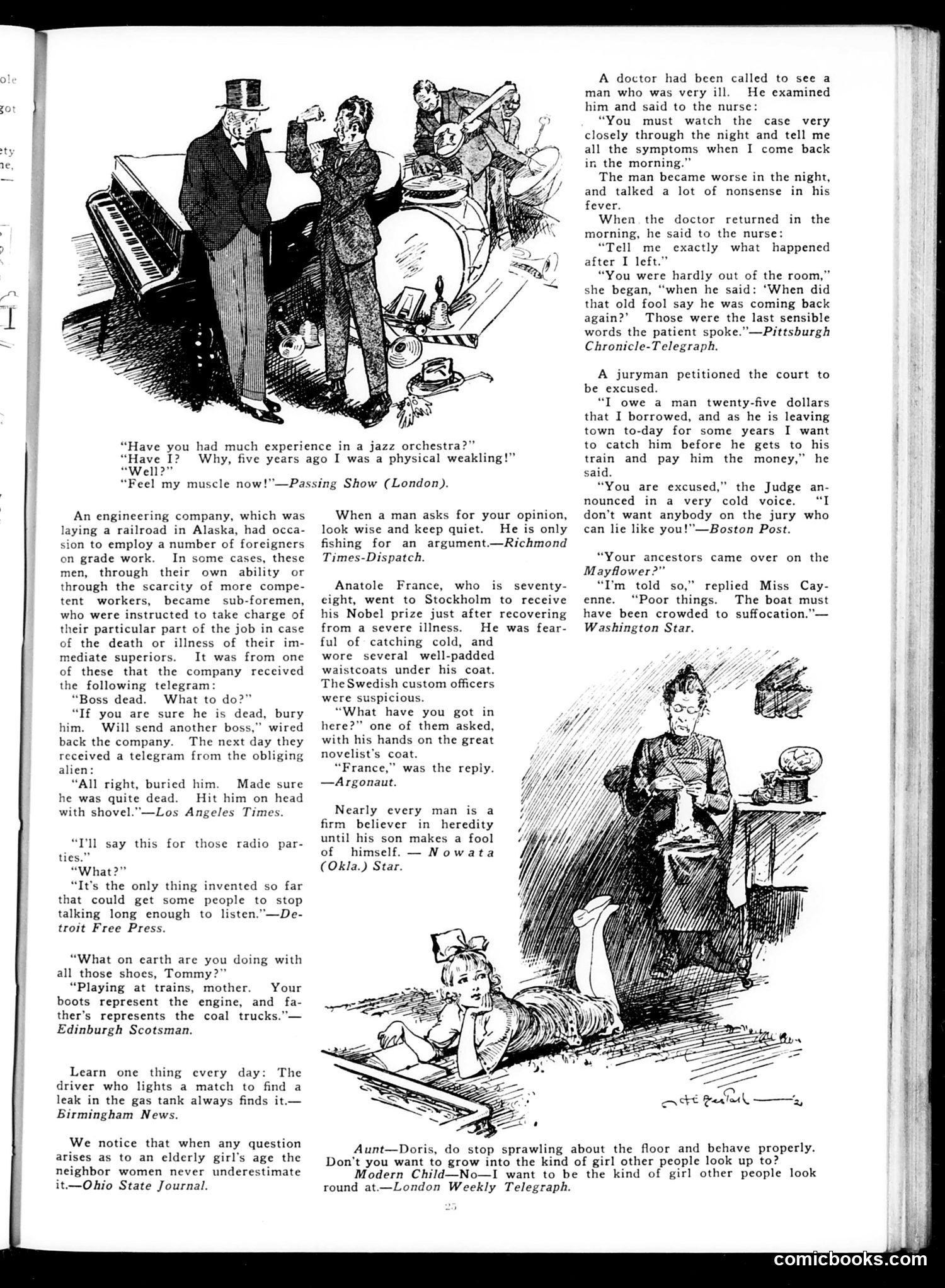
This page collects humorous anecdotes and jokes reflecting early 20th-century American attitudes. The top cartoon shows a jazz orchestra musician claiming five years in the band transformed him from "physical weakling" to muscular—satire on jazz music's perceived crude, vigorous nature and its working-class associations. The text includes several joke categories: **Immigration/Class humor**: A foreign railroad worker in Alaska kills his boss to confirm he's dead before burying him—playing on stereotypes about immigrants' supposed ignorance and brutality. **Modern technology satire**: Radio parties are mocked as the only way to silence talkative people. **Gender stereotypes**: Women allegedly never underestimate elderly women's ages; a modern girl wants to be looked "round at" rather than "up to"—suggesting vanity and impropriety. **Social hypocrisy**: A juror lying about owing money is excused because the judge assumes anyone that dishonest can't be trusted. The overall tone is gentle mockery of contemporary social types, immigrant populations, and changing modern manners.
📄 Transcribed text from this page (OCR, searchable)
Machine-transcribed from the original scan — historical spelling and the odd misread are preserved.
“Have you had much experience in a jazz orchestra?” “Have I? “Well?” Why, five years ago I was a physical weakling!” “Feel my muscle now!"—Passing Show (London). An engineering company, which was laying a railroad in Alaska, had occa- sion to employ a number of foreigners on grade work. In some cases, these men, through their own ability or through the scarcity of more compe- tent workers, became sub-foremen, who were instructed to take charge of their particular part of the job in case of the death or illness of their im- mediate superiors. It was from one of these that the company received the following telegram: “Boss dead. What to do?” “If you are sure he is dead, bury him. Will send another boss,” wired back the company. The next day they received a telegram from the obliging alien: “All right, buried him. Made sure he was quite dead. Hit him on head with shovel.”"—Los Angeles Times. “T'll say this for those radio par- ties.” “What?” “It's the only thing invented so far that could get some people to stop talking long enough to listen.”—De- troit Free Press. “What on earth are you doing with all those shoes, Tommy?” “Playing at trains, mother. Your boots represent the engine, and fa- ther’s represents the coal trucks.”— Edinburgh Scotsman. Learn one thing every day: The driver who lights a match to find a leak in the gas tank always finds it.— Birmingham News. We notice that when any question arises as to an elderly girl's age the neighbor women never underestimate it—Ohio State Journal. When a man asks for your opinion, look wise and keep quiet. He is only fishing for an argument.—Richmond Times-Dispatch. Anatole France, who is seventy- eight, went to Stockholm to receive his Nobel prize just after recovering from a severe illness. He was fear- ful of catching cold, and wore several well-padded waistcoats under his coat. The Swedish custom officers were suspicious. “What have you got in here?” one of them asked, yi with his hands on the great novelist’s coat. “France,” was the reply. —Argonaut. Nearly every man is a firm believer in heredity until his son makes a fool of himself. — Nowata (Okla.) Star. A doctor had been called to see a man who was very ill He examined him and said to the nurse: “You must watch the case very closely through the night and tell me all the symptoms when I come back in the morning.” The man became worse in the night, and talked a lot of nonsense in his fever. When the doctor returned in the morning, he said to the nurse: “Tell me exactly what happened after I left.” “You were hardly out of the room,” she began, “when he said: ‘When did that old fool say he was coming back again?’ Those were the last sensible words the patient spoke.”—Pittsburgh Chronicle-Telegraph. A juryman petitioned the court to be excused. “I owe a man twenty-five dollars that I borrowed, and as he is leaving town to-day for some years I want to catch him before he gets to his train and pay him the money,” he said. “You are excused,” the Judge an- nounced in a very cold voice. “I don’t want anybody on the jury who can lie like you!"—Boston Post. “Your ancestors came over on the Mayflower?” “I'm told so,” replied Miss Cay- enne. “Poor things. The boat must have been crowded to suffocation.”— Washington Star. ly att pesos u Aunt—Doris, do stop sprawling about the floor and behave properly. Don't you want to grow into the kind of girl other people look up to? Modern Child—No—I want to be the kind of girl other people look round at—London Weekly Telegraph. comicbooks.com