
Judge, 1922-05-27 · page 22 of 36
Judge — May 27, 1922 — page 22: what you’re looking at
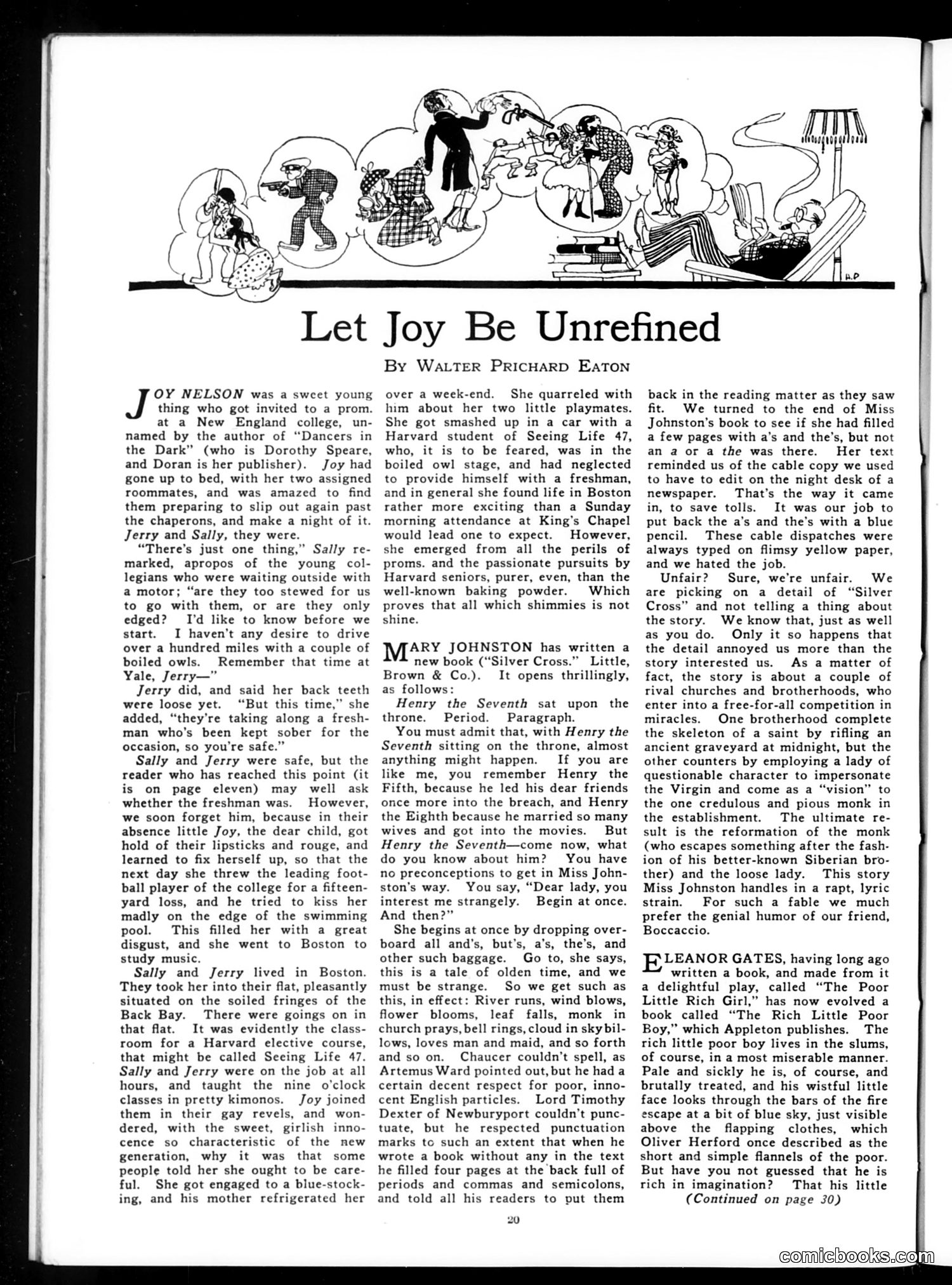
What you’re looking at
This article satirizes 1920s college culture and young women's liberation. The illustration shows various scenes of modern youth entertainment—dancing, socializing, leisure activities—representing the new freedoms available to the "flapper" generation. The story follows Joy Nelson, a naive college girl who befriends two worldly roommates, Sally and Jerry, who teach her to use makeup and engage in unsupervised socializing. The satire targets the moral panic surrounding young women's independence: Joy attends wild parties, rides in cars with drunk drivers, gets "smashed" (intoxicated), and moves to Boston to live an exciting urban life—yet emerges "purer...than well-known baking powder." The piece mockingly suggests that despite parental fears about modern girls' behavior, they remain fundamentally virtuous. The title's irony—"Let Joy Be Unrefined"—captures this tension between conservative anxiety about youth morality and the apparent harmlessness of their actual conduct. Judge here gently ridicules both the rebellious younger generation and the older generation's overblown concerns.
📄 Transcribed text from this page (OCR, searchable)
Machine-transcribed from the original scan — historical spelling and the odd misread are preserved.
OY NELSON was a sweet young thing who got invited to a prom. at a New England college, un- named by the author of “Dancers in the Dark” (who is Dorothy Speare, and Doran is her publisher). Joy had gone up to bed, with her two assigned roommates, and was amazed to find them preparing to slip out again past the chaperons, and make a night of it. Jerry and Sally, they were. “There’s just one thing,” Sally re- marked, apropos of the young col- legians who were waiting outside with a motor; “are they too stewed for us to go with them, or are they only edged? I'd like to know before we start. I haven't any desire to drive over a hundred miles with a couple of boiled owls. Remember that time at Yale, Jerry—" Jerry did, and said her back teeth were loose yet. “But this time,” she added, “they’re taking along a fresh- man who's been kept sober for the occasion, so you're safe.” Sally and Jerry were safe, but the reader who has reached this point (it is on page eleven) may well ask whether the freshman was. However, we soon forget him, because in their absence little Joy, the dear child, got hold of their lipsticks and rouge, and learned to fix herself up, so that the next day she threw the leading foot- ball player of the college for a fifteen- yard loss, and he tried to kiss her madly on the edge of the swimming pool. This filled her with a great disgust, and she went to Boston to study music. Sally and Jerry lived in Boston. They took her into their flat, pleasantly situated on the soiled fringes of the Back Bay. There were goings on in that flat. It was evidently the class- room for a Harvard elective course, that might be called Seeing Life 47. Sally and Jerry were on the job at all hours, and taught the nine o'clock classes in pretty kimonos. Joy joined them in their gay revels, and won- dered, with the sweet, girlish inno- cence so characteristic of the new generation, why it was that some people told her she ought to be care- ful. She got engaged to a blue-stock- ing, and his mother refrigerated her Joy Be Unrefined By WALTER PRICHARD EATON over a week-end. She quarreled with him about her two little playmates. She got smashed up in a car with a Harvard student of Seeing Life 47, who, it is to be feared, was in the boiled owl stage, and had neglected to provide himself with a freshman, and in general she found life in Boston rather more exciting than a Sunday morning attendance at King’s Chapel would lead one to expect. However, she emerged from all the perils of proms. and the passionate pursuits by Harvard seniors, purer, even, than the well-known baking powder. Which proves that all which shimmies is not shine. MiAkY JOHNSTON has written a new book (“Silver Cross.” Little, Brown & Co.). It opens thrillingly, as follows: Henry the Seventh sat upon throne. Period. Paragraph. You must admit that, with Henry the Seventh sitting on the throne, almost anything might happen. If you are like me, you remember Henry the Fifth, because he led his dear friends once more into the breach, and Henry the Eighth because he married so many wives and got into the movies. But Henry the Seventh—come now, what do you know about him? You have no preconceptions to get in Miss John- ston’s way. You say, “Dear lady, you interest me strangely. Begin at once. And then?” She begins at once by dropping over- board all and's, but’s, a’s, the’s, and other such baggage. Go to, she says, this is a tale of olden time, and we must be strange. So we get such as this, in effect: River runs, wind blows, flower blooms, leaf falls, monk in church prays, bell rings, cloud in sky bil- lows, loves man and maid, and so forth and so on. Chaucer couldn't spell, as Artemus Ward pointed out, but he hada certain decent respect for poor, inno- cent English particles. Lord Timothy Dexter of Newburyport couldn't punc- tuate, but he respected punctuation marks to such an extent that when he wrote a book without any in the text he filled four pages at the back full of periods and commas and semicolons, and told all his readers to put them the 20 back in the reading matter as they saw fit. We turned to the end of Miss Johnston's book to see if she had filled a few pages with a’s and the’s, but not an a or a the was there. Her text reminded us of the cable copy we used to have to edit on the night desk of a newspaper. That’s the way it came in, to save tolls. It was our job to put back the a's and the’s with a blue pencil. These cable dispatches were always typed on flimsy yellow paper, and we hated the job. Unfair? Sure, we're unfair. We are picking on a detail of “Silver Cross” and not telling a thing about the story. We know that, just as well as you do. Only it so happens that the detail annoyed us more than the story interested us. As a matter of fact, the story is about a couple of rival churches and brotherhoods, who enter into a free-for-all competition in miracles. One brotherhood complete the skeleton of a saint by rifling an ancient graveyard at midnight, but the other counters by employing a lady of questionable character to impersonate the Virgin and come as a “vision” to the one credulous and pious monk in the establishment. The ultimate re- sult is the reformation of the monk (who escapes something after the fash- ion of his better-known Siberian bro- ther) and the loose lady. This story Miss Johnston handles in a rapt, lyric strain. For such a fable we much prefer the genial humor of our friend, Boccaccio. E,LEANOR GATES, having long ago written a book, and made from it a delightful play, called “The Poor Little Rich Girl,” has now evolved a book called “The Rich Little Poor Boy,” which Appleton publishes. The rich little poor boy lives in the slums, of course, in a most miserable manner. Pale and sickly he is, of course, and brutally treated, and his wistful little face looks through the bars of the fire escape at a bit of blue sky, just visible above the flapping clothes, which Oliver Herford once described as the short and simple flannels of the poor. But have you not guessed that he is rich in imagination? That his little (Continued on page 30) comichooks.