
Judge, 1922-05-27 · page 9 of 36
Judge — May 27, 1922 — page 9: what you’re looking at
What you’re looking at
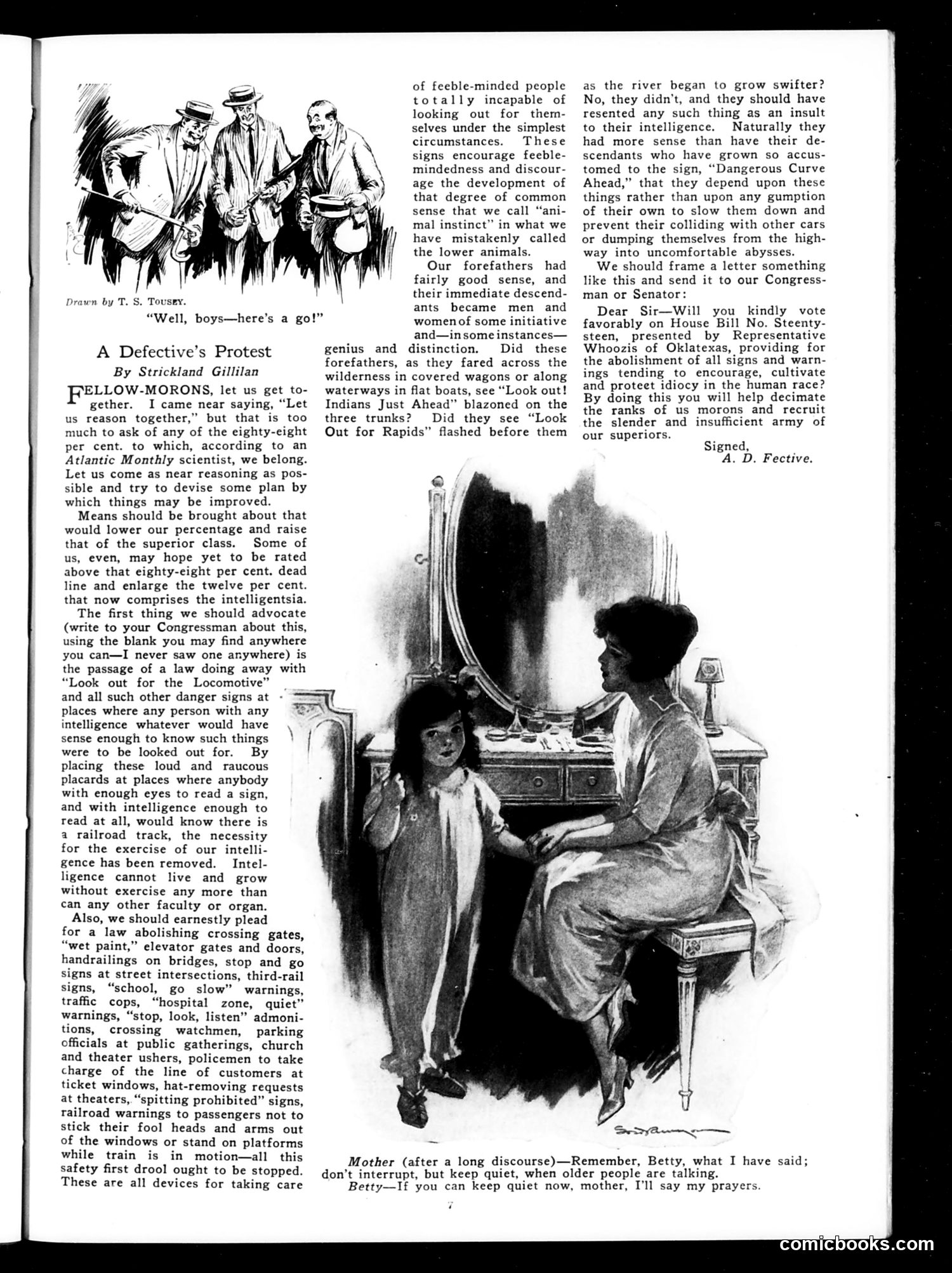
This page satirizes American attitudes toward public safety and intelligence through a sardonic argument attributed to "A Defective's Protest." **The Satire:** The author (Strickland Gillilan) proposes eliminating all safety warnings—railroad crossing signs, "wet paint" notices, handrails, traffic signals, etc.—claiming they cater to the "feeble-minded" and atrophy our natural intelligence. He argues our ancestors survived without such signs, so modern warnings insult our capabilities. **The Point:** This is **ironic mockery**. The piece ridicules people who resent safety regulations as paternalistic infantilization, yet simultaneously reveals how dangerous such thinking is. By framing safety devices as insulting to intelligence, Gillilan exposes the illogical pride and stubbornness behind resistance to public safety measures—showing that rejecting helpful warnings actually demonstrates *lack* of sense, not abundance of it. **The Illustration:** Shows a mother attempting to teach her daughter restraint while visiting (social etiquette), illustrating the tension between supervision/guidance and independence—reinforcing the essay's theme about necessary safeguards. The satire targets Progressive-era debates over government regulation and individual responsibility.
📄 Transcribed text from this page (OCR, searchable)
Machine-transcribed from the original scan — historical spelling and the odd misread are preserved.
Drawn by T. S. Tousey. “Well, boys—here’s a go!” A Defective’s Protest By Strickland Gillilan FFELLOW-MORONS, let us get to- gether. I came near saying, “Let us reason together,” but that is too much to ask of any of the eighty-eight per cent. to which, according to an Atlantic Monthly scientist, we belong. Let us come as near reasoning as pos- sible and try to devise some plan by which things may be improved. Means should be brought about that would lower our percentage and raise that of the superior class. Some of us, even, may hope yet to be rated above that eighty-eight per cent. dead line and enlarge the twelve per cent. that now comprises the intelligentsia. The first thing we should advocate (write to your Congressman about this, using the blank you may find anywhere you can—I never saw one anywhere) is the passage of a law doing away with “Look out for the Locomotive” and all such other danger signs at places where any person with any intelligence whatever would have sense enough to know such things were to be looked out for. By placing these loud and raucous placards at places where anybody with enough eyes to read a sign, and with intelligence enough to read at all, would know there is a railroad track, the necessity for the exercise of our intelli- gence has been removed. Intel- ligence cannot live and grow without exercise any more than can any other faculty or organ. Also, we should earnestly plead for a law abolishing crossing gates, “wet paint,” elevator gates and doors, handrailings on bridges, stop and go signs at street intersections, third-rail signs, “school, go slow” warnings, traffic cops, “hospital zone, quiet” warnings, “stop, look, listen” admoni- tions, crossing watchmen, parking officials at public gatherings, church and theater ushers, policemen to take charge of the line of customers at ticket windows, hat-removing requests at theaters, “spitting prohibited” signs, railroad warnings to passengers not to stick their fool heads and arms out of the windows or stand on platforms while train is in motion—all this safety first drool ought to be stopped. These are all devices for taking care of feeble-minded people totally incapable of looking out for them- selves under the simplest circumstances. These signs encourage feeble- mindedness and discour- age the development of that degree of common sense that we call “ani- mal instinct” in what we have mistakenly called the lower animals. Our forefathers had fairly good sense, and their immediate descend- ants became men and women of some initiative and—insomeinstances— genius and distinction. Did these forefathers, as they fared across the wilderness in covered wagons or along waterways in flat boats, see “Look out! Indians Just Ahead” blazoned on the three trunks? Did they see “Look Out for Rapids” flashed before them as the river began to grow swifter? No, they didn’t, and they should have resented any such thing as an insult to their intelligence. Naturally they had more sense than have their de- scendants who have grown so accus- tomed to the sign, “Dangerous Curve Ahead,” that they depend upon these things rather than upon any gumption of their own to slow them down and prevent their colliding with other cars or dumping themselves from the high- way into uncomfortable abysses. We should frame a letter something like this and send it to our Congress- man or Senator: Dear Sir—Will you kindly vote favorably on House Bill No. Steenty- steen, presented by Representative Whoozis of Oklatexas, providing for the abolishment of all signs and warn- ings tending to encourage, cultivate and proteet idiocy in the human race? By doing this you will help decimate the ranks of us morons and recruit the slender and insufficient army of our superiors. Signed, A. D. Fective. Mother (after a long discourse)—Remember, Betty, what I have said; don’t interrupt, but keep quiet, when older people are talking. Betty—If you can keep quiet now, mother, I'll say my prayers. comicbooks.com