
Judge, 1922-05-27 · page 14 of 36
Judge — May 27, 1922 — page 14: what you’re looking at
What you’re looking at
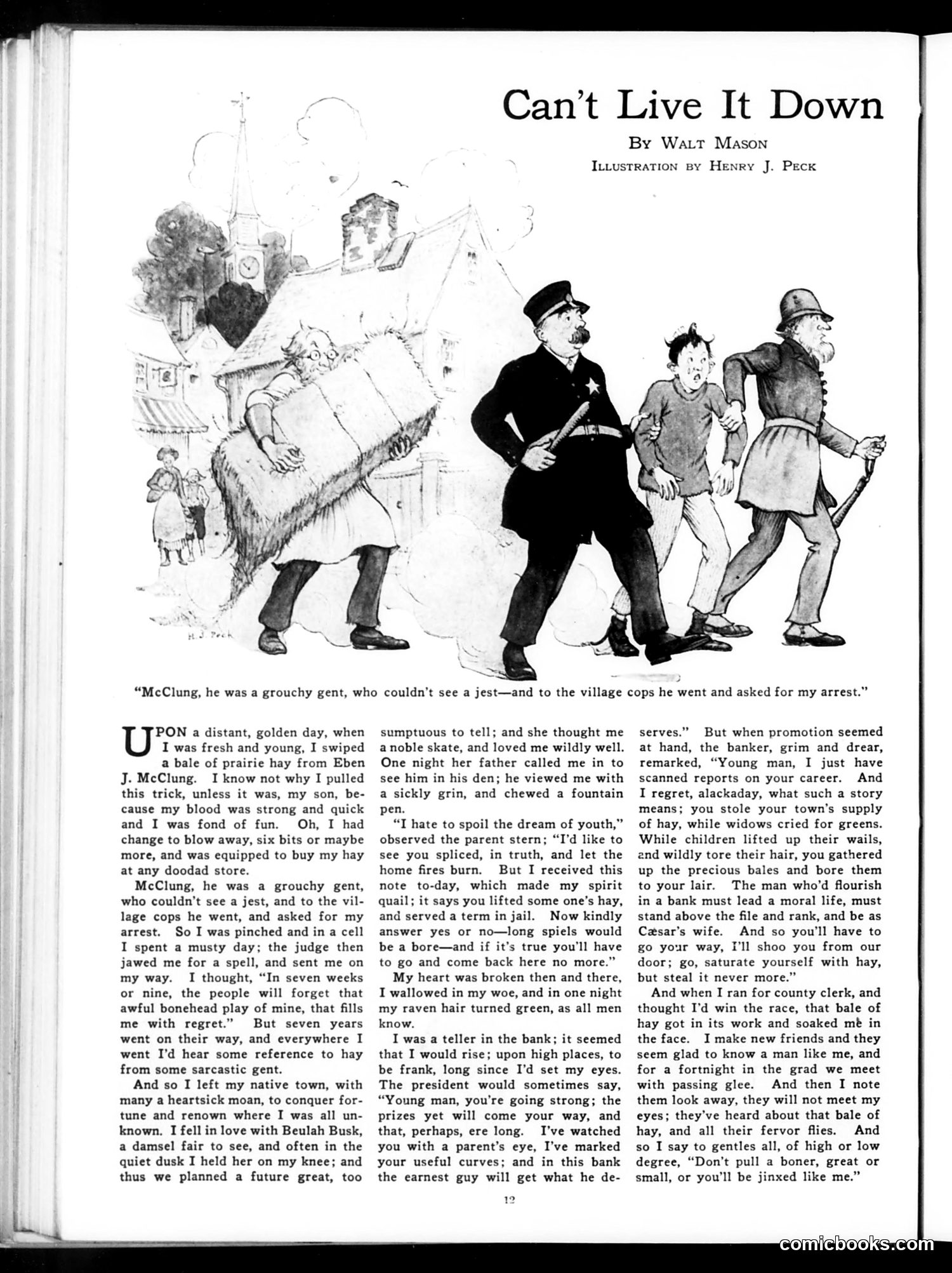
This is a cautionary tale illustrated by Henry J. Peck, presenting a moral lesson about youthful pranks having lifelong consequences. The protagonist steals a bale of hay as a young, mischievous man from farmer Eben J. McClung. Though arrested and briefly jailed, he assumes the incident will be forgotten. However, the theft becomes a permanent stain on his reputation that follows him for seven years and beyond, derailing his life prospects. The story documents three specific moments where the old incident resurfaces: when seeking to marry Beulah Busk (her father refuses him), when pursuing a bank promotion (the banker denies advancement), and when running for county clerk (voters reject him). Each time, the remembered hay theft undermines his aspirations. The satire critiques both small-town gossip culture—which obsessively preserves and repeats social transgressions—and the rigid moral standards of the era, where a minor youthful indiscretion becomes permanently disqualifying. The moral: "Don't pull a boner...or you'll be jinxed like me."
📄 Transcribed text from this page (OCR, searchable)
Machine-transcribed from the original scan — historical spelling and the odd misread are preserved.
Can’t Live It Down By Watt Mason Intustration By Henry J. Peck “McClung, he was a grouchy gent, who couldn't see a jest—and to the village cops he went and asked for my arrest.” I was fresh and young, I swiped a bale of prairie hay from Eben J. McClung. I know not why I pulled this trick, unless it was, my son, be- cause my blood was strong and quick and I was fond of fun. Oh, I had change to blow away, six bits or maybe more, and was equipped to buy my hay at any doodad store. McClung, he was a grouchy gent, who couldn’t see a jest, and to the vil- lage cops he went, and asked for my arrest. So I was pinched and ina cell I spent a musty day; the judge then jawed me for a spell, and sent me on my way. I thought, “In seven weeks or nine, the people will forget that awful bonehead play of mine, that fills me with regret.” But seven years went on their way, and everywhere I went I'd hear some reference to hay from some sarcastic gent. And so I left my native town, with many a heartsick moan, to conquer for- tune and renown where I was all un- known. I fell in love with Beulah Busk, a damsel fair to see, and often in the quiet dusk I held her on my knee; and thus we planned a future great, too UST a distant, golden day, when sumptuous to tell; and she thought me anoble skate, and loved me wildly well. One night her father called me in to see him in his den; he viewed me with a sickly grin, and chewed a fountain pen. “T hate to spoil the dream of youth, observed the parent stern; “I'd like to see you spliced, in truth, and let the home fires burn. But I received this note to-day, which made my spirit quail; it says you lifted some one’s hay, and served a term in jail. Now kindly answer yes or no—long spiels would be a bore—and if it’s true you'll have to go and come back here no more.” My heart was broken then and there, I wallowed in my woe, and in one night my raven hair turned green, as all men know. I was a teller in the bank; it seemed that I would rise; upon high places, to be frank, long since I’d set my eyes. The president would sometimes say, “Young man, you're going strong; the prizes yet will come your way, and that, perhaps, ere long. I’ve watched you with a parent’s eye, I’ve marked your useful curves; and in this bank the earnest guy will get what he de- 12 serves.” But when promotion seemed at hand, the banker, grim and drear, remarked, “Young man, I just have scanned reports on your career. And I regret, alackaday, what such a story means; you stole your town’s supply of hay, while widows cried for greens. While children lifted up their wails, and wildly tore their hair, you gathered up the precious bales and bore them to your lair. The man who'd flourish in a bank must lead a moral life, must stand above the file and rank, and be as Czsar’s wife. And so you'll have to go your way, I'll shoo you from our door; go, saturate yourself with hay, but steal it never more.” And when I ran for county clerk, and thought I'd win the race, that bale of hay got in its work and soaked me in the face. I make new friends and they seem glad to know a man like me, and for a fortnight in the grad we meet with passing glee. And then I note them look away, they will not meet my eyes; they’ve heard about that bale of hay, and all their fervor flies. And so I say to gentles all, of high or low degree, “Don’t pull a boner, great or small, or you'll be jinxed like me.”