
Judge, 1922-05-27 · page 7 of 36
Judge — May 27, 1922 — page 7: what you’re looking at
What you’re looking at
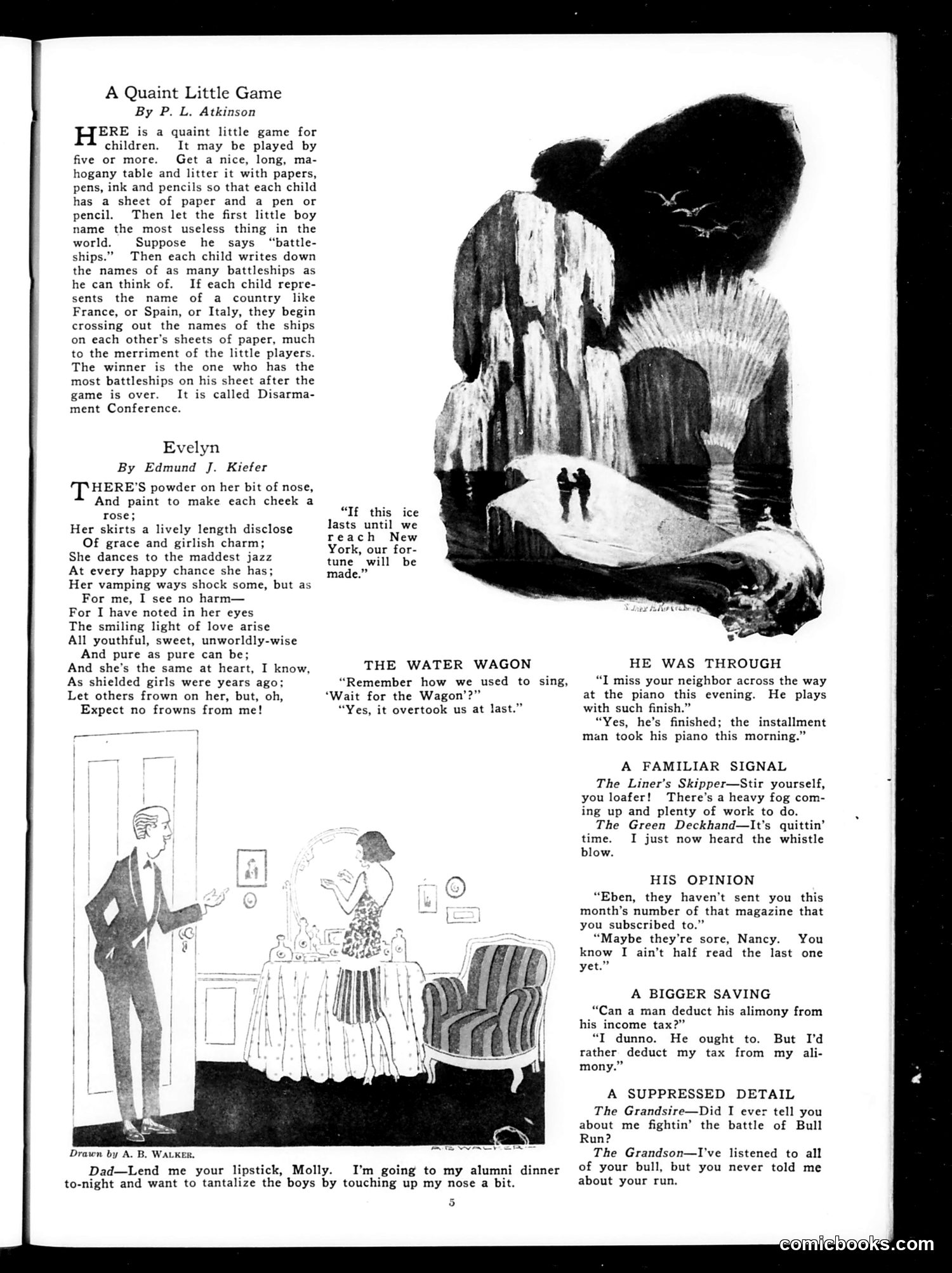
This page contains satirical commentary on 1920s American society through multiple short pieces: **"A Quaint Little Game"** mocks the League of Nations' Disarmament Conference through a children's game metaphor. The "game" involves countries (represented as children) competing to eliminate each other's battleships—satirizing the period's peace efforts as naive child's play unlikely to achieve real disarmament. **"Evelyn"** celebrates modern flapper culture—the short skirts, makeup, and jazz dancing scandalized older generations—while defending young women as fundamentally unchanged in virtue beneath their contemporary style. The remaining vignettes are domestic humor about modern marriage, alimony taxes, piano repossession, and work ethic—typical light satirical fare of the era. The illustrated cartoon shows a man borrowing cosmetics before a social dinner, referencing appearance-obsession among the social elite. Overall, the page reflects Jazz Age anxieties about modernity, generational change, and international politics.
📄 Transcribed text from this page (OCR, searchable)
Machine-transcribed from the original scan — historical spelling and the odd misread are preserved.
A Quaint Little Game By P. L. Atkinson HERE is a quaint little game for children. It may be played by five or more. Get a nice, long, ma- hogany table and litter it with papers, pens, ink and pencils so that each child has a sheet of paper and a pen or pencil. Then let the first little boy name the most useless thing in the world. Suppose he says “battle- ships.” Then each child writes down the names of as many battleships as he can think of. If each child repre- sents the name of a country like France, or Spain, or Italy, they begin crossing out the names of the ships on each other's sheets of paper, much to the merriment of the little players. The winner is the one who has the most battleships on his sheet after the game is over. It is called Disarma- ment Conference. Evelyn By Edmund J. Kiefer THERE'S powder on her bit of nose, And paint to make each cheek a rose; Her skirts a lively length disclose Of grace and girlish charm; She dances to the maddest jazz At every happy chance she has; Her vamping ways shock some, but as For me, I see no harm— For I have noted in her eyes The smiling light of love arise All youthful, sweet, unworldly-wise And pure as pure can be; And she’s the same at heart, I know, As shielded girls were years ago; Let others frown on her, but, oh, Expect no frowns from me! Drawn by A. B. WALKER. Dad—Lend me your lipstick, Molly. “If this ice lasts until we reach New York, our for- tune will be made.” THE WATER WAGON “Remember how we used to sing, ‘Wait for the Wagon’?” “Yes, it overtook us at last.’ I’m going to my alumni dinner to-night and want to tantalize the boys by touching up my nose a bit. 5 HE WAS THROUGH “I miss your neighbor across the way at the piano this evening. He plays with such finish.” “Yes, he’s finished; the installment man took his piano this morning.” A FAMILIAR SIGNAL The Liner’s Skipper—Stir yourself, you loafer! There’s a heavy fog com- ing up and plenty of work to do. The Green Deckhand—It’s quittin’ time. I just now heard the whistle blow. HIS OPINION “Eben, they haven’t sent you this month’s number of that magazine that you subscribed to.” “Maybe they’re sore, Nancy. You know I ain’t half read the last one yet.” A BIGGER SAVING “Can a man deduct his alimony from his income tax?” “I dunno. He ought to. But I'd rather deduct my tax from my ali- mony.” A SUPPRESSED DETAIL The Grandsire—Did I ever tell you about me fightin’ the battle of Bull Run? The Grandson—I've listened to all of your bull, but you never told me about your run.