
Judge, 1922-05-27 · page 10 of 36
Judge — May 27, 1922 — page 10: what you’re looking at
What you’re looking at
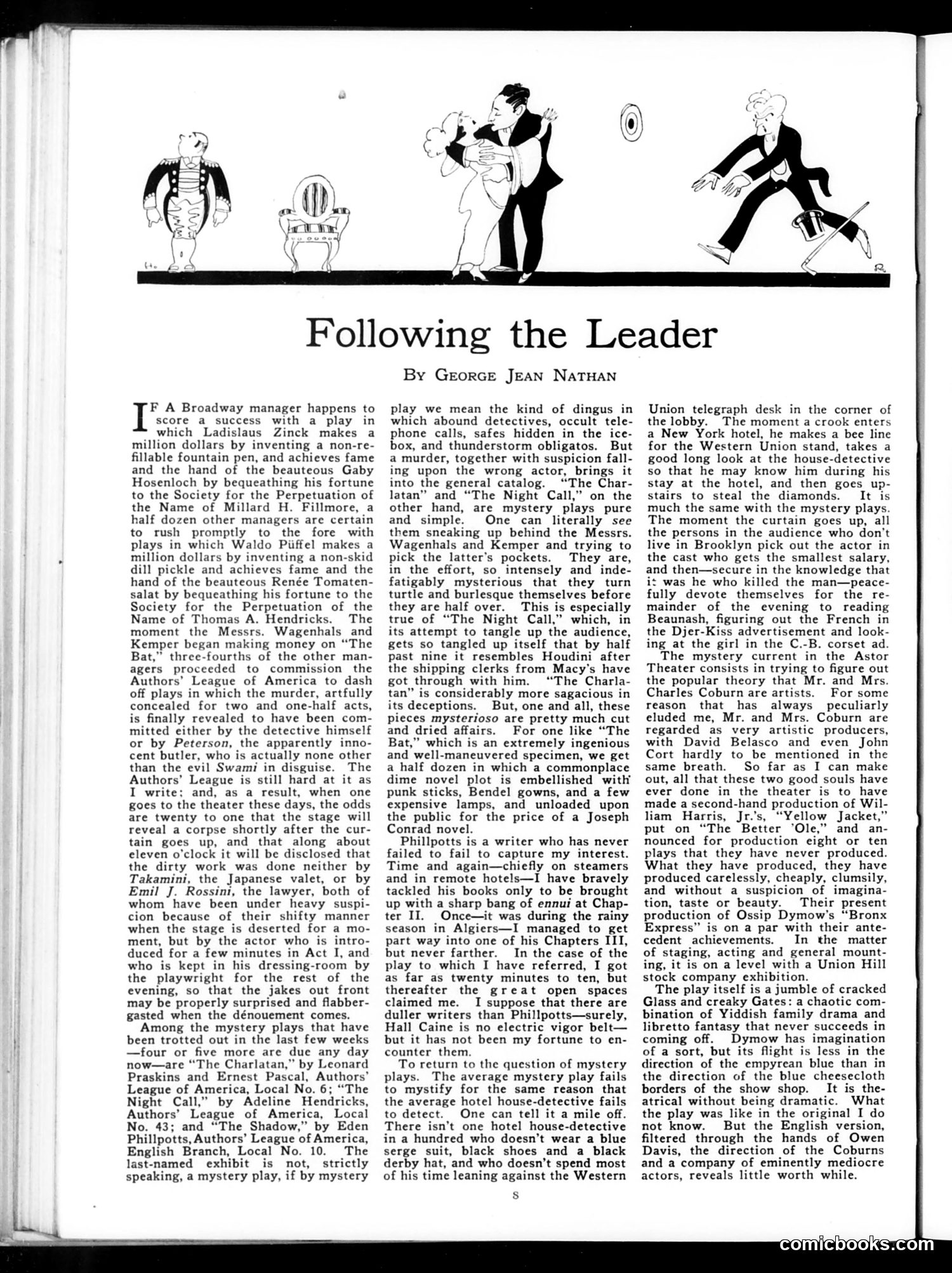
This article by George Jean Nathan satirizes Broadway's herd mentality. Nathan argues that when one play succeeds—using absurdly specific examples like a fountain-pen inventor named Ladislaus Zinck—dozens of competing managers immediately rush to produce nearly identical plays with interchangeable plots (pickle inventors, lawyer characters, mysterious butlers). His primary target is the mystery-play craze. Nathan mocks how productions like "The Bat," "The Charlatan," and "The Night Call" follow a tired formula: murders, false suspects (Japanese valets, shifty lawyers, innocent butlers), and predictable reveal scenes. He particularly skewers "The Night Call" for becoming so convoluted it "resembles Houdini after the shipping clerks from Macy's have got through with him." The cartoon above depicts this "following the leader" concept visually—each figure mimics the previous one's posture and behavior, illustrating Nathan's point about Broadway's lack of originality and creative independence.
📄 Transcribed text from this page (OCR, searchable)
Machine-transcribed from the original scan — historical spelling and the odd misread are preserved.
Following the Leader By Greorce JEAN NaTHAN I’ A Broadway manager happens to score a success with a play in which Ladislaus Zinck makes a million dollars by inventing a non-re- fillable fountain pen, and achieves fame and the hand of the beauteous Gaby Hosenloch by bequeathing his fortune to the Society for the Perpetuation of the Name of Millard H. Fillmore, a half dozen other managers are certain to rush promptly to the fore with plays in which Waldo Piiffel makes a million dollars by inventing a non-skid dill pickle and achieves fame and the hand of the beauteous Renée Tomaten- salat by bequeathing his fortune to the Society for the Perpetuation of the Name of Thomas A. Hendricks. The moment the Messrs. Wagenhals and Kemper began making money on “The Bat,” three-fourths of the other man- agers proceeded to commission the Authors’ League of America to dash off plays in which the murder, artfully concealed for two and one-half acts, is finally revealed to have been com- mitted either by the detective himself or by Peterson, the apparently inno- cent butler, who is actually none other than the evil Swami in disguise. The Authors’ League is still hard at it as I write; and, as a result, when one goes to the theater these days, the odds are twenty to one that the stage will reveal a corpse shortly after the cur- tain goes up, and that along about eleven o'clock it will be disclosed that the dirty work was done neither by Takamini, the Japanese valet, or by Emil J. Rossini, the lawyer, both of whom have been under heavy suspi- cion because of their shifty manner when the stage is deserted for a mo- ment, but by the actor who is intro- duced for a few minutes in Act I, and who is kept in his dressing-room by the playwright for the rest of the evening, so that the jakes out front may be properly surprised and flabber- gasted when the dénouement comes. Among the mystery plays that have been trotted out in the last few weeks —four or five more are due any day now—are “The Charlatan,” by Leonard Praskins and Ernest Pascal, Authors’ League of America, Local No. 6; “The Night Call,” by Adeline Hendricks, Authors’ League of America, Local No. 43; and “The Shadow,” by Eden Phillpotts, Authors’ League of America, English Branch, Local No. 10. The last-named exhibit is not, strictly speaking, a mystery play, if by mystery play we mean the kind of dingus in which abound detectives, occult tele- phone calls, safes hidden in the ice- box, and thunderstorm obligatos. But a murder, together with suspicion fall- ing upon the wrong actor, brings it into the general catalog. “The Char- latan” and “The Night Call,” on the other hand, are mystery plays pure and simple. One can literally see them sneaking up behind the Messrs. Wagenhals and Kemper and trying to pick the latter’s pockets. They are, in the effort, so intensely and inde- fatigably mysterious that they turn turtle and burlesque themselves before they are half over. This is especially true of “The Night Call,” which, in its attempt to tangle up the audience, gets so tangled up itself that by half past nine it resembles Houdini after the shipping clerks from Macy’s have got through with him. “The Charla- tan” is considerably more sagacious in its deceptions. But, one and all, these pieces mysterioso are pretty much cut and dried affairs. For one like “The Bat,” which is an extremely ingenious and well-maneuvered specimen, we get a half dozen in which a commonplace dime novel plot is embellished with punk sticks, Bendel gowns, and a few expensive lamps, and unloaded upon the public for the price of a Joseph Conrad novel. Phillpotts is a writer who has never failed to fail to capture my interest. Time and again—chiefly on steamers and in remote hotels—I have bravely tackled his books only to be brought up with a sharp bang of ennui at Chap- ter II. _Once—it was during the rainy season in Algiers—I managed to get part way into one of his Chapters III, but never farther. In the case of the play to which I have referred, I got as far as twenty minutes to ten, but thereafter the great open spaces claimed me. I suppose that there are duller writers than Phillpotts—surely, Hall Caine is no electric vigor belt— but it has not been my fortune to en- counter them. To return to the question of mystery plays. The average mystery play fails to mystify for the same reason that the average hotel house-detective fails to detect. One can tell it a mile off. There isn’t one hotel house-detective in a hundred who doesn’t wear a blue serge suit, black shoes and a black derby hat, and who doesn’t spend most of his time leaning against the Western 8 Union telegraph desk in the corner of the lobby. The moment a crook enters a New York hotel, he makes a bee line for the Western Union stand, takes a good long look at the house-detective so that he may know him during his stay at the hotel, and then goes up- stairs to steal the diamonds. It is much the same with the mystery plays. The moment the curtain goes up, all the persons in the audience who don't live in Brooklyn pick out the actor in the cast who gets the smallest salary, and then—secure in the knowledge that it was he who killed the man—peace- fully devote themselves for the re- mainder of the evening to reading Beaunash, figuring out the French in the Djer-Kiss advertisement and look- ing at the girl in the C.-B. corset ad. The mystery current in the Astor Theater consists in trying to figure out the popular theory that Mr. and Mrs. Charles Coburn are artists. For some reason that has always peculiarly eluded me, Mr. and Mrs. Coburn are regarded as very artistic producers, with David Belasco and even John Cort hardly to be mentioned in the same breath. So far as I can make out, all that these two good souls have ever done in the theater is to have made a second-hand production of Wil- liam Harris, Jr.’s, “Yellow Jacket,” put on “The Better “Ole,” and an- nounced for production eight or ten plays that they have never produced. What they have produced, they have produced carelessly, cheaply, clumsily, and without a suspicion of imagina- tion, taste or beauty. Their present production of Ossip Dymow’s “Bronx Express” is on a par with their ante- cedent achievements. In the matter of staging, acting and general mount- ing, it is on a level with a Union Hill stock company exhibition. The play itself is a jumble of cracked Glass and creaky Gates: a chaotic com- bination of Yiddish family drama and libretto fantasy that never succeeds in coming off. Dymow has imagination of a sort, but its flight is less in the direction of the empyrean blue than in the direction of the blue cheesecloth borders of the show shop. It is the- atrical without being dramatic. What the play was like in the original I do not know. But the English version, filtered through the hands of Owen Davis, the direction of the Coburns and a company of eminently mediocre actors, reveals little worth while.