
Judge, 1922-05-27 · page 20 of 36
Judge — May 27, 1922 — page 20: what you’re looking at
What you’re looking at
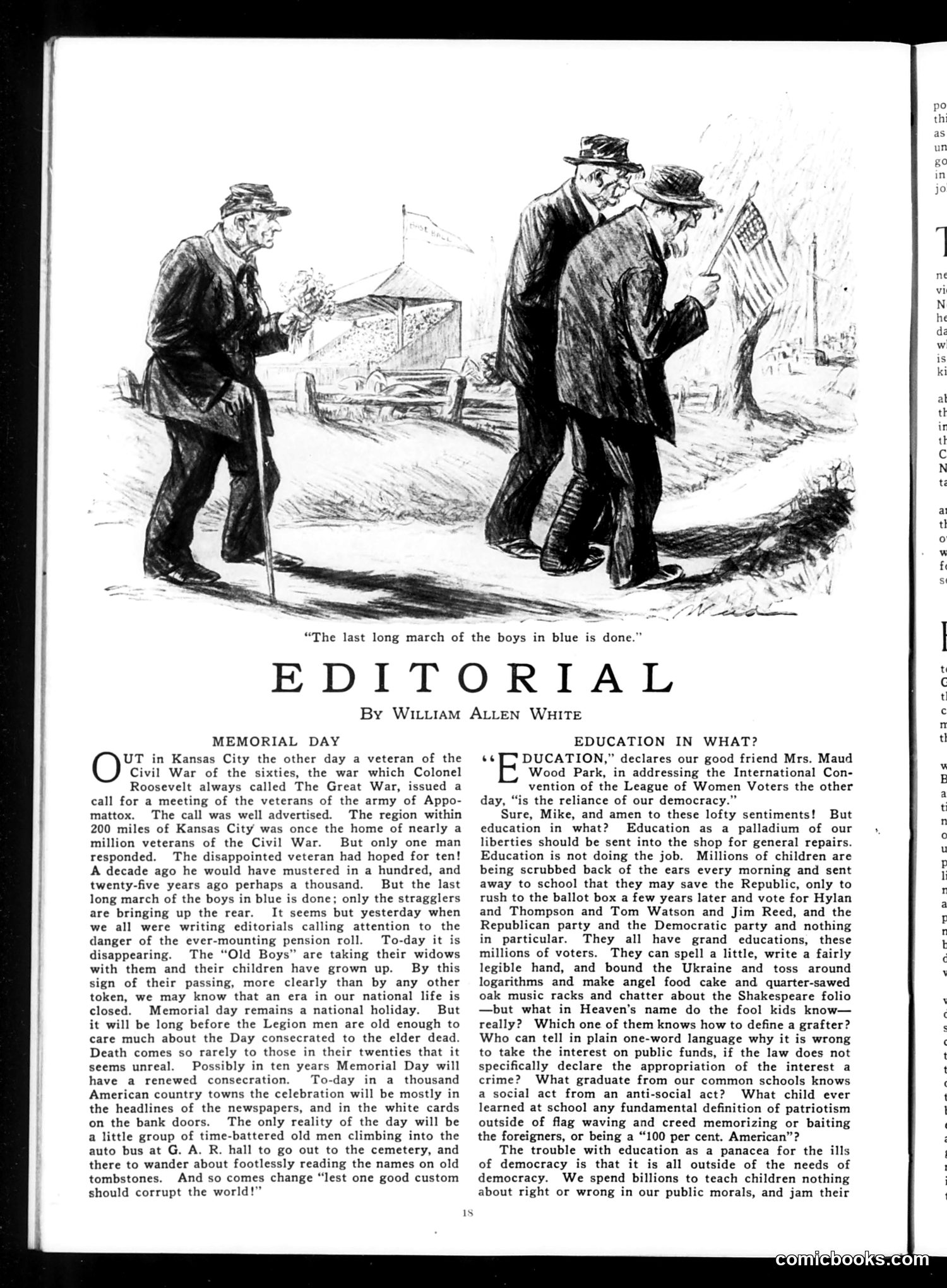
The cartoon depicts Civil War veterans ("boys in blue") at what appears to be a Memorial Day gathering, illustrating White's editorial lament about the aging and dying generation of Union soldiers. **The Satire:** White mourns how few Civil War veterans remain—only one showed up to a Kansas City reunion that once drew hundreds. He uses this as a metaphor for a closing era in American life. **The Second Editorial's Point:** White attacks the gap between educational ideals and reality. He agrees education supports democracy (echoing a League of Women Voters speaker), but argues schools teach only technical skills—spelling, math, literature—while failing to teach *civic morality*. Students memorize patriotic rhetoric but can't define graft or understand why stealing public funds is wrong. White critiques education that produces technically literate citizens who still vote for corrupt politicians and exhibit no genuine understanding of ethics or genuine patriotism beyond flag-waving. The piece argues democracy's survival requires moral education, not just curriculum completion.
📄 Transcribed text from this page (OCR, searchable)
Machine-transcribed from the original scan — historical spelling and the odd misread are preserved.
“The last long march of the boys in blue is done.” EDITORIAL By Wituram ALLEN WHITE MEMORIAL DAY UT in Kansas City the other day a veteran of the Civil War of the sixties, the war which Colonel Roosevelt always called The Great War, issued a call for a meeting of the veterans of the army of Appo- mattox. The call was well advertised. The region within 200 miles of Kansas City was once the home of nearly a million veterans of the Civil War. But only one man responded. The disappointed veteran had hoped for ten! A decade ago he would have mustered in a hundred, and twenty-five years ago perhaps a thousand. But the last long march of the boys in blue is done; only the stragglers are bringing up the rear. It seems but yesterday when we all were writing editorials calling attention to the danger of the ever-mounting pension roll. To-day it is disappearing. The “Old Boys” are taking their widows with them and their children have grown up. By this sign of their passing, more clearly than by any other token, we may know that an era in our national life is closed. Memorial day remains a national holiday. But it will be long before the Legion men are old enough to care much about the Day consecrated to the elder dead. Death comes so rarely to those in their twenties that it seems unreal. Possibly in ten years Memorial Day will have a renewed consecration. To-day in a thousand American country towns the celebration will be mostly in the headlines of the newspapers, and in the white cards on the bank doors. The only reality of the day will be a little group of time-battered old men climbing into the auto bus at G. A. R. hall to go out to the cemetery, and there to wander about footlessly reading the names on old tombstones. And so comes change “lest one good custom should corrupt the world!” EDUCATION IN WHAT? rs DUCATION,” declares our good friend Mrs. Maud Wood Park, in addressing the International Con- vention of the League of Women Voters the other day, “is the reliance of our democracy.” Sure, Mike, and amen to these lofty sentiments! But education in what? Education as a palladium of our liberties should be sent into the shop for general repairs. Education is not doing the job. Millions of children are being scrubbed back of the ears every morning and sent away to school that they may save the Republic, only to rush to the ballot box a few years later and vote for Hylan and Thompson and Tom Watson and Jim Reed, and the Republican party and the Democratic party and nothing in particular. They all have grand educations, these millions of voters. They can spell a little, write a fairly legible hand, and bound the Ukraine and toss around logarithms and make angel food cake and quarter-sawed oak music racks and chatter about the Shakespeare folio —but what in Heaven's name do the fool kids know— really? Which one of them knows how to define a grafter? Who can tell in plain one-word language why it is wrong to take the interest on public funds, if the law does not specifically declare the appropriation of the interest a crime? What graduate from our common schools knows a social act from an anti-social act? What child ever learned at school any fundamental definition of patriotism outside of flag waving and creed memorizing or baiting the foreigners, or being a “100 per cent. American”? The trouble with education as a panacea for the ills of democracy is that it is all outside of the needs of democracy. We spend billions to teach children nothing about right or wrong in our public morals, and jam their a mee =eeas a ak alae je Wg