
Judge, 1922-05-27 · page 4 of 36
Judge — May 27, 1922 — page 4: what you’re looking at
What you’re looking at
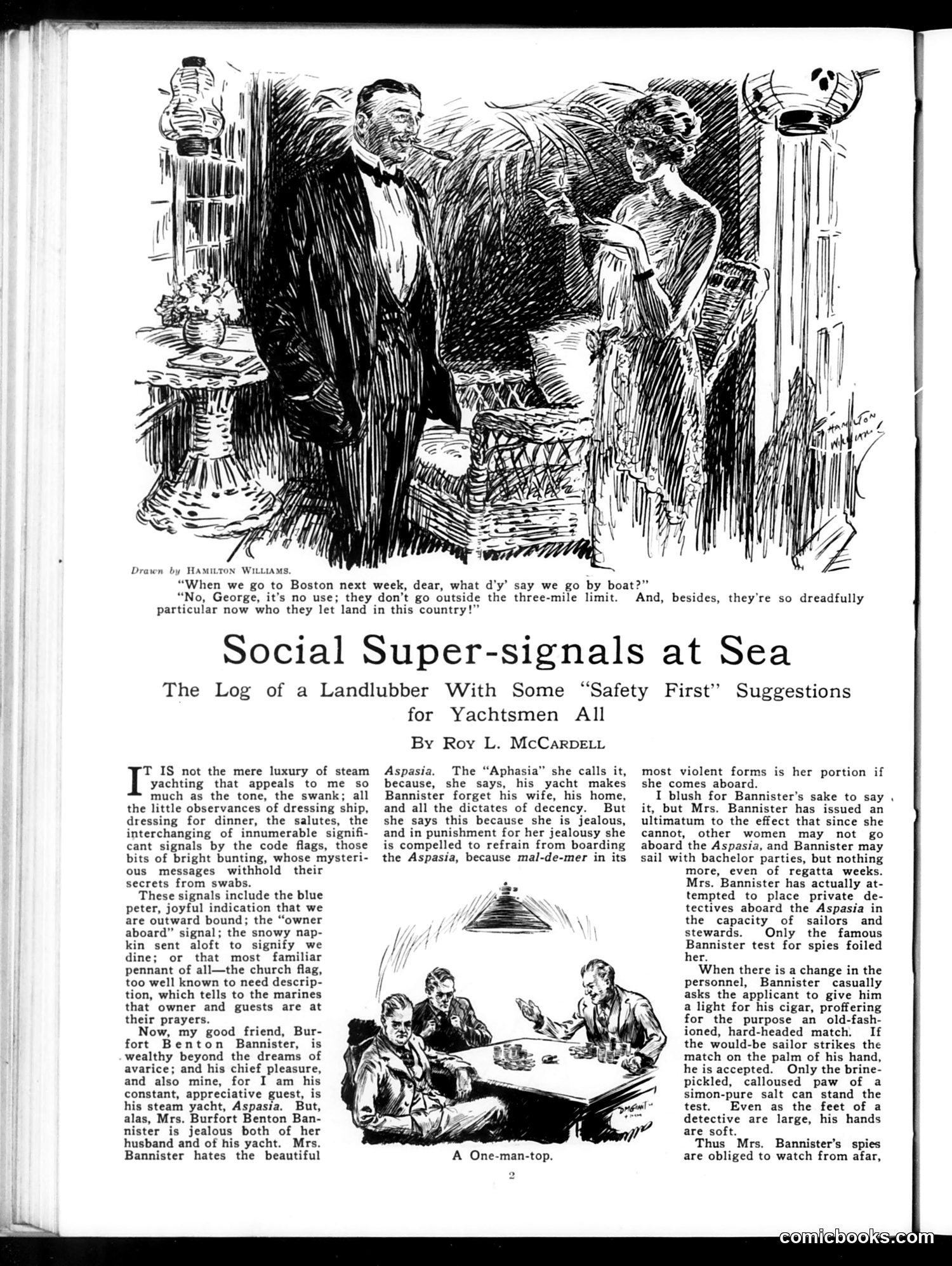
This satirical article by Roy L. McCardell mocks wealthy yachtsmen's social pretensions. The top cartoon depicts a gentleman explaining maritime etiquette to a woman, referencing a yacht owner's jealous wife who forbids boarding his vessel *Aspasia* (likely alluding to the historical Aspasia, mistress of Pericles). The humor targets how wealthy leisure-class men use yachts as exclusive social clubs while their spouses resent exclusion. McCardell satirizes the absurd "signals" and rituals—flag codes, cigar-lighting tests, physical examinations—that yacht captains employ to screen crew and guests, treating yacht society as ridiculously pretentious. The lower illustration showing men at a table depicts yacht life's supposed refinement. The satire suggests wealthy yachtsmen create elaborate, snobbish protocols to maintain social hierarchies among the leisure elite.
📄 Transcribed text from this page (OCR, searchable)
Machine-transcribed from the original scan — historical spelling and the odd misread are preserved.
Drawn by HAMILTON WILLIAMS, SS SH SH S S SS 4 YY > “When we go to Boston next week, dear, what d’y’ say we go by boat?” “No, George, it’s no use; they don’t go outside the three-mile limit. particular now who they let land in this country!” Social Super-signals at Sea The Log of a Landlubber With Some “Safety First’ Suggestions T IS not the mere luxury of steam ] yachting that appeals to me so much as the tone, the swank; all the little observances of dressing ship, dressing for dinner, the salutes, the interchanging of innumerable signifi- cant signals by the code flags, those bits of bright bunting, whose mysteri- ous messages withhold their secrets from swabs. These signals include the blue peter, joyful indication that we are outward bound; the “owner aboard” signal; the snowy nap- kin sent aloft to signify we dine; or that most familiar pennant of all—the church flag, too well known to need descrip- tion, which tells to the marines that owner and guests are at their prayers. Now, my good friend, Bur- fort Benton Bannister, is wealthy beyond the dreams of avarice; and his chief pleasure, and also mine, for I am his constant, appreciative guest, is his steam yacht, Aspasia. But, alas, Mrs. Burfort Benton Ban- nister is jealous both of her husband and of his yacht. Mrs. Bannister hates the beautiful for Yachtsmen All By Roy L. McCarpe.i Aspasia. The “Aphasia” she calls it, because, she says, his yacht makes Bannister forget his wife, his home, and all the dictates of decency. But she says this because she is jealous, and in punishment for her jealousy she is compelled to refrain from boarding the Aspasia, because mal-de-mer in its A One-man-top. And, besides, they’re so dreadfully most violent forms is her portion if she comes aboard. I blush for Bannister’s sake to say . it, but Mrs. Bannister has issued an ultimatum to the effect that since she cannot, other women may not go aboard the Aspasia, and Bannister may sail with bachelor parties, but nothing more, even of regatta weeks. Mrs. Bannister has actually at- tempted to place private de- tectives aboard the Aspasia in the capacity of sailors and stewards. Only the famous Bannister test for spies foiled her. When there is a change in the personnel, Bannister casually asks the applicant to give him a light for his cigar, proffering for the purpose an old-fash- ioned, hard-headed match. If the would-be sailor strikes the match on the palm of his hand, he is accepted. Only the brine- pickled, calloused paw of a simon-pure salt can stand the test. Even as the feet of a detective are large, his hands are soft. Thus Mrs. Bannister’s spies are obliged to watch from afar,