
Judge, 1922-05-27 · page 16 of 36
Judge — May 27, 1922 — page 16: what you’re looking at
What you’re looking at
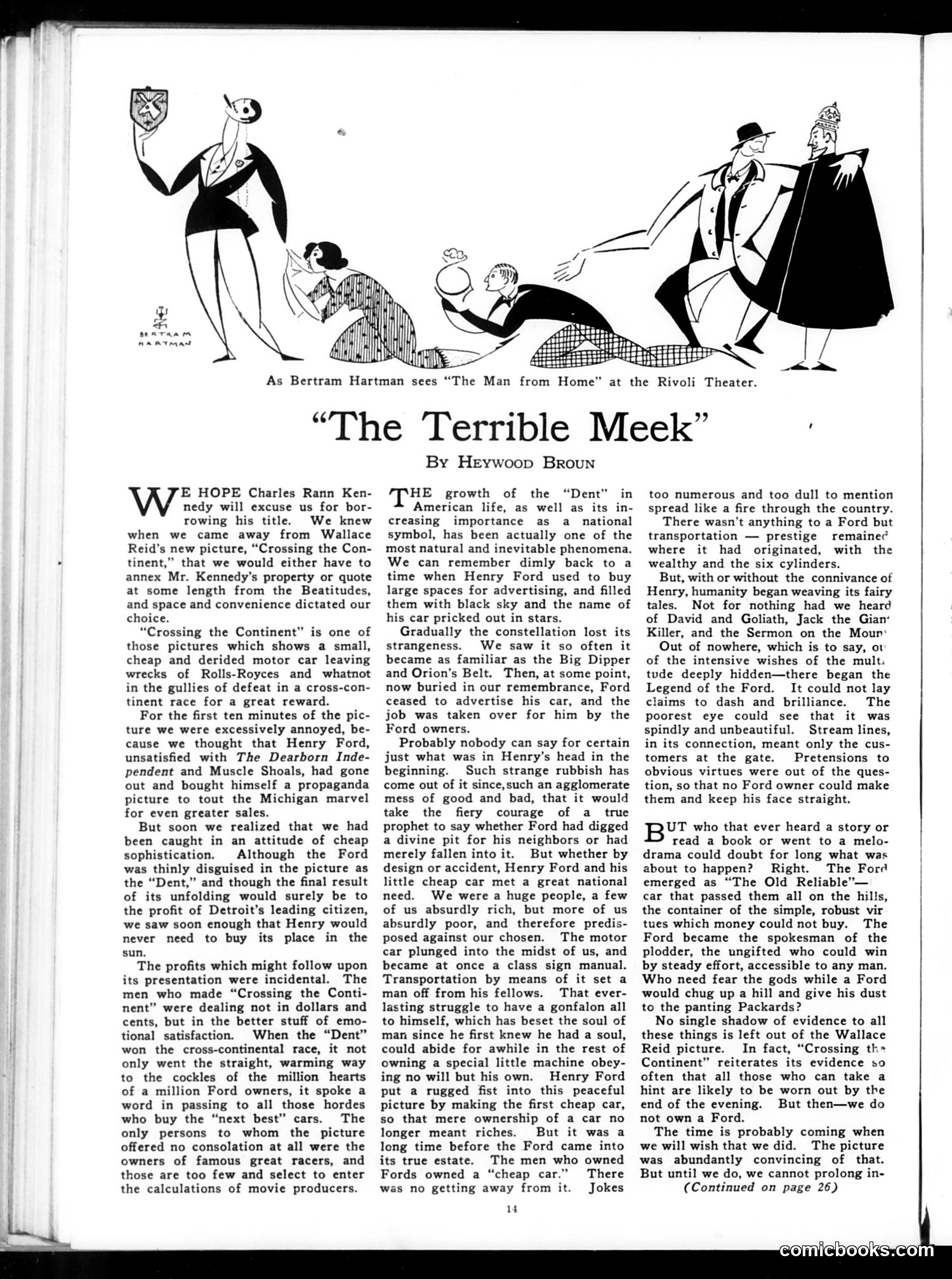
**The cartoon** at top depicts the film "The Man from Home" at the Rivoli Theater, showing elegantly dressed figures in exaggerated poses—likely mocking theatrical melodrama or social pretension. **The article** by Heywood Broun analyzes the film "Crossing the Continent," which features a cheap car (the "Dent," thinly disguised Ford) defeating luxury vehicles in a cross-continental race. **The satire's point:** Broun praises this film not as propaganda for Henry Ford, but as emotionally satisfying populist storytelling. The article celebrates how Ford's affordable automobile democratized transportation for America's poor majority, breaking through rigid class distinctions. By making cars accessible beyond the wealthy elite, Ford unknowingly created a national symbol of mobility and social equality. **The joke:** Even if Ford didn't intend this social commentary, his cheap car accomplished what propaganda couldn't—it spoke to ordinary Americans' desires for dignity and independence, making wealthy competitors' expensive vehicles seem obsolete.
📄 Transcribed text from this page (OCR, searchable)
Machine-transcribed from the original scan — historical spelling and the odd misread are preserved.
im, ! i ki As Bertram Hartman sees “The Man from Home” at the Rivoli Theater. “The Terrible Meek” E HOPE Charles Rann Ken- nedy will excuse us for bor- rowing his title. We knew when we came away from Wallace Reid’s new picture, “Crossing the Con- tinent,” that we would either have to annex Mr. Kennedy’s property or quote at some length from the Beatitudes, and space and convenience dictated our choice. “Crossing the Continent” is one of those pictures which shows a small, cheap and derided motor car leaving wrecks of Rolls-Royces and whatnot in the gullies of defeat in a cross-con- tinent race for a great reward. For the first ten minutes of the pic- ture we were excessively annoyed, be- cause we thought that Henry Ford, unsatisfied with The Dearborn Inde- pendent and Muscle Shoals, had gone out and bought himself a propaganda picture to tout the Michigan marvel for even greater sales. But soon we realized that we had been caught in an attitude of cheap sophistication. Although the Ford was thinly disguised in the picture as the “Dent,” and though the final result of its unfolding would surely be to the profit of Detroit’s leading citizen, ‘we saw soon enough that Henry would never need to buy its place in the sun. The profits which might follow upon its presentation were incidental. The men who made “Crossing the Conti- nent” were dealing not in dollars and cents, but in the better stuff of emo- tional satisfaction. When the “Dent” won the cross-continental race, it not only went the straight, warming way to the cockles of the million hearts of a million Ford owners, it spoke a word in passing to all those hordes who buy the “next best” cars. The only persons to whom the picture offered no consolation at all were the owners of famous great racers, and those are too few and select to enter the calculations of movie producers. By Heywoop Broun THE growth of the “Dent” in American life, as well as its in- creasing importance as a_ national symbol, has been actually one of the most natural and inevitable phenomena. We can remember dimly back to a time when Henry Ford used to buy large spaces for advertising, and filled them with black sky and the name of his car pricked out in stars. Gradually the constellation lost its strangeness. We saw it so often it became as familiar as the Big Dipper and Orion’s Belt. Then, at some point, now buried in our remembrance, Ford ceased to advertise his car, and the job was taken over for him by the Ford owners. Probably nobody can say for certain just what was in Henry’s head in the beginning. Such strange rubbish has come out of it since,such an agglomerate mess of good and bad, that it would take the fiery courage of a_ true prophet to say whether Ford had digged a divine pit for his neighbors or had merely fallen into it. But whether by design or accident, Henry Ford and his little cheap car met a great national need. We were a huge people, a few of us absurdly rich, but more of us absurdly poor, and therefore predis- posed against our chosen. The motor car plunged into the midst of us, and became at once a class sign manual. Transportation by means of it set a man off from his fellows. That ever- lasting struggle to have a gonfalon all to himself, which has beset the soul of man since he first knew he had a soul, could abide for awhile in the rest of owning a special little machine obey- ing no will but his own. Henry Ford put a rugged fist into this peaceful picture by making the first cheap car, so that mere ownership of a car no longer meant riches. But it was a long time before the Ford came into its true estate. The men who owned Fords owned a “cheap car.” There was no getting away from it. Jokes 14 too numerous and too dull to mention spread like a fire through the country. There wasn’t anything to a Ford but transportation — prestige remainec where it had originated, with the wealthy and the six cylinders. But, with or without the connivance of Henry, humanity began weaving its fairy tales. Not for nothing had we heard of David and Goliath, Jack the Gian‘ Killer, and the Sermon on the Moun‘ Out of nowhere, which is to say, ot of the intensive wishes of the mult. tude deeply hidden—there began the Legend of the Ford. It could not lay claims to dash and brilliance. The poorest eye could see that it was spindly and unbeautiful. Stream lines, in its connection, meant only the cus- tomers at the gate. Pretensions to obvious virtues were out of the ques- tion, so that no Ford owner could make them and keep his face straight. Bet who that ever heard a story or read a book or went to a melo- drama could doubt for long what was about to happen? Right. The Ford emerged as “The Old Reliable”’— car that passed them all on the hills, the container of the simple, robust vir tues which money could not buy. The Ford became the spokesman of the plodder, the ungifted who could win by steady effort, accessible to any man. Who need fear the gods while a Ford would chug up a hill and give his dust to the panting Packards? No single shadow of evidence to all these things is left out of the Wallace Reid picture. In fact, “Crossing th= Continent” reiterates its evidence so often that all those who can take a hint are likely to be worn out by the end of the evening. But then—we do not own a Ford. The time is probably coming when we will wish that we did. The picture was abundantly convincing of that. But until we do, we cannot prolong in- (Continued on page 26)