
A complete issue · 36 pages · 1922
Judge — April 29, 1922
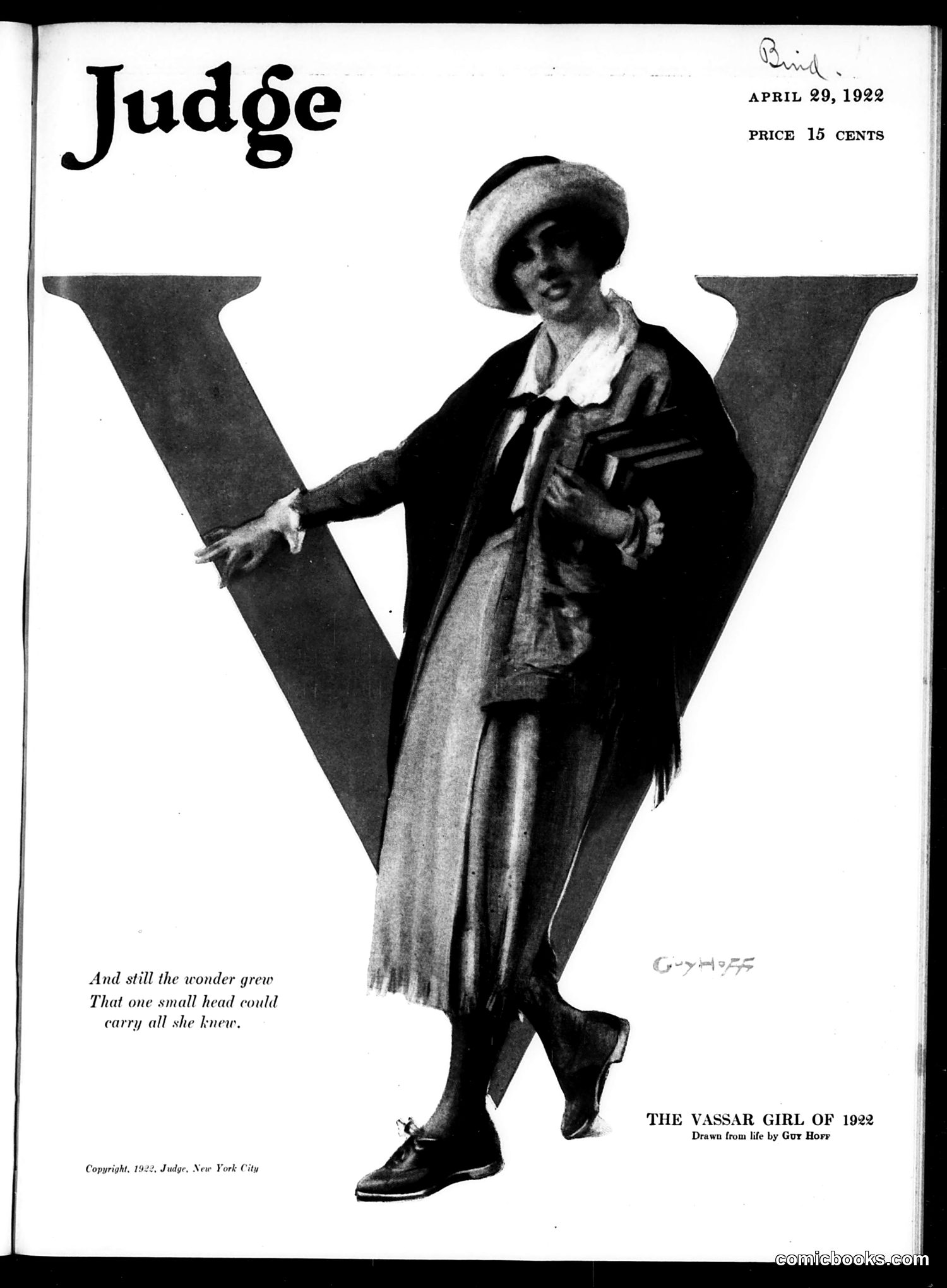
This is the cover of Judge magazine from April 29, 1922, featuring a satirical illustration by Gor Hore titled "The Vassar Girl of 1922." The cartoon depicts a young woman in fashionable 1920s attire—a cloche hat, short skirt, and coat with fringe—posing with an oversized letter "V." The accompanying text, "And still the wonder grew / That one small head could carry all she knew," appears to mock the intellectual pretensions or stereotypical flightiness of female college students. This represents typical Jazz Age satire about educated young women, likely poking fun at the perceived gap between Vassar's prestigious reputation and contemporary stereotypes about flappers and modern girls prioritizing fashion and social life over serious academics.
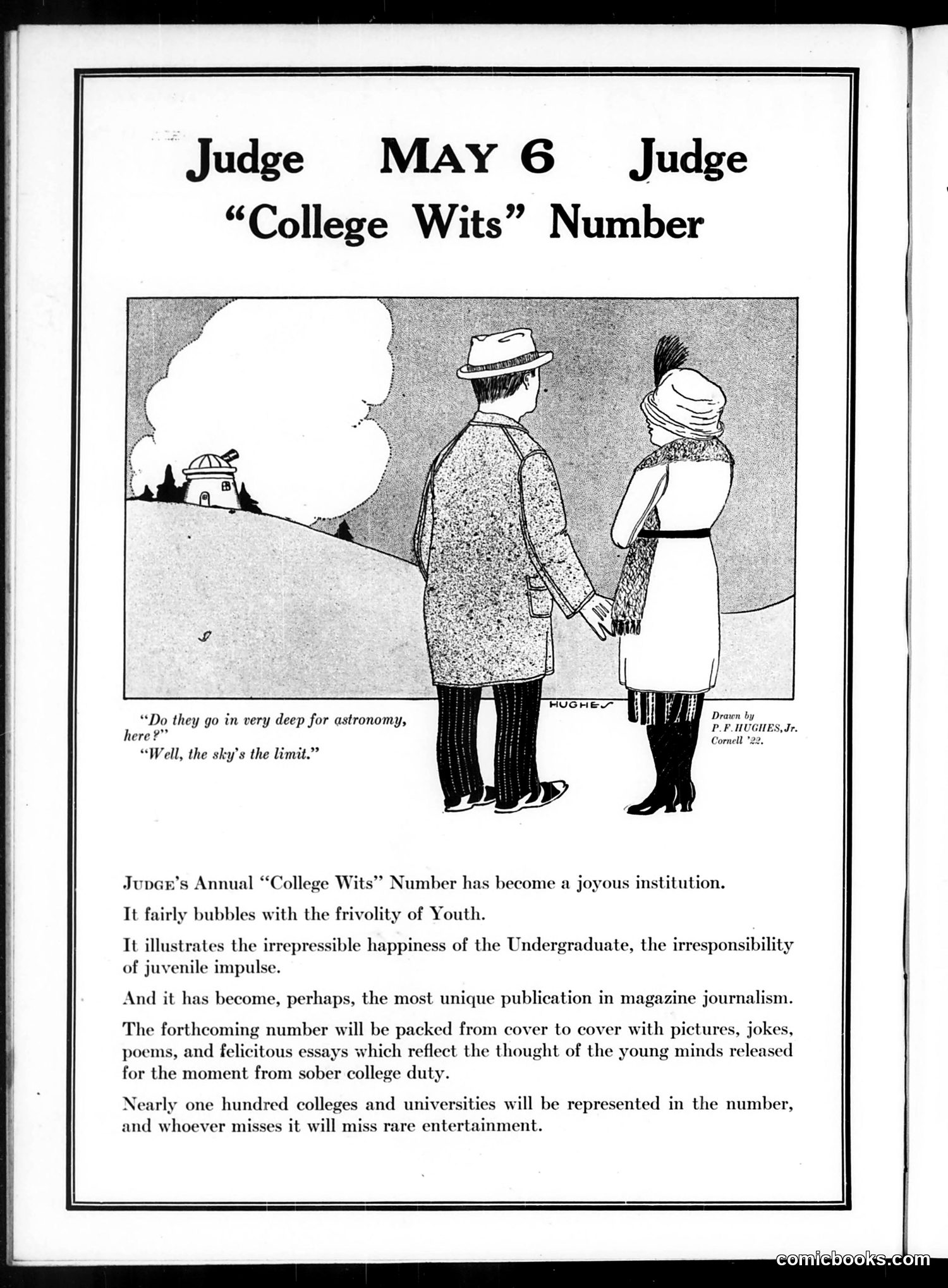
This page promotes Judge's special annual issue celebrating college humor. The cartoon shows a couple viewing what appears to be a massive head or monument, with the man asking "Do they go in very deep for astronomy, here?" The woman replies "Well, the sky's the limit"—a pun playing on astronomical study versus limitless ambition. The accompanying text describes Judge's "College Wits" issue as a celebrated annual publication showcasing undergraduate humor, featuring contributions from nearly one hundred colleges and universities. It emphasizes the issue's unique status in magazine journalism, celebrating youthful frivolity, undergraduate happiness, and the "irresponsibility of juvenile impulse"—positioning college humor as distinctive entertainment reflecting young minds' creative thinking.
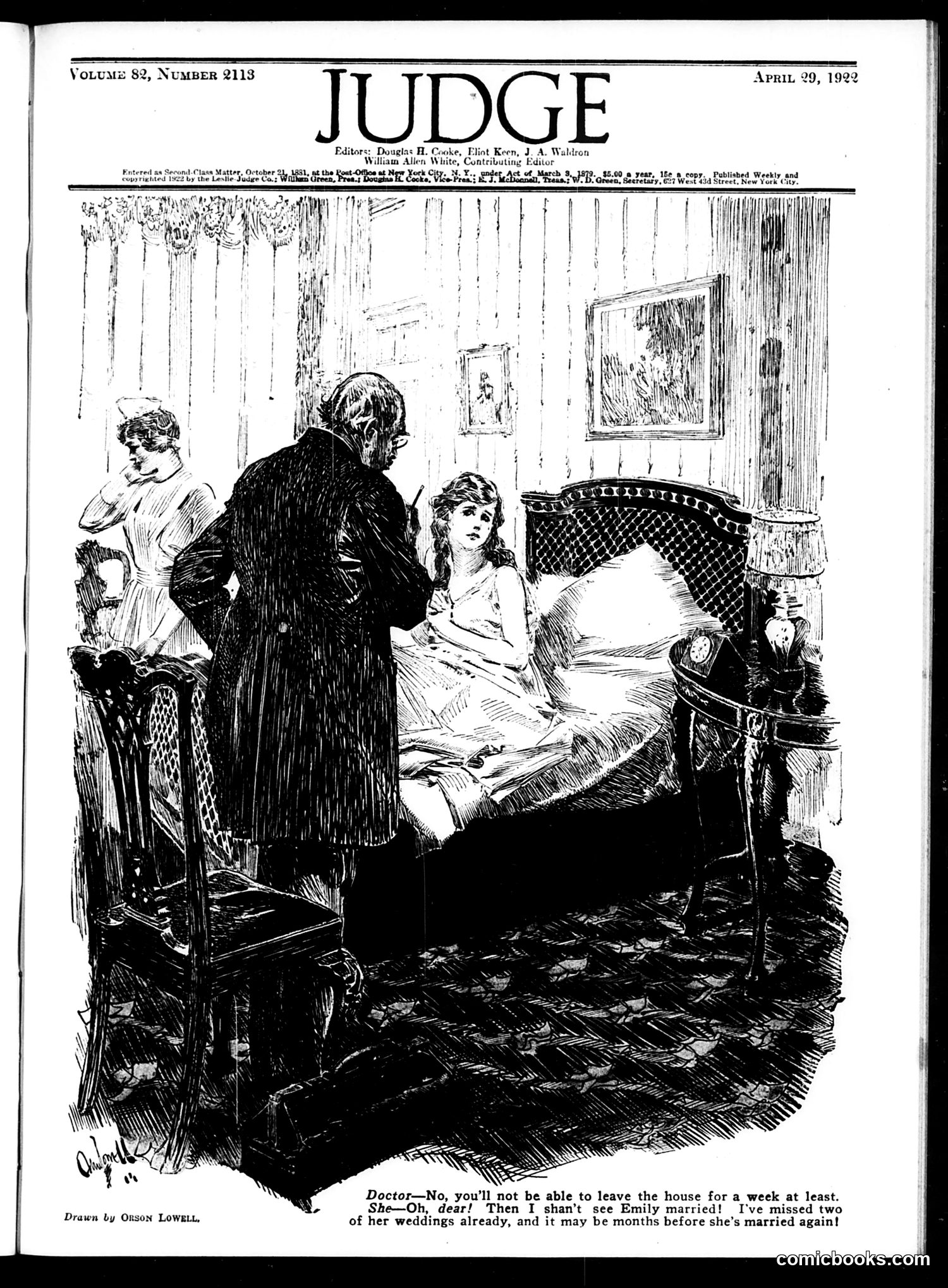
This cartoon satirizes a common domestic situation of the era. A doctor, visiting a bedridden woman (likely ill or recovering), informs her she cannot leave the house for a week. The woman's disappointed response reveals the joke's target: she's upset because she'll miss seeing her friend Emily get married—and worse, she's already missed two of Emily's previous weddings and fears she'll miss this one too before Emily marries "again." The humor relies on early 20th-century satire about serial marriage and divorce, which was becoming more socially visible and acceptable among certain classes, though still considered scandalous. The cartoon mocks both the frequency of Emily's marriages and the woman's social anxiety about missing wedding events.
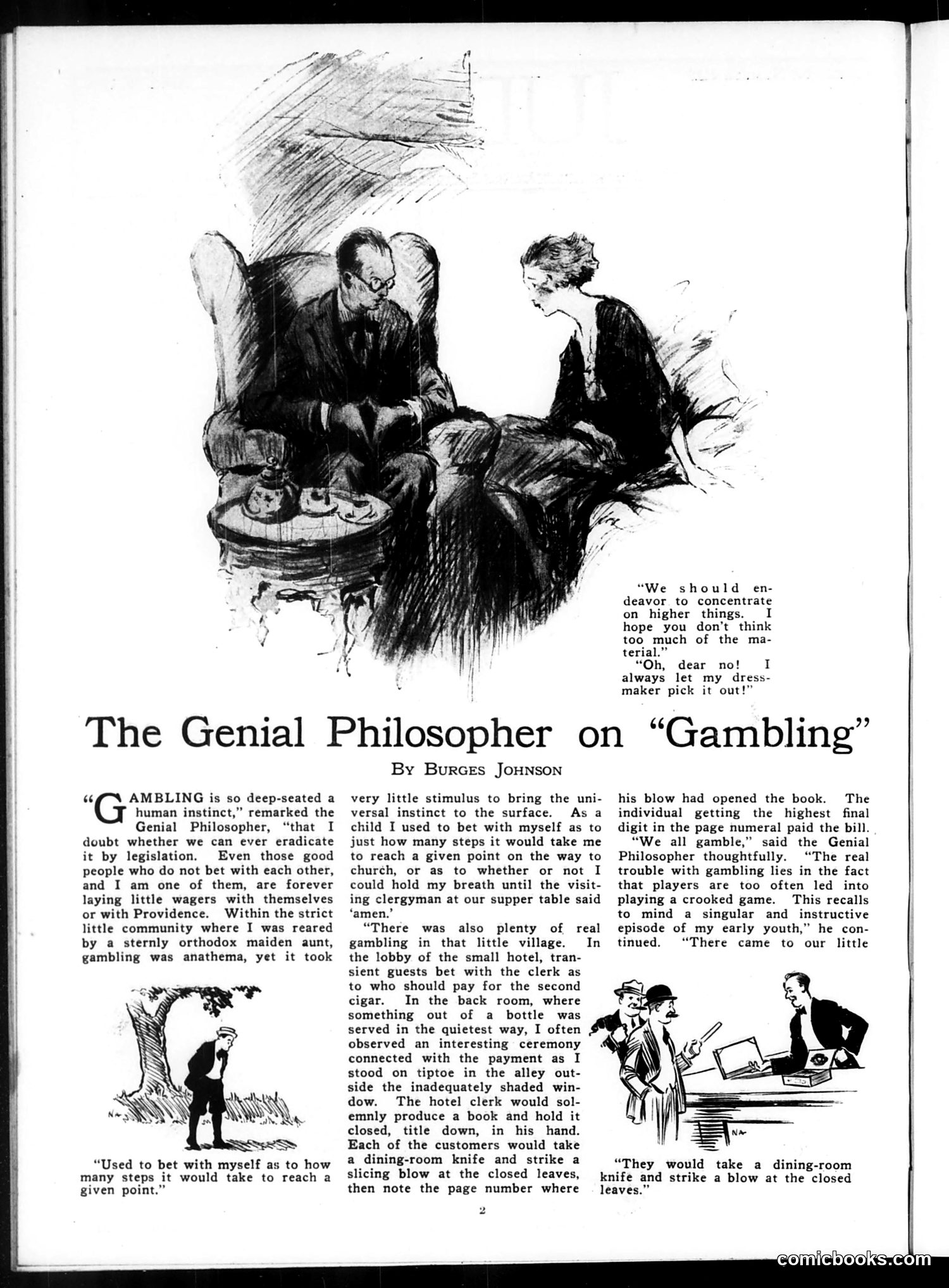
This satirical piece critiques gambling as a deeply rooted human vice that's nearly impossible to eliminate through legislation alone. The philosopher argues that gambling flourishes everywhere—from high society to working-class communities—appearing in various forms across social classes. The cartoon illustrates his point with anecdotes about rural gambling customs, including a small-town hotel where guests wagered over who'd pay for sugar, settling disputes by striking a closed ledger with a dining knife. The accompanying sketches show gambling occurring casually in everyday settings. The satire's message: attempting to ban gambling is futile because it's so ingrained in human nature that people will gamble regardless of legal prohibitions. The piece suggests that moral reform through legislation cannot overcome fundamental human impulses.
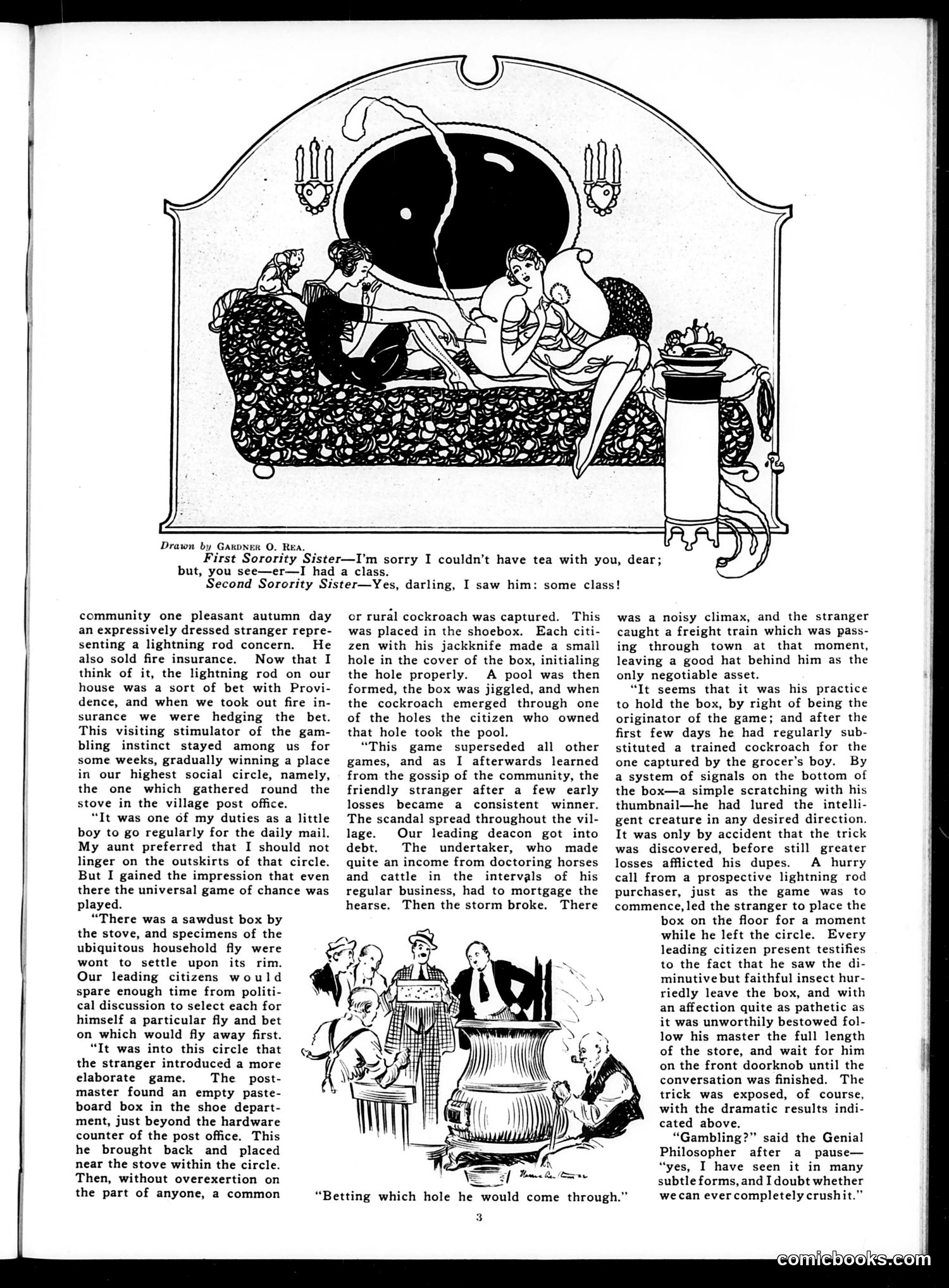
**Top Cartoon:** Drawn by Gardner O. Rea, this depicts two society sisters discussing a man one encountered. The joke plays on class pretension—the first sister apologizes for missing tea due to a class, while the second claims the man had "some class," a pun suggesting both refinement and attendance at educational institutions. **Bottom Story & Illustration:** A humorous narrative about a community betting game involving a cockroach in a shoebox. Citizens place wagers on which hole the insect will emerge from. The story satirizes small-town gambling and entertainment, with the "Genial Philosopher" observing that such pastimes reveal human nature in "many subtle forms." The page exemplifies *Judge*'s focus on satirizing middle-class American social pretensions and rural/community customs through lighthearted humor.
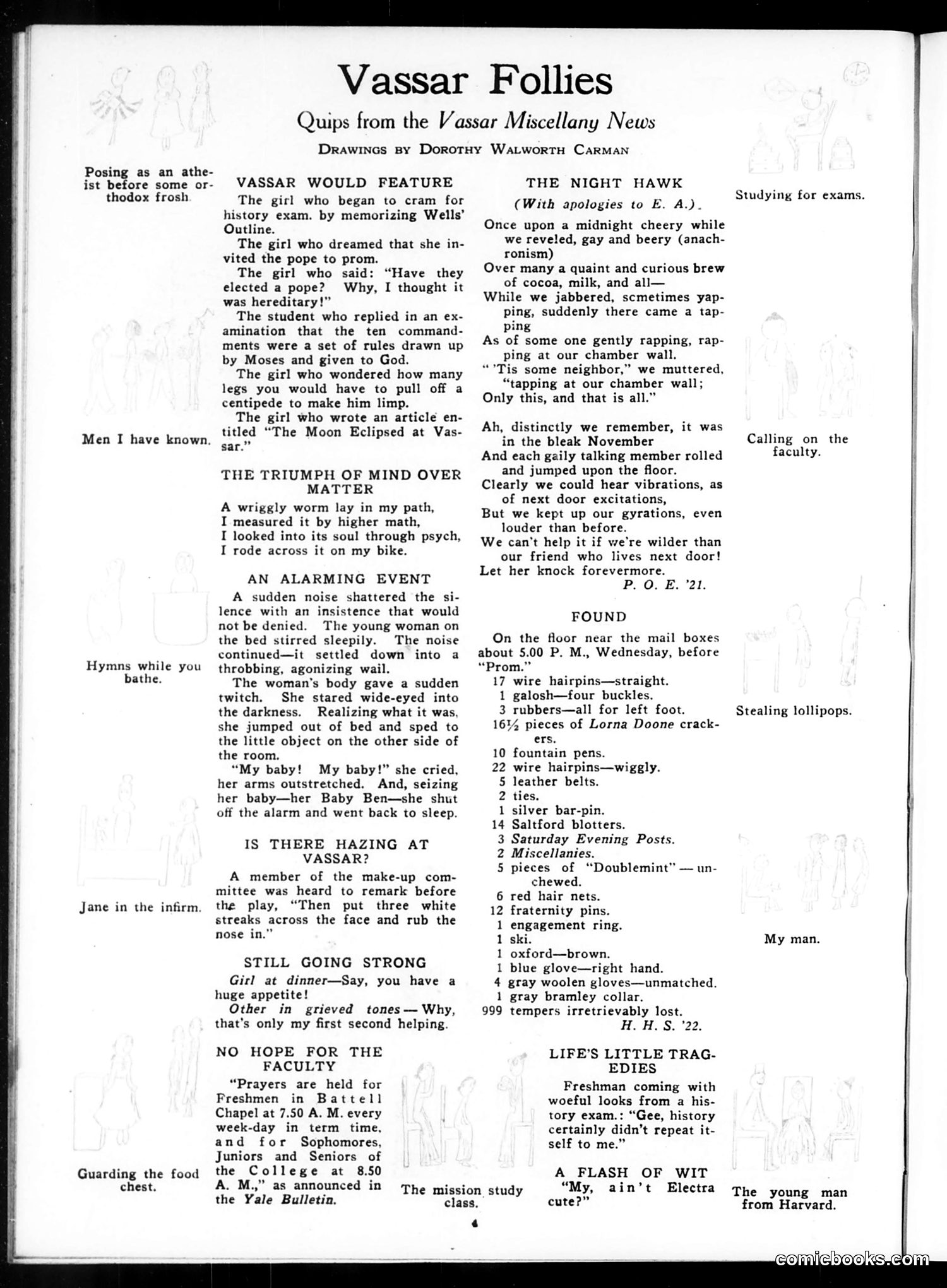
This page presents humorous anecdotes from Vassar College, illustrated by Dorothy Walworth Carman. The content satirizes college life through brief comic sketches rather than political commentary. The jokes target typical student experiences: exam anxiety, dorm noise complaints, hazing questions, dining hall observations, and lost-and-found absurdities. The "Found" section lists 999 lost items—an exaggerated commentary on student carelessness. References include chapel attendance requirements ("Prayers...in Battell Chapel") and faculty interactions, reflecting early 20th-century college structure. The humor is gentle, focused on student foibles rather than social critique. This appears to be light entertainment for Judge's educated readership, celebrating college culture rather than critiquing it politically.
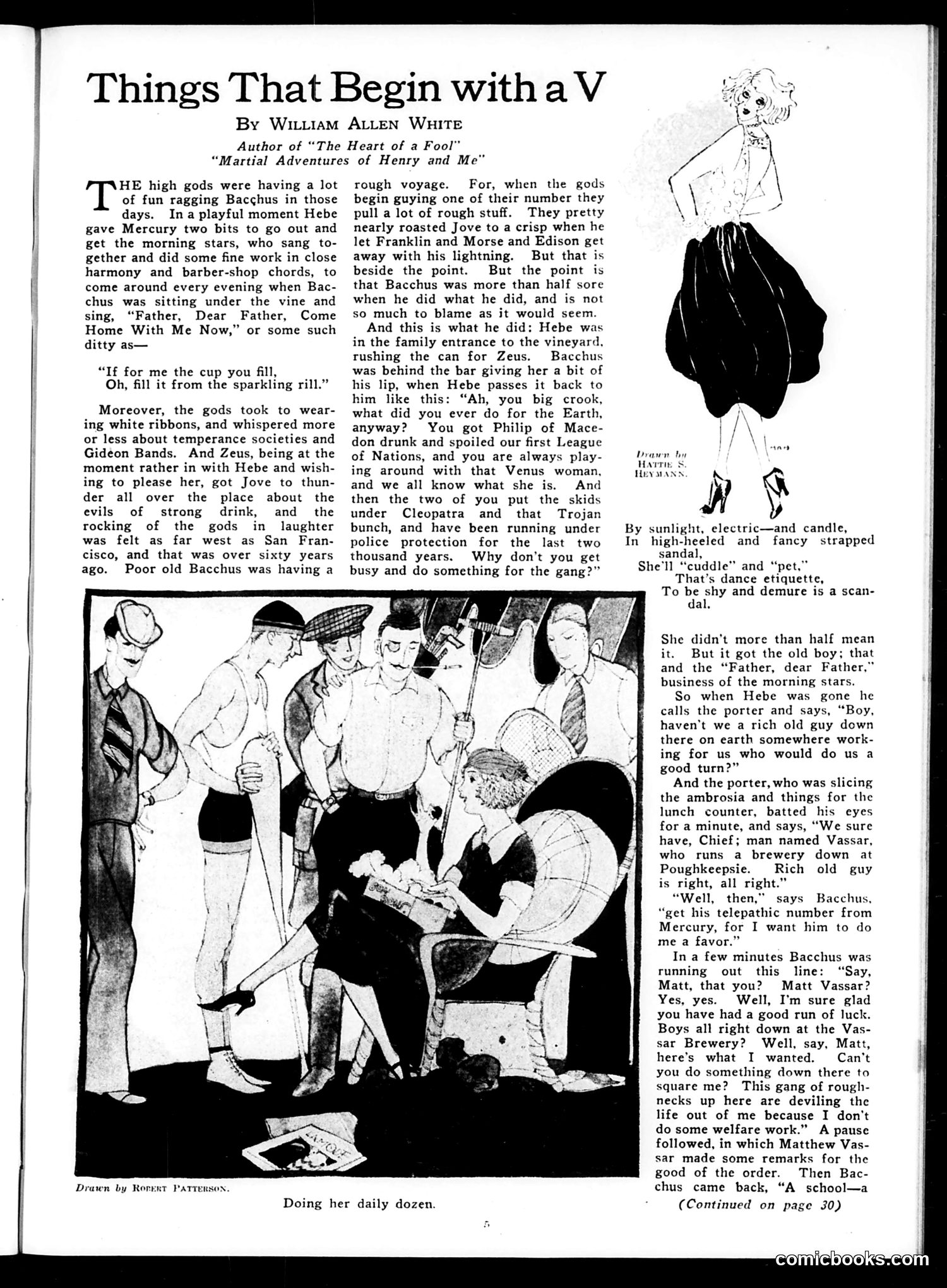
This is a satirical story by William Allen White targeting the temperance movement. The narrative uses Greek mythology (Bacchus, the god of wine, pressured by Hebe and other gods wearing "white ribbons" and promoting "temperance societies") as an allegory for real-world Prohibition advocates. The story's joke: Bacchus, harassed by anti-alcohol crusaders, calls upon Matthew Vassar—a wealthy brewer—asking him to do "welfare work" to rehabilitate his image. The text cuts off mid-sentence, likely revealing Vassar will fund schools or charitable institutions, showing how wealthy industrialists could use philanthropy to neutralize moral criticism of their businesses. The cartoon illustration shows the mythological scene with classical figures. The piece mocks Prohibition activists as self-righteous busybodies while suggesting wealthy businessmen could easily appease them through calculated charity.
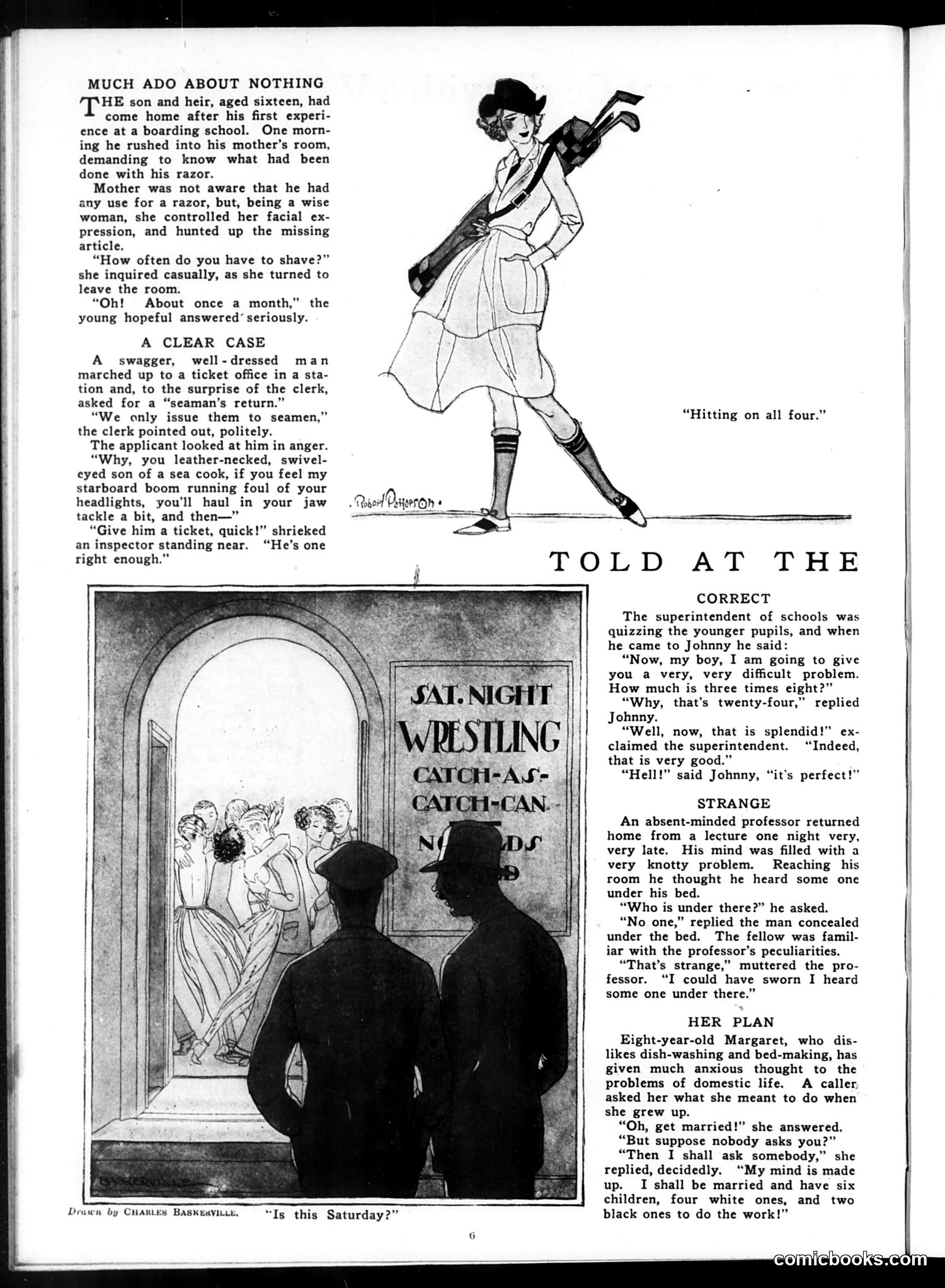
This page contains five brief humorous anecdotes targeting early 20th-century social pretensions and naïveté: **"Much Ado About Nothing"** mocks adolescent affectation—a sixteen-year-old boarding school student demands his razor after shaving only monthly, performing sophistication. **"A Clear Case"** satirizes class assumptions. A well-dressed man uses nautical sailor slang ("starboard boom," "leather-necked") to prove his seafaring credentials to a skeptical ticket clerk. The inspector accepts him as genuine based on this performative language alone—suggesting anyone can fake working-class authenticity through dialect. **"The Correct" and "Strange"** are gentle absurdist humor without clear satirical targets. **"Her Plan"** is darker, reflecting period-acceptable racist attitudes. Eight-year-old Margaret's plan to marry and have children specifically so "two black ones" can do household work presents child exploitation and racial hierarchy as natural domestic solutions—satirizing (or endorsing?) contemporary assumptions about domestic labor and racial roles. The illustration shows theatrical wrestling promoters—likely mocking lowbrow entertainment marketing.
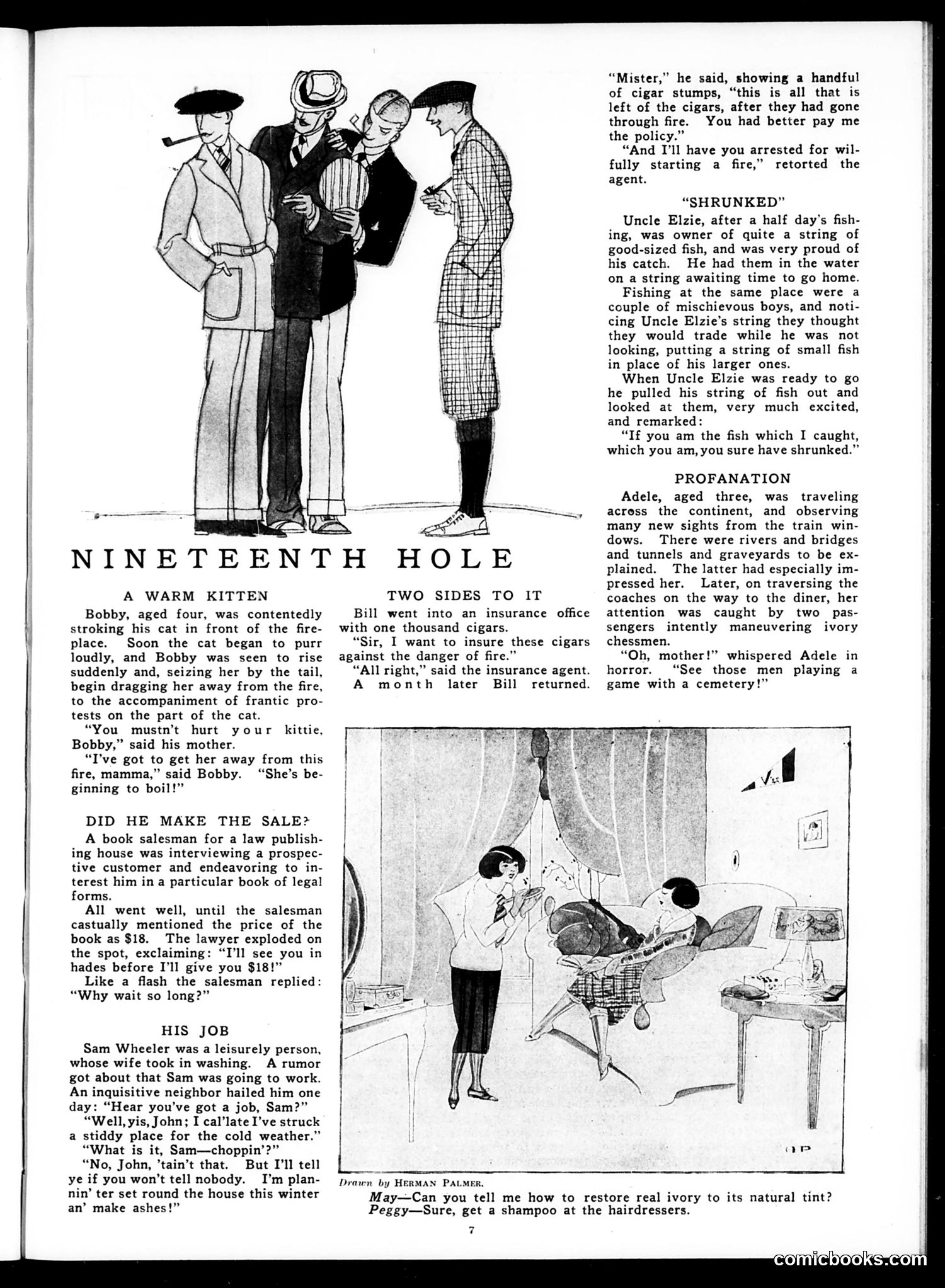
This page contains five brief humorous anecdotes typical of early-20th-century American humor magazines: **"A Warm Kitten"** plays on a child's innocent misunderstanding—a purring cat sounds like boiling water. **"Did He Make the Sale?"** is a lawyer joke: when a prospect angrily says he'd "see you in hades" before paying $18, the quick-witted salesman replies "Why wait so long?"—implying the lawyer's destination is assured. **"His Job"** features working-class dialect humor about a lazy man who plans to "set round the house" making ashes (from the fireplace), a euphemism for doing nothing productive. **"Two Sides to It"** is a con-artist joke: a man insures cigars against fire, smokes them, then claims they burned and demands payment. The agent threatens arrest for arson. **"Shrunked"** involves a fishing prank where boys replace large fish with small ones; the uncle assumes his catch mysteriously shrunk, using nonstandard grammar. The page reflects period attitudes toward humor: wordplay, dialect stereotypes, and everyday deceptions treated as entertainment.
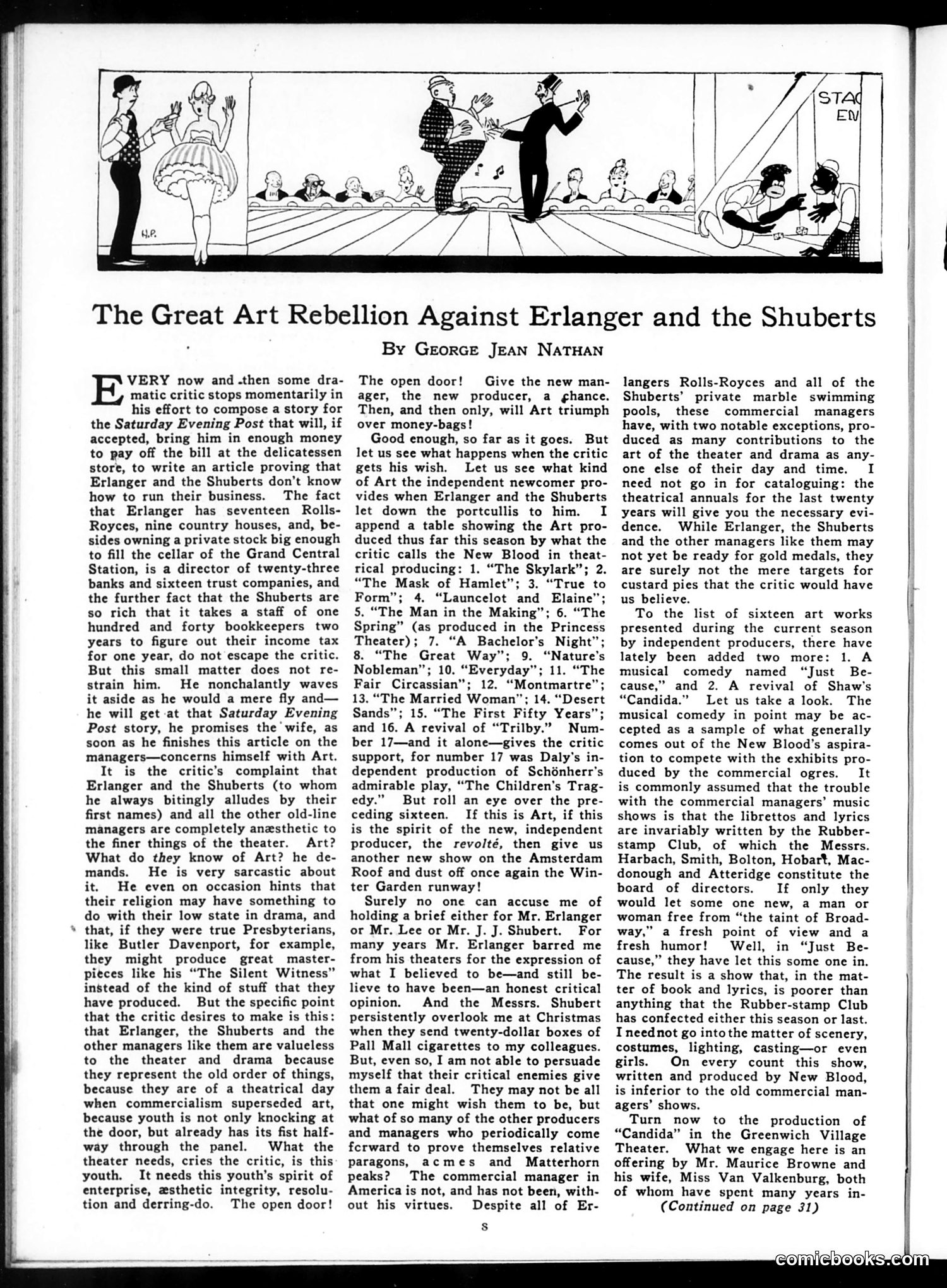
This article by George Jean Nathan sarcastically defends theater managers Erlanger and the Shuberts against critics who claim they lack artistic merit and should yield to younger, "independent" producers with fresh vision. Nathan's argument: Yes, Erlanger and Shuberts are wealthy commercial operators—but critics complaining about this are hypocrites. These critics write for magazines to pay bills, yet lecture about Art. More importantly, Nathan demonstrates that the "new blood" independent producers have actually created mediocre theatrical productions (he lists 16 recent shows, only praising one). The cartoon at top shows theatrical performers on stage before an audience, illustrating the conflict between commercial entertainment and artistic integrity. Nathan's point: The established managers' "crime" is being commercially successful. The young rebels the critics champion produce equally unimpressive work—so their moral superiority about Art is baseless. The establishment's real sin in critics' eyes is merely being old and rich, not actually lacking taste.
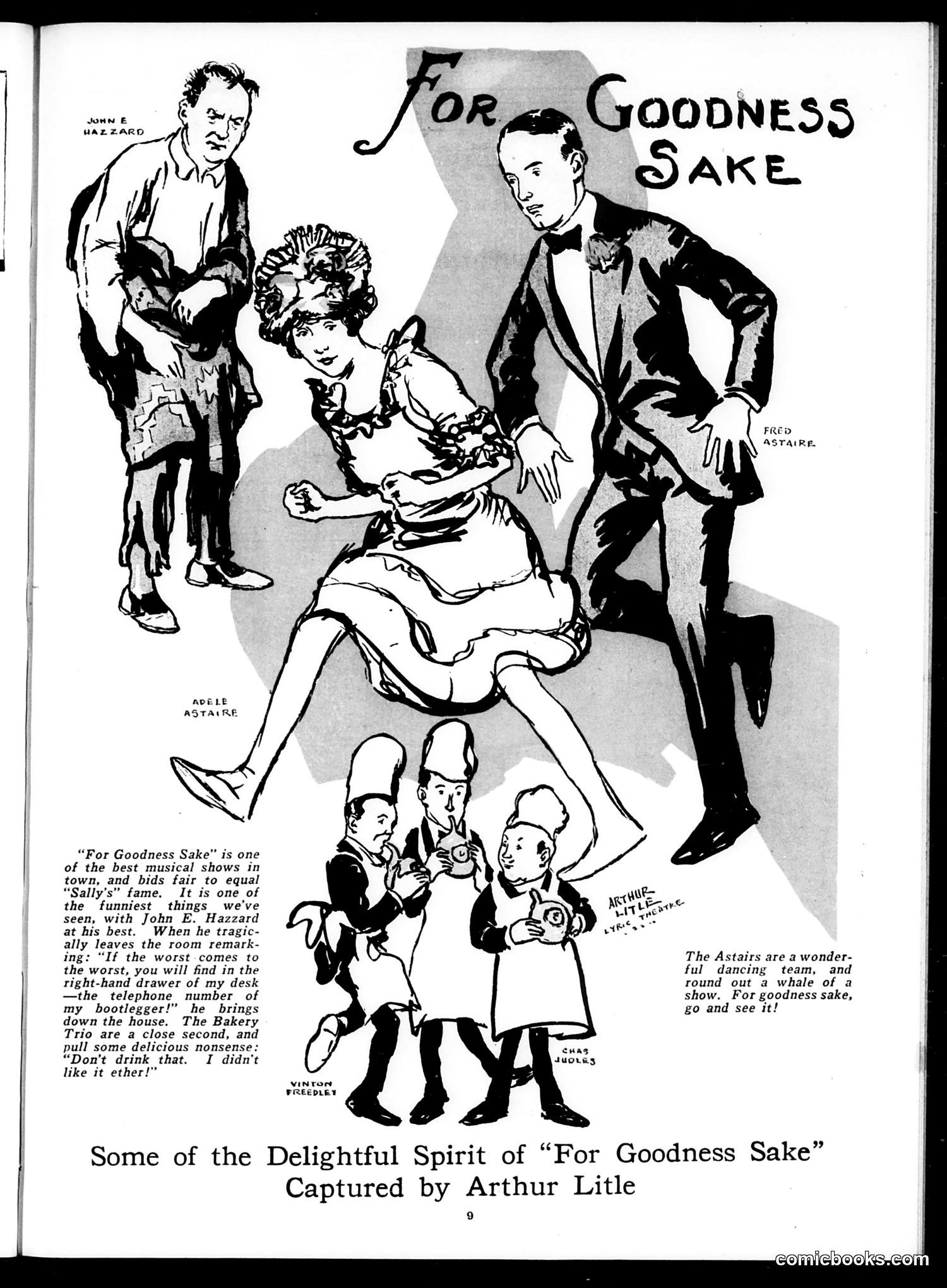
This page promotes a theatrical musical comedy called *"For Goodness Sake,"* featuring the celebrated Astaire siblings (Fred and Adele). The illustrated vignettes, drawn by Arthur Little, capture comedic moments from the show. The humor references Prohibition-era America: one scene depicts a character joking about keeping his "bootlegger's" phone number in a desk drawer—a topical joke given alcohol's illegality at the time. Another bit involves characters debating whether to drink something questionable, reflecting contemporary anxieties about illicit alcohol quality and safety. The review emphasizes the Astaires' dancing prowess and praises performer John E. Hazzard's comedic timing. The "Bakery Trio" provides additional comic relief with nonsensical banter. The cartoons capture vaudeville-style theatrical humor: physical comedy, absurdist dialogue, and social commentary woven into entertainment. This represents typical Judge magazine content—using theatrical reviews as vehicles for satire and humor commentary on contemporary American life.
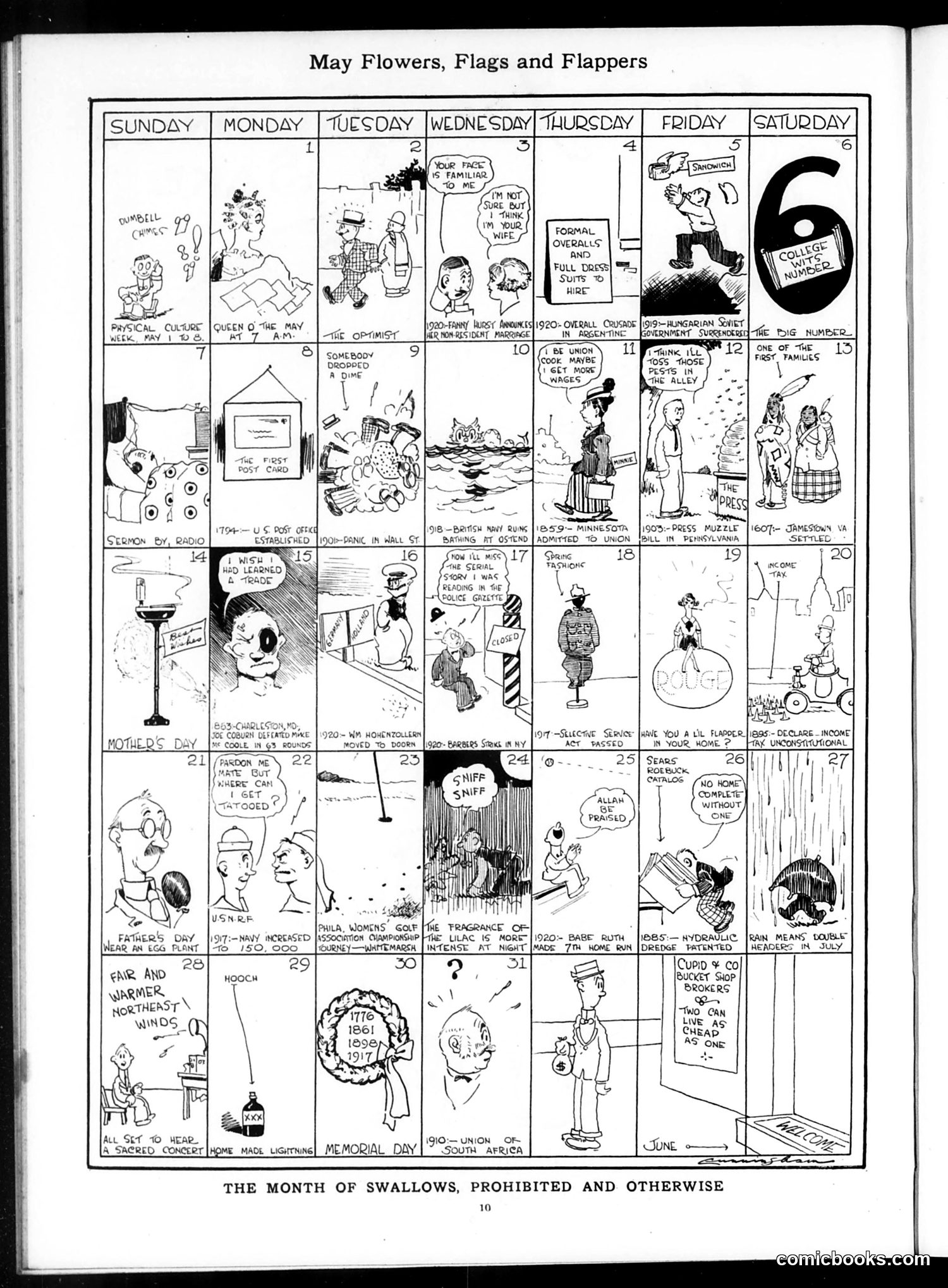
This is a satirical calendar for May presenting American social and political events through humorous vignettes. Key references include: **Historical/Political events:** - Father's Day and Mother's Day celebrations - Memorial Day (May 30) - 1920 references: Women's fashion changes ("flappers"), Prohibition enforcement, income tax implementation - 1910 Union of South Africa formation - Various historical "firsts" (Post Office established, etc.) **Social satire targets:** - The "flapper" phenomenon—young women's changing dress and behavior in the 1920s - Prohibition's effects on society - Class distinctions and family traditions - New technologies (radio sermons, hydraulic dredges) - Changing gender roles (women voting, working) **The humor relies on:** Pairing historical facts with contemporary 1920s social commentary, mocking both old-fashioned traditions and modern innovations. The cartoonist presents evolving American culture as simultaneously progressive and absurd—satirizing everything from prohibition enforcement to flapper fashion. The subtitle "The Month of Swallows, Prohibited and Otherwise" appears to mock Prohibition's reach into everyday life.
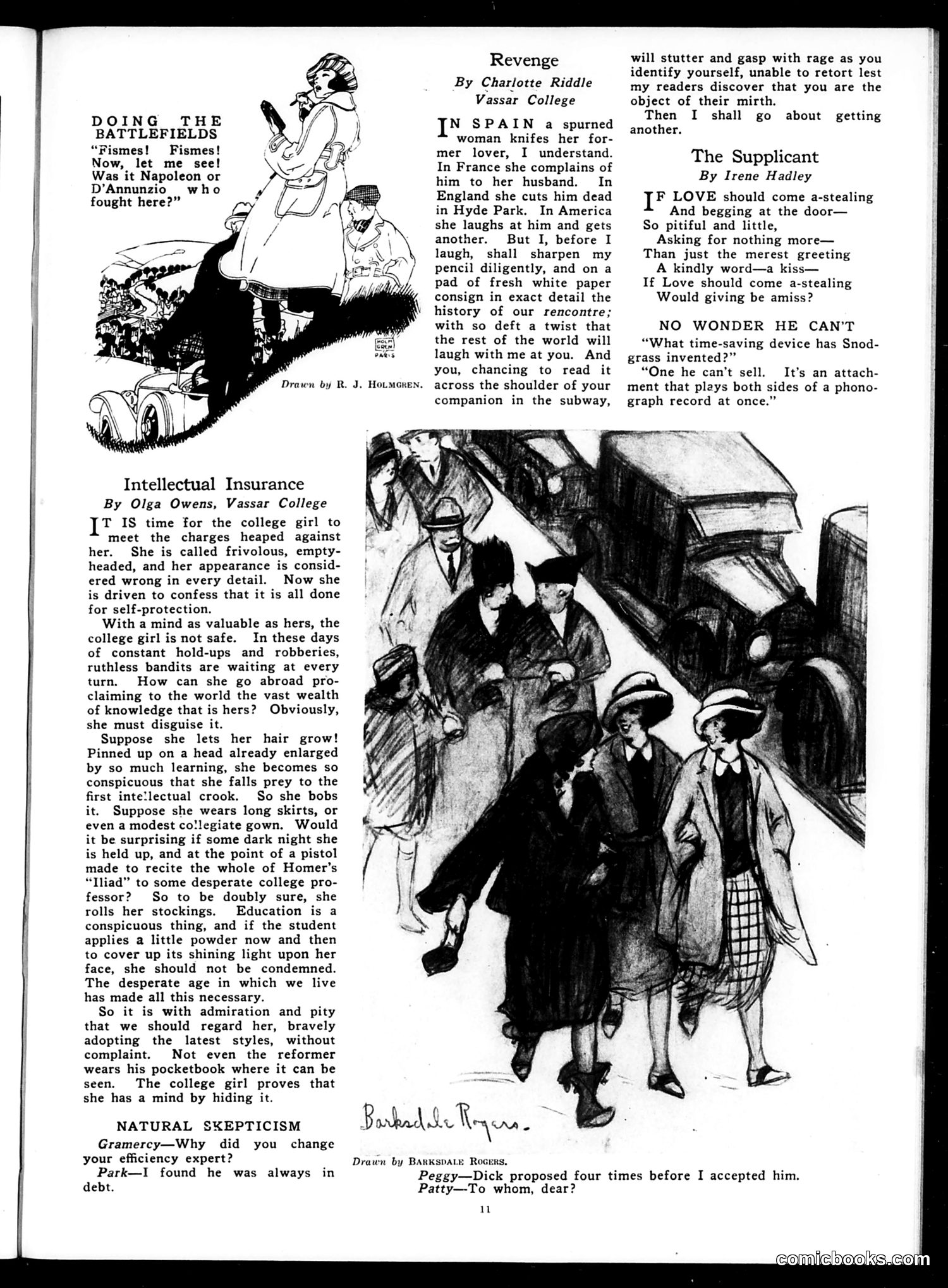
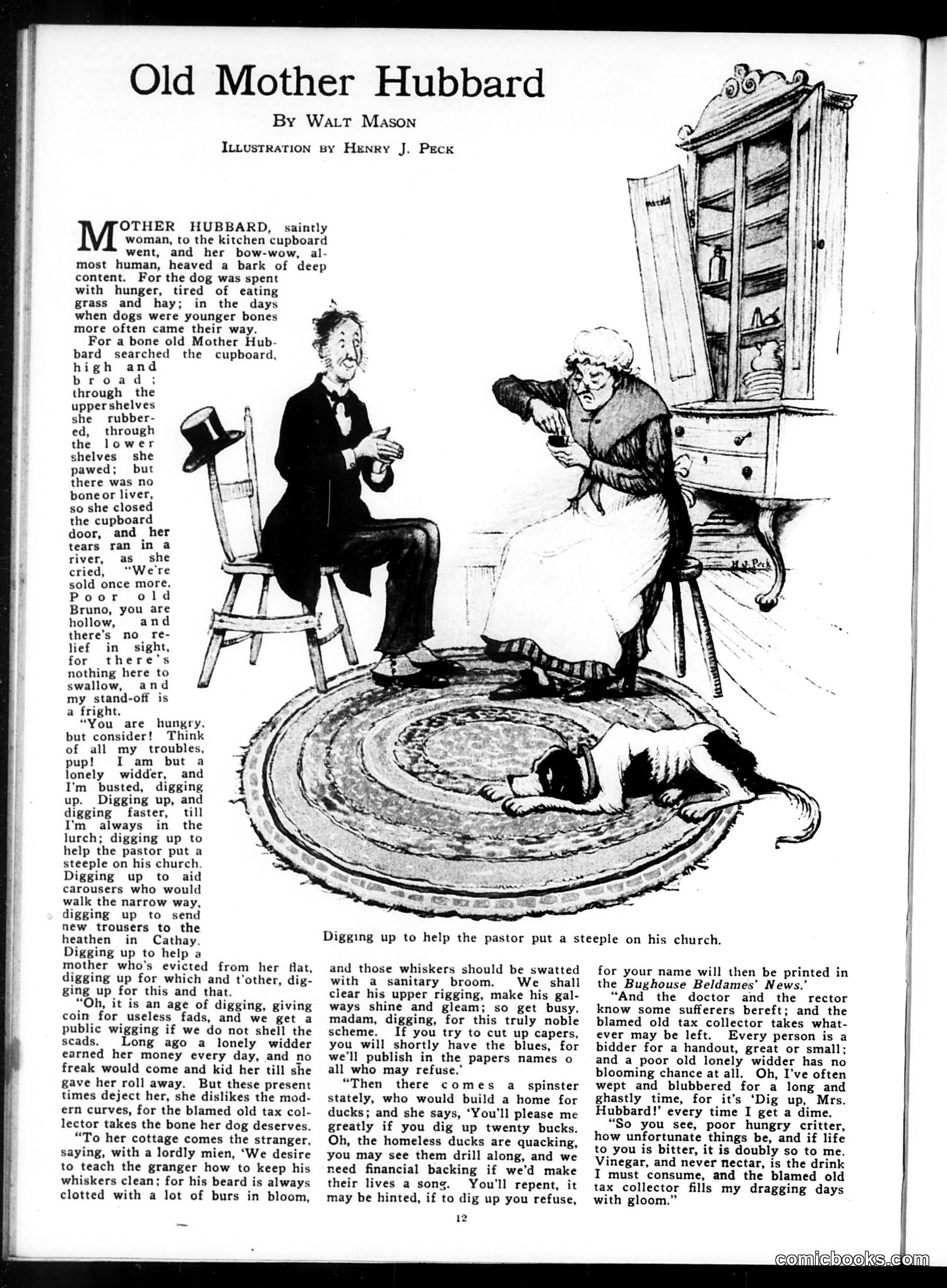
This illustrated story adapts the nursery rhyme to satirize early 20th-century social pressures on the poor. Mother Hubbard, a struggling widow, cannot feed her starving dog because she's constantly solicited for money by various causes and officials. The satire targets relentless fundraising: a pastor wants donations for a church steeple, a "spinster" demands money for a duck sanctuary (likely mocking frivolous causes), and a tax collector extracts her remaining resources. She's also pressured by strangers promoting dubious schemes like "sanitary" beard-cleaning services. The joke is that everyone—churches, reformers, charity-seekers, government—demands the widow "dig up" money while she herself starves. The phrase "Bughouse Beldames' News" (a fake publication) mocks how refusers face public shaming. The cartoon critiques the era's expectation that the poorest citizens subsidize endless worthy (and unworthy) causes while their own needs go unmet.
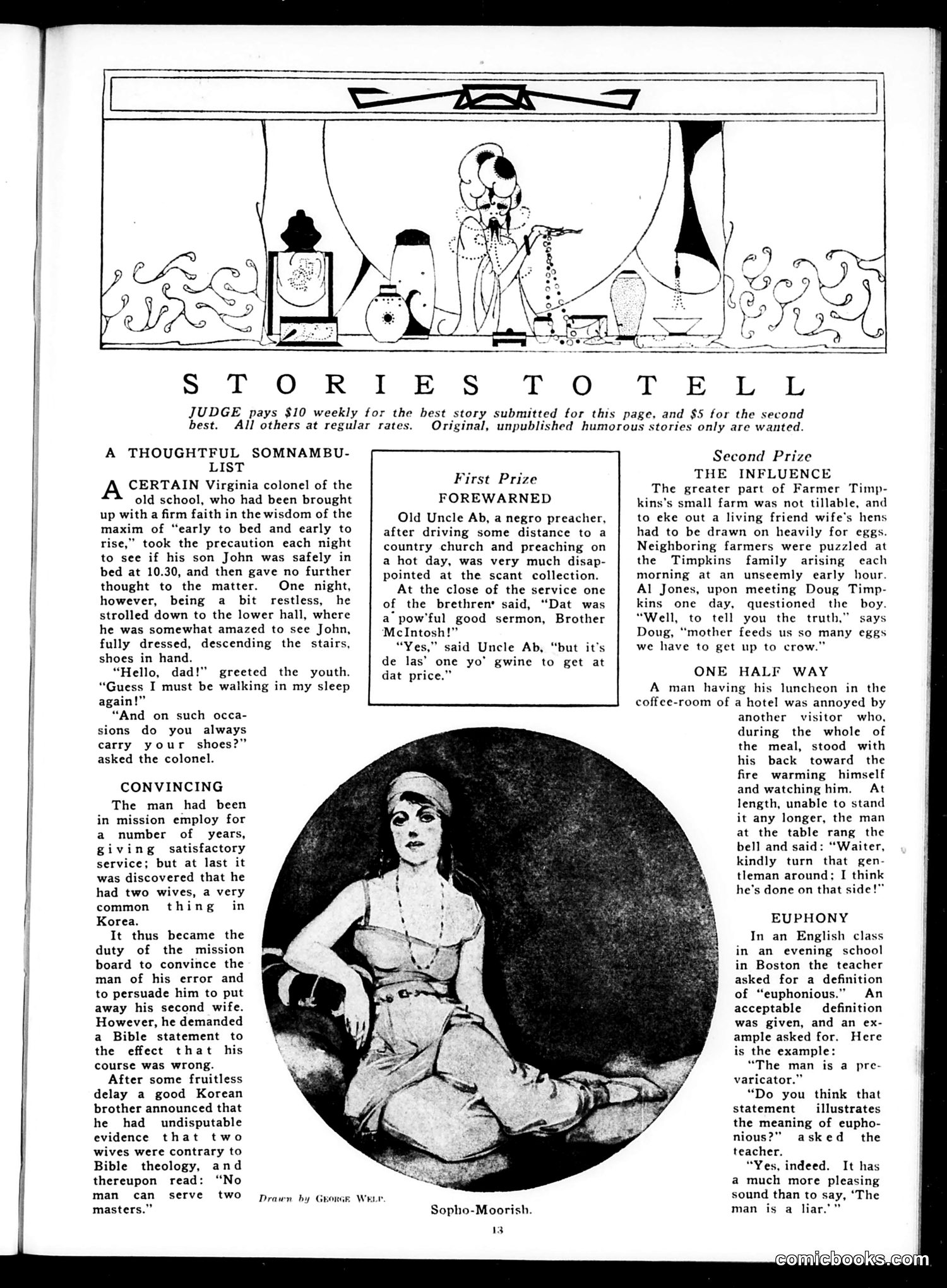
This is a **humor submission page** from Judge magazine featuring five short comedic stories, not political cartoons. The only illustration is a portrait labeled "Sopho-Moorish" accompanying the "Convincing" story. The stories employ period humor conventions: - **"Forewarned"** (1st prize): A Black preacher's joke about disappointing church collections—uses dialect ("de las' one yo' gwine to get") typical of early 20th-century racial stereotyping. - **"The Influence"** features rural humor about farm families. - **"One Half Way"** is a mild observational joke about hotel etiquette. - **"Euphony"** plays on Boston accent and euphemism—suggesting "prevaricator" sounds better than "liar." The content reflects Judge's satirical approach but focuses on social customs, regional dialects, and wordplay rather than explicit political commentary. The racial caricature in the "Forewarned" story represents attitudes typical of the magazine's era.
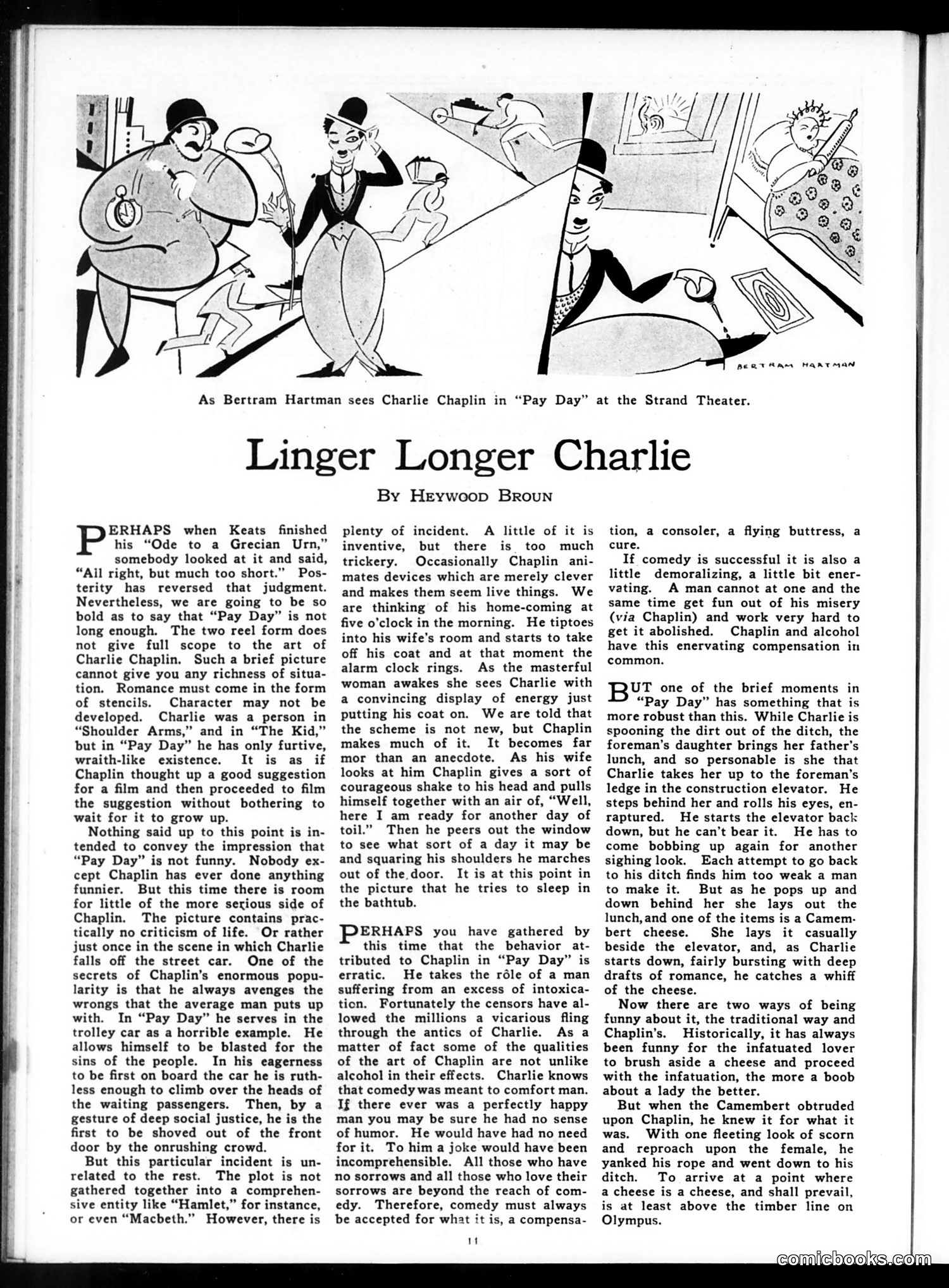
This is a film review by Heywood Broun of Charlie Chaplin's 1922 silent comedy "Pay Day," showing at the Strand Theater. The cartoon at top depicts Bertram Hartman's artistic interpretation of scenes from the film. Broun argues that while "Pay Day" is hilarious, it's too *short* (two reels) to fully showcase Chaplin's artistic range. He notes the film lacks the character development and social commentary present in Chaplin's earlier works like "Shoulder Arms" and "The Kid." The review praises one sequence—Chaplin tiptoeing home drunk at dawn, caught by his awakening wife—as genuinely inventive. However, Broun criticizes the overall plot as scattered anecdotes rather than a cohesive narrative. He concludes that comedy serves to comfort people bearing life's sorrows, implying Chaplin's genius extends beyond mere gags when given proper scope. The caricature shows Chaplin's famous "Tramp" character in various comedic poses with other figures, illustrating the film's physical humor.
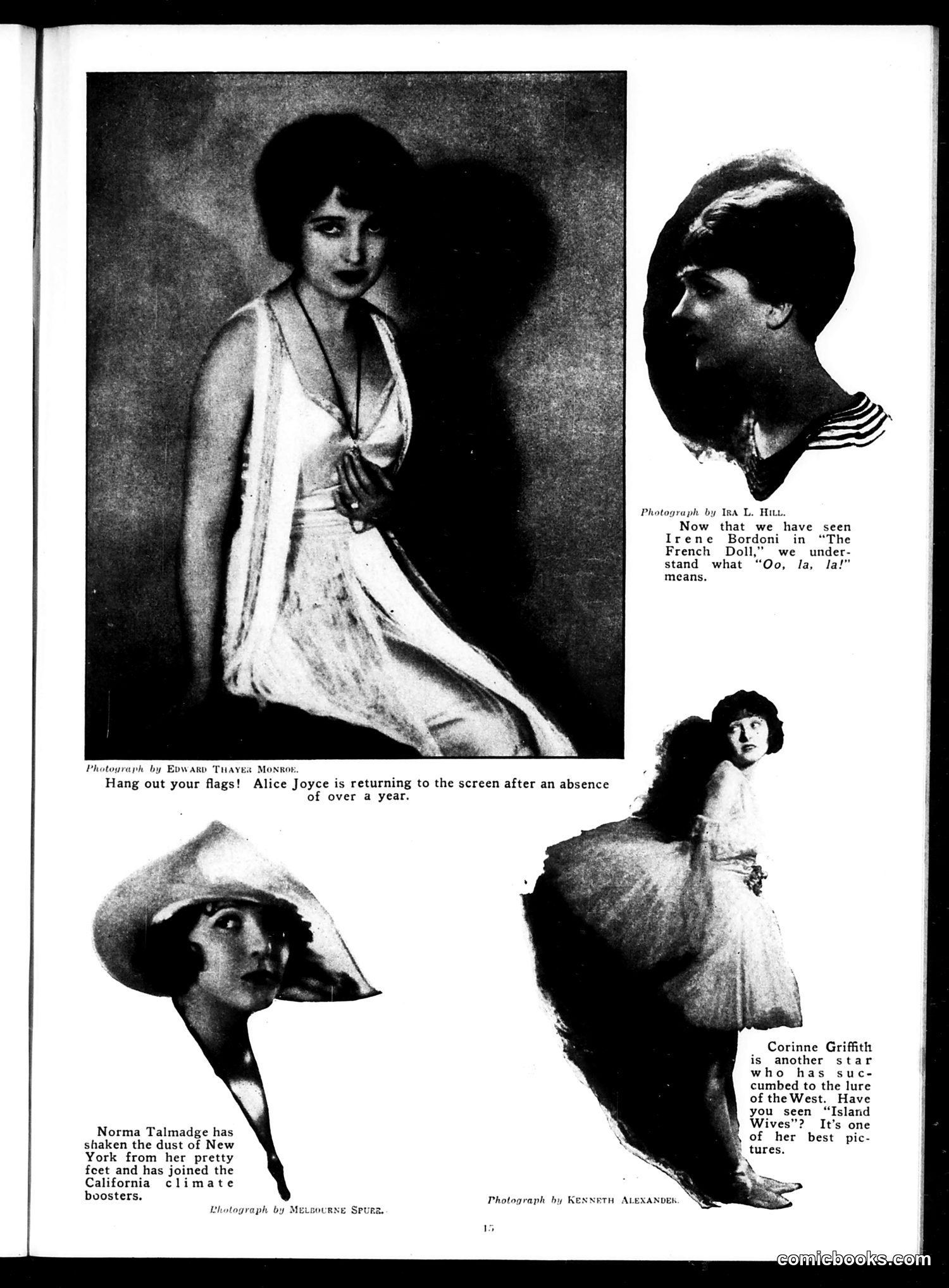
This page celebrates the return and relocation of silent film actresses during the early 1920s. The content consists of four photographic portraits with brief commentary about each actress's career moves: **Alice Joyce** is praised for her return to screen after a year-long absence. **Irene Bordoni** appears in "The French Doll," with the caption making a light joke about understanding French expressions after seeing her perform. **Norma Talmadge** has relocated from New York to California, humorously framed as joining "California climate boosters"—reflecting the era's migration of film production westward. **Corinne Griffith** is noted for similarly moving west and appearing in "Island Wives." The overall tone is congratulatory celebrity gossip dressed in patriotic language ("Hang out your flags!"). The satire gently mocks both actresses' career decisions and the film industry's westward shift during Hollywood's consolidation as the entertainment capital.
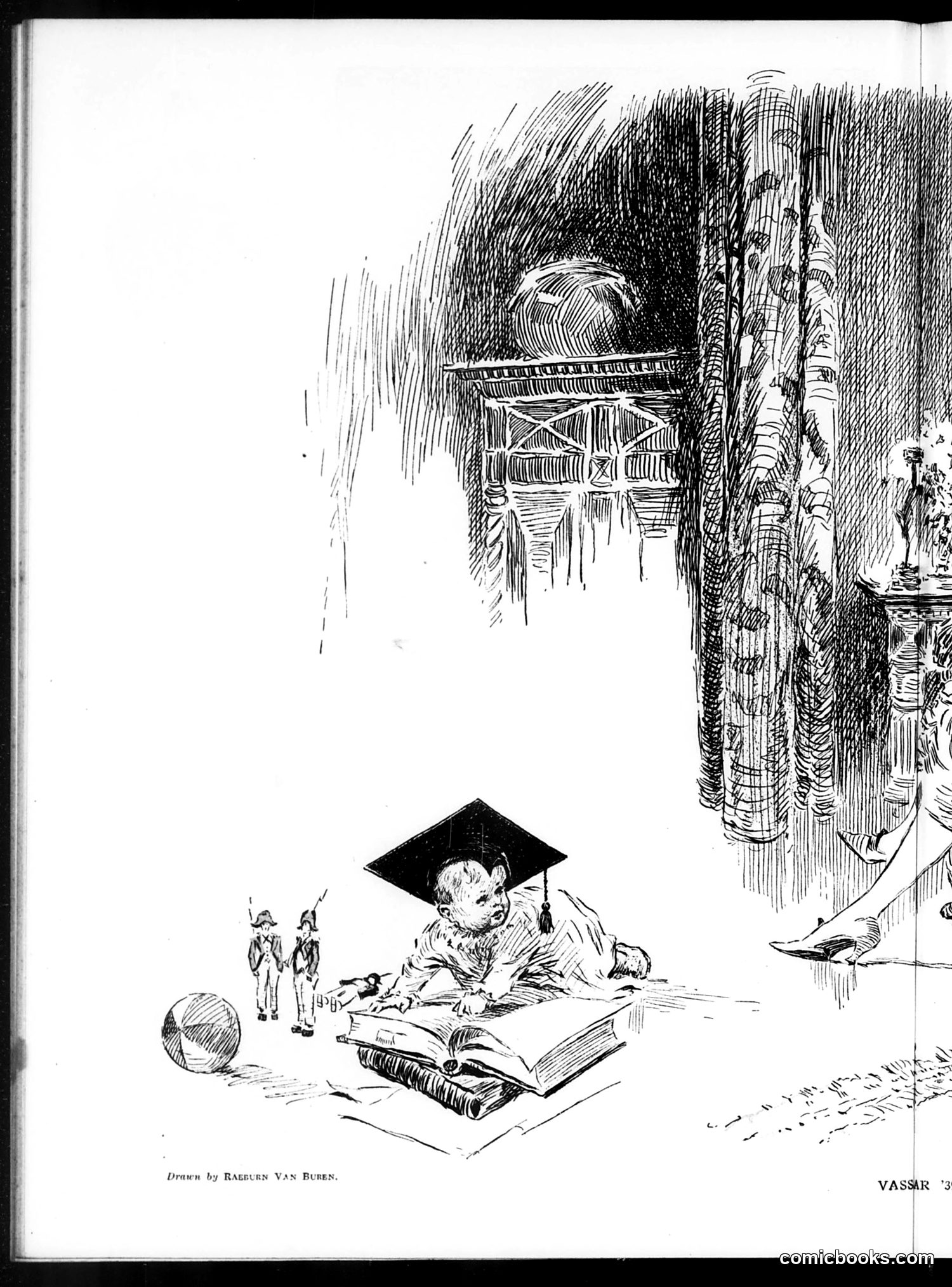
This cartoon by Raeburn Van Buren appears to satirize Vassar College education (note "VASSAR '73"). A tiny infant wearing an academic mortarboard sits among oversized books and military toy soldiers, suggesting the absurdity of attempting rigorous scholarly training. The juxtaposition of an infant's developmental stage with advanced education implies mockery of either Vassar's curriculum or its students' readiness. The exaggerated scale emphasizes the disproportion between the child and the intellectual demands presented. Without additional context from Judge magazine's era, the specific target—whether it's women's education generally, Vassar specifically, or contemporary educational debates—remains somewhat unclear, but the core joke ridicules the mismatch between student capability and educational pretension.
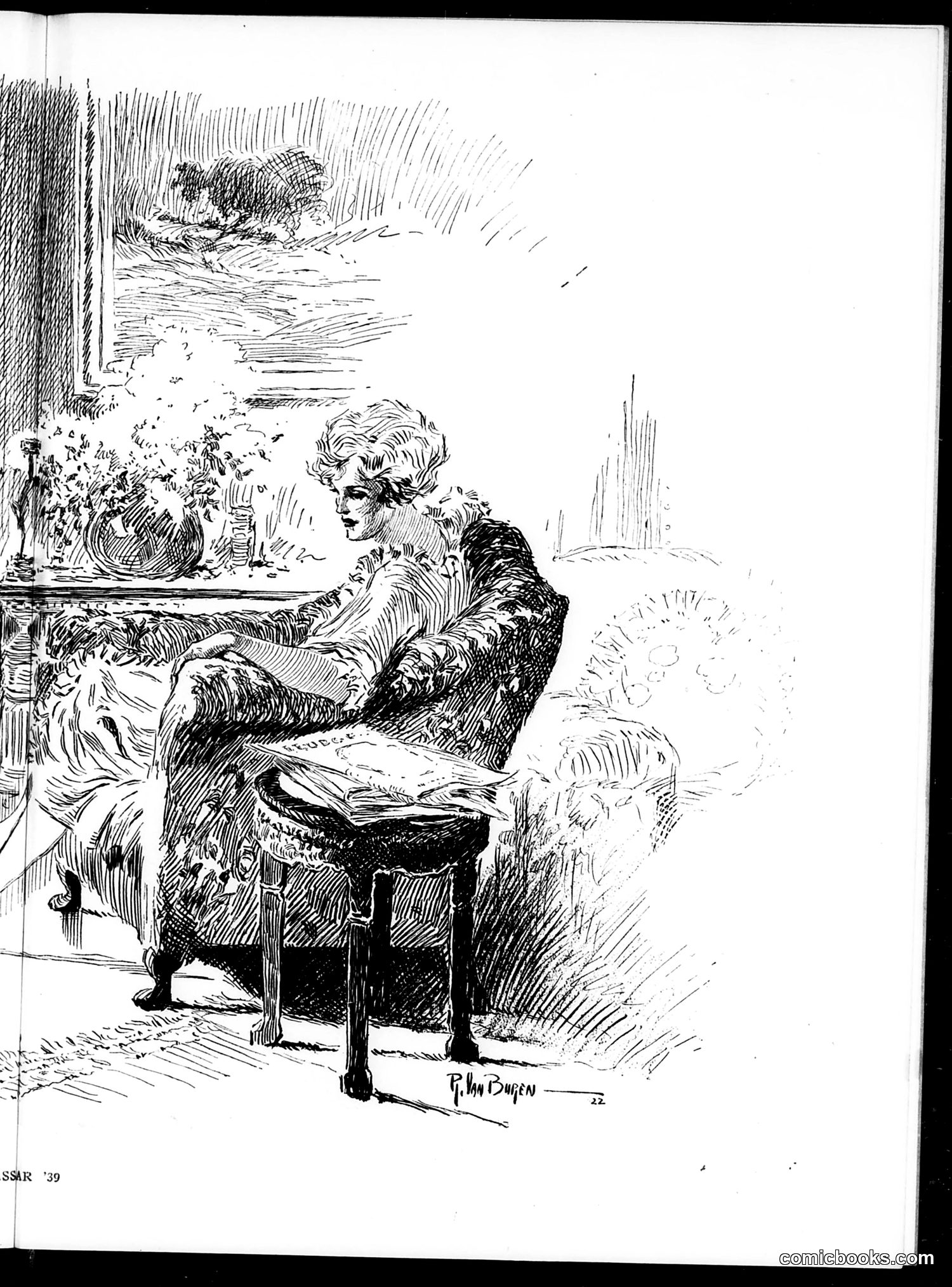
This is a pen-and-ink illustration signed by Ralph Barton, a prominent Judge magazine artist of the era. The drawing depicts a fashionably dressed woman in 1930s attire (note the styled hair and elegant clothing) seated and reading, appearing absorbed in her material. A man is visible in the background. The sparse OCR text provides little context for interpreting specific satire. Without additional caption text visible in the image, the cartoon's precise satirical point—whether it concerns gender roles, literary tastes, social behavior, or another contemporary social issue—cannot be determined with certainty. The date notation "SSAR '39" suggests 1939 publication. The illustration style and composition suggest social commentary typical of Judge magazine's satirical approach, but the specific target or joke remains unclear from this page alone.
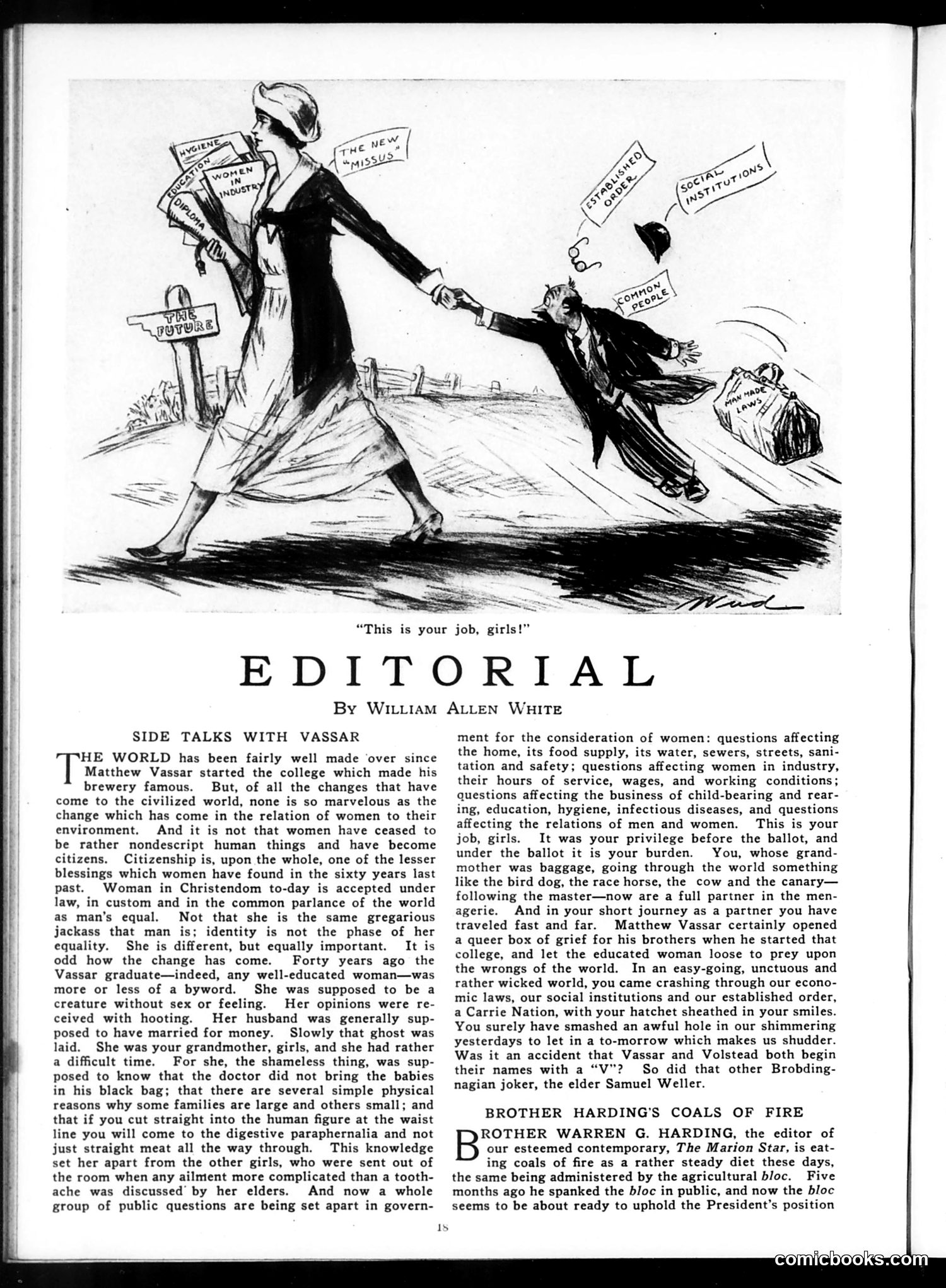
**The Cartoon:** The illustration depicts a woman striding forward holding papers labeled "HYGIENE," "WOMEN IN INDUSTRY," "THE NEW MISSION," "EDUCATION," "SOCIAL INSTITUTIONS," and "COMMON SENSE." A small man (likely representing traditional society or politicians) struggles behind her, being dragged along. **The Satire's Point:** William Allen White's editorial celebrates women's expanded role in civic life following suffrage. The cartoon visualizes this shift: educated women from Vassar College are now tasked with reforming society—addressing public health, labor conditions, education, and social policy. White presents this as both progress and disruption, humorously comparing educated women to Carrie Nation (the famous temperance activist) "with your hatchet sheathed in your smiles." **Historical Context:** This appears post-women's suffrage, positioning voting rights as simultaneously a "privilege" and "burden." The editorial frames women's new civic responsibilities as natural evolution from their previous exclusion from serious consideration. **The Joke:** Men who previously controlled these institutions now find themselves dragged into reform by capable, educated women—a role reversal presented with grudging admiration.
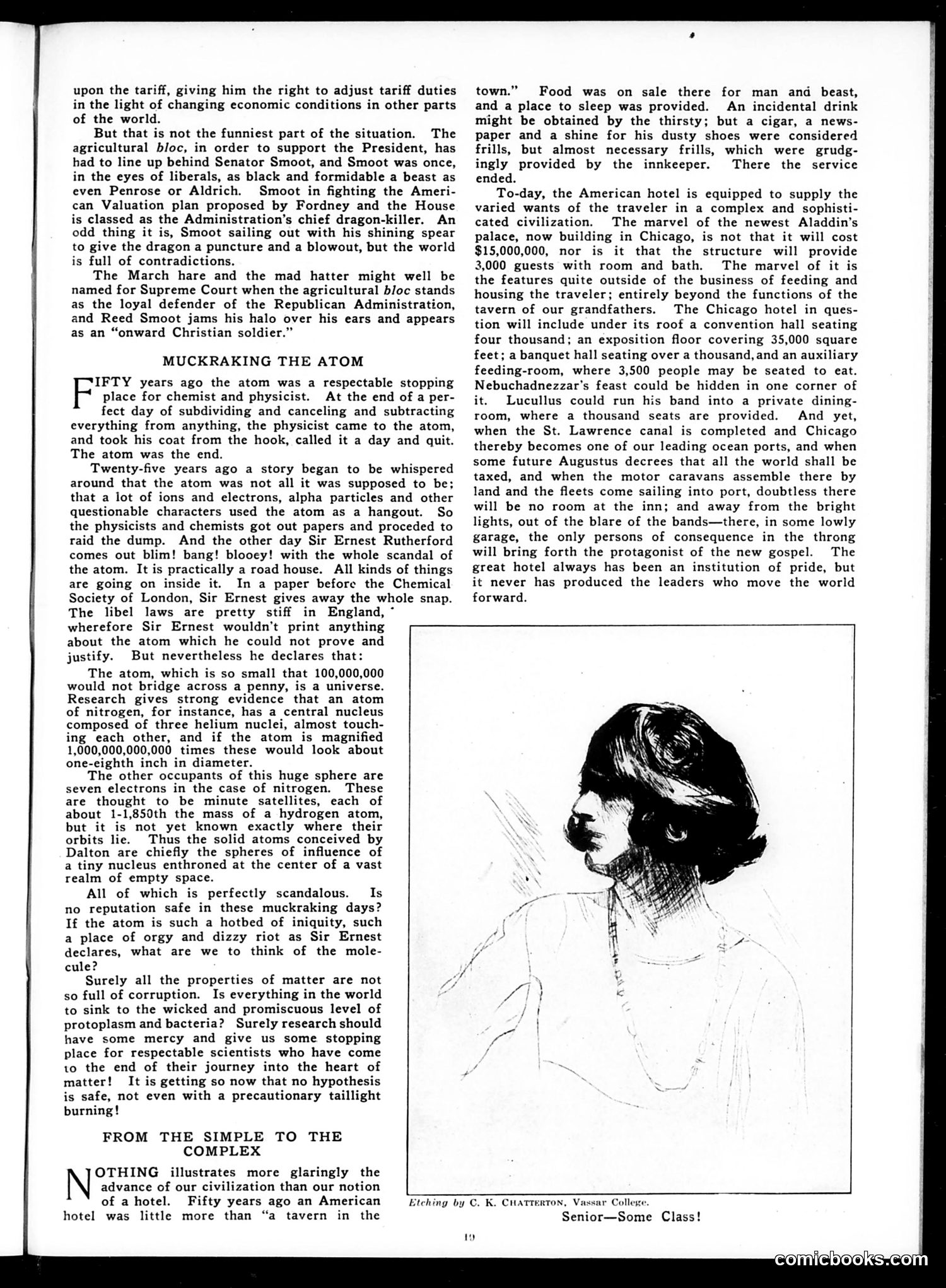
This page contains two distinct articles with different satirical targets: **"Muckraking the Atom"** mocks recent scientific revelations about atomic structure. The piece sarcastically critiques Sir Ernest Rutherford's 1911 discovery that atoms contain electrons and other particles—previously thought to be indivisible. The joke is that physicists treated the atom like a respectable endpoint for research, only to discover it's actually a chaotic "road house" full of questionable characters. The satire also pokes fun at English libel laws, suggesting Rutherford could face legal trouble for revealing such scandalous atomic "gossip." The upper section discusses tariff politics, sarcastically noting that Senator Reed Smoot—once viewed by liberals as a reactionary villain—now appears heroic to the agricultural bloc supporting the President. The "March hare and mad hatter" reference suggests this political realignment is absurd and contradictory. **The sketch** (credited to C.K. Chatterton) shows a woman's portrait; its connection to page content is unclear.
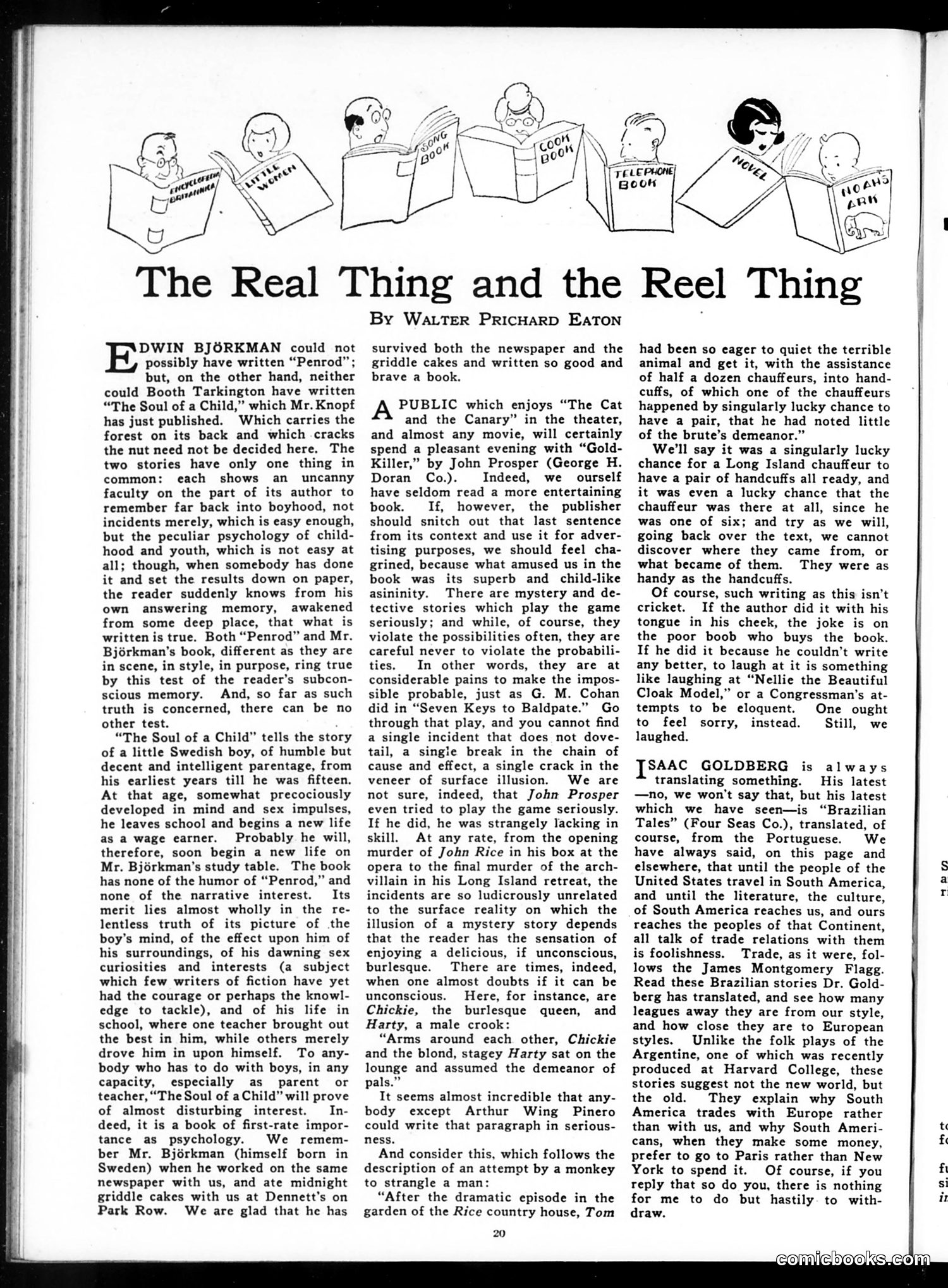
This is a literary criticism article by Walter Prichard Eaton reviewing three books. The cartoon header shows figures reading different books, contrasting "real" literature with entertainment. The article compares two novels about boyhood: Edwin Björkman's "The Soul of a Child" and Booth Tarkington's "Penrod." Eaton praises both for authentically capturing childhood psychology, though they differ in tone and approach. He then reviews "Gold-Killer" by John Prosper, criticizing its absurd plot logic while acknowledging its entertainment value. Eaton contrasts it with G.M. Cohan's play "Seven Keys to Baldpate," which maintains internal consistency despite its theatrical contrivances. The satire suggests tension between "serious" literature's psychological truth and popular entertainment's escapist pleasure—a recurring Judge magazine concern about mass culture versus literary merit. The author's personal connection to Björkman (both worked at the same newspaper) adds editorial warmth to the recommendation.
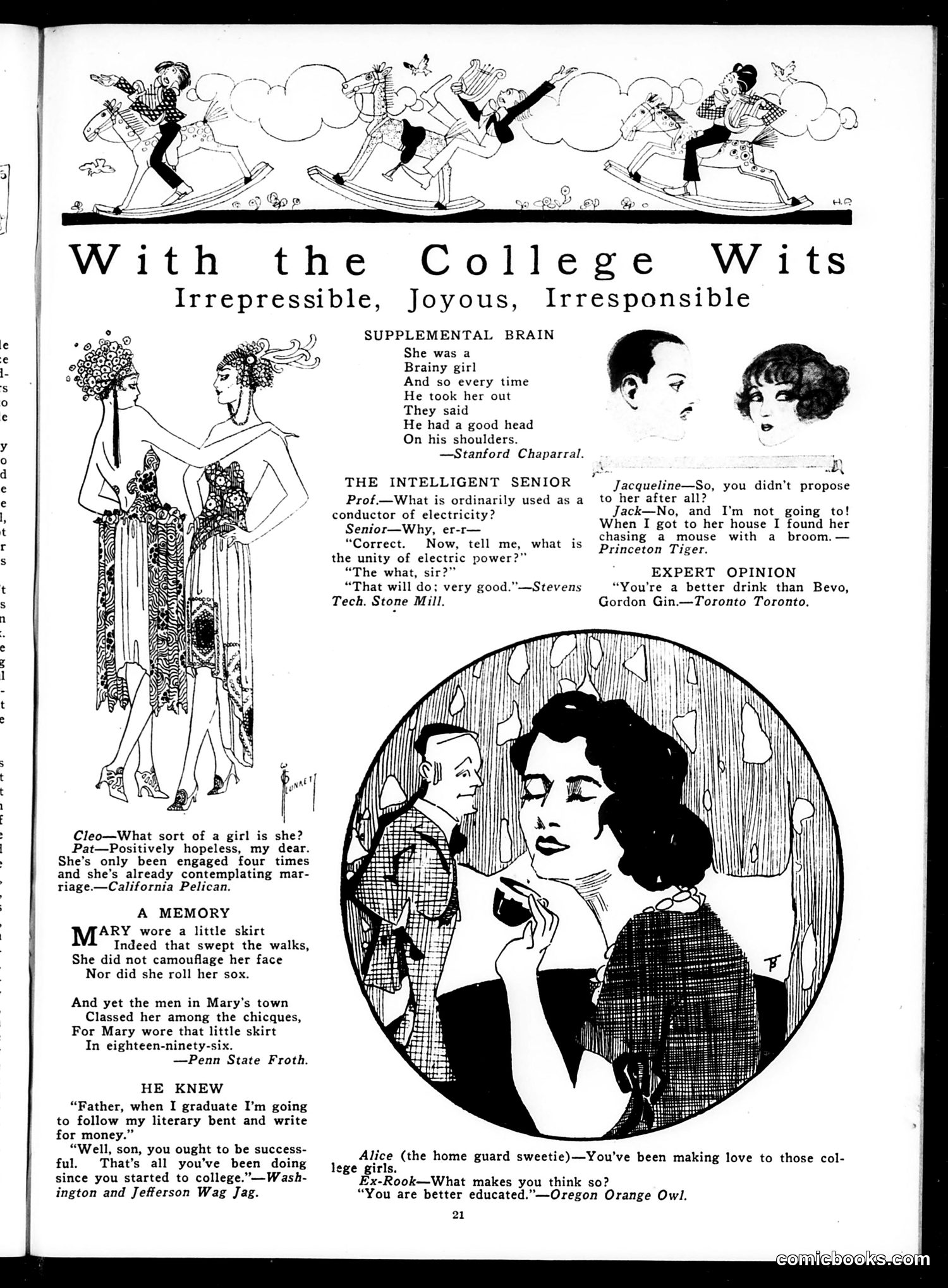
This page collects humorous jokes and quips from college humor magazines (Stanford Chaparral, Princeton Tiger, etc.), typical of Judge's recurring feature satirizing student wit and college life. **The satire targets:** 1. **Young women's changing social behavior**: Multiple jokes mock women's shifting roles—engagement practices ("engaged four times"), dating behavior, and romantic pursuits. The "Mary" poem nostalgically contrasts old-fashioned modesty (1896) with modern "chicques" (fashionable women). 2. **Male students' intellectual pretension**: The "Intelligent Senior" and "He Knew" jokes mock college men who claim sophistication while proving ignorant or lazy. 3. **Dating/courtship absurdities**: Jokes about proposals failing over domestic incompetence, and men's tendency toward shallow romance. The overall tone suggests Judge's readership found college students—particularly women adopting modern freedoms—worthy of gentle mockery. The "supplemental brain" joke reduces intelligent women to physical attractiveness, reflecting period attitudes.
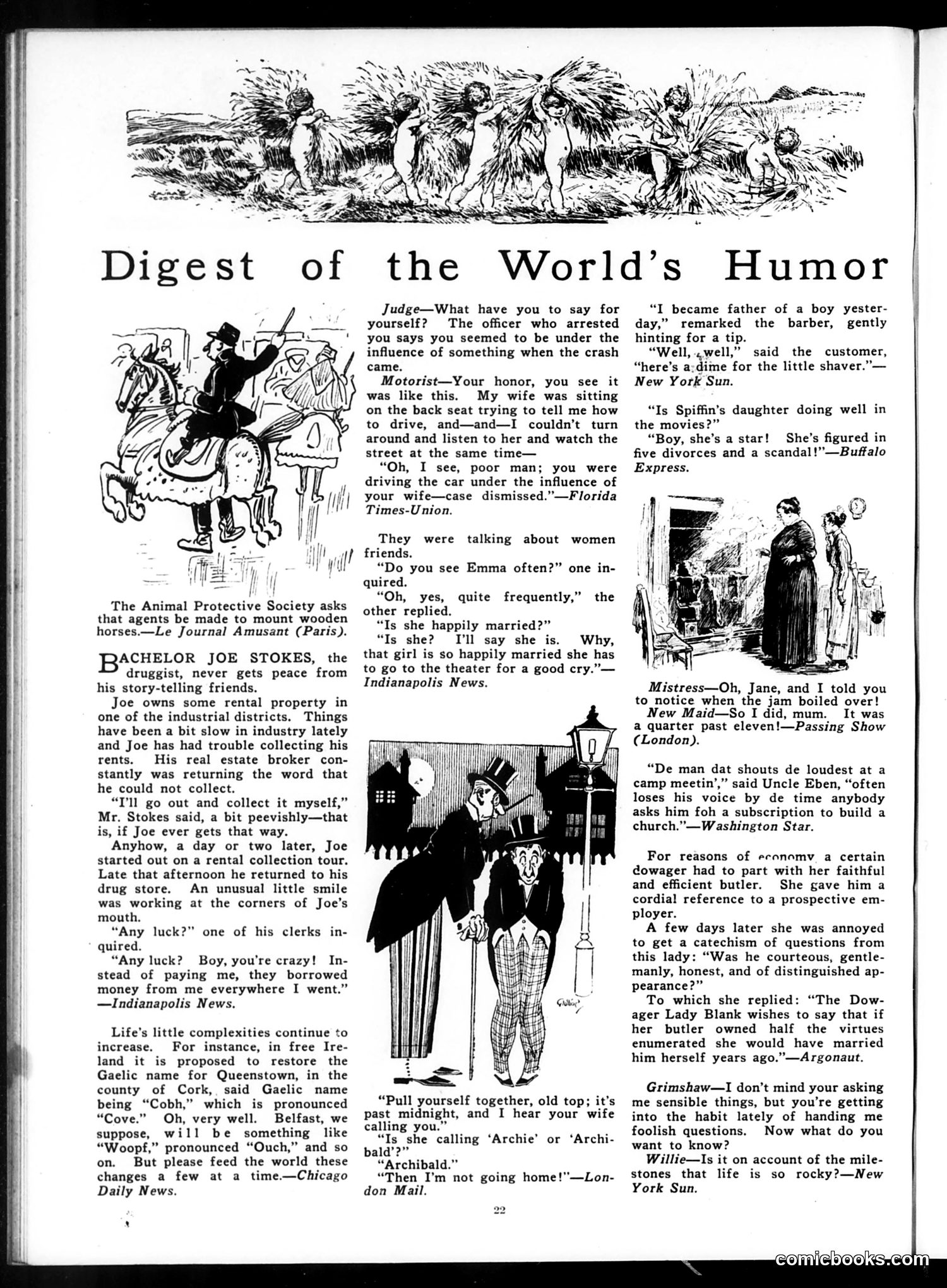
This page compiles short humorous anecdotes and jokes sourced from newspapers and magazines worldwide, a common Judge feature. The satirical content reveals early 20th-century social attitudes: **Key Jokes:** - A motorist blames his wife's backseat driving for a crash—the judge dismissively calls it being under the "influence of your wife" - A barber hints for a tip after announcing his newborn; the customer gives "a dime for the little shaver" (pun on barber/newborn) - A happily married woman must attend theater "for a good cry"—satirizing domesticity as emotionally stifling - A drunk man won't go home when his wife calls "Archibald" (his full name), preferring informal "Archie" **The Cartoon:** Shows a drunken man at night being called home by an unseen wife—illustrating marital tension and male escape into alcohol. The humor assumes male audiences will recognize universal complaints: nagging wives, financial troubles, and marital discord. Women appear as obstacles to male autonomy and enjoyment.
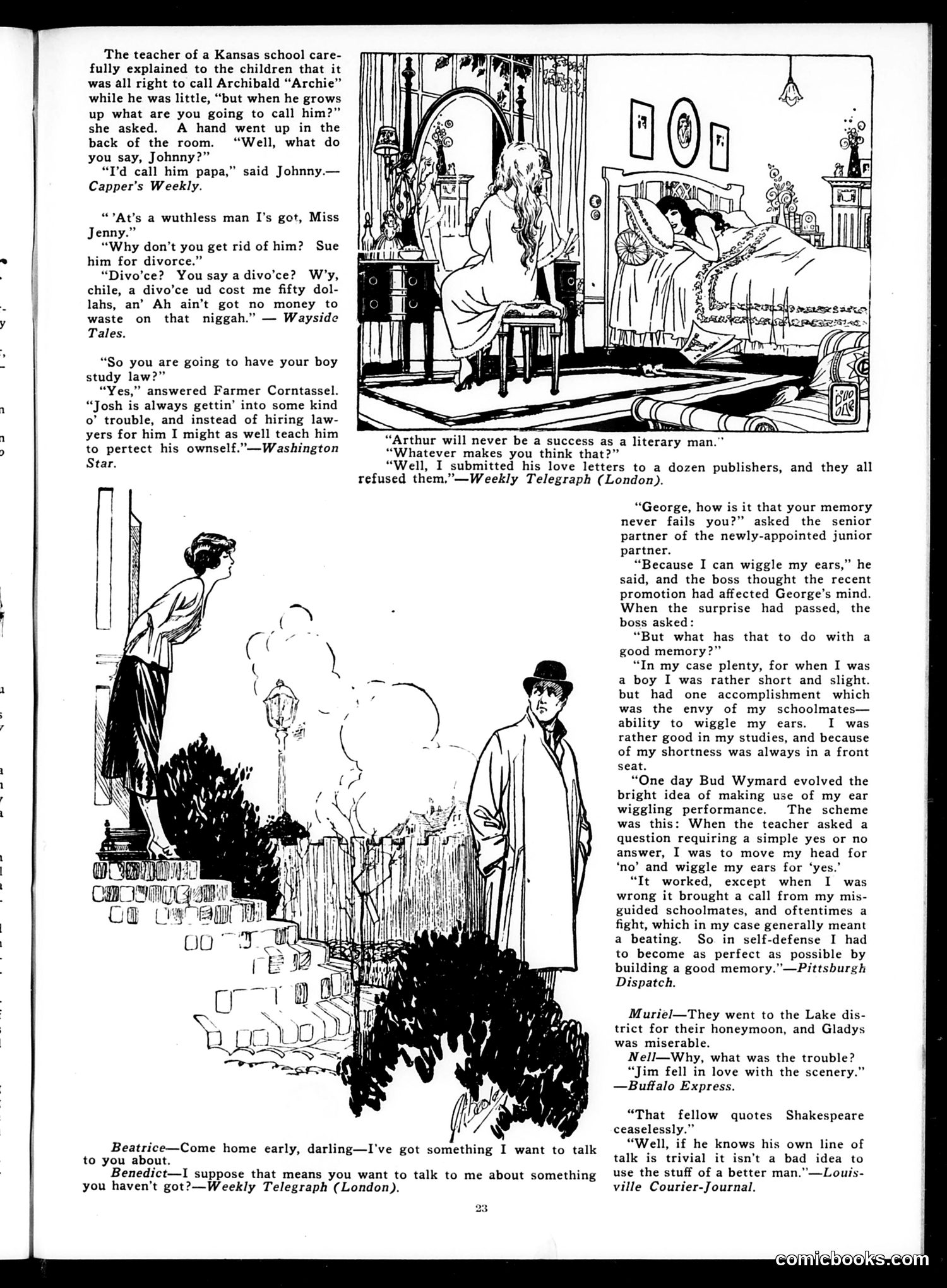
This page contains multiple short humor pieces typical of early 20th-century American satirical magazines: **Content includes:** 1. **Joke about naming conventions** - A child's innocent misunderstanding about what to call someone named Archibald as he grows up, suggesting he'd become "papa." 2. **Racist dialect humor** - A piece using offensive stereotypical Black dialect about divorce costs, reflecting the deeply problematic racial attitudes of the era. 3. **Rural/farmer stereotypes** - A joke about a farmer planning to teach his troublemaking son law rather than hire lawyers. 4. **Marriage humor** - Pieces about spousal miscommunication and honeymoon mishaps. 5. **Ear-wiggling memory trick** - An anecdote about using physical ear-wiggling as a schoolboy signaling system that supposedly improved memory. **The satire targets** middle-class anxieties, marital dynamics, and regional/class stereotypes. The racist content reflects Judge's editorial perspective and historical context, though such material is now recognized as offensive. These jokes relied on shared cultural references and stereotypes familiar to the magazine's contemporary readers.
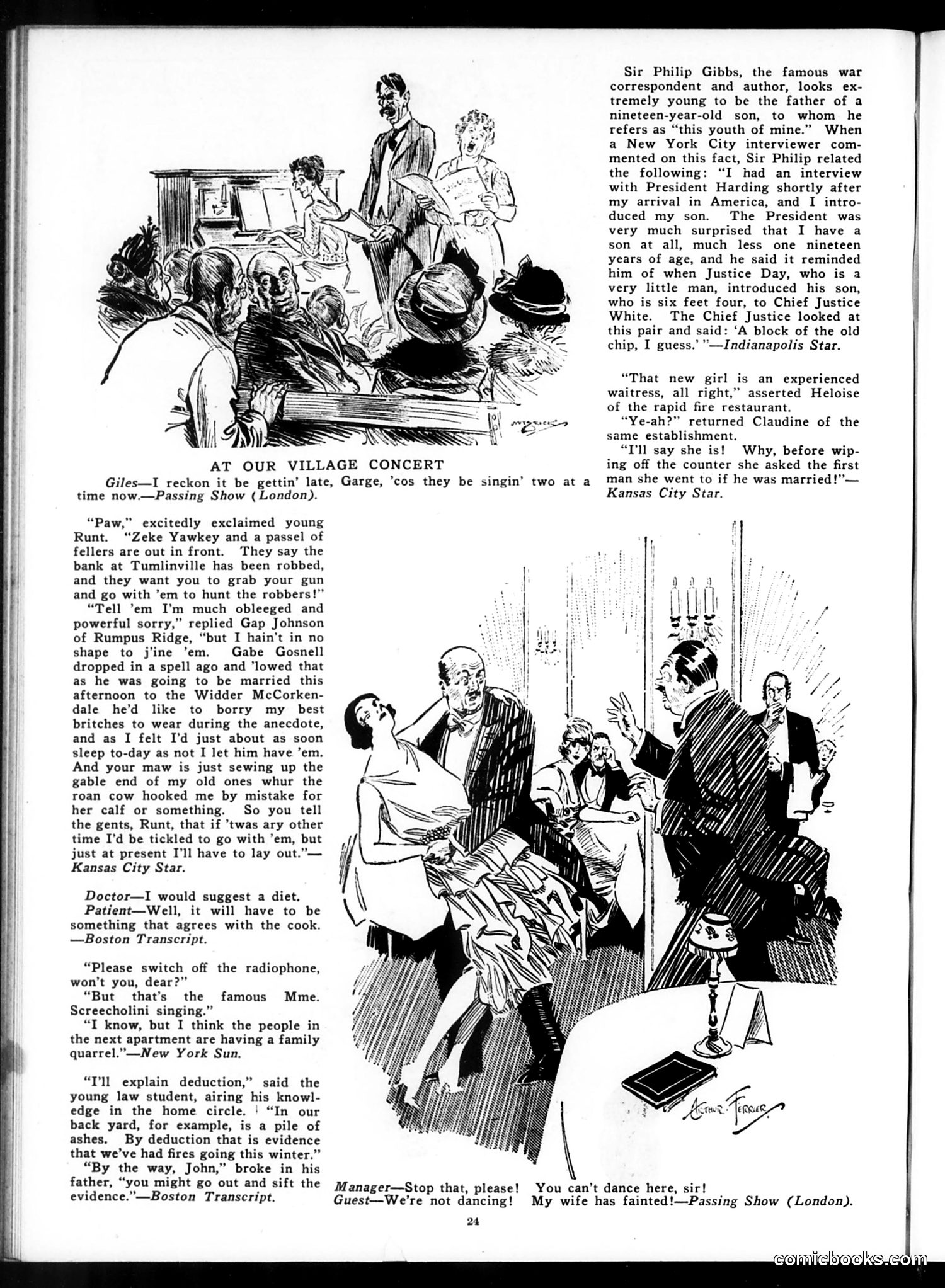
This page from Judge contains multiple short humorous anecdotes with accompanying illustrations, typical of early 20th-century American satirical magazines. **Main Content:** The page features several brief comedic sketches sourced from various newspapers (Kansas City Star, Boston Transcript, New York Sun, Passing Show). These include: - Rural characters declining to join a posse because their pants are being repaired - A doctor's dietary advice undermined by the patient's cook - A neighbor complaining about loud opera singing disturbing apartment dwellers - A law student's logical deduction about winter fires - An anecdote about President Harding meeting war correspondent Sir Philip Gibbs' son **Satire Focus:** The humor targets everyday situations: rural simplicity, marital dynamics, modern conveniences (radiophone), social pretension, and class distinctions. The final illustration shows a fainting woman at what appears to be a public event, captioned about dancing—likely mocking overcrowded or poorly-managed venues. The overall tone is genteel, observational humor rather than hard political satire.
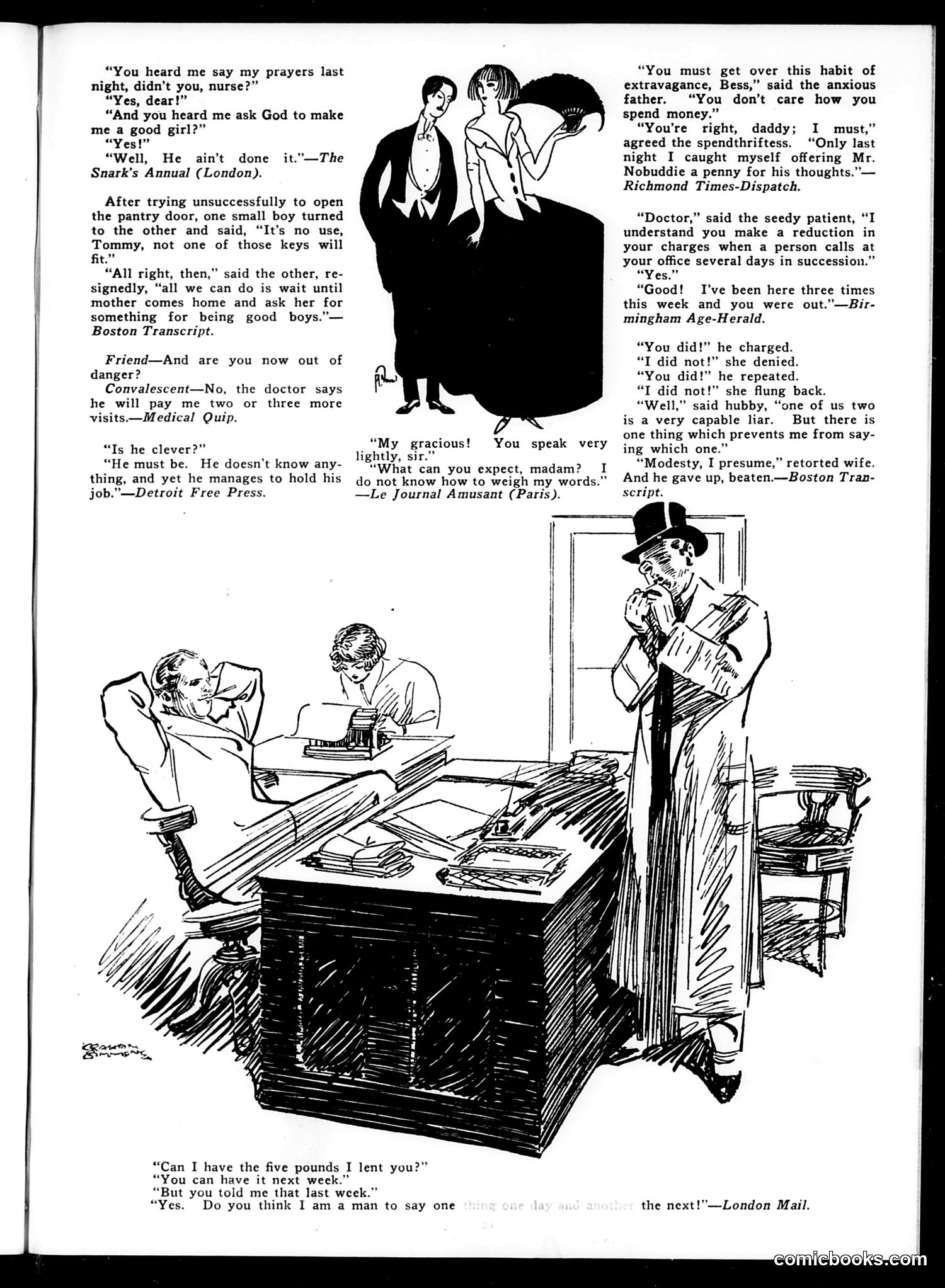
This page collects brief humorous anecdotes from various sources, typical of Judge magazine's format. The cartoons and jokes mock everyday social hypocrisy and human nature: **Key targets:** - **Children's moral contradictions**: A girl prays to be good, then admits God hasn't delivered—satirizing the gap between piety and behavior. - **Parental manipulation**: Boys cynically plan to ask their mother for rewards "for being good"—mocking false virtue. - **Medical profession**: A doctor who makes money from repeat visits; a patient exploits this by calling when the doctor is out. - **Marital dishonesty**: A couple argues over who's lying, with the husband unable to declare his wife dishonest without admitting his own capacity for lying—satirizing marital dynamics and masculine pretense. - **Class and pretense**: A "seedy patient" navigates economic disparities; a woman offers a penny for thoughts, suggesting both poverty and social awkwardness. The satire assumes readers recognize these as universal human flaws—dishonesty, greed, and self-deception—rather than targeting specific political figures or events.
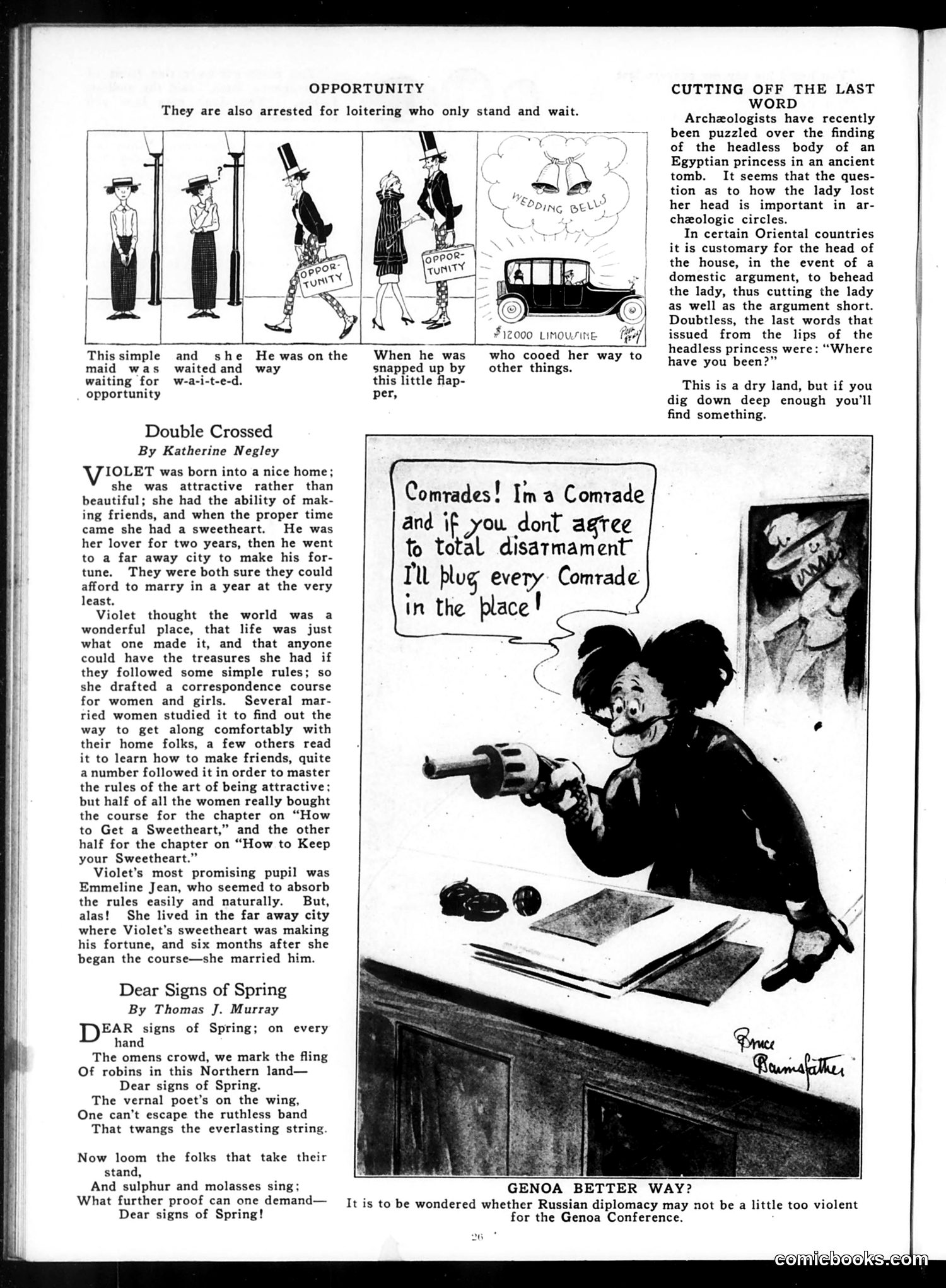
**"Opportunity"** (top): A visual joke about vagrancy laws. The cartoons show people arrested simply for standing idle—satirizing overly broad loitering ordinances that punish unemployment or poverty as criminal behavior. **"Double Crossed"** (middle): A short story about Violet, who writes a self-help course on relationships. The irony: her own sweetheart abandons her for one of her students (Emmeline Jean) who lives in the same city. It's satirizing the gap between relationship advice and real-life romance—the expert gets betrayed. **"Dear Signs of Spring"** (bottom left): A poem celebrating spring's return, including the inevitable arrival of amateur poets and their overwrought verse—gentle mockery of seasonal poetry's clichés. **Russian cartoon** (right): Depicts a caricatured Russian diplomat threatening to "plug every Comrade" if others won't accept "total disarmament." This satirizes Soviet negotiating tactics at the 1922 Genoa Conference, suggesting Russian diplomacy was crude or overly aggressive for international diplomacy.
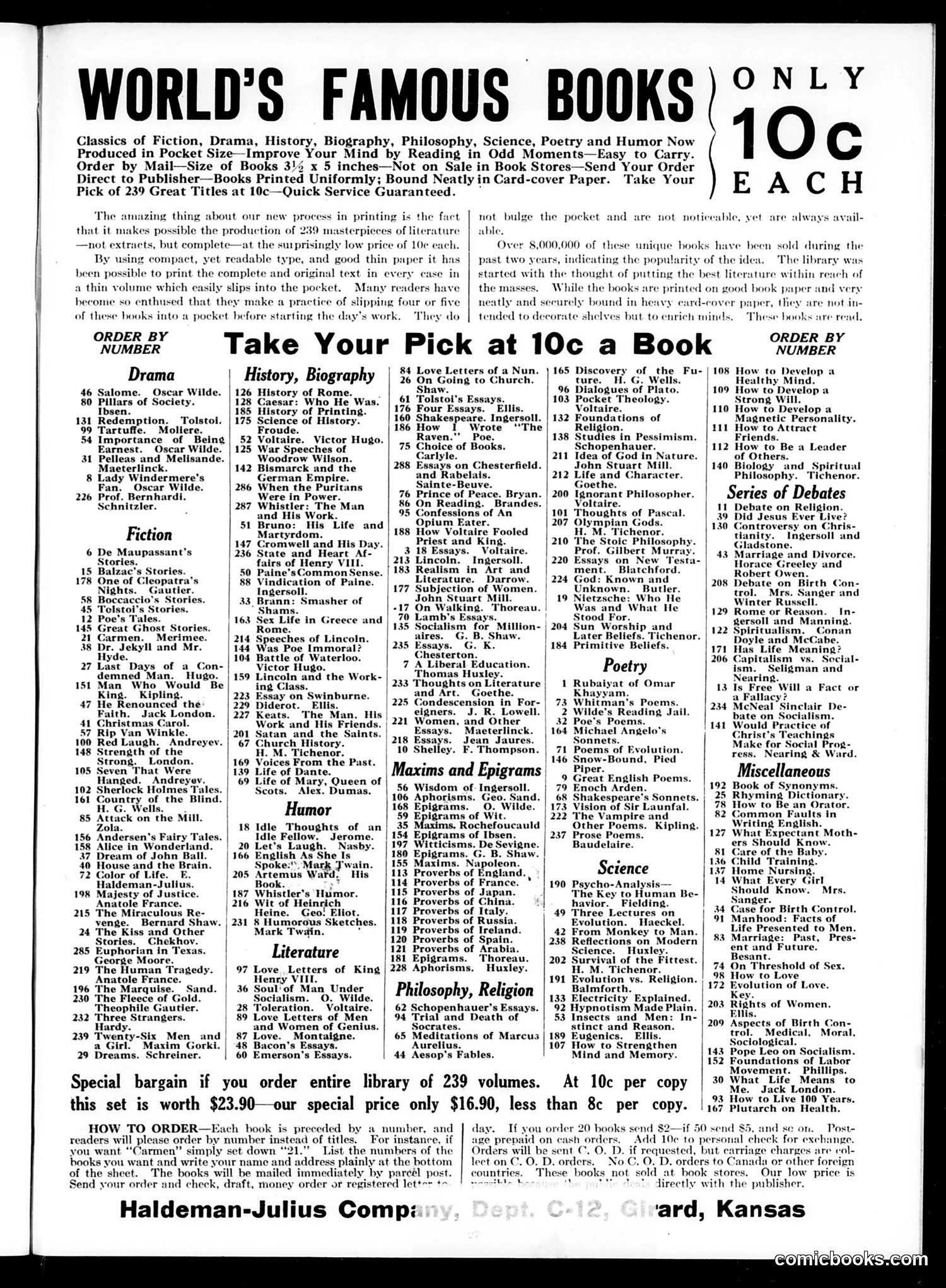
This is not a political cartoon or satirical content—it's a **mail-order book catalog page** from Judge magazine, likely early 20th century. The Haldeman-Julius Company advertises a "pocket library" of 239 classic books in fiction, drama, history, biography, philosophy, science, poetry, and humor, selling for 10 cents each. The appeal is practical and democratic: affordable, portable books you can carry to read "in odd moments." The text emphasizes the innovation of printing complete texts in tiny volumes at low cost—a genuine commercial breakthrough for making literature accessible to ordinary people, not a wealthy elite. There is no satire here; it's straightforward marketing. The only modest humor is the casual sales pitch: readers should order "by number" and mention they want "Carmen, simply set down '21.'"
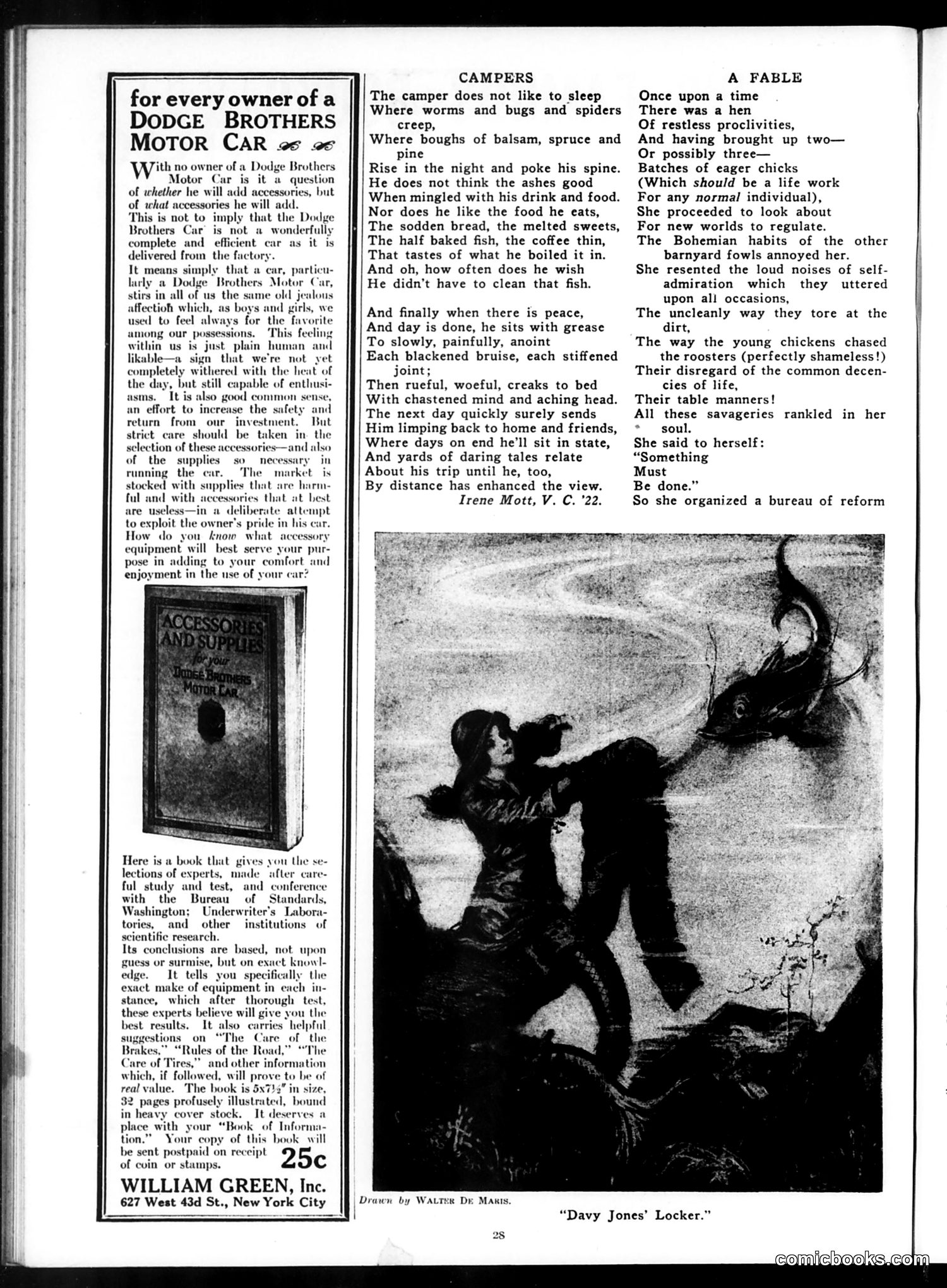
This page contains three distinct pieces of content: **Left side:** An advertisement for Dodge Brothers automobiles, promoting an accessories guide book (25 cents). The ad argues that car owners naturally want to customize their vehicles with proper accessories selected by experts. **Center/Right:** Two literary pieces: 1. **"Campers"** (poem by Irene Mott, V.C. '22): A humorous critique of camping. It describes a camper's miserable experience—uncomfortable sleeping, poor food, bugs, dirt, physical pain—yet afterwards he exaggerates his adventure to friends back home, making it sound grander than it was. The satire mocks both camping's hardships and campers' tendency to embellish their tales. 2. **"A Fable":** A moral story about an officious hen who, after raising chicks, becomes a busybody reformer, annoyed by other barnyard fowls' "Bohemian habits" and "savageries." She establishes a "bureau of reform." This appears to satirize self-righteous social reformers and busybodies who impose their moral standards on others, presented as absurd through animal allegory. Both literary pieces mock human behavior through gentle satire typical of Judge magazine's social commentary.
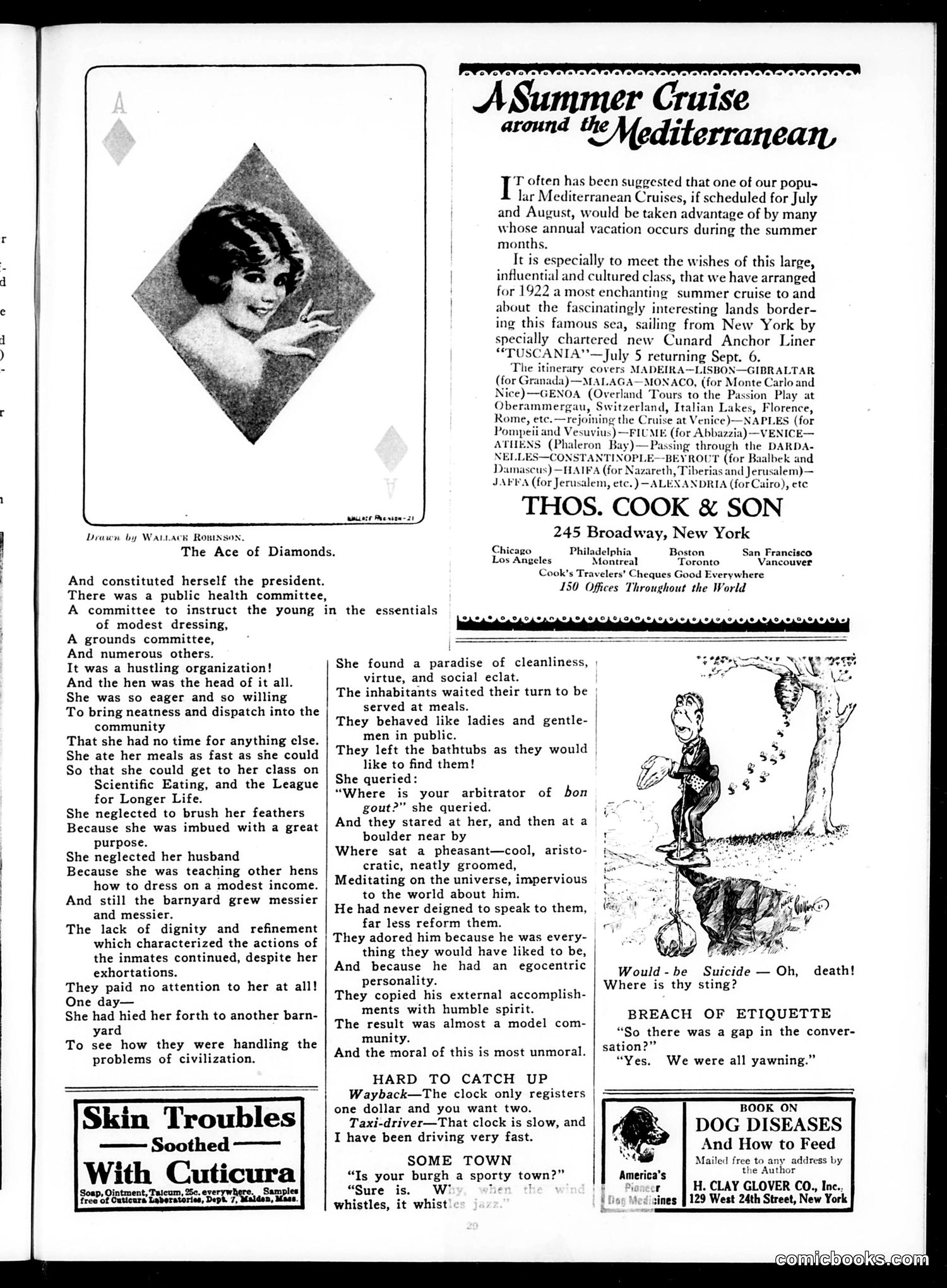
The illustrated story, drawn by Wallace Robson, satirizes an overzealous reformer hen who creates elaborate committees for "modest dressing," "scientific eating," and self-improvement in her barnyard community. Despite her frantic efforts to impose order and refinement on her fellow hens, her barnyard grows "messier and messier"—they ignore her entirely. She discovers a neighboring yard where residents are perfectly civil and orderly. The secret? A detached pheasant who sits "cool, aristocratic," meditating supremely and never speaking to them. The hens adore and copy him precisely *because* he ignores them and their concerns. The satire mocks Progressive Era reformers and women's social improvement movements of the early 1920s: their earnest busybody activism, constant organizing, and belief that rules and lectures could transform human (or animal) behavior. The joke's dark moral: people respond better to indifference and example than to relentless moralizing. The page also includes a Thos. Cook cruise advertisement and minor humorous short jokes.
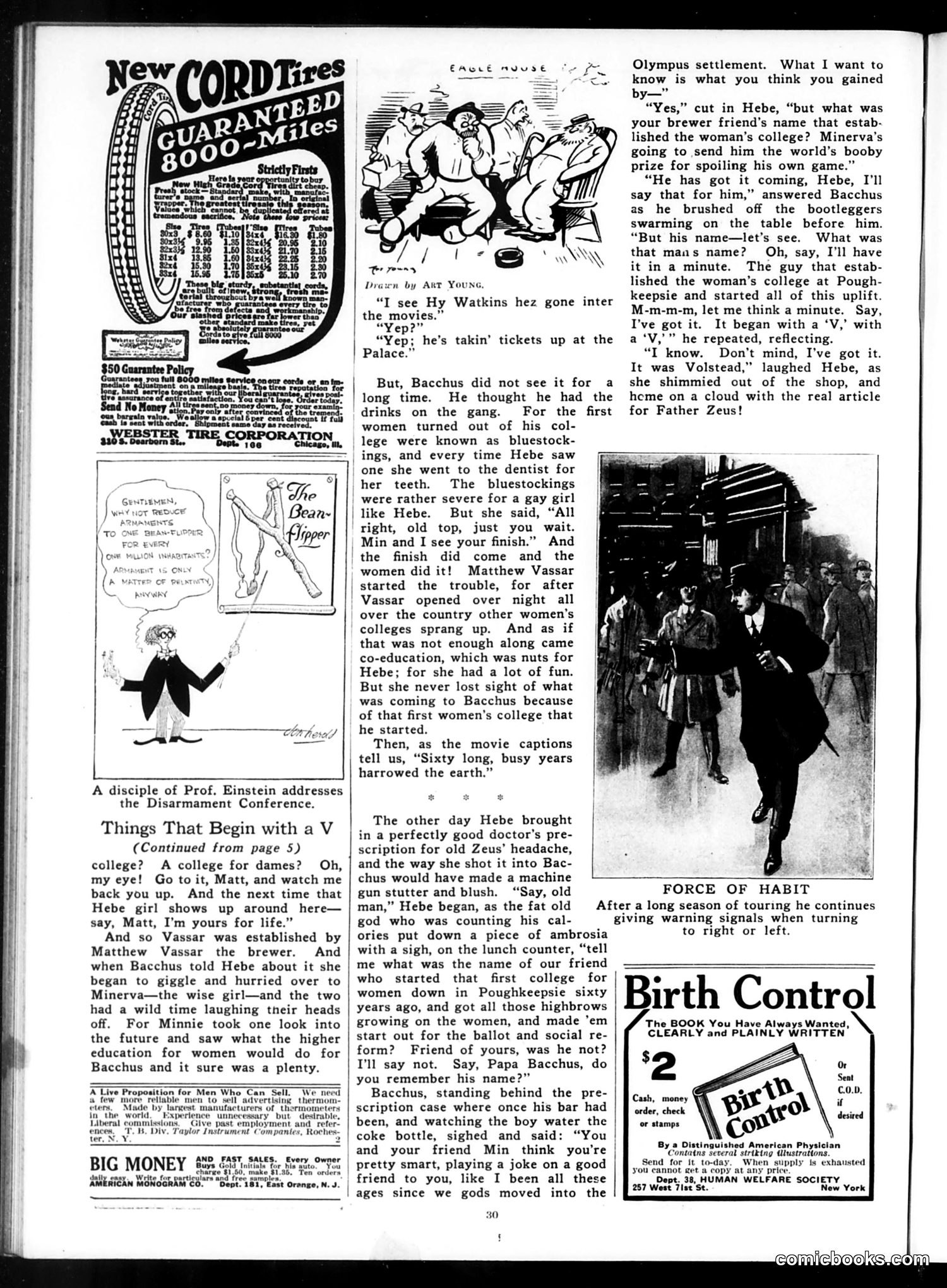
This page satirizes women's education and Prohibition through classical mythology. The main cartoon (top left) shows "A disciple of Prof. Einstein" addressing a disarmament conference—likely mocking both Einstein's pacifism and intellectual pretension during post-WWI disarmament debates. The primary story, "Things That Begin with a V," uses gods (Bacchus, Hebe, Minerva) as characters to mock Matthew Vassar's establishment of Vassar College for women. Hebe and Minerva laugh because women's education will ultimately harm Bacchus (god of wine/drinking). The satire's punchline is brutal: Bacchus cannot remember Vassar's name, so Hebe tricks him into saying "Volstead"—the congressman behind the Volstead Act (Prohibition, 1920). The joke equates women's education and women's suffrage with Prohibition as forces that have destroyed male pleasure and freedom. For Judge's male readership, these represented related threats to traditional male authority.
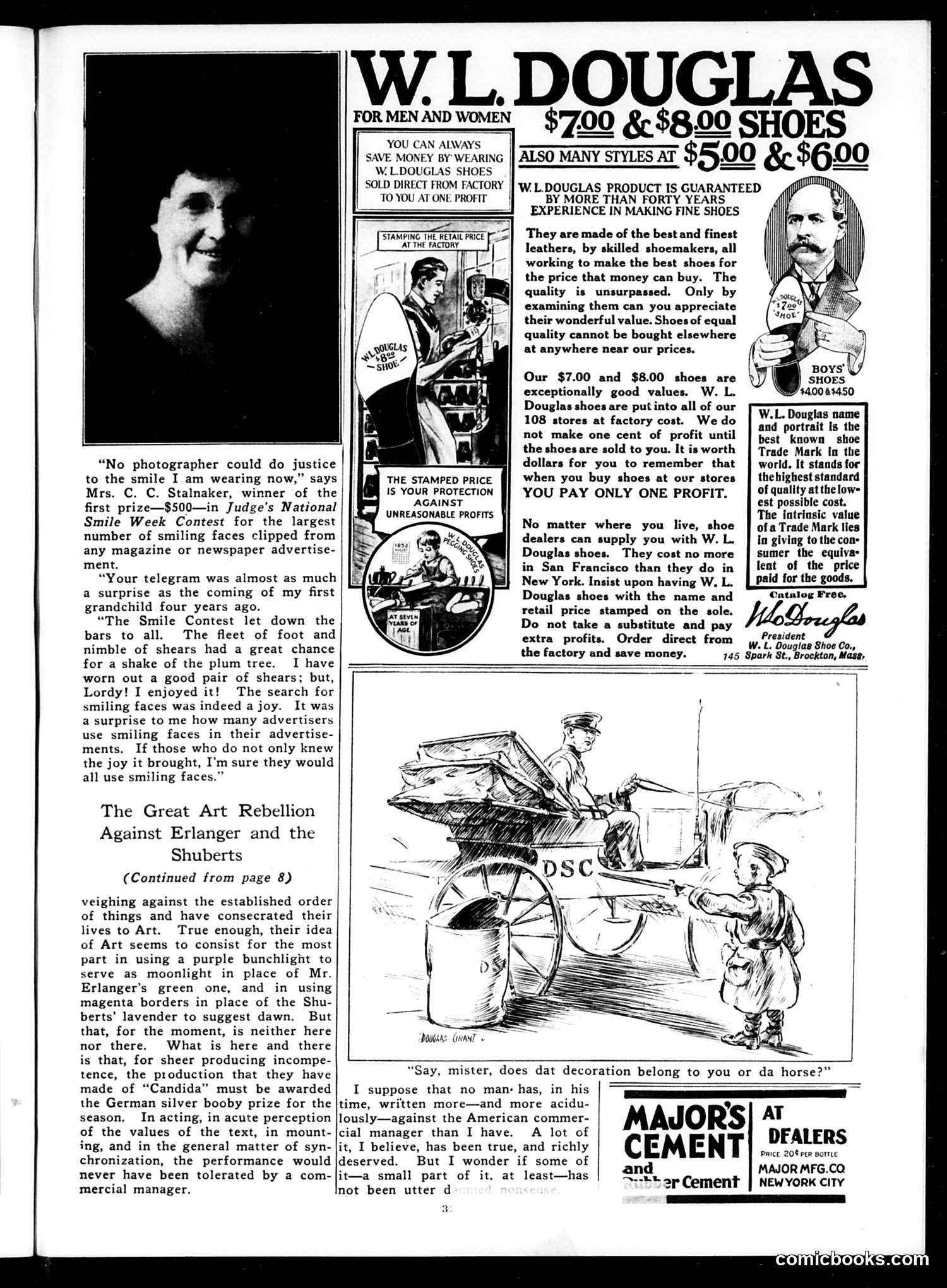
This page contains mixed content: primarily **advertisements** for W.L. Douglas shoes and Major's Cement, plus two editorial pieces. The main cartoon shows a delivery wagon labeled "DSC" (unclear what this abbreviates) with a man carrying a large decorated object, while street children ask: "Say, mister, does dat decoration belong to you or da horse?" The joke appears to mock the absurdity of ornate, oversized decorations—likely satirizing pretentious or excessive design choices, possibly in theater or public display. The text discusses "The Great Art Rebellion Against Erlanger and the Shuberts"—theater producers/managers—criticizing an avant-garde production of "Candida" for incompetent execution despite artistic pretensions (using purple lighting instead of green, magenta borders instead of lavender). The critique mocks revolutionary artists who merely swap colors while lacking actual theatrical competence. The "Smile Contest" article celebrates a reader who won $500 for collecting smiling faces from advertisements—reflecting early 20th-century advertising's deliberate use of cheerful imagery.
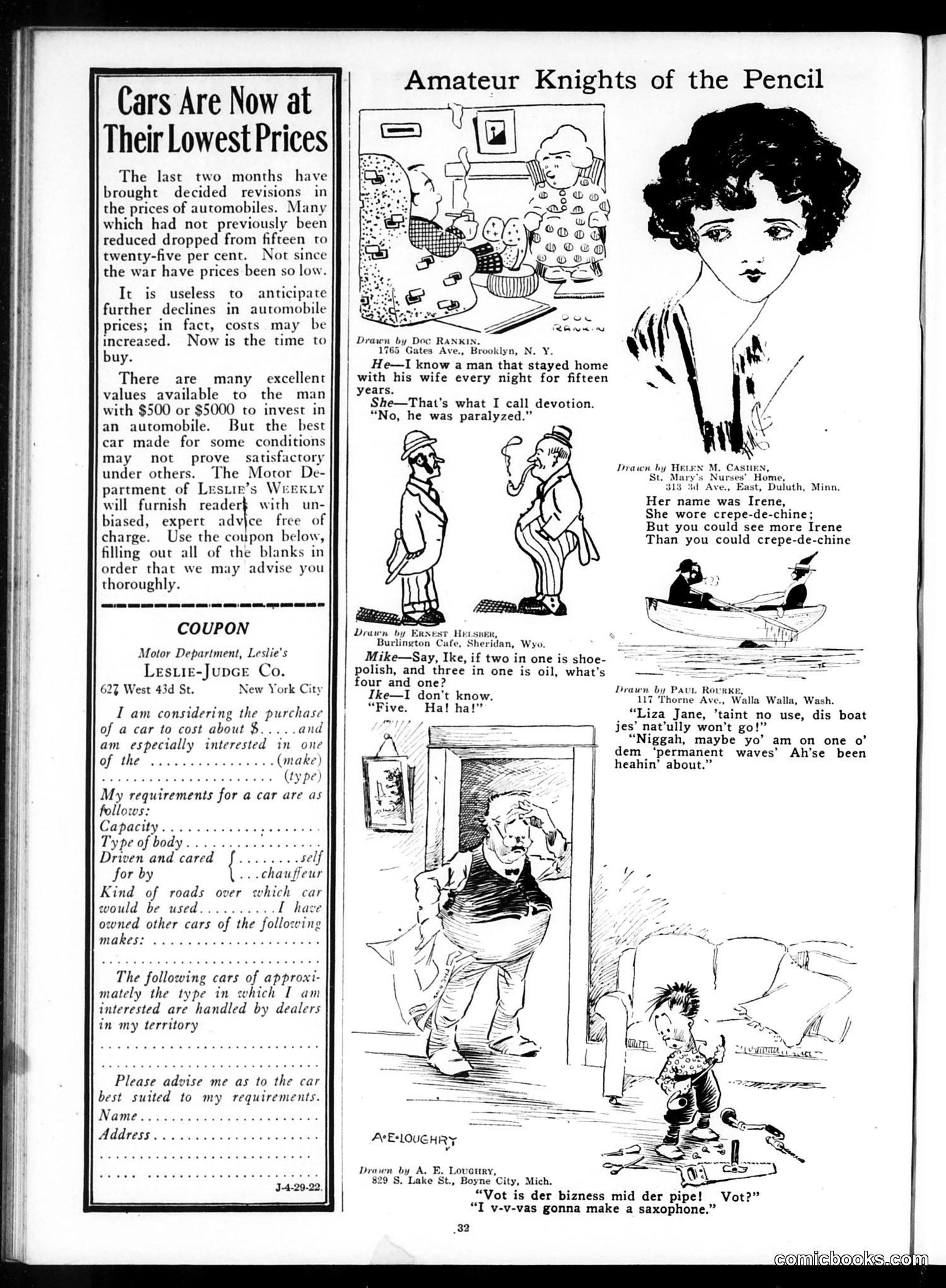
This page combines automotive advertising with humor cartoons typical of 1920s Judge magazine. **Left side:** An advertisement encouraging car purchases while prices are low post-WWI, with a coupon for Leslie's Weekly's Motor Department to provide expert advice. **Right side:** Six separate joke cartoons by different amateur cartoonists: 1. A couple joke about devotion—a man stayed home nightly for 15 years, but he was actually paralyzed, not devoted. 2. A woman in sheer fabric (crepe-de-chine)—the joke being you can see more of her than the actual dress. 3. A riddle about numbers: "two in one" (shoe polish), "three in one" (oil)—answering "four and one" is five. 4. A boating couple where the woman blames the boat; the man suggests she's on "permanent waves" (a 1920s hair-setting trend), making a pun. 5. A child with a pipe explains he's "gonna make a saxophone"—misunderstanding the instrument. The cartoons reflect period humor: mild innuendo, wordplay, and ethnic dialect humor (the boat scene uses racial stereotyping common to the era).
This is a **Leslie's Weekly advertisement**, not a political cartoon. It promotes the magazine's April 29 issue by highlighting its content. The page uses a striking opening: it describes $4.4 billion in imports/exports through New York Harbor as a hypothetical ribbon of dollar bills reaching to the moon and back. This visualizes America's post-WWI commercial expansion. The advertisement emphasizes substantive articles: General George W. Goethals (the Panama Canal engineer) discussing New York's port development; pieces on the Oberammergau Passion Play; exposés on stock fraud; and a new "Radio Department"—reflecting 1920s fascination with emerging technology. The satire is implicit rather than explicit: by opening with absurdist monetary imagery, it gently mocks American commercial boosterism and materialism, then pivots to promoting the magazine as intellectually serious (with financial advice, editorials by Samuel Hopkins Adams). The cost: 10 cents per issue or $5 annually—positioning Leslie's as accessible quality journalism for an ambitious middle-class reader.
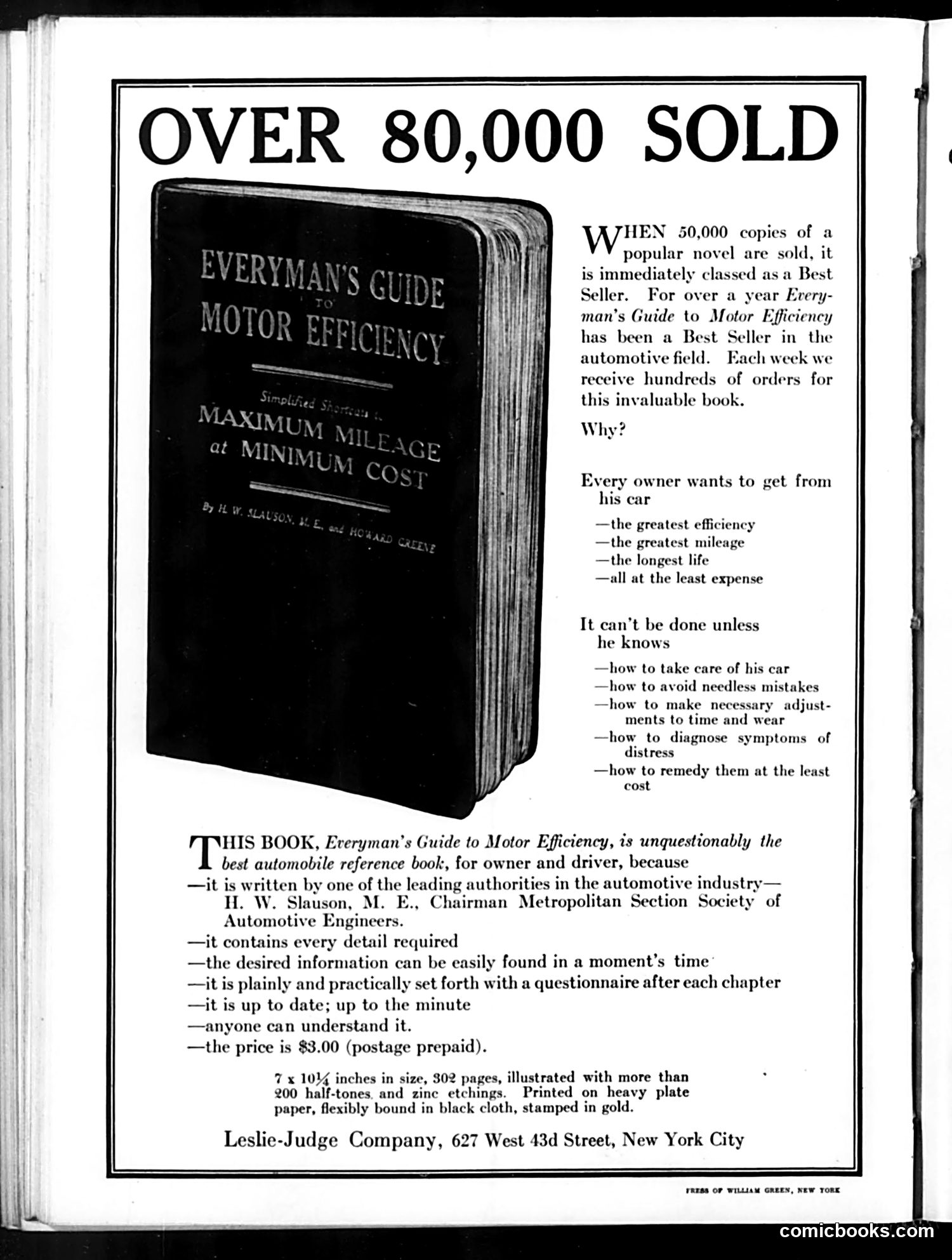
This is **not a cartoon or satirical piece**—it's a straightforward **advertisement** for an automotive reference book titled *Everyman's Guide to Motor Efficiency*. The ad promotes a practical manual for car owners, claiming over 80,000 copies sold. It positions the book as a bestseller by comparing sales figures to popular novels. The pitch targets early automobile owners who need guidance on maintenance, efficiency, and cost-saving—reflecting the early 20th-century moment when car ownership was becoming common but owners lacked technical knowledge. The author, H. W. Slauson, is identified as a legitimate authority (Chairman of the Metropolitan Section Society of Automotive Engineers). The ad emphasizes the book's practical accessibility and affordability ($3.00 postage-paid). This represents Judge magazine's advertising content rather than its satirical editorial material. It reveals contemporary consumer concerns: fuel efficiency, vehicle longevity, and reducing maintenance costs.