
Judge, 1922-04-29 · page 8 of 36
Judge — April 29, 1922 — page 8: what you’re looking at
What you’re looking at
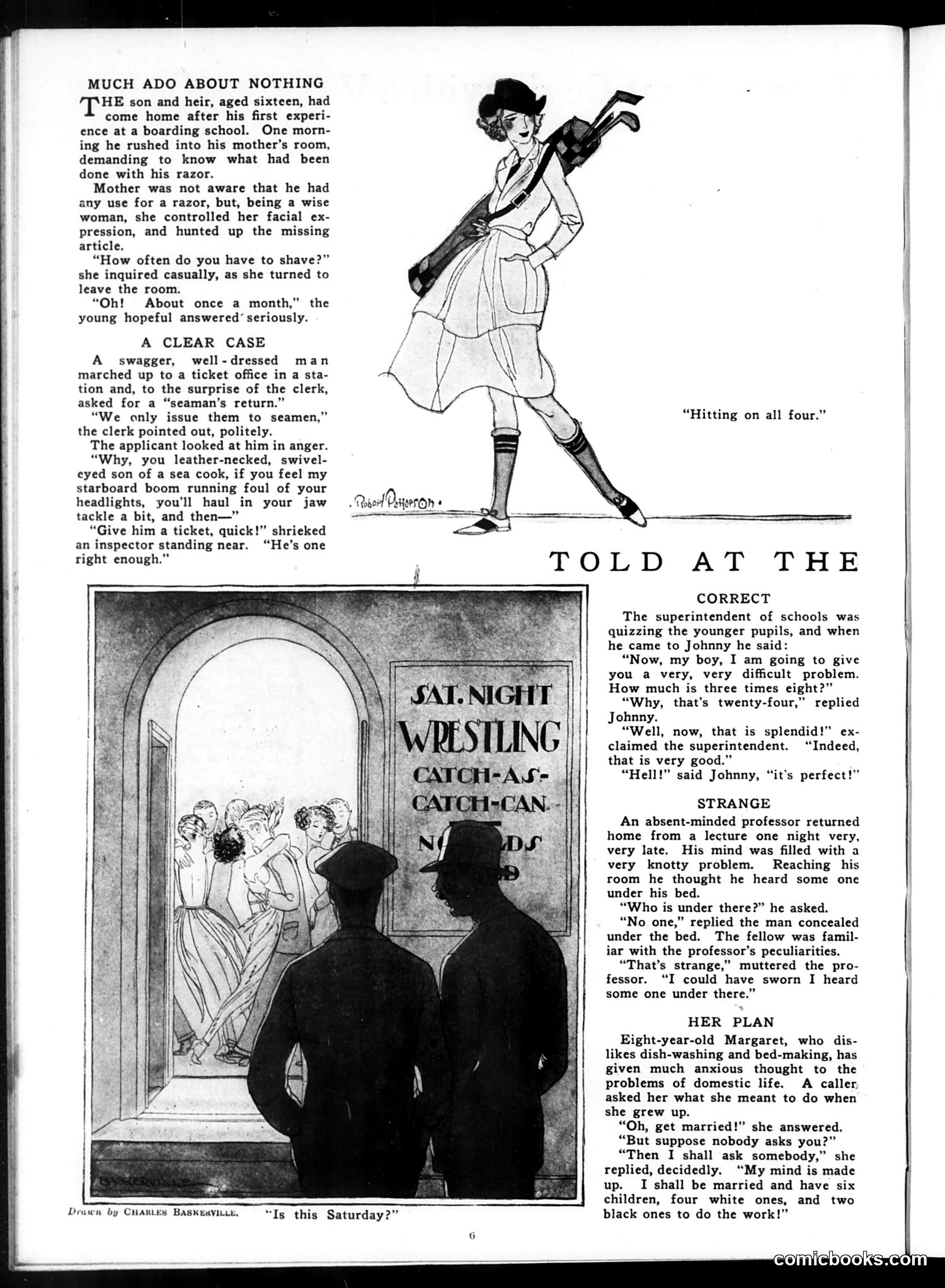
This page contains five brief humorous anecdotes targeting early 20th-century social pretensions and naïveté: **"Much Ado About Nothing"** mocks adolescent affectation—a sixteen-year-old boarding school student demands his razor after shaving only monthly, performing sophistication. **"A Clear Case"** satirizes class assumptions. A well-dressed man uses nautical sailor slang ("starboard boom," "leather-necked") to prove his seafaring credentials to a skeptical ticket clerk. The inspector accepts him as genuine based on this performative language alone—suggesting anyone can fake working-class authenticity through dialect. **"The Correct" and "Strange"** are gentle absurdist humor without clear satirical targets. **"Her Plan"** is darker, reflecting period-acceptable racist attitudes. Eight-year-old Margaret's plan to marry and have children specifically so "two black ones" can do household work presents child exploitation and racial hierarchy as natural domestic solutions—satirizing (or endorsing?) contemporary assumptions about domestic labor and racial roles. The illustration shows theatrical wrestling promoters—likely mocking lowbrow entertainment marketing.
📄 Transcribed text from this page (OCR, searchable)
Machine-transcribed from the original scan — historical spelling and the odd misread are preserved.
MUCH ADO ABOUT NOTHING HE son and heir, aged sixteen, had come home after his first experi- ence at a boarding school. One morn- ing he rushed into his mother’s room, demanding to know what had been done with his razor. Mother was not aware that he had any use for a razor, but, being a wise woman, she controlled her facial ex- pression, and hunted up the missing article. “How often do you have to shave?” she inquired casually, as she turned to leave the room. “Oh! About once a month,” the young hopeful answered’ seriously. A CLEAR CASE A swagger, well-dressed man marched up to a ticket office in a sta- tion and, to the surprise of the clerk, asked for a “seaman’s return.” “We only issue them to seamen,” the clerk pointed out, politely. The applicant looked at him in anger. “Why, you leather-necked, swivel- eyed son of a sea cook, if you feel my starboard boom running foul of your headlights, you'll haul in your jaw tackle a bit, and then—” “Give him a ticket, quick!” shrieked an inspector standing near. “He’s one right enough.” “Hitting on all four.” CORRECT The superintendent of schools was quizzing the younger pupils, and when he came to Johnny he said: “Now, my boy, I am going to give you a very, very difficult problem. How much is three times eight?” “Why, that’s twenty-four,” replied Johnny. “Well, now, that is splendid!” ex- claimed the superintendent. ‘Indeed, that is very good.” “Hell!” said Johnny, “it’s perfect!” STRANGE An absent-minded professor returned home from a lecture one night very, very late. His mind was filled with a very knotty problem. Reaching his room he thought he heard some one under his bed. “Who is under there?” he asked. “No one,” replied the man concealed under the bed. The fellow was famil- iar with the professor’s peculiarities. “That’s strange,” muttered the pro- fessor. “I could have sworn I heard some one under there.” HER PLAN Eight-year-old Margaret, who dis- likes dish-washing and bed-making, has given much anxious thought to the problems of domestic life. A caller asked her what she meant to do when she grew up. “Oh, get married!” she answered. “But suppose nobody asks you?” “Then I shall ask somebody,” she replied, decidedly. “My mind is made up. I shall be married and have six children, four white ones, and two black ones to do the work!”