
Judge, 1922-04-29 · page 16 of 36
Judge — April 29, 1922 — page 16: what you’re looking at
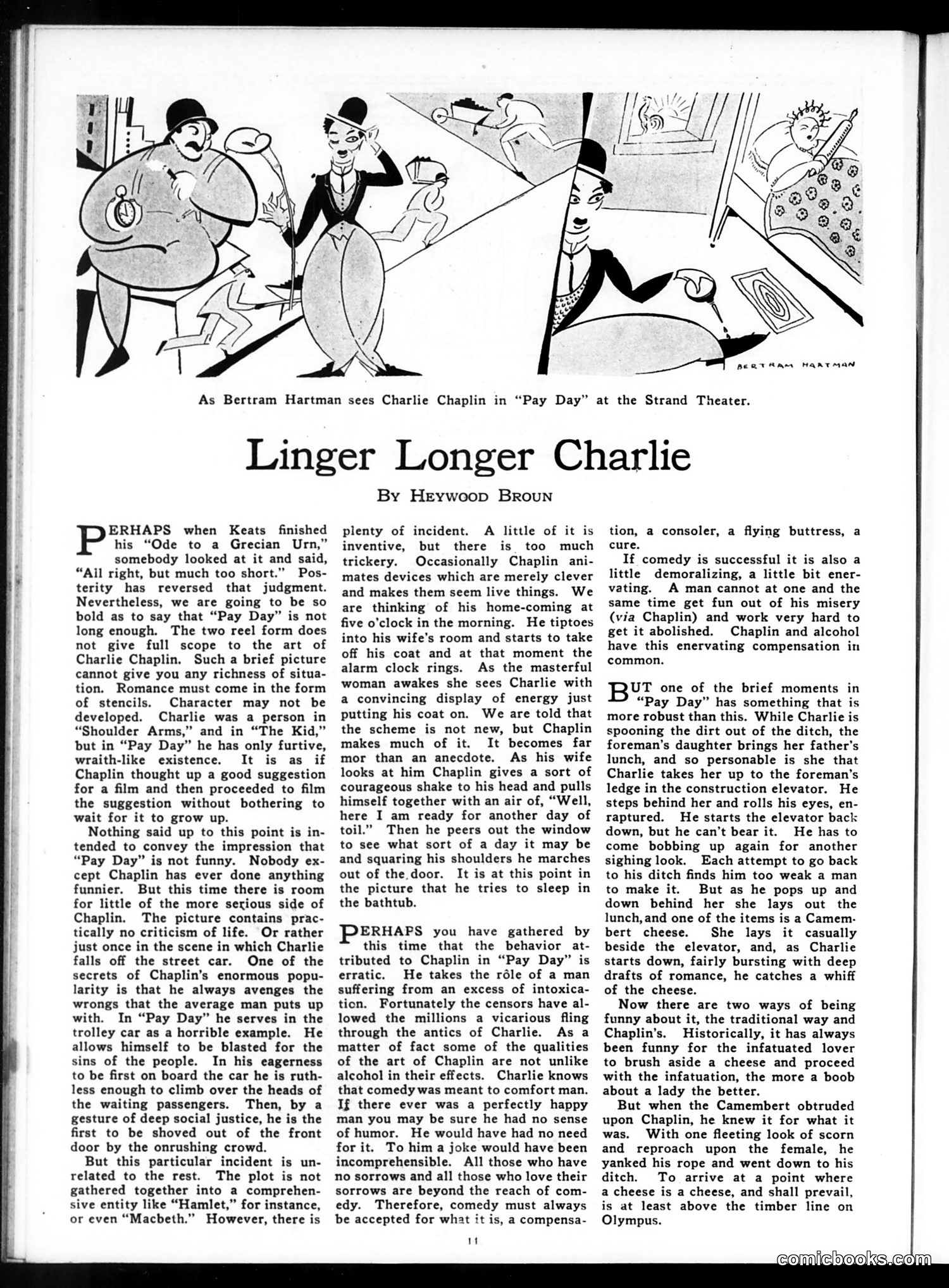
What you’re looking at
This is a film review by Heywood Broun of Charlie Chaplin's 1922 silent comedy "Pay Day," showing at the Strand Theater. The cartoon at top depicts Bertram Hartman's artistic interpretation of scenes from the film. Broun argues that while "Pay Day" is hilarious, it's too *short* (two reels) to fully showcase Chaplin's artistic range. He notes the film lacks the character development and social commentary present in Chaplin's earlier works like "Shoulder Arms" and "The Kid." The review praises one sequence—Chaplin tiptoeing home drunk at dawn, caught by his awakening wife—as genuinely inventive. However, Broun criticizes the overall plot as scattered anecdotes rather than a cohesive narrative. He concludes that comedy serves to comfort people bearing life's sorrows, implying Chaplin's genius extends beyond mere gags when given proper scope. The caricature shows Chaplin's famous "Tramp" character in various comedic poses with other figures, illustrating the film's physical humor.
📄 Transcribed text from this page (OCR, searchable)
Machine-transcribed from the original scan — historical spelling and the odd misread are preserved.
peat ham NaATMAN As Bertram Hartman sees Charlie Chaplin in “Pay Day” at the Strand Theater. Linger Longer Charlie ERHAPS when Keats finished his “Ode to a Grecian Urn,” somebody looked at it and said, “Ail right, but much too short.” Pos- terity has reversed that judgment. Nevertheless, we are going to be so bold as to say that “Pay Day” is not long enough. The two reel form does not give full scope to the art of Charlie Chaplin. Such a brief picture cannot give you any richness of situa- tion. Romance must come in the form of stencils. Character may not be developed. Charlie was a person in “Shoulder Arms,” and in “The Kid,” but in “Pay Day” he has only furtive, wraith-like existence. It is as if Chaplin thought up a good suggestion for a film and then proceeded to film the suggestion without bothering to wait for it to grow up. Nothing said up to this point is in- tended to convey the impression that “Pay Day” is not funny. Nobody ex- cept Chaplin has ever done anything funnier. But this time there is room for little of the more serious side of Chaplin. The picture contains prac- tically no criticism of life. Or rather just once in the scene in which Charlie falls off the street car. One of the secrets of Chaplin’s enormous popu- larity is that he always avenges the wrongs that the average man puts up with. In “Pay Day” he serves in the trolley car as a horrible example. He allows himself to be blasted for the sins of the people. In his eagerness to be first on board the car he is ruth- less enough to climb over the heads of the waiting passengers. Then, by a gesture of deep social justice, he is the first to be shoved out of the front door by the onrushing crowd. But this particular incident is un- related to the rest. The plot is not gathered together into a comprehen- sive entity like “Hamlet,” for instance, or even “Macbeth.” However, there is By Heywoop Broun plenty of incident. A little of it is inventive, but there is too much trickery. Occasionally Chaplin ani- mates devices which are merely clever and makes them seem live things. We are thinking of his home-coming at five o'clock in the morning. He tiptoes into his wife’s room and starts to take off his coat and at that moment the alarm clock rings. As the masterful woman awakes she sees Charlie with a convincing display of energy just putting his coat on. We are told that the scheme is not new, but Chaplin makes much of it. It becomes far mor than an anecdote. As his wife looks at him Chaplin gives a sort of courageous shake to his head and pulls himself together with an air of, “Well, here I am ready for another day of toil.” Then he peers out the window to see what sort of a day it may be and squaring his shoulders he marches out of the. door. It is at this point in the picture that he tries to sleep in the bathtub. PERHAPS you have gathered by this time that the behavior at- tributed to Chaplin in “Pay Day” is erratic. He takes the réle of a man suffering from an excess of intoxica- tion. Fortunately the censors have al- lowed the millions a vicarious fling through the antics of Charlie. As a matter of fact some of the qualities of the art of Chaplin are not unlike alcohol in their effects. Charlie knows that comedy was meant to comfort man. If there ever was a perfectly happy man you may be sure he had no sense of humor. He would have had no need for it. To him a joke would have been incomprehensible. All those who have no sorrows and all those who love their sorrows are beyond the reach of com- edy. Therefore, comedy must always be accepted for what it is, a compensa- " tion, a consoler, a flying buttress, a cure. If comedy is successful it is also a little demoralizing, a little bit ener- vating. A man cannot at one and the same time get fun out of his misery (via Chaplin) and work very hard to get it abolished. Chaplin and alcohol have this enervating compensation in common. UT one of the brief moments in “Pay Day” has something that is more robust than this. While Charlie is spooning the dirt out of the ditch, the foreman’s daughter brings her father’s lunch, and so personable is she that Charlie takes her up to the foreman’s ledge in the construction elevator. He steps behind her and rolls his eyes, en- raptured. He starts the elevator back down, but he can’t bear it. He has to come bobbing up again for another sighing look. Each attempt to go back to his ditch finds him too weak a man to make it. But as he pops up and down behind her she lays out the lunch, and one of the items is a Camem- bert cheese. She lays it casually beside the elevator, and, as Charlie starts down, fairly bursting with deep drafts of romance, he catches a whiff of the cheese. Now there are two ways of being funny about it, the traditional way and Chaplin’s. Historically, it has always been funny for the infatuated lover to brush aside a cheese and proceed with the infatuation, the more a boob about a lady the better. But when the Camembert obtruded upon Chaplin, he knew it for what it was. With one fleeting look of scorn and reproach upon the female, he yanked his rope and went down to his ditch. To arrive at a point where a cheese is a cheese, and shall prevail, is at least above the timber line on Olympus.