
Judge, 1922-04-29 · page 4 of 36
Judge — April 29, 1922 — page 4: what you’re looking at
What you’re looking at
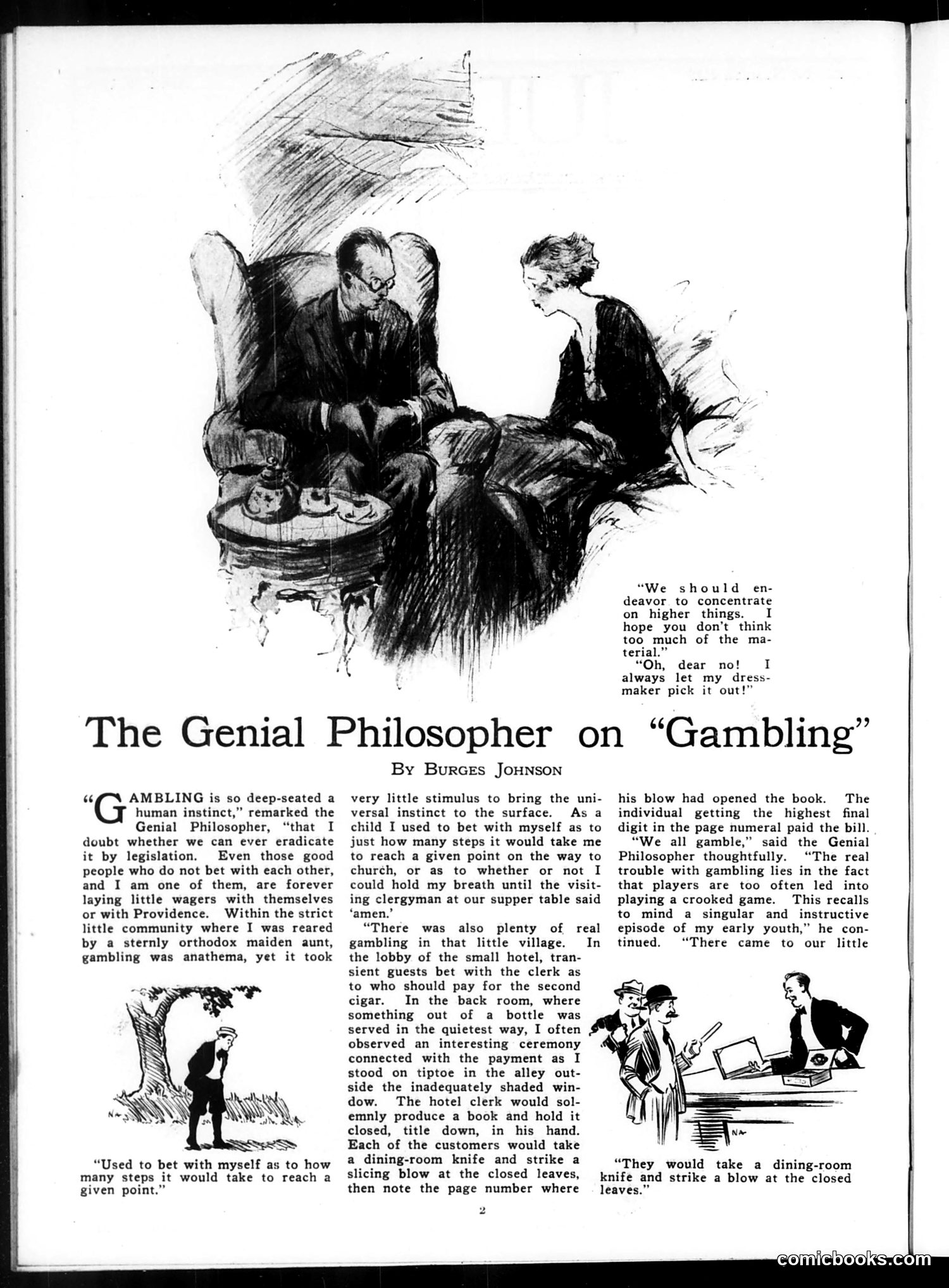
This satirical piece critiques gambling as a deeply rooted human vice that's nearly impossible to eliminate through legislation alone. The philosopher argues that gambling flourishes everywhere—from high society to working-class communities—appearing in various forms across social classes. The cartoon illustrates his point with anecdotes about rural gambling customs, including a small-town hotel where guests wagered over who'd pay for sugar, settling disputes by striking a closed ledger with a dining knife. The accompanying sketches show gambling occurring casually in everyday settings. The satire's message: attempting to ban gambling is futile because it's so ingrained in human nature that people will gamble regardless of legal prohibitions. The piece suggests that moral reform through legislation cannot overcome fundamental human impulses.
📄 Transcribed text from this page (OCR, searchable)
Machine-transcribed from the original scan — historical spelling and the odd misread are preserved.
The Genial Philosopher By Burces JOHNSON human instinct,” remarked the Genial Philosopher, “that I doubt whether we can ever eradicate it by legislation. Even those good people who do not bet with each other, and I am one of them, are forever laying little wagers with themselves or with Providence. Within the strict little community where I was reared by a sternly orthodox maiden aunt, gambling was anathema, yet it took “Gee is so deep-seated a “Used to bet with myself as to how many steps it would take to reach a given point.” very little stimulus to bring the uni- versal instinct to the surface. child I used to bet with myself as to just how many steps it would take me to reach a given point on the way to church, or as to whether or not I could hold my breath until the visit- ing clergyman at our supper table said ‘amen.’ “There was also plenty of real gambling in that little village. In the lobby of the small hotel, tran- sient guests bet with the clerk as to who should pay for the second cigar. In the back room, where something out of a bottle was served in the quietest way, I often observed an interesting ceremony connected with the payment as I stood on tiptoe in the alley out- side the inadequately shaded win- dow. The hotel clerk would sol- emnly produce a book and hold it closed, title down, in his hand. Each of the customers would take a dining-room knife and strike a slicing blow at the closed leaves, then note the page number where “We should en- deavor to concentrate on higher things. hope you don’t think too much of the ma- terial.” “Oh, dear no! I always let my dress- maker pick it out!” on “Gambling” his blow had opened the book. The As a_ individual getting the highest final digit in the page numeral paid the bill. “We all gamble,” said the Genial Philosopher thoughtfully. “The real trouble with gambling lies in the fact that players are too often led into playing a crooked game. This recalls to mind a singular and instructive episode of my early youth,” he con- tinued. “There came to our little “They would take a dining-room knife and strike a blow at the closed leaves.”