
Judge, 1922-04-29 · page 22 of 36
Judge — April 29, 1922 — page 22: what you’re looking at
What you’re looking at
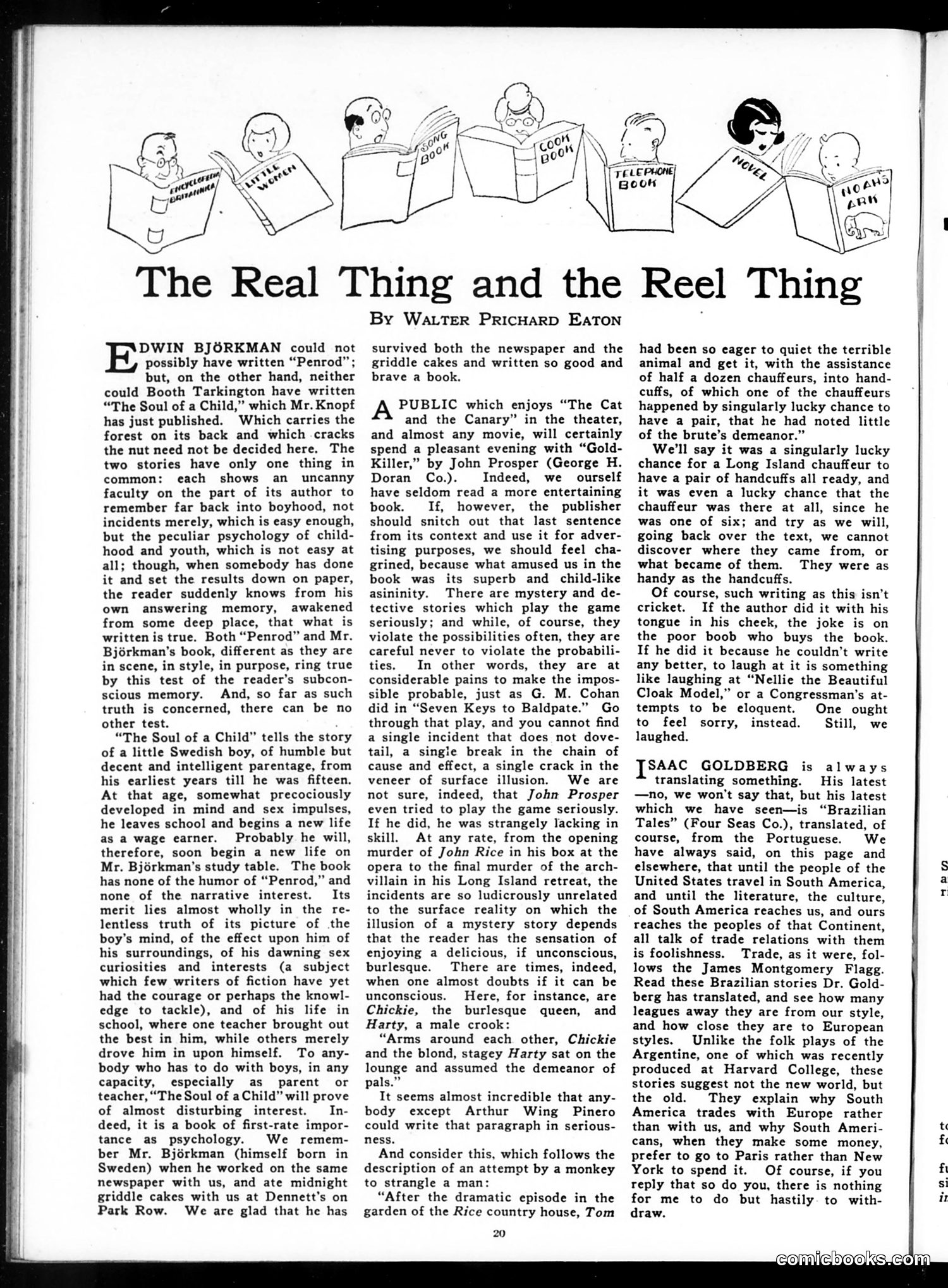
This is a literary criticism article by Walter Prichard Eaton reviewing three books. The cartoon header shows figures reading different books, contrasting "real" literature with entertainment. The article compares two novels about boyhood: Edwin Björkman's "The Soul of a Child" and Booth Tarkington's "Penrod." Eaton praises both for authentically capturing childhood psychology, though they differ in tone and approach. He then reviews "Gold-Killer" by John Prosper, criticizing its absurd plot logic while acknowledging its entertainment value. Eaton contrasts it with G.M. Cohan's play "Seven Keys to Baldpate," which maintains internal consistency despite its theatrical contrivances. The satire suggests tension between "serious" literature's psychological truth and popular entertainment's escapist pleasure—a recurring Judge magazine concern about mass culture versus literary merit. The author's personal connection to Björkman (both worked at the same newspaper) adds editorial warmth to the recommendation.
📄 Transcribed text from this page (OCR, searchable)
Machine-transcribed from the original scan — historical spelling and the odd misread are preserved.
ns i ] The Real Thing and the DWIN BJORKMAN could not possibly have written “Penrod”; but, on the other hand, neither could Booth Tarkington have written “The Soul of a Child,” which Mr. Knopf has just published. Which carries the forest on its back and which cracks the nut need not be decided here. The two stories have only one thing in common: each shows an uncanny faculty on the part of its author to remember far back into boyhood, not incidents merely, which is easy enough, but the peculiar psychology of child- hood and youth, which is not easy at all; though, when somebody has done it and set the results down on paper, the reader suddenly knows from his own answering memory, awakened from some deep place, that what is written is true. Both “Penrod” and Mr. Bjérkman’s book, different as they are in scene, in style, in purpose, ring true by this test of the reader’s subcon- scious memory. And, so far as such truth is concerned, there can be no other test. “The Soul of a Child” tells the story of a little Swedish boy, of humble but decent and intelligent parentage, from his earliest years till he was fifteen. At that age, somewhat precociously developed in mind and sex impulses, he leaves school and begins a new life as a wage earner. Probably he will, therefore, soon begin a new life on Mr. Bjérkman’s study table. The book has none of the humor of “Penrod,” and none of the narrative interest. Its merit lies almost wholly in the re- lentless truth of its picture of the boy’s mind, of the effect upon him of his surroundings, of his dawning sex curiosities and interests (a subject which few writers of fiction have yet had the courage or perhaps the knowl- edge to tackle), and of his life in school, where one teacher brought out the best in him, while others merely drove him in upon himself. To any- body who has to do with boys, in any capacity, especially as parent or teacher, “The Soul of aChild” will prove of almost disturbing interest. In- deed, it is a book of first-rate impor- tance as psychology. We remem- ber Mr. Bjérkman (himself born in Sweden) when he worked on the same newspaper with us, and ate midnight griddle cakes with us at Dennett's on Park Row. We are glad that he has By WaLTER PRICHARD EaTON survived both the newspaper and the griddle cakes and written so good and brave a book. A PUBLIC which enjoys “The Cat and the Canary” in the theater, and almost any movie, will certainly spend a pleasant evening with “Gold- Killer,” by John Prosper (George H. Doran Co.). Indeed, we ourself have seldom read a more entertaining book. If, however, the publisher should snitch out that last sentence from its context and use it for adver- tising purposes, we should feel cha- grined, because what amused us in the book was its superb and child-like asininity. There are mystery and de- tective stories which play the game seriously; and while, of course, they violate the possibilities often, they are careful never to violate the probabili- ties. In other words, they are at considerable pains to make the impos- sible probable, just as G. M. Cohan did in “Seven Keys to Baldpate.” Go through that play, and you cannot find a single incident that does not dove- tail, a single break in the chain of cause and effect, a single crack in the veneer of surface illusion. We are not sure, indeed, that John Prosper even tried to play the game seriously. If he did, he was strangely lacking in skill. At any rate, from the opening murder of John Rice in his box at the opera to the final murder of the arch- villain in his Long Island retreat, the incidents are so ludicrously unrelated to the surface reality on which the illusion of a mystery story depends that the reader has the sensation of enjoying a delicious, if unconscious, burlesque. There are times, indeed, when one almost doubts if it can be unconscious. Here, for instance, are Chickie, the burlesque queen, and Harty, a male crook: “Arms around each other, Chickie and the blond, stagey Harty sat on the lounge and assumed the demeanor of pals.” It seems almost incredible that any- body except Arthur Wing Pinero could write that paragraph in serious- ness. And consider this, which follows the description of an attempt by a monkey to strangle a man: “After the dramatic episode in the garden of the Rice country house, Tom 20 Reel Thing had been so eager to quiet the terrible animal and get it, with the assistance of half a dozen chauffeurs, into hand- cuffs, of which one of the chauffeurs happened by singularly lucky chance to have a pair, that he had noted little of the brute’s demeanor.” We'll say it was a singularly lucky chance for a Long Island chauffeur to have a pair of handcuffs all ready, and it was even a lucky chance that the chauffeur was there at all, since he was one of six; and try as we will, going back over the text, we cannot discover where they came from, or what became of them. They were as handy as the handcuffs. Of course, such writing as this isn’t cricket. If the author did it with his tongue in his cheek, the joke is on the poor boob who buys the book. If he did it because he couldn’t write any better, to laugh at it is something like laughing at “Nellie the Beautiful Cloak Model,” or a Congressman'’s at- tempts to be eloquent. One ought to feel sorry, instead. Still, we laughed. jpsaac GOLDBERG is always translating something. His latest —no, we won't say that, but his latest which we have seen—is “Brazilian Tales” (Four Seas Co.), translated, of course, from the Portuguese. We have always said, on this page and elsewhere, that until the people of the United States travel in South America, and until the literature, the culture, of South America reaches us, and ours reaches the peoples of that Continent, all talk of trade relations with them is foolishness. Trade, as it were, fol- lows the James Montgomery Flagg. Read these Brazilian stories Dr. Gold- berg has translated, and see how many leagues away they are from our style, and how close they are to European styles. Unlike the folk plays of the Argentine, one of which was recently produced at Harvard College, these stories suggest not the new world, but the old. They explain why South America trades with Europe rather than with us, and why South Ameri- cans, when they make some money, prefer to go to Paris rather than New York to spend it. Of course, if you reply that so do you, there is nothing for me to do but hastily to with- draw. COMMeHOOKSSeon 4m