
Judge, 1922-04-29 · page 21 of 36
Judge — April 29, 1922 — page 21: what you’re looking at
What you’re looking at
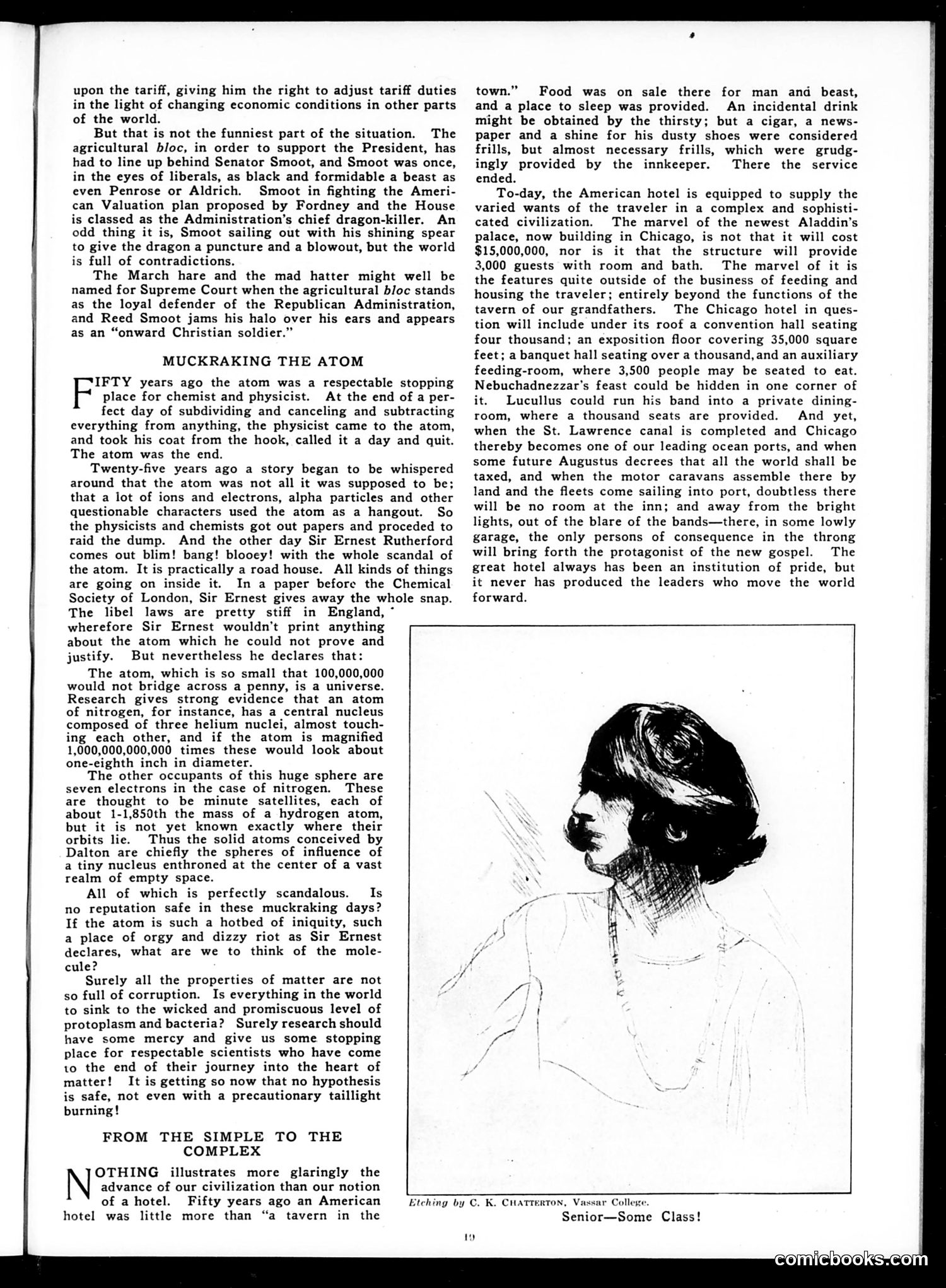
This page contains two distinct articles with different satirical targets: **"Muckraking the Atom"** mocks recent scientific revelations about atomic structure. The piece sarcastically critiques Sir Ernest Rutherford's 1911 discovery that atoms contain electrons and other particles—previously thought to be indivisible. The joke is that physicists treated the atom like a respectable endpoint for research, only to discover it's actually a chaotic "road house" full of questionable characters. The satire also pokes fun at English libel laws, suggesting Rutherford could face legal trouble for revealing such scandalous atomic "gossip." The upper section discusses tariff politics, sarcastically noting that Senator Reed Smoot—once viewed by liberals as a reactionary villain—now appears heroic to the agricultural bloc supporting the President. The "March hare and mad hatter" reference suggests this political realignment is absurd and contradictory. **The sketch** (credited to C.K. Chatterton) shows a woman's portrait; its connection to page content is unclear.
📄 Transcribed text from this page (OCR, searchable)
Machine-transcribed from the original scan — historical spelling and the odd misread are preserved.
upon the tariff, giving him the right to adjust tariff duties in the light of changing economic conditions in other parts of the world. But that is not the funniest part of the situation. The agricultural bloc, in order to support the President, has had to line up behind Senator Smoot, and Smoot was once, in the eyes of liberals, as black and formidable a beast as even Penrose or Aldrich. Smoot in fighting the Ameri- can Valuation plan proposed by Fordney and the House is classed as the Administration’s chief dragon-killer. An odd thing it is, Smoot sailing out with his shining spear to give the dragon a puncture and a blowout, but the world is full of contradictions. The March hare and the mad hatter might well be named for Supreme Court when the agricultural bloc stands as the loyal defender of the Republican Administration, and Reed Smoot jams his halo over his ears and appears as an “onward Christian soldier.” MUCKRAKING THE ATOM IFTY years ago the atom was a respectable stopping place for chemist and physicist. At the end of a per- fect day of subdividing and canceling and subtracting everything from anything, the physicist came to the atom, and took his coat from the hook, called it a day and quit. The atom was the end. Twenty-five years ago a story began to be whispered around that the atom was not all it was supposed to be; that a lot of ions and electrons, alpha particles and other questionable characters used the atom as a hangout. So the physicists and chemists got out papers and proceded to raid the dump. And the other day Sir Ernest Rutherford comes out blim! bang! blooey! with the whole scandal of the atom. It is practically a road house. All kinds of things are going on inside it. In a paper before the Chemical Society of London, Sir Ernest gives away the whole snap. The libel laws are pretty stiff in England, * town.” Food was on sale there for man and beast, and a place to sleep was provided. An incidental drink might be obtained by the thirsty; but a cigar, a news- paper and a shine for his dusty shoes were considered frills, but almost necessary frills, which were grudg- ingly provided by the innkeeper. There the service ended. To-day, the American hotel is equipped to supply the varied wants of the traveler in a complex and sophisti- cated civilization. The marvel of the newest Aladdin’s palace, now building in Chicago, is not that it will cost $15,000,000, nor is it that the structure will provide 3,000 guests with room and bath. The marvel of it is the features quite outside of the business of feeding and housing the traveler; entirely beyond the functions of the tavern of our grandfathers. The Chicago hotel in ques- tion will include under its roof a convention hall seating four thousand; an exposition floor covering 35,000 square feet; a banquet hall seating over a thousand, and an auxiliary feeding-room, where 3,500 people may be seated to eat. Nebuchadnezzar's feast could be hidden in one corner of it. Lucullus could run his band into a private dining- room, where a thousand seats are provided. And yet, when the St. Lawrence canal is completed and Chicago thereby becomes one of our leading ocean ports, and when some future Augustus decrees that all the world shall be taxed, and when the motor caravans assemble there by land and the fleets come sailing into port, doubtless there will be no room at the inn; and away from the bright lights, out of the blare of the bands—there, in some lowly garage, the only persons of consequence in the throng will bring forth the protagonist of the new gospel. The great hotel always has been an institution of pride, but it never has produced the leaders who move the world forward. wherefore Sir Ernest wouldn't print anything about the atom which he could not prove and justify. But nevertheless he declares that: The atom, which is so small that 100,000,000 would not bridge across a penny, is a universe. Research gives strong evidence that an atom of nitrogen, for instance, has a central nucleus composed of three helium nuclei, almost touch- ing each other, and if the atom is magnified 1,000,000,000,000 times these would look about one-eighth inch in diameter. The other occupants of this huge sphere are seven electrons in the case of nitrogen. These are thought to be minute satellites, each of about 1-1,850th the mass of a hydrogen atom, but it is not yet known exactly where their orbits lie. Thus the solid atoms conceived by Dalton are chiefly the spheres of influence of a tiny nucleus enthroned at the center of a vast realm of empty space. All of which is perfectly scandalous. Is no reputation safe in these muckraking days? If the atom is such a hotbed of iniquity, such a place of orgy and dizzy riot as Sir Ernest declares, what are we to think of the mole- cule? Surely all the properties of matter are not so full of corruption. Is everything in the world to sink to the wicked and promiscuous level of protoplasm and bacteria? Surely research should have some mercy and give us some stopping place for respectable scientists who have come 1o the end of their journey into the heart of matter! It is getting so now that no hypothesis is safe, not even with a precautionary taillight burning! FROM THE SIMPLE TO THE COMPLEX OTHING illustrates more glaringly the advance of our civilization than our notion of ahotel. Fifty years ago an American hotel was little more than “a tavern in the Etching by C. K. CHATTERTON, Vassar College. Senior—Some Class! 1