
Judge, 1922-04-29 · page 10 of 36
Judge — April 29, 1922 — page 10: what you’re looking at
What you’re looking at
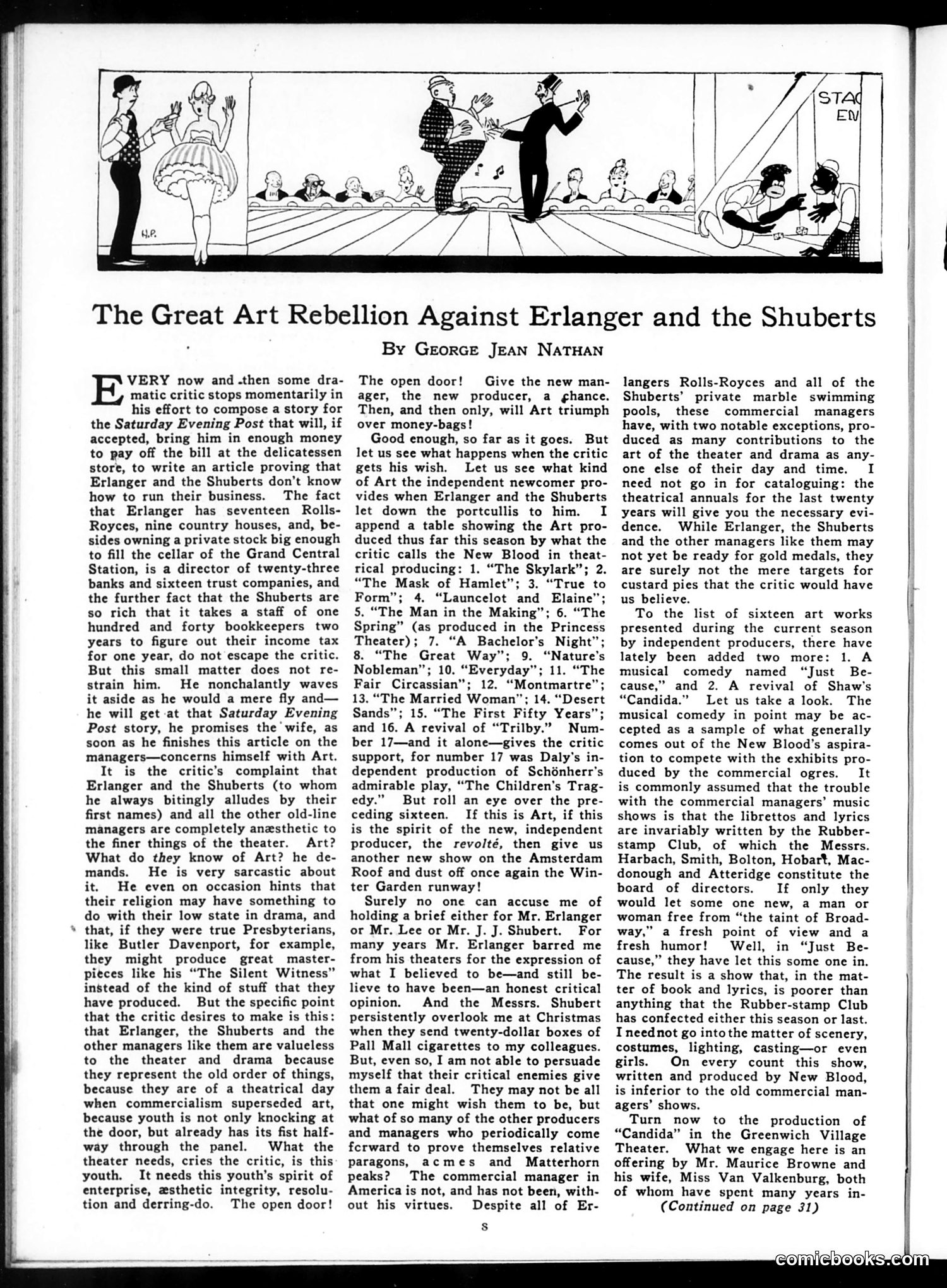
This article by George Jean Nathan sarcastically defends theater managers Erlanger and the Shuberts against critics who claim they lack artistic merit and should yield to younger, "independent" producers with fresh vision. Nathan's argument: Yes, Erlanger and Shuberts are wealthy commercial operators—but critics complaining about this are hypocrites. These critics write for magazines to pay bills, yet lecture about Art. More importantly, Nathan demonstrates that the "new blood" independent producers have actually created mediocre theatrical productions (he lists 16 recent shows, only praising one). The cartoon at top shows theatrical performers on stage before an audience, illustrating the conflict between commercial entertainment and artistic integrity. Nathan's point: The established managers' "crime" is being commercially successful. The young rebels the critics champion produce equally unimpressive work—so their moral superiority about Art is baseless. The establishment's real sin in critics' eyes is merely being old and rich, not actually lacking taste.
📄 Transcribed text from this page (OCR, searchable)
Machine-transcribed from the original scan — historical spelling and the odd misread are preserved.
VERY now and .then some dra- matic critic stops momentarily in his effort to compose a story for the Saturday Evening Post that will, if accepted, bring him in enough money to pay off the bill at the delicatessen store, to write an article proving that Erlanger and the Shuberts don’t know how to run their business. The fact that Erlanger has seventeen Rolls- Royces, nine country houses, and, be- sides owning a private stock big enough to fill the cellar of the Grand Central Station, is a director of twenty-three banks and sixteen trust companies, and the further fact that the Shuberts are so rich that it takes a staff of one hundred and forty bookkeepers two years to figure out their income tax for one year, do not escape the critic. But this small matter does not re- strain him. He nonchalantly waves it aside as he would a mere fly and— he will get at that Saturday Evening Post story, he promises the wife, as soon as he finishes this article on the managers—concerns himself with Art. It is the critic’s complaint that Erlanger and the Shuberts (to whom he always bitingly alludes by their first names) and all the other old-line managers are completely anesthetic to the finer things of the theater. Art? What do they know of Art? he de- mands. He is very sarcastic about it. He even on occasion hints that their religion may have something to do with their low state in drama, and that, if they were true Presbyterians, like Butler Davenport, for example, they might produce great master- pieces like his “The Silent Witness” instead of the kind of stuff that they have produced. But the specific point that the critic desires to make is this: that Erlanger, the Shuberts and the other managers like them are valueless to the theater and drama because they represent the old order of things, because they are of a theatrical day when commercialism superseded art, because youth is not only knocking at the door, but already has its fist half- way through the panel. What the theater needs, cries the critic, is this youth. It needs this youth’s spirit of enterprise, esthetic integrity, resolu- tion and derring-do. The open door! By Georce Jean NATHAN The open door! Give the new man- ager, the new producer, a ghance. Then, and then only, will Art triumph over money-bags! Good enough, so far as it goes. But let us see what happens when the critic gets his wish. Let us see what kind of Art the independent newcomer pro- vides when Erlanger and the Shuberts let down the portcullis to him. I append a table showing the Art pro- duced thus far this season by what the critic calls the New Blood in theat- tical producing: 1. “The Skylark”; 2. “The Mask of Hamlet”; 3. “True to Form”; 4. “Launcelot and Elaine”; 5. “The Man in the Making”; 6. “The Spring” (as produced in the Princess Theater); 7. “A Bachelor's Night”; 8. “The Great Way”; 9. “Nature's Nobleman”; 10. “Everyday”; 11. “The Fair Circassian”; 12. “Montmartre”; 13, “The Married Woman”; 14. “Desert Sands”; 15. “The First Fifty Years”; and 16. A revival of “Trilby.” Num- ber 17—and it alone—gives the critic support, for number 17 was Daly's in- dependent production of Schénherr's admirable play, “The Children's Trag- edy.” But roll an eye over the pre- ceding sixteen. If this is Art, if this is the spirit of the new, independent producer, the revo/té, then give us another new show on the Amsterdam Roof and dust off once again the Win- ter Garden runway! Surely no one can accuse me of holding a brief either for Mr. Erlanger or Mr. Lee or Mr. J. J. Shubert. For many years Mr. Erlanger barred me from his theaters for the expression of what I believed to be—and still be- lieve to have been—an honest critical opinion. And the Messrs. Shubert persistently overlook me at Christmas when they send twenty-dollar boxes of Pall Mall cigarettes to my colleagues. But, even so, I am not able to persuade myself that their critical enemies give them a fair deal. They may not be all that one might wish them to be, but what of so many of the other producers and managers who periodically come ferward to prove themselves relative paragons, acmes and Matterhorn peaks? The commercial manager in America is not, and has not been, with- out his virtues. Despite all of Er- The Great Art Rebellion Against Erlanger and the Shuberts langers Rolls-Royces and all of the Shuberts’ private marble swimming pools, these commercial managers have, with two notable exceptions, pro- duced as many contributions to the art of the theater and drama as any- one else of their day and time. I need not go in for cataloguing: the theatrical annuals for the last twenty years will give you the necessary evi- dence. While Erlanger, the Shuberts and the other managers like them may not yet be ready for gold medals, they are surely not the mere targets for custard pies that the critic would have us believe. To the list of sixteen art works presented during the current season by independent producers, there have lately been added two more: 1. A musical comedy named “Just Be- cause,” and 2. A revival of Shaw's “Candida.” Let us take a look. The musical comedy in point may be ac- cepted as a sample of what generally comes out of the New Blood’s aspira- tion to compete with the exhibits pro- duced by the commercial ogres. It is commonly assumed that the trouble with the commercial managers’ music shows is that the librettos and lyrics are invariably written by the Rubber- stamp Club, of which the Messrs. Harbach, Smith, Bolton, Hobart, Mac- donough and Atteridge constitute the board of directors. If only they would let some one new, a man or woman free from “the taint of Broad- way,” a fresh point of view and a fresh humor! Well, in “Just Be- cause,” they have let this some one in. The result is a show that, in the mat- ter of book and lyrics, is poorer than anything that the Rubber-stamp Club has confected either this season or last. I neednot go into the matter of scenery, costumes, lighting, casting—or even girls. On every count this show, written and produced by New Blood, is inferior to the old commercial man- agers’ shows. Turn now to the production of “Candida” in the Greenwich Village Theater. What we engage here is an offering by Mr. Maurice Browne and his wife, Miss Van Valkenburg, both of whom have spent many years in- (Continued on page 31)