
A complete issue · 36 pages · 1922
Judge — April 15, 1922
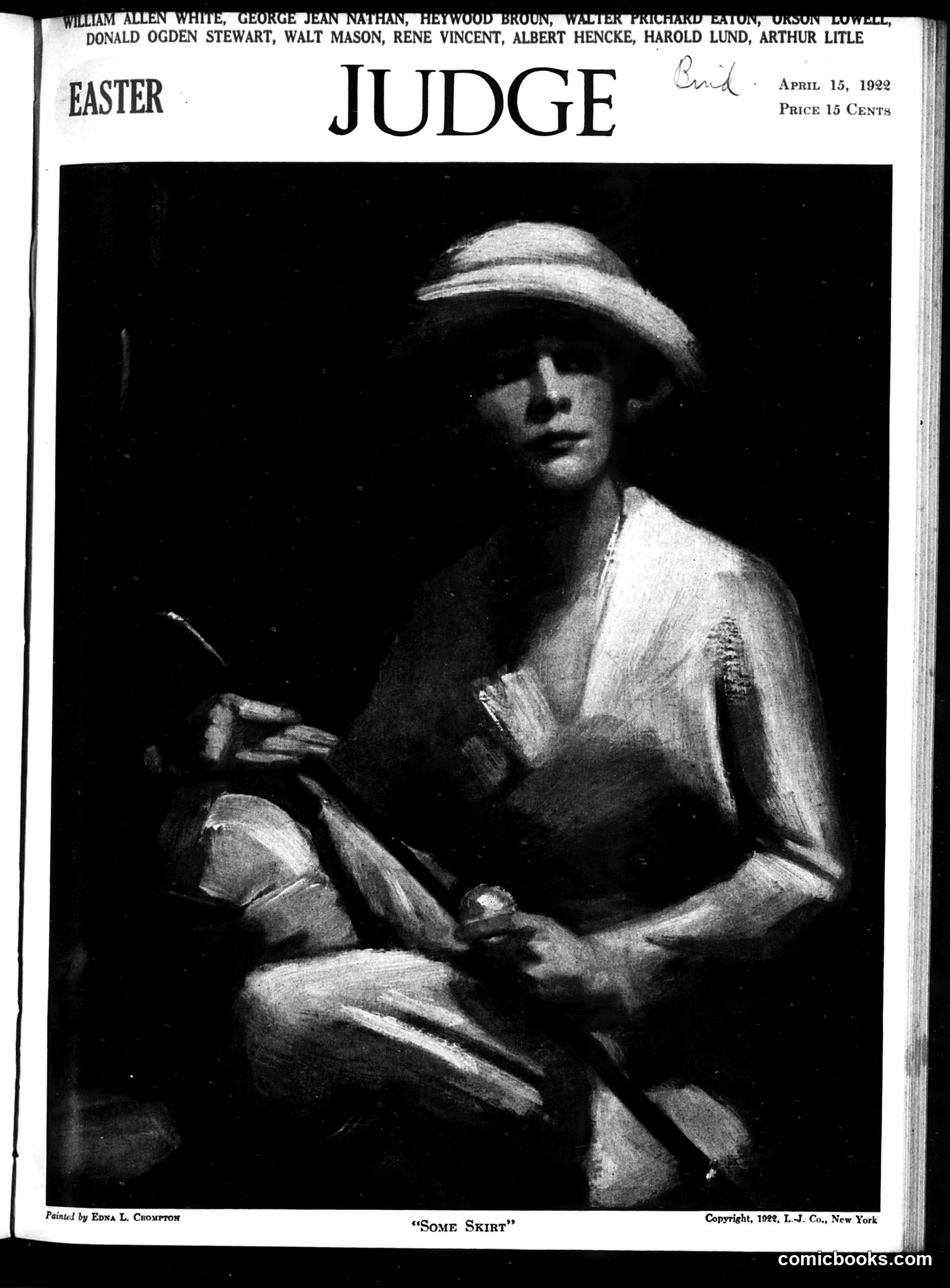
This is primarily a **portrait illustration** rather than a political cartoon. The image shows a woman in 1920s attire (loose dress, cloche hat) holding what appears to be a cigarette or similar object, titled **"Some Skirt."** The phrase "some skirt" was 1920s slang for an attractive young woman. This appears to be satirizing the **"New Woman" of the Jazz Age**—the flapper figure challenging Victorian social norms through smoking, drinking, and looser clothing and behavior. The artwork is credited to **Edna L. Crompton** (visible at bottom). Judge magazine, published April 15, 1922, used such imagery to comment on rapid social changes during the Prohibition and Jazz Age era, when traditional gender roles and propriety were being openly questioned by younger generations.
This page is primarily **advertising copy**, not satirical content. It promotes Leslie's Weekly magazine's April 15 issue, highlighting their "What Do You Think of Prohibition?" questionnaire that solicited public opinion on National Prohibition (the 18th Amendment, in effect 1920-1933). The text notes that Samuel Hopkins Adams, a respected observer of American life, analyzed these responses in an article for that issue. Other features mentioned include Theodore Waters' "Brokers and Breakers" series and a new "Radio Department" conducted by William H. Easton, Ph.D. The copy emphasizes Leslie's Weekly as a serious publication covering contemporary debates and modern topics, advertising single copies at 10 cents or yearly subscriptions at five dollars.
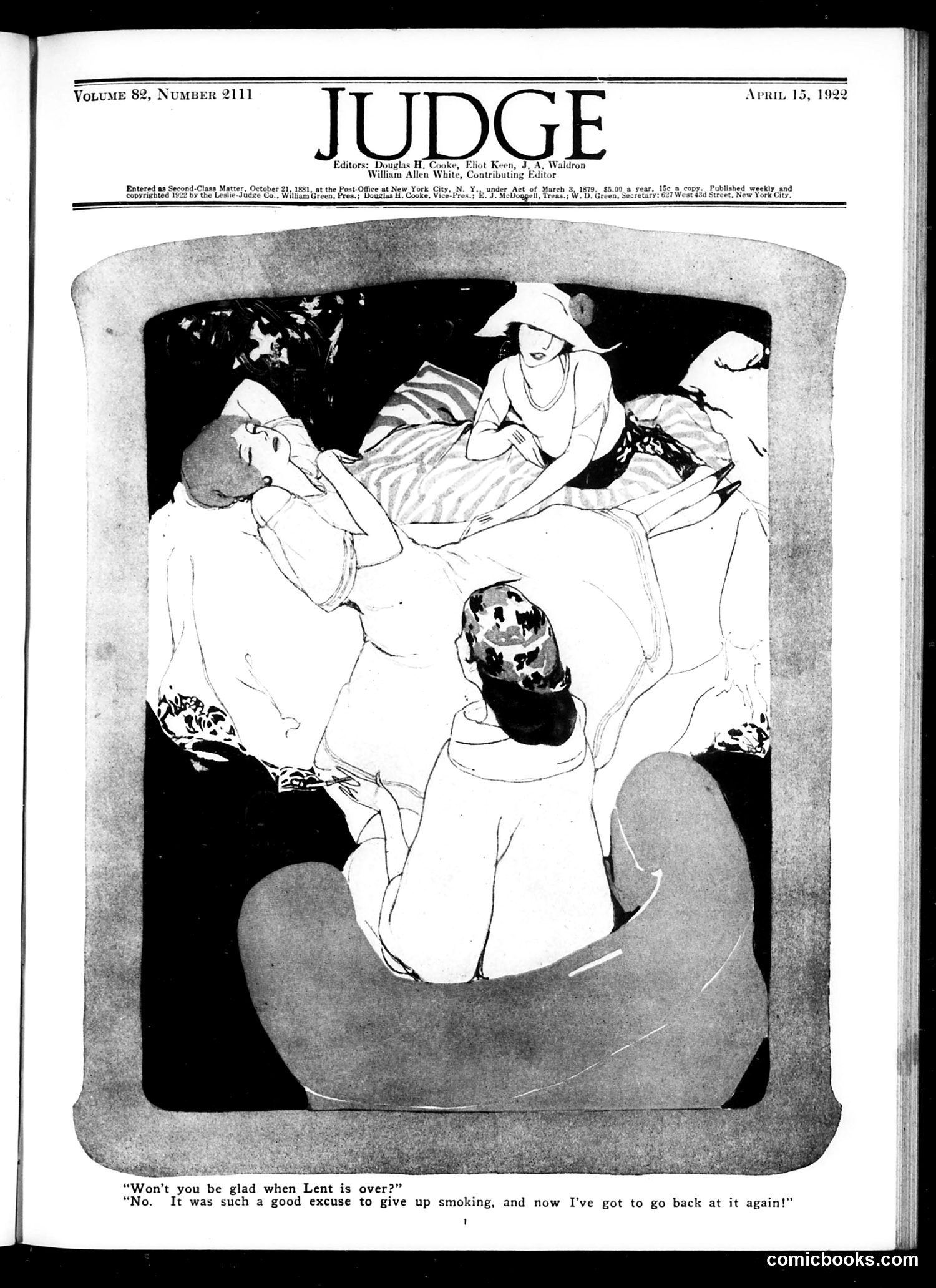
This cartoon satirizes the Catholic practice of Lenten sacrifice. The caption shows a woman telling her husband she's relieved Lent is ending—not for spiritual reasons, but because she used it as an excuse to quit smoking and now must resume the habit. The humor targets the perceived hypocrisy of using religious observance as convenient personal justification. Rather than depicting genuine spiritual commitment, the woman treats Lenten self-denial as a temporary, externally-imposed obligation she's eager to abandon. The illustration shows a bedroom scene with women in 1920s dress, emphasizing the domestic context of this social commentary. The satire reflects early 20th-century American skepticism toward religious practice, suggesting people exploited religious frameworks for personal convenience rather than genuine piety.
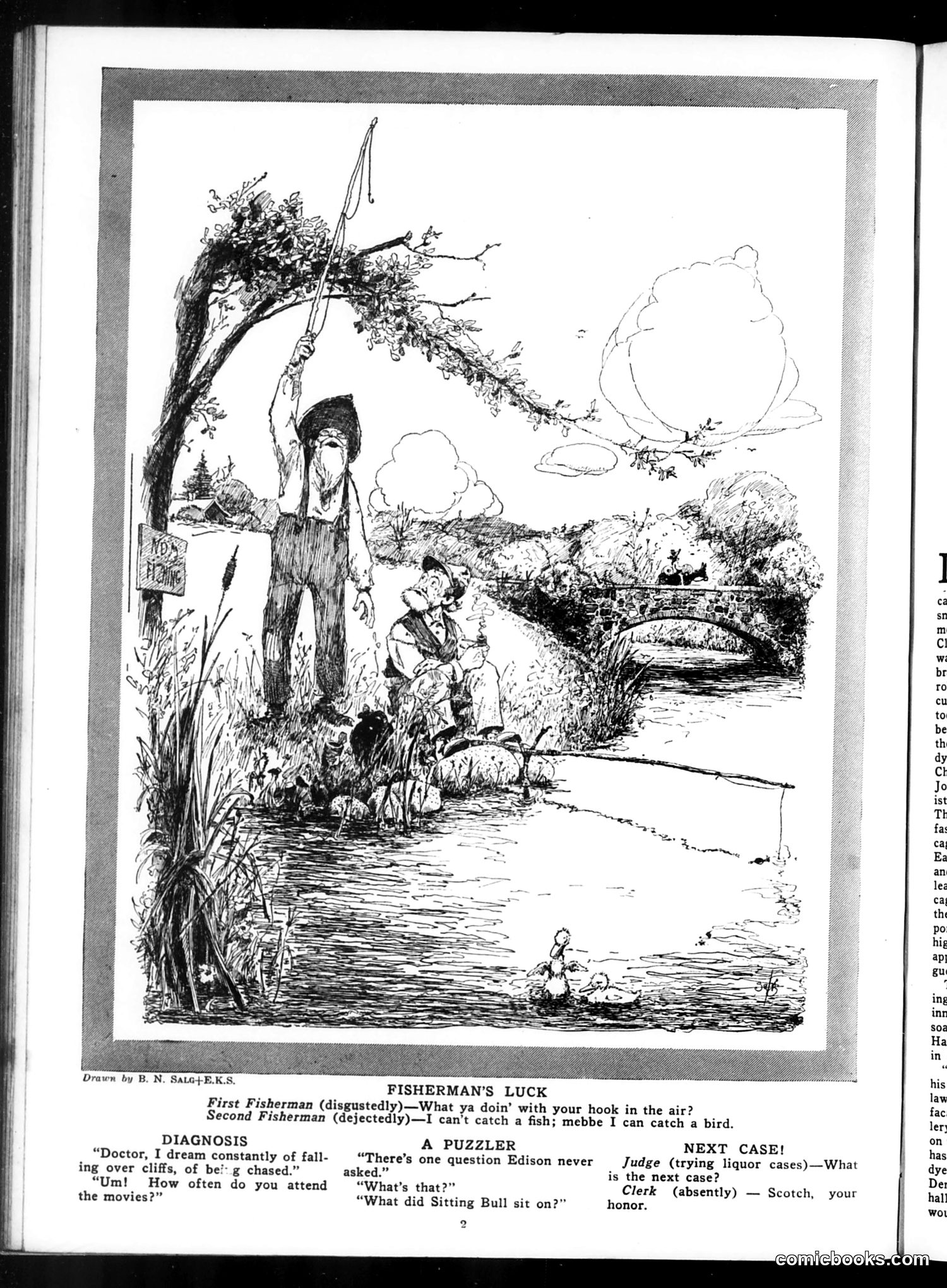
This cartoon depicts a fishing scene with a humorous exchange between two fishermen. The first fisherman, disgusted with his lack of catches, asks what the second fisherman is doing with his hook in the air. The reply—that he can't catch fish but might catch a bird—is a joke about incompetence and lowered expectations. Below the main cartoon are three unrelated joke segments: "Diagnosis" (about frequent movie attendance), "Puzzler" (involving Edison and a riddle), and "Next Case!" (a courtroom joke about Scottish honor). The artwork is credited to B.N. Salo. These appear to be typical satirical humor pieces for Judge magazine, relying on wordplay and observational comedy rather than political commentary. The jokes reflect early 20th-century concerns with entertainment habits and social etiquette.
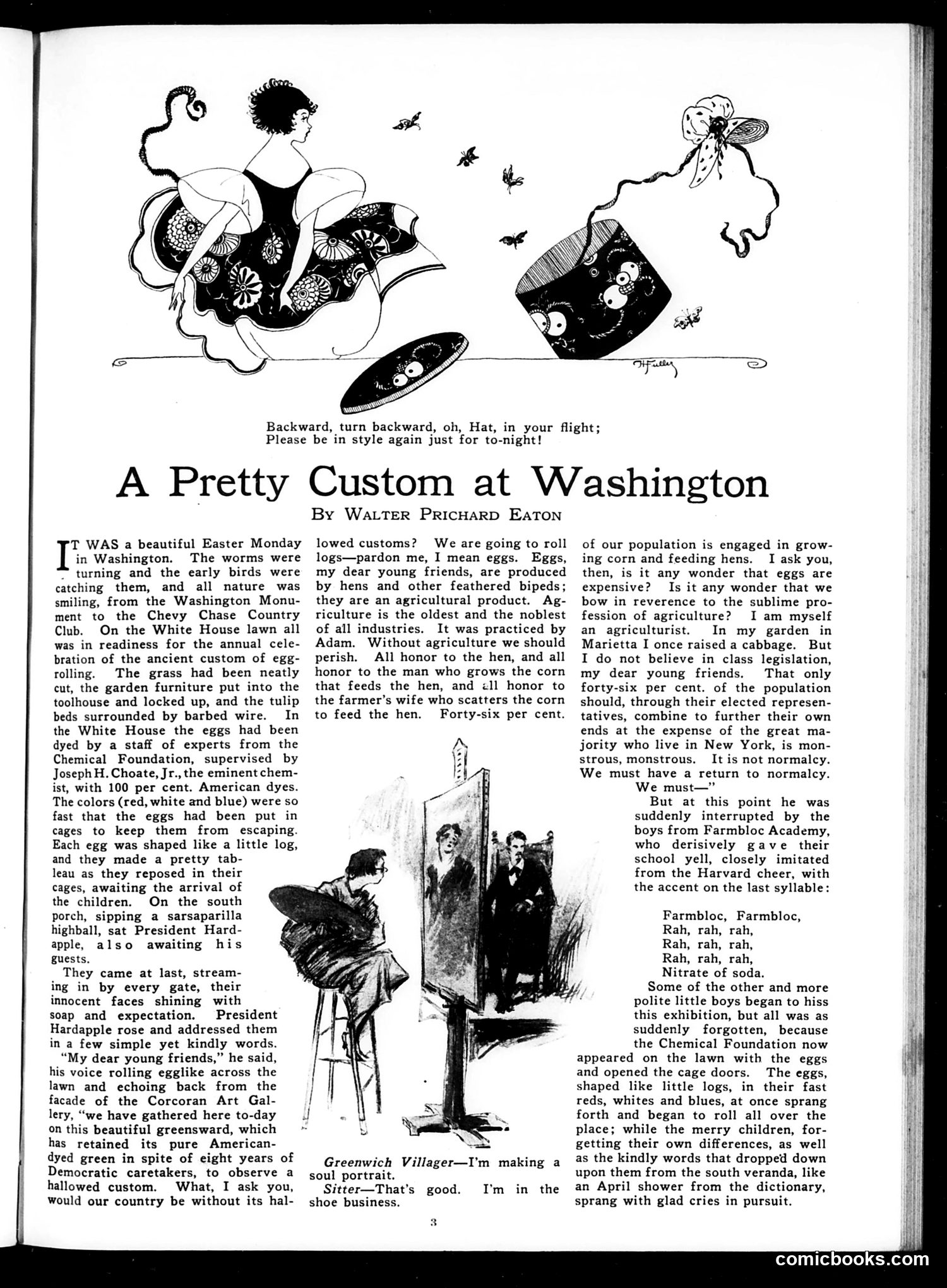
This Walter Prichard Eaton satire mocks the White House Easter egg-rolling tradition. The story describes how eggs dyed by the Chemical Foundation—using 100% American synthetic dyes—were prepared for the White House lawn celebration. President Harding is depicted greeting visitors. The satire's point appears to be **ironic praise of American industrial achievement**: the piece celebrates that this ancient agricultural custom now showcases American chemical industry prowess, with eggs "shaped like little logs" in "reds, whites and blues." The interruption by Farmbloc Academy boys (evident in the illustration) suggests class or regional tensions about who participates in elite White House traditions—country boys disrupting genteel custom.
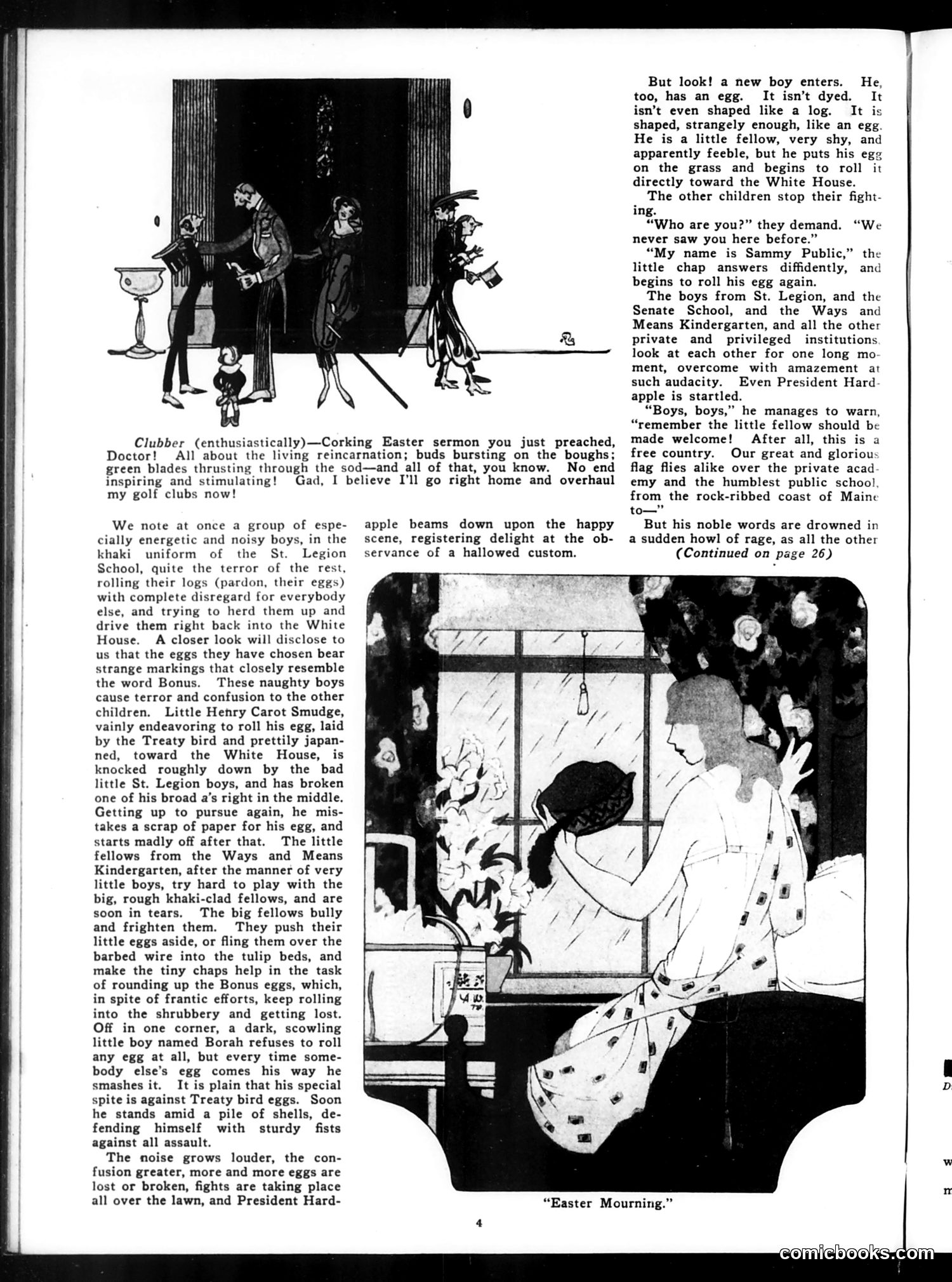
This page satirizes the Easter egg-rolling tradition at the White House lawn. The top illustration depicts well-dressed children from elite schools (St. Legion School, Senate School, Ways and Means Kindergarten) competing aggressively during the egg roll, contrasting their privileged status with working-class children. The narrative mocks how these privileged boys behave badly—rolling eggs toward the White House, breaking eggs, and fighting—while a character named Sammy Public represents an ordinary child who should theoretically be welcome but faces exclusion. The satire criticizes class divisions in America, suggesting that despite democratic ideals, elite institutions train children to dominate public spaces and exclude commoners. The "Easter Mourning" illustration (bottom) appears related to this social commentary about inequality.
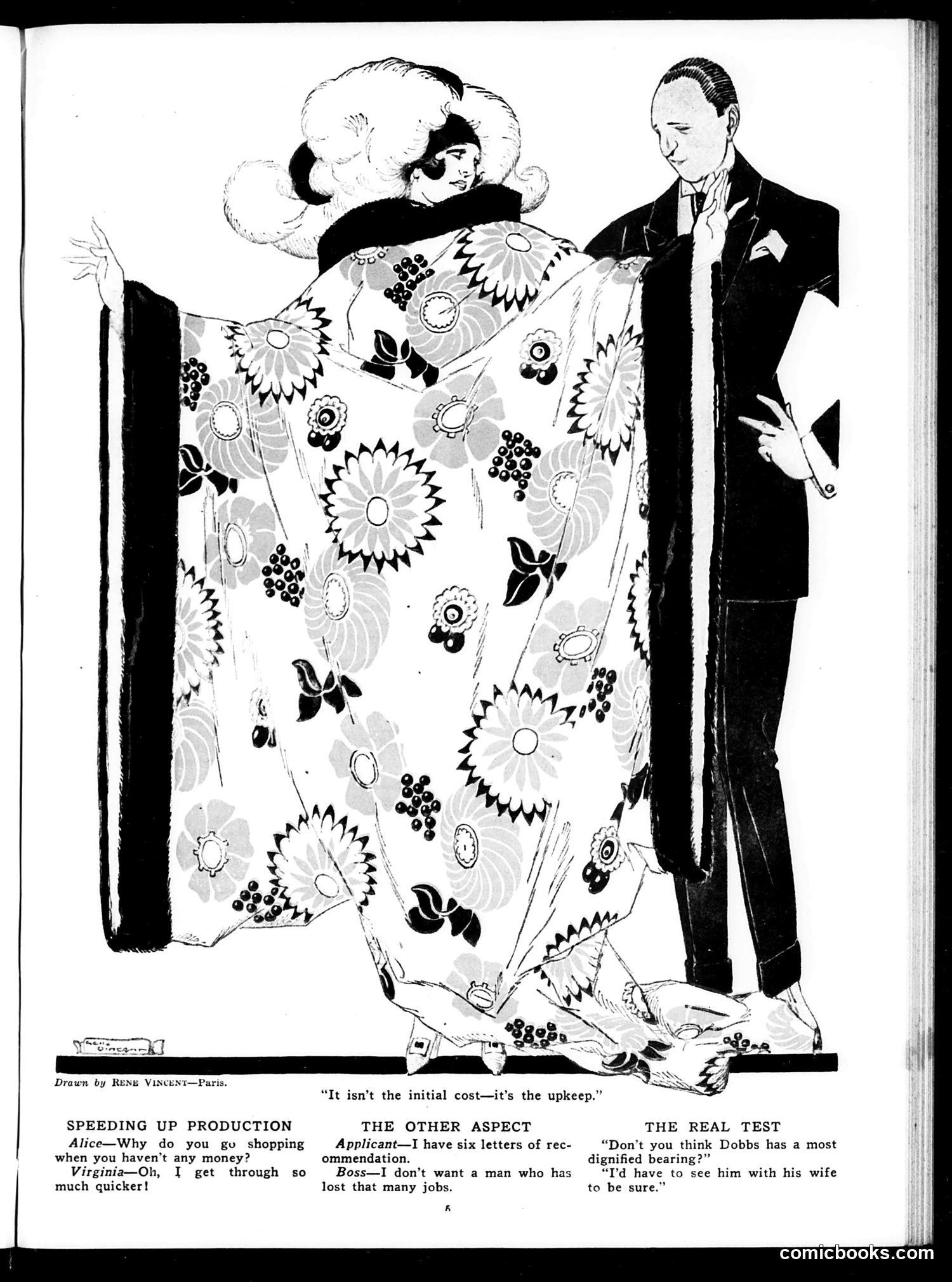
This page contains three separate cartoon jokes reflecting early 20th-century workplace and consumer concerns: **Top illustration** (by René Vincent, a French artist): Shows an expensively dressed woman in an elaborate fur coat and feathered hat with a man in formal wear. The caption "It isn't the initial cost—it's the upkeep" satirizes conspicuous consumption—the idea that wealthy people focus on initial purchases without considering ongoing maintenance costs. This reflects anxieties about frivolous spending among the affluent. **Three captioned vignettes below** address employment and marital concerns: - Shopping without money but "getting through so much quicker" mocks inefficient household management - An applicant with six recommendation letters is rejected because the boss assumes losing that many jobs indicates unreliability - The final joke questions whether someone has "dignified bearing" until seen with his wife, implying wives expose men's true character These reflect period anxieties about economic efficiency, employment reliability, and marital dynamics.
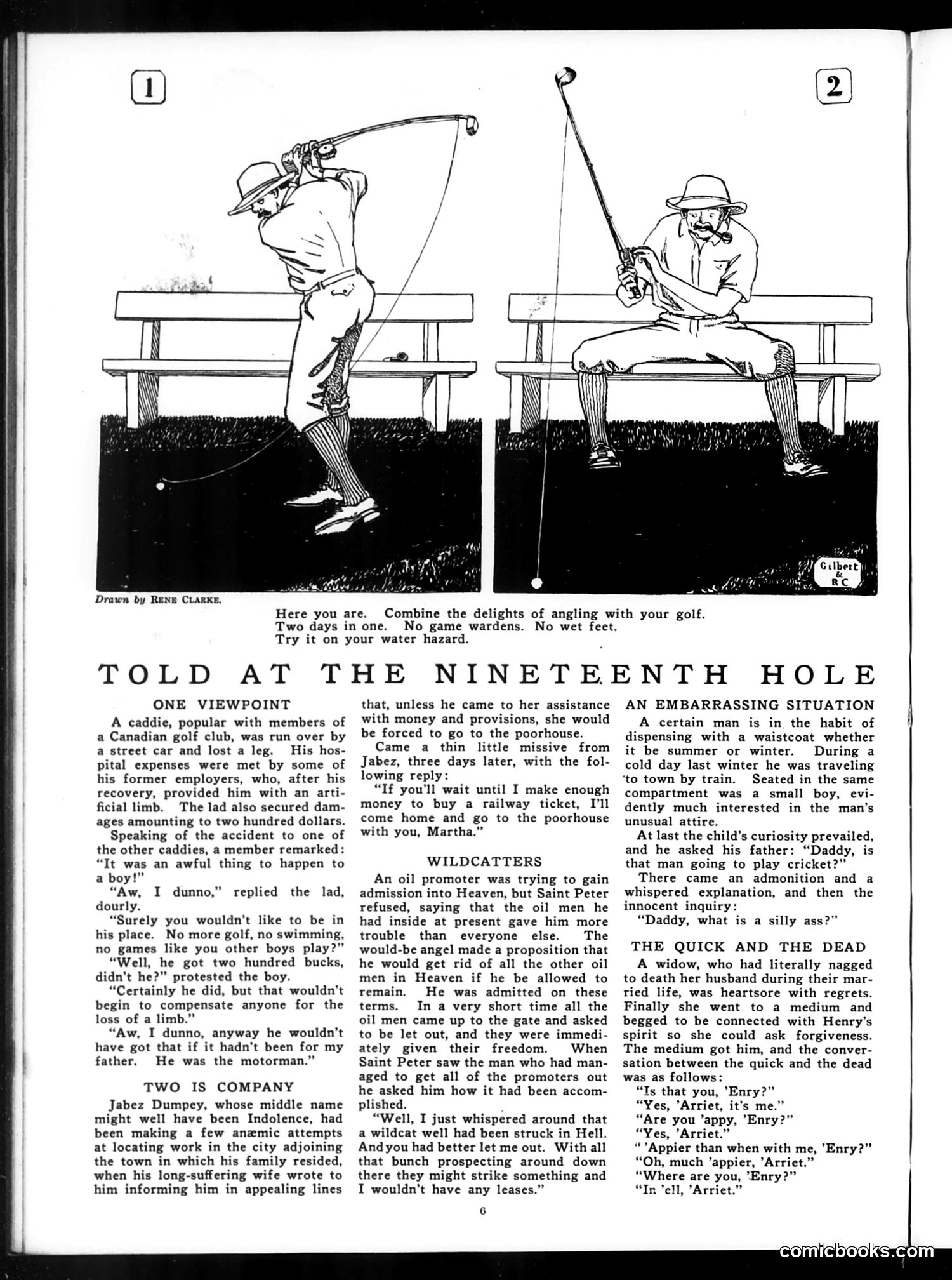
This page contains four satirical humor pieces typical of early-20th-century Judge magazine: **Top illustration**: Two fishing/golfing cartoons by René Clarke showing men combining angling with golf on water hazards—the joke being the impracticality and danger of this combination. **"One Viewpoint"**: Darkly satirical anecdote about a Canadian caddie who lost his leg to a streetcar. The humor comes from the boy's callous response: he's envious because his father (the motorman who hit the caddie) hasn't been compensated, revealing working-class resentment of accident settlements. **"Two Is Company"**: A shiftless husband named Jabez Dumpey responds to his desperate wife's plea from the poorhouse with cynical indifference—he'll only come home to join her there once he scrapes together train fare. Satire of male irresponsibility and poverty. **"Wildcatters"**: Satirizes oil speculators' ruthless greed; a con man gains Heaven entry by promising to remove rival oil promoters, then tricks them into leaving by claiming oil was struck in Hell. **"An Embarrassing Situation" & "The Quick and the Dead"**: Brief, mild domestic humor pieces about social awkwardness and marital discord, using working-class dialect for comic effect.
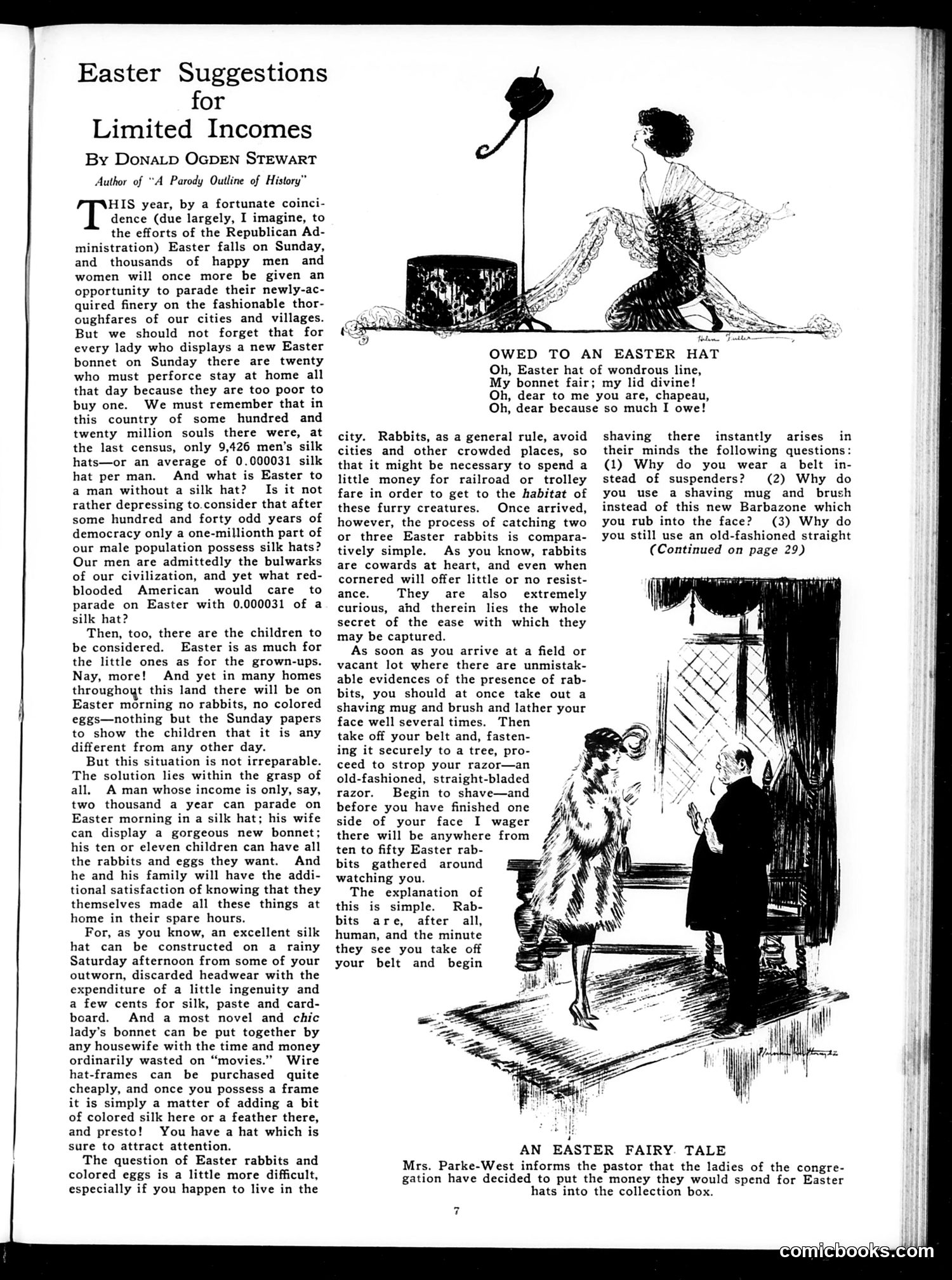
This is a humorous article by Donald Ogden Stewart mocking the pressure on Americans—especially the poor—to display new Easter finery. The piece satirizes the absurd gap between wealthy Easter celebrants parading in fashionable new bonnets and silk hats versus those financially unable to participate. Stewart exaggerates this disparity through ridiculous statistics (only 0.000031 silk hats per man nationwide). The satire's heart lies in his mock "solutions": he suggests poor families construct silk hats from discarded headwear and catch live rabbits by shaving their faces in fields—absurd, impractical ideas presented deadpan as reasonable alternatives. The accompanying illustrations show an elaborate Easter hat and a man shaving outdoors to catch rabbits, visually reinforcing the ridiculousness. The political context: this critiques American inequality and consumerism during the prosperous 1920s, while also poking fun at the Republican Administration's claim that economic opportunity exists for all.
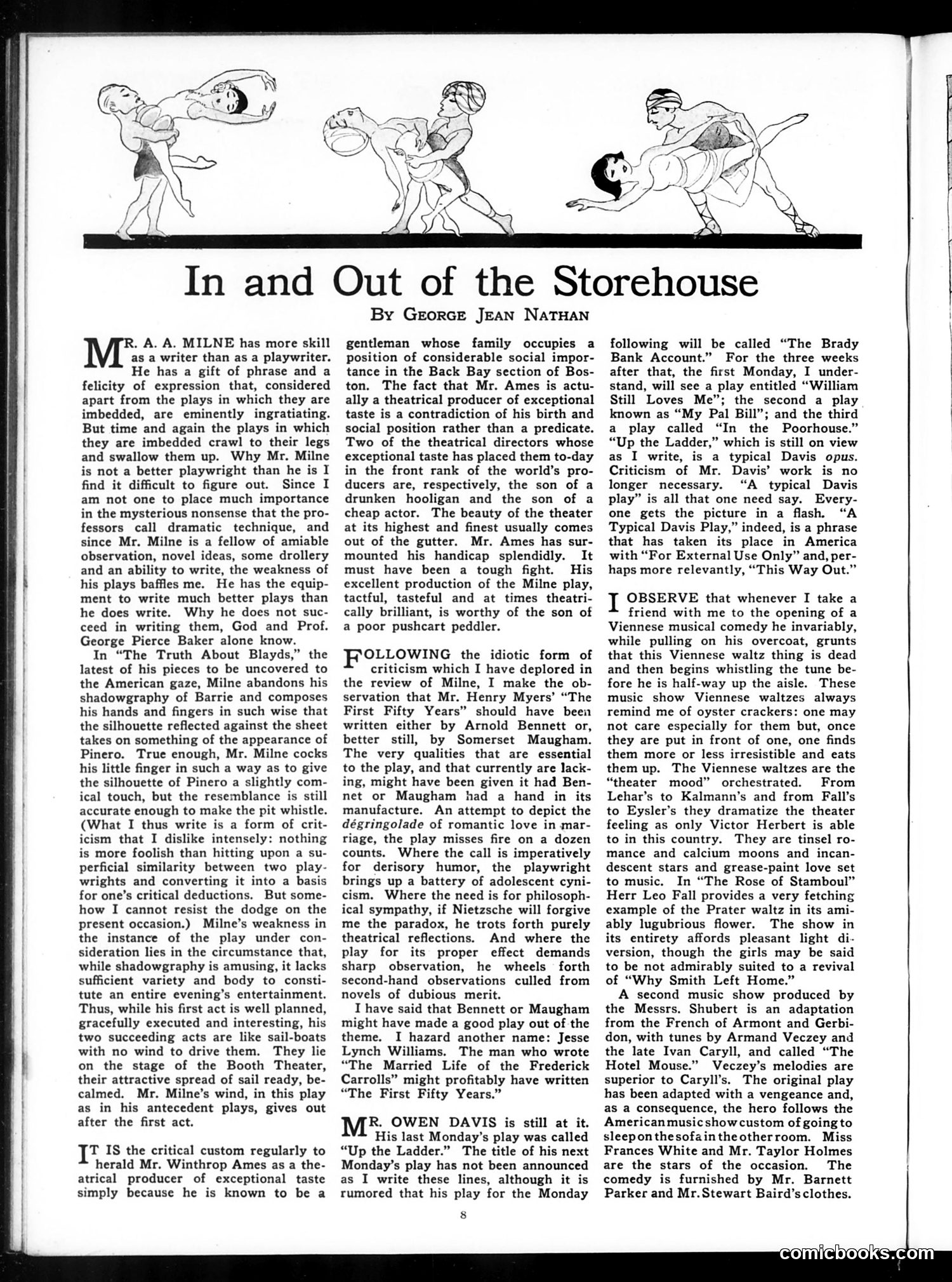
This is a theater review column by George Jean Nathan critiquing recent Broadway plays. The three cartoon vignettes at top illustrate theatrical scenes in a simplified, satirical style typical of Judge magazine. The main text discusses A.A. Milne's play "The Truth About Blayds," performed at the Booth Theater. Nathan praises Milne's writing but faults his dramatic structure—arguing his plays lose momentum after the first act, like "sail-boats with no wind." He uses theatrical silhouettes as metaphor, suggesting Milne's work echoes Pinero rather than Barrie. Nathan also discusses producer Winthrop Ames, noting sardonically that Ames's "exceptional taste" contradicts his privileged Boston background, since "the beauty of the theater...usually comes out of the gutter." The review continues discussing other contemporary plays by Henry Myers and Owen Davis. The column represents typical Judge content: sophisticated cultural criticism with pointed social commentary about theater and class.
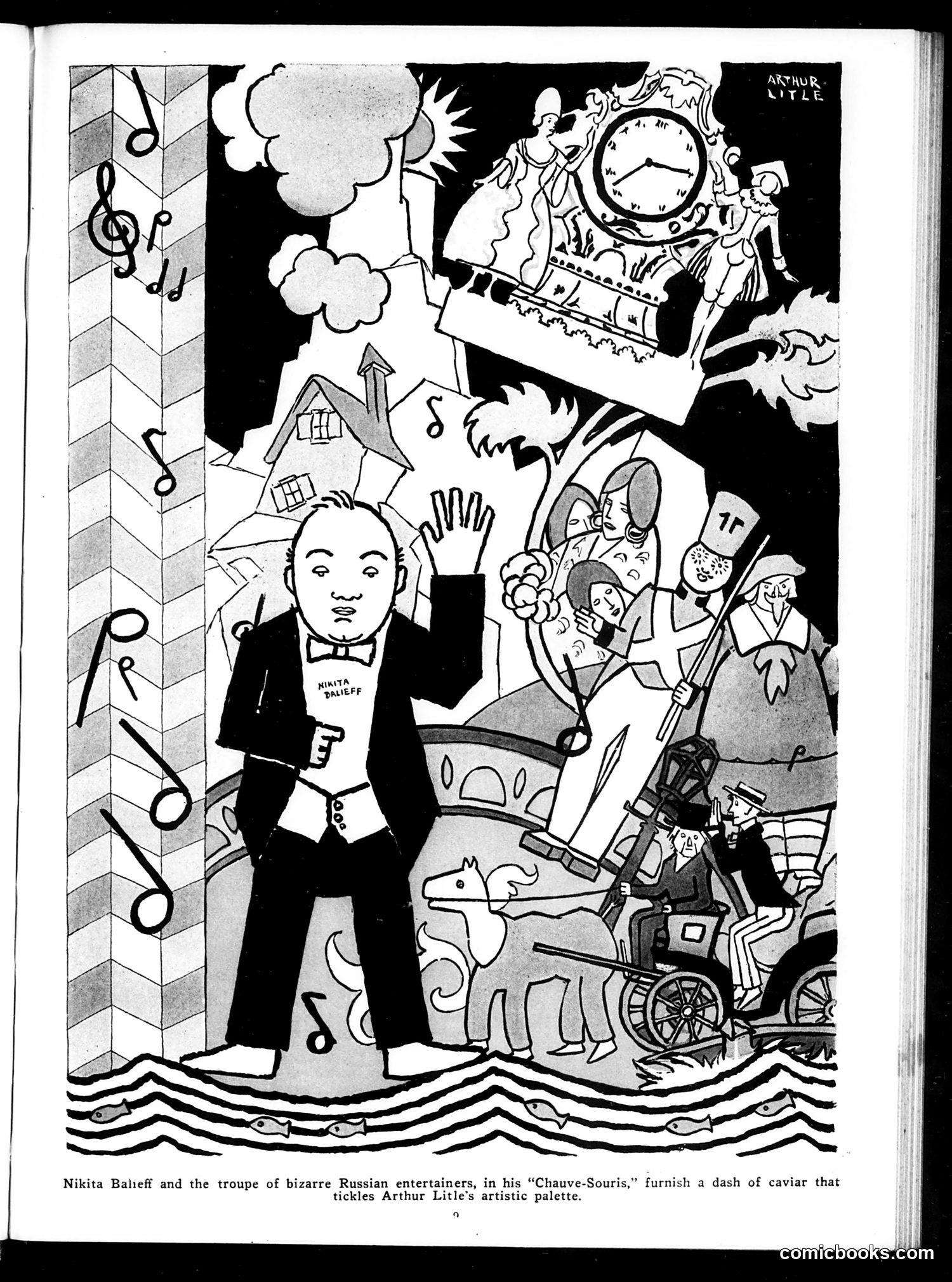
This is an Arthur Little illustration satirizing **Nikita Balieff** and his Russian cabaret troupe "Chauve-Souris" (literally "The Bat"). The caption indicates the entertainment was exotic and expensive—"a dash of caviar that tickles Arthur Little's artistic palate." Balieff was a real Russian impresario who brought avant-garde Soviet theatrical entertainment to 1920s America, creating sensation among wealthy Manhattan audiences. The cartoon mocks this as pretentious cultural consumption: a bald man in formal dress surrounded by absurd Russian performers, clouds, cherubs, and musical instruments. The satire targets both the novelty-seeking rich who embraced "bizarre Russian entertainers" and perhaps the performance's alleged artistic superiority. The wavy lines at bottom and ornate border amplify the mockery of high-culture pretension.
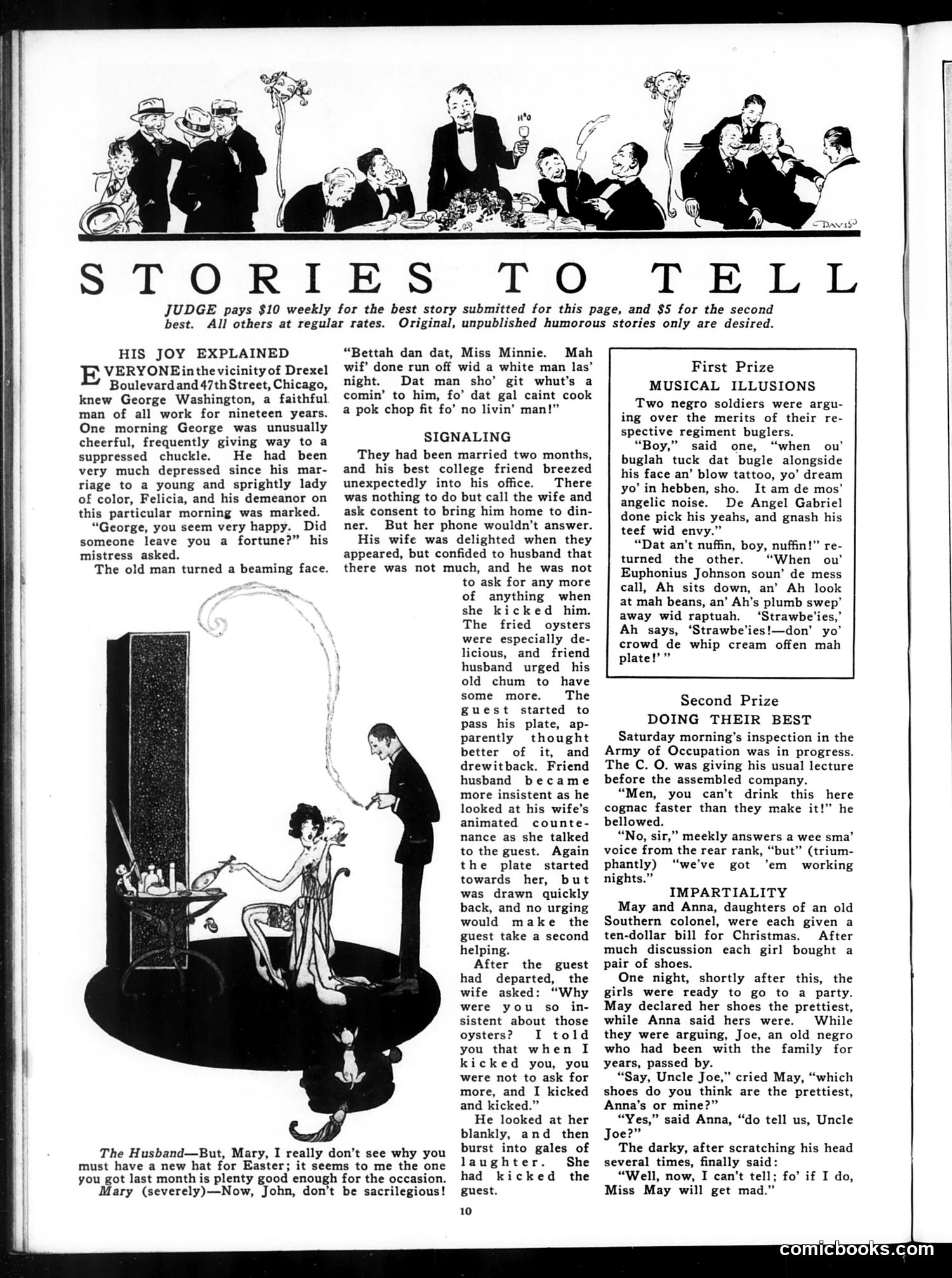
This is a humor submission page from *Judge* magazine featuring three short comic anecdotes for readers' entertainment. **"His Joy Explained"** uses racist dialect humor common to the era. George Washington, a Black servant, is delighted his wife left him for a white man—the joke relies on period stereotypes about Black women's cooking and the racist assumption he'd be relieved. **"Signaling"** depicts marital discord through physical comedy: a wife literally kicks her husband under the dinner table to signal him not to ask guests for seconds. The guest mistakes these kicks as signals meant for him and refuses food, creating absurdist confusion. **The three prize-winning stories** include more dialect humor ("Musical Illusions" with Black soldiers discussing buglers using exaggerated speech) and genteel domestic comedy ("Impartiality" about sisters comparing Christmas shoes). The magazine paid readers $10-$5 for submissions. The elaborate decorative header illustration shows well-dressed diners in a formal setting, establishing the magazine's upper-class audience. These pieces reflect early 20th-century American humor standards, now marked by offensive racial caricature.
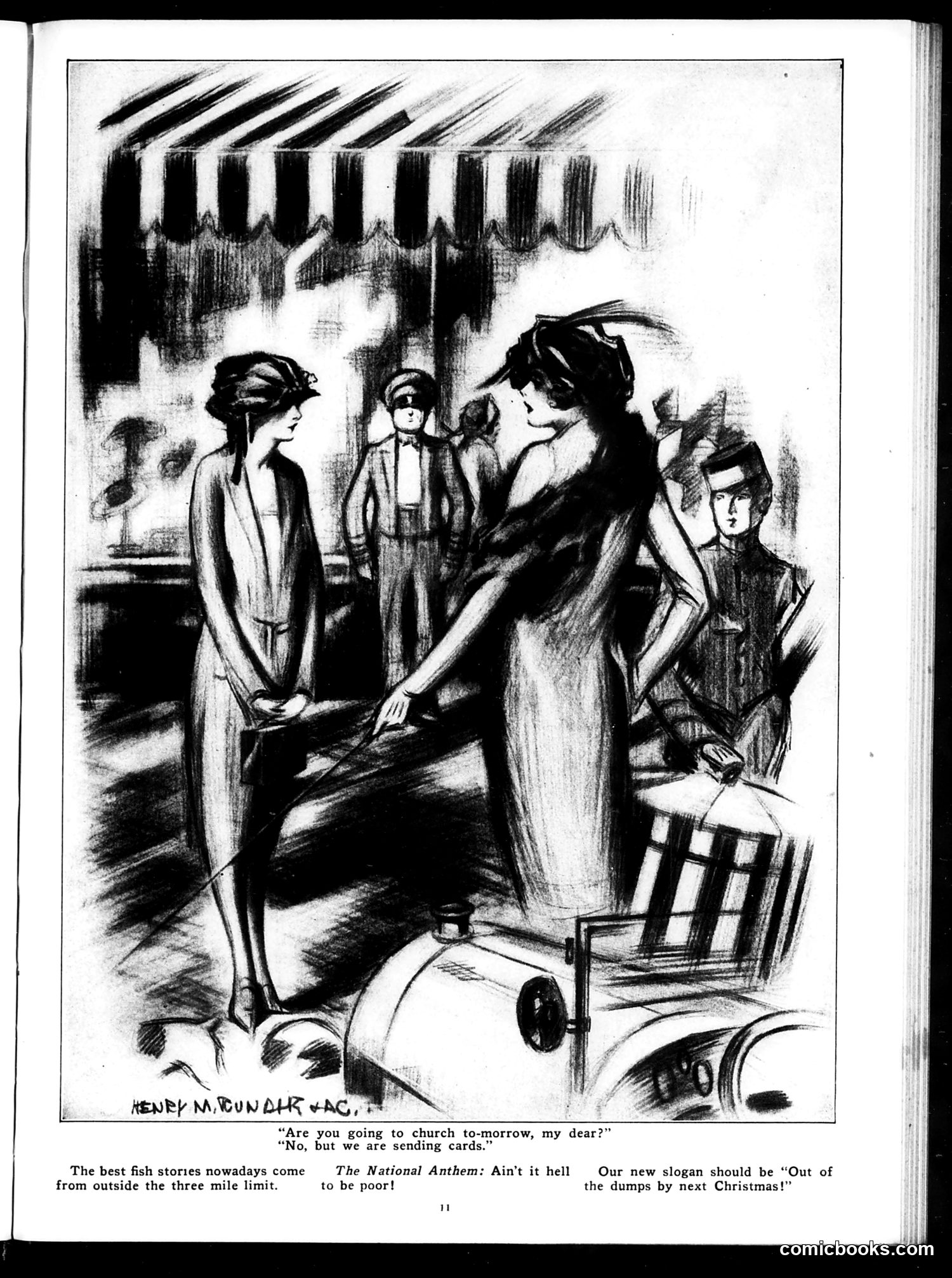
This Henry McBride Judge cartoon satirizes early 20th-century American hypocrisy and social pretense. The main joke depicts a woman declining church attendance while still sending Christmas cards—mocking the disconnect between claimed religious devotion and actual practice. The three accompanying captions mock various social issues: prohibition-era smuggling ("fish stories" from beyond the three-mile limit where bootleggers operated), economic inequality ("Ain't it hell to be poor!"), and Depression-era poverty ("Out of the dumps by next Christmas!"). The cartoon critiques shallow materialism and performative religiosity among the middle/upper classes, suggesting people prioritize appearances (sending cards) over genuine faith or social responsibility toward the poor. The setting with a piano and fashionably dressed figures emphasizes class consciousness—mocking affluent pretense during a period of significant economic hardship.
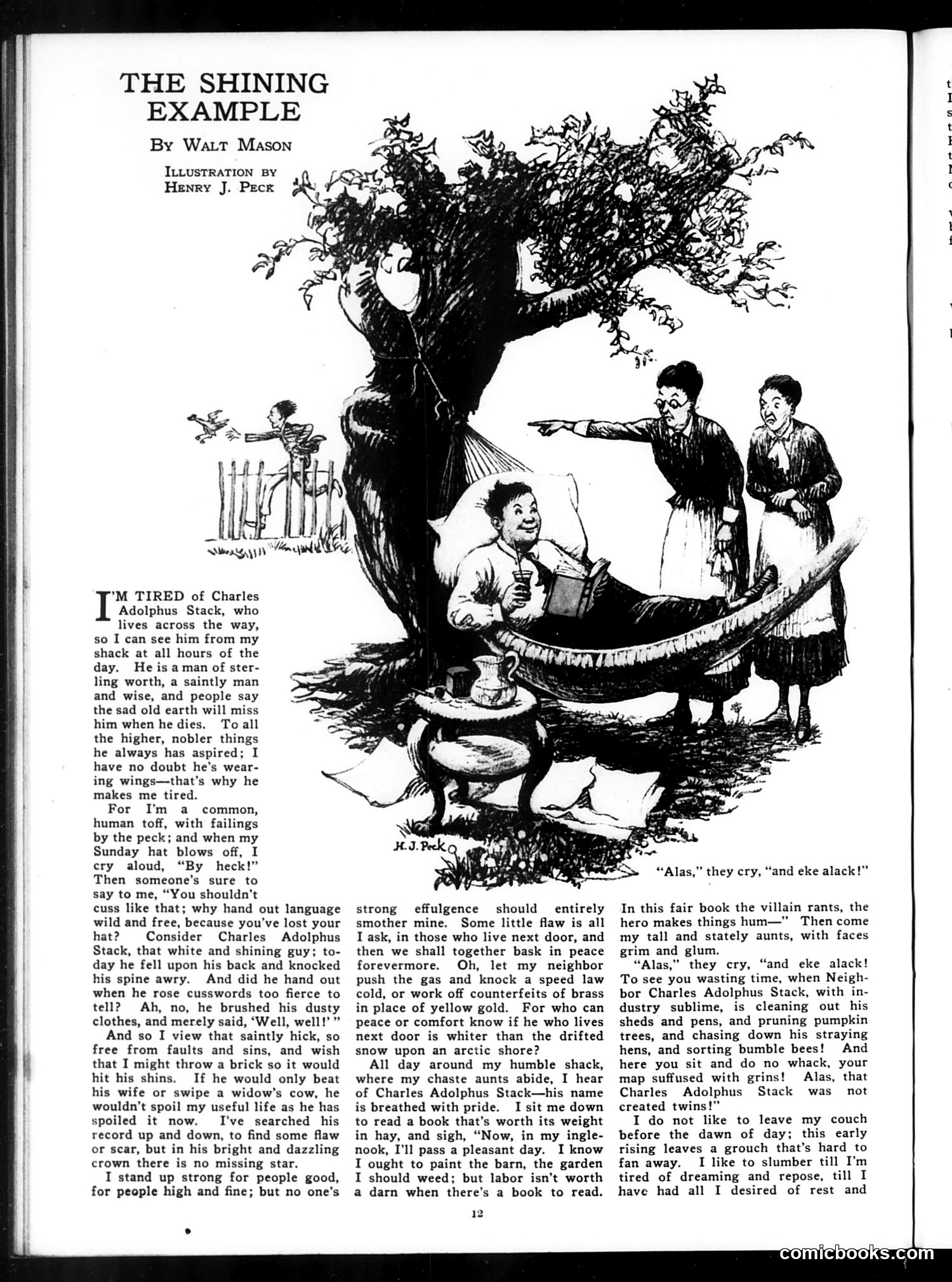
This humorous piece by Walt Mason satirizes the torment of living near an insufferably virtuous neighbor. The narrator—a lazy, profane, ordinary man—is perpetually exhausted by Charles Adolphus Stack, who lives across the way and embodies moral perfection: he never curses, works industriously, and maintains spotless conduct. The joke targets not Stack's virtue itself, but the *social performance* of virtue and how it makes ordinary people feel inadequate. The narrator's relatives constantly compare him unfavorably to Stack, using him as a moral cudgel. The satire suggests that perfect propriety, while admirable, becomes tiresome and alienating to average folk—and that perhaps a little human flaw would make such paragons more bearable. The moral: relentless moral superiority is its own form of selfishness.
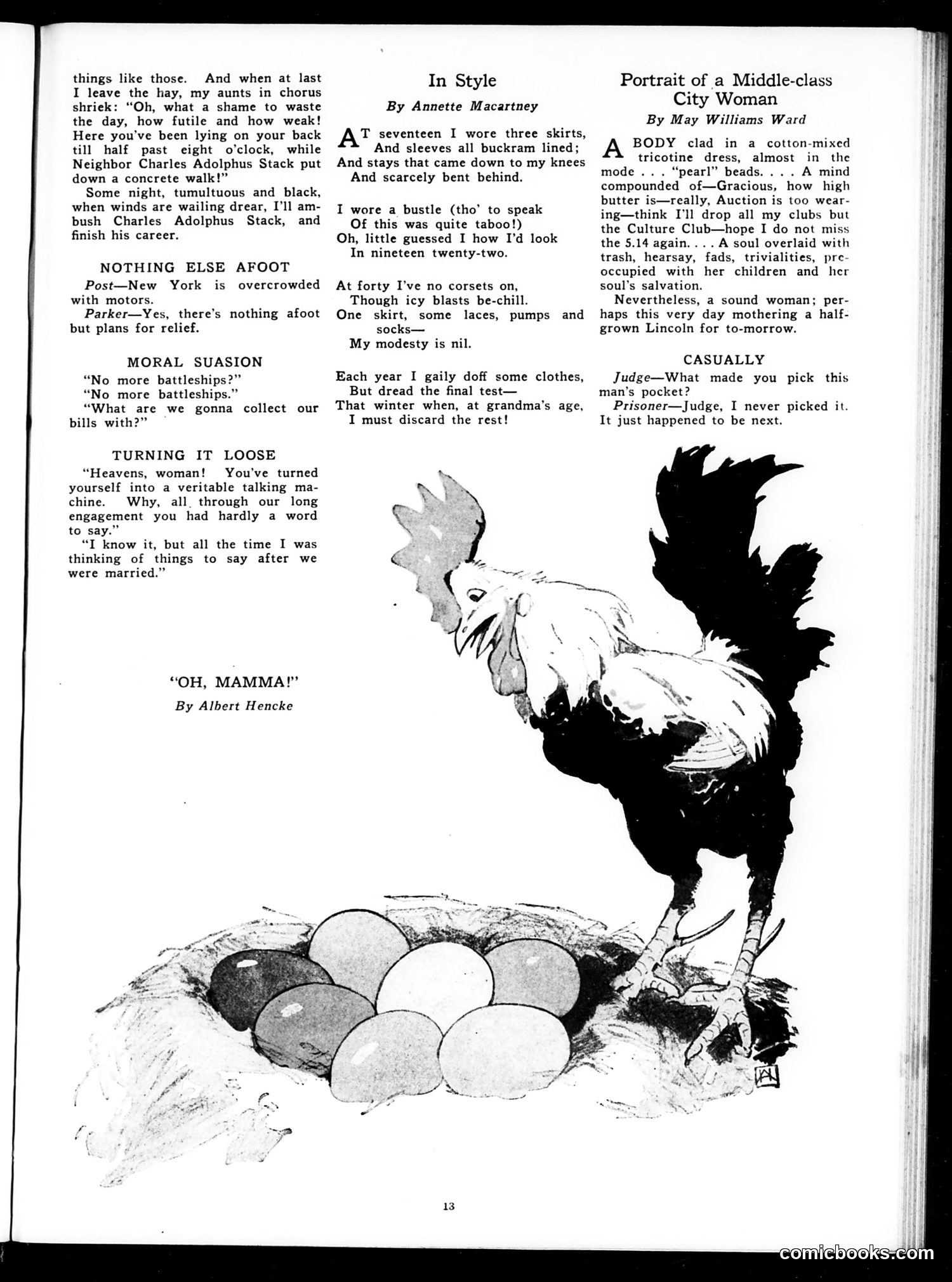
This page contains three satirical pieces targeting early 1920s social attitudes: **"In Style"** mocks women's changing fashion and modesty standards. It contrasts a woman's restrictive Victorian clothing at seventeen (three skirts, buckram sleeves, stays to the knees) with her near-nude appearance at forty, suggesting women progressively abandon propriety with age—a jab at the "flapper" era's loosening of dress codes. **"Portrait of a Middle-class City Woman"** stereotypes a distracted, materialistic housewife obsessing over butter prices and auction sales while neglecting her children and spiritual life, despite self-regard as cultured. **"Oh, Mamma!"** shows a rooster with eggs, captioned as if the bird is proudly calling for its mother—a crude joke about reproduction or perhaps mocking sentimental domesticity. The page also includes brief humor sections like "Turning It Loose" (about chatty wives) and "Casually" (a pickpocket joke), reflecting Judge's typical mix of domestic satire and cynical social commentary targeting women, consumer culture, and changing morality of the Jazz Age.
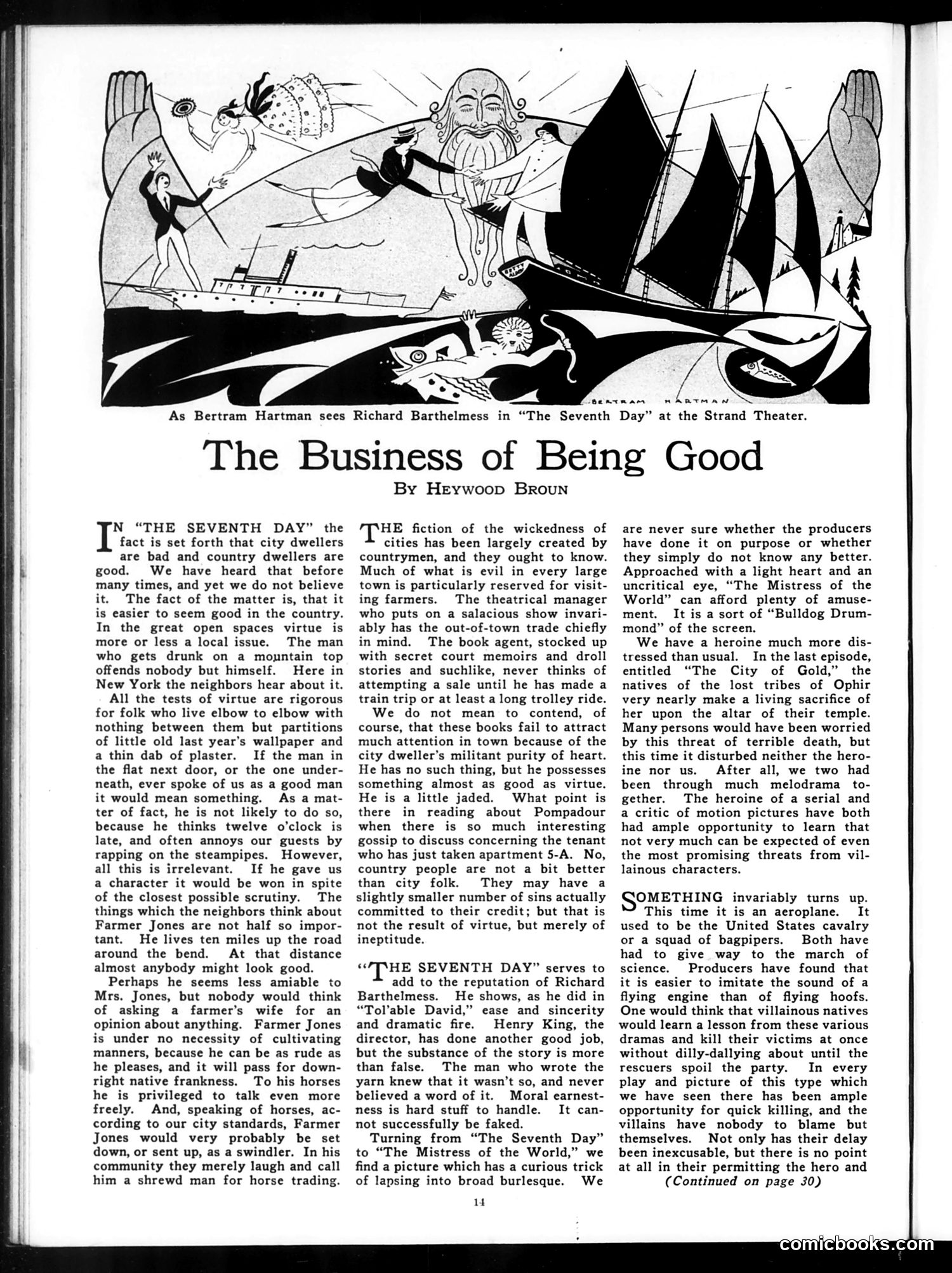
This page reviews "The Seventh Day," a 1920s silent film starring Richard Barthelmess. The illustration shows a melodramatic scene with sailors, ships, and exaggerated figures typical of film advertising. Heywood Broun's article satirizes the film's central moral premise: that country dwellers are virtuous while city dwellers are corrupt. Broun argues this is false mythology. His key point: rural "goodness" is easier only because rural misconduct affects fewer witnesses. A drunk farmer on a mountain harms no one; an intoxicated New Yorker disturbs neighbors through thin walls. Similarly, country residents appear more moral not from virtue but from *limited opportunity* for misbehavior and limited scrutiny. Broun praises lead actor Barthelmess's performance but dismisses the story as dishonest moralizing—"the man who wrote the yarn knew that it wasn't so." The satire targets both sentimental cinema and the rural-virtue myth it perpetuates.
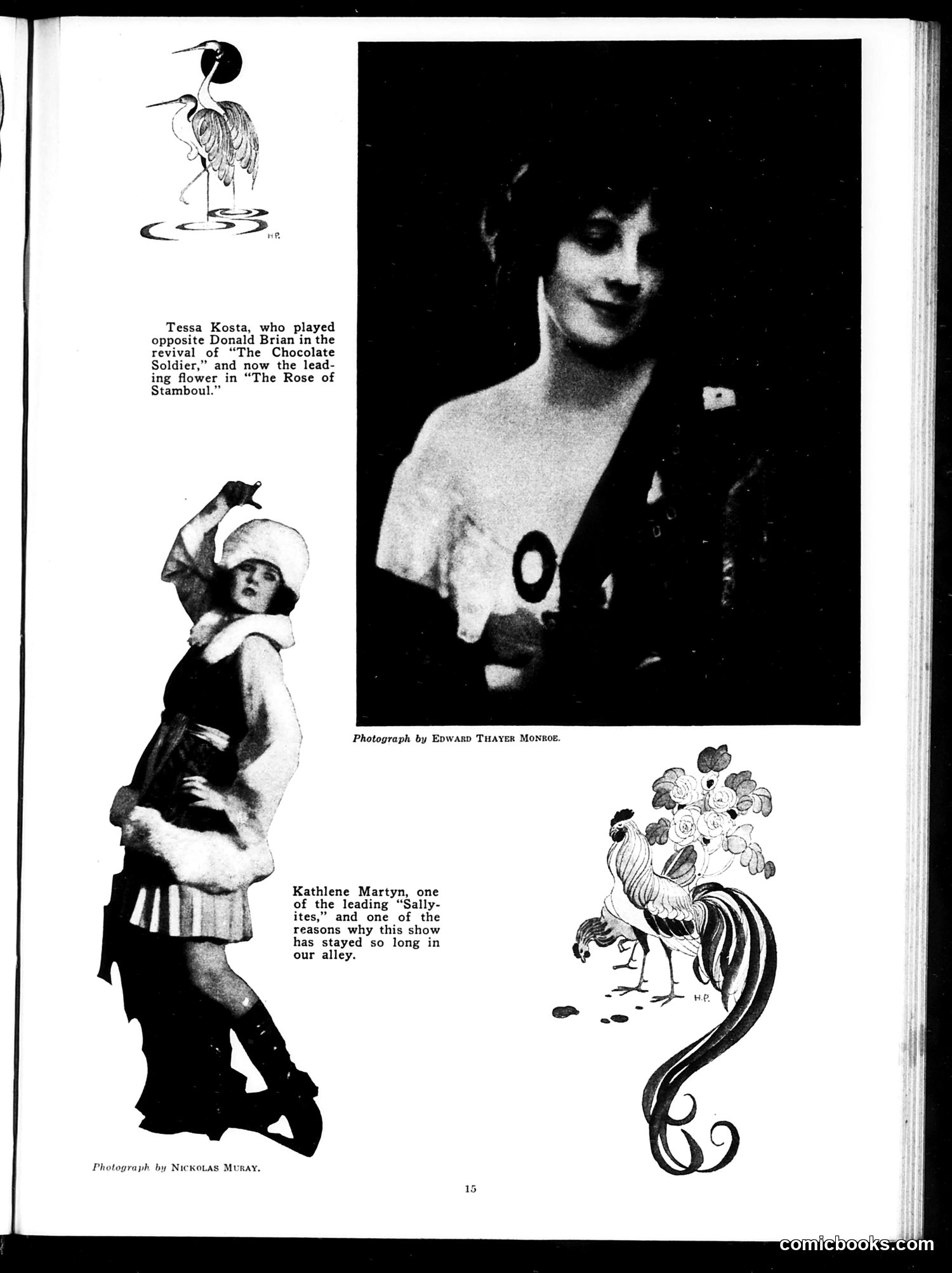
This page promotes Broadway shows through celebrity photographs and illustrations. It features: **Tessa Kosta** — actress in "The Chocolate Soldier" revival and "The Rose of Stamboul," photographed by Edward Thayer Monroe. **Kathlene Martyn** — a leading performer in "Sallyites" (likely "Sally," a popular musical), photographed by Nickolas Murray. The text humorously credits her as a reason the show has had such long-running success in the theater district ("our alley"). The decorative illustrations—birds and a rooster with flowers—are typical Judge magazine ornaments. This is essentially **celebrity coverage disguised as editorial content**, promoting current theatrical productions to the magazine's upscale readership. No political satire is evident; this is straightforward entertainment journalism from the early 20th century.
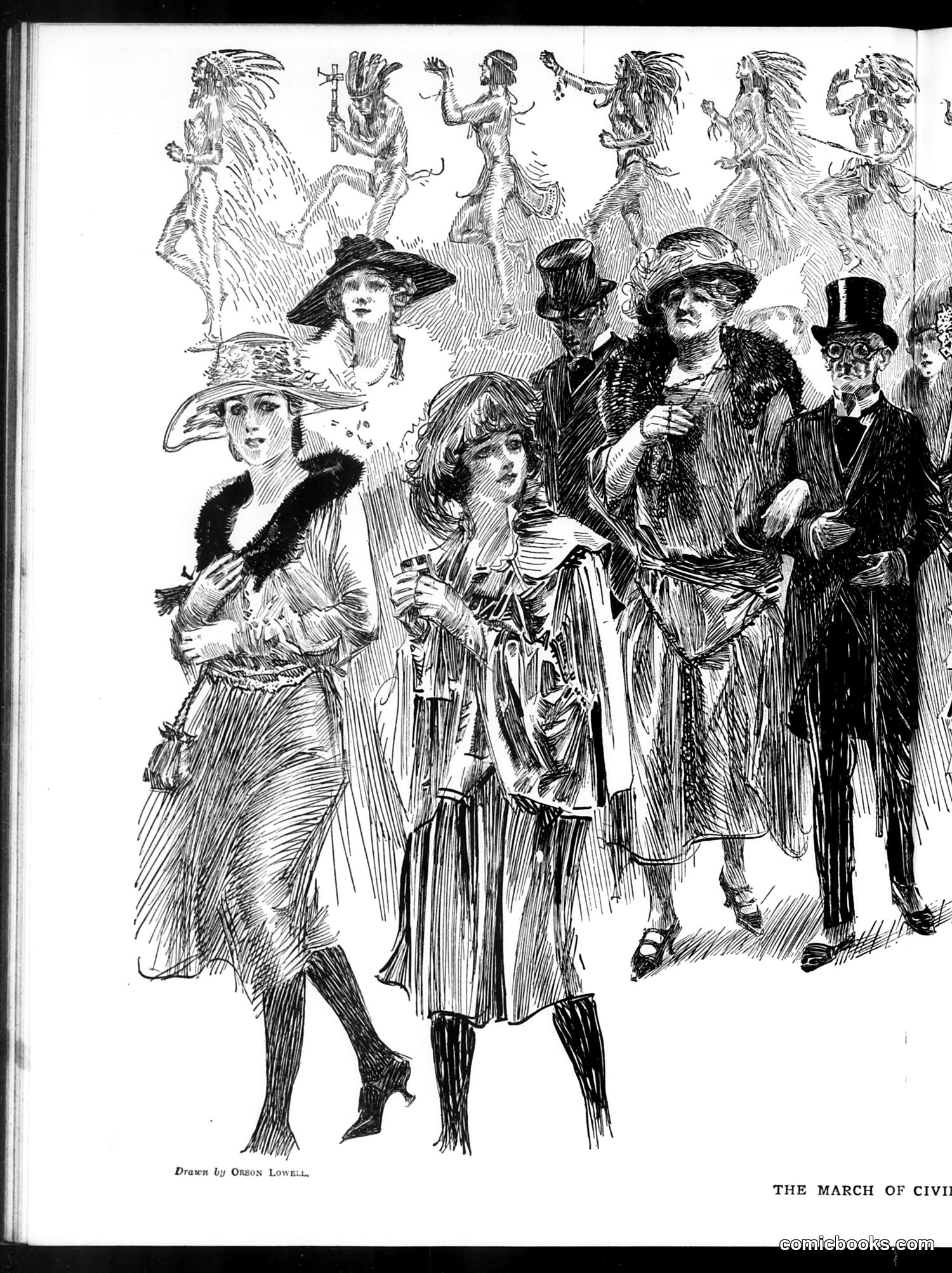
This satirical illustration by Orson Lowell appears to depict a procession of well-dressed society figures (women in elaborate hats and coats, men in top hats) walking beneath demonic or devilish spirits hovering above them. The cartoon seems to critique the contrast between civilization's outward appearance—fashionable dress and refined social gatherings—and its underlying moral corruption or spiritual darkness. The demons above suggest that despite society's pretense of respectability and progress, vice or immorality drives the "march of civilization." The title's incomplete spelling ("CIVII") may be a printing error or intentional wordplay. Without additional context or date information, the specific social critique remains somewhat unclear, though it clearly mocks Victorian-era pretensions to moral superiority.
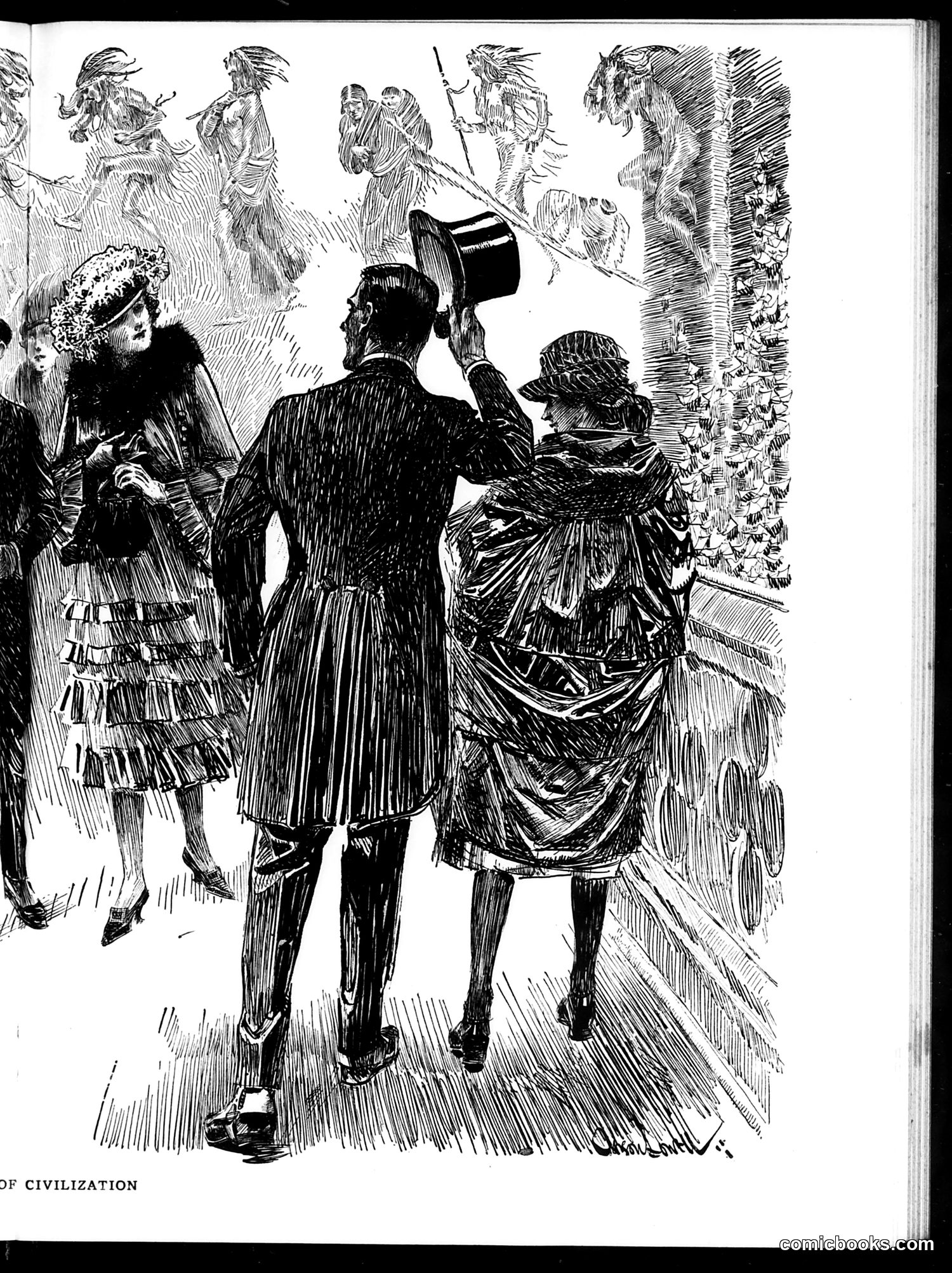
This appears to be a satirical illustration titled "Of Civilization" from *Judge* magazine. The image shows a well-dressed man in a top hat wielding an axe against what appears to be a decorated wall or structure, while well-dressed onlookers (including a woman in fashionable dress) observe. Figures in the background appear distressed or fleeing. The satire likely critiques destructive behavior by the "civilized" classes—the irony being that someone dressed formally and refined is committing vandalism or destruction. This may reference labor unrest, social upheaval, or wealthy individuals' complicity in societal damage during the Gilded Age or Progressive Era. Without additional context or visible date, the specific historical event remains unclear, but the cartoon's message appears to be that "civilization" masks barbaric behavior.
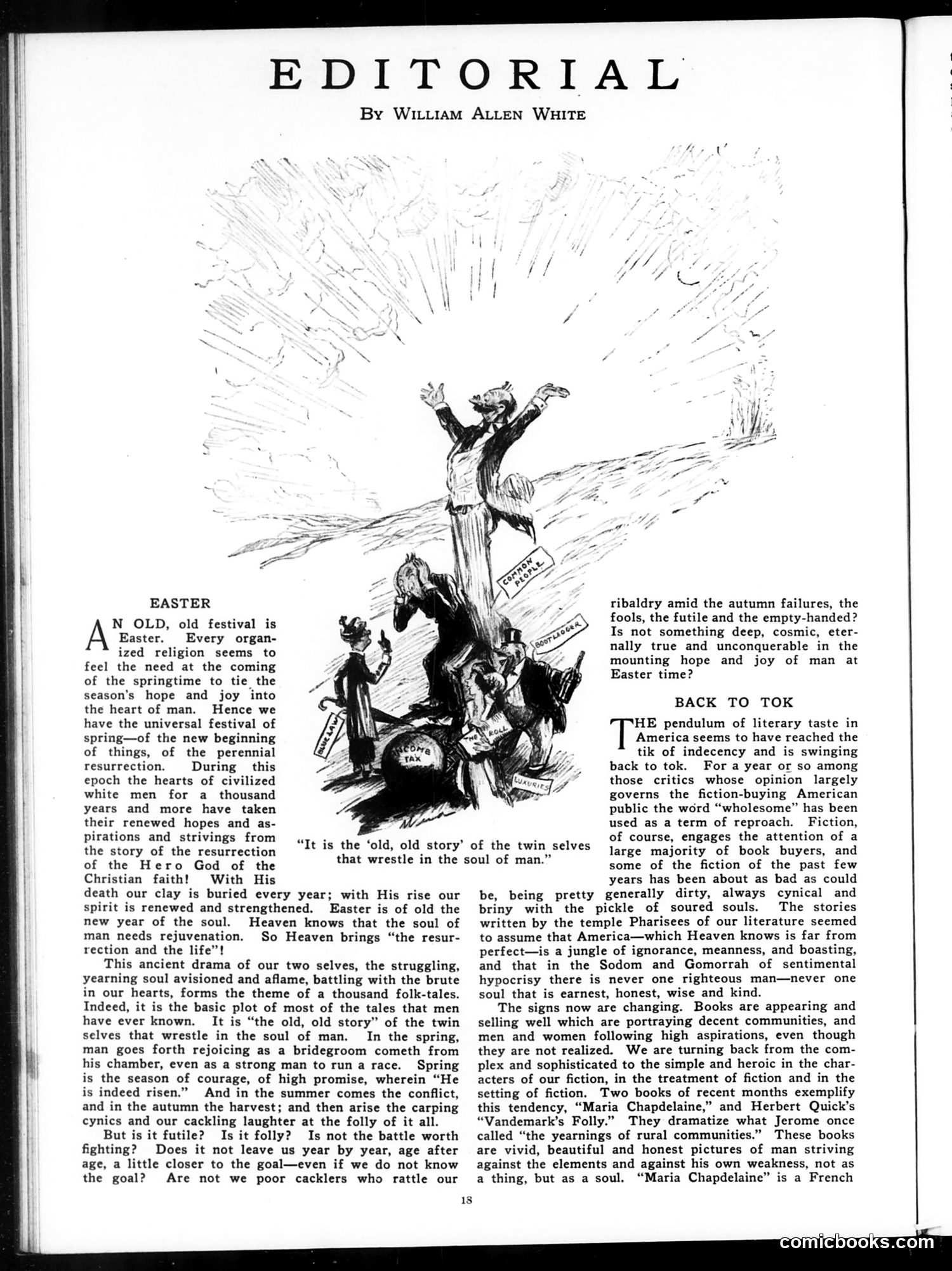
This is an editorial page by William Allen White comprising two pieces on American culture and literature. **"Easter"** is a philosophical reflection on the Easter holiday as expressing humanity's eternal struggle between spiritual aspiration and base instinct—"the old, old story of the twin selves that wrestle in the soul of man." White frames Easter as celebrating resurrection and renewal, arguing this cyclical battle ennobles rather than defeats us. **"Back to Tok"** critiques a recent literary trend. White argues American fiction had become excessively cynical and "dirty," portraying America as hopelessly corrupt. He applauds a course correction toward "wholesome" fiction depicting decent communities and morally earnest characters. He praises recent novels like *Maria Chapdelaine* and *Vandemark's Folly* for returning to honest depictions of people struggling nobly against hardship—representing "the yearnings of rural communities." The cartoon above shows figures celebrating atop a cross-marked hill, visually reinforcing the resurrection theme.
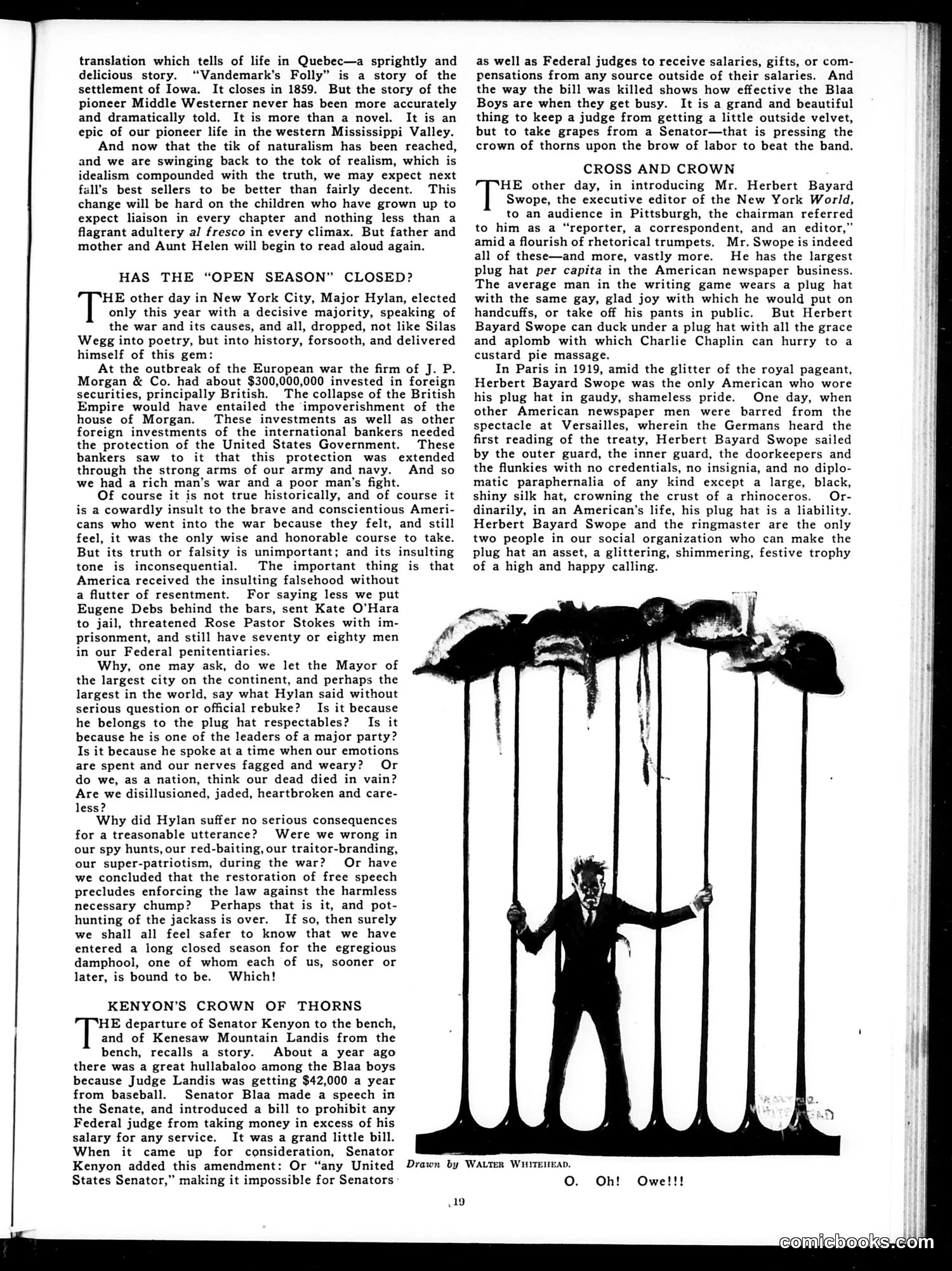
This page critiques Mayor John Hylan of New York City for making anti-war statements without consequences. The cartoon by Walter Whitehead shows a figure (Hylan) wielding a whip labeled "O. Oh! Owe!!!" — satirizing his criticism that America's WWI involvement served wealthy bankers' interests rather than the nation's. The text argues the hypocrisy: during wartime, dissidents like Eugene Debs and Rose Pastor Stokes faced imprisonment for similar anti-war speech, yet Hylan—a major political figure—escaped rebuke. Judge questions whether Americans have grown "disillusioned" about the war, or whether political status granted immunity from prosecution for statements that would jail ordinary citizens. The piece demands accountability, suggesting post-war America has become complacent about enforcing free-speech restrictions selectively based on power and party affiliation.
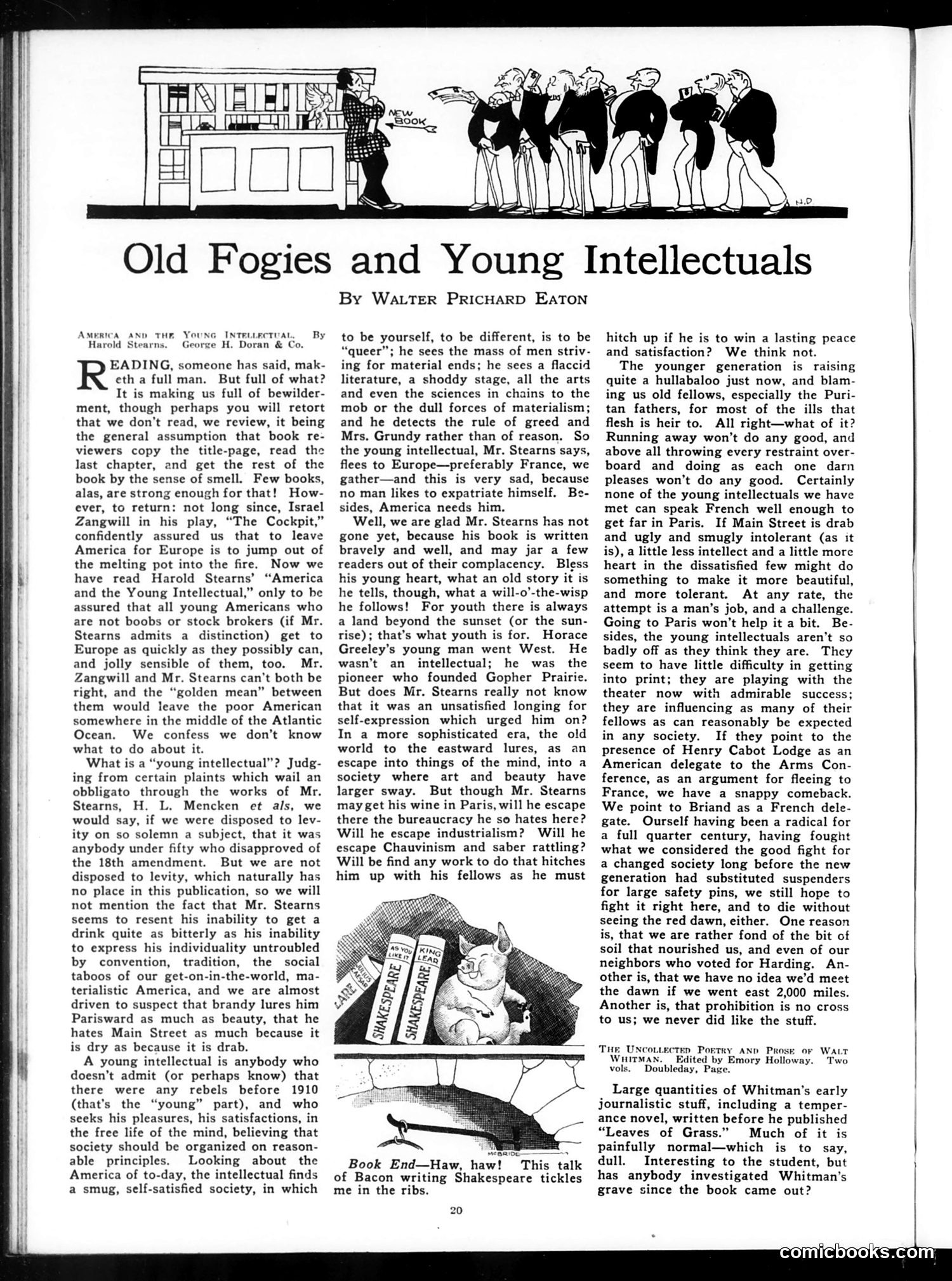
This is a book review by Walter Prichard Eaton critiquing Harold Stearns' work "America and the Young Intellectual." The cartoon at top shows a building (representing America) with young men in suits bowing/fleeing eastward toward Europe. **The satire:** Eaton mocks young American intellectuals who reject their own country as materially-obsessed and conformist, fleeing to Europe (especially Paris) seeking artistic and intellectual freedom. He notes this mirrors historical American restlessness—referencing Horace Greeley's "Go West, young man"—but argues the impulse is ultimately the same romantic escapism, just redirected eastward. **Key targets:** Stearns, H.L. Mencken, and the post-WWI generation seeking exile. Eaton suggests their complaints about Prohibition ("unable to get a drink") undermine their highbrow critiques of American materialism. He defends America as needing these dissidents, while gently mocking their predictable rebellion as old as youth itself—romanticizing elsewhere rather than building at home.
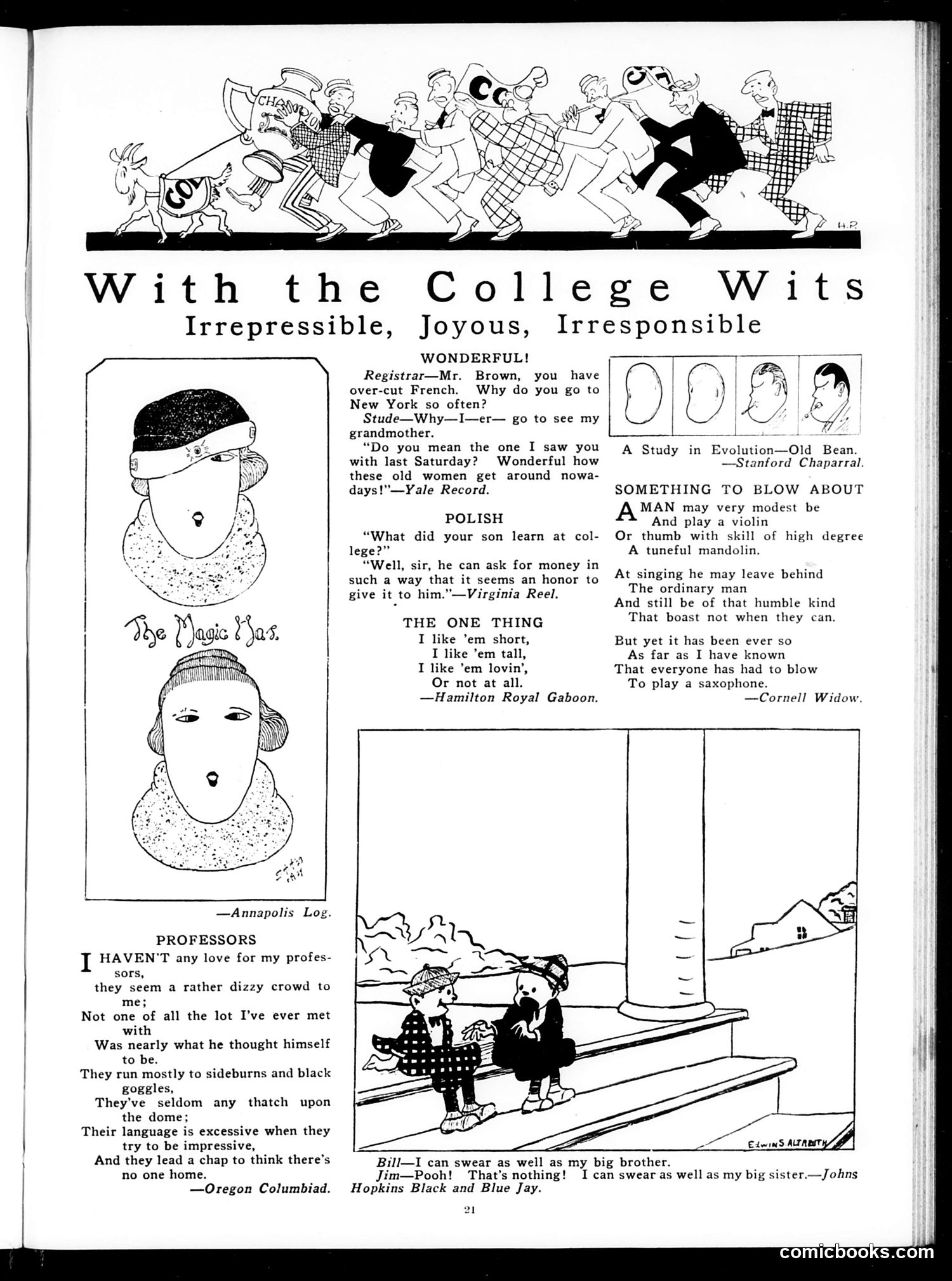
This page collects humorous observations about college life and professors, presented through poems, jokes, and illustrations. The satire targets academic pretension and student behavior. **Key targets:** - **Professors**: Mocked as pompous yet incompetent—described as "dizzy," bald or balding ("seldom any thatch upon the dome"), wearing "sideburns and black goggles," and using unnecessarily complex language to seem impressive while lacking actual substance. - **Students**: Portrayed as lazy and manipulative (one learns to ask for money "in such a way that it seems an honor"), or sexually precocious (the grandmother joke implies the student was seen with an older woman). - **Adolescent braggadocio**: The bottom cartoon mocks children competing over who can swear better, suggesting college students display similarly immature competitiveness. The page's subtitle—"Irrepressible, Joyous, Irresponsible"—encapsulates the era's stereotype of college life as frivolous and character-building institutions as failures.
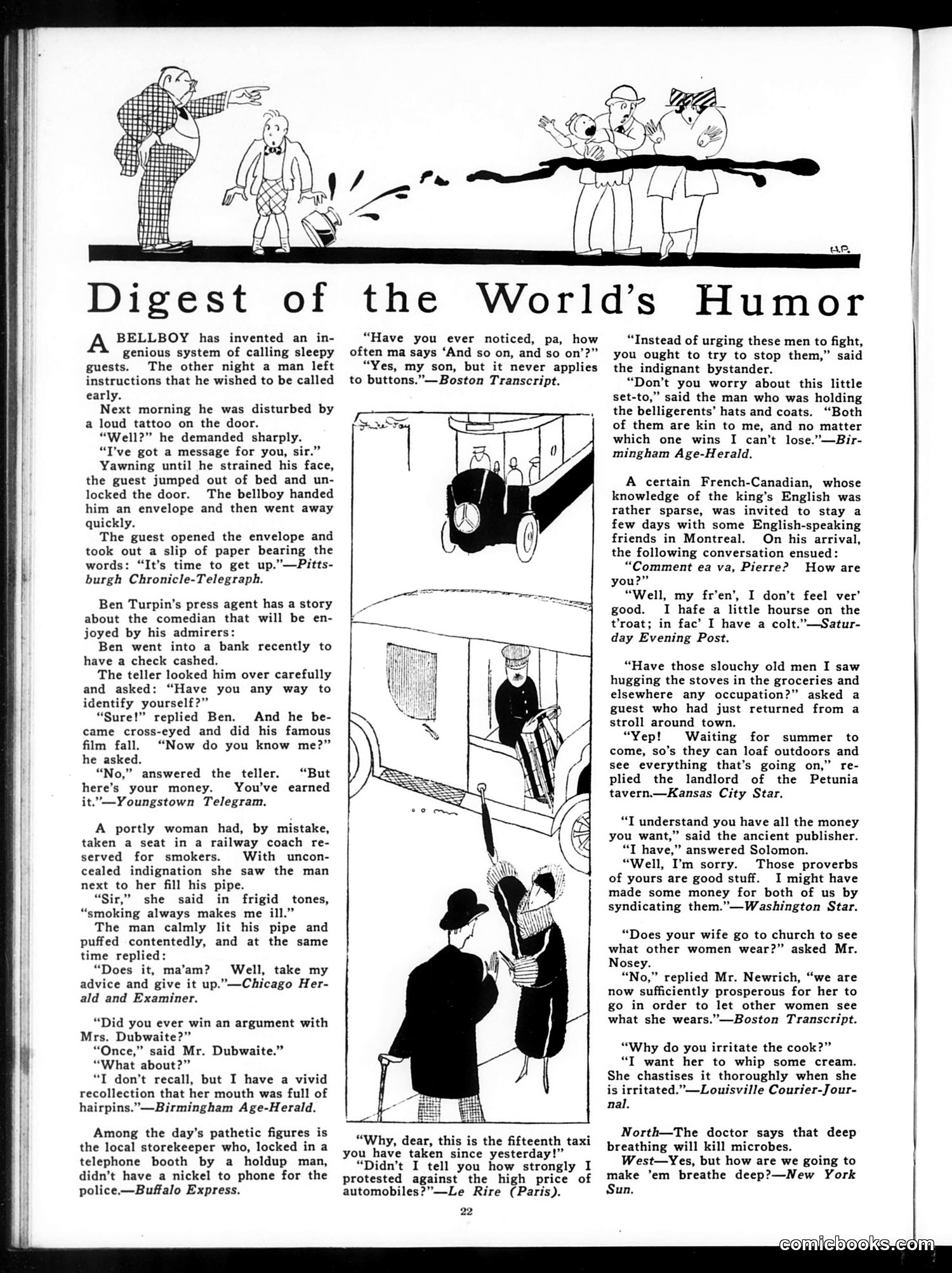
This page collects humorous anecdotes from newspapers worldwide, reflecting early 20th-century comedy tastes. The cartoons and jokes target: **Social pretension**: A newly wealthy man ("Newrich") displays prosperity anxieties; a French-Canadian's broken English marks him as outsider. **Gender dynamics**: A woman's complaint about smoking is dismissed; wives' repetitive speech and fashion-obsession are mocked. **Class commentary**: Unemployed men "waiting for summer" to loaf; a storekeeper locked in a phone booth can't afford a nickel to call police—highlighting poverty during apparent prosperity. **Marital conflict**: A husband's single "argument win" came when his wife's mouth was full of hairpins (domestic frustration humor). **Economic critique**: Someone protests taxi fares by taking fifteen taxis—absurdist logic mocking consumerism. The page's tone is genteel satire aimed at middle-class readers, with ethnic caricature and gender stereotypes typical of 1920s-era mainstream humor.
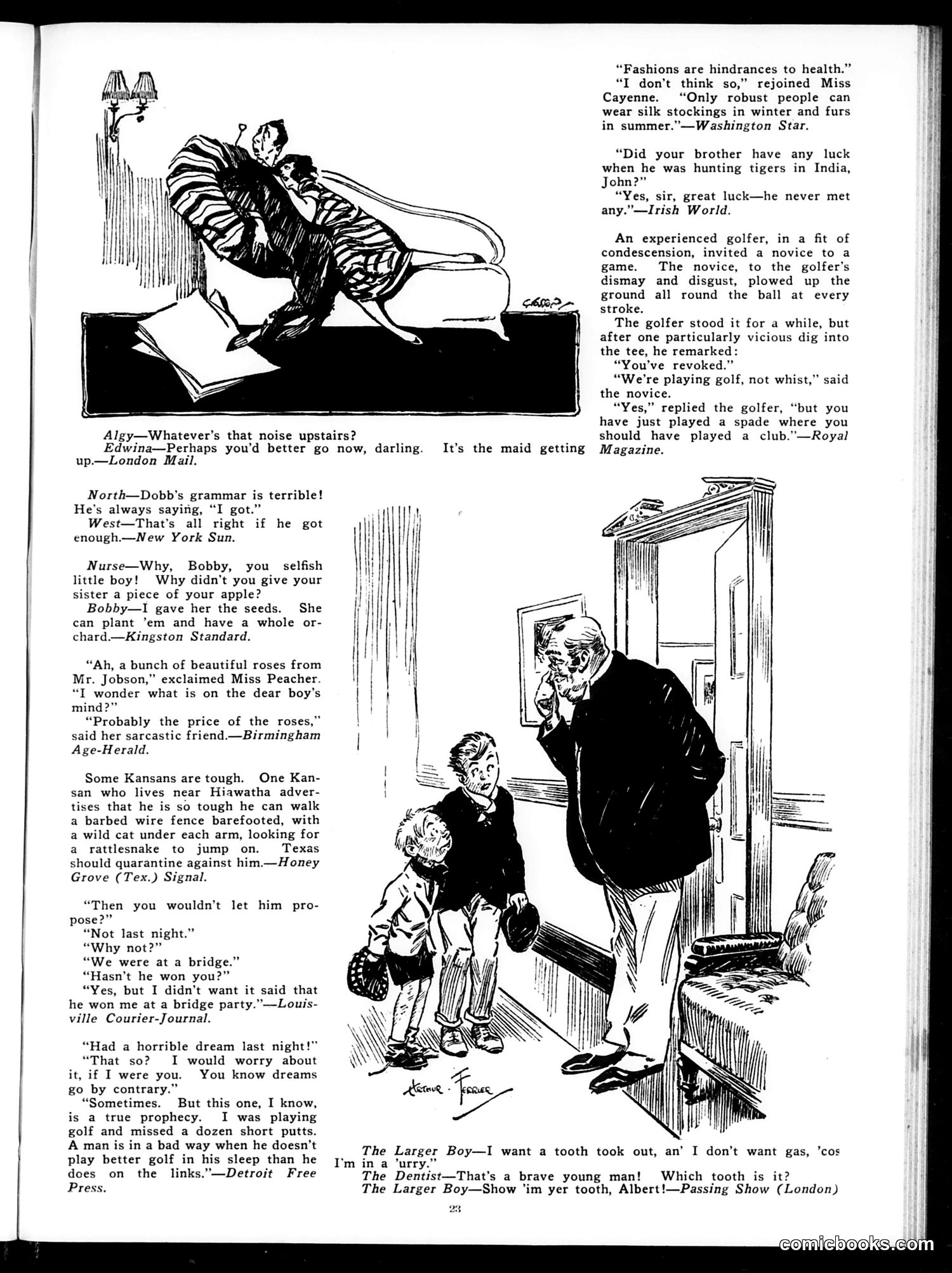
This page contains humorous anecdotes and two cartoon illustrations typical of early 20th-century American satirical journalism. **Top cartoon**: Shows a woman in exaggerated striped clothing reclining dramatically on furniture. The dialogue references servants and domestic disruption—likely satirizing fashion's impracticality or women's theatrical behavior. **Bottom cartoon**: Depicts an older man (likely a dentist or authority figure) with two young boys at a doorway. One boy requests tooth extraction without anesthesia because he's "in a hurry," while his companion is told to show his tooth. This satirizes working-class stoicism and youthful bravado. The surrounding text consists of brief jokes and anecdotes from various newspapers, mocking: - Fashion contradictions (silk stockings in winter claimed as "robust") - Golf etiquette violations by novices - Grammar mistakes - Kansas toughness stereotypes - Romantic miscalculations The humor relies on wordplay, social pretension, and class-based observations typical of period magazines aimed at educated, middle-class readers.
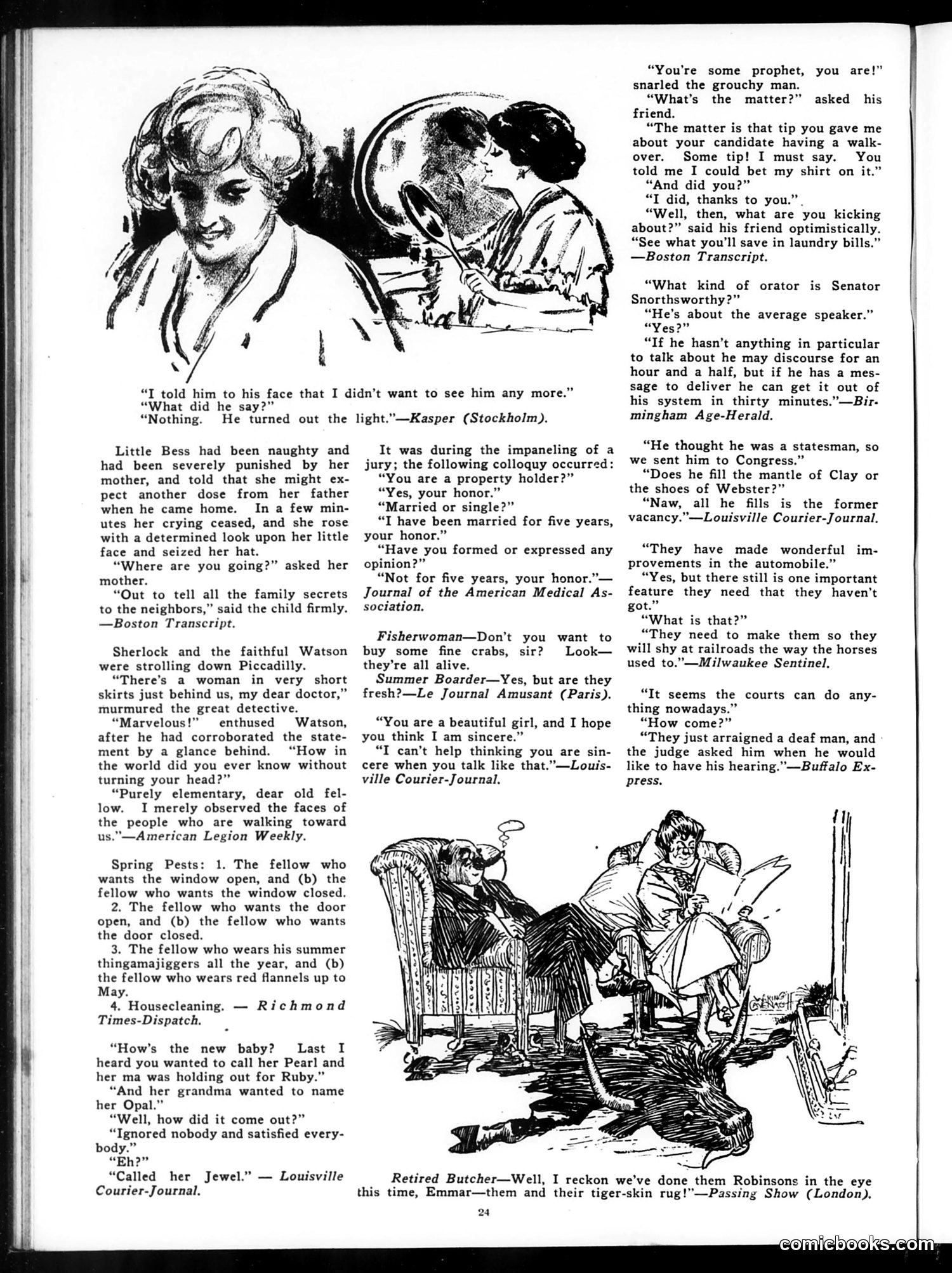
This page from *Judge* contains multiple short humor pieces typical of early 20th-century American satirical magazines. The cartoons and jokes mock everyday social situations and public figures. **Key content includes:** - A Sherlock Holmes parody satirizing the famous detective's deductive powers—Watson is fooled by a woman in short skirts, humor reflecting anxiety about changing women's fashion - Domestic humor about a punished child threatening to reveal family secrets as blackmail - A political joke about Senator Snorthsworthy (fictional), mocking long-winded politicians who speak extensively about nothing - Jokes about spring annoyances, baby naming disputes, and jury selection - Automobiles being criticized for not "shy" at railroads like horses—nostalgia for the horse-drawn era The humor reflects concerns about modern life, women's liberation, political incompetence, and technological change—themes resonating with early 1900s audiences adapting to rapidly shifting social norms.
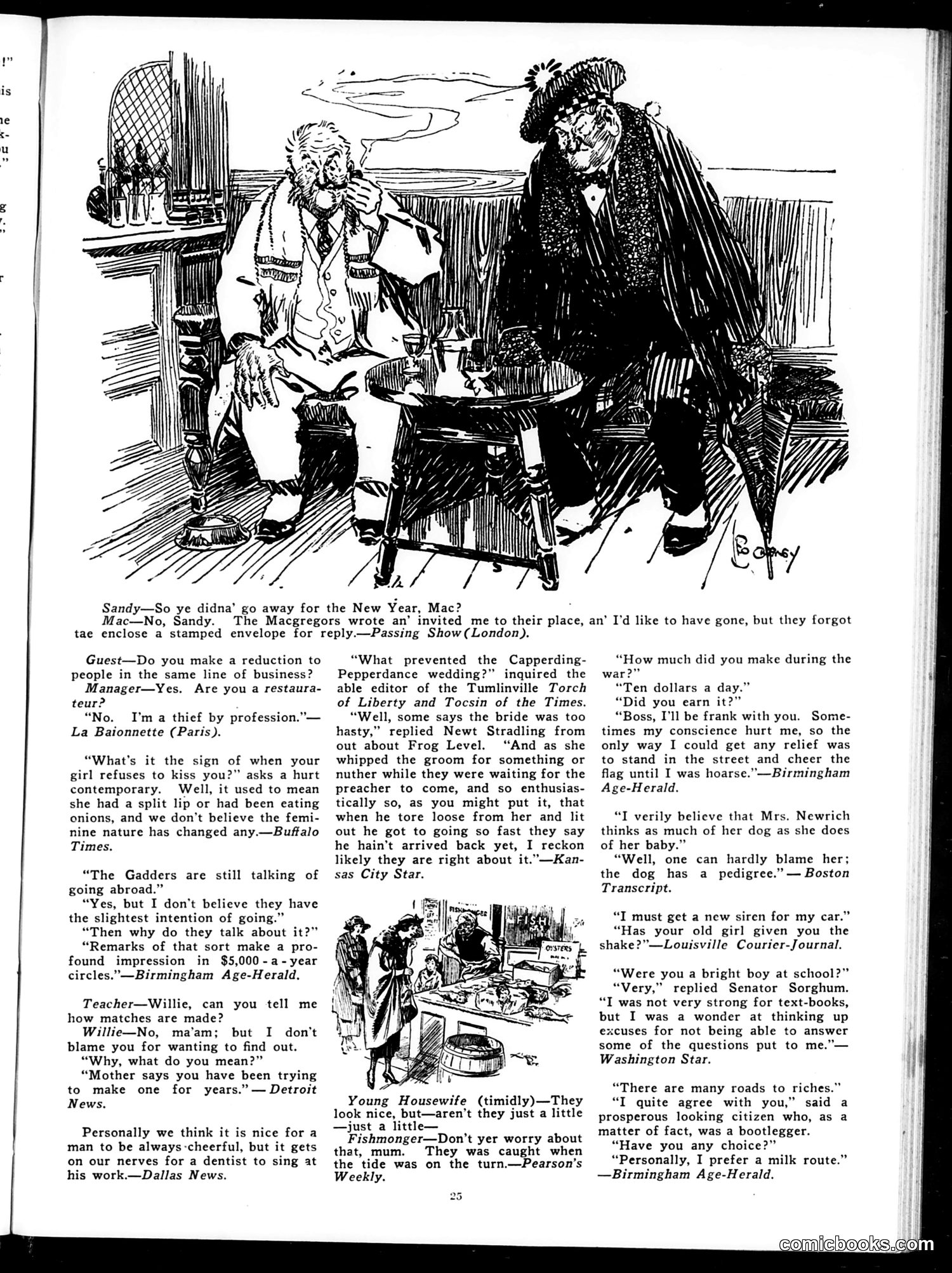
The top cartoon shows two Scottish men (indicated by dialect and kilts) discussing why one didn't travel for New Year—a common holiday getaway. The Macgregors invited him but forgot to include postage for the reply, so he couldn't accept. The joke is about social class and forgetfulness among the wealthy. The page is primarily composed of **brief satirical quips** from various newspapers and magazines, covering common themes: - **Class anxiety**: Wealthy people ("$5,000-a-year circles") pretend travel plans to impress - **War profiteering**: A worker admitted cheering flags for relief rather than honest work - **Prohibition era bootlegging**: A "prosperous citizen" is revealed as a bootlegger choosing the milk route to riches - **Gender/marriage satire**: A bride so violent she drives away her groom - **Pet snobbery**: A nouveau riche woman values her dog's pedigree over her baby These snippets lampoon American social pretension, wartime hypocrisy, and emerging 1920s consumer culture.
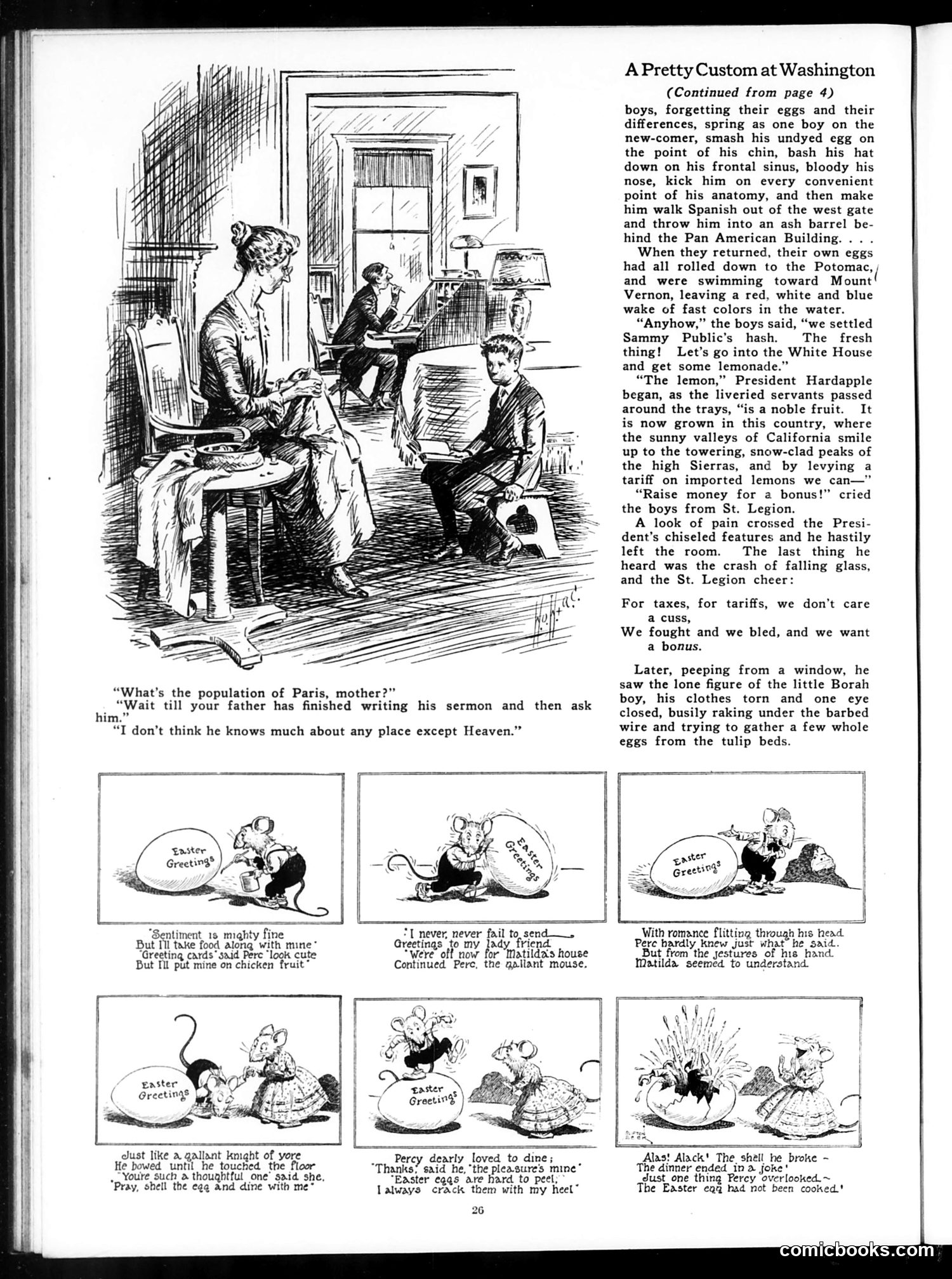
This page contains two distinct pieces of satirical content: **Upper Section — "A Pretty Custom at Washington":** A story mocking Easter egg traditions at the White House during President Harding's administration. Boys from the "St. Legion" (likely veterans' organizations) crash an Easter egg event, beat up a newcomer, then interrupt a presidential lecture on tariffs and lemons by demanding a "bonus"—likely referencing WWI veterans' demands for payment. The satire targets both rowdy veterans and Harding's verbose, disconnected political rhetoric. **Lower Section — Mouse Comics:** A series of six comic strips featuring anthropomorphic mice exchanging Easter greetings and attempting courtship. One mouse character named Percy tries impressing a lady mouse but fumbles the romance, culminating in him cracking a raw egg on himself because it was uncooked—a physical comedy punchline with no deeper political meaning. The page ridicules Harding-era politics while mixing in lighthearted holiday humor, typical of Judge's approach to contemporary social commentary.
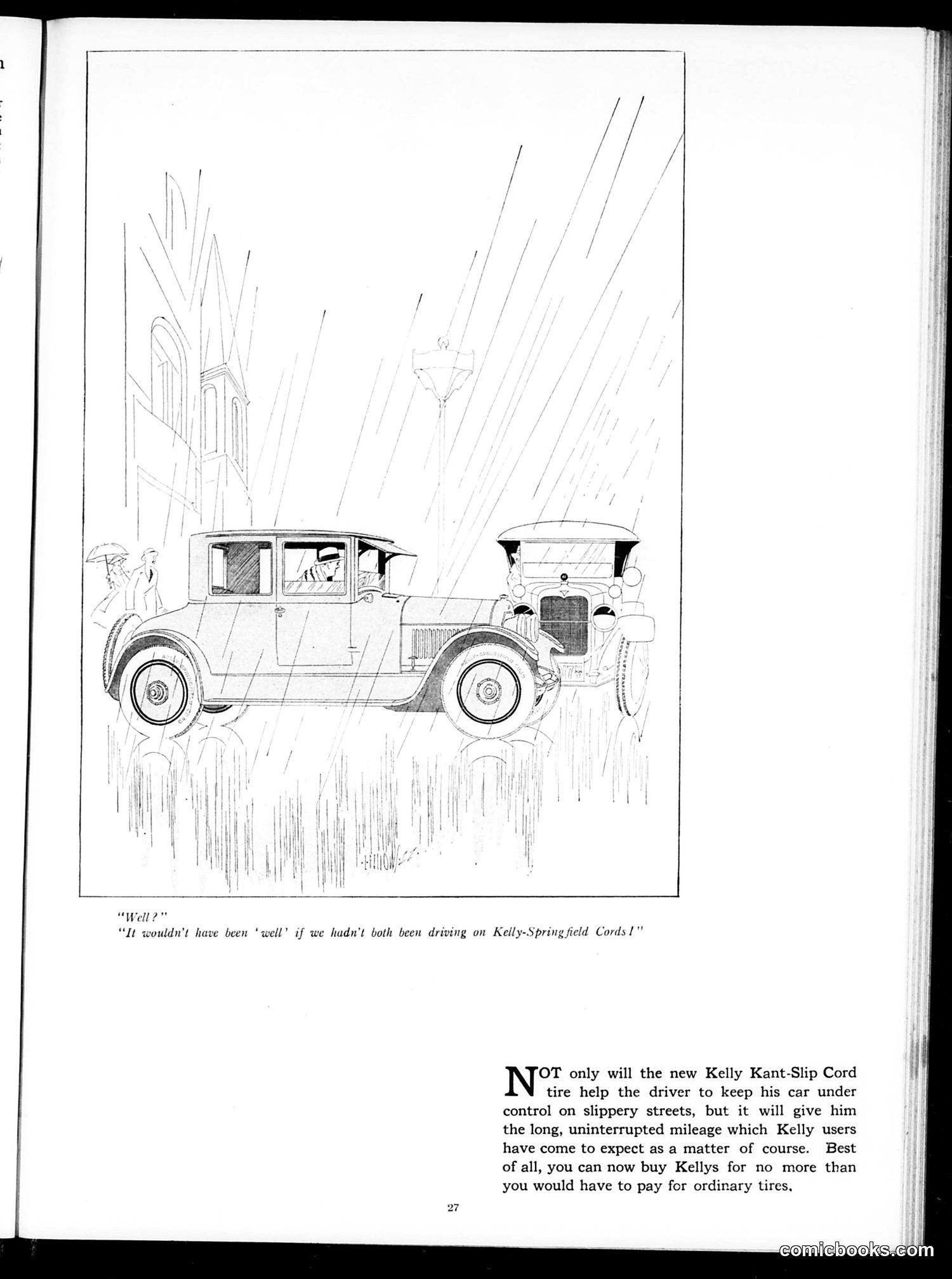
This is a **tire advertisement disguised as a cartoon joke** from Judge magazine. Two cars have nearly collided in heavy rain on a slippery street. The drivers are exchanging remarks—one asking "Well?" (implying blame or concern), the other responding that the accident was avoided *because* both were using Kelly-Springield Cord tires. The satire is subtle: the "joke" isn't actually funny by modern standards. Instead, Judge is using a near-disaster scenario to advertise Kelly tires' superior grip on wet roads. The punchline essentially endorses the product: good tire choice prevented catastrophe. The accompanying text emphasizes Kelly's "Kant-Slip" technology for traction, durability ("long, uninterrupted mileage"), and price competitiveness. This is early automotive advertising leveraging safety concerns—a persuasion technique still used today, though this execution reads more as straightforward promotion than satire.
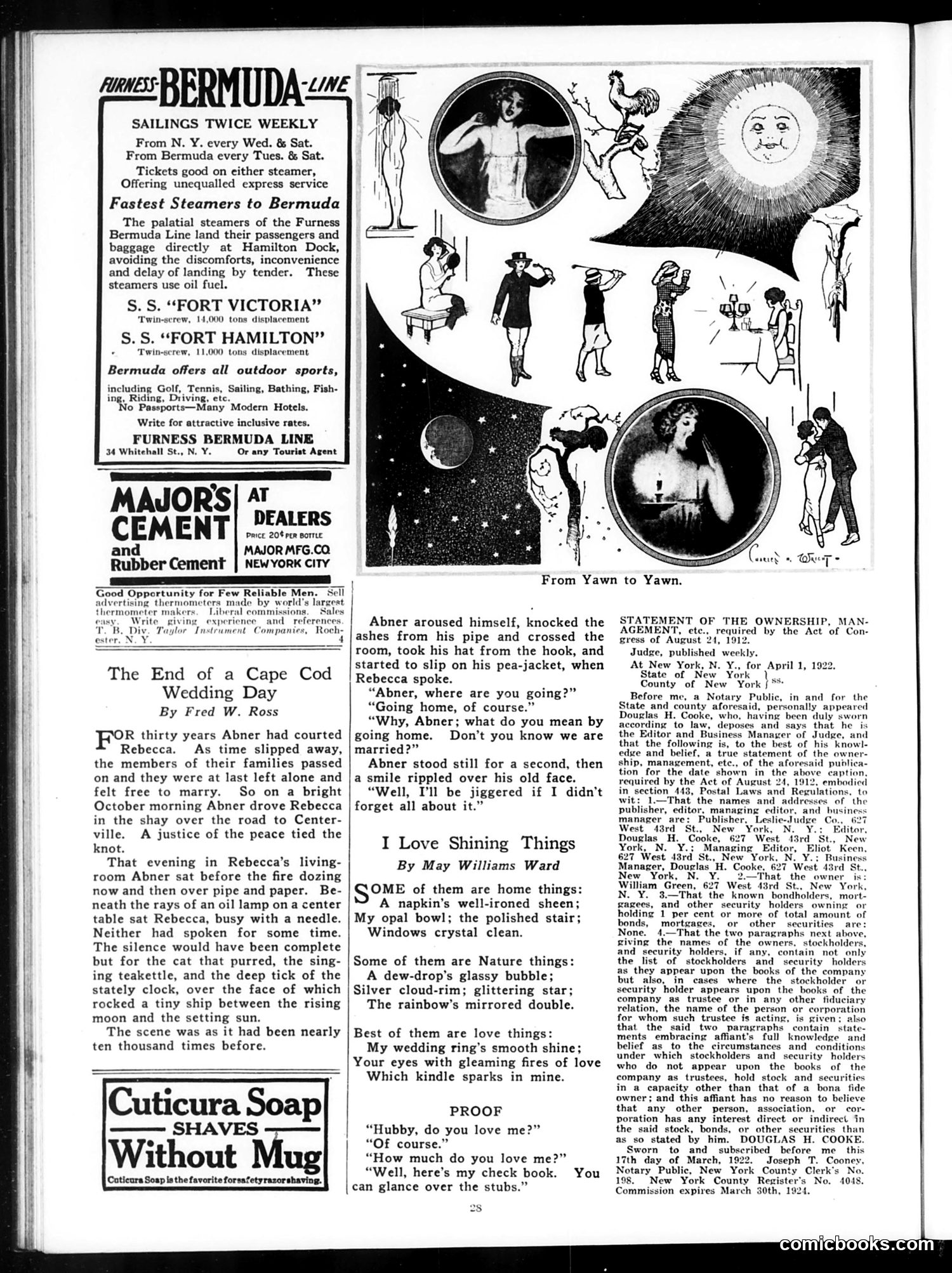
This page contains primarily **advertising and fiction** rather than political satire. The main content includes: **"The End of a Cape Cod Wedding Day"** — a humorous short story about an elderly couple, Abner and Rebecca, who marry after 30 years of courtship. The joke: after the wedding, Abner automatically heads home as usual, forgetting he's now married. It's gentle domestic humor reflecting early 1920s rural American life. **Supporting poems and jokes** about "shining things" and marital love ("Hubby, do you love me?") employ the era's sentimental-yet-ironic tone common to Judge magazine. **The visual cartoon** (upper right, labeled "From Yawn to Yawn") appears to satirize boredom in marriage through domestic scenes. The page is dominated by **period advertisements**: Furness Bermuda Line steamship travel, Major's rubber cement, Cuticura Soap, and employment opportunities — typical of magazine monetization in this era. No identifiable political figures or specific contemporary events are referenced; the content targets general domestic life and consumer goods.
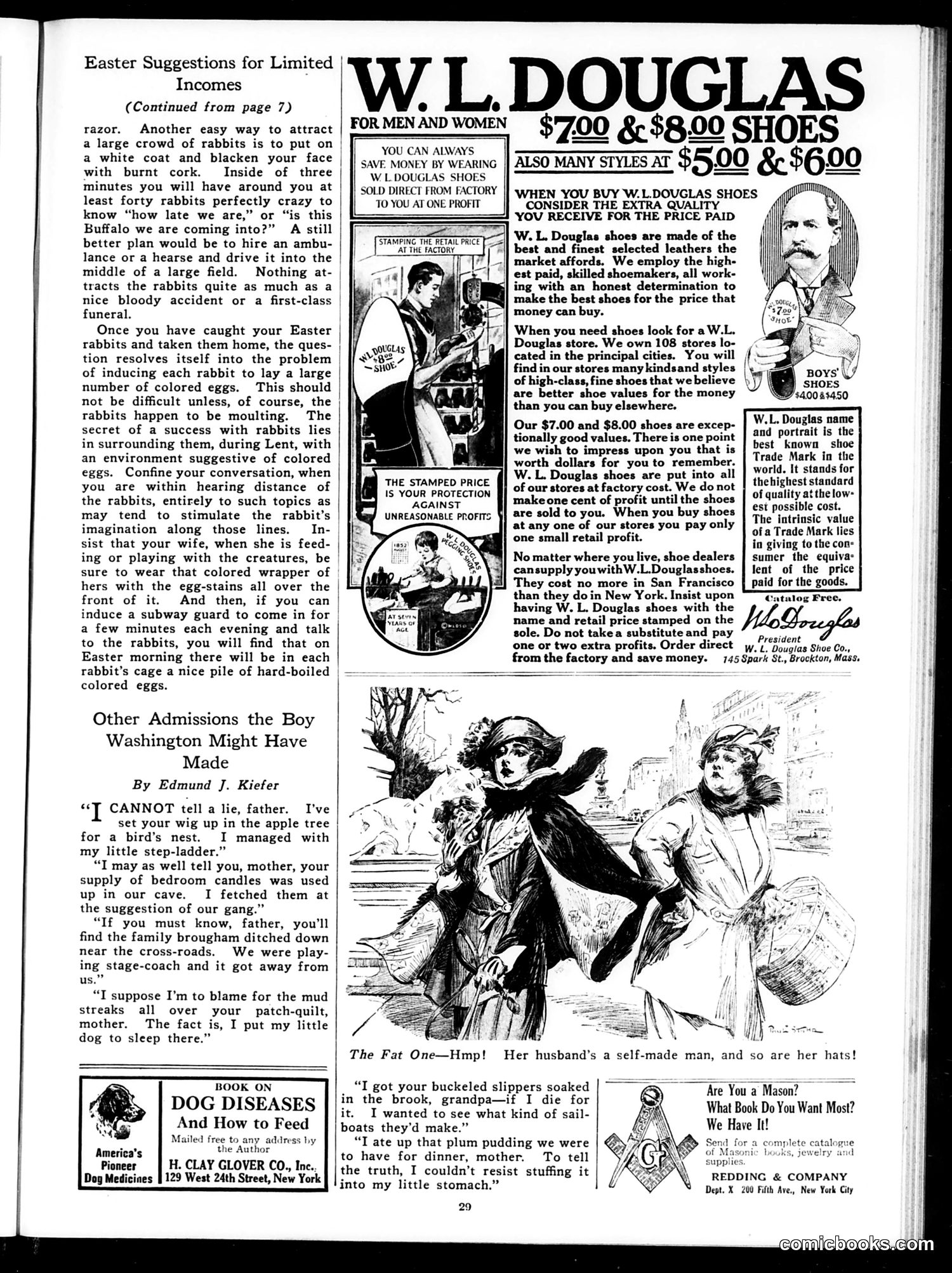
This page combines advertising with satirical humor typical of early 20th-century Judge magazine. **Main Content:** The centerpiece is "Other Admissions the Boy Washington Might Have Made" by Edmund J. Kiefer—a satire on the famous (likely apocryphal) story of young George Washington confessing to chopping down his father's cherry tree. The piece humorously invents OTHER confessions Washington might have made: damaging a wig, using candles, wrecking a carriage, and dirtying quilts. The joke relies on the reader's familiarity with the cherry-tree legend and satirizes both that myth and the expectation of childhood obedience. **Supporting Material:** The page opens with "Easter Suggestions for Limited Incomes"—absurdist advice on catching rabbits and making them lay colored eggs, using ridiculous methods (blackface, hearses, colored wrappers). This is comedic nonsense playing on Easter traditions. **Advertisements:** The W.L. Douglas shoe ad dominates the right side, emphasizing factory-direct sales and quality, with portraits of the company founder. A dog-medicine book advertisement appears at bottom. The humor assumes reader familiarity with American folklore and commercial appeals of the era.
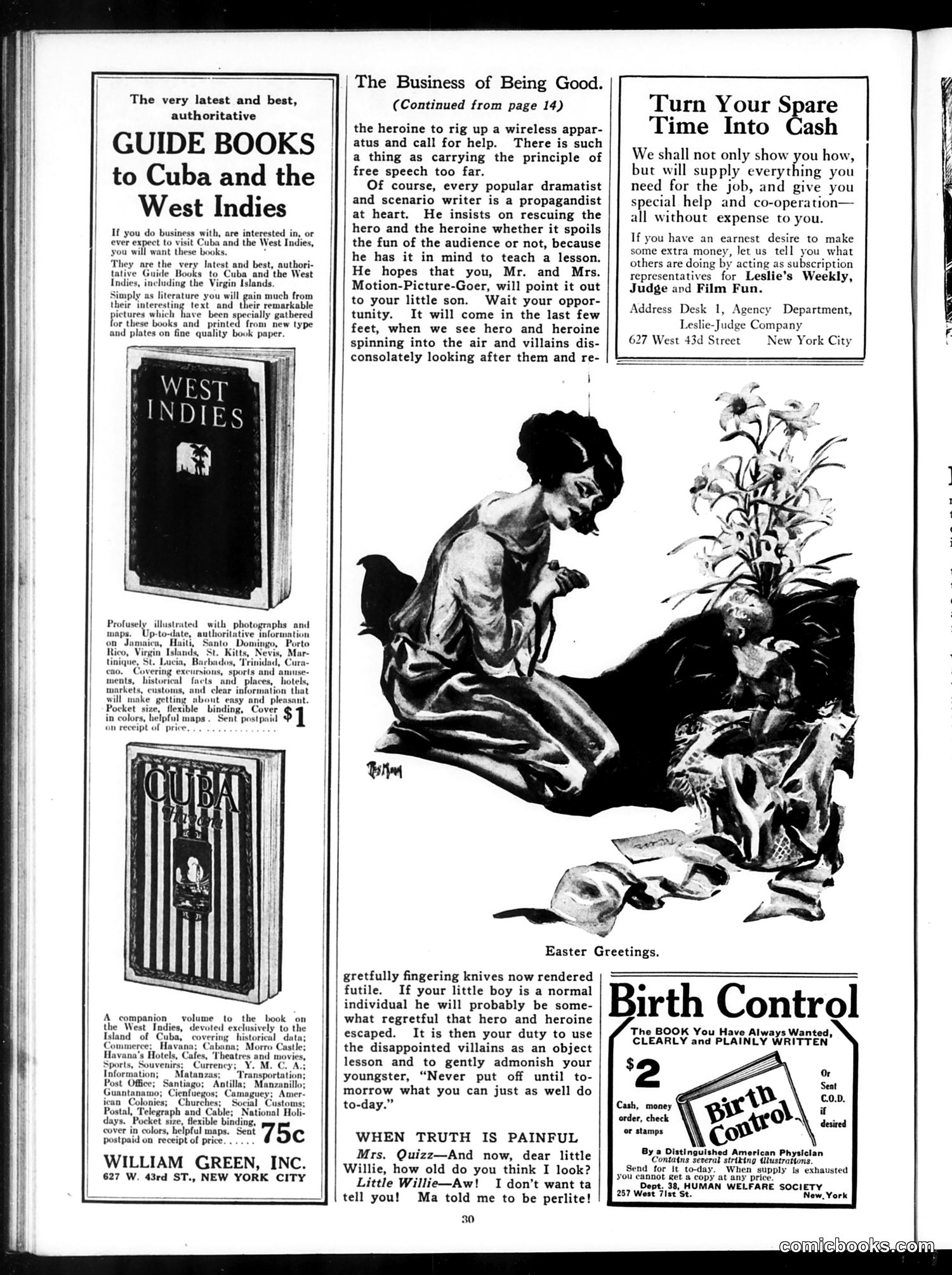
This page is primarily advertising, with some editorial content interspersed. **Main Advertisements:** - **Left side**: Guide books to Cuba and the West Indies, published by William Green, Inc.—promotional materials for Caribbean travel. - **Right side**: "Turn Your Spare Time Into Cash"—a subscription solicitation scheme for Judge, Leslie's Weekly, and Film Fun magazines. - **Lower right**: A Birth Control book advertisement, presented as medically authoritative. **Editorial Content:** - "The Business of Being Good" (top center): Satirizes motion-picture moralists who insist on happy endings and "lessons" for children, despite audience preference for dramatic villainy. - "Easter Greetings" illustration (center): Shows a woman with spring flowers—seasonal holiday imagery. - "When Truth is Painful" (bottom): A brief joke about a child tactfully avoiding telling an adult her appearance. The page reflects Judge magazine's mix of satire, light humor, and direct-mail advertising typical of early 20th-century publications.
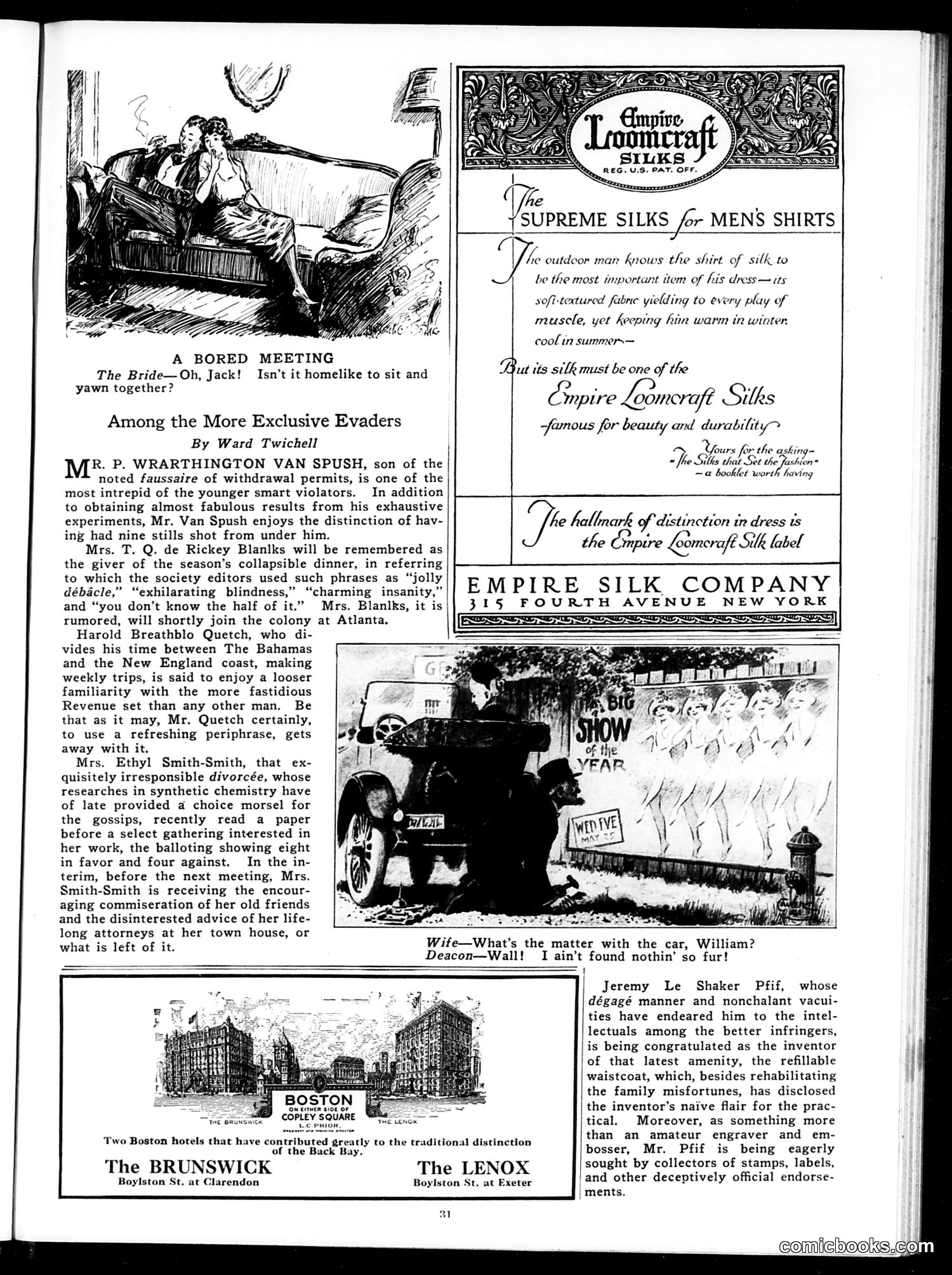
This Judge magazine page satirizes Prohibition-era tax evasion and lawbreaking among the wealthy elite. The article "Among the More Exclusive Evaders" mocks socialites who flagrantly violate laws: - **Mr. Van Spush** runs illegal stills (nine confiscated by authorities) - **Mrs. Blankks** hosts scandalous parties ("collapsible dinner") - **Mr. Quetch** enjoys friendly relations with Revenue agents - **Mrs. Smith-Smith** conducts chemistry experiments (likely bootlegging-related) - **Jeremy Le Shaker Pfif** is congratulated for inventing a "refillable waistcoat" and creating counterfeit stamps and endorsements The satire's point: wealthy "smart violators" openly break Prohibition and tax laws with impunity, while charming society and bribing officials. The humor derives from Judge naming these fictional characters with absurdly pretentious names and cataloging their crimes as if they were mere social accomplishments—mocking how the rich faced no real consequences during Prohibition.
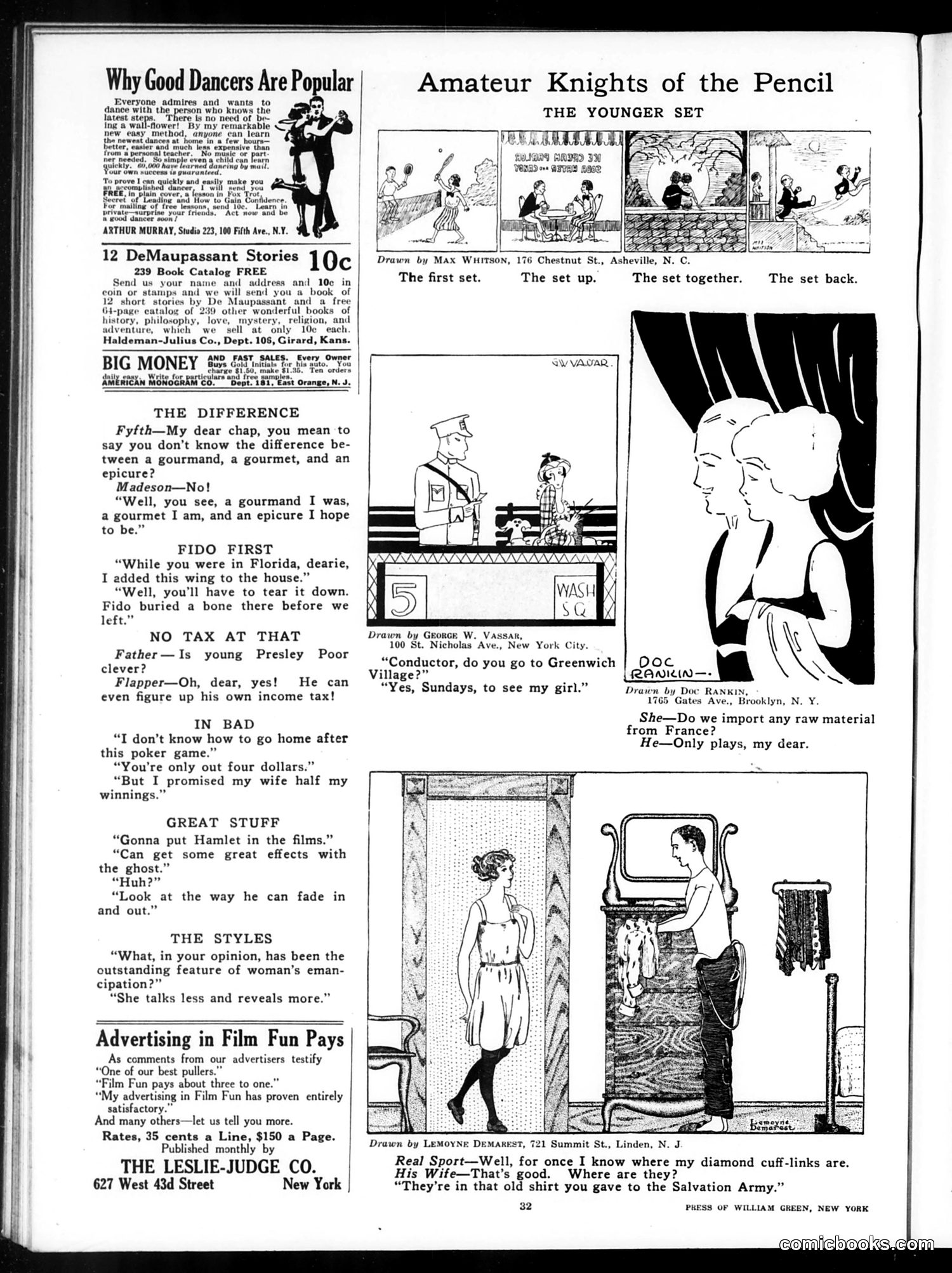
This page contains multiple brief jokes and cartoons typical of early 20th-century American humor magazines, presented without obvious political content. The cartoons satirize domestic and social situations: a wife concerned her husband buried a bone in new construction (mocking dogs' priorities); a young man unable to face his wife after losing at poker; a flapper praising a suitor for calculating his own taxes (satirizing youth or gender relations); and confusion about whether raw materials from France are actual goods or theatrical plays (mocking France's cultural exports, particularly theater and art). The longest cartoon sequence, "Amateur Knights of the Pencil: The Younger Set," illustrates children playing outdoors through four panels showing setup, socializing, and relaxation. Other jokes target women's emancipation ("talks less and reveals more") and reference Greenwich Village bohemian culture. The page is primarily advertisements interspersed with light, society-focused humor rather than serious political satire.
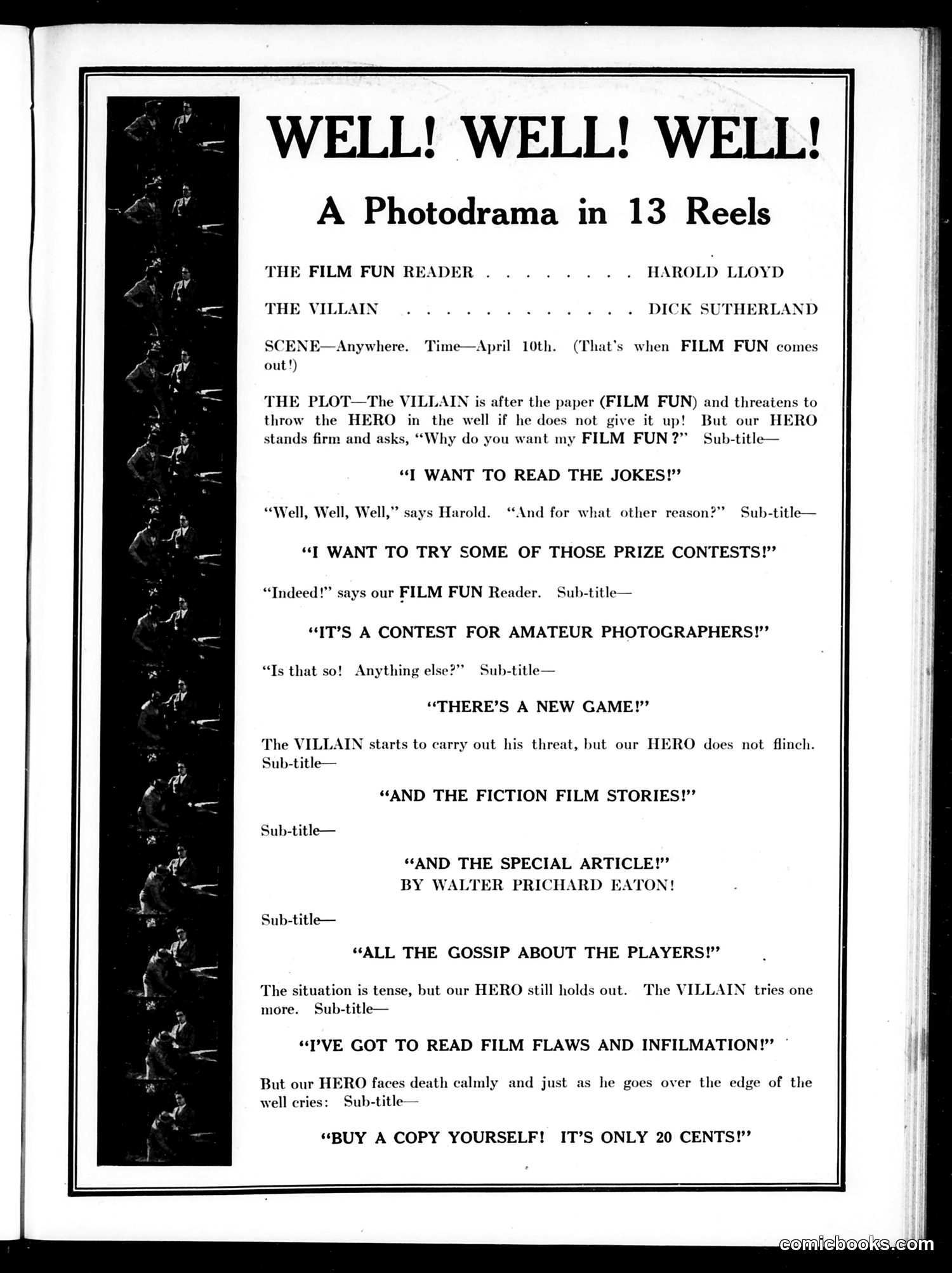
This is a promotional piece for *Film Fun* magazine (arriving April 10th), styled as a silent-film melodrama. It's not political satire but rather self-promotional advertising disguised as entertainment. The "plot" features Harold Lloyd (the famous silent-film comedian) as the hero and Dick Sutherland as a villain threatening to throw Lloyd down a well unless he surrenders his copy of *Film Fun*. Lloyd refuses, breathlessly listing the magazine's appeals: jokes, photography contests, fiction stories, an article by Walter Prichard Eaton, and gossip about actors. As he faces death, he makes a final pitch to readers to buy the magazine themselves for twenty cents. The humor relies on silent-film tropes (melodrama, intertitles, over-the-top stakes) to comedically exaggerate *Film Fun's* desirability. It's essentially meta-advertising: using the very medium the magazine covers to market itself.
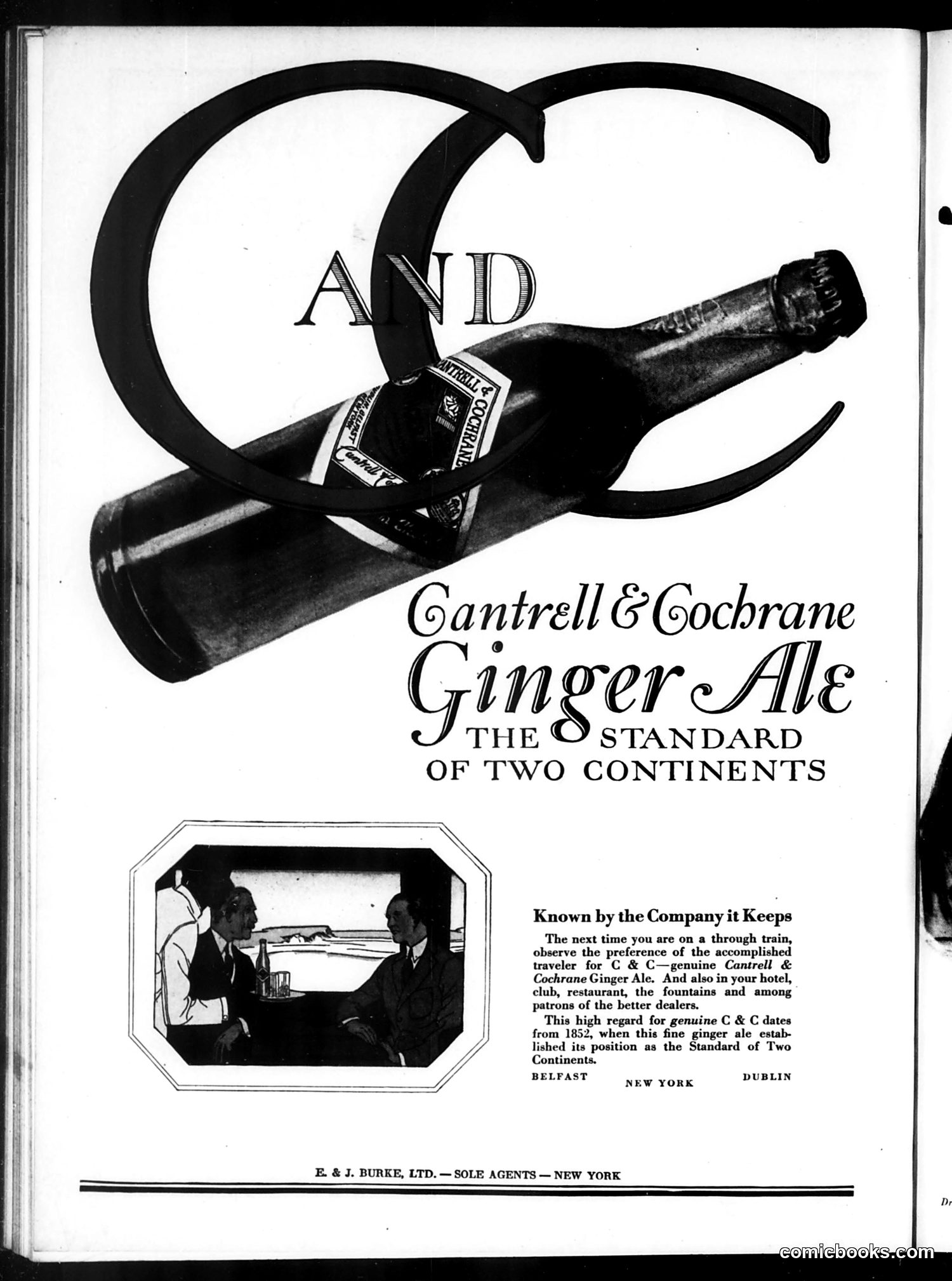
This is primarily an **advertisement**, not political satire. The page promotes Cantrell & Cochrane Ginger Ale, an Irish-produced beverage established in 1852. The large decorative "C&C" lettering frames a bottle of the product. Below is a small illustration showing two well-dressed men in conversation aboard what appears to be a train, reinforcing the ad's claim that "accomplished travelers" prefer this brand. The marketing strategy emphasizes **class and sophistication**—the product is "known by the company it keeps," appearing in luxury settings (trains, hotels, clubs, restaurants) frequented by the elite. The phrase "Standard of Two Continents" refers to the brand's availability in both Europe (Belfast, Dublin) and North America (New York), suggesting international prestige and quality. This reflects early 20th-century advertising techniques emphasizing aspiration and social status rather than product features.