
Judge, 1922-04-15 · page 16 of 36
Judge — April 15, 1922 — page 16: what you’re looking at
What you’re looking at
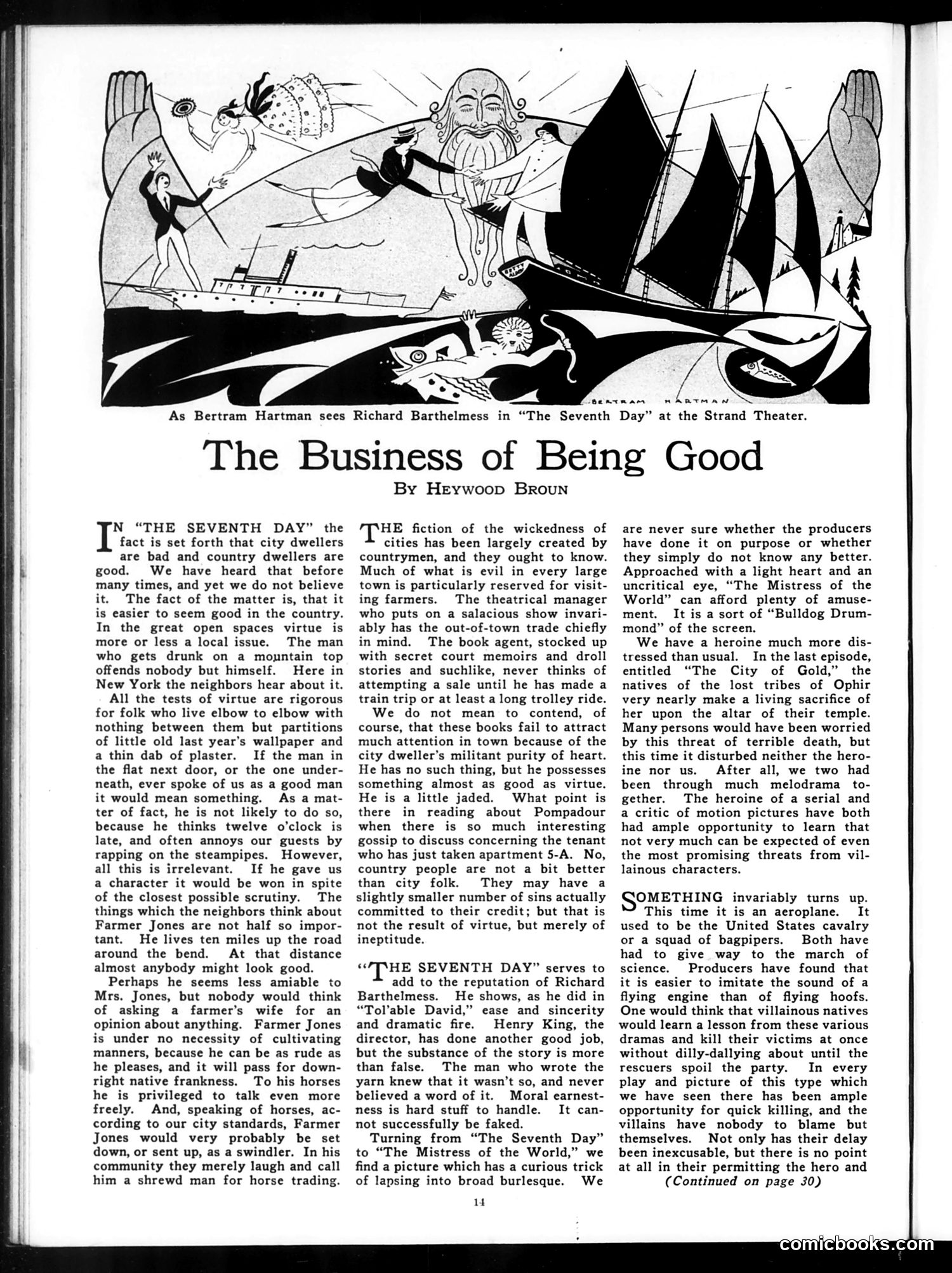
This page reviews "The Seventh Day," a 1920s silent film starring Richard Barthelmess. The illustration shows a melodramatic scene with sailors, ships, and exaggerated figures typical of film advertising. Heywood Broun's article satirizes the film's central moral premise: that country dwellers are virtuous while city dwellers are corrupt. Broun argues this is false mythology. His key point: rural "goodness" is easier only because rural misconduct affects fewer witnesses. A drunk farmer on a mountain harms no one; an intoxicated New Yorker disturbs neighbors through thin walls. Similarly, country residents appear more moral not from virtue but from *limited opportunity* for misbehavior and limited scrutiny. Broun praises lead actor Barthelmess's performance but dismisses the story as dishonest moralizing—"the man who wrote the yarn knew that it wasn't so." The satire targets both sentimental cinema and the rural-virtue myth it perpetuates.
📄 Transcribed text from this page (OCR, searchable)
Machine-transcribed from the original scan — historical spelling and the odd misread are preserved.
N “THE SEVENTH DAY” the fact is set forth that city dwellers are bad and country dwellers are good. We have heard that before many times, and yet we do not believe it. The fact of the matter is, that it is easier to seem good in the country. In the great open spaces virtue is more or less a local issue. The man who gets drunk on a monntain top offends nobody but himself. Here in New York the neighbors hear about it. All the tests of virtue are rigorous for folk who live elbow to elbow with nothing between them but partitions of little old last year’s wallpaper and a thin dab of plaster. If the man in the flat next door, or the one under- neath, ever spoke of us as a good man it would mean something. As a mat- ter of fact, he is not likely to do so, because he thinks twelve o'clock is late, and often annoys our guests by rapping on the steampipes. However, all this is irrelevant. If he gave us a character it would be won in spite of the closest possible scrutiny. The things which the neighbors think about Farmer Jones are not half so impor- tant. He lives ten miles up the road around the bend. At that distance almost anybody might look good. Perhaps he seems less amiable to Mrs. Jones, but nobody would think of asking a farmer’s wife for an opinion about anything. Farmer Jones is under no necessity of cultivating manners, because he can be as rude as he pleases, and it will pass for down- right native frankness. To his horses he is privileged to talk even more freely. And, speaking of horses, ac- cording to our city standards, Farmer Jones would very probably be set down, or sent up, as a swindler. In his community they merely laugh and call him a shrewd man for horse trading. As Bertram Hartman sees Richard Barthelmess in “The Seventh Day” at the Strand Theater. The Business of Being Good By Heywoop Broun HE fiction of the wickedness of cities has been largely created by countrymen, and they ought to know. Much of what is evil in every large town is particularly reserved for visit- ing farmers. The theatrical manager who puts on a salacious show invari- ably has the out-of-town trade chiefly in mind. The book agent, stocked up with secret court memoirs and droll stories and suchlike, never thinks of attempting a sale until he has made a train trip or at least a long trolley ride. We do not mean to contend, of course, that these books fail to attract much attention in town because of the city dweller’s militant purity of heart. He has no such thing, but he possesses something almost as good as virtue. He is a little jaded. What point is there in reading about Pompadour when there is so much interesting gossip to discuss concerning the tenant who has just taken apartment 5-A. No, country people are not a bit better than city folk. They may have a slightly smaller number of sins actually committed to their credit; but that is not the result of virtue, but merely of ineptitude. “/T\HE SEVENTH DAY” serves to add to the reputation of Richard Barthelmess. He shows, as he did in “Tol'able David,” ease and sincerity and dramatic fire. Henry King, the director, has done another good job, but the substance of the story is more than false. The man who wrote the yarn knew that it wasn’t so, and never believed a word of it. Moral earnest- ness is hard stuff to handle. It can- not successfully be faked. Turning from “The Seventh Day” to “The Mistress of the World,” we find a picture which has a curious trick of lapsing into broad burlesque. We 14 are never sure whether the producers have done it on purpose or whether they simply do not know any better. Approached with a light heart and an uncritical eye, “The Mistress of the World” can afford plenty of amuse- ment. It is a sort of “Bulldog Drum- mond” of the screen. We have a heroine much more dis- tressed than usual. In the last episode, entitled “The City of Gold,” the natives of the lost tribes of Ophir very nearly make a living sacrifice of her upon the altar of their temple. Many persons would have been worried by this threat of terrible death, but this time it disturbed neither the hero- ine nor us. After all, we two had been through much melodrama to- gether. The heroine of a serial and a critic of motion pictures have both had ample opportunity to learn that not very much can be expected of even the most promising threats from vil- lainous characters. SOMETHING invariably turns up. This time it is an aeroplane. It used to be the United States cavalry or a squad of bagpipers. Both have had to give way to the march of science. Producers have found that it is easier to imitate the sound of a flying engine than of flying hoofs. One would think that villainous natives would learn a lesson from these various dramas and kill their victims at once without dilly-dallying about until the rescuers spoil the party. In every play and picture of this type which we have seen there has been ample opportunity for quick killing, and the villains have nobody to blame but themselves. Not only has their delay been inexcusable, but there is no point at all in their permitting the hero and (Continued on page 30)