
Judge, 1922-04-15 · page 6 of 36
Judge — April 15, 1922 — page 6: what you’re looking at
What you’re looking at
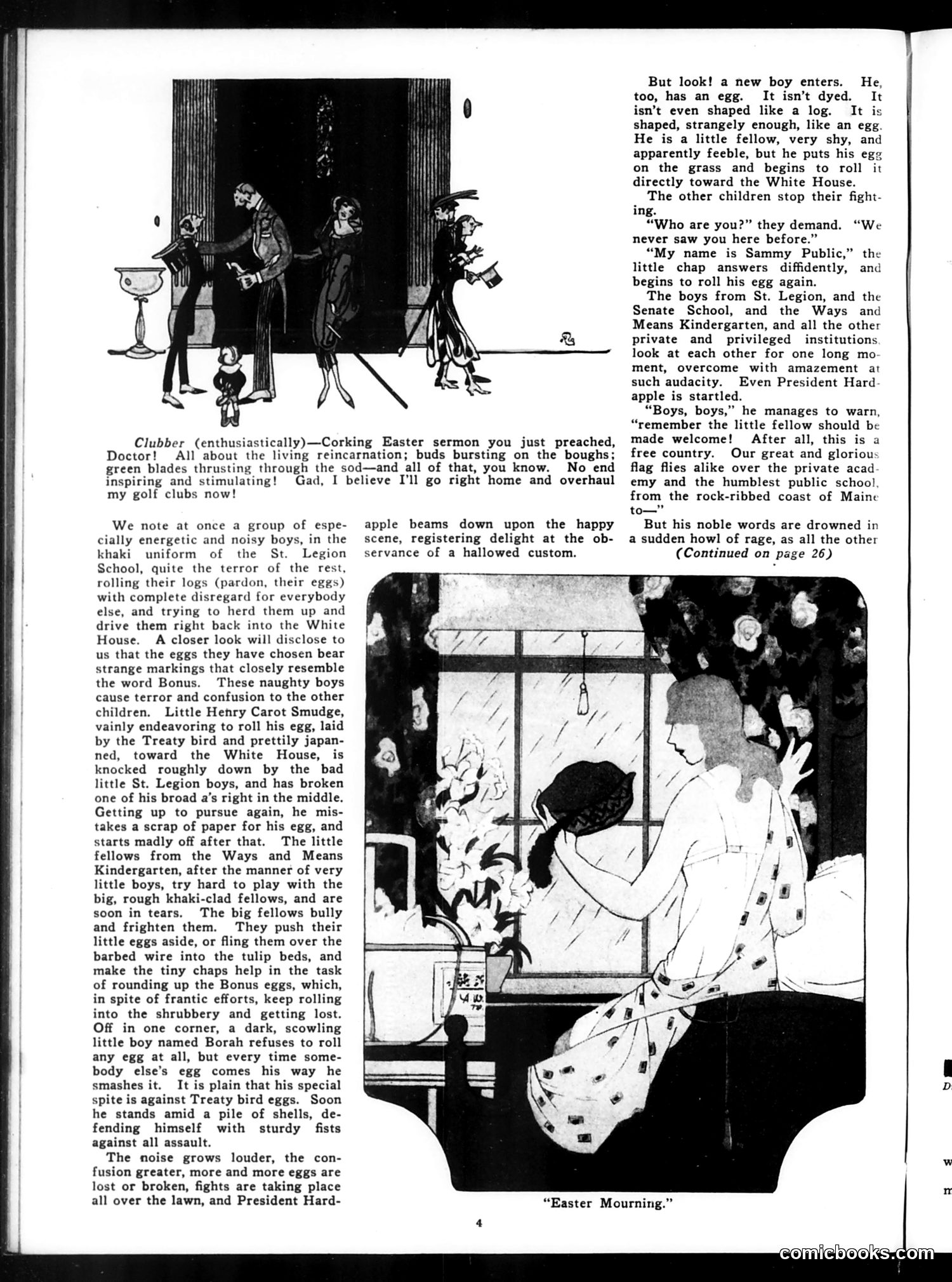
This page satirizes the Easter egg-rolling tradition at the White House lawn. The top illustration depicts well-dressed children from elite schools (St. Legion School, Senate School, Ways and Means Kindergarten) competing aggressively during the egg roll, contrasting their privileged status with working-class children. The narrative mocks how these privileged boys behave badly—rolling eggs toward the White House, breaking eggs, and fighting—while a character named Sammy Public represents an ordinary child who should theoretically be welcome but faces exclusion. The satire criticizes class divisions in America, suggesting that despite democratic ideals, elite institutions train children to dominate public spaces and exclude commoners. The "Easter Mourning" illustration (bottom) appears related to this social commentary about inequality.
📄 Transcribed text from this page (OCR, searchable)
Machine-transcribed from the original scan — historical spelling and the odd misread are preserved.
Clubber (enthusiastically)—Corking Easter sermon you just preached, Doctor! green blades thrusting through the sod—and all of that, you know. Gad, I believe I'll go right home and overhaul inspiring and stimulating! my golf clubs now! We note at once a group of espe- cially energetic and noisy boys, in the khaki uniform of the St. Legion School, quite the terror of the rest, rolling their logs (pardon, their eggs) with complete disregard for everybody else, and trying to herd them up and drive them right back into the White House. A closer look will disclose to us that the eggs they have chosen bear strange markings that closely resemble the word Bonus. These naughty boys cause terror and confusion to the other children. Little Henry Carot Smudge, vainly endeavoring to roll his egg, laid by the Treaty bird and prettily japan- ned, toward the White House, is knocked roughly down by the bad little St. Legion boys, and has broken one of his broad a’s right in the middle. Getting up to pursue again, he mis- takes a scrap of paper for his egg, and starts madly off after that. The little fellows from the Ways and Means Kindergarten, after the manner of very little boys, try hard to play with the big, rough khaki-clad fellows, and are soon in tears. The big fellows bully and frighten them. They push their little eggs aside, or fling them over the barbed wire into the tulip beds, and make the tiny chaps help in the task of rounding up the Bonus eggs, which, in spite of frantic efforts, keep rolling into the shrubbery and getting lost. Off in one corner, a dark, scowling little boy named Borah refuses to roll any egg at all, but every time some- body else’s egg comes his way he smashes it. It is plain that his special spite is against Treaty bird eggs. Soon he stands amid a pile of shells, de- fending himself with sturdy fists against all assault. The noise grows louder, the con- fusion greater, more and more eggs are lost or broken, fights are taking place all over the lawn, and President Hard- All about the living reincarnation; buds bursting on the boughs; No end apple beams down upon the happy scene, registering delight at the ob- servance of a hallowed custom. But look! a new boy enters. He, too, has an egg. It isn’t dyed. It isn’t even shaped like a log. It is shaped, strangely enough, like an egg. He is a little fellow, very shy, and apparently feeble, but he puts his egg on the grass and begins to roll it directly toward the White House. The other children stop their fight- ing. “Who are you?” they demand. never saw you here before.” “My name is Sammy Public,” the little chap answers diffidently, and begins to roll his egg again. The boys from St. Legion, and the Senate School, and the Ways and Means Kindergarten, and all the other private and privileged institutions. look at each other for one long mo. ment, overcome with amazement at such audacity. Even President Hard apple is startled. “Boys, boys,” he manages to warn, “remember the little fellow should be made welcome! After all, this is a free country. Our great and glorious flag flies alike over the private acad emy and the humblest public school, from the rock-ribbed coast of Maine to—” But his noble words are drowned in a sudden howl of rage, as all the other (Continued on page 26) “Easter Mourning.”