
Judge, 1922-04-15 · page 20 of 36
Judge — April 15, 1922 — page 20: what you’re looking at
What you’re looking at
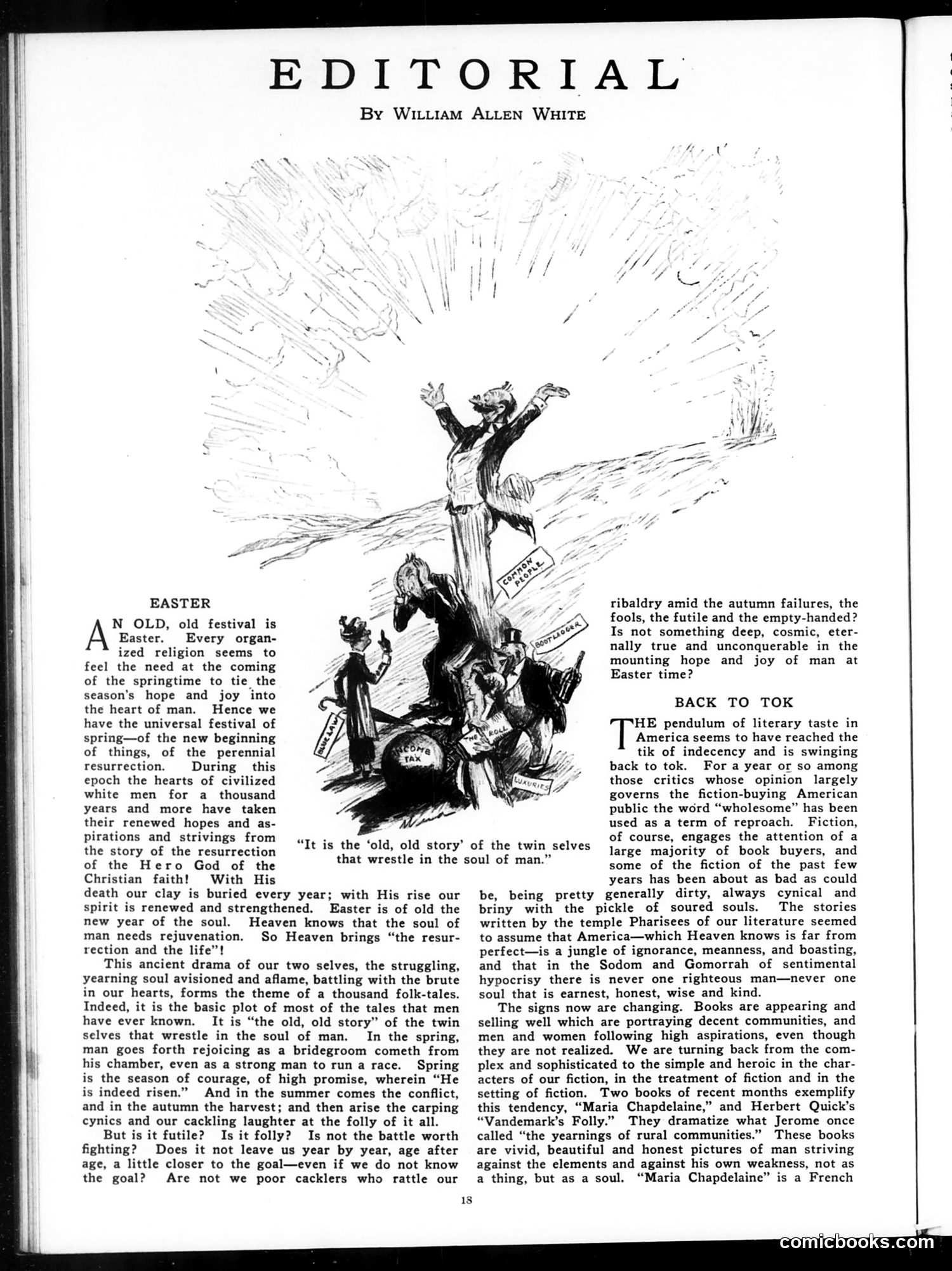
This is an editorial page by William Allen White comprising two pieces on American culture and literature. **"Easter"** is a philosophical reflection on the Easter holiday as expressing humanity's eternal struggle between spiritual aspiration and base instinct—"the old, old story of the twin selves that wrestle in the soul of man." White frames Easter as celebrating resurrection and renewal, arguing this cyclical battle ennobles rather than defeats us. **"Back to Tok"** critiques a recent literary trend. White argues American fiction had become excessively cynical and "dirty," portraying America as hopelessly corrupt. He applauds a course correction toward "wholesome" fiction depicting decent communities and morally earnest characters. He praises recent novels like *Maria Chapdelaine* and *Vandemark's Folly* for returning to honest depictions of people struggling nobly against hardship—representing "the yearnings of rural communities." The cartoon above shows figures celebrating atop a cross-marked hill, visually reinforcing the resurrection theme.
📄 Transcribed text from this page (OCR, searchable)
Machine-transcribed from the original scan — historical spelling and the odd misread are preserved.
EDITORIAL By Witiiam ALLEN WHITE EASTER N OLD, old festival is Easter. Every organ- ized religion seems to feel the need at the coming of the springtime to tie the season’s hope and joy into the heart of man. Hence we have the universal festival of spring—of the new beginning of things, of the perennial resurrection. During this epoch the hearts of civilized white men for a thousand years and more have taken their renewed hopes and as- pirations and strivings from the story of the resurrection of the Hero God of the Christian faith! With His death our clay is buried every year; with His rise our spirit is renewed and strengthened. Easter is of old the new year of the soul. Heaven knows that the soul of man needs rejuvenation. So Heaven brings “the resur- rection and the life”! This ancient drama of our two selves, the struggling, yearning soul avisioned and aflame, battling with the brute in our hearts, forms the theme of a thousand folk-tales. Indeed, it is the basic plot of most of the tales that men have ever known. It is “the old, old story” of the twin selves that wrestle in the soul of man. In the spring, man goes forth rejoicing as a bridegroom cometh from his chamber, even as a strong man to run a race. Spring is the season of courage, of high promise, wherein “He is indeed risen.” And in the summer comes the conflict, and in the autumn the harvest; and then arise the carping cynics and our cackling laughter at the folly of it all. But is it futile? Is it folly? Is not the battle worth fighting? Does it not leave us year by year, age after age, a little closer to the goal—even if we do not know the goal? Are not we poor cacklers who rattle our “It is the ‘old, old story’ of the twin selves that wrestle in the soul of man.” 18 ribaldry amid the autumn failures, the fools, the futile and the empty-handed? Is not something deep, cosmic, eter- nally true and unconquerable in the mounting hope and joy of man at Easter time? BACK TO TOK ‘HE pendulum of literary taste in America seems to have reached the tik of indecency and is swinging back to tok. For a year or so among those critics whose opinion largely governs the fiction-buying American public the word “wholesome” has been used as a term of reproach. Fiction, of course, engages the attention of a large majority of book buyers, and some of the fiction of the past few years has been about as bad as could be, being pretty generally dirty, always cynical and briny with the pickle of soured souls. The stories written by the temple Pharisees of our literature seemed to assume that America—which Heaven knows is far from perfect—is a jungle of ignorance, meanness, and boasting, and that in the Sodom and Gomorrah of sentimental hypocrisy there is never one righteous man—never one soul that is earnest, honest, wise and kind. The signs now are changing. Books are appearing and selling well which are portraying decent communities, and men and women following high aspirations, even though they are not realized. We are turning back from the com- plex and sophisticated to the simple and heroic in the char- acters of our fiction, in the treatment of fiction and in the setting of fiction. Two books of recent months exemplify this tendency, “Maria Chapdelaine,” and Herbert Quick's “Vandemark’s Folly.” They dramatize what Jerome once called “the yearnings of rural communities.” These books are vivid, beautiful and honest pictures of man striving against the elements and against his own weakness, not as a thing, but as a soul. “Maria Chapdelaine” is a French