
Judge, 1922-04-15 · page 10 of 36
Judge — April 15, 1922 — page 10: what you’re looking at
What you’re looking at
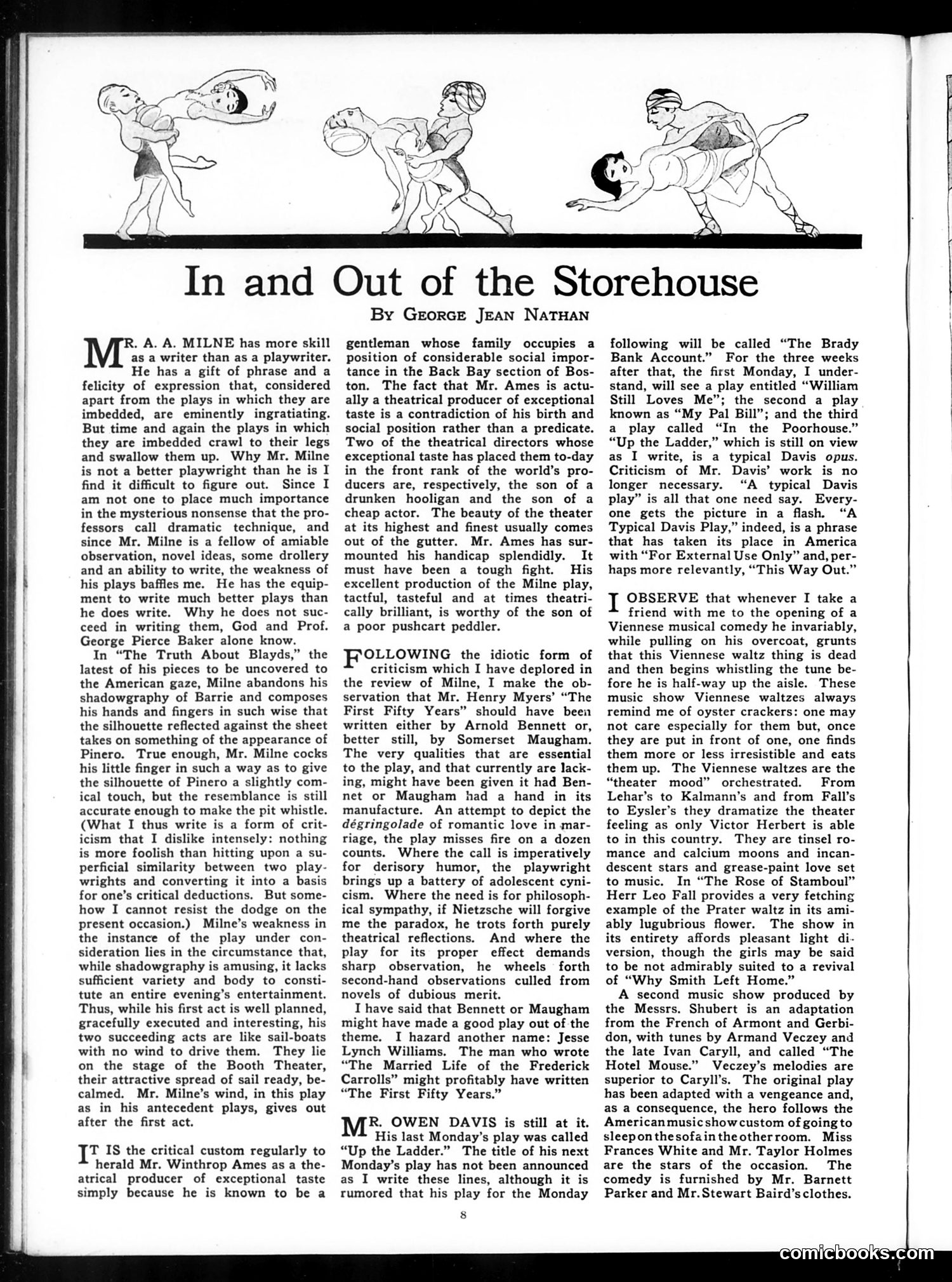
This is a theater review column by George Jean Nathan critiquing recent Broadway plays. The three cartoon vignettes at top illustrate theatrical scenes in a simplified, satirical style typical of Judge magazine. The main text discusses A.A. Milne's play "The Truth About Blayds," performed at the Booth Theater. Nathan praises Milne's writing but faults his dramatic structure—arguing his plays lose momentum after the first act, like "sail-boats with no wind." He uses theatrical silhouettes as metaphor, suggesting Milne's work echoes Pinero rather than Barrie. Nathan also discusses producer Winthrop Ames, noting sardonically that Ames's "exceptional taste" contradicts his privileged Boston background, since "the beauty of the theater...usually comes out of the gutter." The review continues discussing other contemporary plays by Henry Myers and Owen Davis. The column represents typical Judge content: sophisticated cultural criticism with pointed social commentary about theater and class.
📄 Transcribed text from this page (OCR, searchable)
Machine-transcribed from the original scan — historical spelling and the odd misread are preserved.
. A. A. MILNE has more skill as a writer than as a playwriter. He has a gift of phrase and a felicity of expression that, considered apart from the plays in which they are imbedded, are eminently ingratiating. But time and again the plays in which they are imbedded crawl to their legs and swallow them up. Why Mr. Milne is not a better playwright than he is I find it difficult to figure out. Since I am not one to place much importance in the mysterious nonsense that the pro- fessors call dramatic technique, and since Mr. Milne is a fellow of amiable observation, novel ideas, some drollery and an ability to write, the weakness of his plays baffles me. He has the equip- ment to write much better plays than he does write. Why he does not suc- ceed in writing them, God and Prof. George Pierce Baker alone know. In “The Truth About Blayds,” the latest of his pieces to be uncovered to the American gaze, Milne abandons his shadowgraphy of Barrie and composes his hands and fingers in such wise that the silhouette reflected against the sheet takes on something of the appearance of Pinero. True enough, Mr. Milne cocks his little finger in such a way as to give the silhouette of Pinero a slightly com- ical touch, but the resemblance is still accurate enough to make the pit whistle. (What I thus write is a form of crit- icism that I dislike intensely: nothing is more foolish than hitting upon a su- perficial similarity between two play- wrights and converting it into a basis for one’s critical deductions. But some- how I cannot resist the dodge on the present occasion.) Milne’s weakness in the instance of the play under con- sideration lies in the circumstance that, while shadowgraphy is amusing, it lacks sufficient variety and body to consti- tute an entire evening’s entertainment. Thus, while his first act is well planned, gracefully executed and interesting, his two succeeding acts are like sail-boats with no wind to drive them. They lie on the stage of the Booth Theater, their attractive spread of sail ready, be- calmed. Mr. Milne’s wind, in this play as in his antecedent plays, gives out after the first act. It IS the critical custom regularly to herald Mr. Winthrop Ames as a the- atrical producer of exceptional taste simply because he is known to be a In and Out of the Storehouse By Georce JEAN NATHAN gentleman whose family occupies a position of considerable social impor- tance in the Back Bay section of Bos- ton. The fact that Mr. Ames is actu- ally a theatrical producer of exceptional taste is a contradiction of his birth and social position rather than a predicate. Two of the theatrical directors whose exceptional taste has placed them to-day in the front rank of the world’s pro- ducers are, respectively, the son of a drunken hooligan and the son of a cheap actor. The beauty of the theater at its highest and finest usually comes out of the gutter. Mr. Ames has sur- mounted his handicap splendidly. It must have been a tough fight. His excellent production of the Milne play, tactful, tasteful and at times theatri- cally brilliant, is worthy of the son of a poor pushcart peddler. OLLOWING the idiotic form of criticism which I have deplored in the review of Milne, I make the ob- servation that Mr. Henry Myers’ “The First Fifty Years” should have been written either by Arnold Bennett or, better still, by Somerset Maugham. The very qualities that are essential to the play, and that currently are lack- ing, might have been given it had Ben- net or Maugham had a hand in its manufacture. An attempt to depict the dégringolade of romantic love in mar- riage, the play misses fire on a dozen counts. Where the call is imperatively for derisory humor, the playwright brings up a battery of adolescent cyni- cism. Where the need is for philosoph- ical sympathy, if Nietzsche will forgive me the paradox, he trots forth purely theatrical reflections. And where the play for its proper effect demands sharp observation, he wheels forth second-hand observations culled from novels of dubious merit. I have said that Bennett or Maugham might have made a good play out of the theme. I hazard another name: Jesse Lynch Williams. The man who wrote “The Married Life of the Frederick Carrolls” might profitably have written “The First Fifty Years.” ME. OWEN DAVIS is still at it. His last Monday’s play was called “Up the Ladder.” The title of his next Monday’s play has not been announced as I write these lines, although it is rumored that his play for the Monday 8 following will be called “The Brady Bank Account.” For the three weeks after that, the first Monday, I under- stand, will see a play entitled “William Still Loves Me”; the second a play known as “My Pal Bill”; and the third a play called “In the Poorhouse.” “Up the Ladder,” which is still on view as I write, is a typical Davis opus. Criticism of Mr. Davis’ work is no longer necessary. “A typical Davis play” is all that one need say. Every- one gets the picture in a flash, “A Typical Davis Play,” indeed, is a phrase that has taken its place in America with “For External Use Only” and, per- haps more relevantly, “This Way Out.” OBSERVE that whenever I take a friend with me to the opening of a Viennese musical comedy he invariably, while pulling on his overcoat, grunts that this Viennese waltz thing is dead and then begins whistling the tune be- fore he is half-way up the aisle. These music show Viennese waltzes always remind me of oyster crackers: one may not care especially for them but, once they are put in front of one, one finds them more or less irresistible and eats them up. The Viennese waltzes are the “theater mood” orchestrated. From Lehar’s to Kalmann’s and from Fall’s to Eysler’s they dramatize the theater feeling as only Victor Herbert is able to in this country. They are tinsel ro- mance and calcium moons and incan- descent stars and grease-paint love set to music. In “The Rose of Stamboul” Herr Leo Fall provides a very fetching example of the Prater waltz in its ami- ably lugubrious flower. The show in its entirety affords pleasant light di- version, though the girls may be said to be not admirably suited to a revival of “Why Smith Left Home.” A second music show produced by the Messrs. Shubert is an adaptation from the French of Armont and Gerbi- don, with tunes by Armand Veczey and the late Ivan Caryll, and called “The Hotel Mouse.” Veczey’s melodies are superior to Caryll’s. The original play has been adapted with a vengeance and, as a consequence, the hero follows the Americanmusicshowcustom of going to sleeponthesofaintheotherroom. Miss Frances White and Mr. Taylor Holmes are the stars of the occasion. The comedy is furnished by Mr. Barnett Parker and Mr.Stewart Baird’s clothes.