
Judge, 1922-04-15 · page 9 of 36
Judge — April 15, 1922 — page 9: what you’re looking at
What you’re looking at
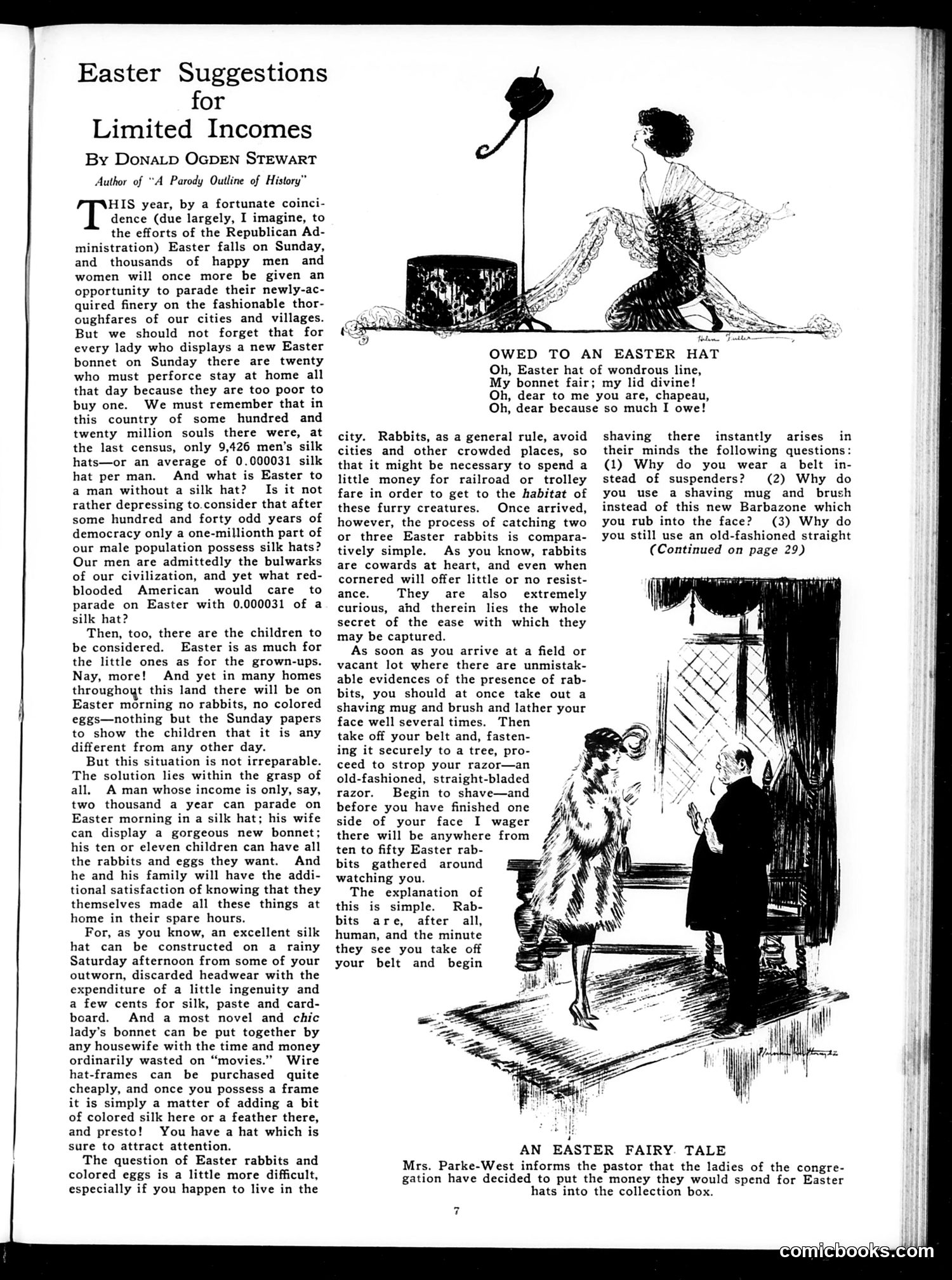
This is a humorous article by Donald Ogden Stewart mocking the pressure on Americans—especially the poor—to display new Easter finery. The piece satirizes the absurd gap between wealthy Easter celebrants parading in fashionable new bonnets and silk hats versus those financially unable to participate. Stewart exaggerates this disparity through ridiculous statistics (only 0.000031 silk hats per man nationwide). The satire's heart lies in his mock "solutions": he suggests poor families construct silk hats from discarded headwear and catch live rabbits by shaving their faces in fields—absurd, impractical ideas presented deadpan as reasonable alternatives. The accompanying illustrations show an elaborate Easter hat and a man shaving outdoors to catch rabbits, visually reinforcing the ridiculousness. The political context: this critiques American inequality and consumerism during the prosperous 1920s, while also poking fun at the Republican Administration's claim that economic opportunity exists for all.
📄 Transcribed text from this page (OCR, searchable)
Machine-transcribed from the original scan — historical spelling and the odd misread are preserved.
Easter Suggestions for Limited Incomes By DonaLp OGDEN STEWART Author of “A Parody Outline of History” HIS year, by a fortunate coinci- dence (due largely, I imagine, to the efforts of the Republican Ad- ministration) Easter falls on Sunday, and thousands of happy men and women will once more be given an opportunity to parade their newly-ac- quired finery on the fashionable thor- oughfares of our cities and villages. But we should not forget that for every lady who displays a new Easter bonnet on Sunday there are twenty who must perforce stay at home all that day because they are too poor to buy one. We must remember that in this country of some hundred and twenty million souls there were, at the last census, only 9,426 men’s silk hats—or an average of 0.000031 silk hat per man. And what is Easter to a man without a silk hat? Is it not rather depressing to.consider that after some hundred and forty odd years of democracy only a one-millionth part of our male population possess silk hats? Our men are admittedly the bulwarks of our civilization, and yet what red- blooded American would care to parade on Easter with 0.000031 of a silk hat? Then, too, there are the children to be considered. Easter is as much for the little ones as for the grown-ups. Nay, more! And yet in many homes throughoyt this land there will be on Easter morning no rabbits, no colored eggs—nothing but the Sunday papers to show the children that it is any different from any other day. But this situation is not irreparable. The solution lies within the grasp of all. A man whose income is only, say, two thousand a year can parade on Easter morning in a silk hat; his wife can display a gorgeous new bonnet; his ten or eleven children can have all the rabbits and eggs they want. And he and his family will have the addi- tional satisfaction of knowing that they themselves made all these things at home in their spare hours. For, as you know, an excellent silk hat can be constructed on a rainy Saturday afternoon from some of your outworn, discarded headwear with the expenditure of a little ingenuity and a few cents for silk, paste and card- board. And a most novel and chic lady’s bonnet can be put together by any housewife with the time and money ordinarily wasted on “movies.” Wire hat-frames can be purchased quite cheaply, and once you possess a frame it is simply a matter of adding a bit of colored silk here or a feather there, and presto! You have a hat which is sure to attract attention. The question of Easter rabbits and colored eggs is a little more difficult, especially if you happen to live in the OWED TO AN EASTER HAT Oh, Easter hat of wondrous line, My bonnet fair; my lid divine! Oh, dear to me you are, chapeau, Oh, dear because so much I owe! city. Rabbits, as a general rule, avoid cities and other crowded places, so that it might be necessary to spend a little money for railroad or trolley fare in order to get to the habitat of these furry creatures. Once arrived, however, the process of catching two or three Easter rabbits is compara- tively simple. As you know, rabbits are cowards at heart, and even when cornered will offer little or no resist- ance. They are also extremely curious, ahd therein lies the whole secret of the ease with which they may be captured. As soon as you arrive at a field or vacant lot where there are unmistak- able evidences of the presence of rab- bits, you should at once take out a shaving mug and brush and lather your face well several times. Then take off your belt and, fasten- ing it securely to a tree, pro- ceed to strop your razor—an old-fashioned, straight-bladed razor. Begin to shave—and before you have finished one side of your face I wager there will be anywhere from ten to fifty Easter rab- bits gathered around watching you. The explanation of this is simple. Rab- bits are, after all, human, and the minute they see you take off your belt and begin shaving there instantly arises in their minds the following questions: (1) Why do you wear a belt in- stead of suspenders? (2) Why do you use a shaving mug and brush instead of this new Barbazone which you rub into the face? (3) Why do you still use an old-fashioned straight (Continued on page 29) AN EASTER FAIRY. TALE Mrs. Parke-West informs the pastor that the ladies of the congre- gation have decided to put the money they would spend for Easter hats into the collection box.