
Judge, 1922-04-15 · page 22 of 36
Judge — April 15, 1922 — page 22: what you’re looking at
What you’re looking at
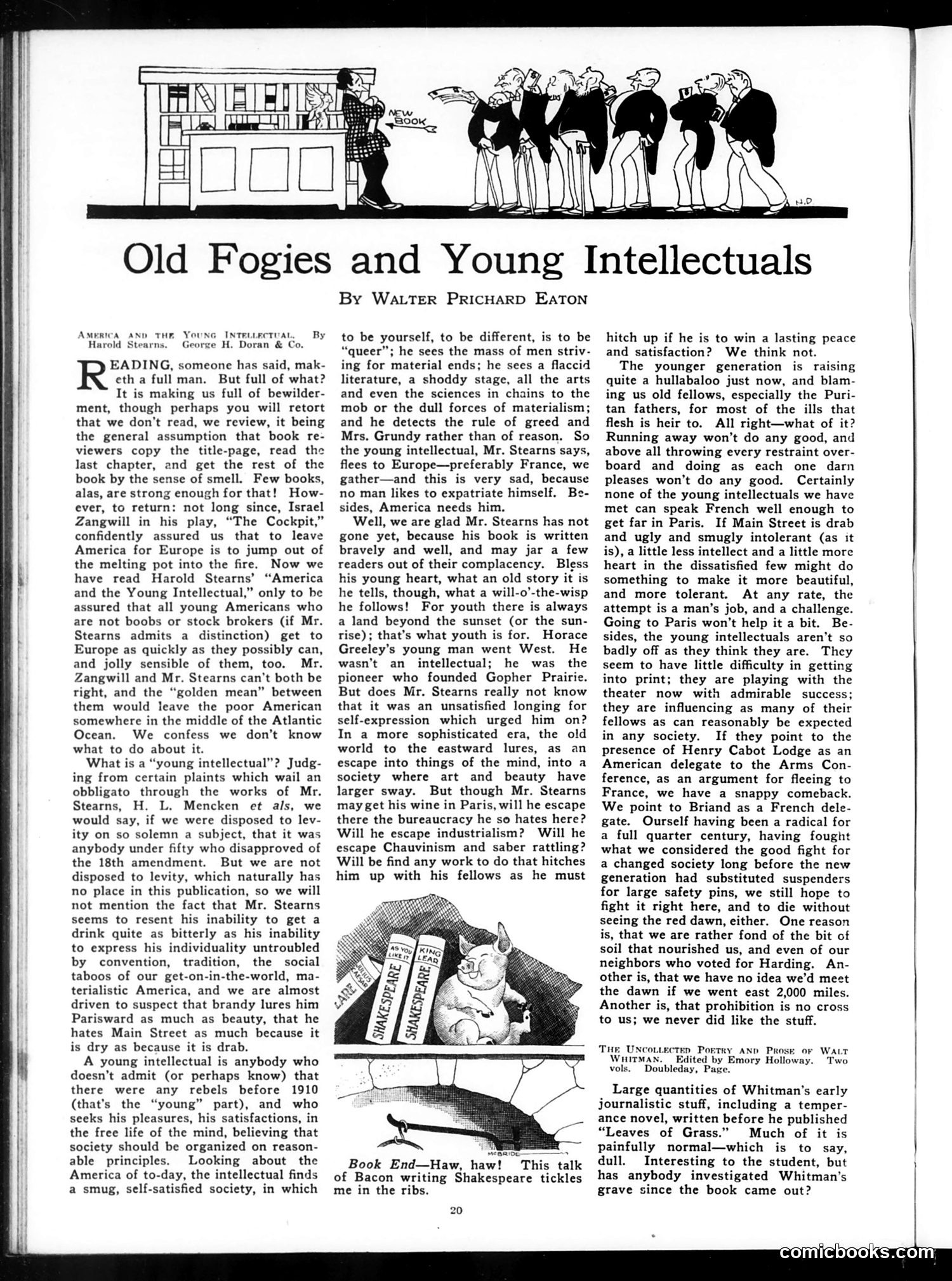
This is a book review by Walter Prichard Eaton critiquing Harold Stearns' work "America and the Young Intellectual." The cartoon at top shows a building (representing America) with young men in suits bowing/fleeing eastward toward Europe. **The satire:** Eaton mocks young American intellectuals who reject their own country as materially-obsessed and conformist, fleeing to Europe (especially Paris) seeking artistic and intellectual freedom. He notes this mirrors historical American restlessness—referencing Horace Greeley's "Go West, young man"—but argues the impulse is ultimately the same romantic escapism, just redirected eastward. **Key targets:** Stearns, H.L. Mencken, and the post-WWI generation seeking exile. Eaton suggests their complaints about Prohibition ("unable to get a drink") undermine their highbrow critiques of American materialism. He defends America as needing these dissidents, while gently mocking their predictable rebellion as old as youth itself—romanticizing elsewhere rather than building at home.
📄 Transcribed text from this page (OCR, searchable)
Machine-transcribed from the original scan — historical spelling and the odd misread are preserved.
INTELLECTUAL By H. Doran & Co. AMERICA AND THR Harold Stearns. EADING, someone has said, mak- eth a full man. But full of what? It is making us full of bewilder- ment, though perhaps you will retort that we don’t read, we review, it being the general assumption that book re- viewers copy the title-page, read the last chapter, and get the rest of the book by the sense of smell. Few books, alas, are strong enough for that! How- ever, to return: not long since, Israel Zangwill in his play, “The Cockpit,” confidently assured us that to leave America for Europe is to jump out of the melting pot into the fire. Now we have read Harold Stearns’ “America and the Young Intellectual,” only to be assured that all young Americans who are not boobs or stock brokers (if Mr. Stearns admits a distinction) get to Europe as quickly as they possibly can, and jolly sensible of them, too. Mr. Zangwill and Mr. Stearns can’t both be right, and the “golden mean” between them would leave the poor American somewhere in the middle of the Atlantic Ocean. We confess we don’t know what to do about i What is a “young intellectual”? Judg- ing from certain plaints which wail an obbligato through the works of Mr. Stearns, H. L. Mencken et als, we would say, if we were disposed to lev- ity on so solemn a subject, that it was anybody under fifty who disapproved of the 18th amendment. But we are not disposed to levity, which naturally has no place in this publication, so we will not mention the fact that Mr. Stearns seems to resent his inability to get a drink quite as bitterly as his inability to express his individuality untroubled by convention, tradition, the social taboos of our get-on-in-the-world, ma- terialistic America, and we are almost driven to suspect that brandy lures him Parisward as much as beauty, that he hates Main Street as much because it is dry as because it is drab. A young intellectual is anybody who doesn’t admit (or perhaps know) that there were any rebels before 1910 (that's the “young” part), and who seeks his pleasures, his satisfactions, in the free life of the mind, believing that society should be organized on reason- able principles. Looking about the America of to-day, the intellectual finds a smug, self-satisfied society, in which Old Fogies and Young Intellectuals By WALTER PRICHARD EATON to be yourself, to be different, is to be “queer”; he sees the mass of men striv- ing for material ends; he sees a flaccid literature, a shoddy stage, all the arts and even the sciences in chains to the mob or the dull forces of materialism; and he detects the rule of greed and Mrs. Grundy rather than of reason. So the young intellectual, Mr. Stearns says, flees to Europe—preferably France, we gather—and this is very sad, because no man likes to expatriate himself. Be- sides, America needs him. Well, we are glad Mr. Stearns has not gone yet, because his book is written bravely and well, and may jar a few readers out of their complacency. Bless his young heart, what an old story it is he tells, though, what a will-o’-the-wisp he follows! For youth there is always a land beyond the sunset (or the sun- tise); that’s what youth is for. Horace Greeley’s young man went West. He wasn't an intellectual; he was the pioneer who founded Gopher Prairie. But does Mr. Stearns really not know that it was an unsatisfied longing for self-expression which urged him on? In a more sophisticated era, the old world to the eastward lures, as an escape into things of the mind, into a society where art and beauty have larger sway. But though Mr. Stearns may get his wine in Paris, will he escape there the bureaucracy he so hates here? Will he escape industrialism? Will he escape Chauvinism and saber rattling? Will be find any work to do that hitches him up with his fellows as he must Book End—Haw, haw! This talk of Bacon writing Shakespeare tickles me in the ribs. 20 hitch up if he is to win a lasting peace and satisfaction? We think not. The younger generation is raising quite a hullabaloo just now, and blam- ing us old fellows, especially the Puri- tan fathers, for most of the ills that flesh is heir to. All right—what of it? Running away won't do any good, and above all throwing every restraint over- board and doing as each one darn pleases won’t do any good. Certainly none of the young intellectuals we have met can speak French well enough to get far in Paris. If Main Street is drab and ugly and smugly intolerant (as it is), a little less intellect and a little more heart in the dissatisfied few might do something to make it more beautiful, and more tolerant. At any rate, the attempt is a man’s job, and a challenge. Going to Paris won't help it a bit. Be- sides, the young intellectuals aren’t so badly off as they think they are. They seem to have little difficulty in getting into print; they are playing with the theater now with admirable success; they are influencing as many of their fellows as can reasonably be expected in any society. If they point to the presence of Henry Cabot Lodge as an American delegate to the Arms Con- ference, as an argument for fleeing to France, we have a snappy comeback. We point to Briand as a French dele- gate. Ourself having been a radical for a full quarter century, having fought what we considered the good fight for a changed society long before the new generation had substituted suspenders for large safety pins, we still hope to fight it right here, and to die without seeing the red dawn, either. One reason is, that we are rather fond of the bit of soil that nourished us, and even of our neighbors who voted for Harding. An- other is, that we have no idea we'd meet the dawn if we went east 2,000 miles. Another is, that prohibition is no cross to us; we never did like the stuff. Tue UNcoLLECTED Poetry AND Prose oF WALT Whitman. Edited by Emory Holloway. Two vols. Doubleday, Page. Large quantities of Whitman's early journalistic stuff, including a temper- ance novel, written before he published “Leaves of Grass.” Much of it is painfully normal—which is to say, dull. Interesting to the student, but has anybody investigated Whitman’s grave since the book came out?