
Judge, 1922-04-15 · page 21 of 36
Judge — April 15, 1922 — page 21: what you’re looking at
What you’re looking at
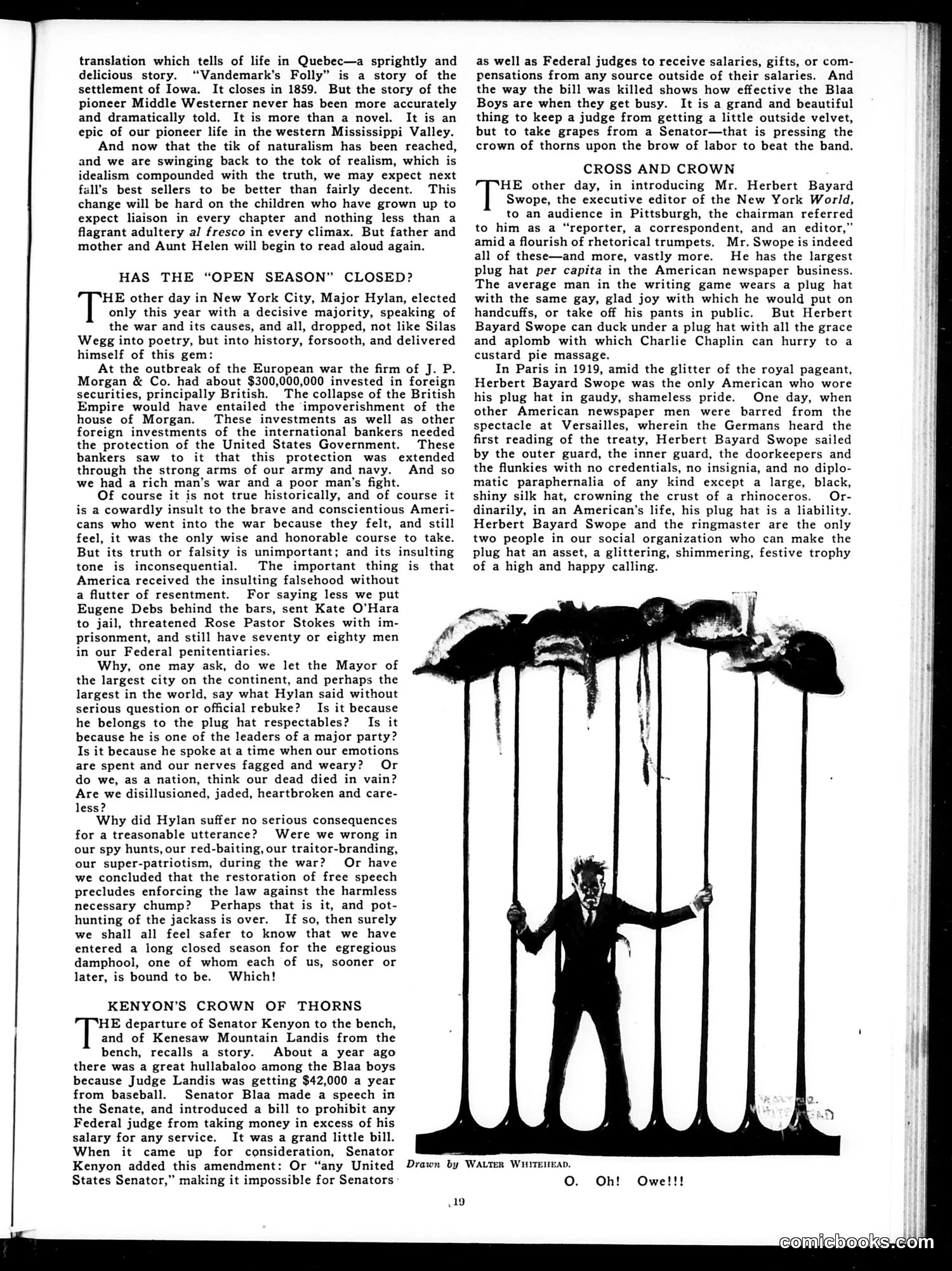
This page critiques Mayor John Hylan of New York City for making anti-war statements without consequences. The cartoon by Walter Whitehead shows a figure (Hylan) wielding a whip labeled "O. Oh! Owe!!!" — satirizing his criticism that America's WWI involvement served wealthy bankers' interests rather than the nation's. The text argues the hypocrisy: during wartime, dissidents like Eugene Debs and Rose Pastor Stokes faced imprisonment for similar anti-war speech, yet Hylan—a major political figure—escaped rebuke. Judge questions whether Americans have grown "disillusioned" about the war, or whether political status granted immunity from prosecution for statements that would jail ordinary citizens. The piece demands accountability, suggesting post-war America has become complacent about enforcing free-speech restrictions selectively based on power and party affiliation.
📄 Transcribed text from this page (OCR, searchable)
Machine-transcribed from the original scan — historical spelling and the odd misread are preserved.
translation which tells of life in Quebec—a sprightly and delicious story. ‘“Vandemark’s Folly” is a story of the settlement of Iowa. It closes in 1859. But the story of the pioneer Middle Westerner never has been more accurately and dramatically told. It is more than a novel. It is an epic of our pioneer life in the western Mississippi Valley. And now that the tik of naturalism has been reached, and we are swinging back to the tok of realism, which is idealism compounded with the truth, we may expect next fall’s best sellers to be better than fairly decent. This change will be hard on the children who have grown up to expect liaison in every chapter and nothing less than a flagrant adultery al fresco in every climax. But father and mother and Aunt Helen will begin to read aloud again. HAS THE “OPEN SEASON” CLOSED? 'HE other day in New York City, Major Hylan, elected only this year with a decisive majority, speaking of the war and its causes, and all, dropped, not like Silas Wegg into poetry, but into history, forsooth, and delivered himself of this gem: At the outbreak of the European war the firm of J. P. Morgan & Co. had about $300,000,000 invested in foreign securities, principally British. The collapse of the British Empire would have entailed the impoverishment of the house of Morgan. These investments as well as other foreign investments of the international bankers needed the protection of the United States Government. These bankers saw to it that this protection was extended through the strong arms of our army and navy. And so we had a rich man’s war and a poor man’s fight. Of course it is not true historically, and of course it is a cowardly insult to the brave and conscientious Ameri- cans who went into the war because they felt, and still feel, it was the only wise and honorable course to take. But its truth or falsity is unimportant; and its insulting tone is inconsequential. The important thing is that America received the insulting falsehood without a flutter of resentment. For saying less we put Eugene Debs behind the bars, sent Kate O’Hara to jail, threatened Rose Pastor Stokes with im- prisonment, and still have seventy or eighty men in our Federal penitentiaries. Why, one may ask, do we let the Mayor of the largest city on the continent, and perhaps the largest in the world, say what Hylan said without serious question or official rebuke? Is it because he belongs to the plug hat respectables? Is it because he is one of the leaders of a major party? Is it because he spoke at a time when our emotions are spent and our nerves fagged and weary? Or do we, as a nation, think our dead died in vain? Are we disillusioned, jaded, heartbroken and care- less? Why did Hylan suffer no serious consequences for a treasonable utterance? Were we wrong in our spy hunts, our red-baiting, our traitor-branding, our super-patriotism, during the war? Or have we concluded that the restoration of free speech precludes enforcing the law against the harmless necessary chump? Perhaps that is it, and pot- hunting of the jackass is over. If so, then surely we shall all feel safer to know that we have entered a long closed season for the egregious damphool, one of whom each of us, sooner or later, is bound to be. Which! KENYON’S CROWN OF THORNS ‘HE departure of Senator Kenyon to the bench, and of Kenesaw Mountain Landis from the bench, recalls a story. About a year ago there was a great hullabaloo among the Blaa boys because Judge Landis was getting $42,000 a year from baseball. Senator Blaa made a speech in the Senate, and introduced a bill to prohibit any Federal judge from taking money in excess of his salary for any service. It was a grand little bill. When it came up for consideration, Senator Kenyon added this amendment: Or “any United Drawn b; States Senator,” making it impossible for Senators as well as Federal judges to receive salaries, gifts, or com- pensations from any source outside of their salaries. And the way the bill was killed shows how effective the Blaa Boys are when they get busy. It is a grand and beautiful thing to keep a judge from getting a little outside velvet, but to take grapes from a Senator—that is pressing the crown of thorns upon the brow of labor to beat the band. CROSS AND CROWN HE other day, in introducing Mr. Herbert Bayard Swope, the executive editor of the New York World, to an audience in Pittsburgh, the chairman referred to him as a “reporter, a correspondent, and an editor,” amid a flourish of rhetorical trumpets. Mr. Swope is indeed all of these—and more, vastly more. He has the largest plug hat per capita in the American newspaper business. The average man in the writing game wears a plug hat with the same gay, glad joy with which he would put on handcuffs, or take off his pants in public. But Herbert Bayard Swope can duck under a plug hat with all the grace and aplomb with which Charlie Chaplin can hurry to a custard pie massage. In Paris in 1919, amid the glitter of the royal pageant, Herbert Bayard Swope was the only American who wore his plug hat in gaudy, shameless pride. One day, when other American newspaper men were barred from the spectacle at Versailles, wherein the Germans heard the first reading of the treaty, Herbert Bayard Swope sailed by the outer guard, the inner guard, the doorkeepers and the flunkies with no credentials, no insignia, and no diplo- matic paraphernalia of any kind except a large, black, shiny silk hat, crowning the crust of a rhinoceros. Or- dinarily, in an American’s life, his plug hat is a liability. Herbert Bayard Swope and the ringmaster are the only two people in our social organization who can make the plug hat an asset, a glittering, shimmering, festive trophy of a high and happy calling. yy WALTER WittTenEan. feu) O. Oh! Owe!!!