
Judge, 1922-04-15 · page 12 of 36
Judge — April 15, 1922 — page 12: what you’re looking at
What you’re looking at
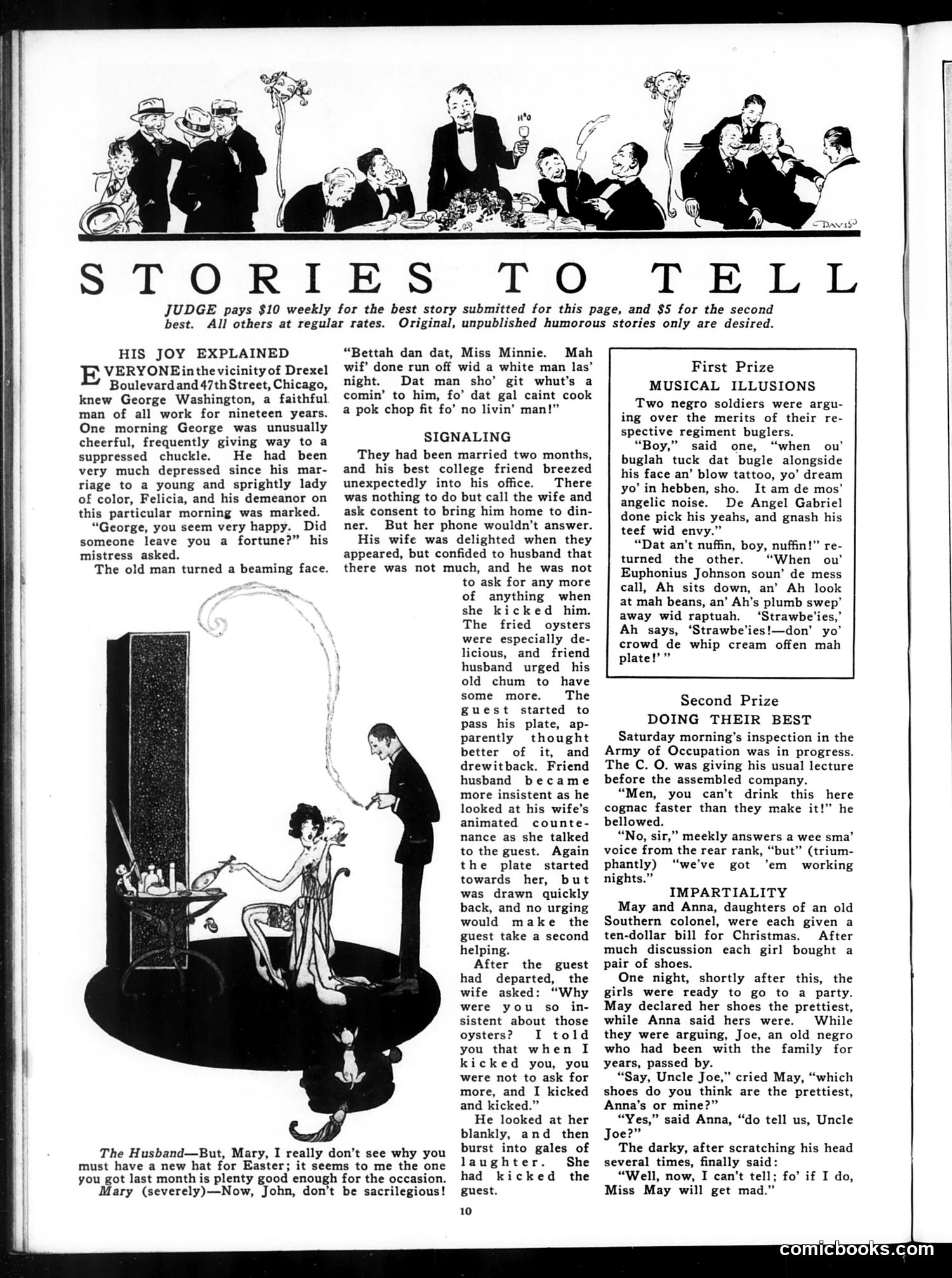
This is a humor submission page from *Judge* magazine featuring three short comic anecdotes for readers' entertainment. **"His Joy Explained"** uses racist dialect humor common to the era. George Washington, a Black servant, is delighted his wife left him for a white man—the joke relies on period stereotypes about Black women's cooking and the racist assumption he'd be relieved. **"Signaling"** depicts marital discord through physical comedy: a wife literally kicks her husband under the dinner table to signal him not to ask guests for seconds. The guest mistakes these kicks as signals meant for him and refuses food, creating absurdist confusion. **The three prize-winning stories** include more dialect humor ("Musical Illusions" with Black soldiers discussing buglers using exaggerated speech) and genteel domestic comedy ("Impartiality" about sisters comparing Christmas shoes). The magazine paid readers $10-$5 for submissions. The elaborate decorative header illustration shows well-dressed diners in a formal setting, establishing the magazine's upper-class audience. These pieces reflect early 20th-century American humor standards, now marked by offensive racial caricature.
📄 Transcribed text from this page (OCR, searchable)
Machine-transcribed from the original scan — historical spelling and the odd misread are preserved.
Davis? STORIES TO TELL JUDGE pays $10 weekly for the best story submitted for this page, and $5 for the second best. HIS JOY EXPLAINED VERYONEinthe vicinity of Drexel Boulevard and 47th Street, Chicago, knew George Washington, a faithful man of all work for nineteen years. One morning George was unusually cheerful, frequently giving way to a suppressed chuckle. He had been very much depressed since his mar- riage to a young and sprightly lady of color, Felicia, and his demeanor on this particular morning was marked. “George, you seem very happy. Did someone leave you a fortune?” his mistress asked. The old man turned a beaming face. The Husband—But, Mary, I really don’t see why you must have a new hat for Easter; it seems to me the one you got last month is plenty good enough for the occasion. Mary (severely)—Now, John, don’t be sacrilegious! All others at regular rates. Mah “Bettah dan dat, Miss Minnie. wif’ done run off wid a white man las night. Dat man sho’ git whut’s a comin’ to him, fo’ dat gal caint cook a pok chop fit fo’ no livin’ man!” SIGNALING They had been married two months, and his best college friend breezed unexpectedly into his office. There was nothing to do but call the wife and ask consent to bring him home to din- ner. But her phone wouldn’t answer. His wife was delighted when they appeared, but confided to husband that there was not much, and he was not to ask for any more of anything when she kicked him. The fried oysters were especially de- licious, and friend husband urged his old chum to have some more. The guest started to pass his plate, ap- parently thought better of it, and drewitback. Friend husband became more insistent as he looked at his wife’s animated counte- nance as she talked to the guest. Again the plate started towards her, but was drawn quickly back, and no urging would make the guest take a second helping. After the guest had departed, the wife asked: “Why were you so in- sistent about those oysters? I told you that when I kicked you, you were not to ask for more, and I kicked and kicked.” He looked at her blankly, and then burst into gales of laughter. She had kicked the guest. 10 Original, unpublished humorous stories only are desired. First Prize MUSICAL ILLUSIONS Two negro soldiers were argu- ing over the merits of their re- spective regiment buglers. “Boy,” said one, “when ou’ buglah tuck dat bugle alongside his face an’ blow tattoo, yo’ dream yo’ in hebben, sho. It am de mos’ angelic noise. De Angel Gabriel done pick his yeahs, and gnash his teef wid envy.” “Dat an’t nuffin, boy, nuffin!” re- turned the other. “When ou’ Euphonius Johnson soun’ de mess call, Ah sits down, an’ Ah look at mah beans, an’ Ah’s plumb swep’ away wid raptuah. ‘Strawbe’ies,’ Ah says, ‘Strawbe’ies!—don’ yo’ crowd de whip cream offen mah plate!’” Second Prize DOING THEIR BEST Saturday morning’s inspection in the Army of Occupation was in progress. The C. O. was giving his usual lecture before the assembled company. “Men, you can’t drink this here cognac faster than they make it!” he bellowed. “No, sir,” meekly answers a wee sma’ voice from the rear rank, “but” (trium- phantly) “we've got ’em_ working nights.” IMPARTIALITY May and Anna, daughters of an old Southern colonel, were each given a ten-dollar bill for Christmas. After much discussion each girl bought a pair of shoes. One night, shortly after this, the girls were ready to go to a party. May declared her shoes the prettiest, while Anna said hers were. While they were arguing, Joe, an old negro who had been with the family for years, passed by. “Say, Uncle Joe,” cried May, “which shoes do you think are the prettiest, Anna’s or mine?” “Yes,” said Anna, “do tell us, Uncle Joe?” The darky, after scratching his head several times, finally said: “Well, now, I can’t tell; fo’ if I do, Miss May will get mad.”