
A complete issue · 36 pages · 1922
Judge — April 1, 1922
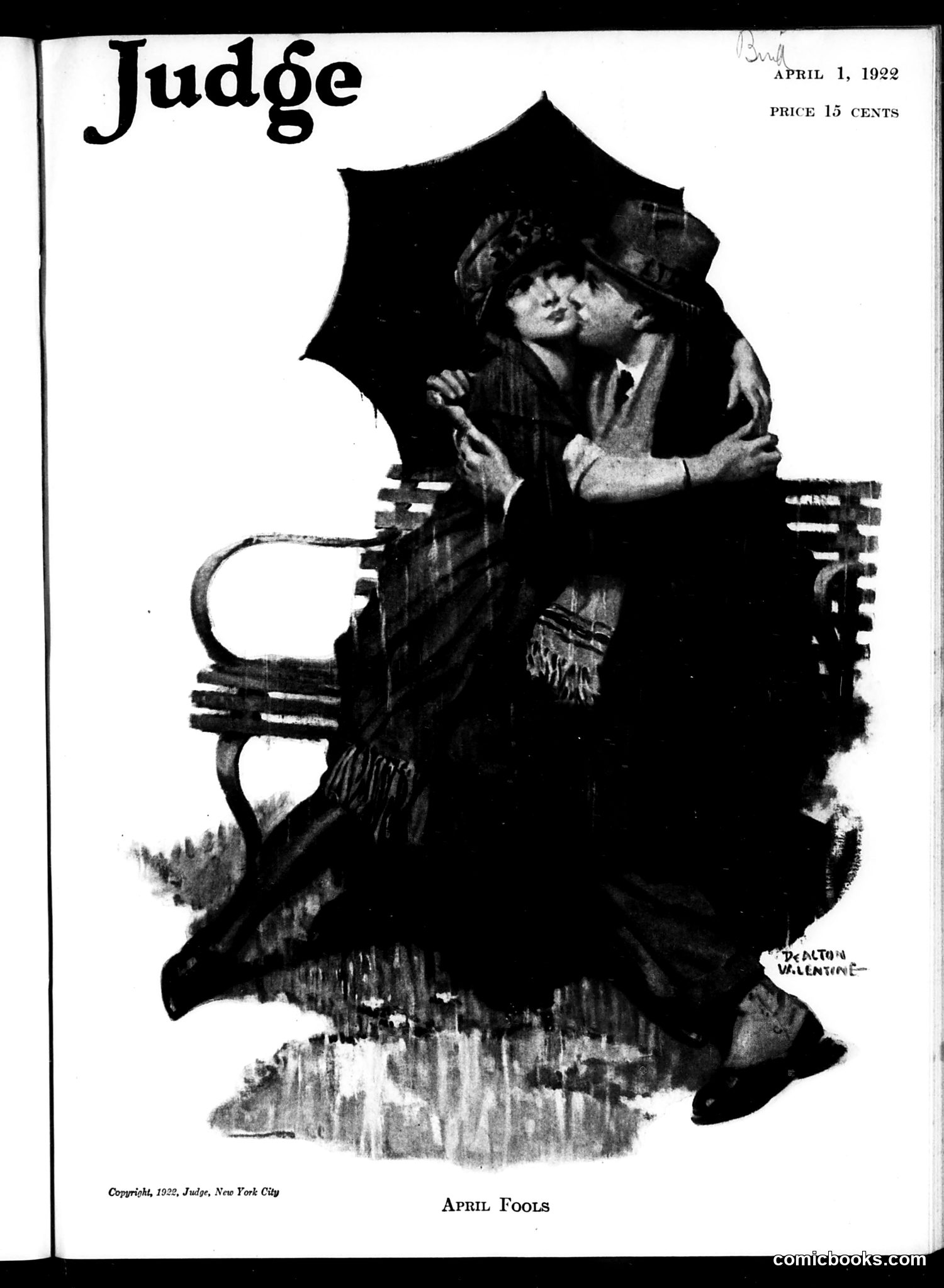
This is a Judge magazine cover from April 1, 1922, titled "April Fools." The illustration by Dalton Valentine depicts a figure sitting in a chair, holding an umbrella while appearing to look upward. The composition suggests someone caught in unexpected rain or weather—a visual pun appropriate for April Fools' Day. The cartoon's joke likely plays on April Fools' tradition of pranks and trickery. The figure's posture and the umbrella suggest being fooled or caught off-guard by weather, possibly referencing common April Fools' jokes about weather or being tricked into unnecessary precautions. Without additional context identifying the specific figure, the satire appears to target gullibility or the foolishness of falling for typical April pranks.
This is primarily **advertising copy**, not satire or political commentary. The page promotes Leslie's Weekly magazine's new "Radio Department" launching April 1st. The content references Herbert Hoover, then Secretary of Commerce, who made public statements about radio telephony's explosive growth—from 50,000 users a year prior to 600,000 currently. The text describes broadcasting stations spreading across America, offering news, weather, music, and entertainment via radio. Leslie's Weekly is capitalizing on this technological enthusiasm by announcing a dedicated Radio Department to cover this "latest American furor." The tone is promotional excitement rather than satirical critique. There's no cartoon visible on this page—it's straightforward magazine advertisement.
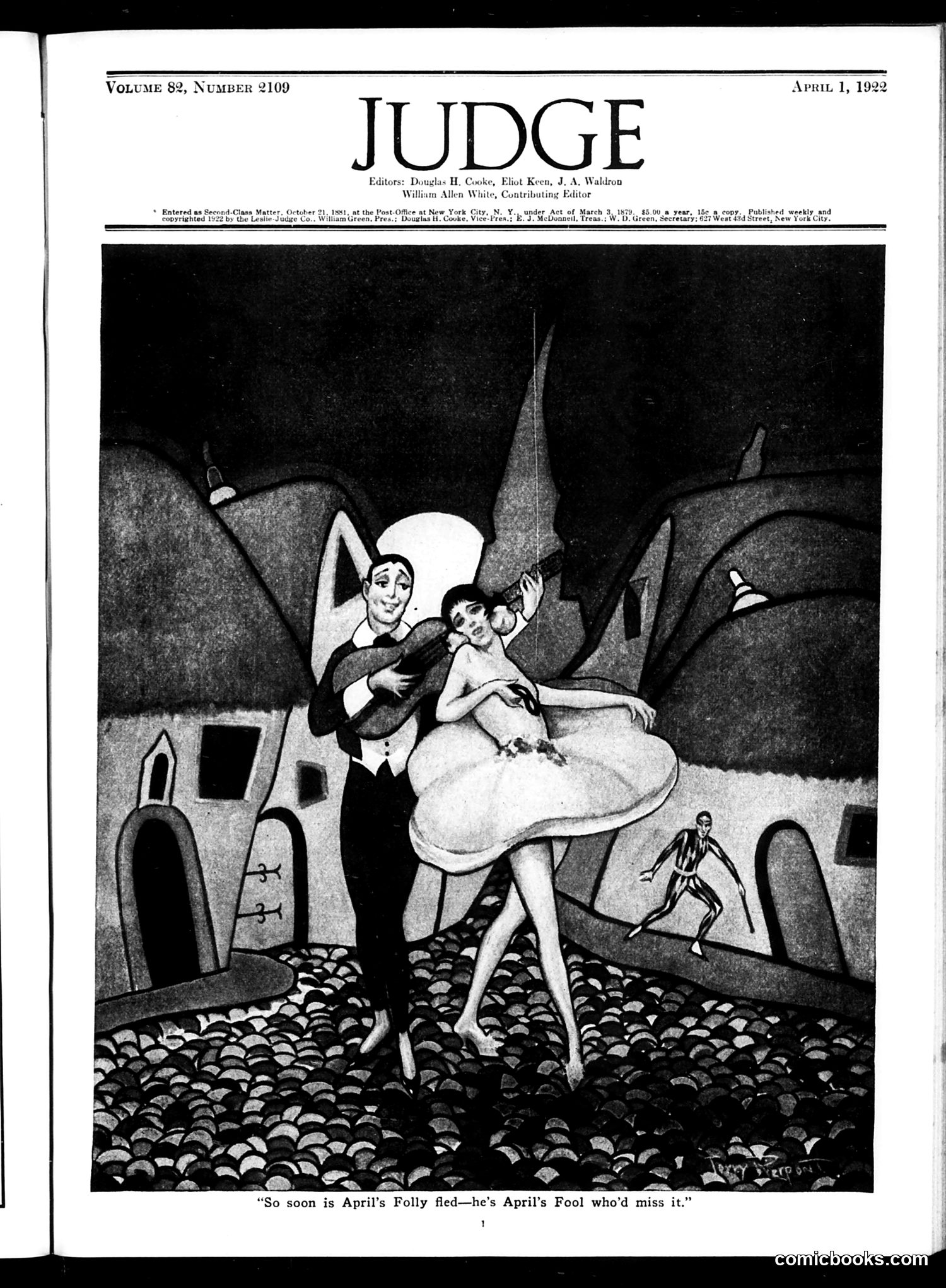
This is an April Fools' Day cartoon playing on the holiday's tradition of pranks and deception. The caption reads: "So soon is April's Folly fled—he's April's Fool who'd miss it." The illustration depicts a whimsical, fantasy scene set in what appears to be a magical or theatrical cityscape. A figure in formal dress (likely representing April or spring) holds a child while dancing or fleeing with a woman in an elaborate dress. A small figure on the right appears to be chasing them. The cartoon satirizes April Fools' Day itself—the transient nature of spring foolishness and those who fail to participate in or appreciate the holiday's pranks and merriment. The fantastic, slightly surreal staging emphasizes the playful, deceptive spirit of April 1st celebrations.
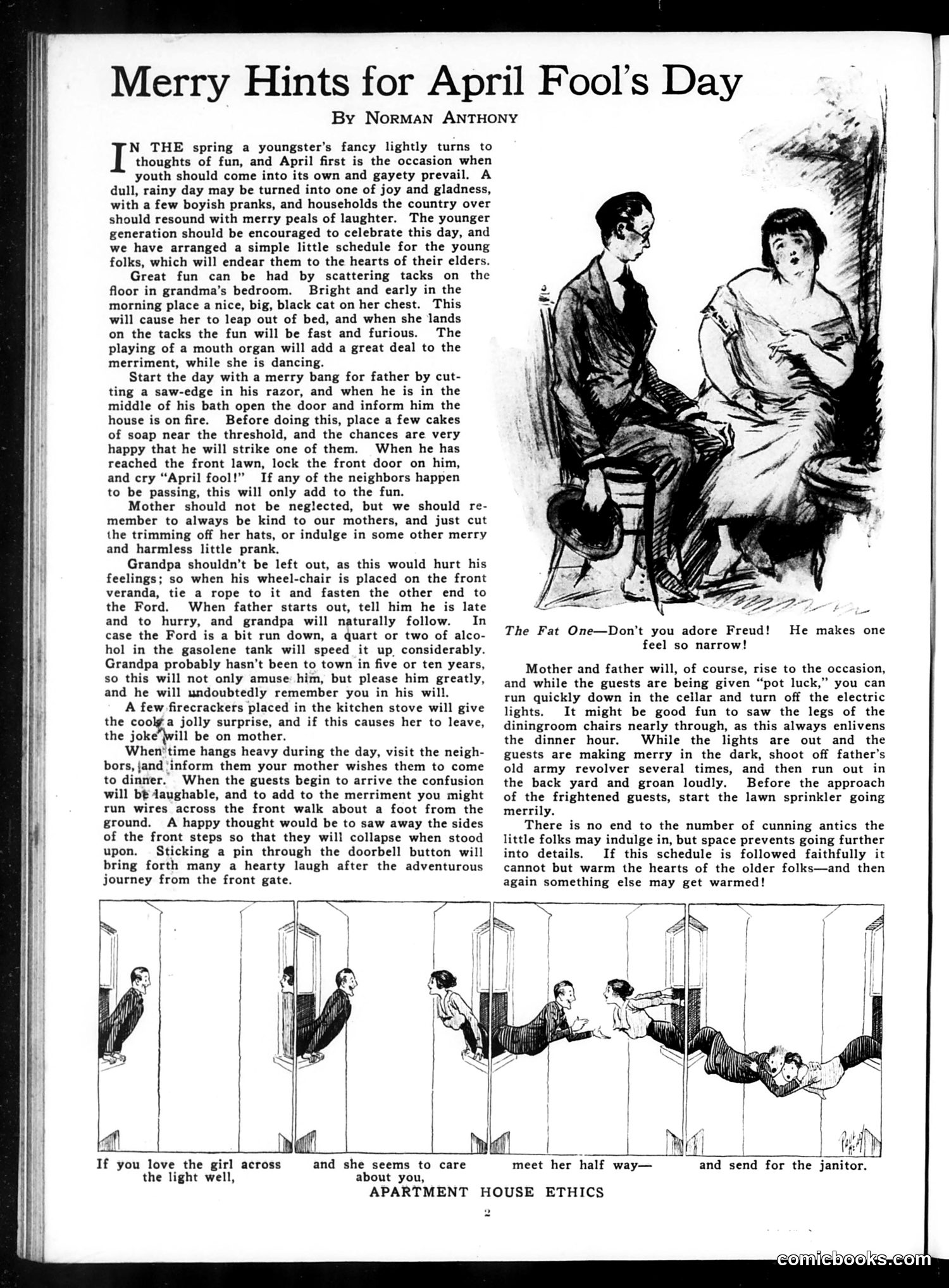
This is a humorous advice column for April 1st pranks, not political satire. The article suggests pranks targeting family members: scattering tacks in grandmother's bedroom, cutting a saw-edge in father's razor, placing firecrackers in the kitchen stove, and locking father out while claiming the house is on fire. The accompanying illustrations show slapstick scenarios of people being pranked—falling through doors, collapsing, etc. The bottom panel, titled "Apartment House Ethics," depicts a comedic chain reaction of neighbors falling through apartment doors, with the caption suggesting romance between neighbors. This reflects 1920s-era humor emphasizing physical comedy and mild household chaos as family entertainment. The tone is lighthearted domestic mischief rather than social commentary.
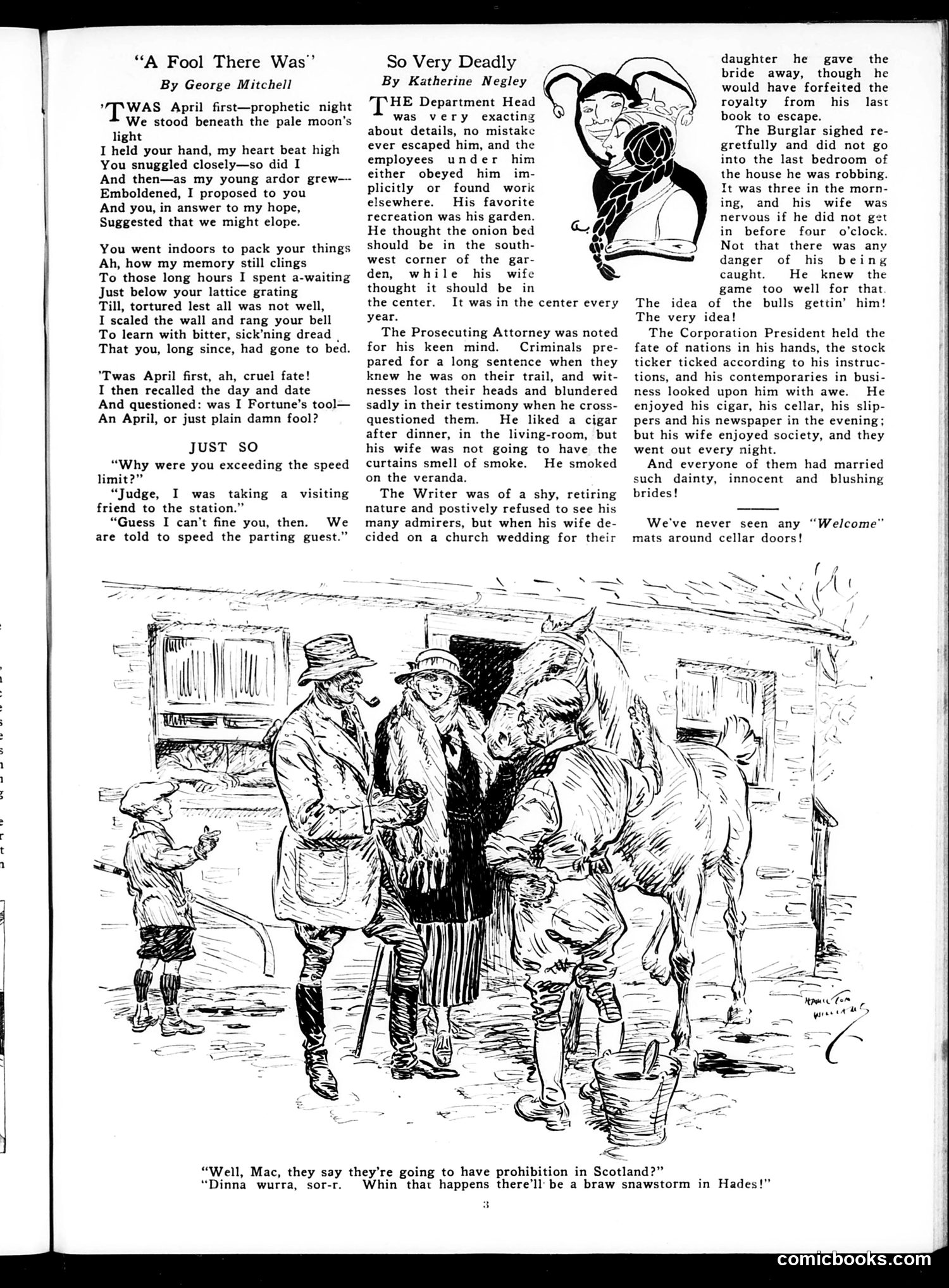
This page contains two distinct pieces: **Top Section:** Two poems—"A Fool There Was" by George Mitchell and "So Very Deadly" by Katherine Negley—appear to be romantic/relationship commentary, likely satirizing courtship customs of the era. **Bottom Cartoon:** Shows what appears to be working-class men in conversation, with dialogue about prohibition coming to Scotland. One character warns that if prohibition arrives in Scotland, "there'll be a braw snawstorm in Hades"—Scottish dialect suggesting Hell itself will freeze over, as Scots are stereotyped as devoted to alcohol. This reflects early 20th-century American attitudes toward Prohibition (enacted 1920), using ethnic/national caricature humor. The cartoon satirizes the perceived incompatibility between Scottish culture and alcohol restriction, treating the concept as absurdly impossible. The small illustration at top appears unrelated domestic humor.
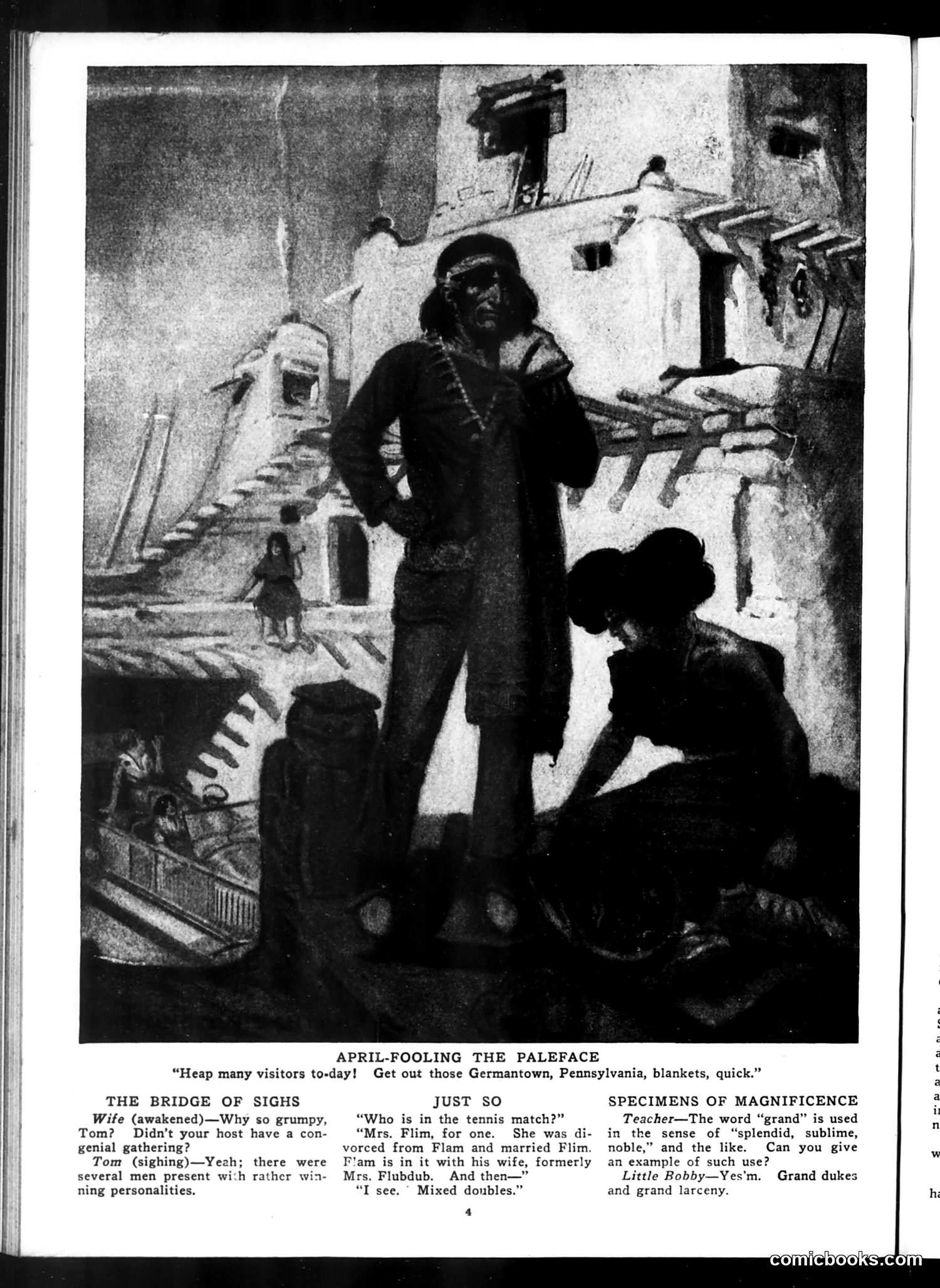
This page contains three separate comic sketches satirizing early 20th-century social situations: **"April-Fooling the Paleface"** depicts someone in Native American costume deceiving visitors, likely mocking both April Fools' Day pranks and stereotypical portrayals of Native Americans. **"The Bridge of Sighs"** presents a marital scenario: a woman questions her grumpy husband about a "congenial gathering," mentioning his former wife. The husband reveals she's now married to "Flim" and divorced from "Flam," with the cryptic joke "Mixed doubles"—wordplay on tennis terminology applied to multiple marriages. **"Just So"** and **"Specimens of Magnificence"** appear to be brief educational or definitional jokes about language usage. The page reflects period humor focused on marriage complications, casual racism, and linguistic wit typical of early Judge magazine content.
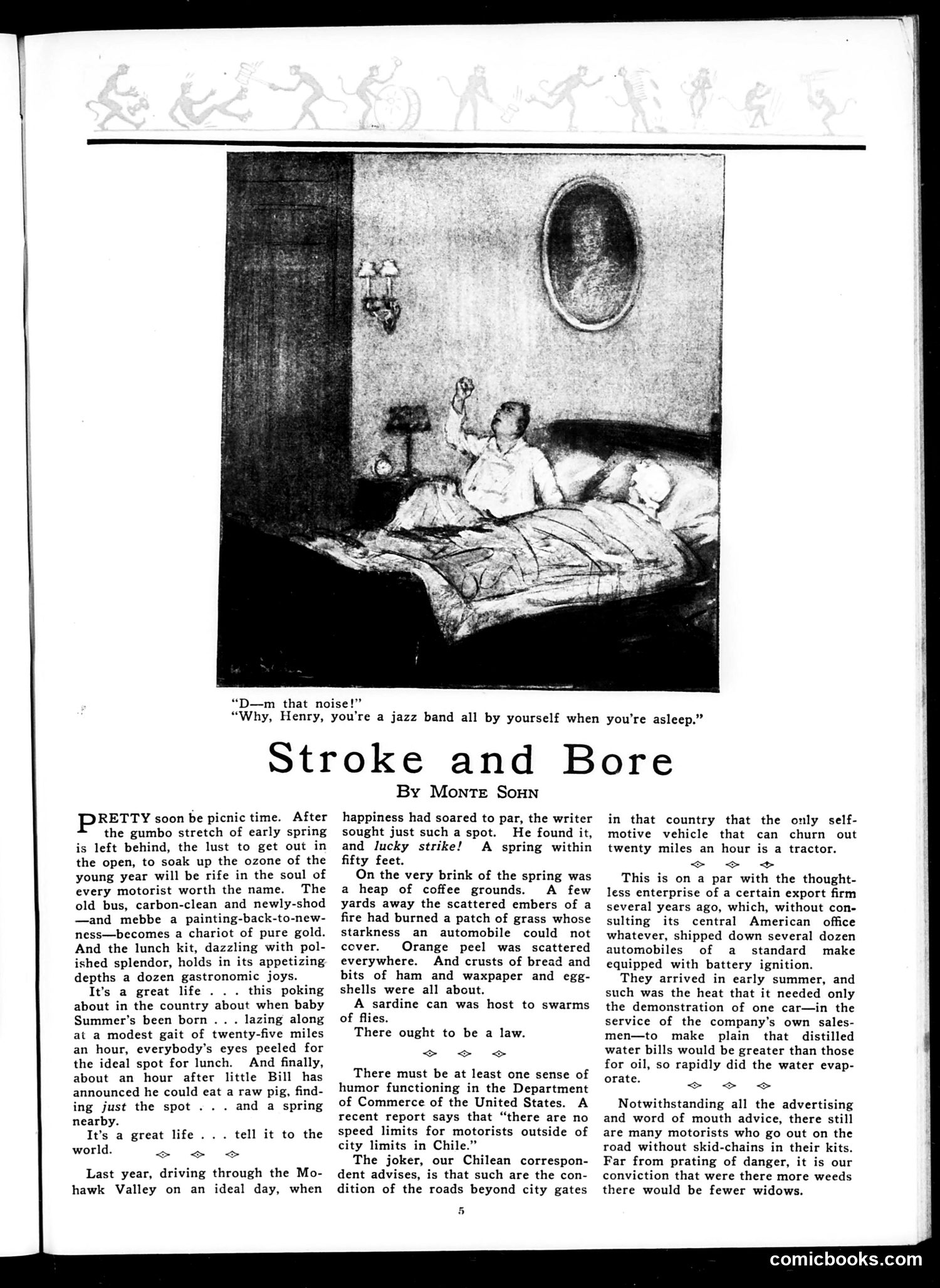
The page contains a brief comic sketch (top) about a couple in bed—the husband complains about noise while snoring loudly himself, and his wife retorts that he's "a jazz band" when sleeping. This is a domestic humor joke playing on the common annoyance of a spouse's snoring. The main content is Monte Sohn's essay "Stroke and Bore," a humorous commentary on 1920s motoring culture. It celebrates spring picnics by automobile but critiques the thoughtlessness of motorists who litter natural areas—describing a polluted spring littered with coffee grounds, orange peels, and sardine cans. Sohn then mocks the absurdity of international business through two anecdotes: Chile's boast of "no speed limits" (undermined by terrible roads where only tractors reach 20 mph), and an American firm shipping standard automobiles to Central America without accounting for extreme heat destroying water-cooled engines. The final comment about skid-chains and widows darkly jokes that poor road safety equipment causes fatal accidents—a timely concern in the early automotive era.
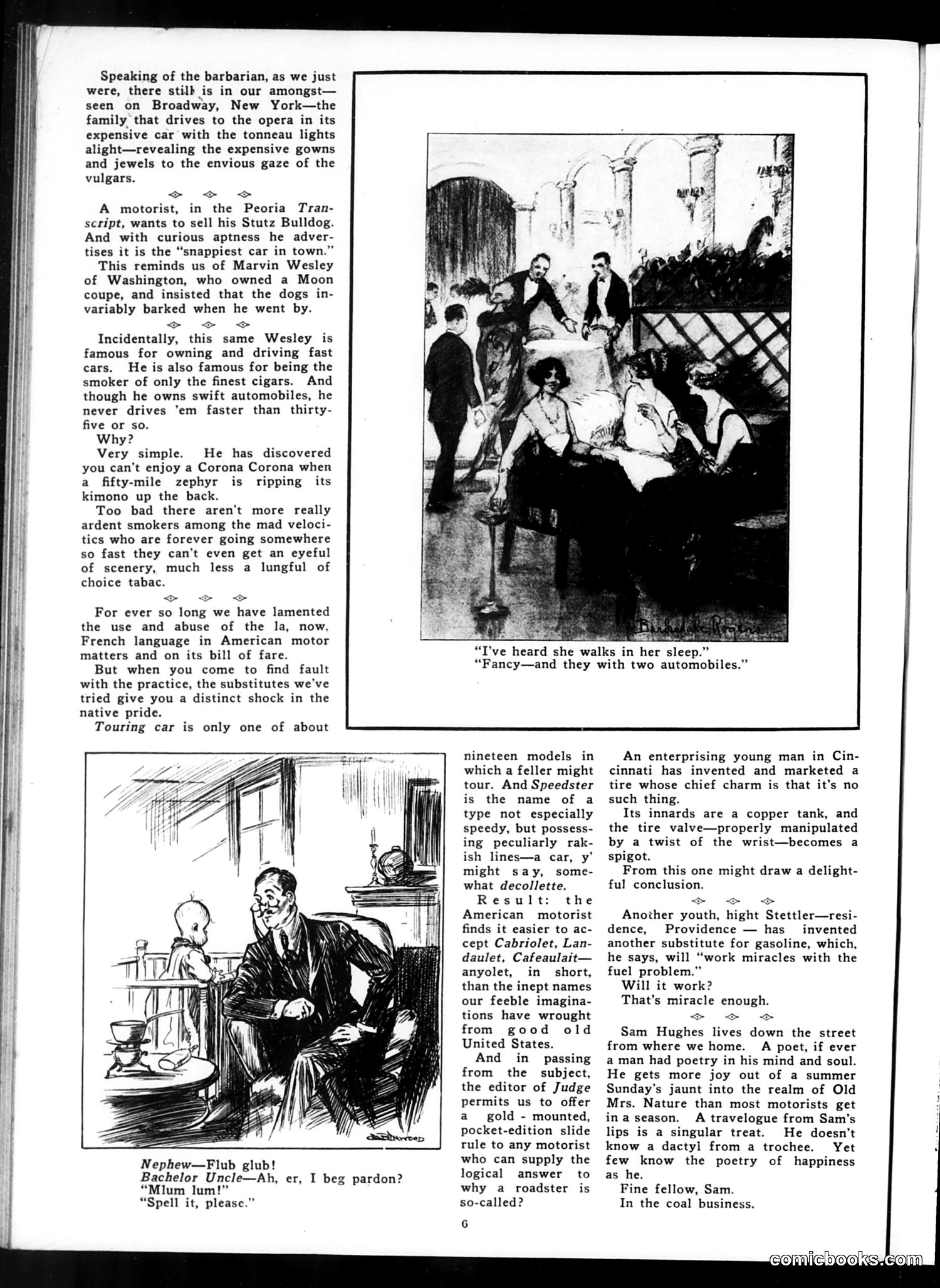
This page satirizes early 20th-century American car culture and affectation. The main targets are: **The Broadway Opera-Goers**: Mocked for ostentatiously displaying wealth—driving expensive cars with illuminated interiors to reveal their jewelry and gowns to "envious" pedestrians. The satire critiques vulgar status-seeking. **The Fast-Car Smoker Problem**: Marvin Wesley of Washington is ridiculed for owning swift automobiles but never driving faster than 35 mph. The joke: he can't enjoy fine Corona cigars at high speeds because wind ruins them. Judge mocks speedster culture while praising restraint. **French Car Terminology**: The magazine laments Americans' slavish adoption of French automobile names (Cabriolet, Landaulet, Cafeaulait) while admitting English substitutes sound absurd. This reflects broader anxieties about American cultural independence versus European imitation. **The Cartoon**: Shows a drunk uncle and nephew—absurdist humor about nonsensical speech ("Flub glub!"). The page celebrates Sam Hughes, a humble coal-business poet who finds joy in simple motoring rather than conspicuous consumption.
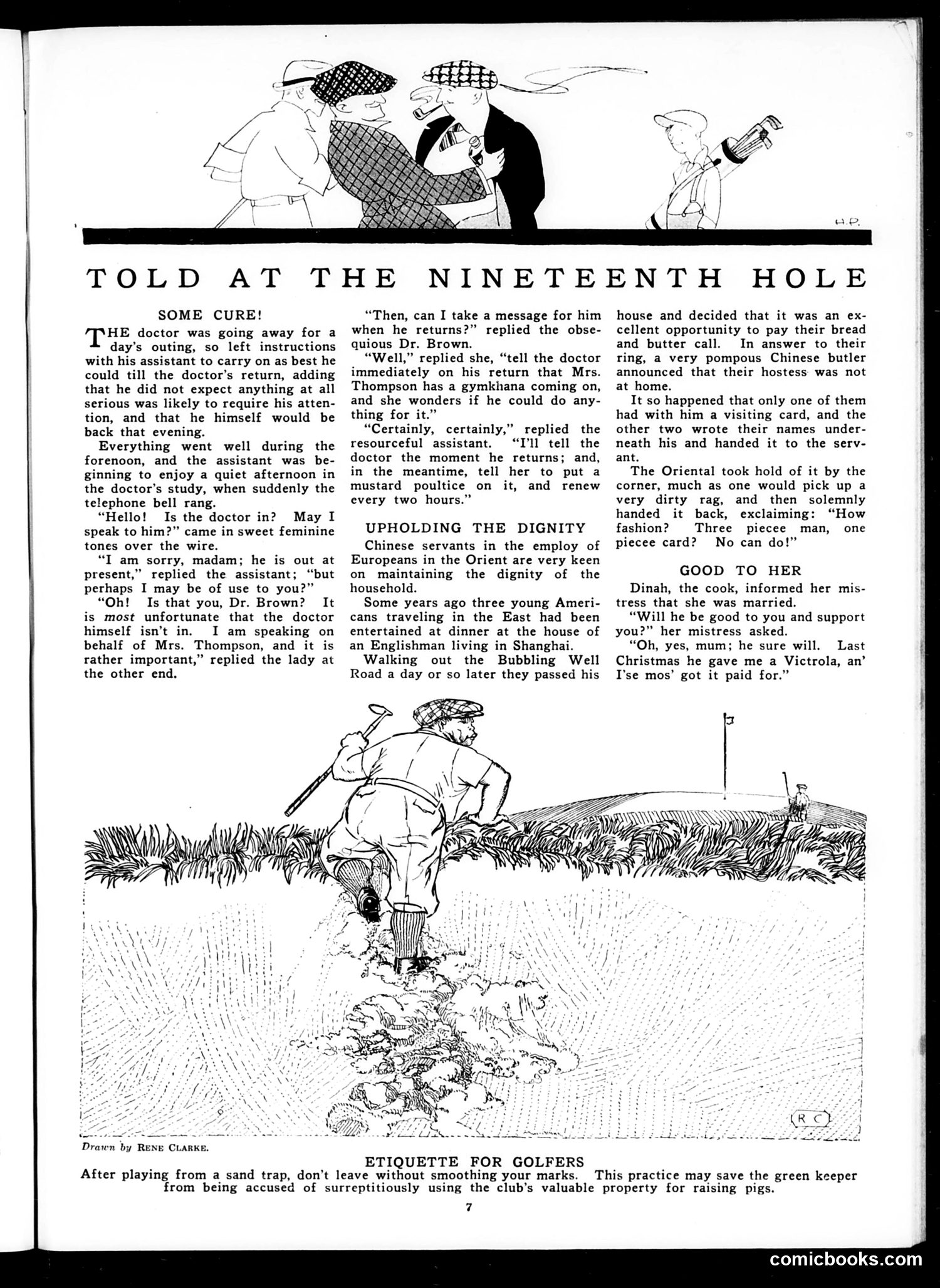
This page presents three humorous anecdotes told by golfers at the nineteenth hole (the clubhouse). **"Some Cure!"** mocks a doctor's assistant who, asked to help with a "gymkhana" (a British athletic event), mishears it as a medical condition and prescribes a mustard poultice—absurd medical advice for a social event. **"Upholding the Dignity"** satirizes Chinese servants' formality. A butler refuses to accept a visiting card shared by three men, declaring "Three piecee man, one piecee card? No can do!"—maintaining household dignity through rigid protocol. **"Good to Her"** features a Black cook boasting her husband's generosity because he bought her a Victrola (record player) she's still paying for—gentle humor about modest working-class aspirations. The bottom section offers golf etiquette: smooth sand trap marks to avoid accusations of letting pigs root there—a joking warning about maintaining course standards.
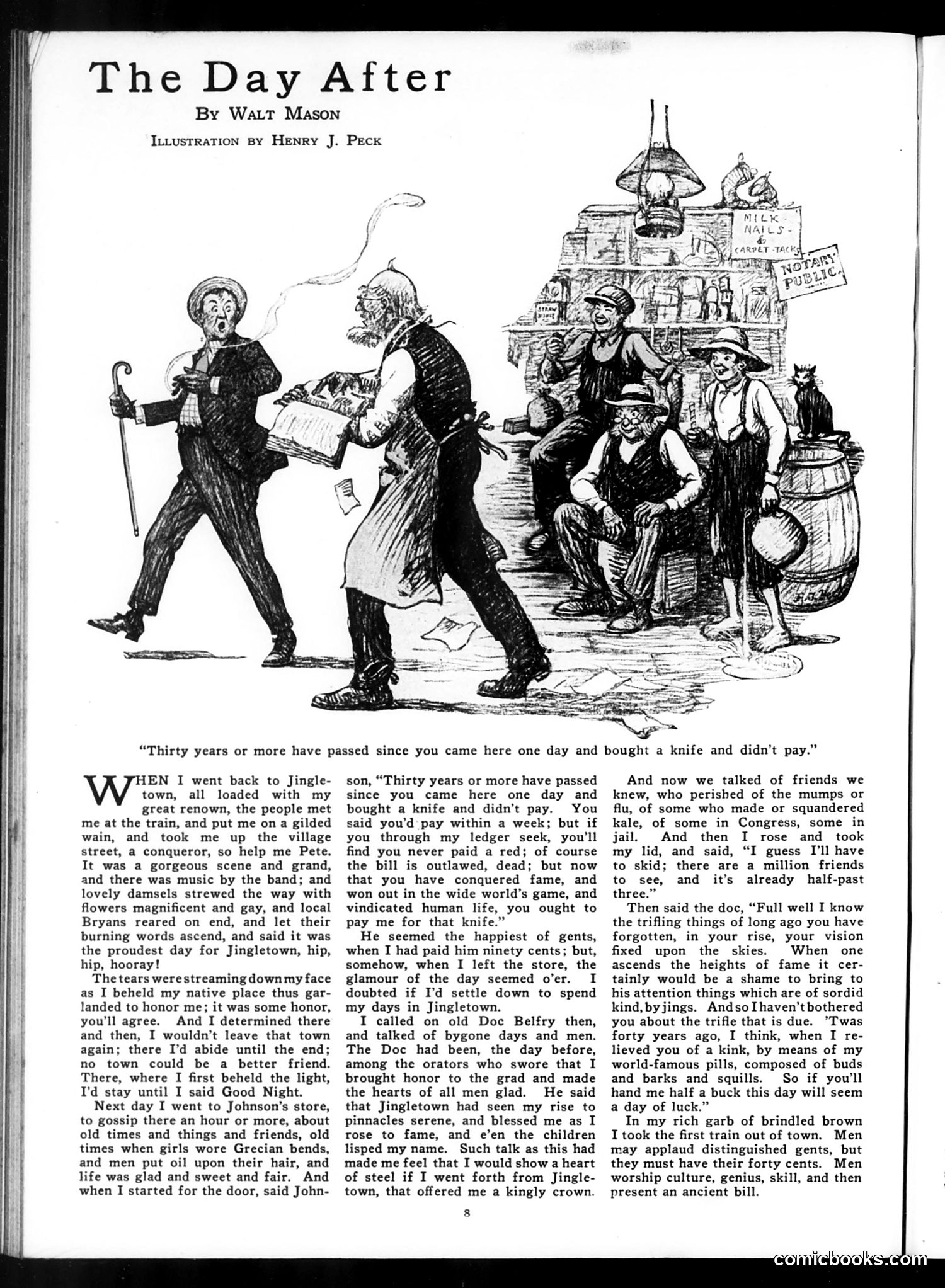
This story-cartoon satirizes the gap between hometown adulation and petty reality. A man returns to his small town of Jingletown as a celebrated success, greeted with parades and flowery speeches. However, his triumphant homecoming crumbles as old acquaintances immediately present unpaid bills: a storekeeper demands payment for a knife purchased thirty years prior, and a doctor extracts fifty cents for ancient medical services. The satire's point is clear: small-town people worship successful natives publicly while privately viewing them as debtors to exploit. Despite the protagonist's newfound wealth and status, locals reduce him to settling trivial old accounts. The final moral—"Men worship culture, genius, skill, and then present an ancient bill"—reveals the hypocrisy: communities celebrate distinguished citizens' achievements while greedily demanding forgotten debts. It's commentary on small-town commercialism and ingratitude masquerading as pride.
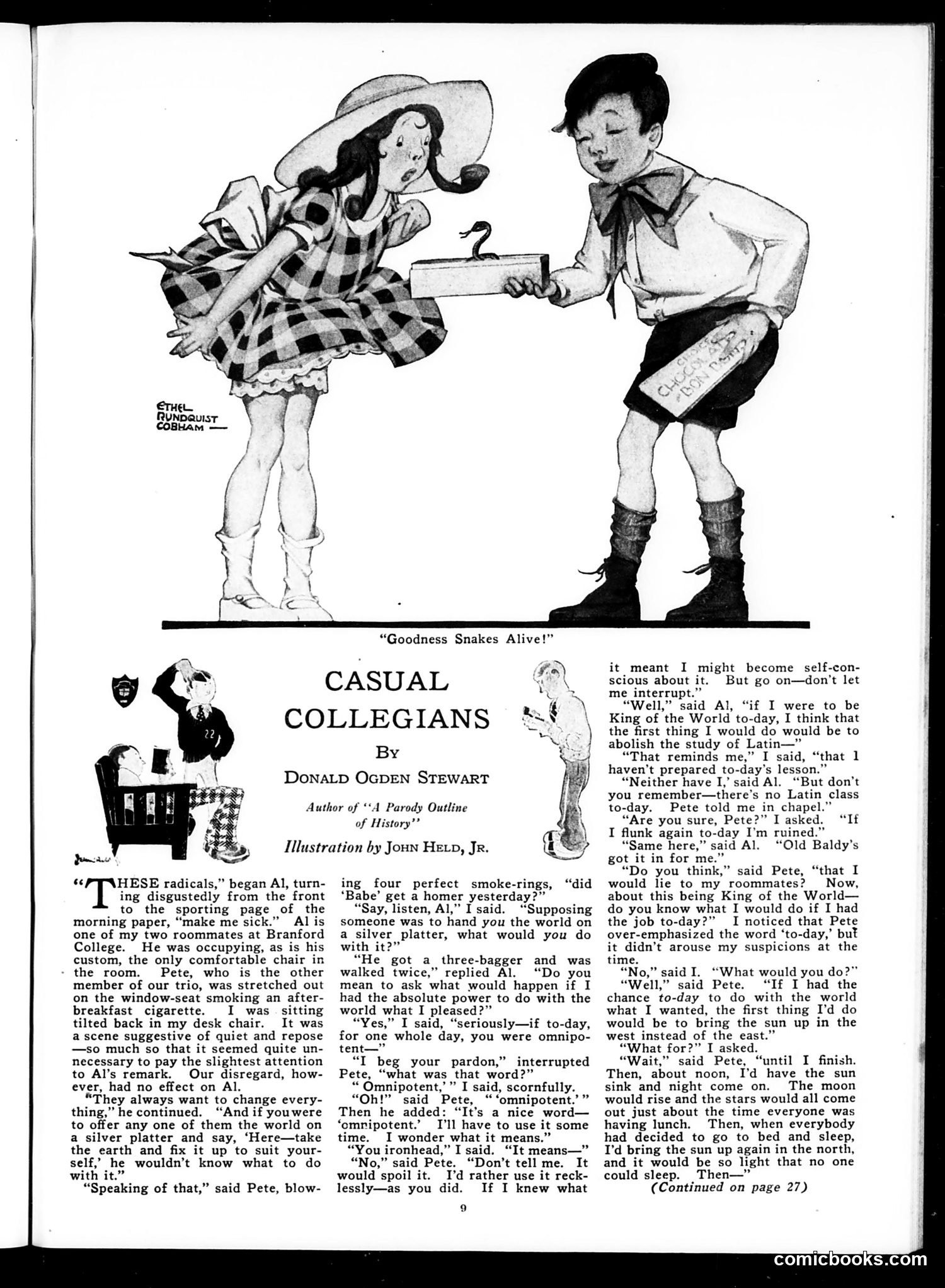
This is a humorous short story satirizing Yale undergraduates (set at Branford College) and their casual attitudes toward serious matters. Three roommates discuss what they'd do if they had absolute power over the world—a setup for philosophical reflection. The satire targets their intellectual laziness: Al dismisses "radicals" while ignoring the substantive question; Pete admits not knowing what "omnipotent" means but prefers using words carelessly rather than learning; all three are more concerned about a Latin exam they haven't prepared for than about world-changing powers. The joke culminates in Pete's absurd fantasy—he'd rearrange the sun and moon's movements to prevent sleep—revealing these college men prioritize petty disruption over meaningful reform. The story mocks educated youth's indifference to politics and learning, embodied in their dismissive treatment of a serious hypothetical question.
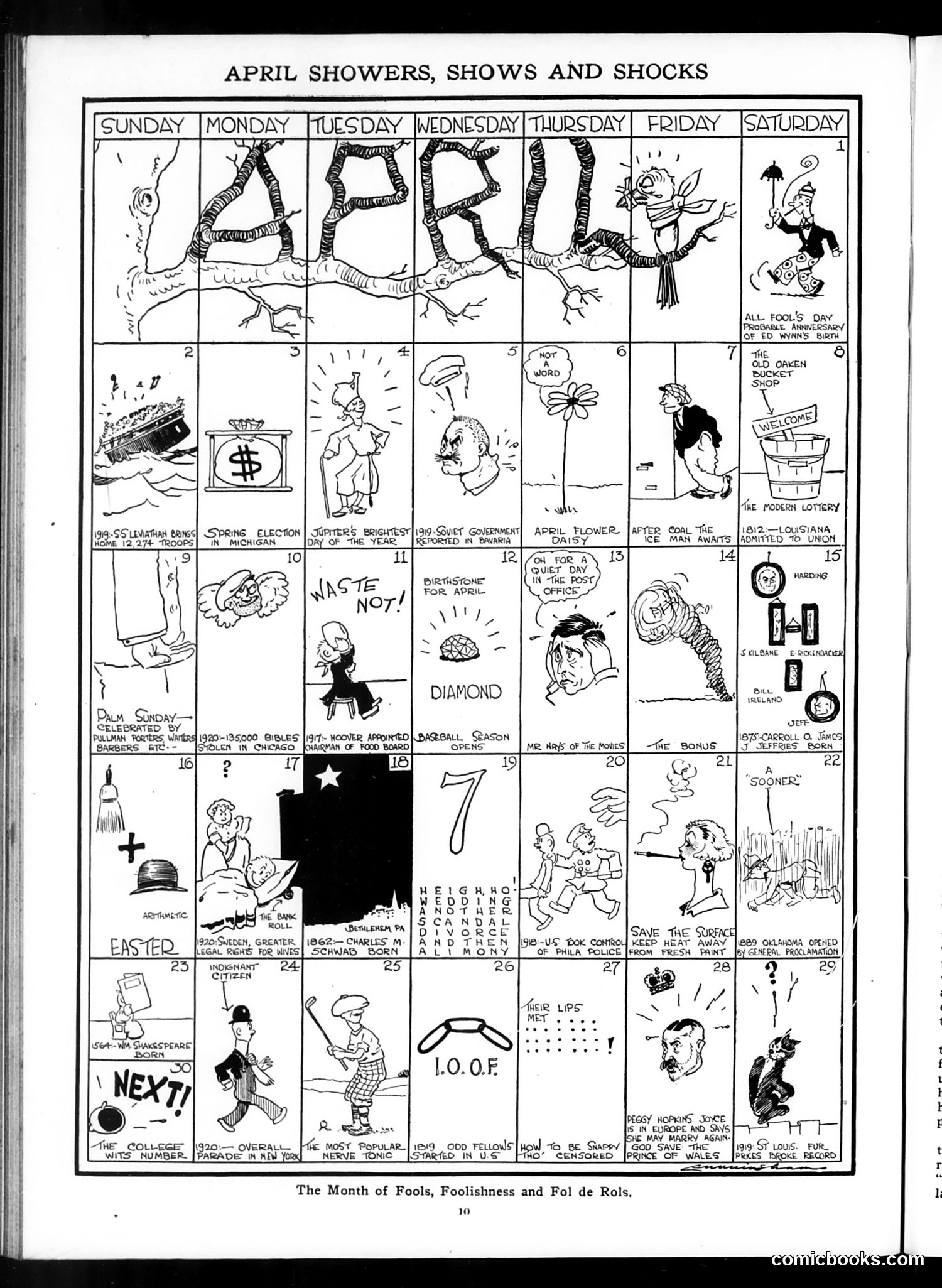
This is a 1920 calendar-style satirical page from *Judge* magazine, with daily entries mixing historical events, contemporary gossip, and topical humor. **Key references include:** - **April Fool's Day** (1st): Notes entertainer Ed Wynn's birthday - **Spring elections** (3rd): References 1919 government events - **Hoover** (11th): Herbert Hoover as Food Board chairman (WWI rationing context) - **Baseball season** (13th): Opening day - **Peggy Hopkins Joyce** (28th): A notorious 1920s socialite/actress known for multiple marriages and affairs, shown as scandal fodder with the caption "She may marry again" - **Various historical births/events**: Including Charles Schwab (steel magnate), references to Prohibition-era bootlegging The humor targets contemporary American society: political upheaval post-WWI, celebrity scandals, dating/marriage customs, and urban life. The subtitle—"The Month of Fools, Foolishness and Fol de Rols"—frames April as a month of absurdity and vice.
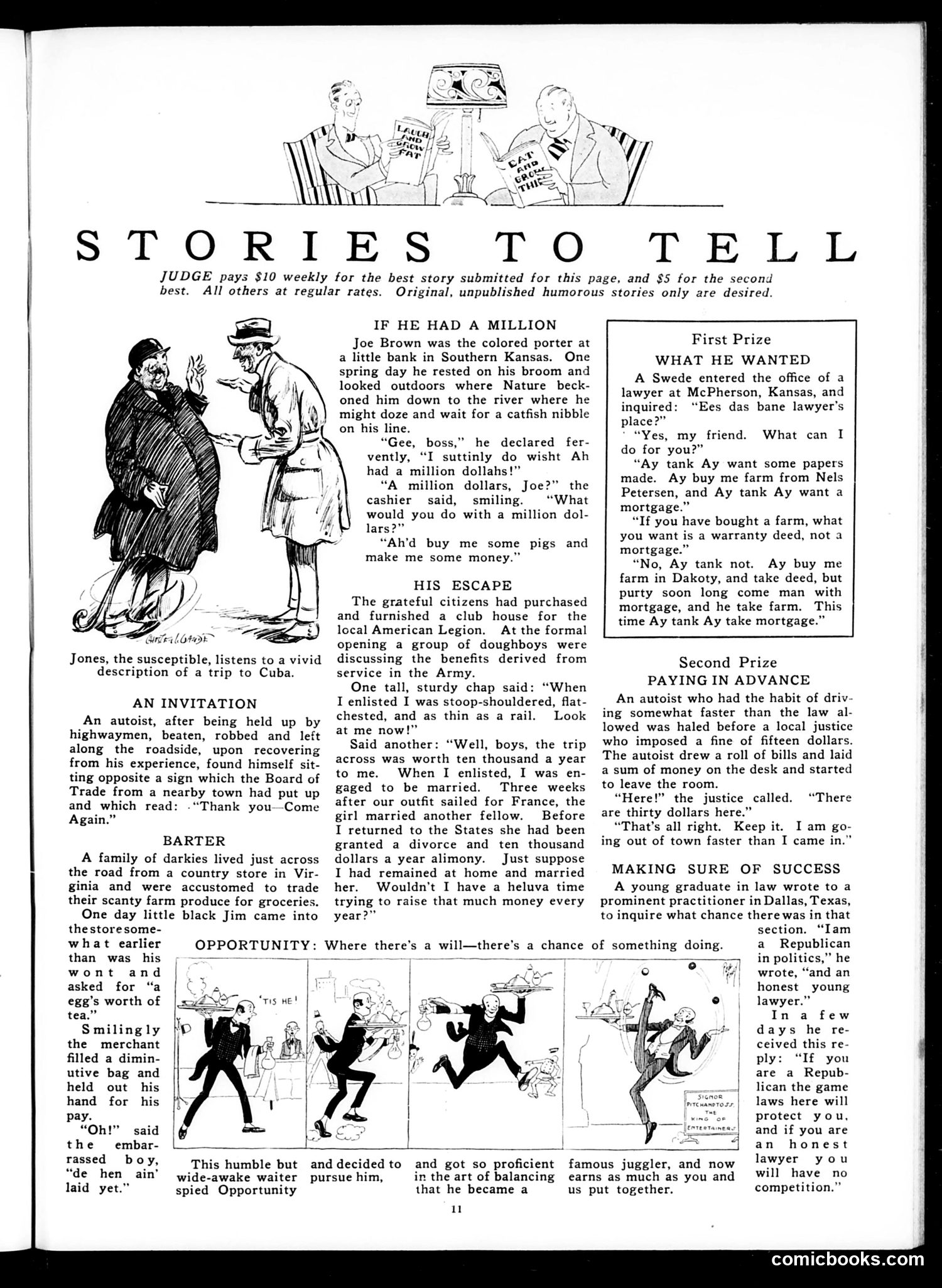
This page from **Judge** magazine collects humorous short stories typical of early 20th-century American humor. The satire relies on period-specific stereotypes and social commentary: **"IF HE HAD A MILLION"** mocks a Black bank porter's modest ambitions—he'd only buy pigs for modest profit—satirizing either limited Black economic opportunity or working-class lack of imagination. **"HIS ESCAPE"** jokes darkly about a soldier's divorce settlement as a financial benefit of WWI military service, suggesting marriage was economically ruinous. **"WHAT HE WANTED"** uses exaggerated Swedish immigrant dialect and malapropism (wanting a "mortgage" instead of a "warranty deed") to portray foreign newcomers as comically ignorant of American legal/financial systems. **"PAYING IN ADVANCE"** is straightforward: an impatient speeder overpays a fine to leave town faster. The humor throughout relies on ethnic caricature, class stereotypes, and dialect comedy—attitudes toward immigrants, African Americans, and rural people typical of this era's "genteel" satire.
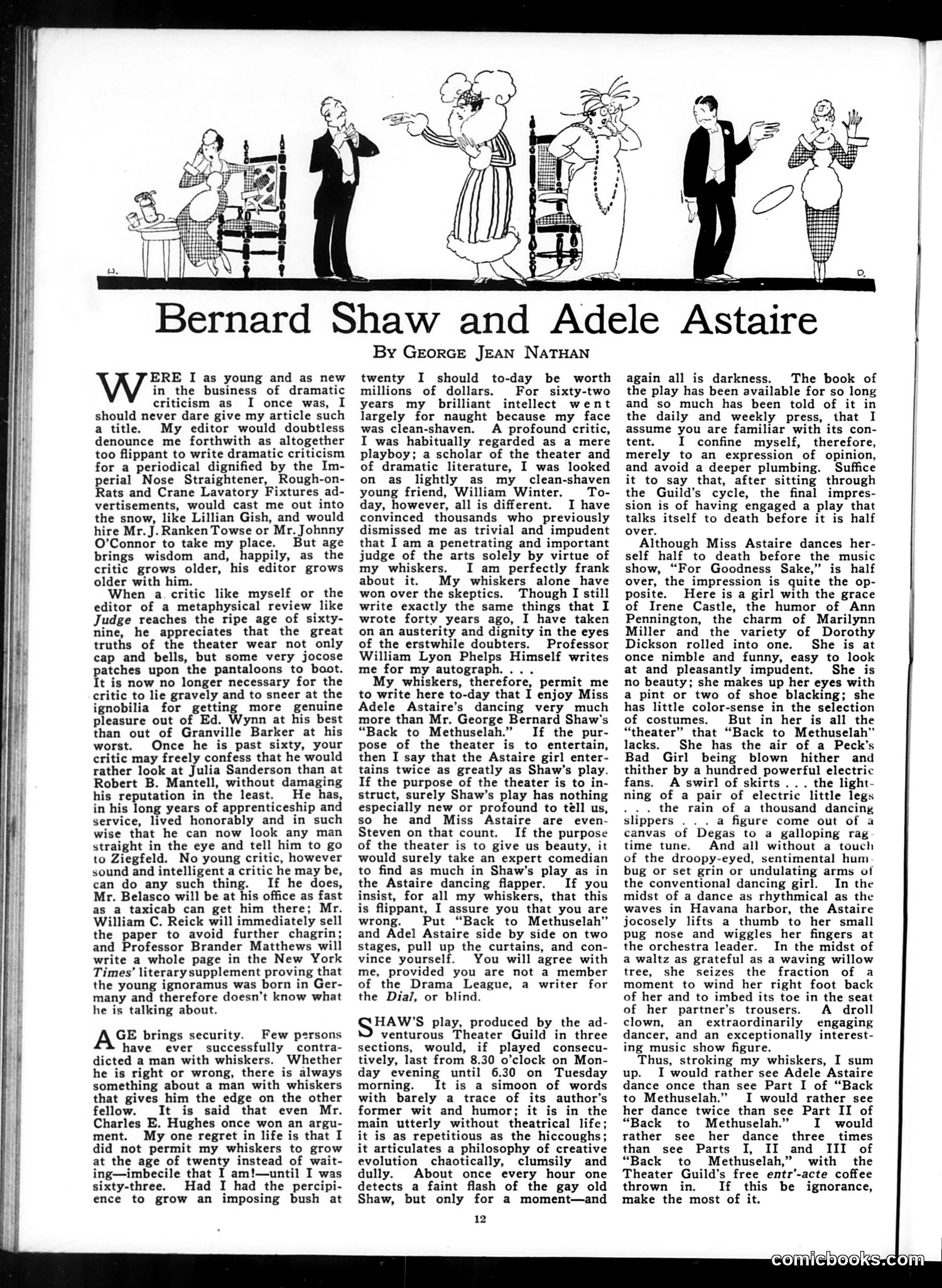
This is a humorous essay by drama critic George Jean Nathan accompanying an illustration of theatrical figures. The piece satirizes several things: **The Main Subjects:** - **Bernard Shaw** and his play "Back to Methuselah" (an actual 1921 Shaw work) - **Adele Astaire**, the famous dancer and sister of Fred Astaire **The Satire:** Nathan argues that growing old and acquiring whiskers gave him credibility as a critic—despite holding the same opinions for 40 years. He uses this tongue-in-cheek admission to justify saying he enjoys Astaire's entertainment value more than Shaw's intellectually heavy play. **The Point:** Nathan mocks the pretension of serious dramatic criticism and the theater establishment's reverence for highbrow work like Shaw's. He suggests that entertainment—Astaire's dancing—has legitimate value alongside intellectual theater. **Context:** The illustration shows various theatrical types observing these entertainers, reflecting the divide between "serious" theater and popular entertainment in the 1920s.
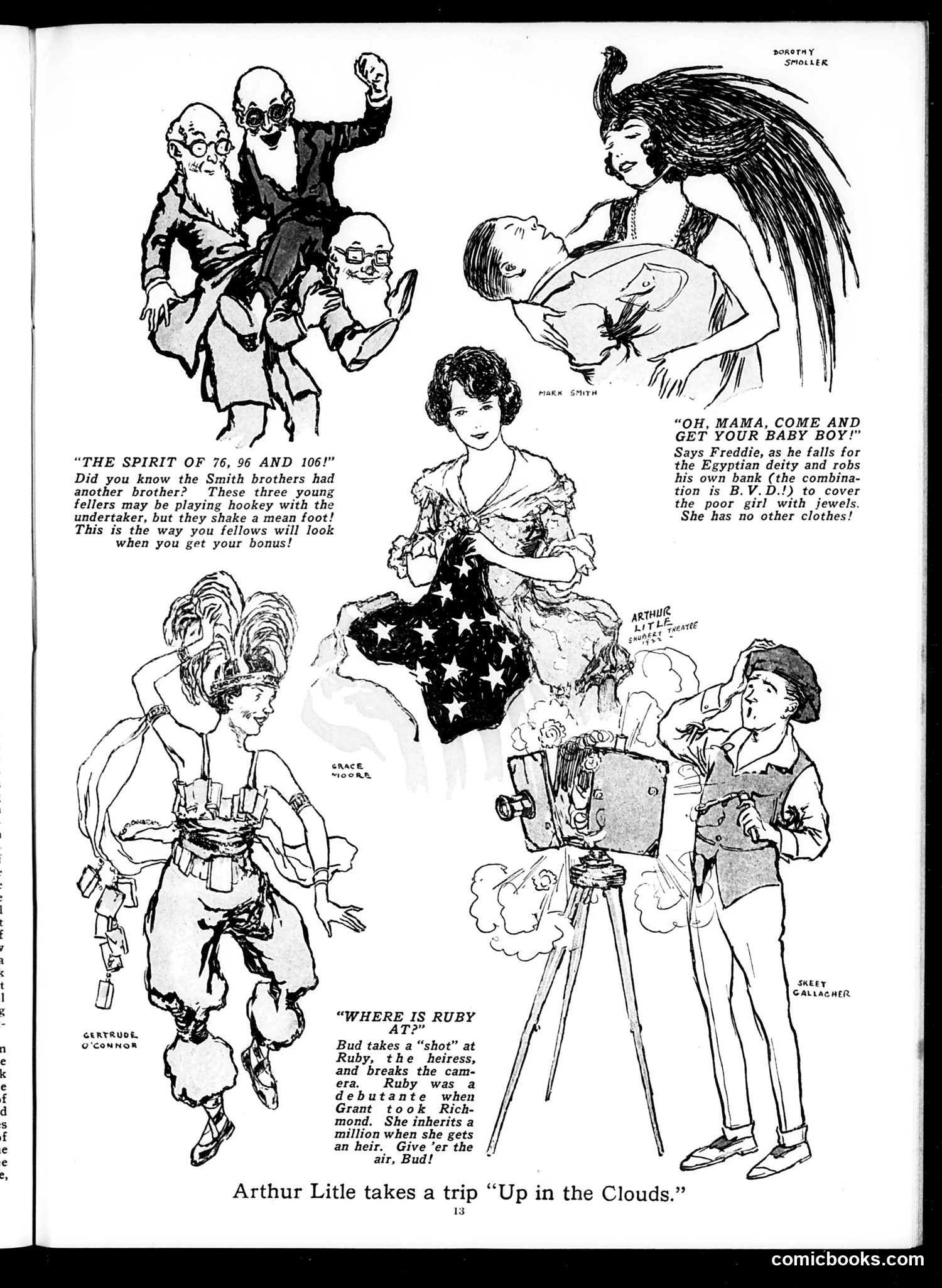
This page from *Judge* magazine contains multiple satirical sketches mocking contemporary figures and social trends, likely from the 1920s era. **"The Spirit of 76, 96 and 106"** jokes about the Smith brothers (likely the famous cough-drop merchants) having a third brother, playing on their celebrity. The caption suggests young men will age poorly if they don't collect their war bonuses—a reference to delayed veterans' payments post-WWI. **"Oh, Mama, Come and Get Your Baby Boy"** satirizes Freddie (likely a known public figure) who seduces an Egyptian deity character and steals from his bank using "B.V.D." (a brand name pun) to clothe a poor girl instead of helping her legitimately. **"Where is Ruby At?"** ridicules a debutante named Ruby who inherited wealth. Bud photographs her and breaks the camera—the joke being she's been an heiress since the Civil War era and will only truly gain money upon having an heir. The sketches collectively mock wealth, romantic scandal, and social pretension through exaggerated characterizations and wordplay typical of satirical magazines of this period.
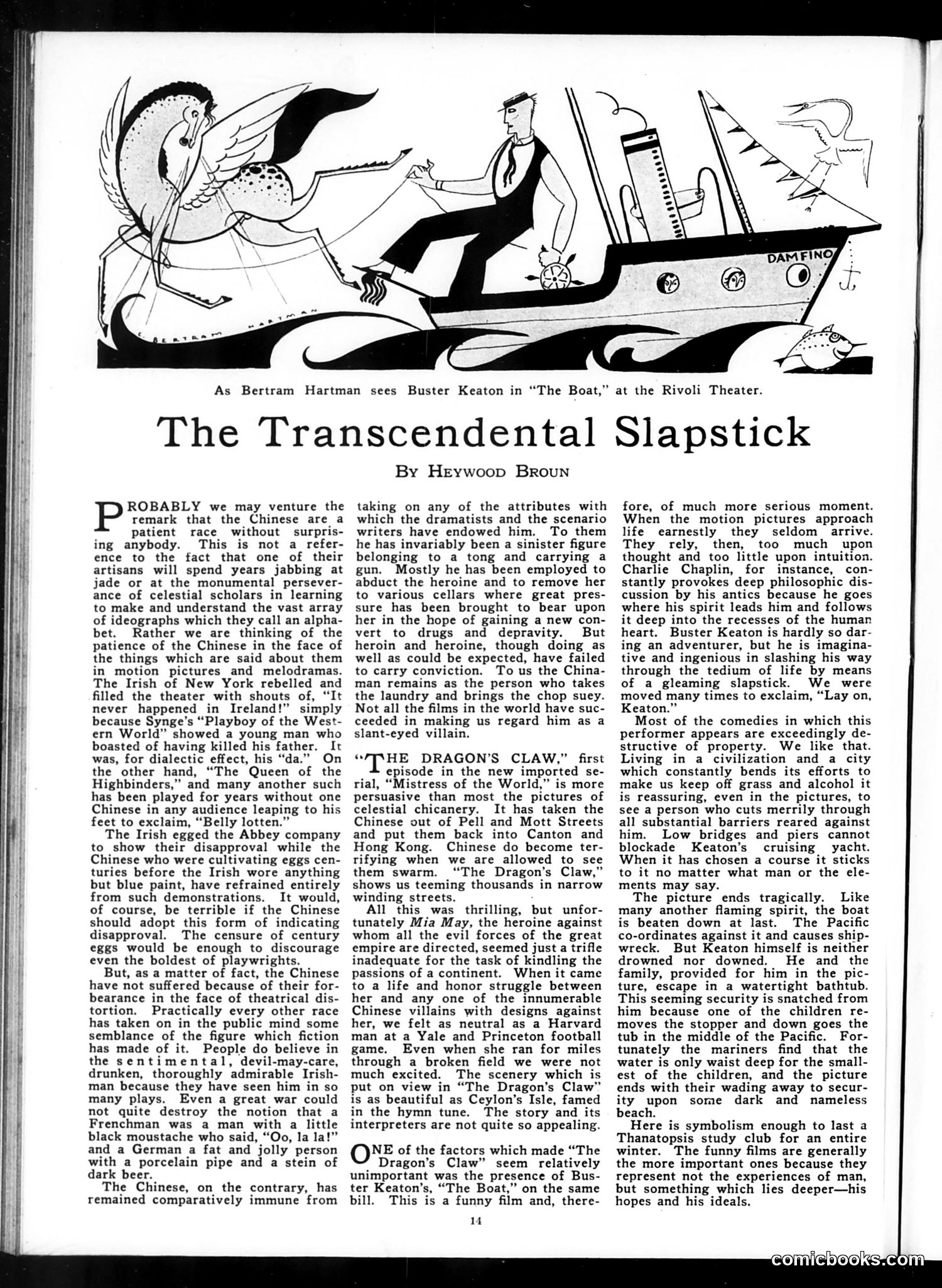
This page contains a film review by Heywood Broun discussing Buster Keaton's comedy "The Boat" (shown in the cartoon at top) and comparing it to imported Chinese-themed serials like "The Dragon's Claw." **The cartoon** depicts Keaton's famous slapstick style—a man in formal dress precariously balanced on a boat while being attacked by a large bird, illustrating the physical absurdity of silent-era comedy. **The satire's point:** Broun argues that while other ethnic groups (Irish, French, Germans) have been stereotyped by theatrical representations, Chinese people have remained immune to such caricaturing in American popular consciousness. Despite melodramas portraying them as villains in opium dens and tongs, Americans still simply see Chinese people as laundry workers and restaurant operators. Broun suggests this "patience" demonstrates Chinese cultural resilience—their real identity resists Hollywood's distortions. The article contrasts serious imported dramas with Keaton's "transcendental" comedies that work through pure physical humor rather than ethnic stereotyping.
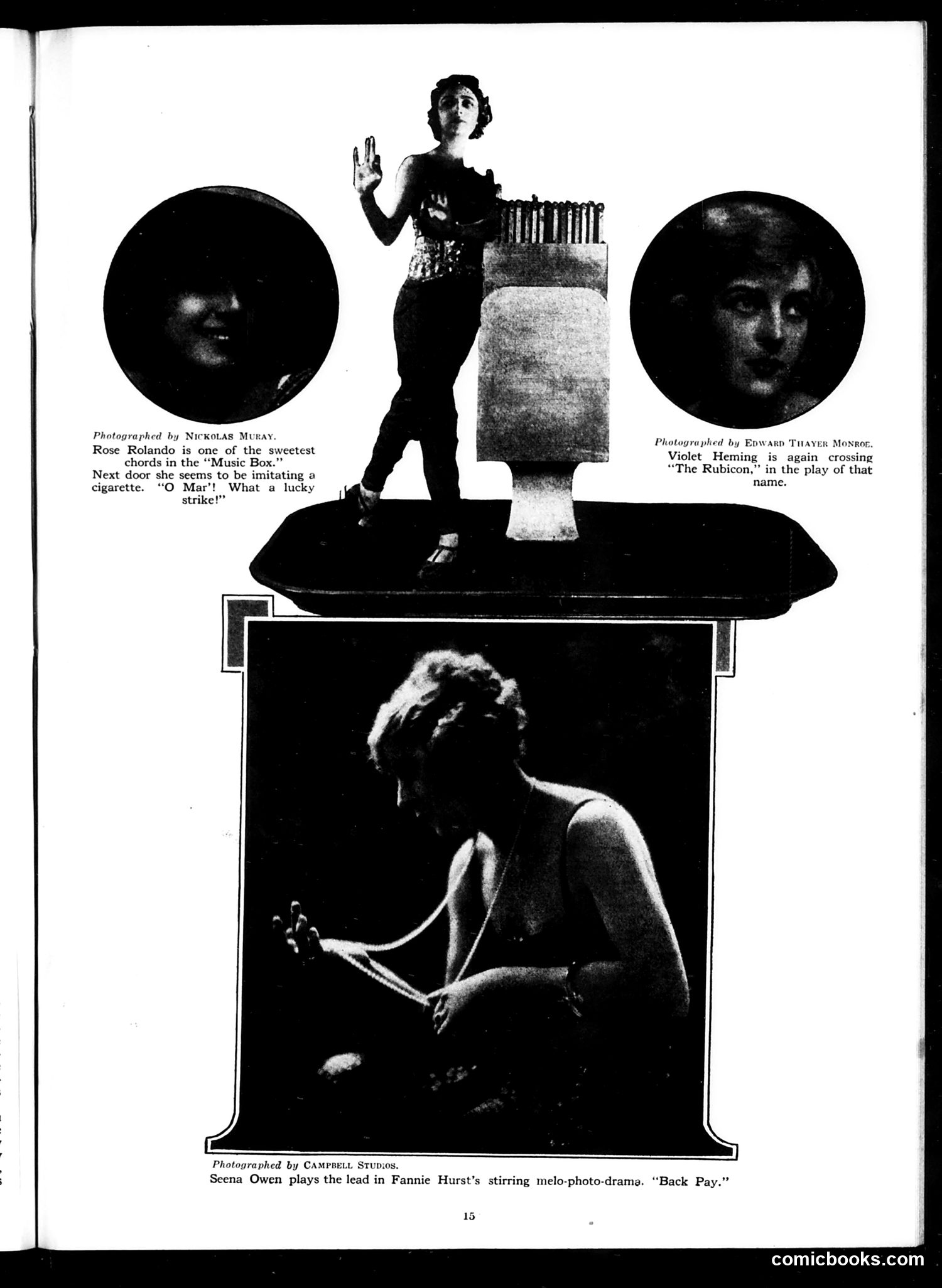
This page from *Judge* magazine features theatrical photographs and brief satirical commentary about stage performers and productions, likely from the 1920s. The captions use wordplay and puns as humor: - **Rose Rolando** ("Music Box"): The joke plays on "sweetest chords"—she's shown imitating a cigarette, prompting "O Mar'! What a lucky strike!" (pun on cigarette brands/luck) - **Violet Heming** ("The Rubicon"): References her crossing "The Rubicon" (the famous historical river/point of no return), suggesting she's taking on significant dramatic roles - **Seena Owen** ("Back Pay"): Presented straightforwardly as the lead in Fannie Hurst's melodrama The page functions as theatrical promotion combined with light satire—typical of *Judge's* entertainment coverage. The humor is gentle wordplay rather than sharp social commentary, reflecting early 20th-century magazine style mixing gossip, puns, and show-business promotion.
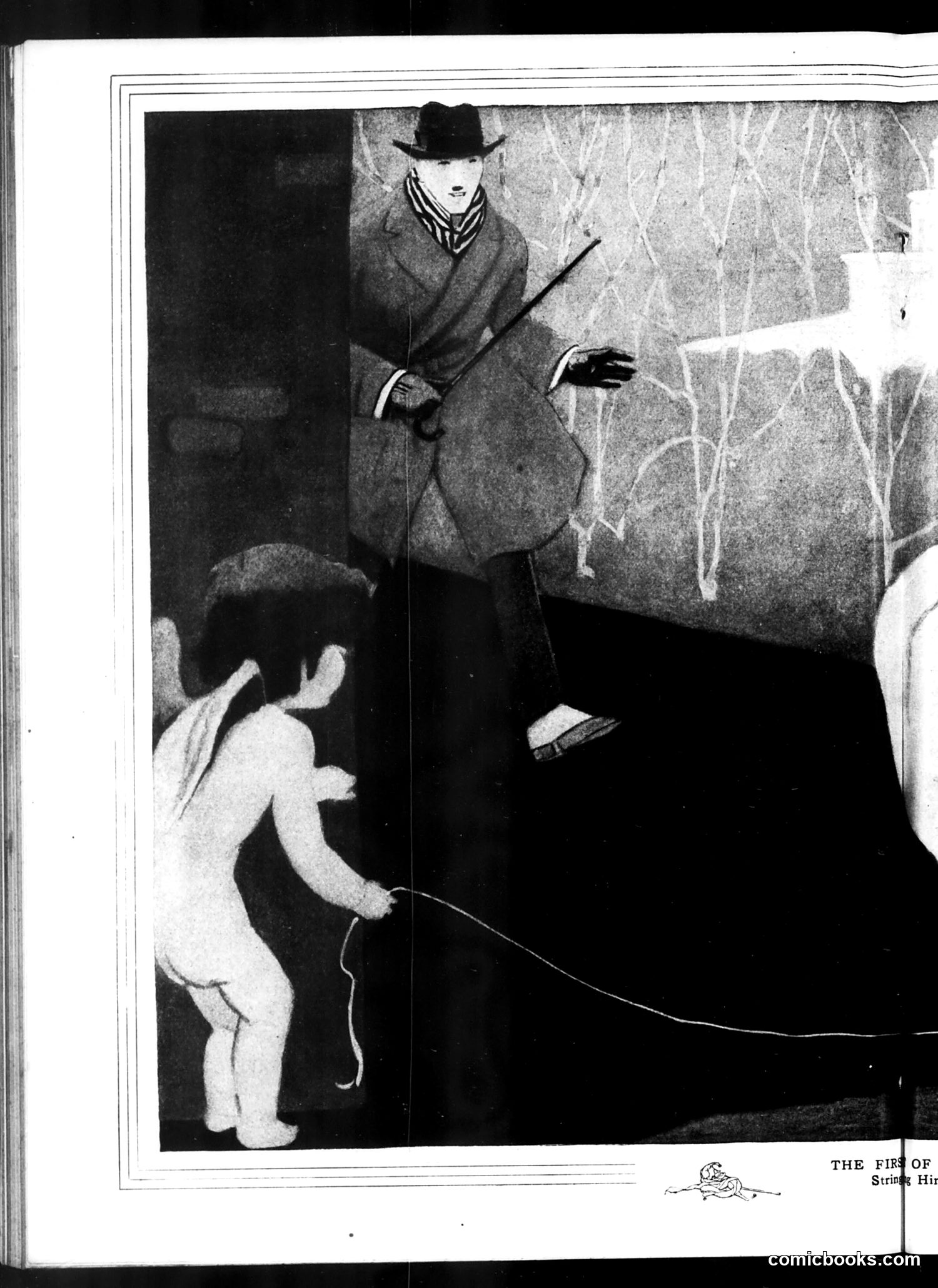
This appears to be a satirical cartoon from Judge magazine showing a confrontation between two figures. A well-dressed man wearing a cowboy hat and coat holds a whip or riding crop, standing in a dominant pose over a smaller, nude or partially-clothed figure on the left. The setting appears theatrical, with painted scenery visible in the background. The incomplete text visible ("THE FIR" and "Strin Hi") makes it difficult to identify the specific reference with certainty. However, the imagery suggests social commentary about power dynamics or possibly commentary on theatrical/entertainment figures of the era. Without the complete caption and context, the specific satirical target remains unclear, though the composition emphasizes themes of authority and subjugation typical of Judge's social commentary.
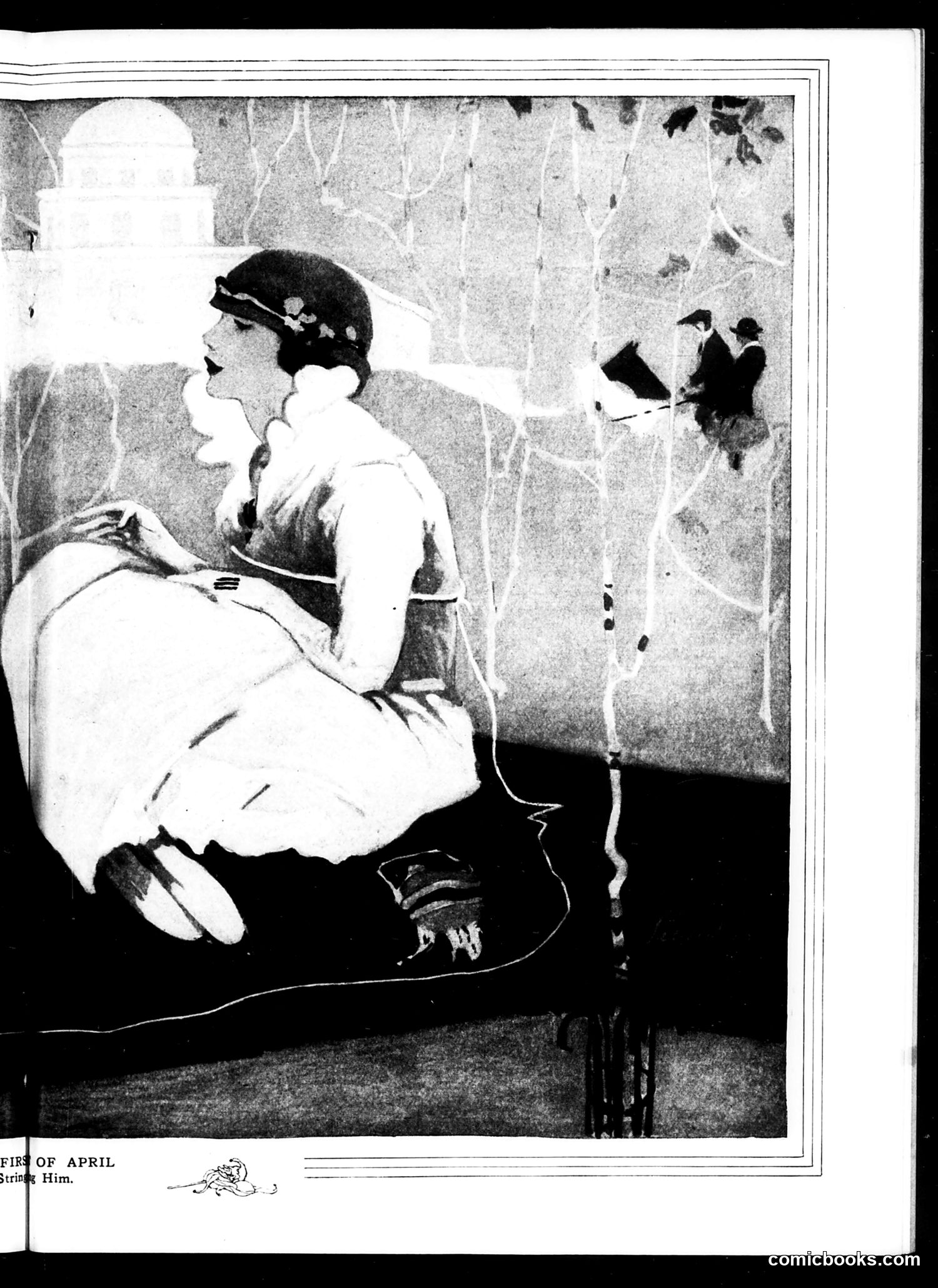
This Judge cartoon appears to satirize a romantic or courtship scenario. A woman in 1920s attire sits indoors by a window, holding what appears to be a telephone cord or string connected to a man visible outside. The title "Stringing Him" suggests the woman is manipulating or leading on her suitor—a period colloquialism meaning to deceive or toy with someone romantically. The visual metaphor of literal "stringing" reinforces the joke: she controls him like a puppet on a string. This reflects era-typical satire about gender dynamics in courtship, where women were depicted as cunning manipulators of besotted men. The "Ides of April" reference suggests April foolery or trickery, fitting the theme of deception.
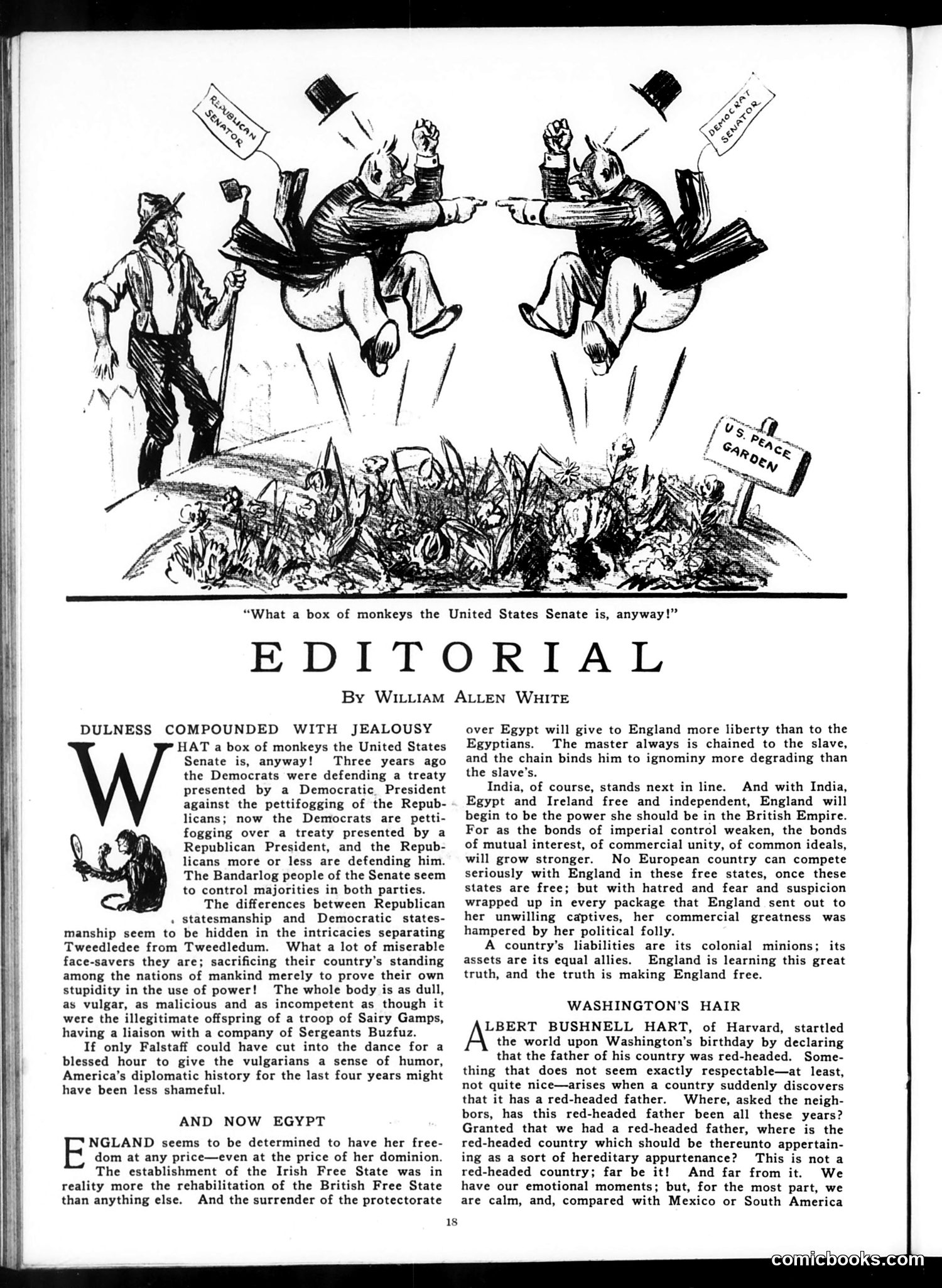
**Top Cartoon:** Depicts the U.S. Senate as chaotic "monkeys" juggling contradictory positions. The illustration shows two identical figures (representing Democrats and Republicans) performing acrobatic reversals while wielding signs labeled "REPUBLICAN FOLLY" and "DEMOCRATIC FOLLY." Below them, a small figure watches as documents labeled "USELESS GARDEN" grow wild. **The Point:** William Allen White's editorial criticizes Senate hypocrisy—Democrats once defended a Democratic President's treaty against Republican obstruction; now they obstruct a Republican President's treaty while Republicans defend it. White argues both parties prioritize political face-saving over national interest, sacrificing America's standing through petty partisan reversals. **Literary References:** White invokes Kipling's "Bandarlog" (monkey people), Dickens characters (Sairy Gamps, Sergeant Buzfuz), and Falstaff to underscore the Senate's incompetence, vulgarity, and lack of humor. **Secondary content** discusses British imperial policy toward Egypt and Ireland, and a Harvard professor's claim that George Washington was red-headed.
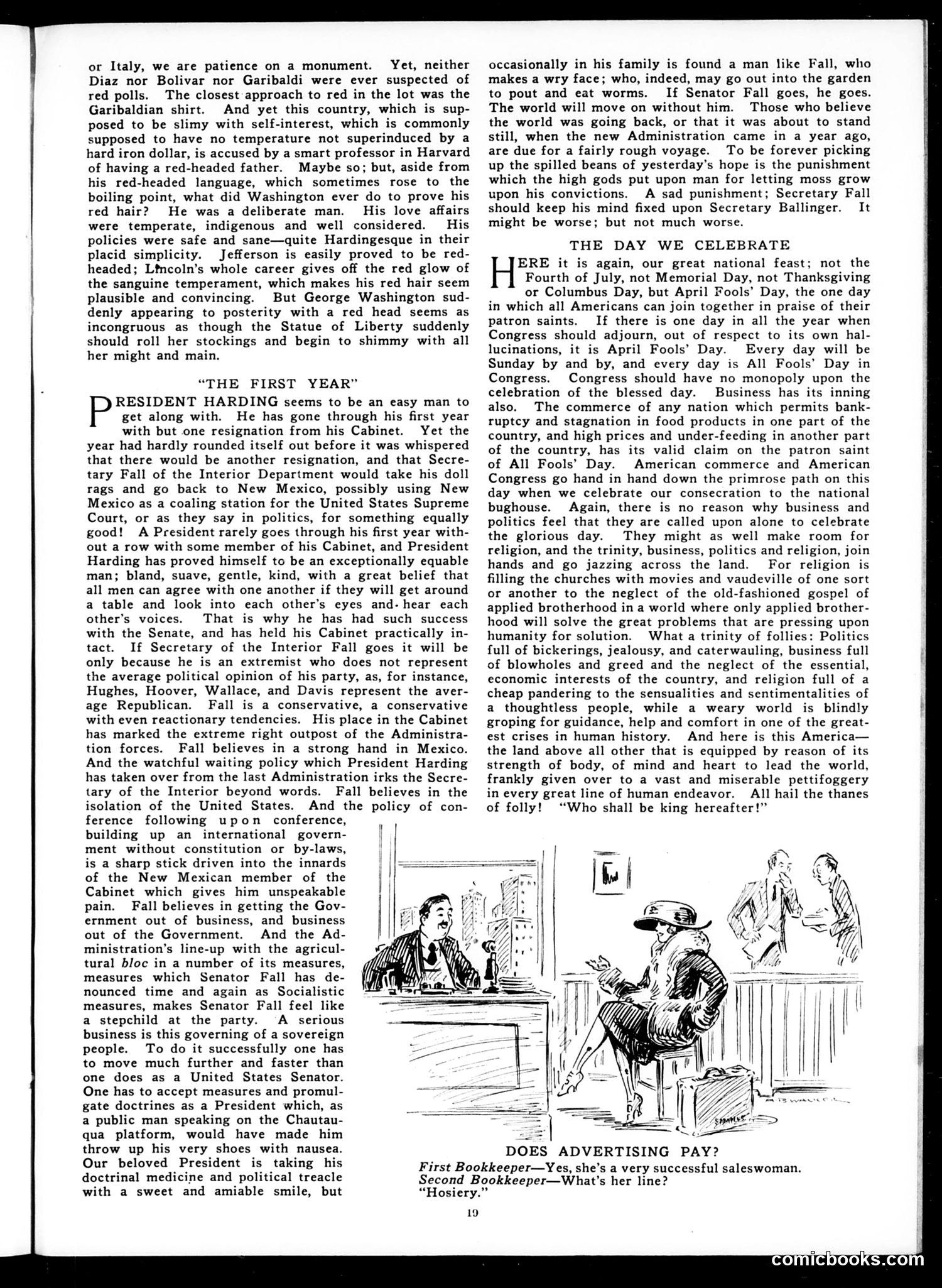
This page from Judge magazine critiques President Harding's first year in office (likely 1922). The upper text defends Washington and Jefferson against accusations of "red" (communist) sympathies, arguing their temperaments don't support such claims—a response to 1920s "Red Scare" rhetoric. The main article examines Interior Secretary Albert Fall, whom the writer characterizes as an extremist conservative—isolated within Harding's cabinet. Fall opposes Harding's diplomatic conferences and international cooperation, favoring instead isolationism and a "strong hand in Mexico" (likely referencing American interventionism). The piece suggests Fall's reactionary positions make him uncomfortable with the administration's agricultural compromises, which Fall deems "Socialistic." The cartoon below depicts two bookkeepers discussing advertising's effectiveness—likely satirizing business culture or sales techniques. The satire targets Fall's ideological rigidity within a more moderate Republican administration.
This page contains book reviews rather than political cartoons. The header illustration shows books and a figure amid literary clutter—a decorative flourish for a literary section. The main review discusses Princess Bibesco's "I Have Only Myself to Blame," daughter of British political figure Margot Asquith. The reviewer sarcastically compares her to her mother, noting both write scandalous memoirs. He criticizes Bibesco's collection of erotic, sophisticated short stories as psychologically true but pathetic—products of a worn-out aristocracy obsessed with sex. The review uses comparison to make its point: Bibesco represents decadent European privilege, while American writer Hamlin Garland's "Daughter of the Middle Border" represents healthier American values. A subsequent review praises Konrad Bercovici's gypsy tales for their passionate directness and connection to "mother earth"—superior to the artificial preoccupations of aristocrats like the Asquiths. The satire targets upper-class European decadence versus American authenticity.
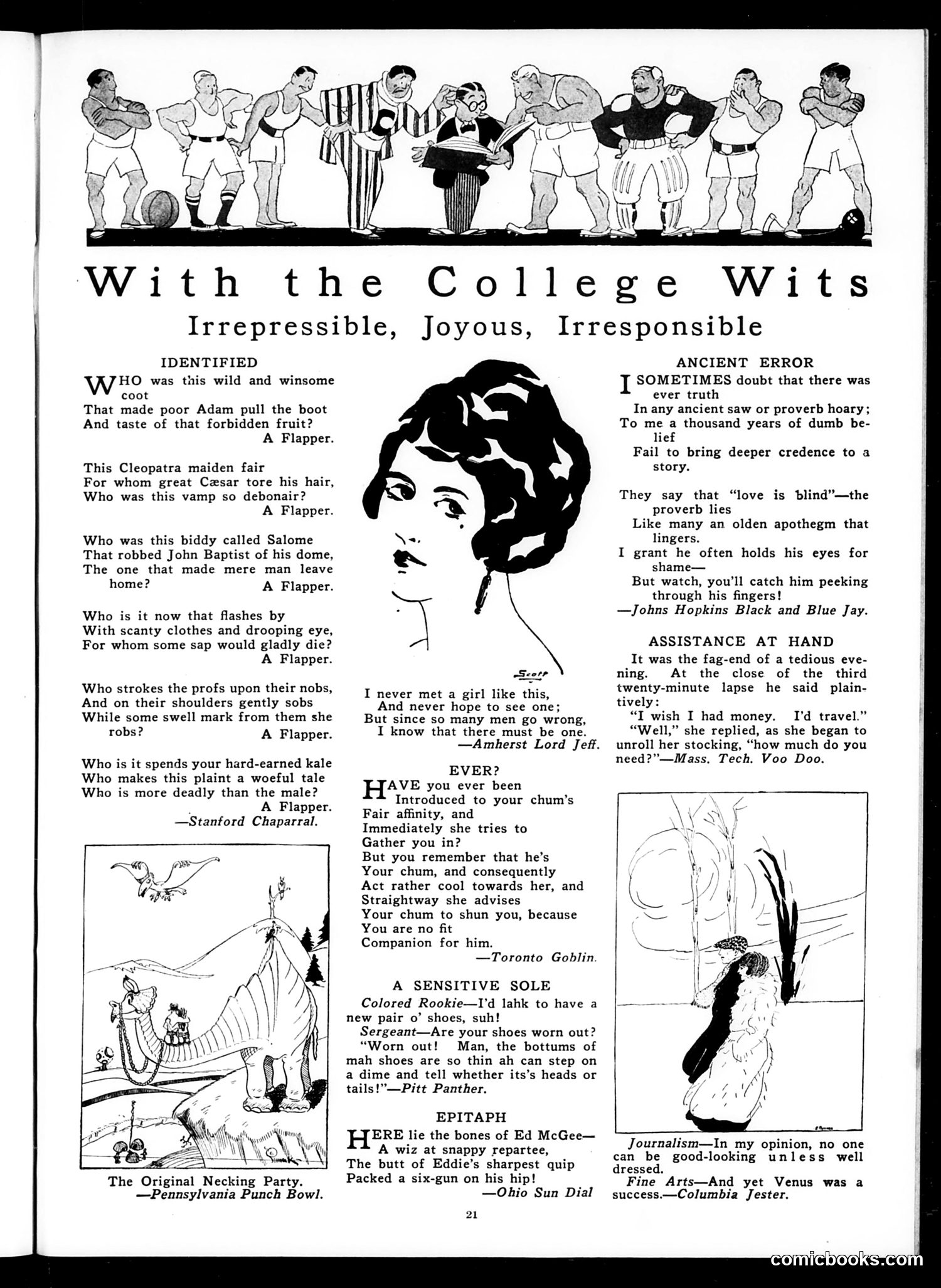
This page collects humorous verses from college publications, centered on 1920s social satire—particularly the "Flapper" phenomenon. **Main Target: The Flapper** The header poem (from Stanford Chaparral) traces female seduction from Eve through Cleopatra and Salome to modern "flappers"—young women of the Jazz Age known for scanty clothing, bobbed hair, and sexual boldness. The joke equates them with historically destructive women, suggesting they're morally corrupting ("deadly than the male"). **Secondary Themes:** - College romance dynamics and social awkwardness - Racial humor: a "Colored Rookie" dialect joke about worn-out shoes - A dark punchline: a man known for sharp insults carried a gun (implying retaliation) **Visual Element:** "The Original Necking Party" cartoon shows historical figures, likely connecting past seduction to modern kissing/petting culture. These pieces reflect contemporary anxiety about changing sexual mores and women's liberation, expressed through collegiate wit typical of early-1920s humor magazines.
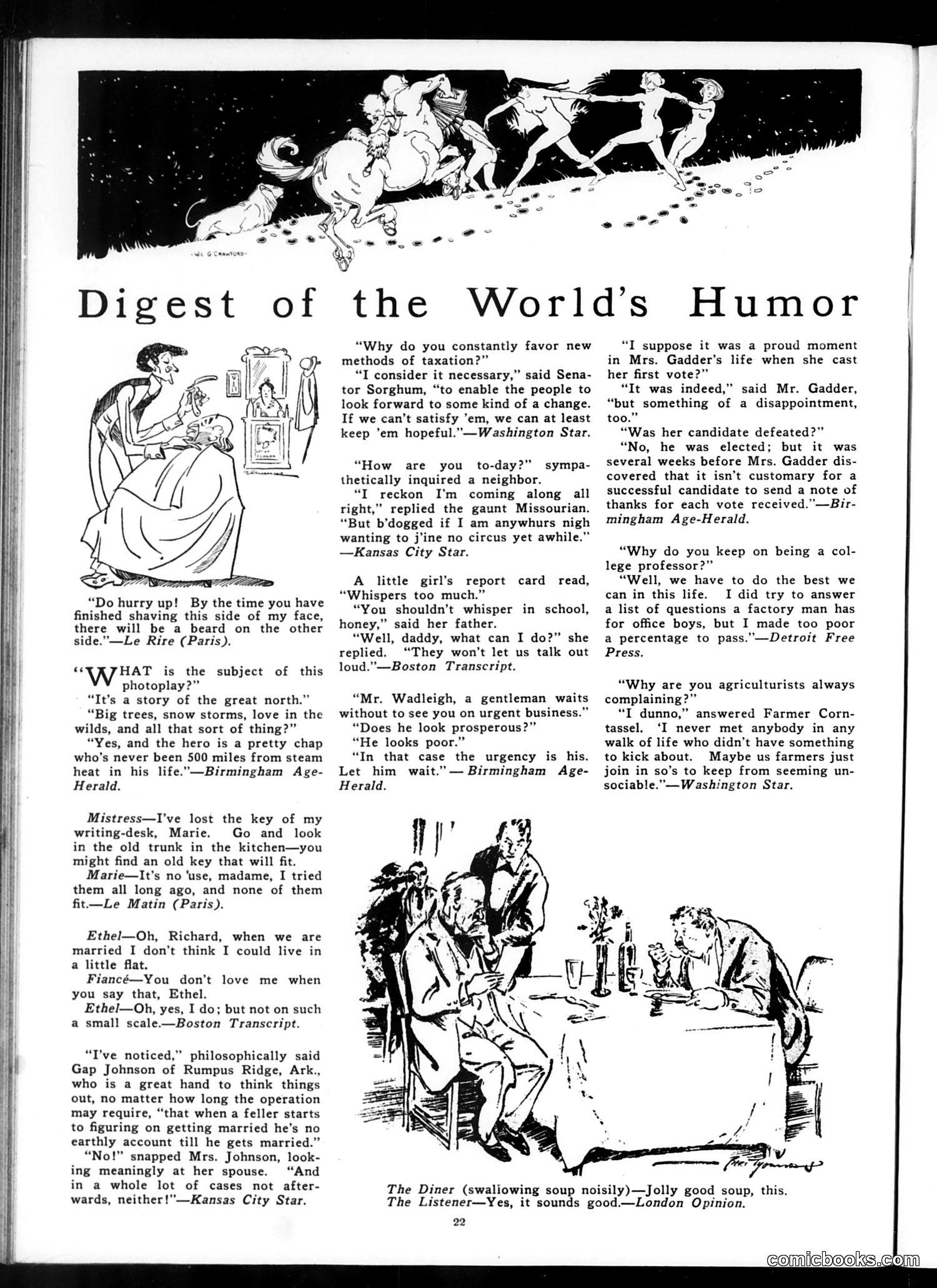
This page collects brief, comedic anecdotes from various newspapers and magazines, reprinted to showcase international humor. The jokes reflect early-20th-century social attitudes: **Key themes:** - **Gender dynamics**: Women's emerging independence (voting, marriage expectations) becomes comic fodder - **Class attitudes**: A businessman refuses to see poor visitors, implying poverty equals non-urgency - **Political satire**: Senator Sorghum admits new taxes distract dissatisfied citizens rather than solving problems - **Occupational complaints**: Farmers, professors, and working people grumble about their lots - **Marriage skepticism**: Multiple jokes mock married life as disappointingly ordinary The cartoons show domestic scenes—a couple shaving, men dining—illustrating these situations. The humor is gentle, relying on wordplay and understated observation rather than sharp wit. The anthology format (crediting sources like *Washington Star*, *Boston Transcript*, *Le Matin*) legitimizes these as genuinely circulating humor, creating an international "best of" collection for Judge's readers.
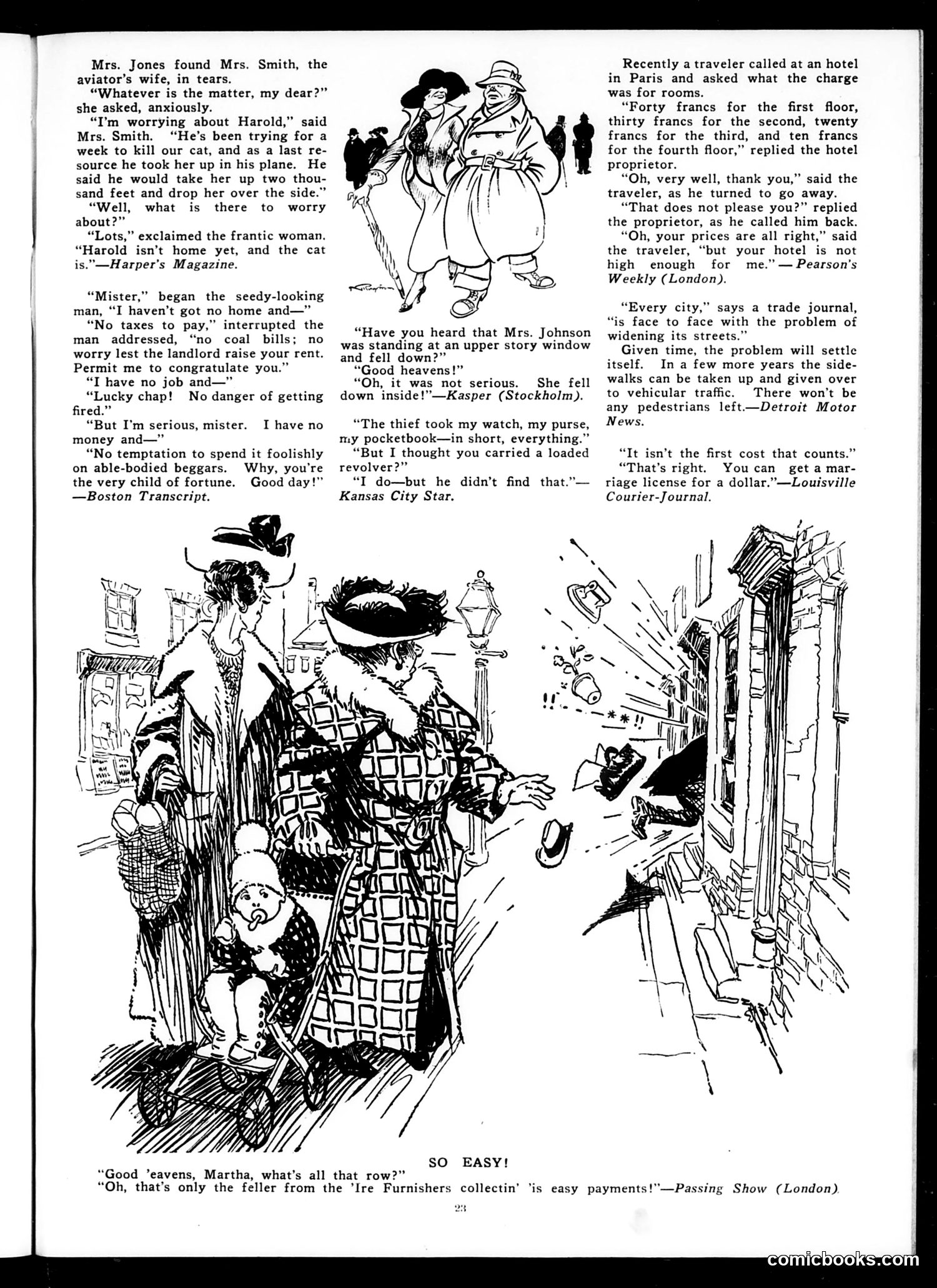
This page contains multiple short humorous anecdotes and jokes typical of early 20th-century satirical magazines. The cartoons illustrate contemporary social concerns: **Top cartoon**: Shows a woman overwhelmed by debt collectors ("'Ire Furnishers"), satirizing the then-new "easy payments" installment buying system that encouraged working-class people to accumulate debt they couldn't afford. **Text jokes** cover period anxieties: aviation as a dangerous novelty (the aviator husband), homelessness and economic inequality, early automobile traffic congestion, and marriage/divorce costs. One joke mocks hotel pricing discrimination based on room height—a jab at arbitrary pricing practices. The **overall theme** is satirizing modern consumer culture, financial systems, and technological change. These jokes reflect anxieties about rapid industrialization, installment credit, and urban congestion that characterized the early 1900s. The humor relies on wordplay and ironic reversals typical of the era's comedy style.
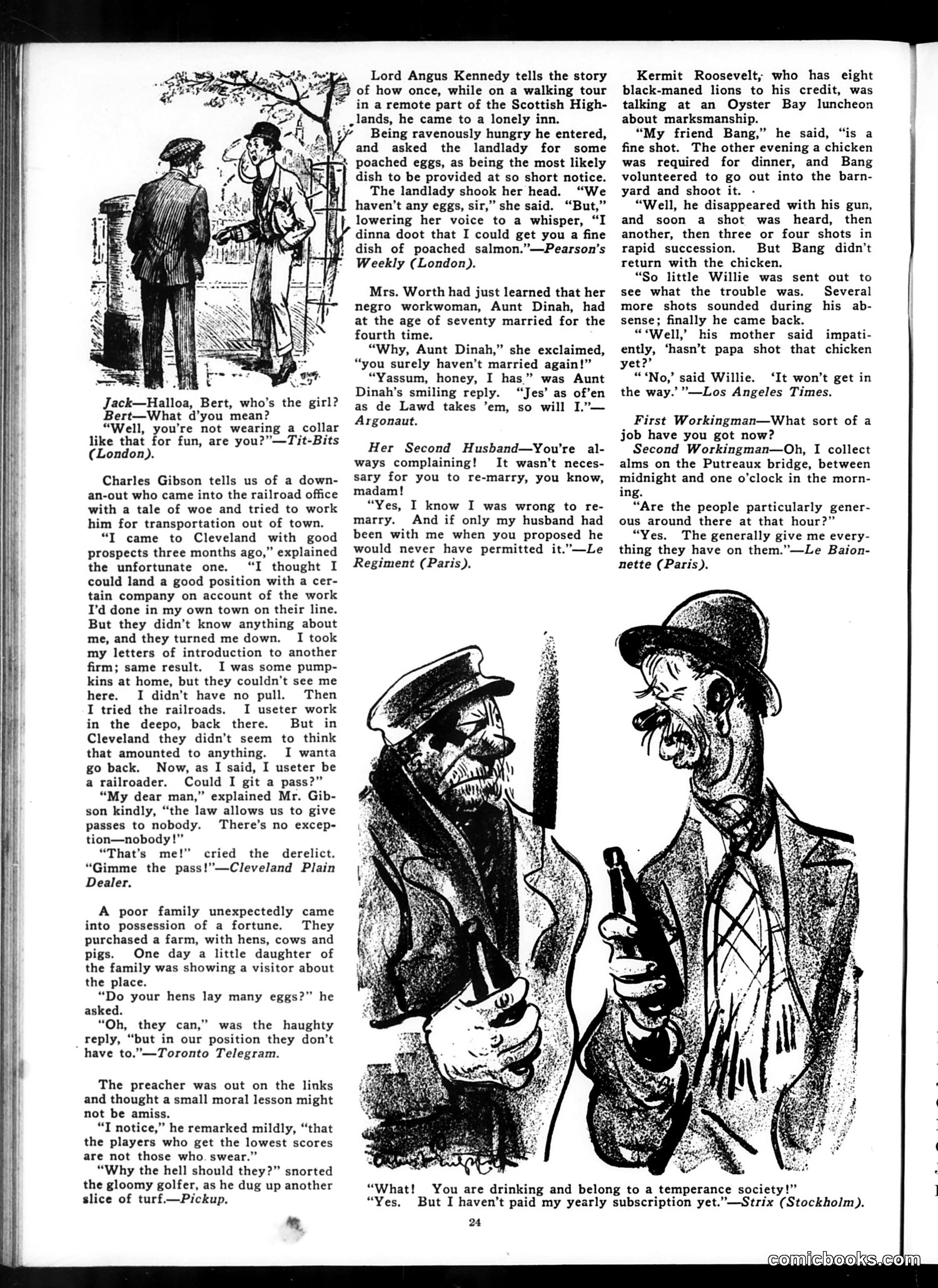
This page from Judge magazine contains multiple brief humorous anecdotes and one cartoon, typical of the publication's format. The stories mock social pretension and human nature through exaggeration: **Key items include:** - **The cartoon (bottom right)**: Shows two men in conversation about temperance society membership—one claims membership while actively drinking, satirizing hypocrisy among reformers. - **"Her Second Husband"** anecdote: A woman justifies remarriage by claiming her late husband wouldn't have approved her current husband's proposal—absurdist logic about marital propriety. - **Kermit Roosevelt story**: Recounts a bungled hunting attempt where "Bang" fires repeatedly to shoot one chicken, missing entirely while a child witnesses the incompetence—mocking overconfidence and poor marksmanship among the privileged. - **"Aunt Dinah" story**: Uses dialect humor to portray repeated remarriage as natural acceptance of fate, reflecting period attitudes. These jokes target pretension, contradiction between stated values and actions, and class-based incompetence—standard Judge magazine satire.
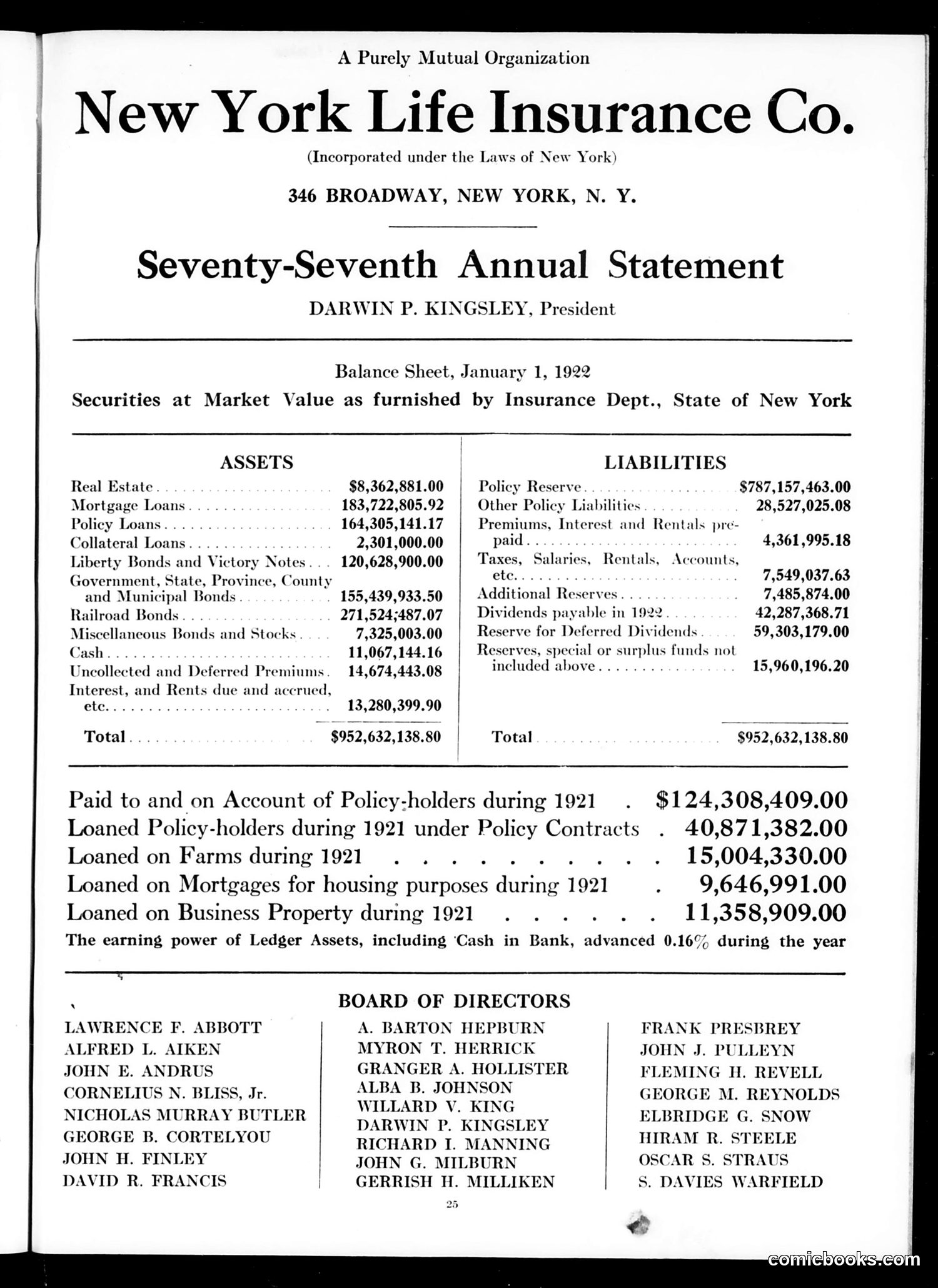
This is not a cartoon page—it's a corporate financial statement from the New York Life Insurance Company's 77th annual report, dated January 1, 1922. The document presents the company's balance sheet, listing nearly $953 million in assets and liabilities, along with information about payouts and loans to policyholders during 1921. The page concludes with a board of directors listing prominent businessmen and civic figures of the era, including Nicholas Murray Butler (Columbia University president) and Oscar S. Straus (former U.S. Secretary of Commerce). This appears in *Judge* magazine likely as a paid corporate advertisement or public relations piece—a common practice for major companies to publish financial statements in popular periodicals to demonstrate stability and trustworthiness to potential customers during the post-World War I economic period.
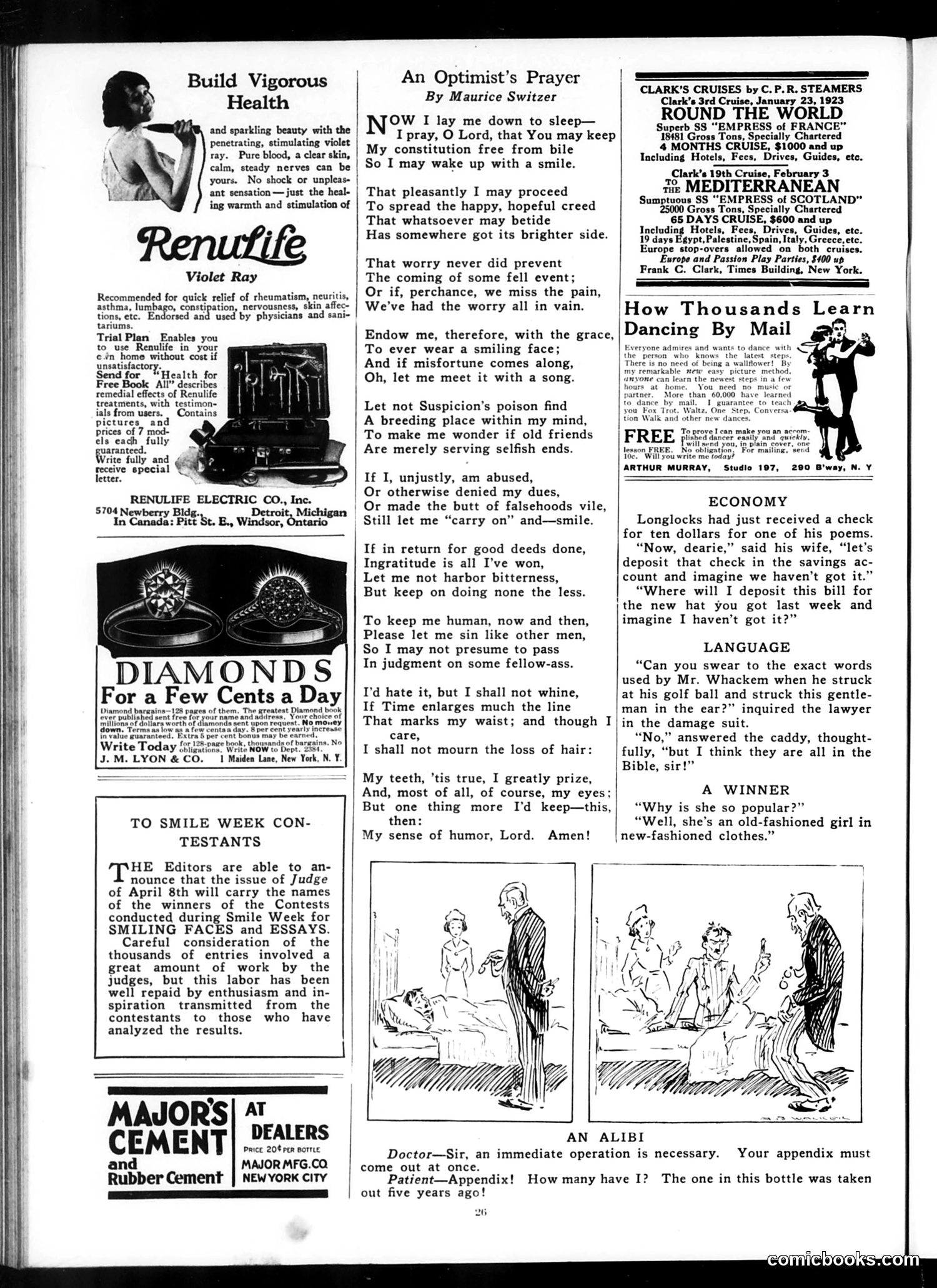
This page is primarily **advertisements and light humor pieces** rather than political satire. Key content includes: **Advertisements:** Renulife "Violet Ray" (a quack medical device promising cure-all health benefits), diamonds, cement, and cruise packages—typical early 1920s ads targeting middle-class consumers. **"An Optimist's Prayer"** by Maurice Switzer is a humorous poem about maintaining cheerfulness despite life's disappointments—relevant to post-WWI American optimism. **Cartoon "An Alibi"** shows a doctor telling a patient his appendix must be removed; the patient protests he already had one removed five years ago. The joke: the patient is making excuses rather than accepting medical reality. **Short humor pieces** ("Economy," "Language," "A Winner") are gentle jokes about domestic life and word usage—nothing overtly political. The page reflects 1920s consumer culture and popular entertainment rather than political commentary or social critique.
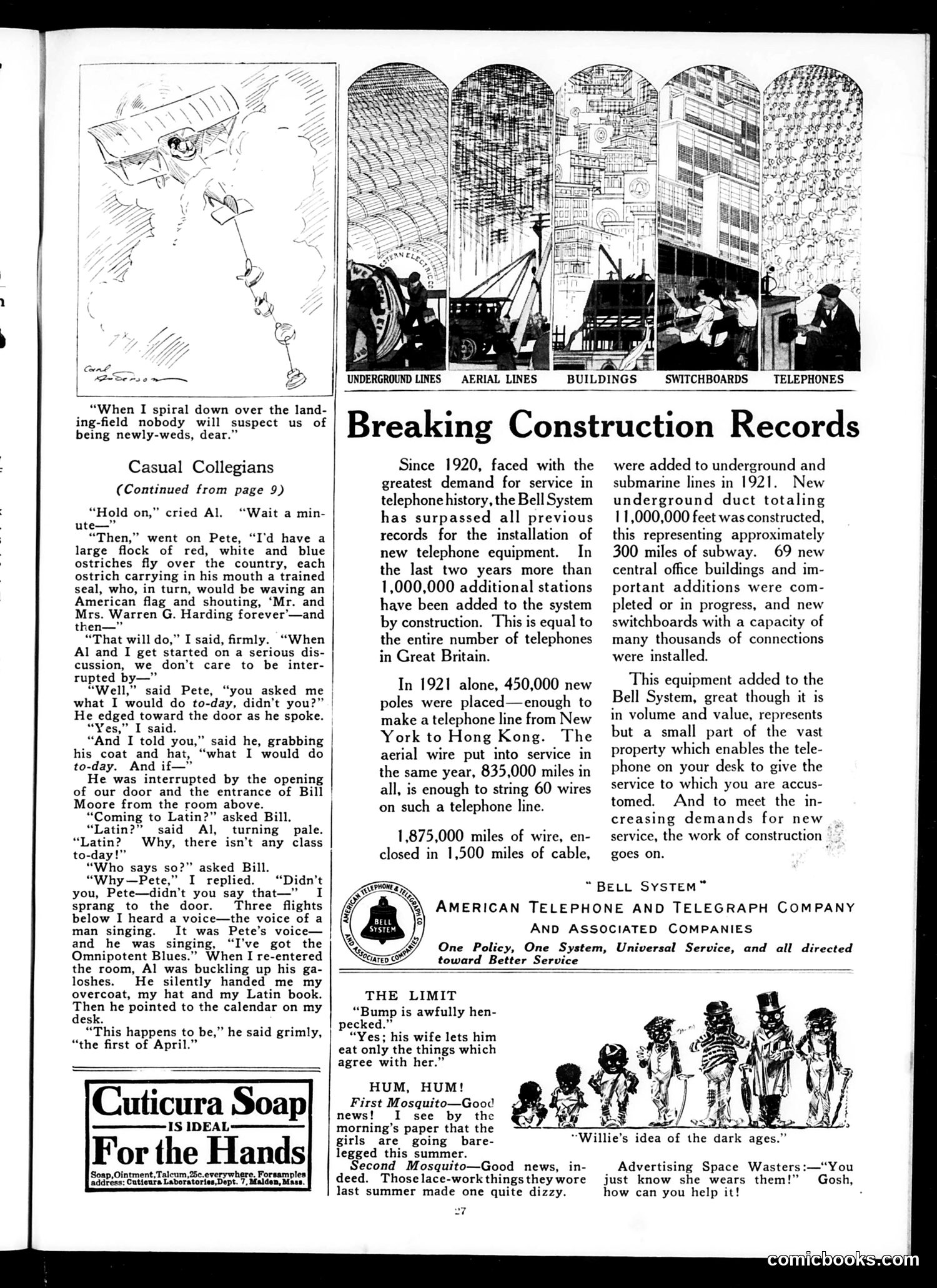
This page contains two unrelated items: a humorous short story and a corporate advertisement. **"Casual Collegians" (top left)**: A college humor piece where Pete plays an April Fools' prank on his roommate Al. Al asks Pete what he'd do that day; Pete elaborates absurdly (ostriches carrying trained seals waving American flags and shouting about President Warren G. Harding). When Al later asks about Latin class, Pete tricks him by claiming there's no class—then sings "I've got the Omnipotent Blues" while leaving. Al discovers the deception by checking the calendar: it's April 1st. The joke mocks both elaborate pranks and gullible victims. **"Breaking Construction Records" (right side)**: A Bell System advertisement showcasing telephone infrastructure expansion since 1920—poles, wires, cables, buildings, and switchboards. The accompanying diagrams depict modern urban telephone networks. This celebrates industrial progress and corporate achievement. **Lower cartoons**: Brief jokes about henpecked husbands and mosquitoes anticipating women's bare legs (fashionable in the 1920s).
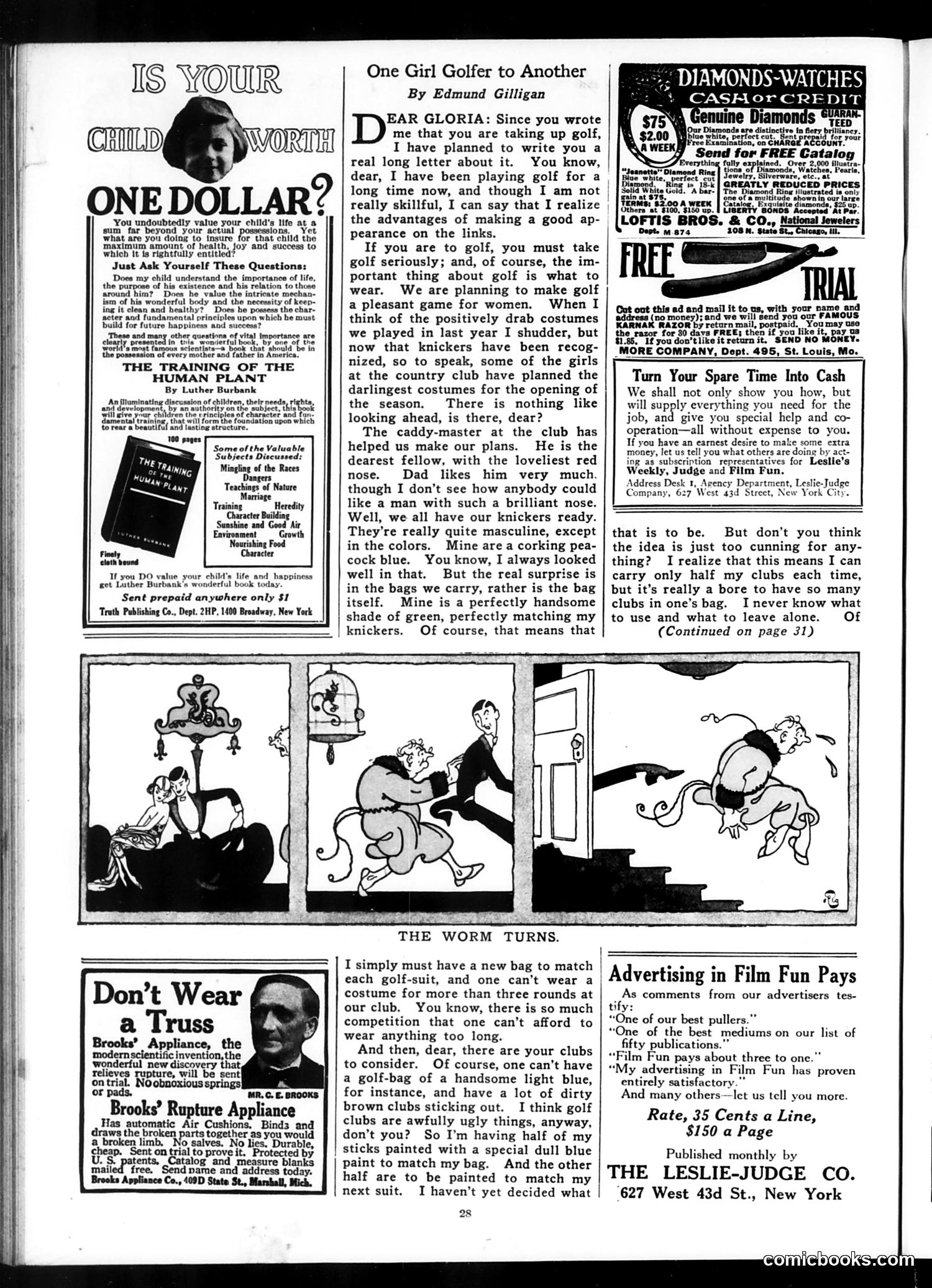
This page features a satirical three-panel cartoon titled "The Worm Turns" (bottom) depicting marital role reversal. The panels show women performing traditionally male activities—smoking, physically dominating a man, and departing—while men are diminished or absent. The humor relies on early-20th-century gender norms: the joke is that domestic dynamics have inverted. Above this, Edmund Gilligan's column "One Girl Golfer to Another" satirizes women's emerging participation in golf as superficial consumerism rather than genuine athletic interest. The correspondent obsesses over matching costumes, bags, and painted golf clubs to outfits—emphasizing fashion over sport. This reflects contemporary anxieties about women's expanding social roles: her concerns are portrayed as trivial, materialistic, and impractical, mocking the idea that women could approach traditionally male activities (golf, athletics) with anything besides vanity. Together, these pieces mockingly address changing gender roles in the 1920s Jazz Age—women gaining independence and recreational freedom—by portraying them as either domineering or frivolously fashion-focused.
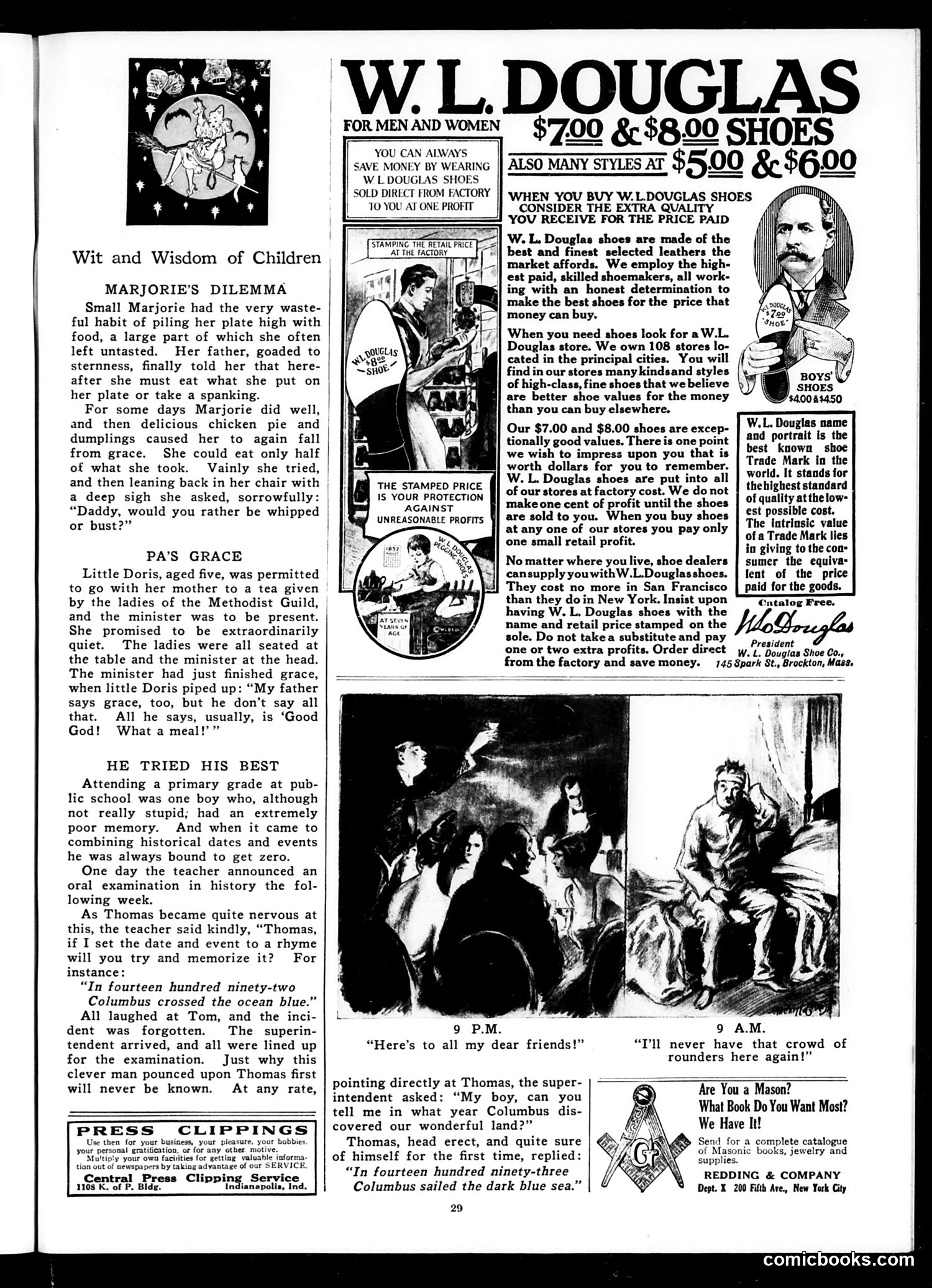
This page contains three humorous anecdotes about children's unfiltered honesty—a common "Wit and Wisdom of Children" feature in early 20th-century magazines. **The satire:** Each story uses children's innocent candor to mock adult pretense. In "Marjorie's Dilemma," a child's logical question exposes parental hypocrisy about waste. "Pa's Grace" ridicules religious formality when a five-year-old reveals her father's actual mealtime prayer is crude pragmatism. "He Tried His Best" depicts a struggling student who memorizes a rhyme about Columbus—likely satirizing rote memorization in education. **The bulk of the page** is advertising for W.L. Douglas shoes ($7-8, also $5-6), which uses direct-factory sales to undercut retail markup. The ad emphasizes value and anti-profiteering rhetoric. There's also a masonic organization ad at bottom. The cartoons accompanying the stories are generic illustrations of domestic scenes rather than political satire. This appears primarily an advertising page with filler content rather than substantive social commentary.
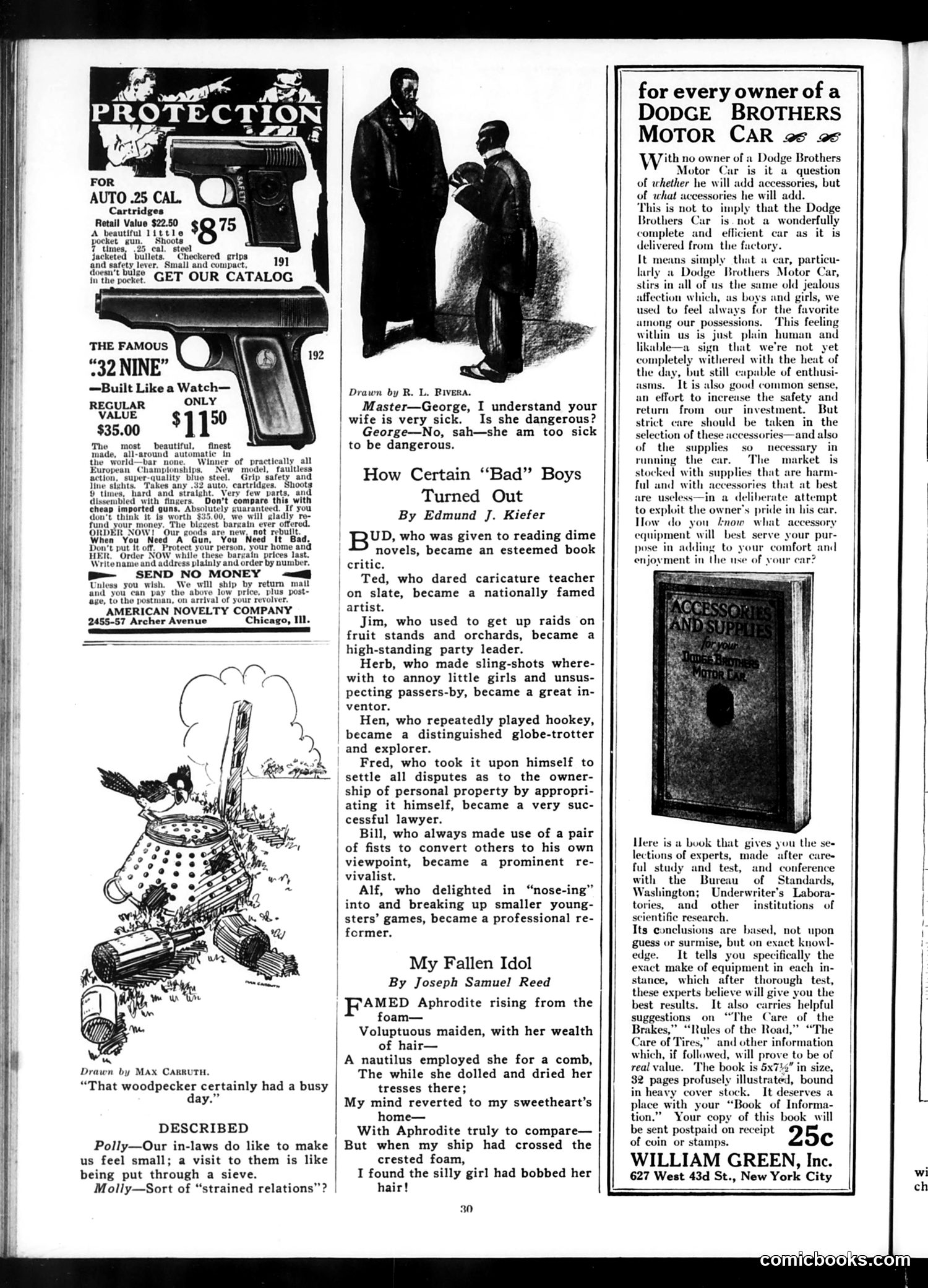
This page from Judge magazine (circa 1910s-1920s based on style) contains mostly **advertisements and light humor pieces** rather than political satire. ## Key Content: **Advertisements** dominate: firearms/revolvers ("Protection" .25 cal, "The Famous .32 Nine"), a Dodge Brothers automobile, and a motor car accessories book. These reflect period consumer culture. **Comic Pieces** include: - A woodpecker joke (presumably visual humor, now lost) - "Strained relations" pun about in-laws - A master-servant dialect joke about illness **Main Article**: "How Certain 'Bad' Boys Turned Out" by Edmund J. Kiefer presents a **moralizing narrative** where mischievous childhood behaviors—dime novel reading, caricaturing teachers, petty theft, fighting—lead to respectable adult careers (critic, artist, lawyer, inventor). This reflects period **progressive optimism** about reform and redemption. **Poetry**: "My Fallen Idol" uses romantic imagery (Aphrodite) to express disappointment when his sweetheart adopts the modern "bobbed hair" style—mild social commentary on changing women's fashions. The page reflects early-20th-century consumer advertising alongside genteel humor and conservative anxiety about social change.
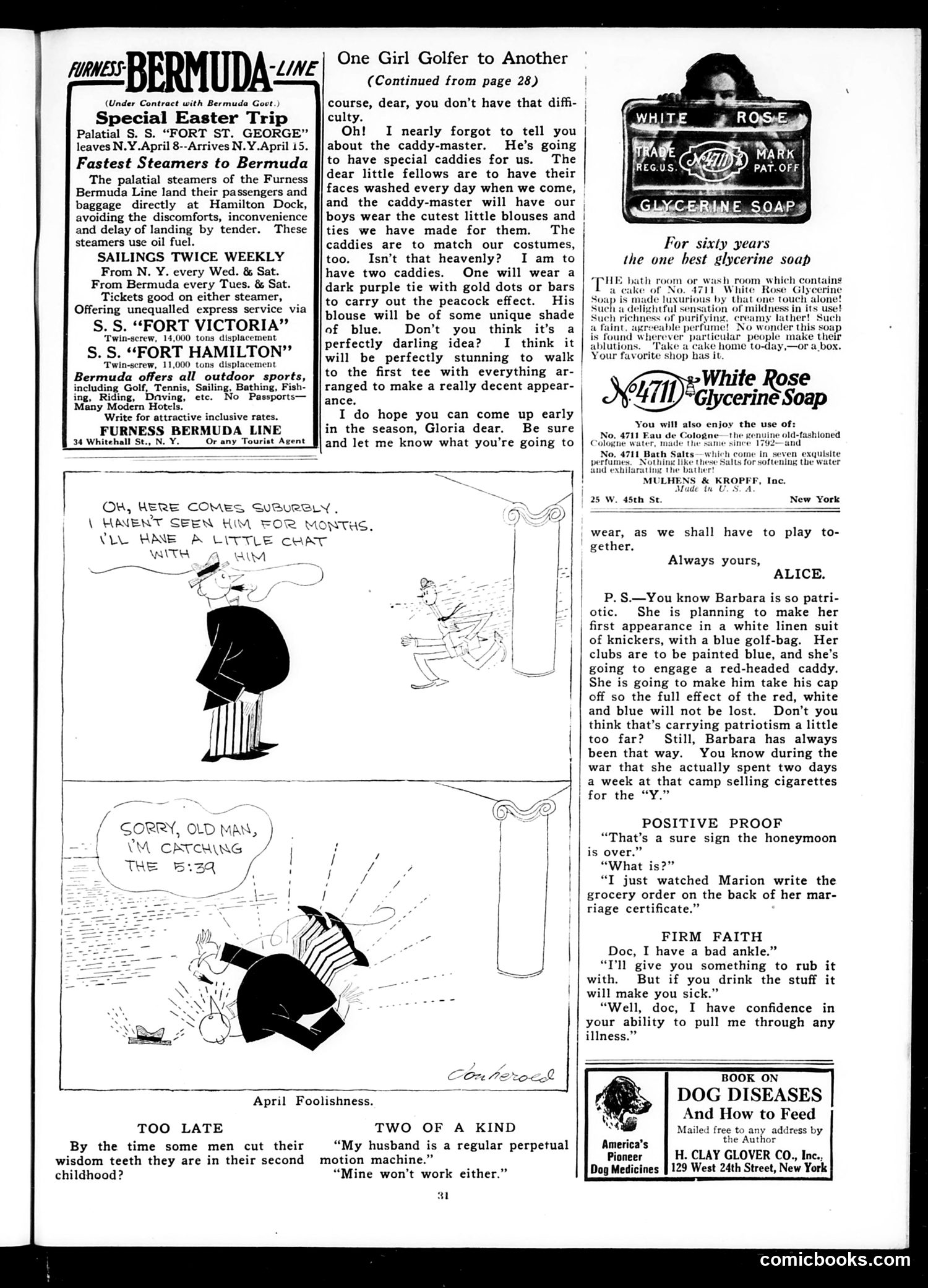
This page from Judge contains social satire rather than political commentary. The main feature is "One Girl Golfer to Another"—a humorous letter mocking elite women's vanity and excessive leisure pursuits. The writer boasts about having special caddies dressed in matching coordinated outfits that complement the golfers' costumes, suggesting the absurdity of wealthy women treating golf as a fashion spectacle rather than sport. The postscript satirizes wartime patriotism: a woman named Barbara plans to make her golf appearance patriotic by wearing red, white, and blue clothing and painting her clubs blue—empty nationalist posturing rather than meaningful civic contribution. The cartoon panels below depict April Fool's pranks. The page is otherwise dominated by advertisements (Bermuda travel, White Rose soap, dog medicine) typical of Judge's commercial content.
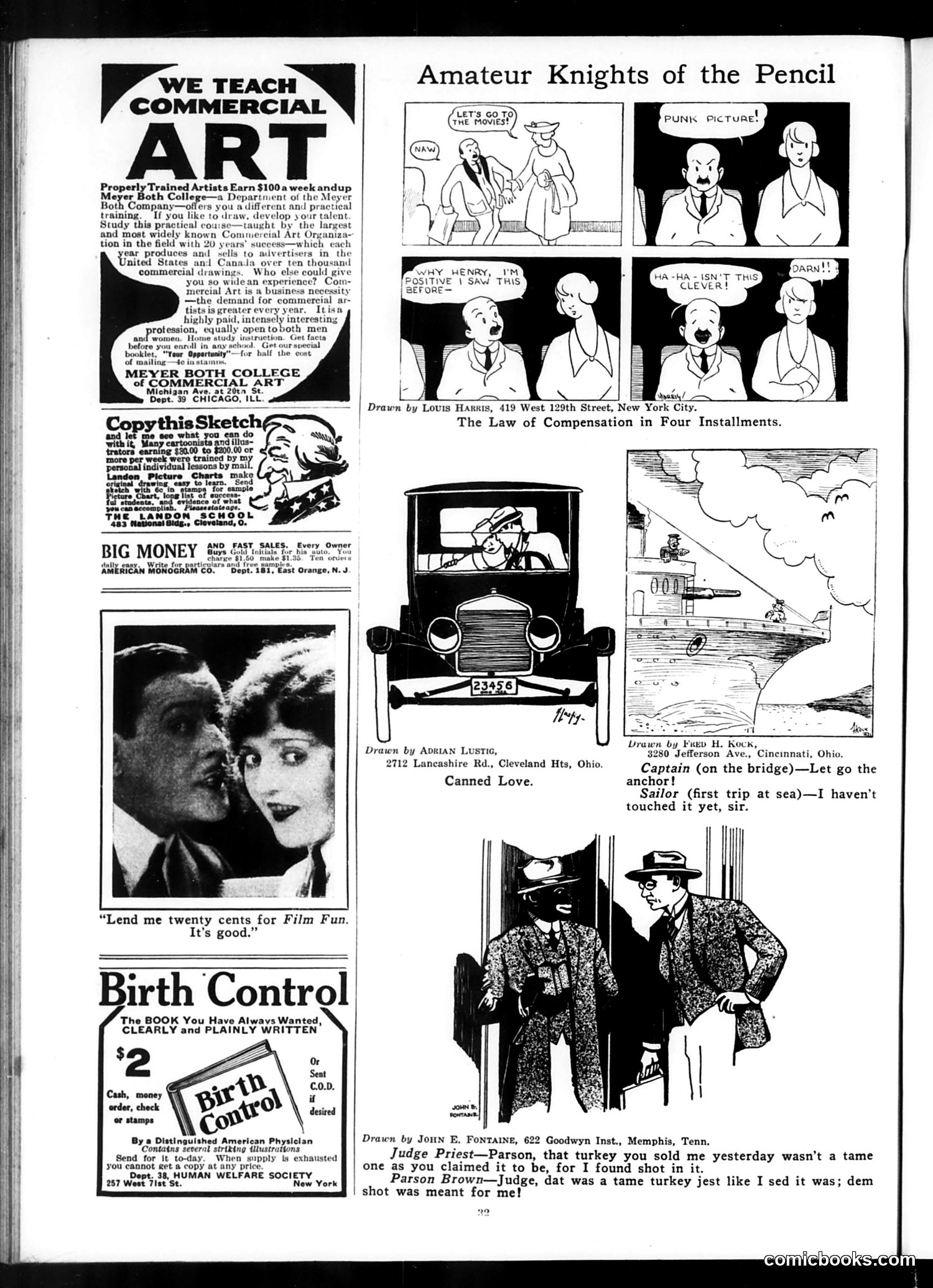
This page showcases amateur cartoons submitted to *Judge* magazine's readers. The three comic strips illustrate common joke formats of the era: 1. **"The Law of Compensation in Four Installments"** (top): A couple discusses going to the movies; the husband claims he saw the film before. The joke's payoff—suggesting he's been unfaithful or lying—plays on marital suspicion humor typical of the period. 2. **"Canned Love"** (middle): A car cartoon where the driver appears to be a woman, likely satirizing early automotive culture and gender roles. 3. **"Judge Priest" segment** (bottom): A rural dialect joke where a parson defends selling a "wild" turkey by claiming the shot wounds prove it was tame—absurd logic played for humor. The "Judge Priest" character was a popular folk-judge figure in American humor. The page also advertises art schools, birth control information, and commercial art training—reflecting 1920s-30s interests in both cartooning careers and social reform topics.
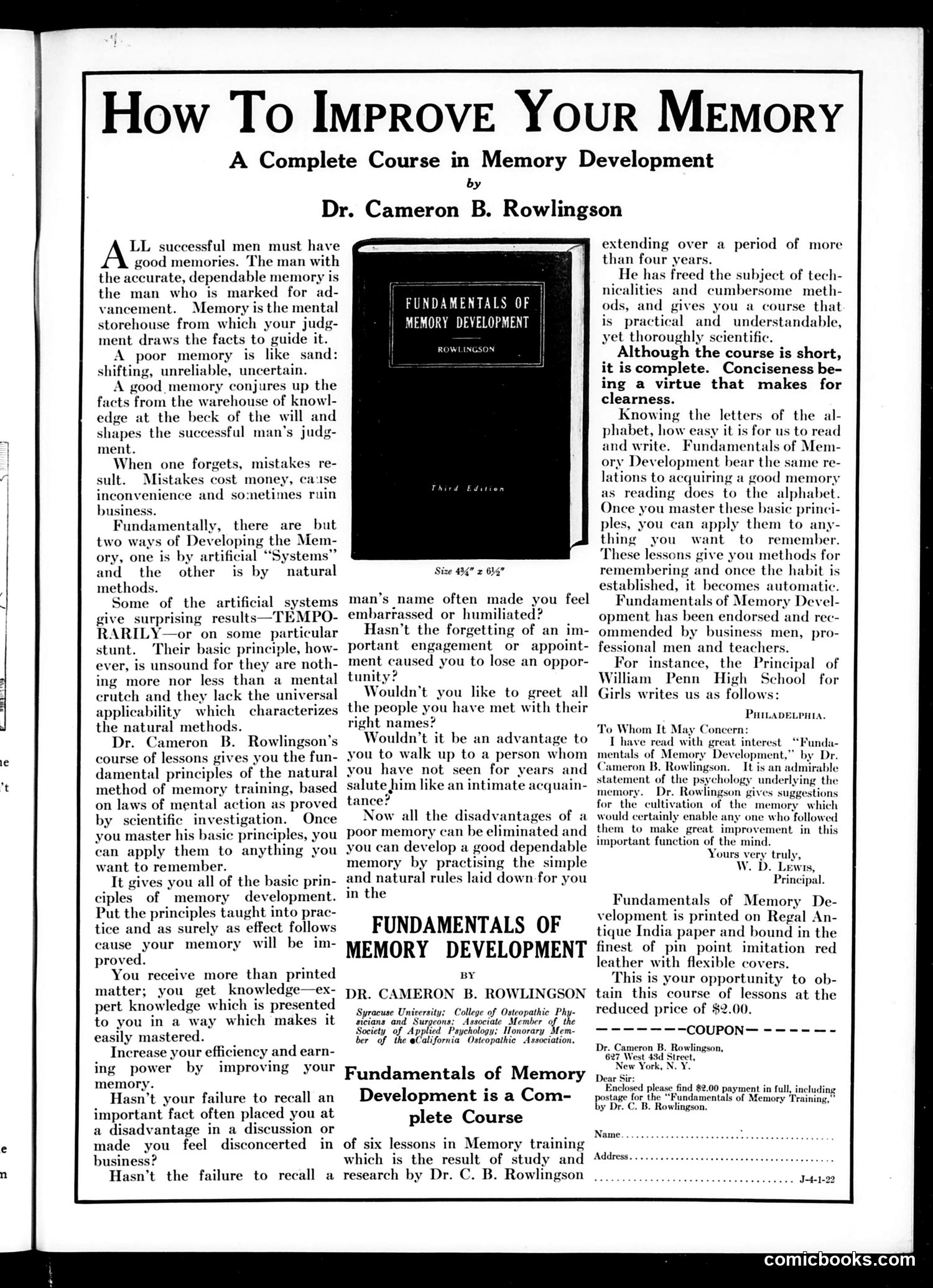
This is primarily **advertising copy**, not a satirical cartoon. It promotes Dr. Cameron B. Rowlingson's mail-order memory-training course ("Fundamentals of Memory Development"). The page uses early 20th-century self-help marketing language, appealing to male business ambition: successful men need good memories; forgetting costs money and causes embarrassment in social situations (like failing to recall someone's name). The copy promises that Rowlingson's "natural methods" (superior to artificial "systems") will improve memory through scientific principles. This reflects the era's enthusiasm for **practical self-improvement** and **applied psychology**. The framing—that memory development equals business success and social competence—reveals period attitudes about masculine achievement and the value of mental training. The testimonial from William Penn High School and the credentials listing suggest this was a genuine educational product, not satire, though modern readers might find the grandiose claims amusing.
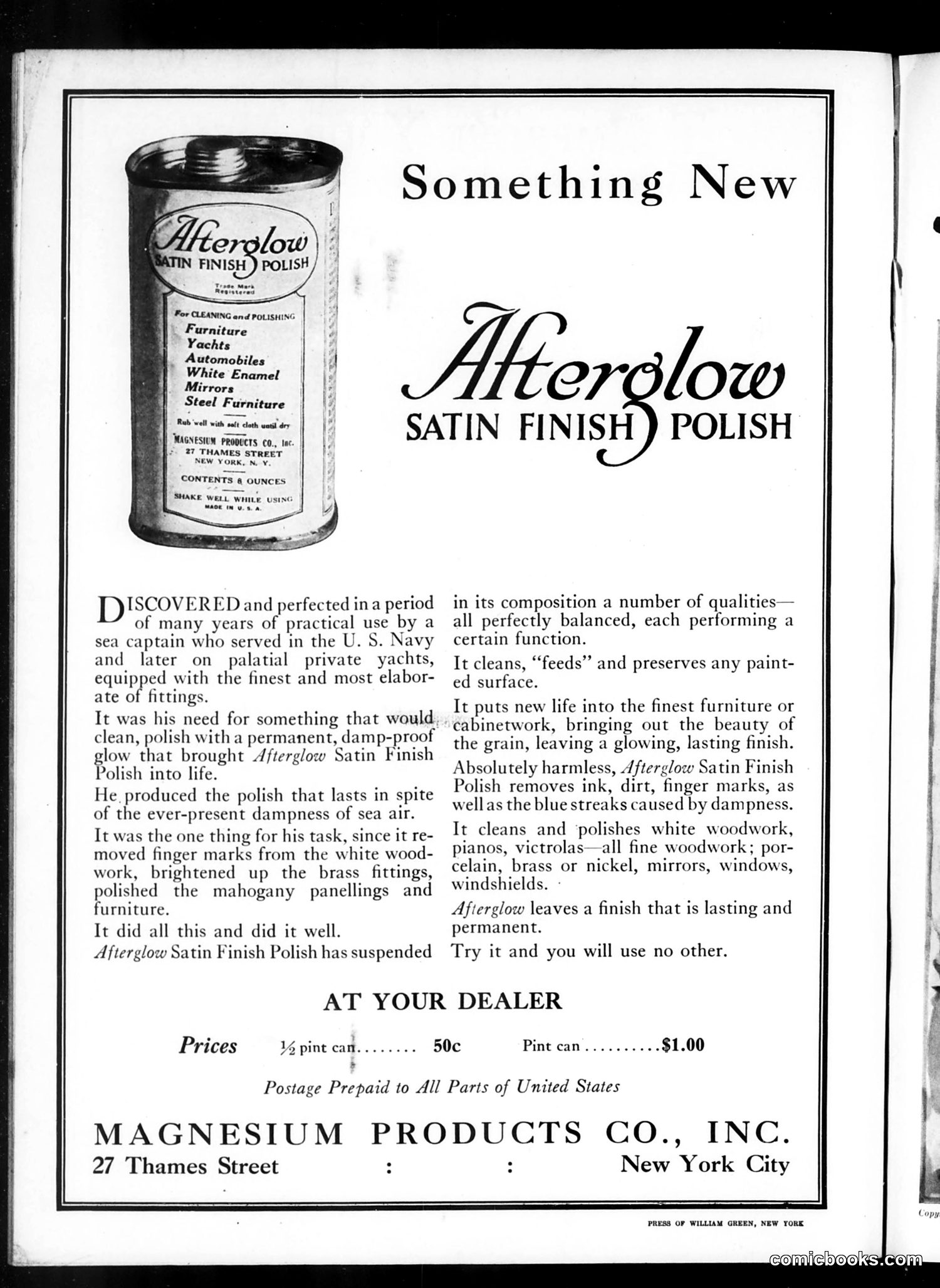
This page contains **no cartoon or satire**—it is a straightforward advertisement for Afterglow Satin Finish Polish, a cleaning and polishing product manufactured by Magnesium Products Co., Inc. in New York City. The ad uses a common early 20th-century marketing approach: presenting the product's origin story (invented by a U.S. Navy sea captain for maintaining yacht fittings) to establish credibility and prestige. The copy emphasizes the polish's practical benefits—removing fingerprints and dampness marks while producing a durable, waterproof finish suitable for furniture, pianos, woodwork, and brass. Prices are listed (50¢ for a half-pint, $1.00 for a pint), with postage prepaid to all U.S. locations. This appears in *Judge*, a satirical magazine, simply as a paid advertisement among other periodical content. There is no satirical intent or hidden meaning—it is commercial advertising from the era.