
Judge, 1922-04-01 · page 20 of 36
Judge — April 1, 1922 — page 20: what you’re looking at
What you’re looking at
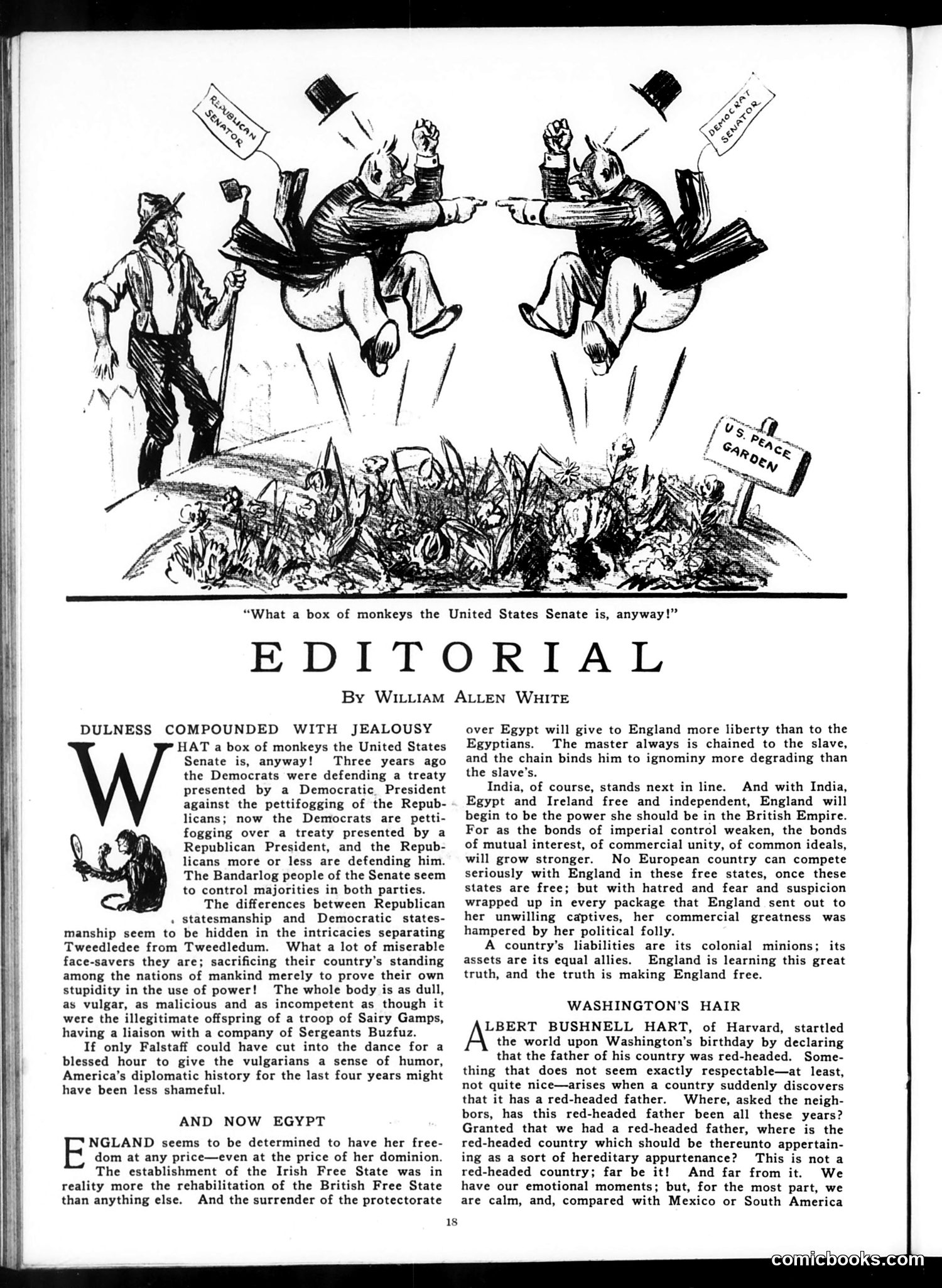
**Top Cartoon:** Depicts the U.S. Senate as chaotic "monkeys" juggling contradictory positions. The illustration shows two identical figures (representing Democrats and Republicans) performing acrobatic reversals while wielding signs labeled "REPUBLICAN FOLLY" and "DEMOCRATIC FOLLY." Below them, a small figure watches as documents labeled "USELESS GARDEN" grow wild. **The Point:** William Allen White's editorial criticizes Senate hypocrisy—Democrats once defended a Democratic President's treaty against Republican obstruction; now they obstruct a Republican President's treaty while Republicans defend it. White argues both parties prioritize political face-saving over national interest, sacrificing America's standing through petty partisan reversals. **Literary References:** White invokes Kipling's "Bandarlog" (monkey people), Dickens characters (Sairy Gamps, Sergeant Buzfuz), and Falstaff to underscore the Senate's incompetence, vulgarity, and lack of humor. **Secondary content** discusses British imperial policy toward Egypt and Ireland, and a Harvard professor's claim that George Washington was red-headed.
📄 Transcribed text from this page (OCR, searchable)
Machine-transcribed from the original scan — historical spelling and the odd misread are preserved.
“What a box of monkeys the United States Senate is, anyway!” EDITORIAL By Wituiam ALLEN WHITE DULNESS COMPOUNDED WITH JEALOUSY HAT a box of monkeys the United States Senate is, anyway! Three years ago the Democrats were defending a treaty presented by a Democratic. President against the pettifogging of the Repub- licans; now the Democrats are petti- fogging over a treaty presented by a Republican President, and the Repub- licans more or less are defending him. The Bandarlog people of the Senate seem to control majorities in both parties. The differences between Republican . statesmanship and Democratic states- manship seem to be hidden in the intricacies separating Tweedledee from Tweedledum. What a lot of miserable face-savers they are; sacrificing their country’s standing among the nations of mankind merely to prove their own stupidity in the use of power! The whole body is as dull, as vulgar, as malicious and as incompetent as though it were the illegitimate offspring of a troop of Sairy Gamps, having a liaison with a company of Sergeants Buzfuz. If only Falstaff could have cut into the dance for a blessed hour to give the vulgarians a sense of humor, America’s diplomatic history for the last four years might have been less shameful. AND NOW EGYPT NGLAND seems to be determined to have her free- E dom at any price—even at the price of her dominion. The establishment of the Irish Free State was in reality more the rehabilitation of the British Free State than anything else. And the surrender of the protectorate over Egypt will give to England more liberty than to the Egyptians. The master always is chained to the slave, and the chain binds him to ignominy more degrading than the slave's. India, of course, stands next in line. And with India, Egypt and Ireland free and independent, England will begin to be the power she should be in the British Empire. For as the bonds of imperial control weaken, the bonds of mutual interest, of commercial unity, of common ideals, will grow stronger. No European country can compete seriously with England in these free states, once these states are free; but with hatred and fear and suspicion wrapped up in every package that England sent out to her unwilling captives, her commercial greatness was hampered by her political folly. A country’s liabilities are its colonial minions; its assets are its equal allies. England is learning this great truth, and the truth is making England free. WASHINGTON’S HAIR LBERT BUSHNELL HART, of Harvard, startled the world upon Washington’s birthday by declaring that the father of his country was red-headed. Some- thing that does not seem exactly respectable—at least, not quite nice—arises when a country suddenly discovers that it has a red-headed father. Where, asked the neigh- bors, has this red-headed father been all these years? Granted that we had a red-headed father, where is the red-headed country which should be thereunto appertain- ing as a sort of hereditary appurtenance? This is not a red-headed country; far be it! And far from it. We have our emotional moments; but, for the most part, we are calm, and, compared with Mexico or South America COMICDOO