
Judge, 1922-04-01 · page 16 of 36
Judge — April 1, 1922 — page 16: what you’re looking at
What you’re looking at
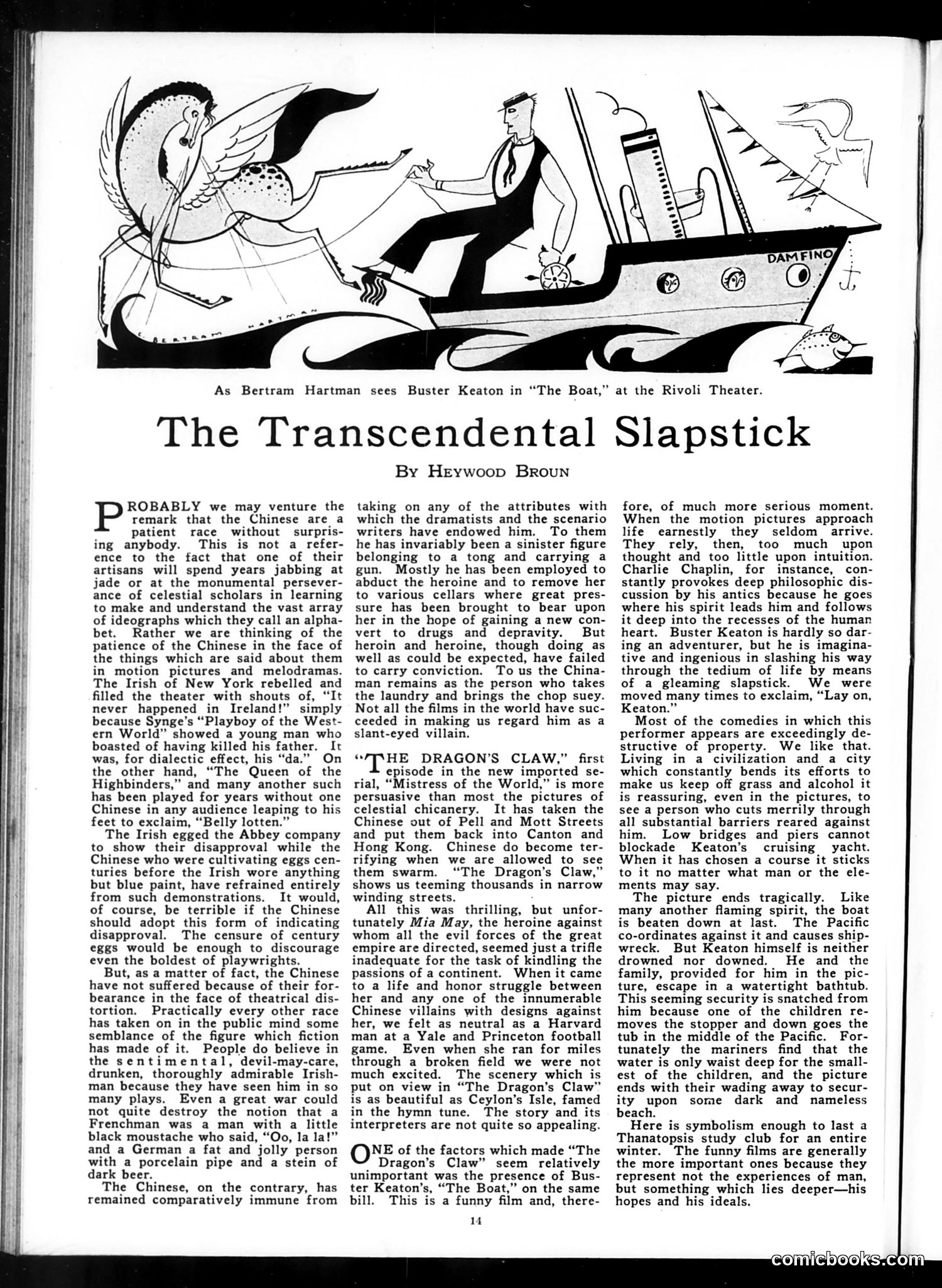
This page contains a film review by Heywood Broun discussing Buster Keaton's comedy "The Boat" (shown in the cartoon at top) and comparing it to imported Chinese-themed serials like "The Dragon's Claw." **The cartoon** depicts Keaton's famous slapstick style—a man in formal dress precariously balanced on a boat while being attacked by a large bird, illustrating the physical absurdity of silent-era comedy. **The satire's point:** Broun argues that while other ethnic groups (Irish, French, Germans) have been stereotyped by theatrical representations, Chinese people have remained immune to such caricaturing in American popular consciousness. Despite melodramas portraying them as villains in opium dens and tongs, Americans still simply see Chinese people as laundry workers and restaurant operators. Broun suggests this "patience" demonstrates Chinese cultural resilience—their real identity resists Hollywood's distortions. The article contrasts serious imported dramas with Keaton's "transcendental" comedies that work through pure physical humor rather than ethnic stereotyping.
📄 Transcribed text from this page (OCR, searchable)
Machine-transcribed from the original scan — historical spelling and the odd misread are preserved.
As Bertram Hartman sees Buster Keaton in “The Boat,” at the Rivoli Theater. The Transcendental Slapstick ROBABLY we may venture the remark that the Chinese are a patient race without surpris- ing anybody. This is not a refer- ence to the fact that one of their artisans will spend years jabbing at jade or at the monumental persever- ance of celestial scholars in learning to make and understand the vast array of ideographs which they call an alpha- bet. Rather we are thinking of the patience of the Chinese in the face of the things which are said about them in motion pictures and melodramas. The Irish of New York rebelled and filled the theater with shouts of, “It never happened in Ireland!” simply because Synge’s “Playboy of the West- ern World” showed a young man who boasted of having killed his father. It was, for dialectic effect, his “da.” On the other hand, “The Queen of the Highbinders,” and many another such has been played for years without one Chinese in any audience leaping to his feet to exclaim, “Belly lotten.” The Irish egged the Abbey company to show their disapproval while the Chinese who were cultivating eggs cen- turies before the Irish wore anything but blue paint, have refrained entirely from such demonstrations. It would, of course, be terrible if the Chinese should adopt this form of indicating disapproval. The censure of century eggs would be enough to discourage even the boldest of playwrights. But, as a matter of fact, the Chinese have not suffered because of their for- bearance in the face of theatrical dis- tortion. Practically every other race has taken on in the public mind some semblance of the figure which fiction has made of it. People do believe in the sentimental, devil-may-care, drunken, thoroughly admirable Irish- man because they have seen him in so many plays. Even a great war could not quite destroy the notion that a Frenchman was a man with a little black moustache who said, “Oo, la la!” and a German a fat and jolly person with a porcelain pipe and a stein of dark beer. The Chinese, on the contrary, has remained comparatively immune from By Hreywoop Broun taking on any of the attributes with which the dramatists and the scenario writers have endowed him. To them he has invariably been a sinister figure belonging to a tong and carrying a gun. Mostly he has been employed to abduct the heroine and to remove her to various cellars where great pres- sure has been brought to bear upon her in the hope of gaining a new con- vert to drugs and depravity. But heroin and heroine, though doing as well as could be expected, have failed to carry conviction. To us the China- man remains as the person who takes the laundry and brings the chop suey. Not all the films in the world have suc- ceeded in making us regard him as a slant-eyed villain. “fTHE DRAGON’S CLAW,” first episode in the new imported se- rial, “Mistress of the World,” is more persuasive than most the pictures of celestial chicanery. It has taken the Chinese out of Pell and Mott Streets and put them back into Canton and Hong Kong. Chinese do become ter- rifying when we are allowed to see them swarm. “The Dragon’s Claw,” shows us teeming thousands in narrow winding streets. this was thrilling, but unfor- tunately Mia May, the heroine against whom all the evil forces of the great empire are directed, seemed just a trifle inadequate for the task of kindling the passions of a continent. When it came to a life and honor struggle between her and any one of the innumerable Chinese villains with designs against her, we felt as neutral as a Harvard man at a Yale and Princeton football game. Even when she ran for miles through a broken field we were not much excited. The scenery which is put on view in “The Dragon’s Claw” is as beautiful as Ceylon’s Isle, famed in the hymn tune. The story and its interpreters are not quite so appealing. NE of the factors which made “The Dragon’s Claw” seem relatively unimportant was the presence of Bus- ter Keaton’s, “The Boat,” on the same bill. This is a funny film and, there- 4 fore, of much more serious moment. When the motion pictures approach life earnestly they seldom arrive. They rely, then, too much upon thought and too little upon intuition. Charlie Chaplin, for instance, con- stantly provokes deep philosophic dis- cussion by his antics because he goes where his spirit leads him and follows it deep into the recesses of the human heart. Buster Keaton is hardly so dar- ing an adventurer, but he is imagina- tive and ingenious in slashing his way through the tedium of life by means of a gleaming slapstick. We were moved many times to exclaim, “Lay on, Keaton.” Most of the comedies in which this performer appears are exceedingly de- structive of property. We like that. Living in a civilization and a city which constantly bends its efforts to make us keep off grass and alcohol it is reassuring, even in the pictures, to see a person who cuts merrily through all substantial barriers reared against him. Low bridges and piers cannot blockade Keaton’s cruising yacht. When it has chosen a course it sticks to it no matter what man or the ele- ments may say. The picture ends tragically. Like many another flaming spirit, the boat is beaten down at last. The Pacific co-ordinates against it and causes ship- wreck. But Keaton himself is neither drowned nor downed. He and the family, provided for him in the pic- ture, escape in a watertight bathtub. This seeming security is snatched from him because one of the children re- moves the stopper and down goes the tub in the middle of the Pacific. For- tunately the mariners find that the water is only waist deep for the small- est of the children, and the picture ends with their wading away to secur- ity upon some dark and nameless beach. Here is symbolism enough to last a Thanatopsis study club for an entire winter. The funny films are generally the more important ones because they represent not the experiences of man, but something which lies deeper—his hopes and his ideals. Comicbooks-com