
Judge, 1922-04-01 · page 11 of 36
Judge — April 1, 1922 — page 11: what you’re looking at
What you’re looking at
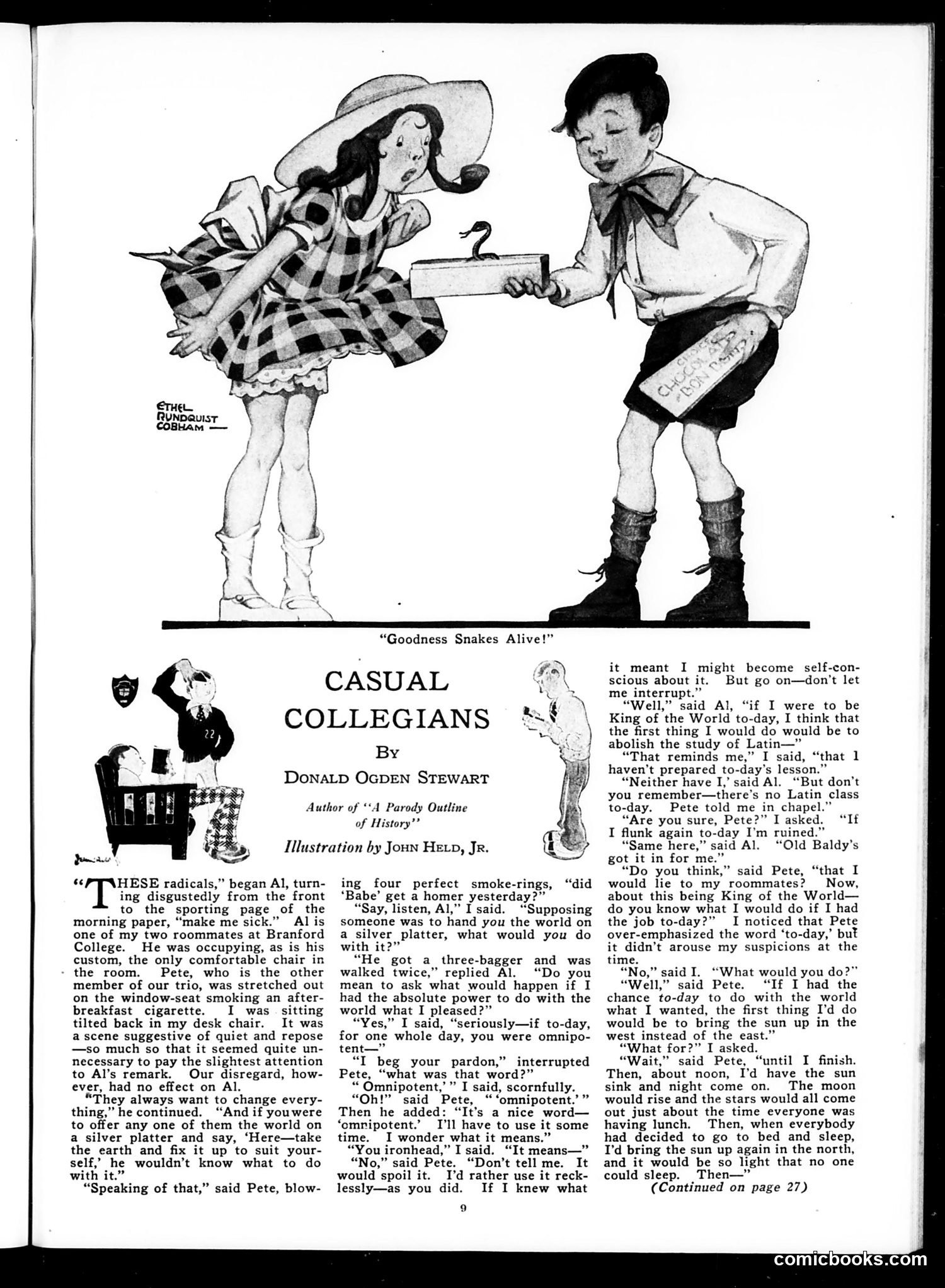
This is a humorous short story satirizing Yale undergraduates (set at Branford College) and their casual attitudes toward serious matters. Three roommates discuss what they'd do if they had absolute power over the world—a setup for philosophical reflection. The satire targets their intellectual laziness: Al dismisses "radicals" while ignoring the substantive question; Pete admits not knowing what "omnipotent" means but prefers using words carelessly rather than learning; all three are more concerned about a Latin exam they haven't prepared for than about world-changing powers. The joke culminates in Pete's absurd fantasy—he'd rearrange the sun and moon's movements to prevent sleep—revealing these college men prioritize petty disruption over meaningful reform. The story mocks educated youth's indifference to politics and learning, embodied in their dismissive treatment of a serious hypothetical question.
📄 Transcribed text from this page (OCR, searchable)
Machine-transcribed from the original scan — historical spelling and the odd misread are preserved.
CASUAL “Goodness Snakes Alive!” Se) COLLEGIANS By DonaLpD OGDEN STEWART Author of ‘‘A Parody Outline of History” Illustration by Joun HEtp, Jr. “ HESE radicals,” began Al, turn- ing disgustedly from the front to the sporting page of the morning paper, “make me sick.” Al is one of my two roommates at Branford College. He was occupying, as is his custom, the only comfortable chair in - the room. Pete, who is the other member of our trio, was stretched out on the window-seat smoking an after- breakfast cigarette. I was sitting tilted back in my desk chair. It was a scene suggestive of quiet and repose —so much so that it seemed quite un- necessary to pay the slightest attention to Al’s remark. Our disregard, how- ever, had no effect on Al. “They always want to change every- thing,” he continued. “And if youwere to offer any one of them the world on a silver platter and say, ‘Here—take the earth and fix it up to suit your- self,’ he wouldn’t know what to do with it.” “Speaking of that,” said Pete, blow- ing four perfect smoke-rings, “did ‘Babe’ get a homer yesterday?” “Say, listen, Al,” I said. “Supposing someone was to hand you the world on a silver platter, what would you do with it?” “He got a three-bagger and was walked twice,” replied Al. “Do you mean to ask what would happen if I had the absolute power to do with the world what I pleased?” “Yes,” I said, “seriously—if to-day, for one whole day, you were omnipo- tent—” “I beg your pardon,” interrupted Pete, “what was that word?” “ Omnipotent,’” I said, scornfully. “Oh!” said Pete, “ ‘omnipotent. Then he added: “It’s a nice word— ‘omnipotent.’ I'll have to use it some time. I wonder what it means.” “You ironhead,” I said. “It means—” “No,” said Pete. “Don’t tell me. It would spoil it. I’d rather use it reck- lessly—as you did. If I knew what 9 it meant I might become self-con- scious about it. But go on—don't let me interrupt.” “Well,” said Al, “if I were to be King of the World to-day, I think that the first thing I would do would be to abolish the study of Latin—” “That reminds me,” I said, “that 1 haven't prepared to-day’s lesson.” “Neither have I,’ said Al. “But don’t you remember—there’s no Latin class to-day. Pete told me in chapel.” “Are you sure, Pete?” I asked. “If I flunk again to-day I’m ruined.” “Same here,” said Al. “Old Baldy’s got it in for me.” “Do you think,” said Pete, “that I would lie to my roommates? Now, about this being King of the World— do you know what I would do if I had the job to-day?” I noticed that Pete over-emphasized the word ‘to-day,’ but it didn’t arouse my suspicions at the time. “No,” said I. “What would you do?” “Well,” said Pete. “If I had the chance to-day to do with the world what I wanted, the first thing I’d do would be to bring the sun up in the west instead of the east.” “What for?” I asked. “Wait,” said Pete, “until I finish. Then, about noon, I'd have the sun sink and night come on. The moon would rise and the stars would all come out just about the time everyone was having lunch. Then, when everybody had decided to go to bed and sleep, I'd bring the sun up again in the north, and it would be so light that no one could sleep. _Then—” (Continued on page 27)