
Judge, 1922-04-01 · page 14 of 36
Judge — April 1, 1922 — page 14: what you’re looking at
What you’re looking at
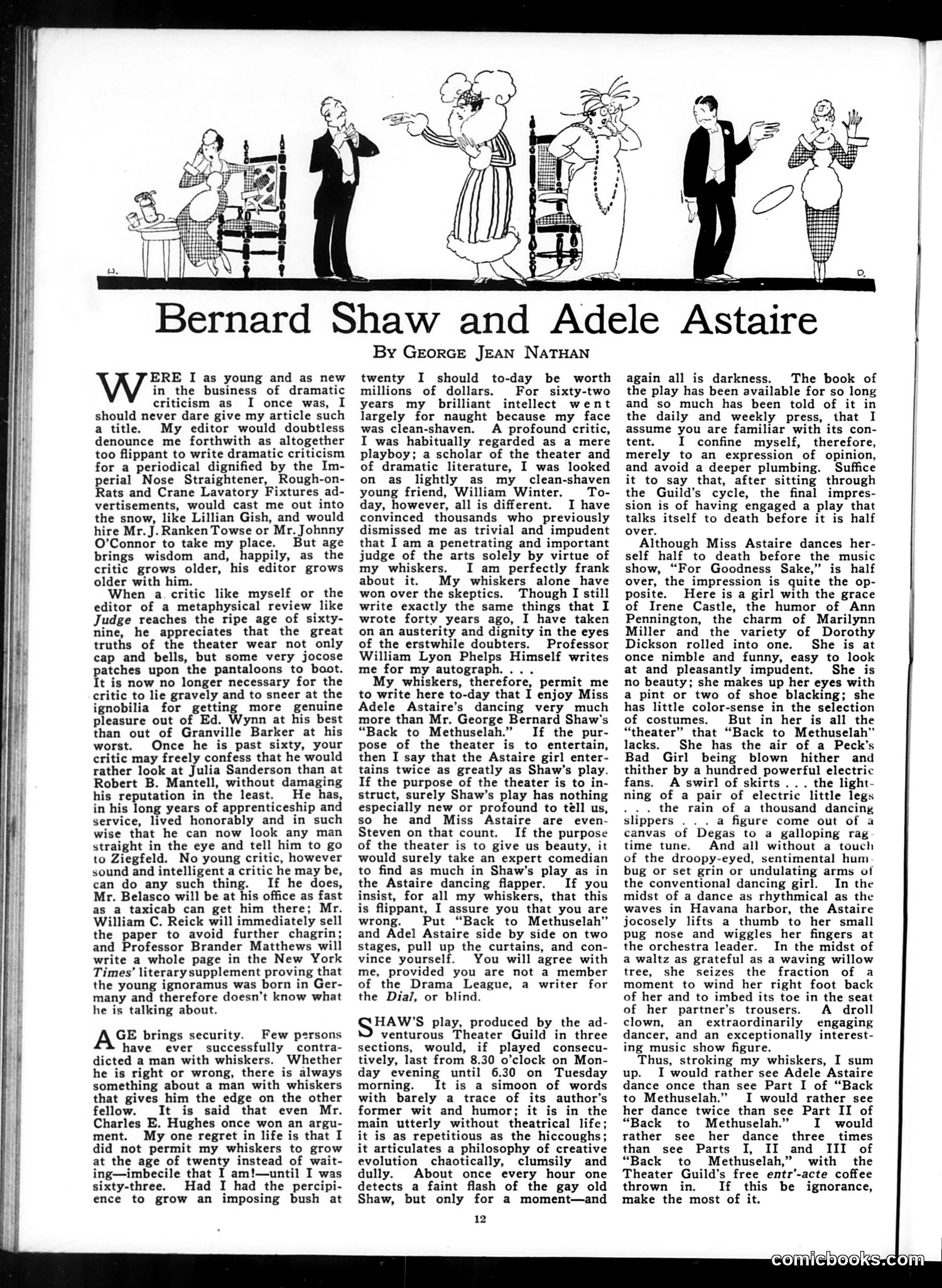
This is a humorous essay by drama critic George Jean Nathan accompanying an illustration of theatrical figures. The piece satirizes several things: **The Main Subjects:** - **Bernard Shaw** and his play "Back to Methuselah" (an actual 1921 Shaw work) - **Adele Astaire**, the famous dancer and sister of Fred Astaire **The Satire:** Nathan argues that growing old and acquiring whiskers gave him credibility as a critic—despite holding the same opinions for 40 years. He uses this tongue-in-cheek admission to justify saying he enjoys Astaire's entertainment value more than Shaw's intellectually heavy play. **The Point:** Nathan mocks the pretension of serious dramatic criticism and the theater establishment's reverence for highbrow work like Shaw's. He suggests that entertainment—Astaire's dancing—has legitimate value alongside intellectual theater. **Context:** The illustration shows various theatrical types observing these entertainers, reflecting the divide between "serious" theater and popular entertainment in the 1920s.
📄 Transcribed text from this page (OCR, searchable)
Machine-transcribed from the original scan — historical spelling and the odd misread are preserved.
Ee Bernard Shaw and Adele Astaire ERE I as young and as new in the business of dramatic criticism as I once was, I should never dare give my article such a title. My editor would doubtless denounce me forthwith as altogether too flippant to write dramatic criticism for a periodical dignified by the Im- perial Nose Straightener, Rough-on- Rats and Crane Lavatory Fixtures ad- vertisements, would cast me out into the snow, like Lillian Gish, and would hire Mr. J. Ranken Towse or Mr. Johnny O’Connor to take my place. But age brings wisdom and, happily, as the critic grows older, his editor grows older with him. When a critic like myself or the editor of a metaphysical review like Judge reaches the ripe age of sixty- nine, he appreciates that the great truths of the theater wear not only cap and bells, but some very jocose patches upon the pantaloons to boot. It is now no longer necessary for the critic to lie gravely and to sneer at the ignobilia for getting more genuine pleasure out of Ed. Wynn at his best than out of Granville Barker at his worst. Once he is past sixty, your critic may freely confess that he would rather look at Julia Sanderson than at Robert B. Mantell, without damaging his reputation in the least. He has, in his long years of apprenticeship and service, lived honorably and in such wise that he can now look any man straight in the eye and tell him to go to Ziegfeld. No young critic, however sound and intelligent a critic he may be, can do any such thing. If he does, Mr. Belasco will be at his office as fast as a taxicab can get him there; Mr. William C. Reick will immediately sell the paper to avoid further chagrin; and Professor Brander Matthews will write a whole page in the New York Times’ literary supplement proving that the young ignoramus was born in Ger- many and therefore doesn’t know what he is talking about. ASE brings security. Few persons have ever successfully contra- dicted a man with whiskers. Whether he is right or wrong, there is always something about a man with whiskers that gives him the edge on the other fellow. _It_is said that even Mr. Charles E. Hughes once won an argu- ment. My one regret in life is that I did not permit my whiskers to grow at the age of twenty instead of wait- ing—imbecile that I am!—until I was sixty-three. Had I had the percipi- ence to grow an imposing bush at By Greorce JEAN NATHAN twenty I should to-day be worth millions of dollars. For sixty-two years my brilliant intellect went largely for naught because my face was clean-shaven. A profound critic, I was habitually regarded as a mere playboy; a scholar of the theater and of dramatic literature, I was looked on as lightly as my _ clean-shaven young friend, William Winter. To- day, however, all is different. I have convinced thousands who previously dismissed me as trivial and impudent that I am a penetrating and important judge of the arts solely by virtue of my whiskers. I am perfectly frank about it. My whiskers alone have won over the skeptics. Though I still write exactly the same things that I wrote forty years ago, I have taken on an austerity and dignity in the eyes of the erstwhile doubters. Professor William Lyon Phelps Himself writes me for my autograph... . My whiskers, therefore, permit me to write here to-day that I enjoy Miss Adele Astaire’s dancing very much more than Mr. George Bernard Shaw's “Back to Methuselah.” If the pur- pose of the theater is to entertain, then I say that the Astaire girl enter- tains twice as greatly as Shaw’s play. If the purpose of the theater is to in- struct, surely Shaw’s play has nothing especially new or profound to téll us, so he and Miss Astaire are even- Steven on that count. If the purpose of the theater is to give us beauty, it would surely take an expert comedian to find as much in Shaw’s play as in the Astaire dancing flapper. If you insist, for all my whiskers, that this is flippant, I assure you that you are wrong. Put “Back to Methuselah” and Adel Astaire side by side on two stages, pull up the curtains, and con- vince yourself. You will agree with me, provided you are not a member of the Drama League, a writer for the Dial, or blind. GHAW's play, produced by the ad- venturous Theater Guild in three sections, would, if played consecu- tively, last from 8.30 o'clock on Mon- day evening until 6.30 on Tuesday morning. It is a simoon of words with barely a trace of its author’s former wit and humor; it is in the main utterly without theatrical life; it is as repetitious as the hiccoughs; it articulates a philosophy of creative evolution chaotically, clumsily and dully. About once every hour one detects a faint flash of the gay old Shaw, but only for a moment—and 12 again all is darkness. The book of the play has been available for so long and so much has been told of it in the daily and weekly press, that I assume you are familiar with its con- tent. I confine myself, therefore, merely to an expression of opinion, and avoid a deeper plumbing. Suffice it to say that, after sitting through the Guild’s cycle, the final impres- sion is of having engaged a play that talks itself to death before it is half over. Although Miss Astaire dances her- self half to death before the music show, “For Goodness Sake,” is half over, the impression is quite the op- posite. Here is a girl with the grace of Irene Castle, the humor of Ann Pennington, the charm of Marilynn Miller and the variety of Dorothy Dickson rolled into one. She is at once nimble and funny, easy to look at and pleasantly impudent. She is no beauty; she makes up her eyes with a pint or two of shoe blacking; she has little color-sense in the selection of costumes. But in her is all the “theater” that “Back to Methuselah” lacks. She has the air of a Peck’s Bad Girl being blown hither and thither by a hundred powerful electric fans. A swirl of skirts... the light- ning of a pair of electric little legs ... the rain of a thousand dancing slippers . . . a figure come out of a canvas of Degas to a galloping rag time tune. And all without a touch of the droopy-eyed, sentimental hum bug or set grin or undulating arms of the conventional dancing girl. In the midst of a dance as rhythmical as the waves in Havana harbor, the Astaire jocosely lifts a thumb to her small pug nose and wiggles her fingers at the orchestra leader. In the midst of a waltz as grateful as a waving willow tree, she seizes the fraction of a moment to wind her right foot back of her and to imbed its toe in the seat of her partner’s trousers. A droll clown, an extraordinarily engaging dancer, and an exceptionally interest- ing music show figure. Thus, stroking my whiskers, I sum up. I would rather see Adele Astaire dance once than see Part I of “Back to Methuselah.” I would rather see her dance twice than see Part II of “Back to Methuselah.” I would rather see her dance three_ times than see Parts I, II and III of “Back to Methuselah,” with the Theater Guild’s free entr’-acte coffee thrown in. If this be ignorance, make the most of it. Comicbooks-comn |