
Judge, 1922-04-01 · page 7 of 36
Judge — April 1, 1922 — page 7: what you’re looking at
What you’re looking at
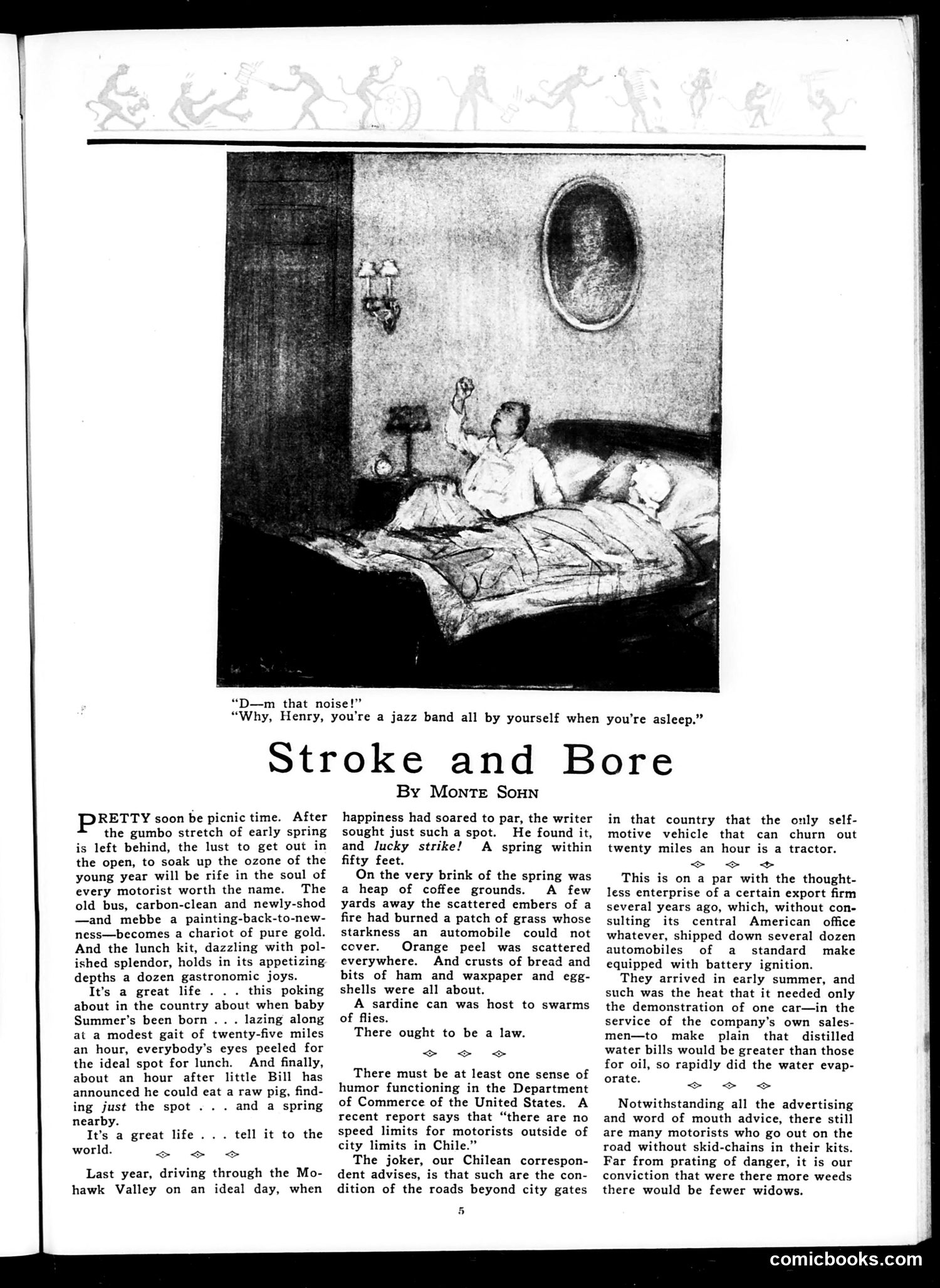
The page contains a brief comic sketch (top) about a couple in bed—the husband complains about noise while snoring loudly himself, and his wife retorts that he's "a jazz band" when sleeping. This is a domestic humor joke playing on the common annoyance of a spouse's snoring. The main content is Monte Sohn's essay "Stroke and Bore," a humorous commentary on 1920s motoring culture. It celebrates spring picnics by automobile but critiques the thoughtlessness of motorists who litter natural areas—describing a polluted spring littered with coffee grounds, orange peels, and sardine cans. Sohn then mocks the absurdity of international business through two anecdotes: Chile's boast of "no speed limits" (undermined by terrible roads where only tractors reach 20 mph), and an American firm shipping standard automobiles to Central America without accounting for extreme heat destroying water-cooled engines. The final comment about skid-chains and widows darkly jokes that poor road safety equipment causes fatal accidents—a timely concern in the early automotive era.
📄 Transcribed text from this page (OCR, searchable)
Machine-transcribed from the original scan — historical spelling and the odd misread are preserved.
“D—m that noise!” . “Why, Henry, you're a jazz band all by yourself when you're asleep.” Stroke and Bore PRETTY soon be picnic time. After the gumbo stretch of early spring is left behind, the lust to get out in the open, to soak up the ozone of the young year will be rife in the soul of every motorist worth the name. The old bus, carbon-clean and newly-shod —and mebbe a painting-back-to-new- ness—becomes a chariot of pure gold. And the lunch kit, dazzling with pol- ished splendor, holds in its appetizing depths a dozen gastronomic joys. It’s a great life . .. this poking about in the country about when baby Summer’s been born .. . lazing along at a modest gait of twenty-five miles an hour, everybody’s eyes peeled for the ideal spot for lunch. And finally, about an hour after little Bill has announced he could eat a raw pig, find- ing just the spot ... and a spring nearby. It’s a great life... world. oss Ss Last year, driving through the Mo- hawk Valley on an ideal day, when tell it to the By Monte Soun happiness had soared to par, the writer sought just such a spot. He found it, and lucky strike! A spring within fifty feet. On the very brink of the spring was a heap of coffee grounds. A few yards away the scattered embers of a fire had burned a patch of grass whose starkness an automobile could not cover. Orange peel was scattered everywhere. And crusts of bread and bits of ham and waxpaper and egg- shells were all about. A sardine can was host to swarms of flies. There ought to be a law. o> sos Ss There must be at least one sense of humor functioning in the Department of Commerce of the United States. A recent report says that “there are no speed limits for motorists outside of city limits in Chile.” The joker, our Chilean correspon- dent advises, is that such are the con- dition of the roads beyond city gates 5 in that country that the only self- motive vehicle that can churn out twenty miles an hour is a tractor. o> o> +> This is on a par with the thought- less enterprise of a certain export firm several years ago, which, without con- sulting its central American office whatever, shipped down several dozen automobiles of a standard make equipped with battery ignition. They arrived in early summer, and such was the heat that it needed only the demonstration of one car—in the service of the company’s own sales- men—to make plain that distilled water bills would be greater than those for oil, so rapidly did the water evap- orate. sss Notwithstanding all the advertising and word of mouth advice, there still are many motorists who go out on the road without skid-chains in their kits. Far from prating of danger, it is our conviction that were there more weeds there would be fewer widows. comicbooks.com