
Judge, 1922-04-01 · page 8 of 36
Judge — April 1, 1922 — page 8: what you’re looking at
What you’re looking at
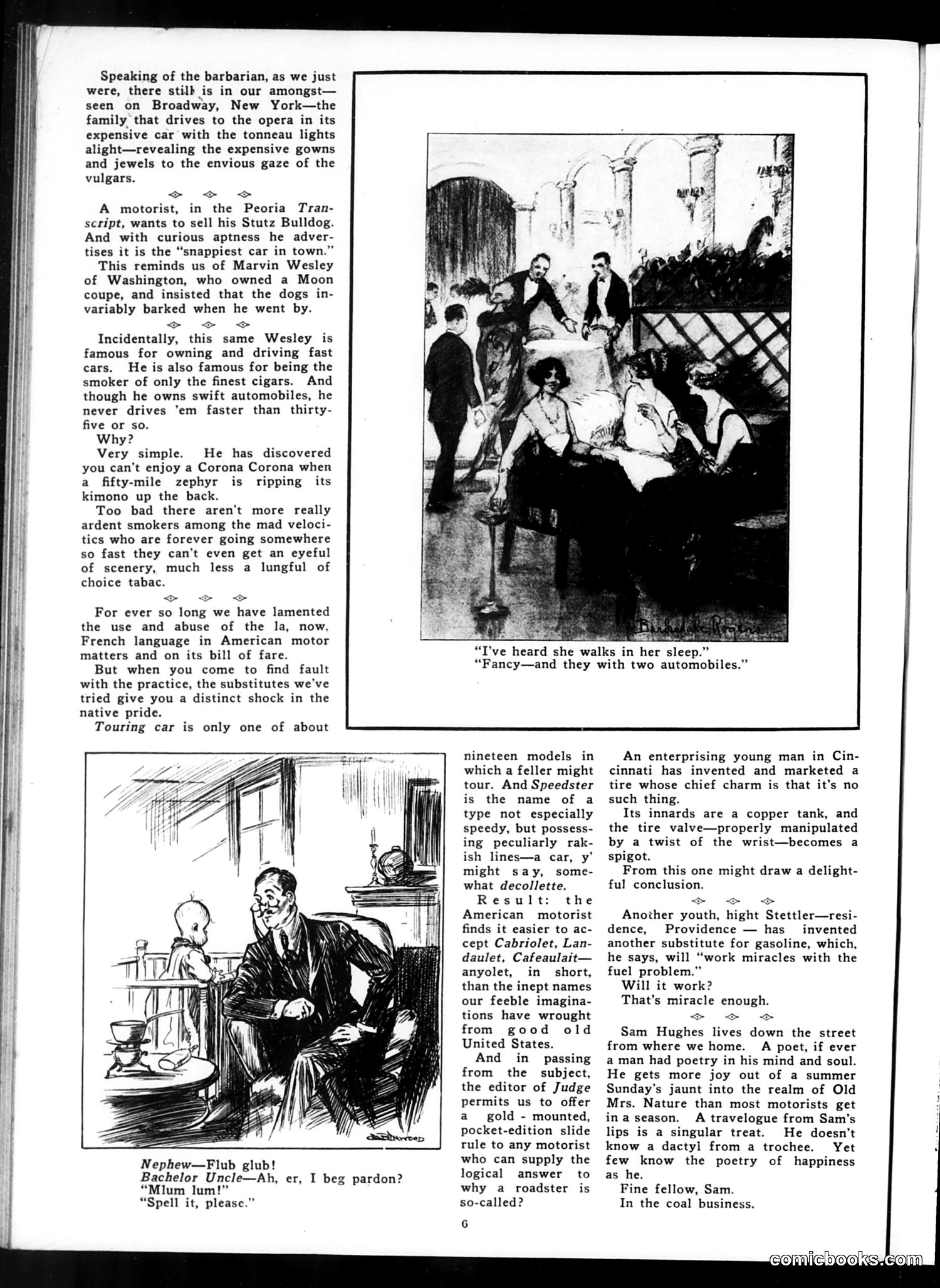
This page satirizes early 20th-century American car culture and affectation. The main targets are: **The Broadway Opera-Goers**: Mocked for ostentatiously displaying wealth—driving expensive cars with illuminated interiors to reveal their jewelry and gowns to "envious" pedestrians. The satire critiques vulgar status-seeking. **The Fast-Car Smoker Problem**: Marvin Wesley of Washington is ridiculed for owning swift automobiles but never driving faster than 35 mph. The joke: he can't enjoy fine Corona cigars at high speeds because wind ruins them. Judge mocks speedster culture while praising restraint. **French Car Terminology**: The magazine laments Americans' slavish adoption of French automobile names (Cabriolet, Landaulet, Cafeaulait) while admitting English substitutes sound absurd. This reflects broader anxieties about American cultural independence versus European imitation. **The Cartoon**: Shows a drunk uncle and nephew—absurdist humor about nonsensical speech ("Flub glub!"). The page celebrates Sam Hughes, a humble coal-business poet who finds joy in simple motoring rather than conspicuous consumption.
📄 Transcribed text from this page (OCR, searchable)
Machine-transcribed from the original scan — historical spelling and the odd misread are preserved.
Speaking of the barbarian, as we just were, there stilb is in our amongst— seen on Broadway, New York—the family that drives to the opera in its expensive car with the tonneau lights alight—revealing the expensive gowns and jewels to the envious gaze of the vulgars. o> s- s> A motorist, in the Peoria Tran- script, wants to sell his Stutz Bulldog. And with curious aptness he adver- tises it is the “snappiest car in town.” This reminds us of Marvin Wesley of Washington, who owned a Moon coupe, and insisted that the dogs in- variably barked when he went by. oo <> Incidentally, this same Wesley is famous for owning and driving fast cars. He is also famous for being the smoker of only the finest cigars. And though he owns swift automobiles, he never drives ’em faster than thirty- five or so. Why? Very simple. He has discovered you can’t enjoy a Corona Corona when a fifty-mile zephyr is ripping its kimono up the back. Too bad there aren't more really ardent smokers among the mad veloci- tics who are forever going somewhere so fast they can’t even get an eyeful of scenery, much less a lungful of choice tabac. > os + For ever so long we have lamented the use and abuse of the la, now, French language in American motor matters and on its bill of fare. But when you come to find fault with the practice, the substitutes we've tried give you a distinct shock in the native pride. Touring car is only one of about Nephew—Flub glub! Bachelor Uncle—Ah, er, I beg pardon? “Mlum lum!” “Spell it, please.” nineteen models in which a feller might tour. And Speedster is the name of a type not especially speedy, but possess- ing peculiarly rak- ish lines—a car, y’ might say, some- what decollette. Result: the American motorist finds it easier to ac- cept Cabriolet, Lan- daulet, Cafeaulait— anyolet, in short, than the inept names our feeble imagina- tions have wrought from good old United States. And in passing from the subject, the editor of Judge permits us to offer a gold - mounted, pocket-edition slide rule to any motorist who can supply the logical answer to why a roadster is so-called? 6 i PS itt set “I’ve heard she walks in her sleep.” “Fancy—and they with two automobiles.” = An enterprising young man in Cin- cinnati has invented and marketed a tire whose chief charm is that it’s no such thing. Its innards are a copper tank, and the tire valve—properly manipulated by a twist of the wrist—becomes a spigot. From this one might draw a delight- ful conclusion. o> > > Another youth, hight Stettler—resi- dence, Providence — has_ invented another substitute for gasoline, which, he says, will “work miracles with the fuel problem.” Will it work? That’s miracle enough. > f+ > Sam Hughes lives down the street from where we home. A poet, if ever a man had poetry in his mind and soul. He gets more joy out of a summer Sunday’s jaunt into the realm of Old Mrs. Nature than most motorists get inaseason. A travelogue from Sam’s lips is a singular treat. He doesn’t know a dactyl from a trochee. Yet few know the poetry of happiness as he. Fine fellow, Sam. In the coal business.