
Judge, 1922-04-01 · page 22 of 36
Judge — April 1, 1922 — page 22: what you’re looking at
What you’re looking at
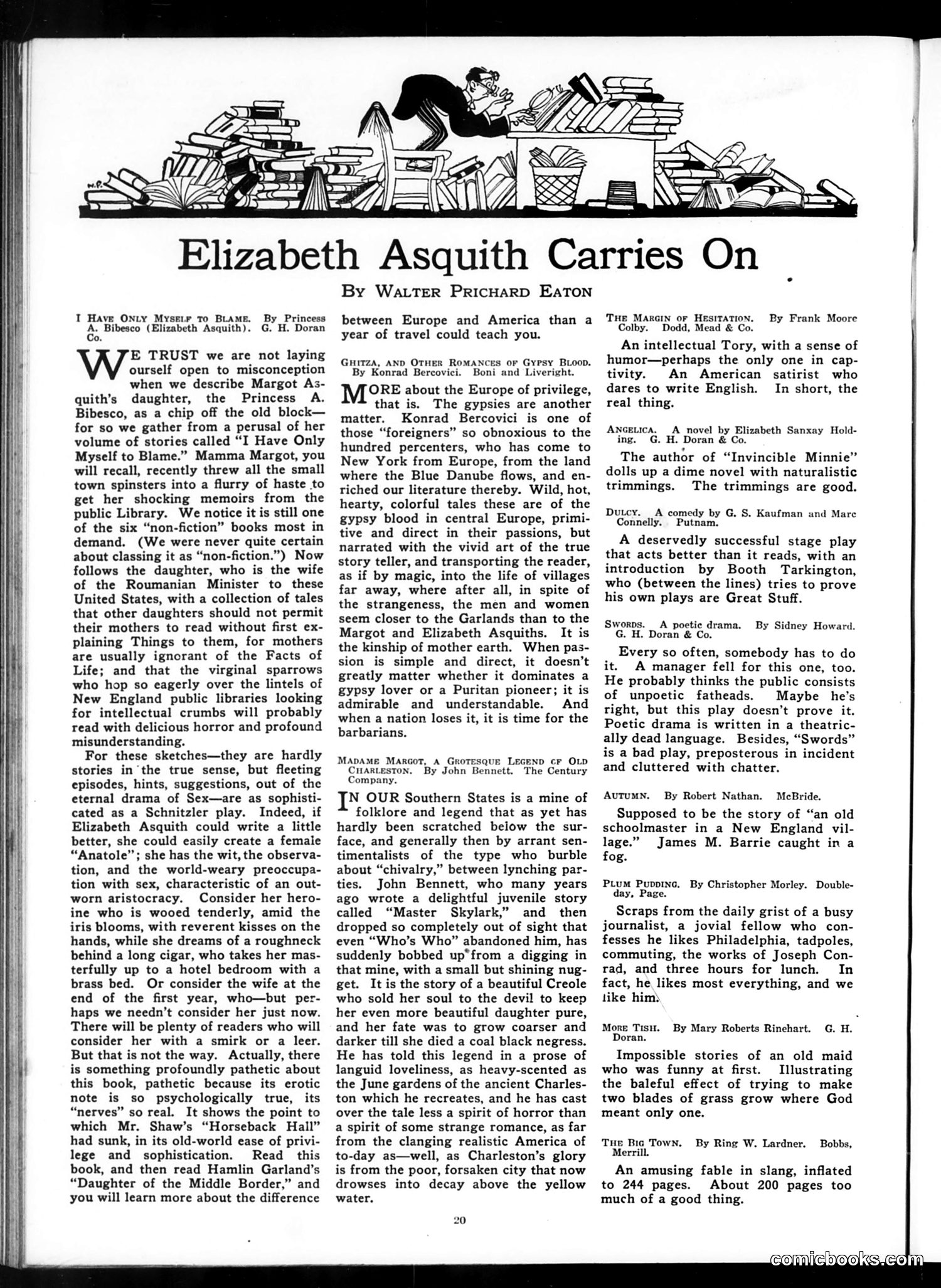
This page contains book reviews rather than political cartoons. The header illustration shows books and a figure amid literary clutter—a decorative flourish for a literary section. The main review discusses Princess Bibesco's "I Have Only Myself to Blame," daughter of British political figure Margot Asquith. The reviewer sarcastically compares her to her mother, noting both write scandalous memoirs. He criticizes Bibesco's collection of erotic, sophisticated short stories as psychologically true but pathetic—products of a worn-out aristocracy obsessed with sex. The review uses comparison to make its point: Bibesco represents decadent European privilege, while American writer Hamlin Garland's "Daughter of the Middle Border" represents healthier American values. A subsequent review praises Konrad Bercovici's gypsy tales for their passionate directness and connection to "mother earth"—superior to the artificial preoccupations of aristocrats like the Asquiths. The satire targets upper-class European decadence versus American authenticity.
📄 Transcribed text from this page (OCR, searchable)
Machine-transcribed from the original scan — historical spelling and the odd misread are preserved.
I Have ONty Myseir to Brame. By Princess & Bibesco (Elizabeth Asquith). G. H. Doran 0. E TRUST we are not laying ourself open to misconception when we describe Margot As- quith’s daughter, the Princess A. Bibesco, as a chip off the old block— for so we gather from a perusal of her volume of stories called “I Have Only Myself to Blame.” Mamma Margot, you will recall, recently threw all the small town spinsters into a flurry of haste to get her shocking memoirs from the public Library. We notice it is still one of the six “non-fiction” books most in demand. (We were never quite certain about classing it as “non-fiction.”) Now follows the daughter, who is the wife of the Roumanian Minister to these United States, with a collection of tales that other daughters should not permit their mothers to read without first ex- plaining Things to them, for mothers are usually ignorant of the Facts of Life; and that the virginal sparrows who hop so eagerly over the lintels of New England public libraries looking for intellectual crumbs will probably read with delicious horror and profound misunderstanding. For these sketches—they are hardly stories inthe true sense, but fleeting episodes, hints, suggestions, out of the eternal drama of Sex—are as sophisti- cated as a Schnitzler play. Indeed, if Elizabeth Asquith could write a little better, she could easily create a female “Anatole”; she has the wit, the observa- tion, and the world-weary preoccupa- tion with sex, characteristic of an out- worn aristocracy. Consider her hero- ine who is wooed tenderly, amid the iris blooms, with reverent kisses on the hands, while she dreams of a roughneck behind a long cigar, who takes her mas- terfully up to a hotel bedroom with a brass bed. Or consider the wife at the end of the first year, who—but per- haps we needn’t consider her just now. There will be plenty of readers who will consider her with a smirk or a leer. But that is not the way. Actually, there is something profoundly pathetic about this book, pathetic because its erotic note is so psychologically true, its “nerves” so real. It shows the point to which Mr. Shaw’s “Horseback Hall” had sunk, in its old-world ease of privi- lege and sophistication. Read this book, and then read Hamlin Garland’s “Daughter of the Middle Border,” and you will learn more about the difference By WatTeR PricHAaRD EATON between Europe and America than a year of travel could teach you. Gurrza, AND OTHER RoMANcES oF Gypsy Boop. By Konrad Bercovici. Boni and Liveright. Mere about the Europe of privilege, that is. The gypsies are another matter. Konrad Bercovici is one of those “foreigners” so obnoxious to the hundred percenters, who has come to New York from Europe, from the land where the Blue Danube flows, and en- riched our literature thereby. Wild, hot, hearty, colorful tales these are of the gypsy blood in central Europe, primi- tive and direct in their passions, but narrated with the vivid art of the true story teller, and transporting the reader, as if by magic, into the life of villages far away, where after all, in spite of the strangeness, the men and women seem closer to the Garlands than to the Margot and Elizabeth Asquiths. It is the kinship of mother earth. When pas- sion is simple and direct, it doesn’t greatly matter whether it dominates a gypsy lover or a Puritan pioneer; it is admirable and understandable. And when a nation loses it, it is time for the barbarians. MADAME MARGoT, A Grotesque LEGEND cr OLD Cnarteston. By John Bennett. The Century Company. N OUR Southern States is a mine of folklore and legend that as yet has hardly been scratched below the sur- face, and generally then by arrant sen- timentalists of the type who burble about “chivalry,” between lynching par- ties. John Bennett, who many years ago wrote a delightful juvenile story called “Master Skylark,” and then dropped so completely out of sight that even “Who’s Who” abandoned him, has suddenly bobbed up*from a digging in that mine, with a small but shining nug- get. It is the story of a beautiful Creole who sold her soul to the devil to keep her even more beautiful daughter pure, and her fate was to grow coarser and darker till she died a coal black negress. He has told this legend in a prose of languid loveliness, as heavy-scented as the June gardens of the ancient Charles- ton which he recreates, and he has cast over the tale less a spirit of horror than a spirit of some strange romance, as far from the clanging realistic America of to-day as—well, as Charleston’s glory is from the poor, forsaken city that now drowses into decay above the yellow water. 20 Elizabeth Asquith Carries On THE MARGIN oF HESITATION. Colby. Dodd, Mead & Co. An intellectual Tory, with a sense of humor—perhaps the only one in cap- tivity. An American satirist who dares to write English. In short, the real thing. By Frank Moore ANGELICA, A novel by Elizabeth Sanxay Hold- ing. G. H. Doran & Co. The author of “Invincible Minnie” dolls up a dime novel with naturalistic trimmings. The trimmings are good. Dutcy. A comedy by G. S. Kaufman and Mare Connelly. Putnam. A deservedly successful stage play that acts better than it reads, with an introduction by Booth Tarkington, who (between the lines) tries to prove his own plays are Great Stuff. Sworps. A poetic drama. By Sidney Howard. G. H. Doran & Co. Every so often, somebody has to do it. A manager fell for this one, too. He probably thinks the public consists of unpoetic fatheads. Maybe he’s right, but this play doesn’t prove it. Poetic drama is written in a theatric- ally dead language. Besides, “Swords” is a bad play, preposterous in incident and cluttered with chatter. AutumN. By Robert Nathan. McBride. Supposed to be the story of “an old schoolmaster in a New England vil- lage.” James M. Barrie caught in a fog. Pum Puppinc. By Christopher Morley. Double- day, Page. Scraps from the daily grist of a busy journalist, a jovial fellow who con- fesses he likes Philadelphia, tadpoles, commuting, the works of Joseph Con- rad, and three hours for lunch. In fact, he likes most everything, and we like him) More TisH. G. H. Doran. Impossible stories of an old maid who was funny at first. Illustrating the baleful effect of trying to make two blades of grass grow where God meant only one. By Mary Roberts Rinchart. Tue Bic Town. Bobbs, errill By Ring W. Lardner. An amusing fable in slang, inflated to 244 pages. About 200 pages too much of a good thing. COMmiechooksseon