
A complete issue · 36 pages · 1921
Judge — November 26, 1921
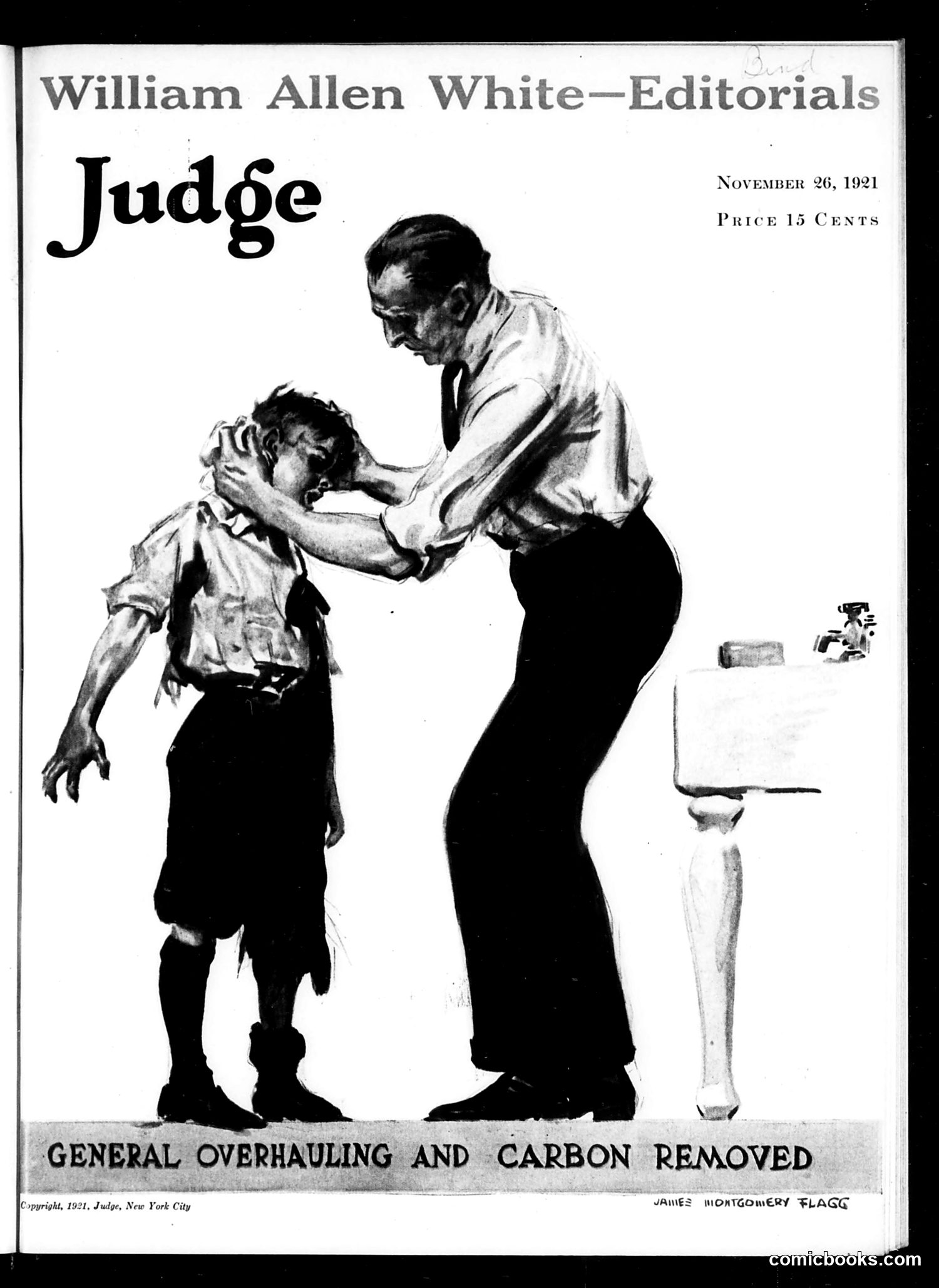
This satirical cover uses a mechanical metaphor to comment on a person or institution needing "General Overhauling and Carbon Removed." The illustration shows an adult figure working on a child like a mechanic servicing an engine, with tools visible. The phrase "carbon removed" refers to cleaning carbon buildup from machinery—here used as metaphor for removing corrupting influences or bad habits from a young person through disciplinary correction. The specific target is unclear without additional context, but the satire likely addresses either: - Educational reform - Parental/judicial discipline practices - Corruption in youth institutions The cartoon reflects early 1920s attitudes toward correction and reformation, treating human improvement as mechanical repair.
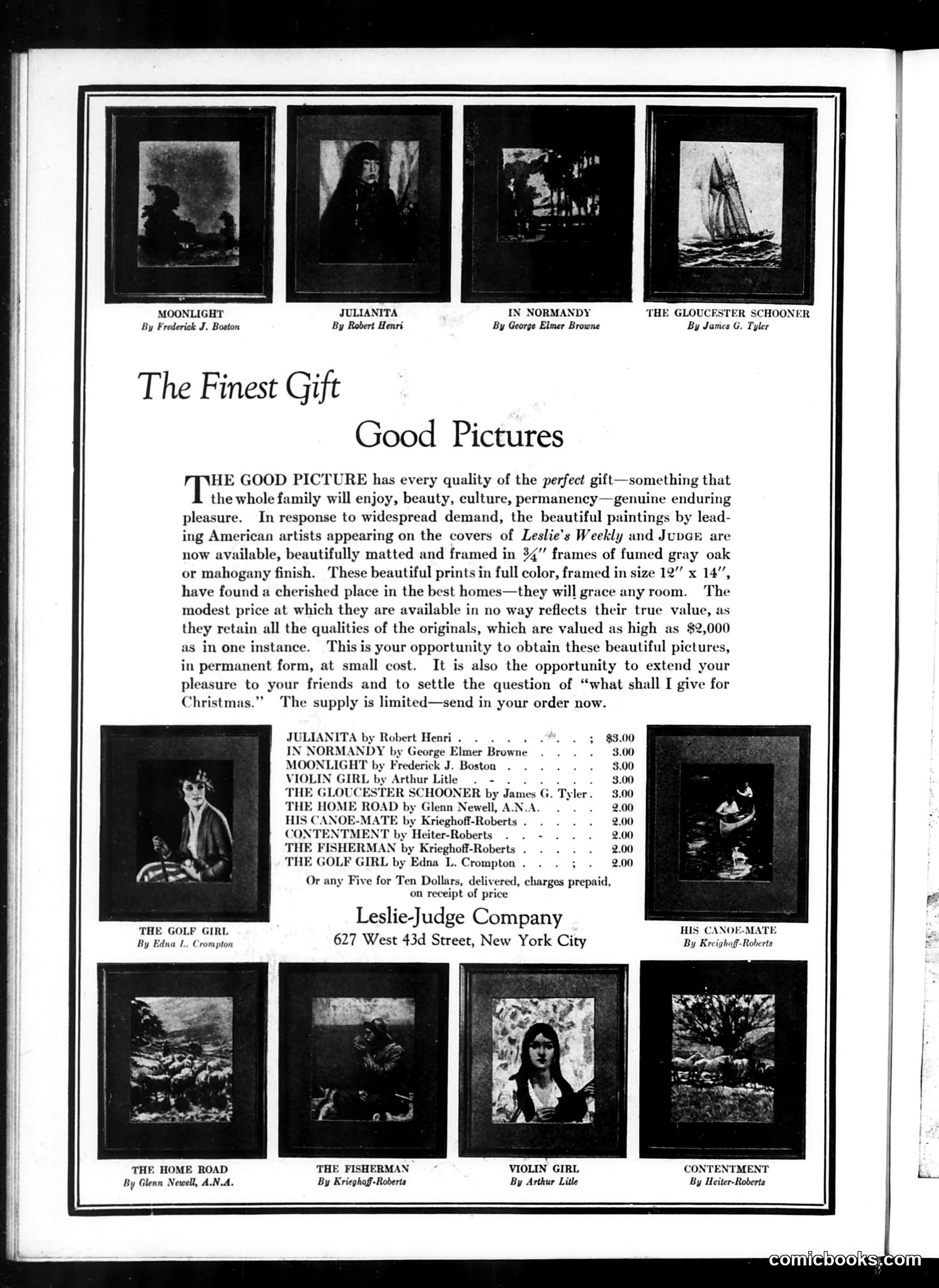
This page is **primarily advertising**, not satire or political commentary. The Leslie-Judge Company is marketing framed art prints—reproductions of paintings by American artists that appeared on *Leslie's Weekly* and *Judge* magazine covers. The ad emphasizes these prints as affordable gifts ("the finest gift"), priced at $3.00 each or five for $10. It notes the originals were valued at $8,000, positioning these reproductions as accessible luxury for middle-class homes. The artists listed (Robert Henri, George Elmer Browne, James G. Tyler, etc.) were contemporary American painters; the subject matter—moonlight scenes, sailing vessels, portraits of girls—reflects popular aesthetic tastes of the period. This represents merchandising tied to magazine circulation rather than political cartooning.
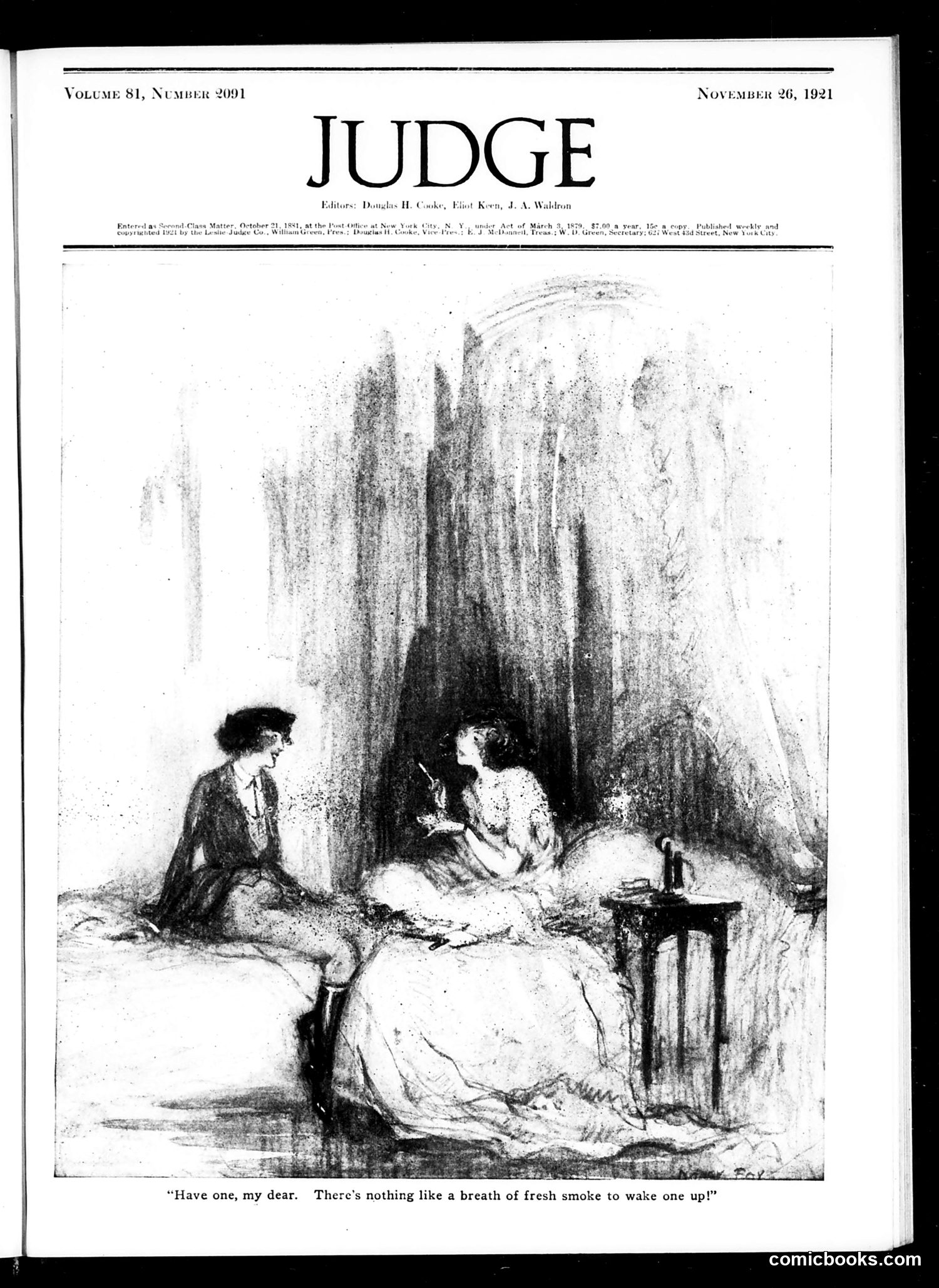
This is the cover of Judge magazine from November 26, 1921. The cartoon depicts two women in an interior setting, with one reclining on a bed or couch and another sitting beside her offering a cigarette, saying "Have one, my dear. There's nothing like a breath of fresh smoke to wake one up!" The satire targets changing social norms around women smoking, which was controversial in the 1920s. The image mocks the "modern woman" of the Jazz Age—women who defied Victorian propriety by smoking publicly, a practice considered scandalous and masculine. By presenting cigarette-smoking as a casual, revitalizing habit among fashionable women, Judge satirizes both the new female independence and society's anxieties about these social changes. The elegant setting emphasizes this was becoming acceptable among the upper classes.
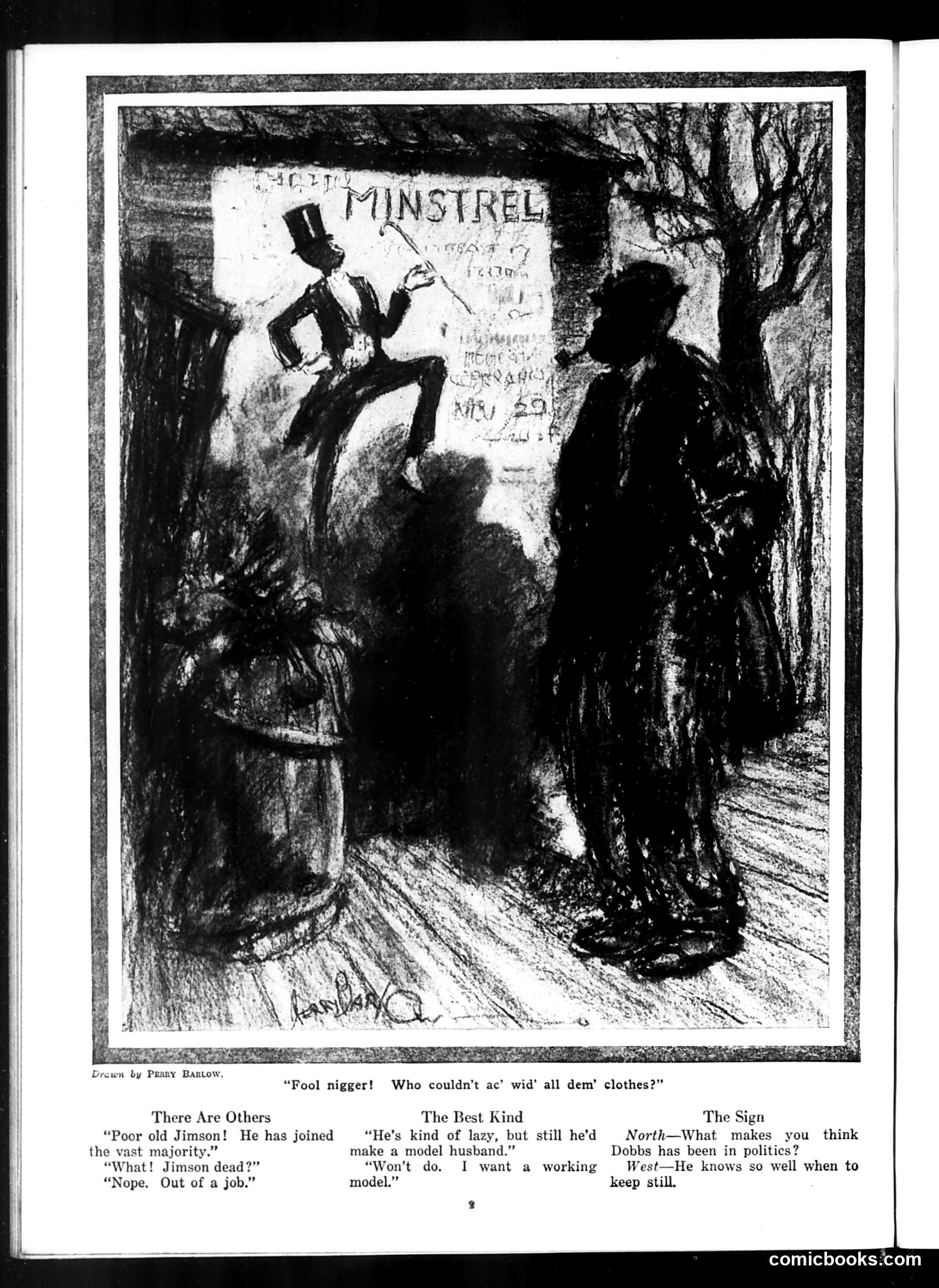
This cartoon by Perry Barlow depicts a street scene with a minstrel performer (identified by the sign reading "MINSTREL" behind him) in blackface makeup, entertaining passersby. The offensive racial caricature was common in early 20th-century American entertainment. The caption quotes the minstrel asking "Fool nigger! Who couldn't ac' wid' all dem' clothes?" — using period-accurate but deeply racist dialect humor typical of Judge magazine's satirical approach. The three accompanying jokes below mock various types of men (poor jimsons, lazy husbands, and politicians), suggesting the page uses social commentary through crude stereotypes and offensive language. The satire targets class and gender stereotypes rather than directly confronting the racism on display, reflecting the magazine's problematic editorial standards of that era.
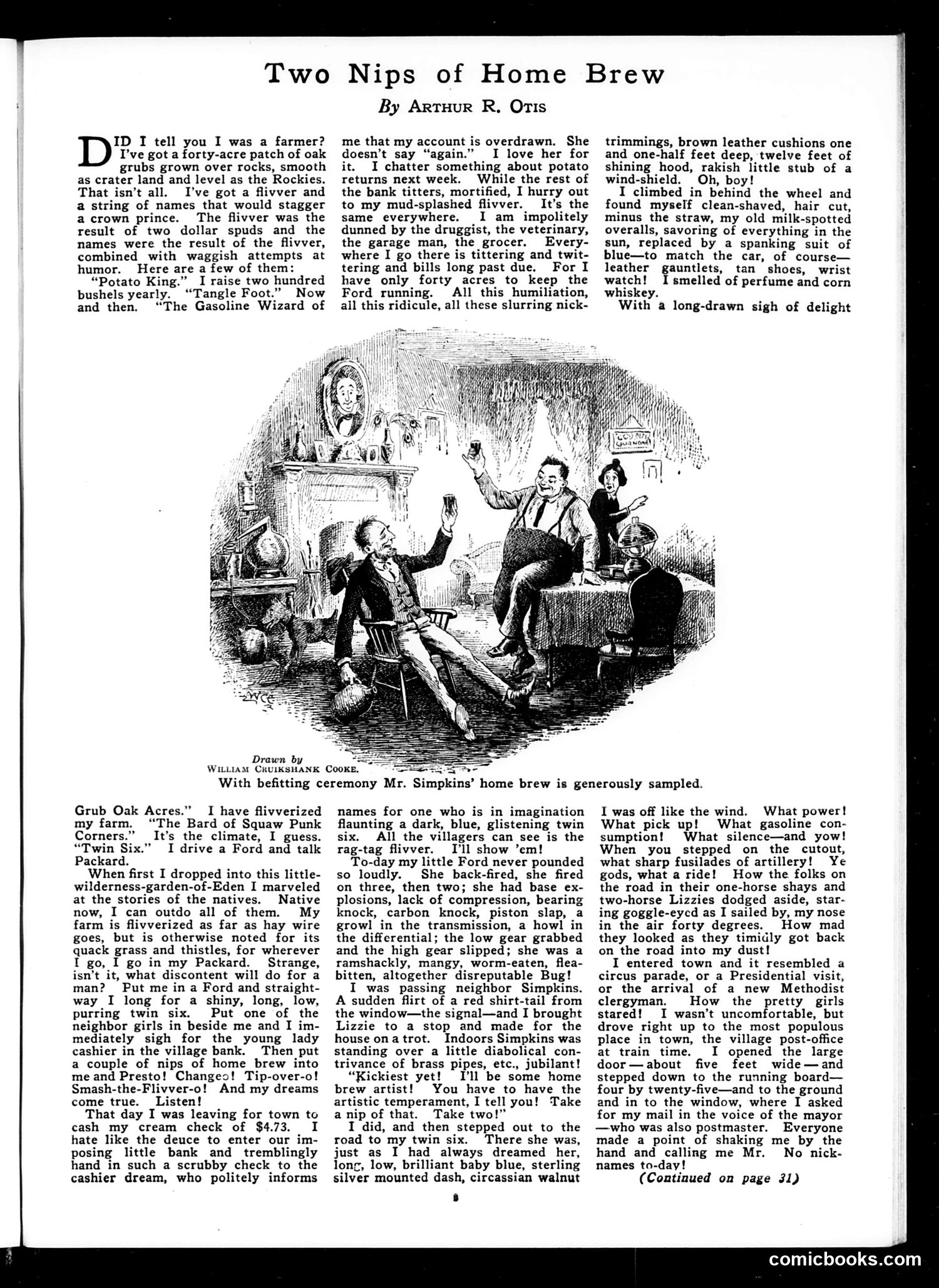
This is a humorous short story illustrated with a satirical sketch. The narrative follows a farmer boasting about his various money-making schemes—potato farming, raising cattle, and driving a Ford—all apparently failures that leave him perpetually broke and embarrassed. The illustration depicts men sampling "home brew" (illegally distilled alcohol during Prohibition era), with the caption noting it's "generously sampled." The story's title "Two Nips" puns on both drinking and the farmer's financial misfortunes. The satire targets rural incompetence and the widespread illegal alcohol production during Prohibition, presenting the farmer's failed enterprises and his resort to bootlegging as comedic commentary on Depression-era economic struggles.
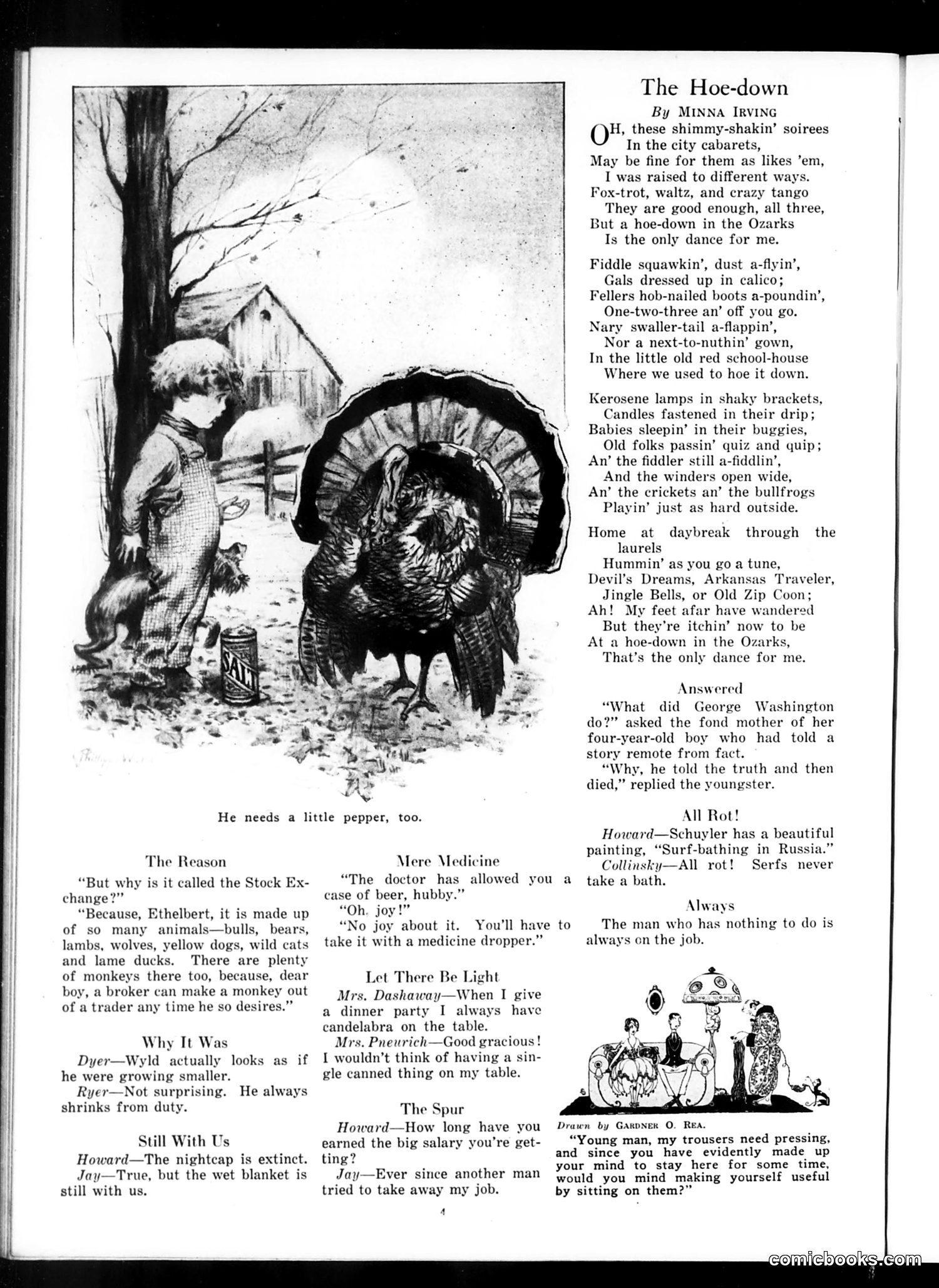
The main illustration shows a child and a turkey, captioned "He needs a little pepper, too." This appears to be a simple domestic humor piece rather than political satire—depicting a child's innocent, perhaps mischievous observation about seasoning poultry. The page primarily contains light humor and jokes rather than political content: - "The Reason" and "Why It Was" offer humorous explanations for everyday matters - "Mere Medicine," "Let There Be Light," and "The Spur" are brief comedic dialogues - "The Hoe-down" is a poem by Minna Irving celebrating rural Ozark dancing culture A small illustration at bottom right by Gardner O. Rea shows diners, captioning a joke about trouser-pressing. This page represents Judge's entertainment and humor content, not political or social satire.
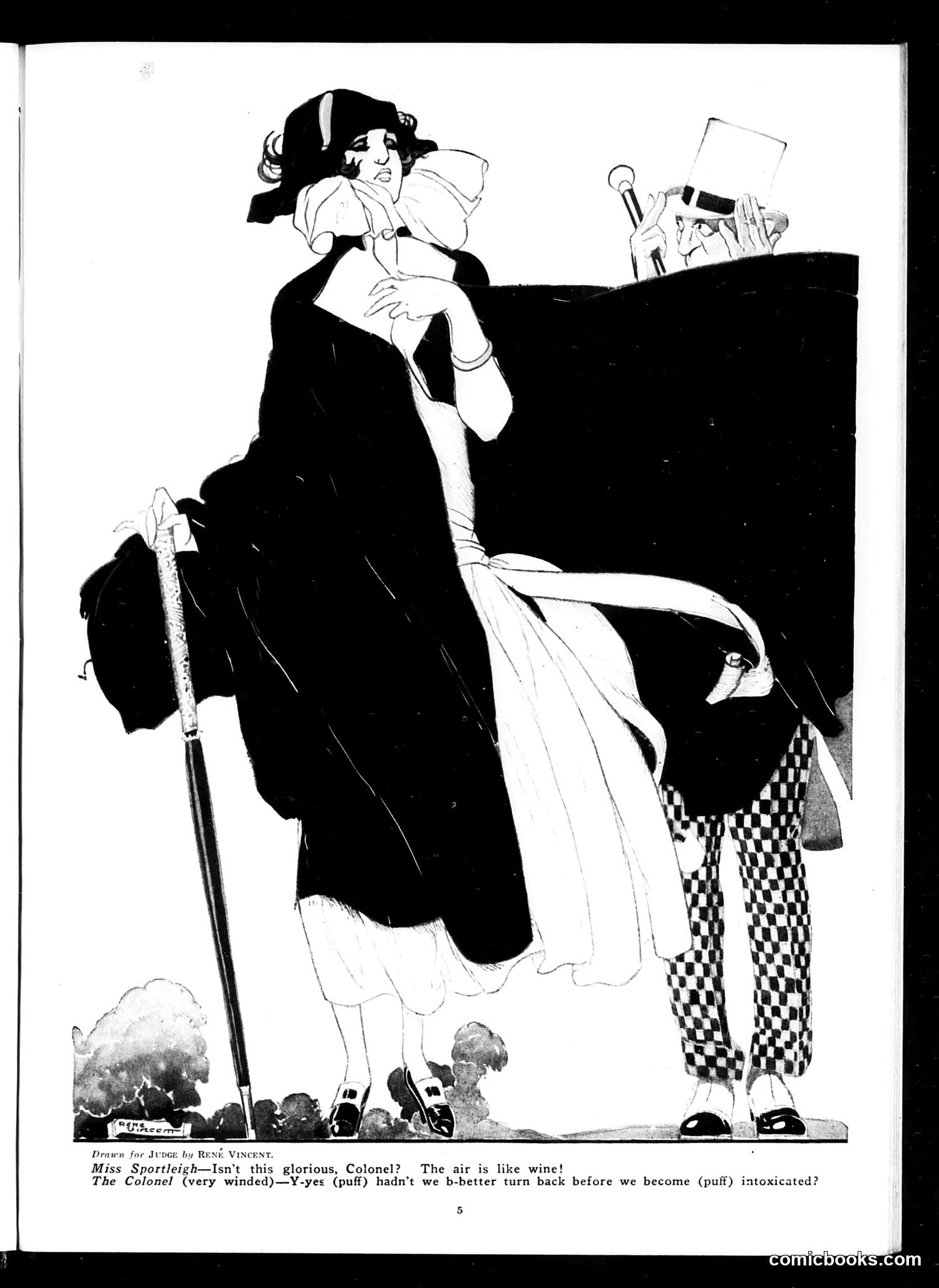
This Judge cartoon satirizes early 20th-century courtship customs and gender dynamics. Miss Sportleigh, a fashionable woman in athletic attire, drags an elderly Colonel on an exhausting outdoor excursion. She's exhilarated by the "glorious" air and physical activity, while he's literally breathless and struggling to keep pace. The satire targets the "New Woman"—the emerging independent female figure of the era who rejected Victorian passivity for sports, hiking, and active pursuits. The Colonel represents old-fashioned masculinity unable to match her vigor. His pun about becoming "intoxicated" by fresh air suggests anxiety about losing control in this newly assertive female presence. The cartoon mocks both the Colonel's physical decline and outdated gender assumptions, while gently poking fun at the New Woman's relentless athleticism.
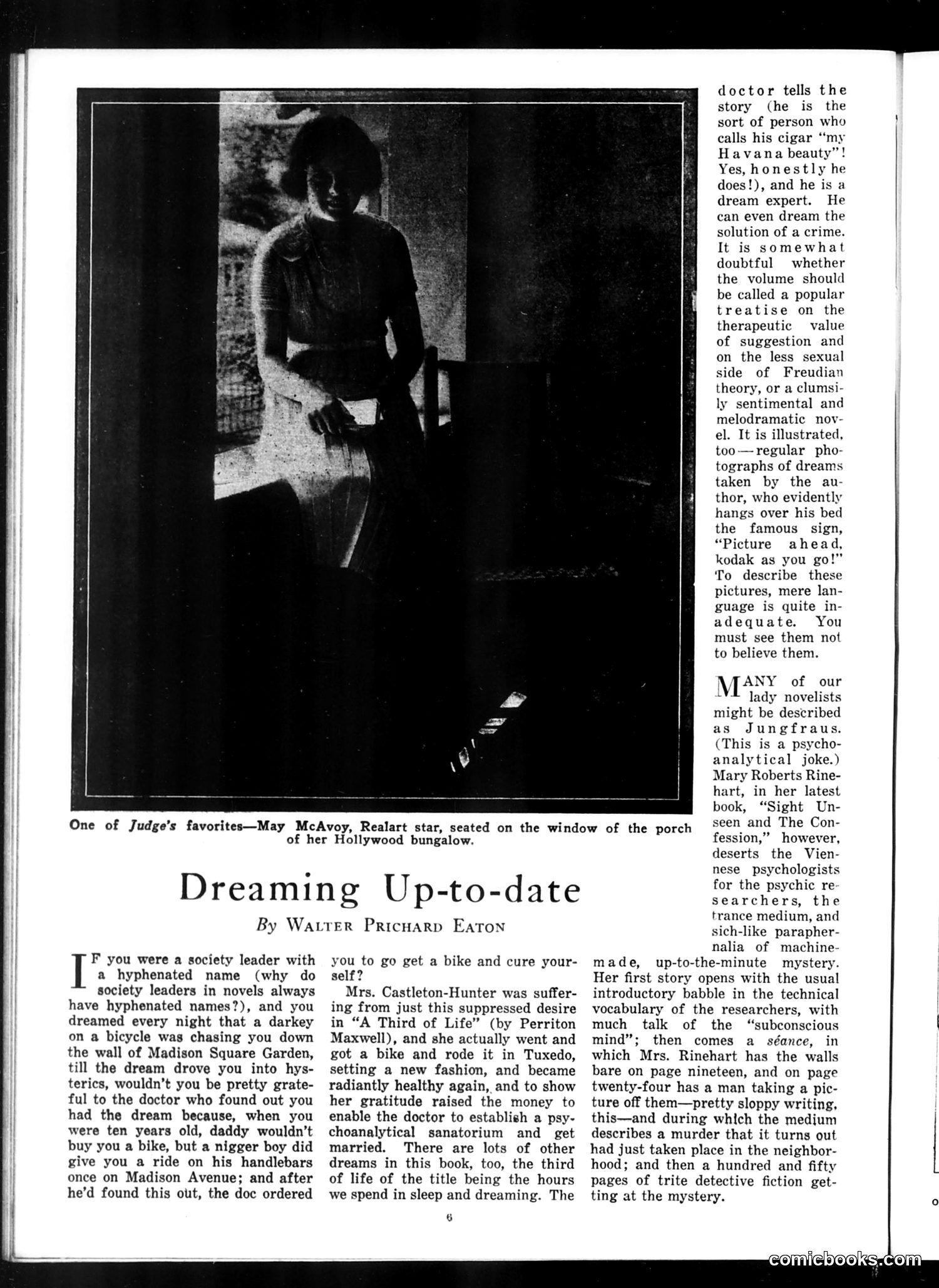
This page contains a book review essay titled "Dreaming Up-to-date" by Walter Prichard Eaton, not a political cartoon. The accompanying photograph shows actress May McAvoy, identified as a "Judge's favorite," sitting on a Hollywood bungalow porch. The essay reviews two contemporary novels: Perriton Maxwell's "A Third of Life" (about psychoanalysis and dream therapy) and Mary Roberts Rinehart's "Sight Unseen and The Confession" (featuring séances and psychic phenomena). Eaton mocks both books' engagement with trendy psychological and spiritualist ideas—Freudianism and trance mediums—that were fashionable among 1920s intellectuals. He satirizes the pretentious pseudo-science by noting Rinehart's "sloppy writing" and the absurdity of photographing dreams. The casual use of a racial slur reflects the casual bigotry of the era, though it appears incidental to the satire's main targets: intellectualism and faddish theories.
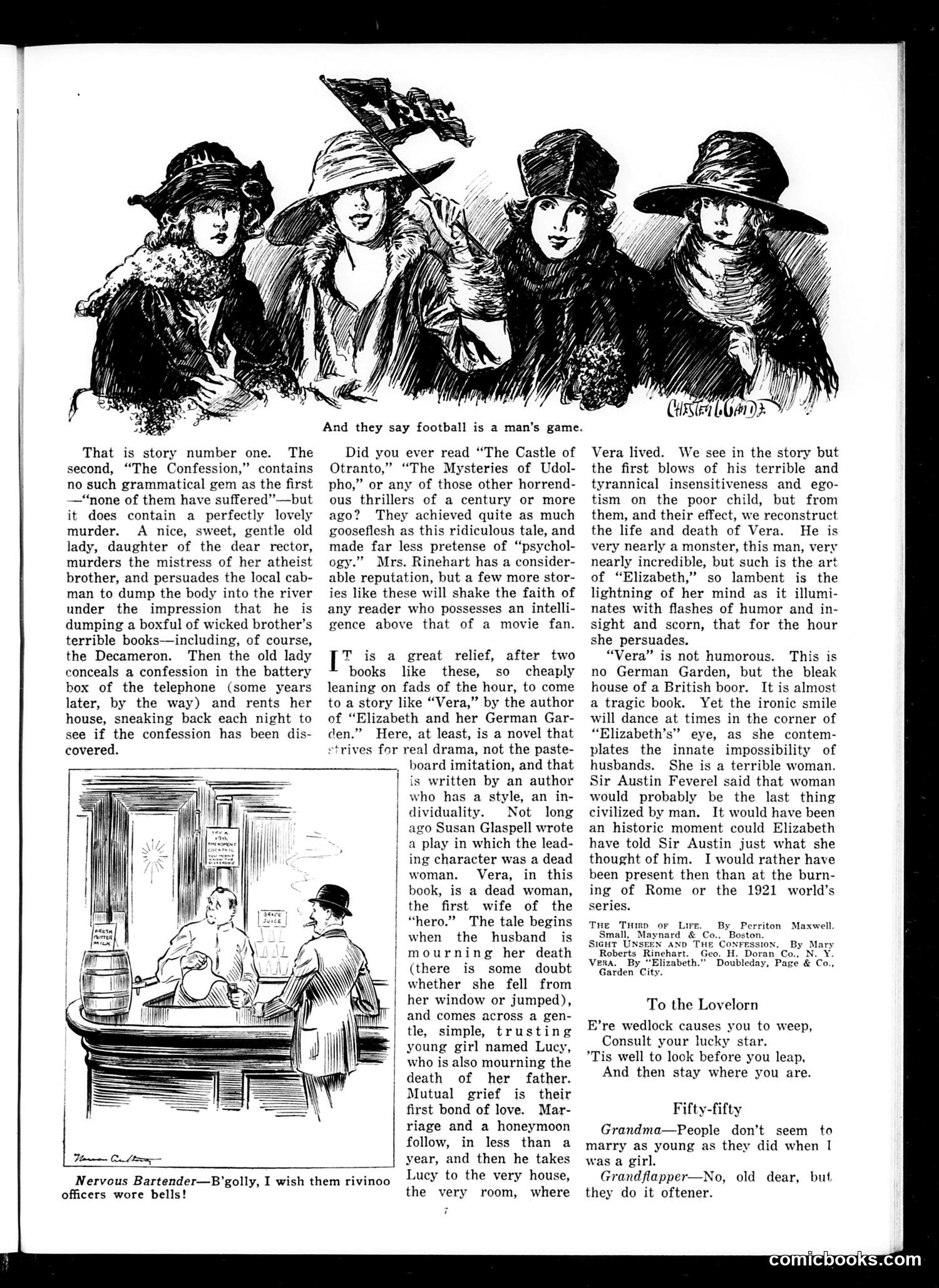
This page reviews three books, with particular focus on critiquing popular author **Mrs. Rinehart** (likely Mary Roberts Rinehart, a bestselling mystery writer of the 1920s). **The satire:** The opening cartoon shows four fashionable women with the caption "And they say football is a man's game"—a joke suggesting women's intense interest in sensational mystery novels rivals men's sports obsession. **The literary criticism:** The reviewer dismisses Rinehart's detective novels as formulaic, melodramatic drivel reminiscent of Gothic horror from a century prior. They contain ridiculous plots (an old lady confessing murder via a telephone battery box) yet pretend to psychological sophistication, appealing only to readers with "an intelligence...above that of a movie fan." **The praise:** By contrast, "Vera" by "Elizabeth and her German Garden" receives approval for genuine artistry and style, depicting a tyrannical husband's emotional abuse with real dramatic weight rather than cheap sensationalism. **The bottom cartoon** ("Nervous Bartender") appears unrelated advertising filler. The page reflects 1920s intellectual snobbery toward popular women's fiction and cinema.
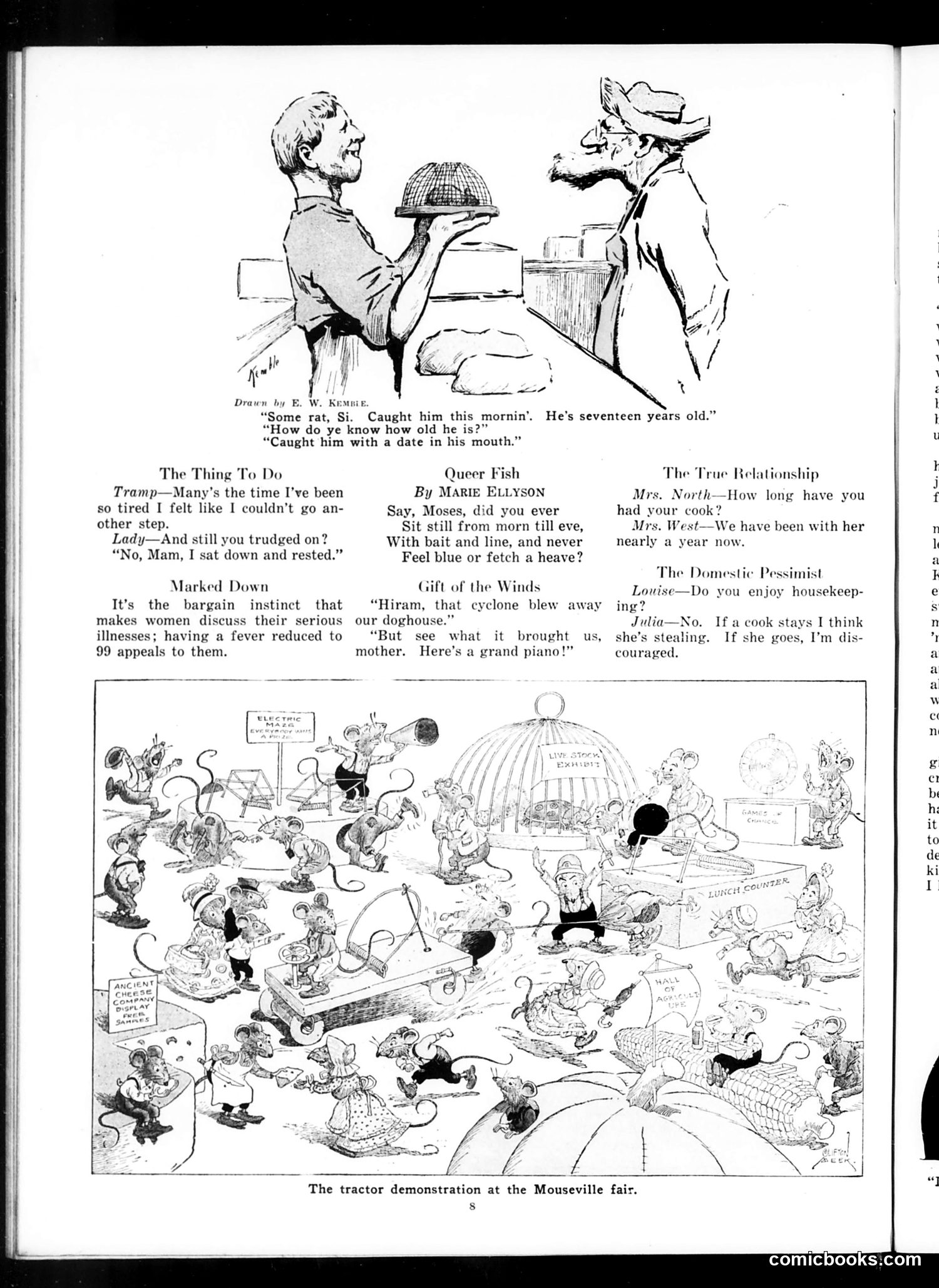
This page contains several brief comic sketches and a large cartoon illustration satirizing early 20th-century domestic and social life. The top sketches mock everyday situations: a tramp's complaint about walking is undercut by his admission he simply sat down; a woman's anxiety about fishing contradicts the premise that sitting still prevents illness; a servant-employer relationship reveals the "no-win" domestic dynamic where cooks are suspected of theft if they stay or laziness if they leave. The dominant illustration depicts "the tractor demonstration at the Mouseville fair"—a anthropomorphic mouse village scene parodying rural agricultural progress. The mice represent farmers or fair-goers examining tractors and farm machinery, likely satirizing either the novelty of mechanized farming or rural people's fascination with new technology. The cartoon's humor relies on exaggeration and anthropomorphism typical of Judge's style, mocking both rural life and the anxieties of domestic servants and employers—class commentary wrapped in whimsy.
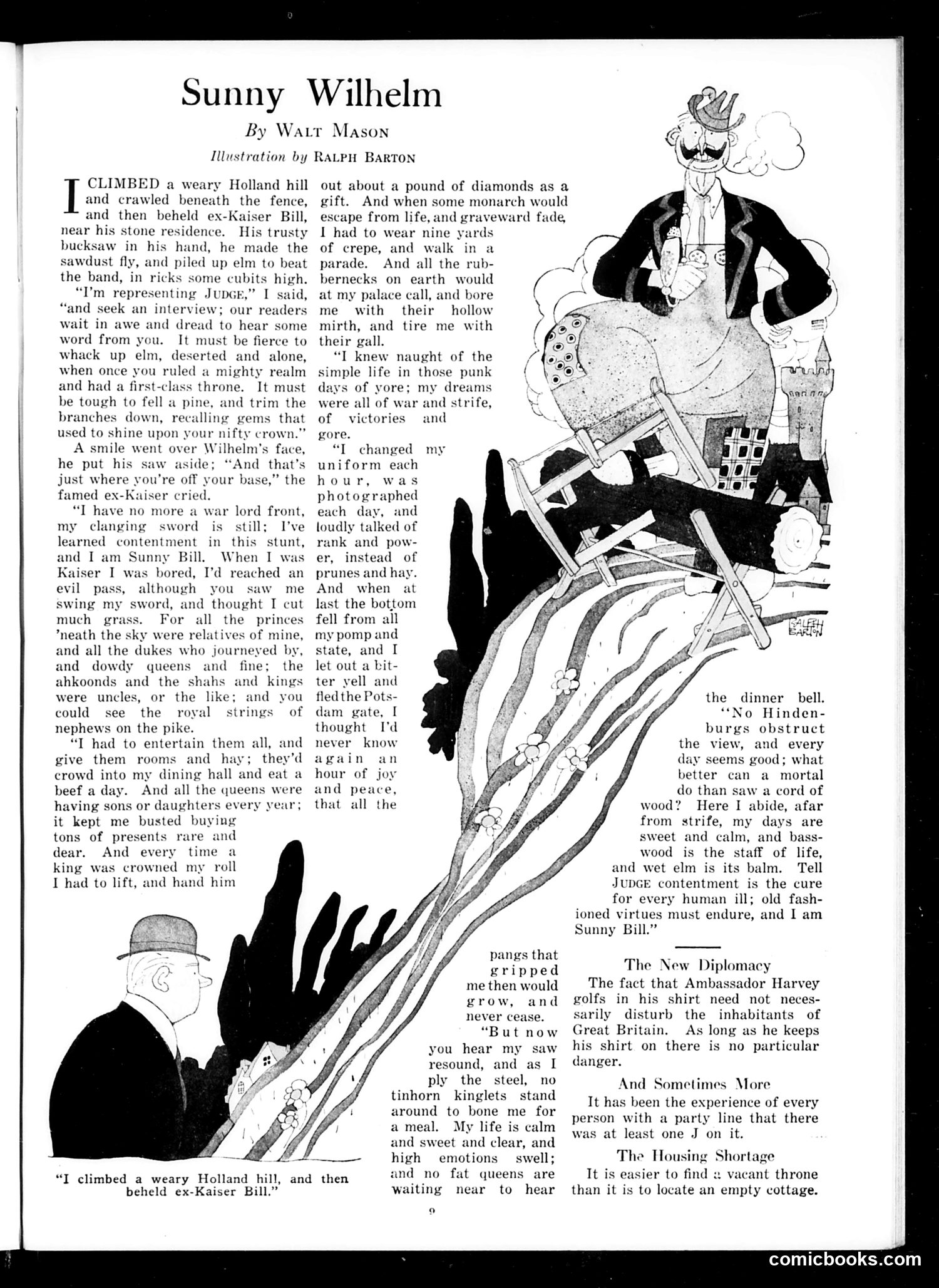
This story mocks **Wilhelm II**, the exiled German Kaiser who abdicated after World War I and fled to the Netherlands. The cartoonist presents Wilhelm claiming contentment in his reduced circumstances—sawing wood, living simply—as a sharp ironic commentary. The satire works on multiple levels: Wilhelm brags about his former imperial glory (nine yards of funeral crepe, constant entertaining, royal relatives everywhere) while now finding peace in manual labor and "basswood." The joke is that this powerful warmonger, who caused immense suffering through his ambitions, now claims to have discovered happiness through humble domesticity. The accompanying editorial snippets—about Ambassador Harvey golfing in his shirt and housing shortages—suggest contemporary political commentary, but the main target is clear: ridiculing the fallen autocrat's convenient conversion to simple living while implying his former power-hunger was inherently hollow and destructive.
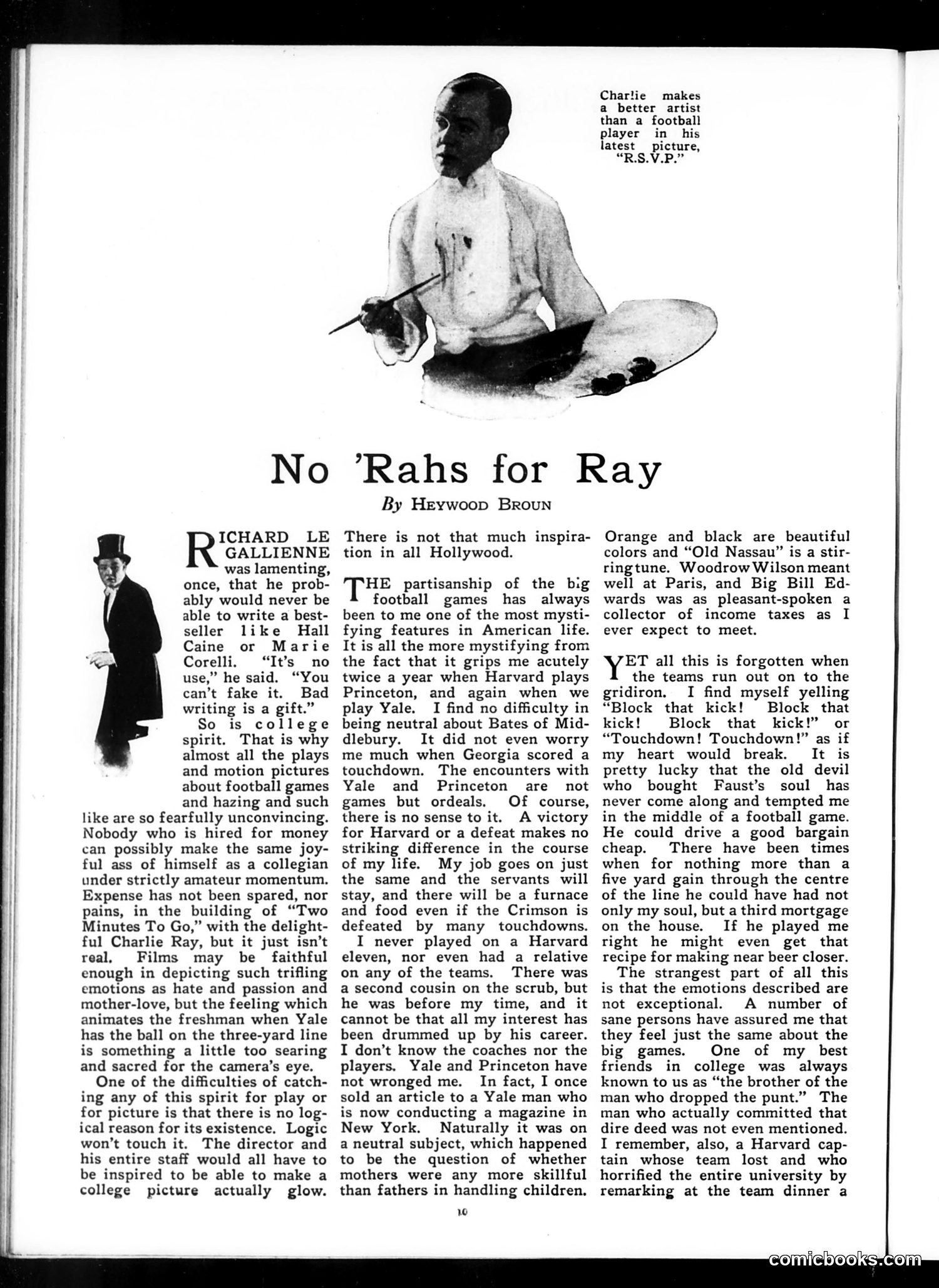
This article by Heywood Broun critiques a college football film starring Charlie Ray (titled "Two Minutes To Go"), arguing it fails to capture authentic collegiate spirit. The accompanying illustration shows Ray as an artist, noting he's "a better artist than a football player." Broun's point: genuine college football enthusiasm—particularly the irrational fervor surrounding Harvard-Yale and Harvard-Princeton games—cannot be manufactured for cinema. He describes this tribal passion as illogical yet irresistible, admitting his own inability to remain neutral about these rivalries despite having no logical stake in them. The satire targets Hollywood's tendency to cheaply replicate authentic emotion. Broun suggests that the "sacred" intensity of collegiate football fandom is too genuine and inexplicable to survive professional dramatization. Only amateurs genuinely living the experience can authentically embody such spirit—professionals hired to fake it will always fall short. The reference to figures like Woodrow Wilson and income tax collector Bill Edwards grounds his argument in 1920s contemporary life.
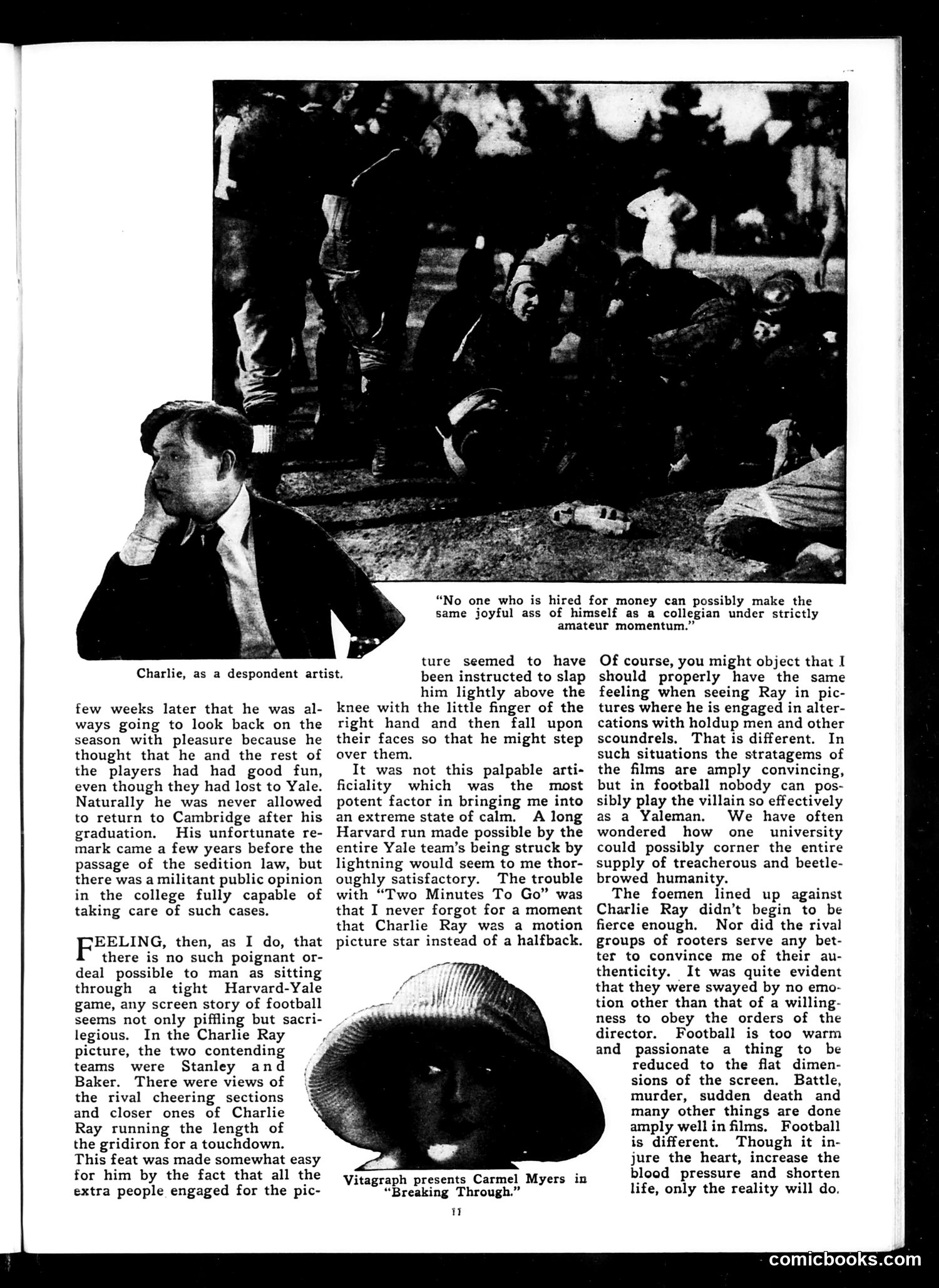
This is a film criticism piece from Judge magazine about the movie "Two Minutes To Go," starring actor Charlie Ray. The author argues that football is uniquely unsuitable for cinema adaptation. The satire's point: while films can convincingly portray crime, violence, and drama, they fundamentally fail at capturing football because the sport's genuine passion and chaos cannot be faked. The author notes that the extras playing Yale players were so obviously following director's orders—literally slapping Ray "lightly above the knee" before falling down—that it destroyed any authenticity. The piece includes a jab at Yale University, sarcastically praising their supposed monopoly on "treacherous and beetle-browed humanity," suggesting Yale rooters were naturally better villains than hired extras. The accompanying photos show scenes from the film and Ray as "a despondent artist." The broader critique is about cinema's limitations when adapting inherently visceral, passionate human experiences.
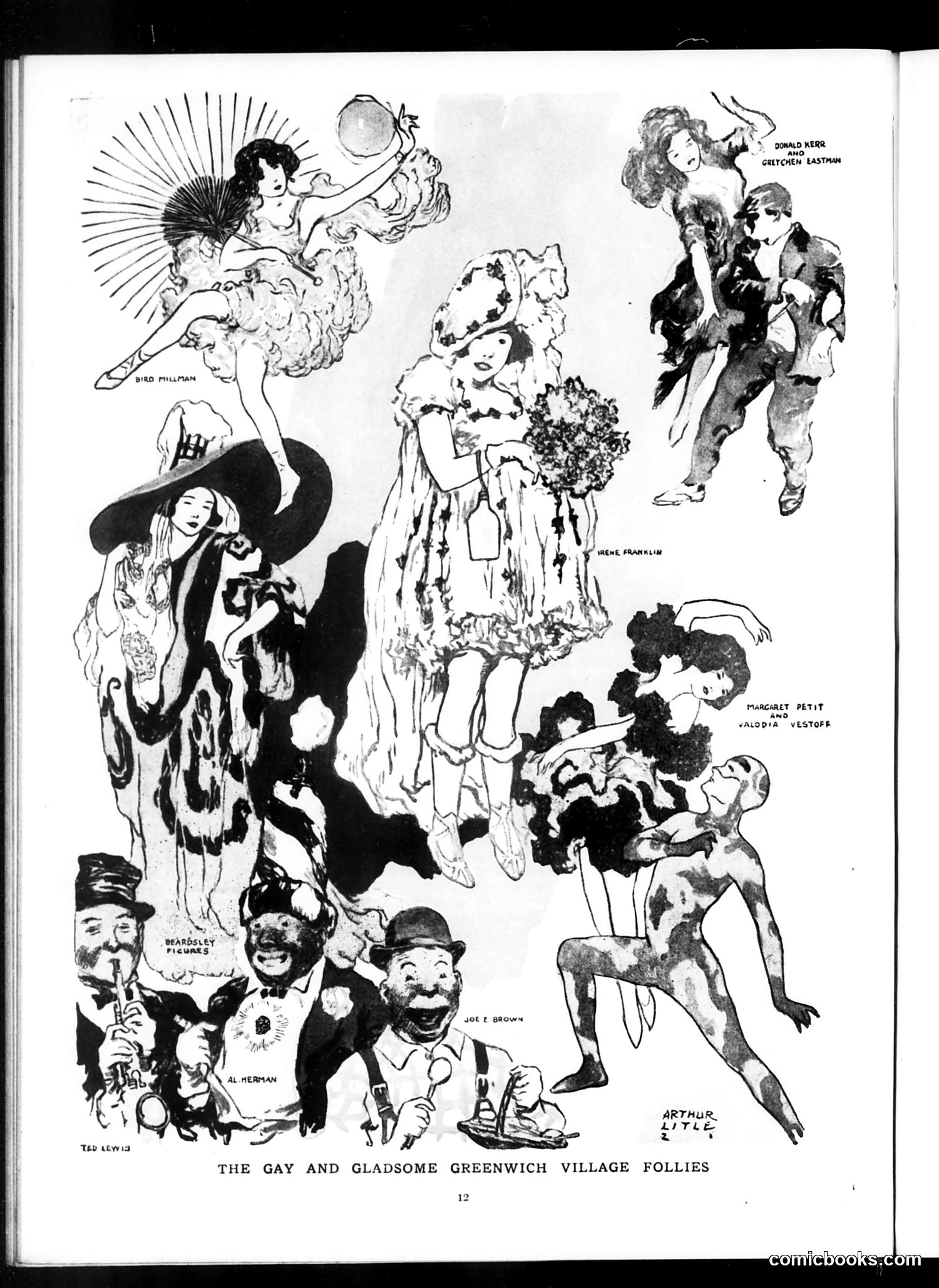
This page showcases theatrical performers and personalities, likely from an early 20th-century Broadway revue or similar entertainment production. The title references Greenwich Village, a Manhattan neighborhood known as a bohemian artistic hub. The illustrated figures include various performers in costume and theatrical dress, with names labeled including "Irene Franklin," "Donald Kerr and Gretchen Hartman," "Arthur Little," and others. The caricatured style emphasizes distinctive features of each performer. The satire appears gentle—celebrating Greenwich Village's reputation for artistic eccentricity and theatrical culture rather than mocking it sharply. Judge magazine here documents popular entertainment personalities of the era, treating them as noteworthy cultural figures worthy of illustrated coverage alongside the magazine's typical political and social commentary.
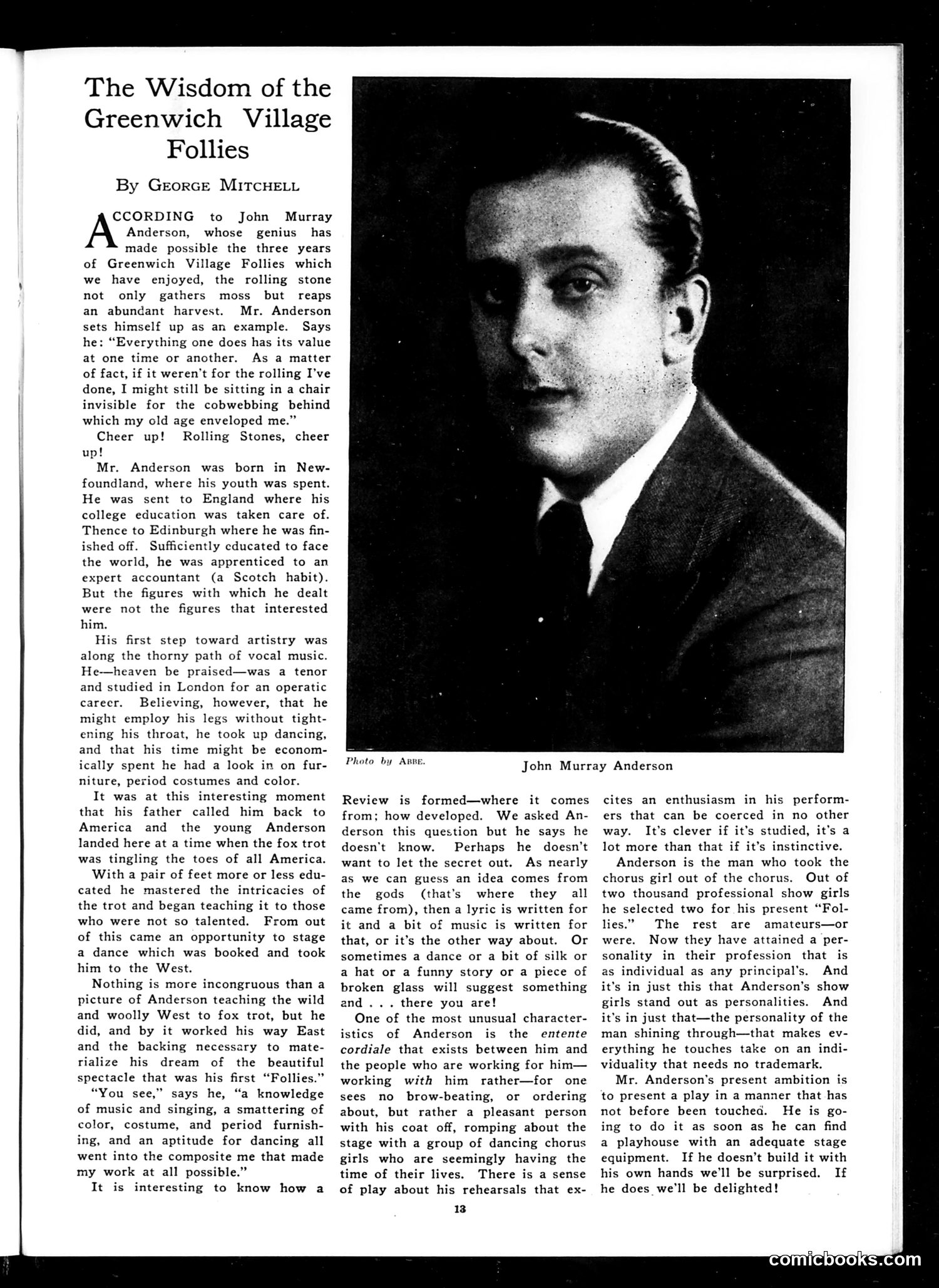
This is a **profile/interview article**, not a political cartoon. It celebrates John Murray Anderson, the director of the *Greenwich Village Follies*, a popular Broadway revue running in the early 1920s. The piece chronicles Anderson's unconventional path to theatrical success: born in Newfoundland, educated in England and Scotland, trained as an accountant, then pivoting to vocal music, dance, and stagecraft. The article praises his philosophy that "everything one does has its value"—his varied experiences (the "rolling stone") enabled his artistic achievements. Key to the satire is Anderson's reputation as an unusually progressive director who treats chorus girls as collaborators rather than subordinates, works "with his coat off," and cultivates genuine enthusiasm rather than enforcing discipline through authority. The accompanying photograph shows Anderson in formal dress, presenting him as a serious artistic figure—underscoring *Judge* magazine's admiration for his unconventional success story during the Jazz Age theatrical boom.
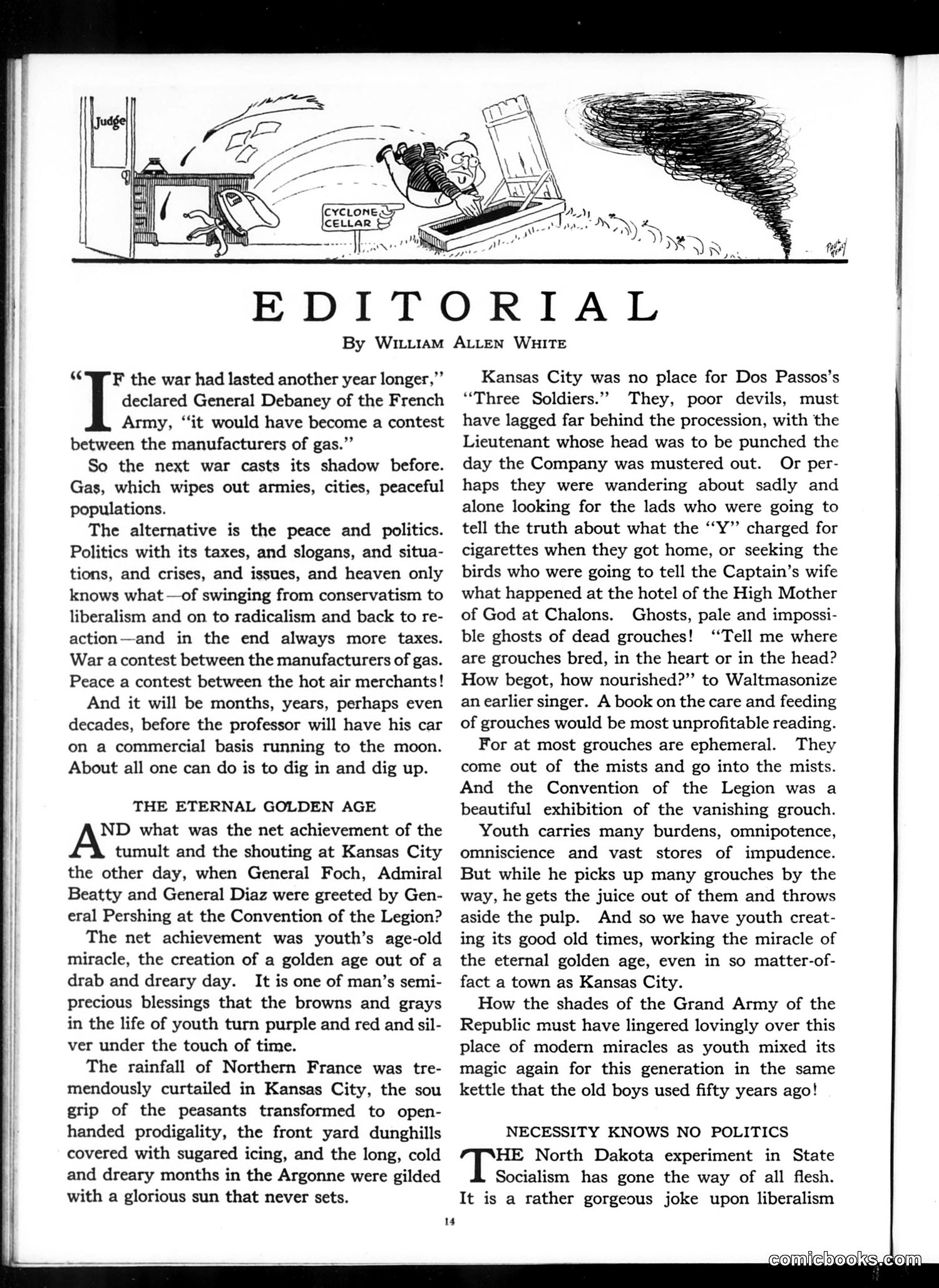
**The Cartoon:** The header illustration shows a judge's bench on the left, with a "cyclone cellar" (tornado shelter) in the center, and a violent tornado on the right—all labeled "CYCLONE CELLAR." This visual metaphor sets up the editorial's theme. **The Content:** William Allen White's editorial juxtaposes two post-WWI anxieties: future warfare (gas weapons as manufacturers' contest) versus peacetime politics (a "contest between hot air merchants"). He criticizes both as destructive alternatives. The main section celebrates a Kansas City Legion convention where WWI generals were honored. White praises youth's ability to transform bleak reality into romanticized memory—calling this an "eternal golden age" miracle. He contrasts this with Dos Passos's *Three Soldiers*, a grittier, anti-romantic war novel, suggesting youth naturally sanitizes harsh truths. The final section mocks North Dakota's failed state socialism experiment, framing it as a "gorgeous joke upon liberalism." **The Point:** A nostalgia-soaked critique of both political extremes and war's sanitization through collective memory.
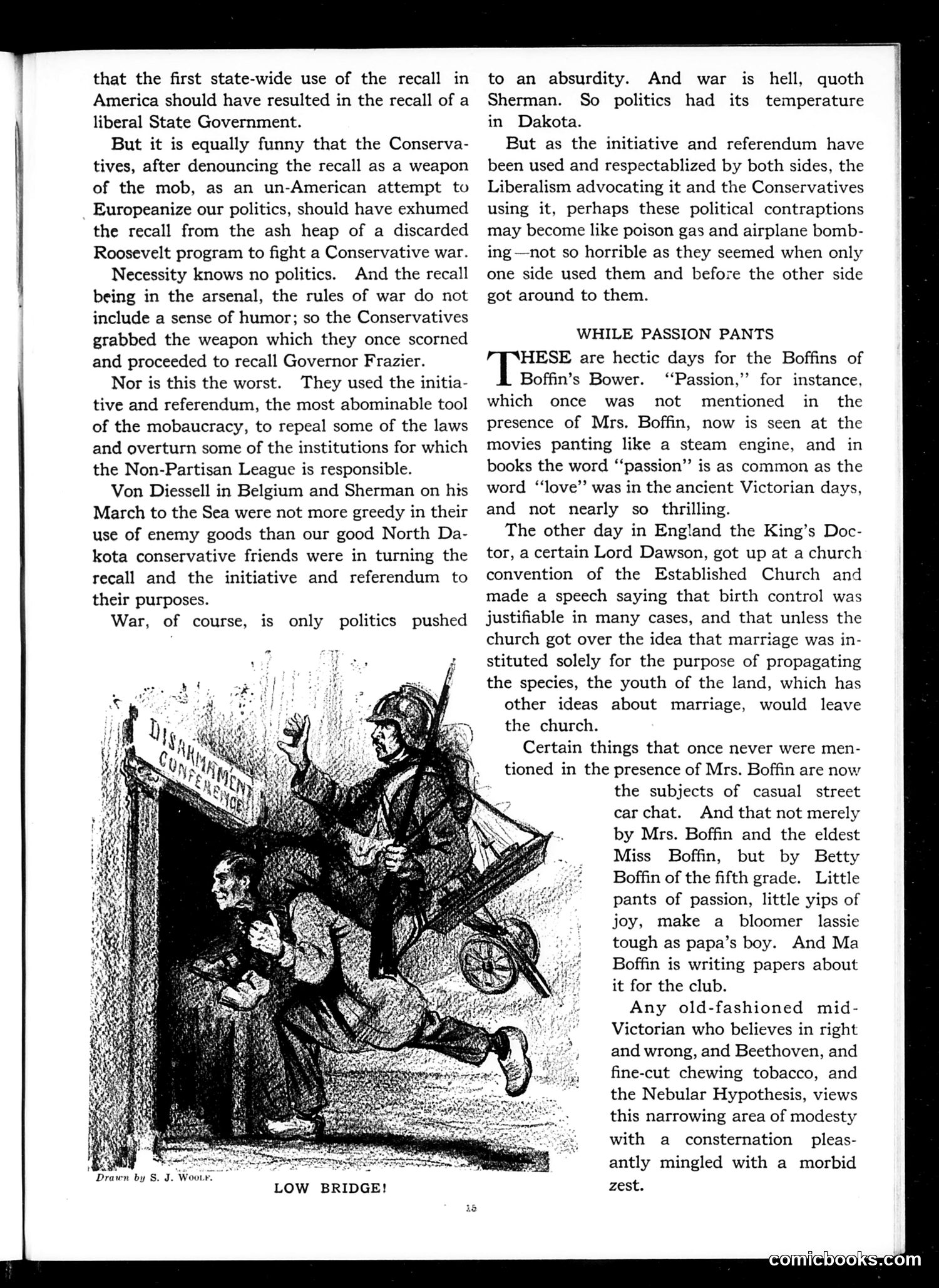
The page contains two satirical pieces from Judge magazine: **Political Cartoon & Editorial ("Low Bridge!"):** The cartoon (by S.J. Woolf) and accompanying text mock North Dakota politics, specifically the ironic use of progressive democratic tools. Conservatives had previously denounced the "recall," "initiative," and "referendum" as mob-rule Europeanization of American politics—yet weaponized these same mechanisms to recall Governor Frazier and overturn Non-Partisan League legislation. The text compares this opportunism to Von Diessel and Sherman's wartime plundering. The satire argues that once both political sides adopt these tools, they become normalized, like poison gas in warfare. **"While Passion Pants":** This lighter piece satirizes changing social mores. It notes that "passion" was once taboo in polite society (especially before Mrs. Boffin) but now appears casually in movies and books. A Church of England doctor's recent endorsement of birth control exemplifies this shift. The satire targets old-fashioned Victorians who cling to rigid propriety while secretly fascinated by modern frankness about sexuality and marriage.
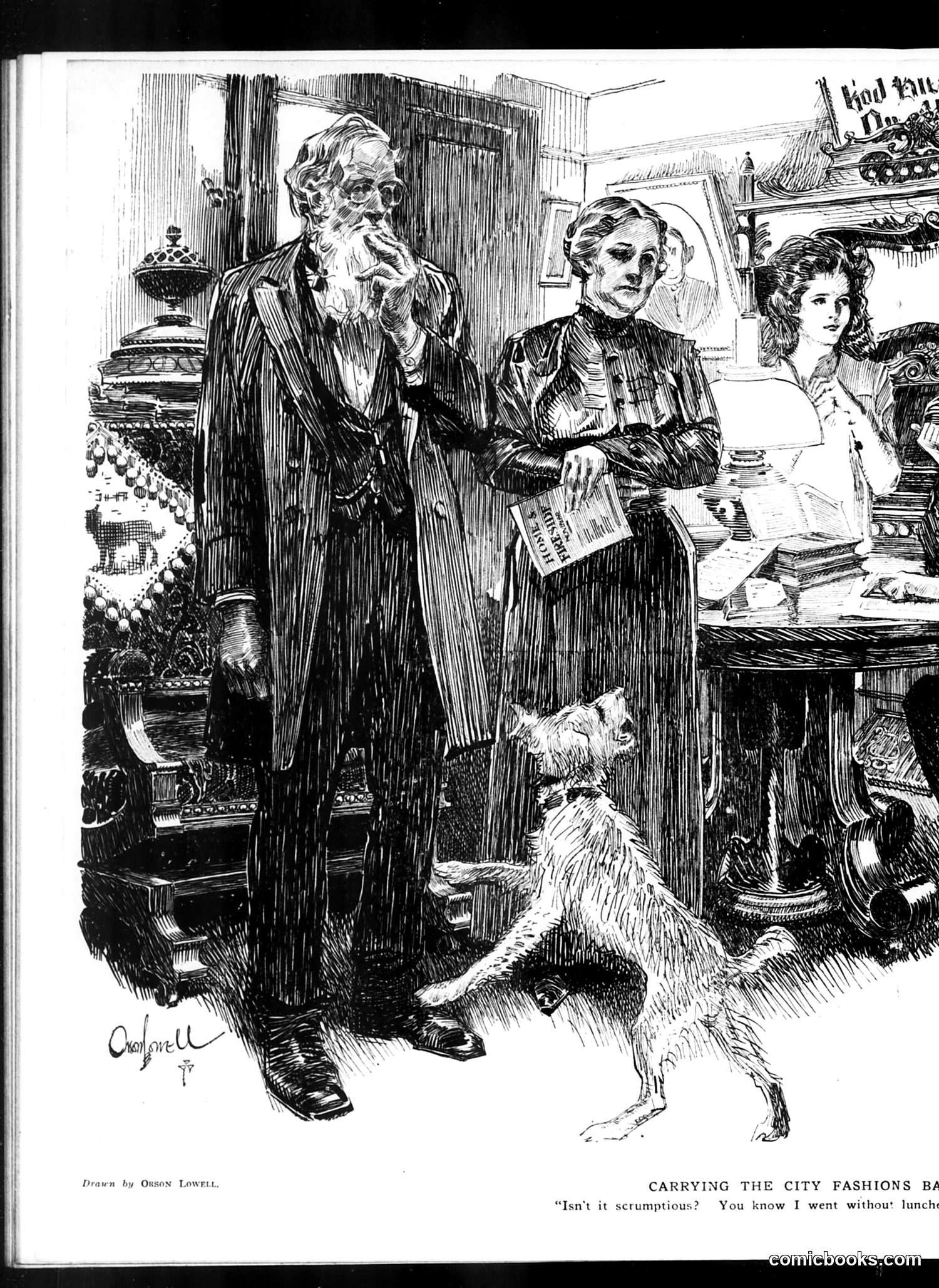
This illustration by Orson Lowell depicts a satirical scene about urban fashion and social pretense. An elderly bearded gentleman in formal attire appears to be showing off fashionable items to companions, while a small dog stands prominently in the foreground. The caption "Carrying the City Fashions Ba[ck]" suggests the joke concerns someone bringing trendy urban styles to a different setting—likely rural or small-town America. The dialogue fragment "Isn't it scrumptious? You know I went without lunch" implies the figure has made financial sacrifices to afford fashionable goods, poking fun at the vanity of those who prioritize appearances over practical needs. The dog's presence may emphasize the absurdity of the scene. The satire targets bourgeois social climbing and the superficiality of fashion consciousness.
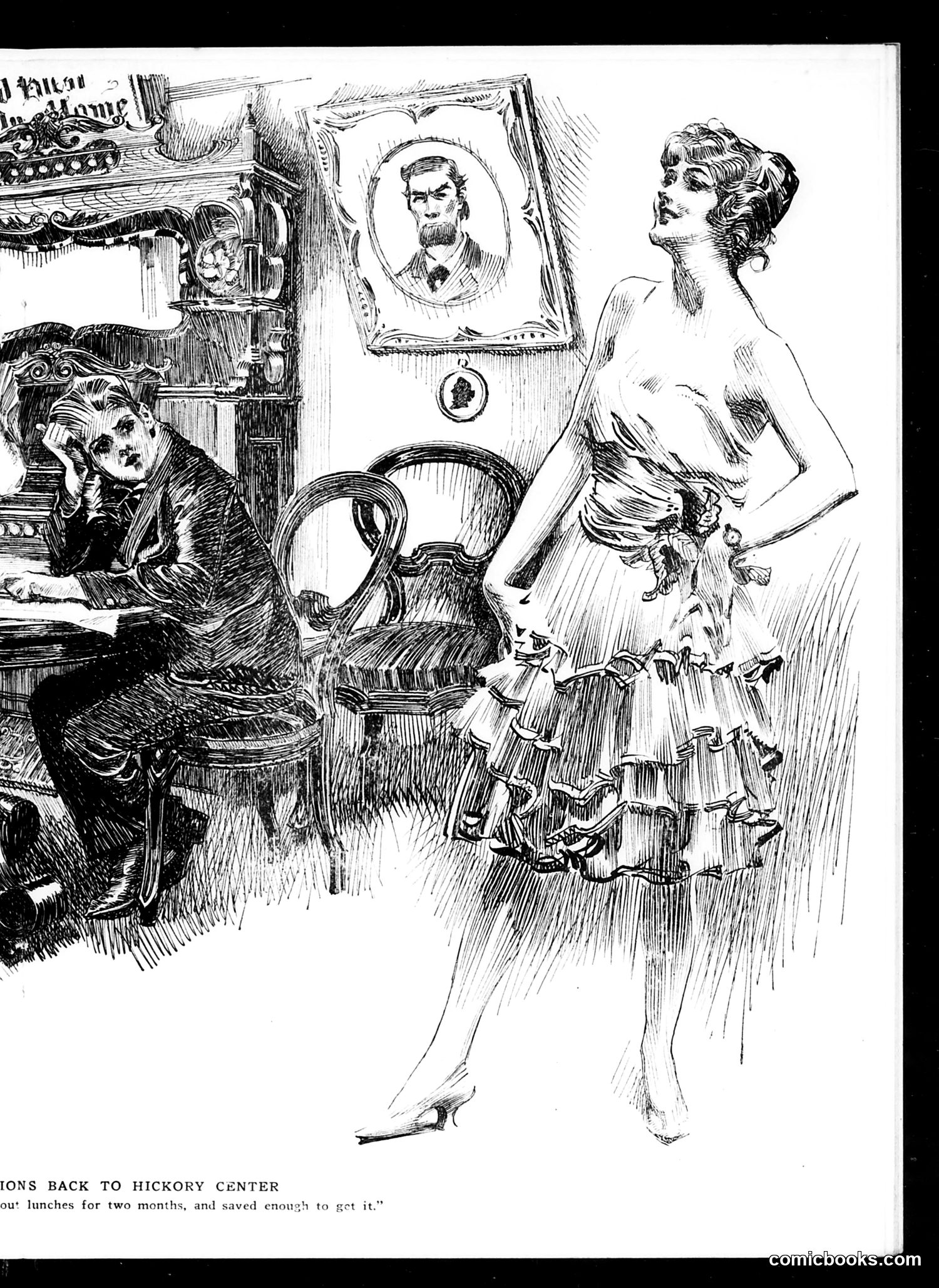
This appears to be a satirical illustration from *Judge* magazine depicting a domestic scene with social commentary. The visible text fragment references "Hickory Center" and mentions saving money from lunches over two months, suggesting the cartoon comments on working-class economics or household budgeting during a specific era. The scene shows a woman in an elegant dress (likely representing a society or upper-class figure) alongside a seated man examining what appears to be a portrait on the wall. The ornate interior details suggest commentary on class aspirations or financial pretense. However, without the complete caption and date, the specific satirical target remains unclear. The humor likely involves either economic struggle masked by social pretension or commentary on frugality among a particular social group during this period.
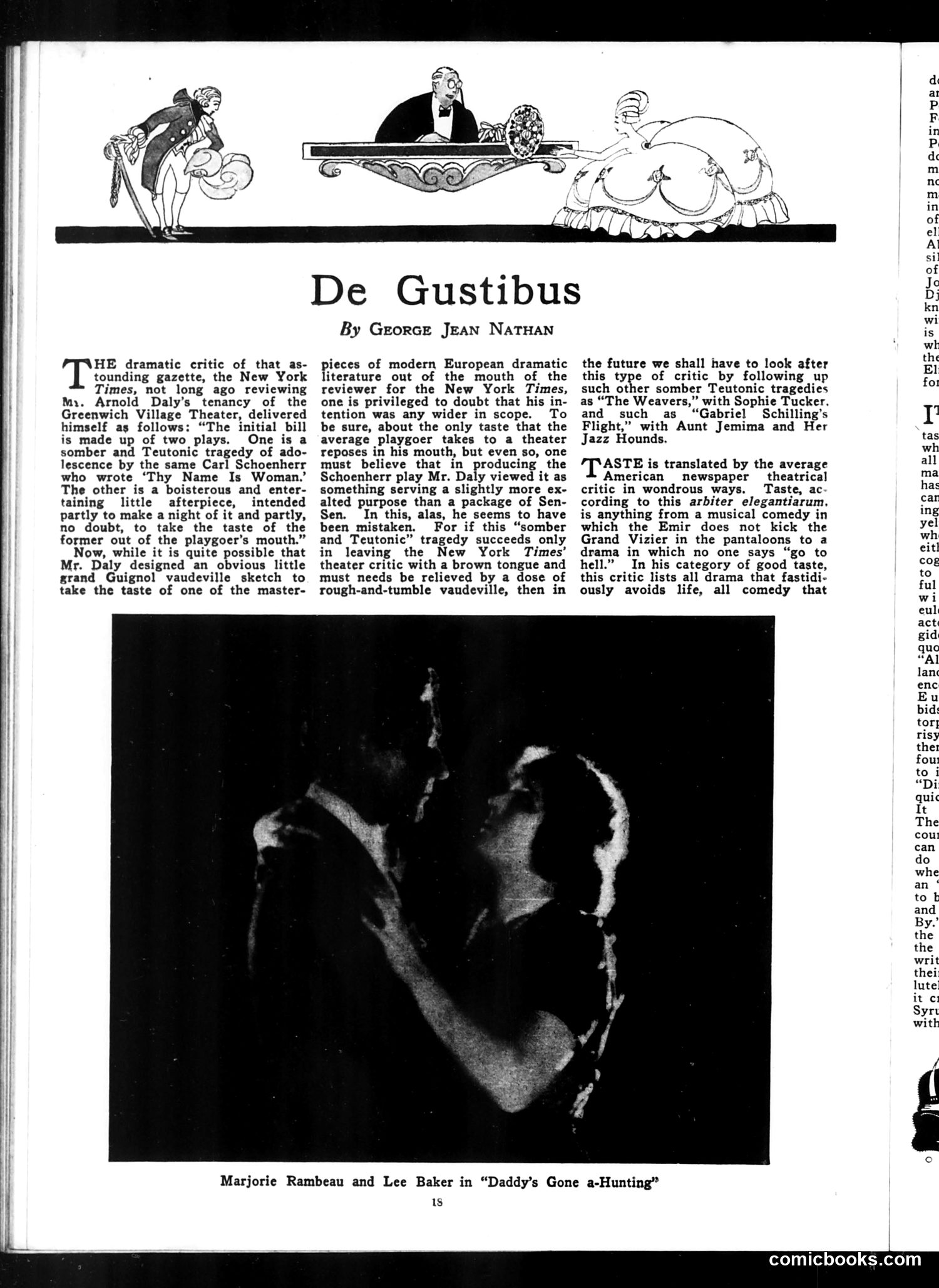
This article satirizes the New York Times theater critic's review of Arnold Daly's production at Greenwich Village Theater. Nathan mocks the critic for praising a heavy Teutonic tragedy solely because it was "relieved" by a lighter vaudeville afterpiece—suggesting the critic's palate needed cleansing from serious art. Nathan argues the Times critic confuses "taste" with escapism, believing good theater must avoid depicting real life or using mild profanity. He ridicules this narrow aesthetic by suggesting future serious plays should be paired with Sophie Tucker or "Aunt Jemima and Her Jazz Hounds"—obviously absurd pairings that expose the critic's shallow standards. The accompanying photograph shows Marjorie Rambeau and Lee Baker in "Daddy's Gone a-Hunting," apparently an example of theatrical entertainment the critic would judge favorably.
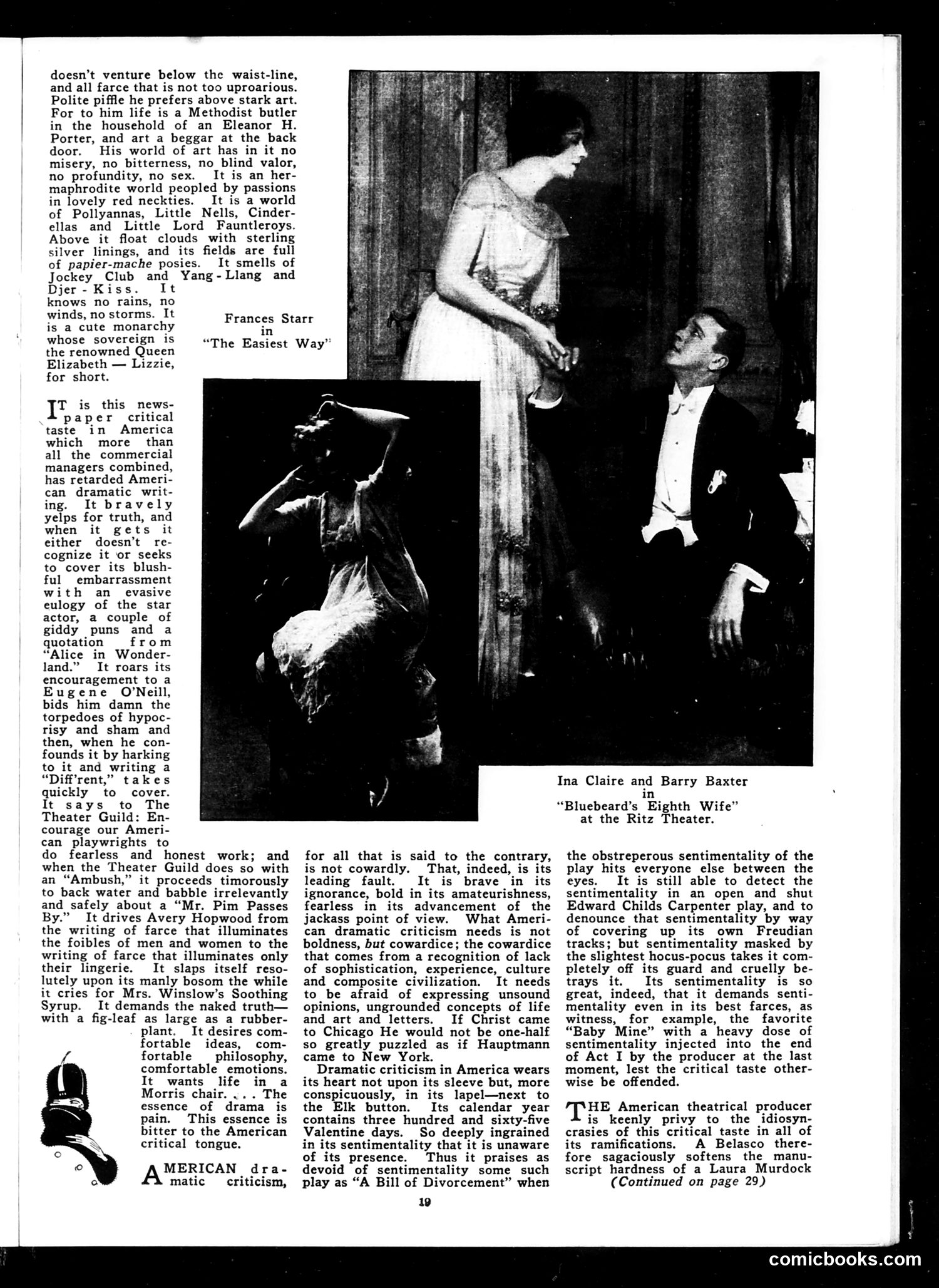
This page critiques American theatrical criticism circa the 1920s, using specific plays and playwrights as examples. The author argues that critics demand "fearless" drama while punishing playwrights who deliver it—citing Eugene O'Neill's experience with "Diff'rent" and the Theater Guild's reception of "Ambush." The piece attacks critics' sentimentality disguised as sophistication: they praise emotionally manipulative plays like "A Bill of Divorcement" while condemning openly sentimental works. The author mocks their preference for safe, pleasant art (evoking Eleanor Porter's "Pollyanna") and their inability to tolerate genuine depiction of human suffering and sexuality. Two theatrical photographs illustrate the piece: Frances Starr in "The Easiest Way" and Ina Claire with Barry Baxter in "Bluebeard's Eighth Wife" at the Ritz Theater. The satire essentially accuses American critics of hypocrisy—demanding courage from writers while demonstrating cowardice through their own sentimental blind spots.
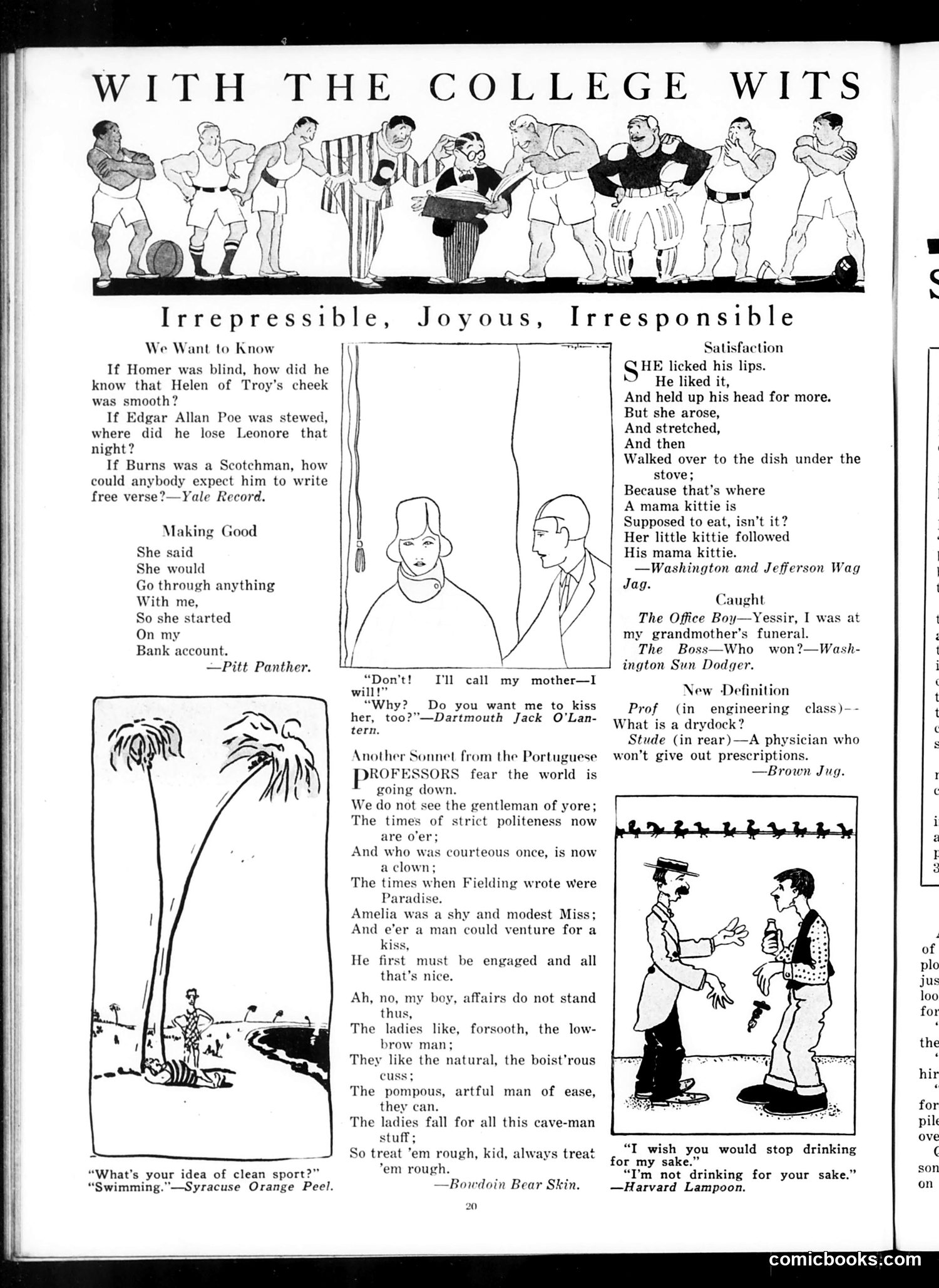
This page from *Judge* magazine collects humorous quips from college humor publications (Yale Record, Pitt Panther, etc.). The content reflects early 20th-century college comedy: **The satirical pieces mock:** - Literary pretension ("If Burns was Scottish, how could he write free verse?") — attacking academic posturing about famous authors - Gender dynamics in dating and relationships — multiple jokes about women pursuing men's money or manipulating situations - Generational decline — the sonnet "Another Sonnet from the Portuguese" laments that modern women prefer rough, natural men to refined gentlemen, inverting Victorian courtship ideals - Authority figures — the office boy's grandmother's funeral joke (treating tragedy casually) and the engineering professor's fake definition **The cartoon at top** shows college men in various poses, illustrating the "irrepressible, joyous, irresponsible" stereotype of college boys. The humor relies on assumptions about courtship, class, and social propriety that were contemporary in the 1920s-30s era. The cynical tone about relationships and mocking of both refined behavior and academic seriousness defines this era's college humor.
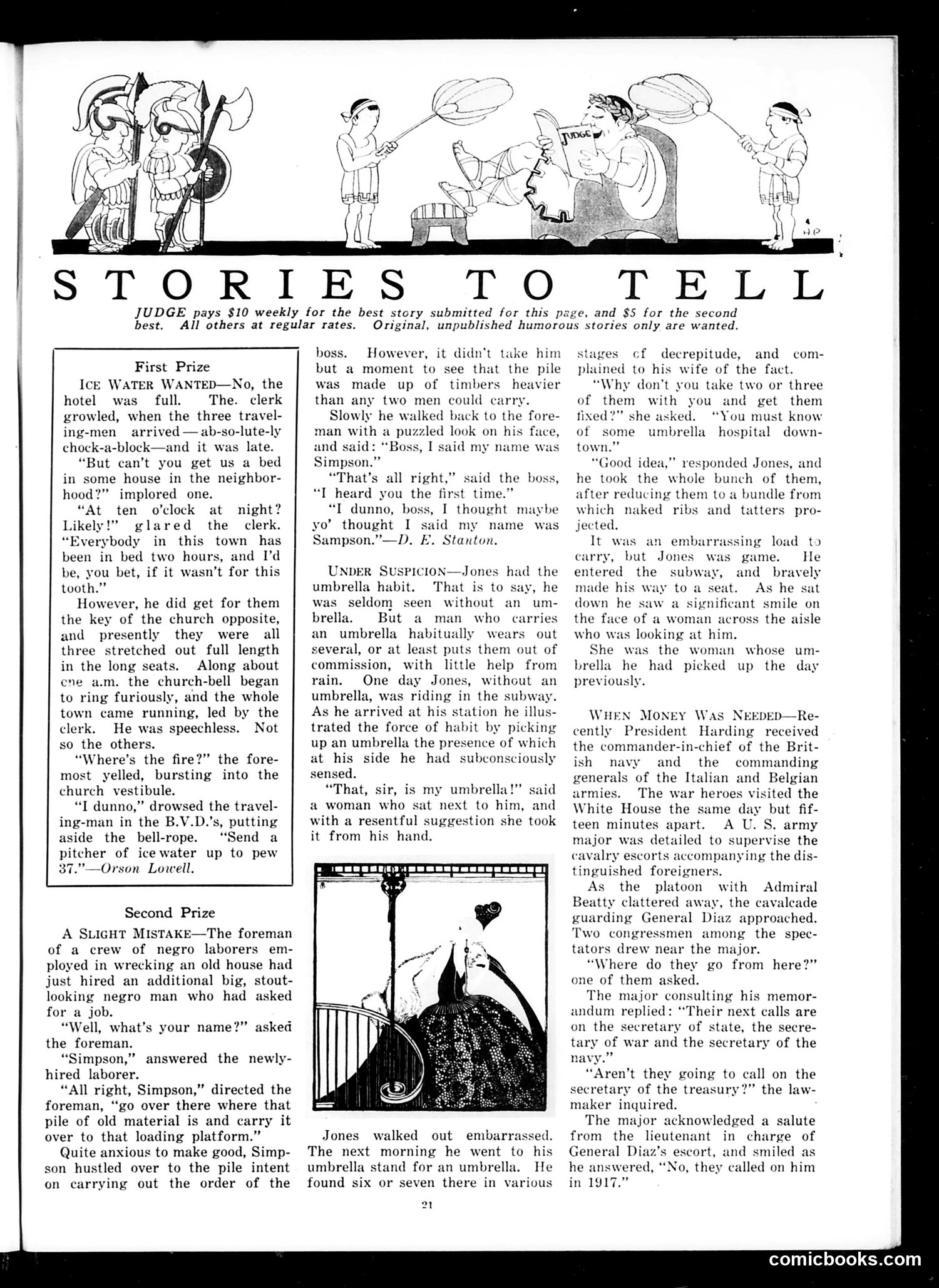
This is a **humor/joke submission page** from *Judge* magazine, featuring three short comic anecdotes rather than political satire. **First Prize story**: Three traveling salesmen arrive at a full hotel late at night. The irritable clerk, suffering from a toothache, reluctantly lets them sleep in the local church. When the church bell rings at 1 a.m. (summoning townspeople for a fire), one drowsy salesman requests ice water be sent to "pew 37"—treating the church like a hotel. The humor relies on absurdist hotel-guest behavior and the clerk's misfortune. **Second Prize**: A foreman mishires a laborer named Simpson, then assigns him to move an impossibly heavy pile of materials. Simpson returns confused, thinking the foreman misheard his name—a misunderstanding-based joke playing on workplace miscommunication. **The illustrated story**: A habitual umbrella-carrier, Jones, absent-mindedly takes a woman's umbrella on the subway. Later, embarrassed by his collection of broken umbrellas, he encounters the *same woman* on the train—creating comedic irony about his umbrella obsession and her recognition of him. These are lighthearted domestic humor pieces, not political commentary.
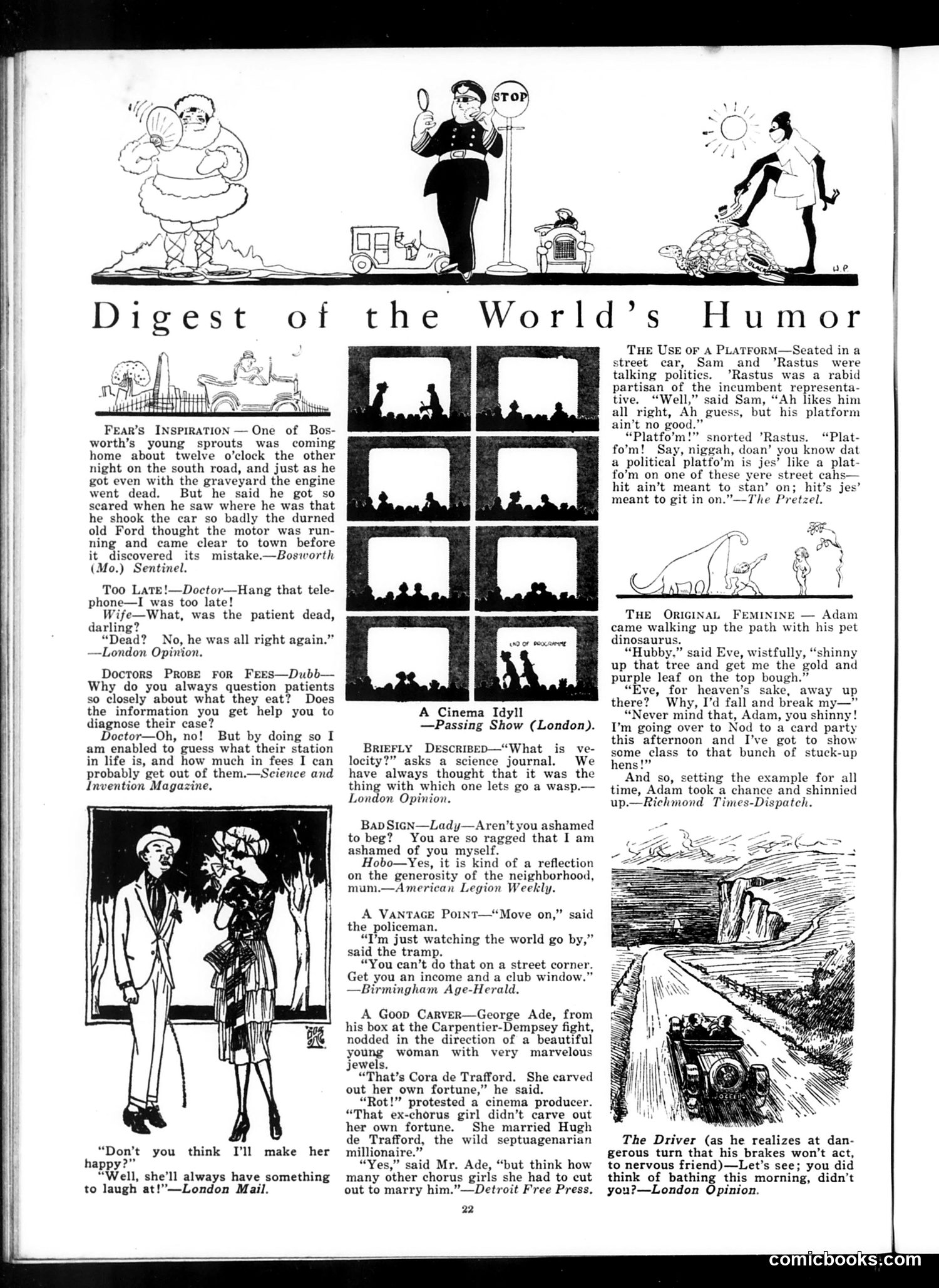
This page collects brief humorous anecdotes from various sources, reflecting early 20th-century American and British attitudes: **Key items:** - **"Fear's Inspiration"**: A young man's car stalls near a graveyard; fear makes him shake it so violently the engine restarts—mocking both automotive unreliability and superstitious terror. - **"The Use of a Platform"**: Two Black men ('Sam and 'Rastus) discuss politics using dialect humor. The joke relies on a play-on-words: 'Rastus misunderstands "platform" (political policy) as the physical platform on a streetcar. This reflects the era's casual racist caricature through stereotypical dialect. - **"The Original Feminine"**: A prehistoric joke where Eve demands Adam climb a dangerous tree to fetch leaves for impressing friends—stereotyping women as vain and demanding even in Eden. - **"A Good Carver"**: Wordplay about a chorus girl who "carved out her fortune" through marriage rather than her own efforts, satirizing both gender economics and Hollywood. The page contains no identified political figures—mostly social satire reflecting 1920s-era attitudes toward class, gender, and race.
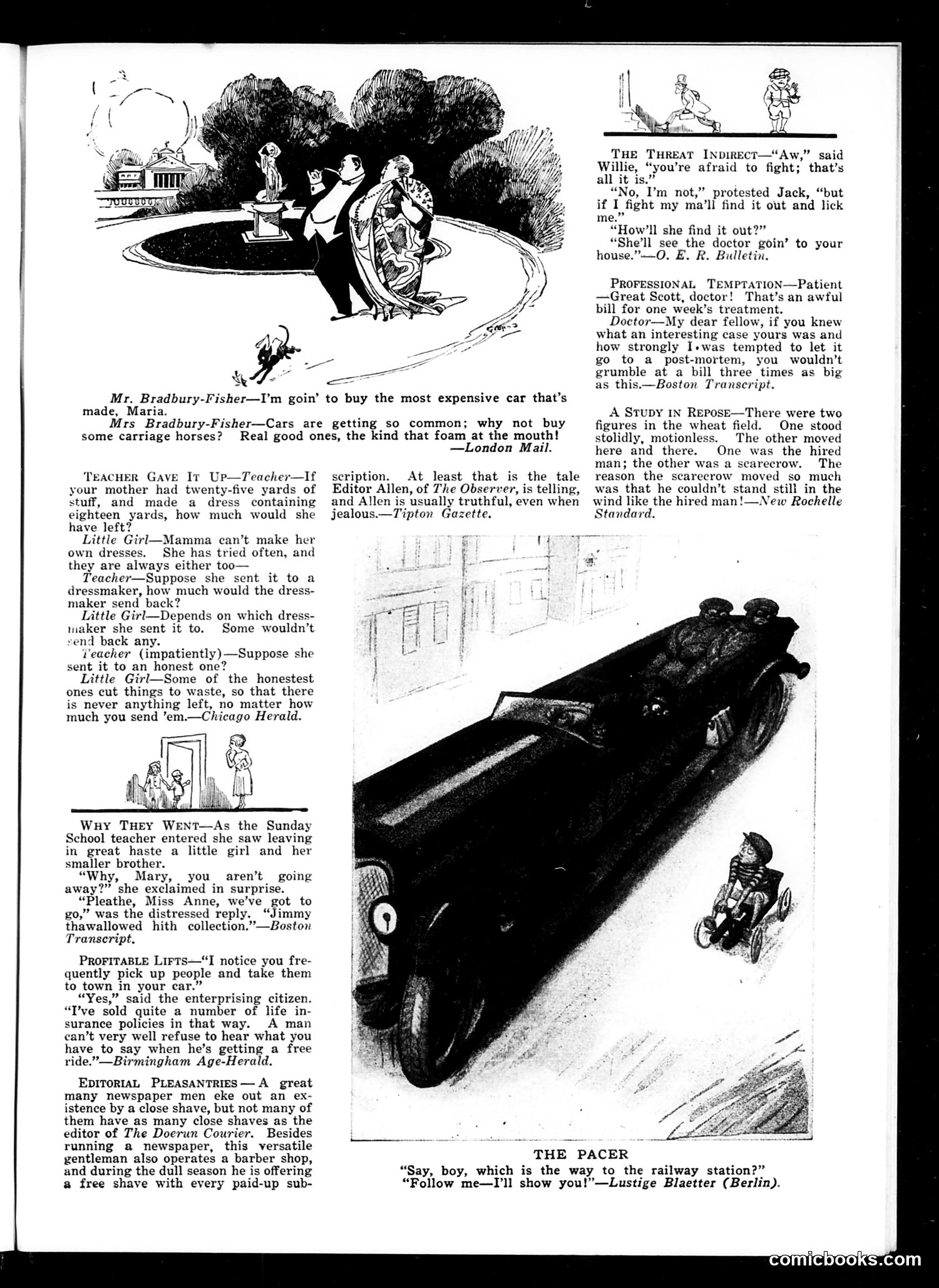
This page contains multiple short humorous anecdotes and one prominent cartoon illustrating early 20th-century social satire. **"The Pacer" Cartoon (main image):** Shows a man in a motorcar racing alongside a boy on a bicycle or small vehicle. The joke plays on the word "pacer"—the car's speed is so excessive that the boy must follow frantically to reach the railway station, inverting the expected helper-and-helped dynamic. **Recurring Themes:** - **Class anxiety**: Mr. Bradbury-Fisher's expensive car purchase satirizes nouveau-riche consumerism and status-seeking (cars were still luxury items) - **Professional ethics**: The doctor's hint about profiting from patient deaths mocks medical greed - **Gender roles**: The dressmaker anecdote stereotypes women's domestic incompetence - **Childhood innocence**: Multiple jokes involve children's naïve misunderstandings (the boy swallowing church collection money) **Social Context:** These pieces reflect Progressive-era anxieties about modernization, commercialism, and changing social hierarchies. The humor relies on period-specific assumptions about class, profession, and gender now requiring explanation for modern readers.
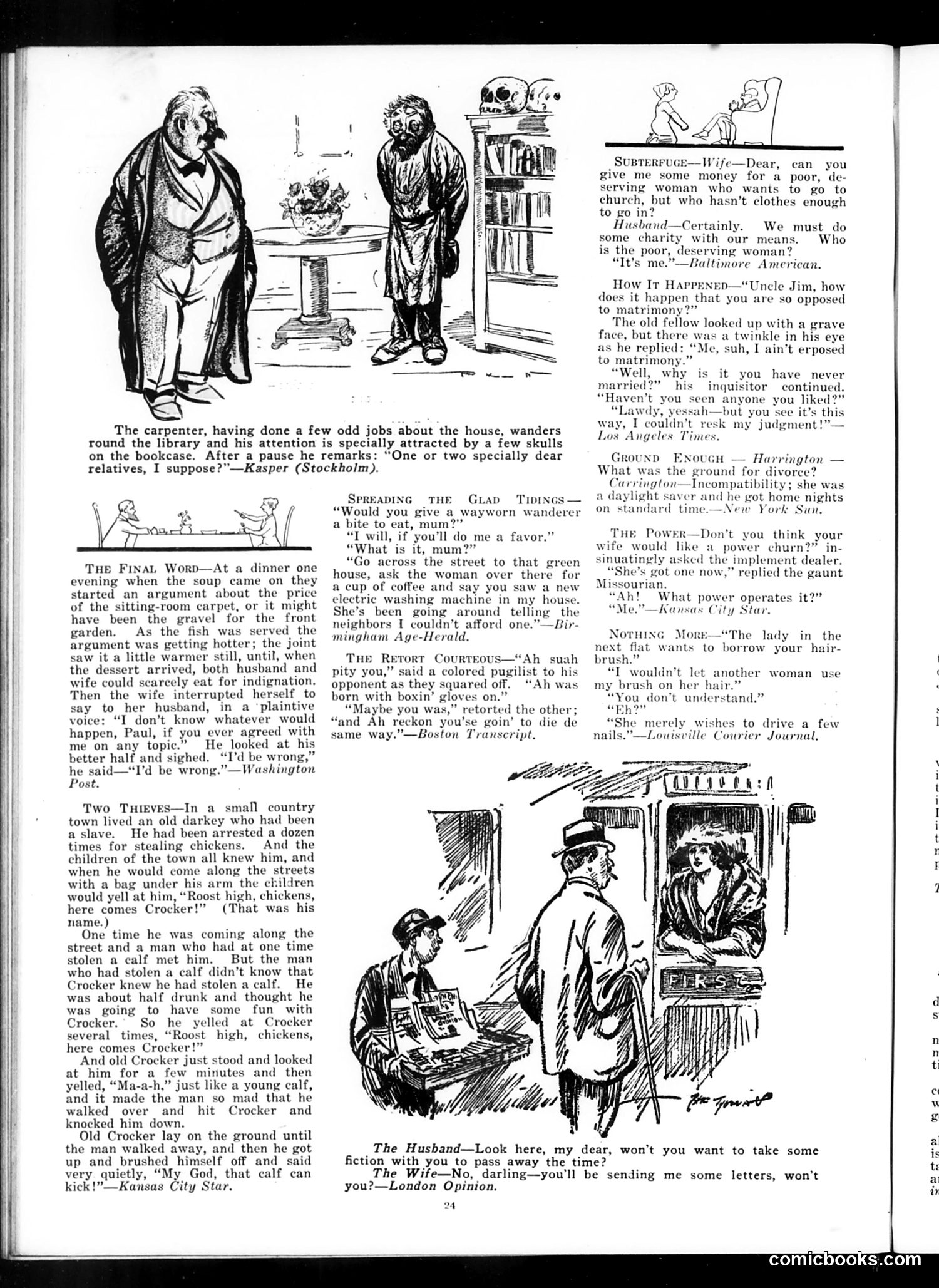
This page contains multiple brief humorous anecdotes satirizing domestic life and social conventions of early 20th-century America. The cartoons mock marital dynamics: wives manipulating husbands for personal expenses under pretense of charity; husbands resisting matrimony; couples arguing over household purchases. One sketch depicts a carpenter observing skulls on a bookcase—likely relatives' remains, suggesting dark family secrets. A recurring theme is women's deception and manipulation within marriage, presented as comedic inevitability. Another sketch uses a racist caricature of a formerly enslaved man repeatedly called "Crocker" for stealing chickens—the humor relies on stereotype and degradation. The "Two Thieves" story presents a crude moral lesson using offensive racial language and imagery common to the era. Overall, these anecdotes reflect contemporary attitudes: skepticism toward marriage, domestic conflict as entertainment, and casual racism presented as harmless humor. The satire targets marital absurdities rather than challenging social injustices.
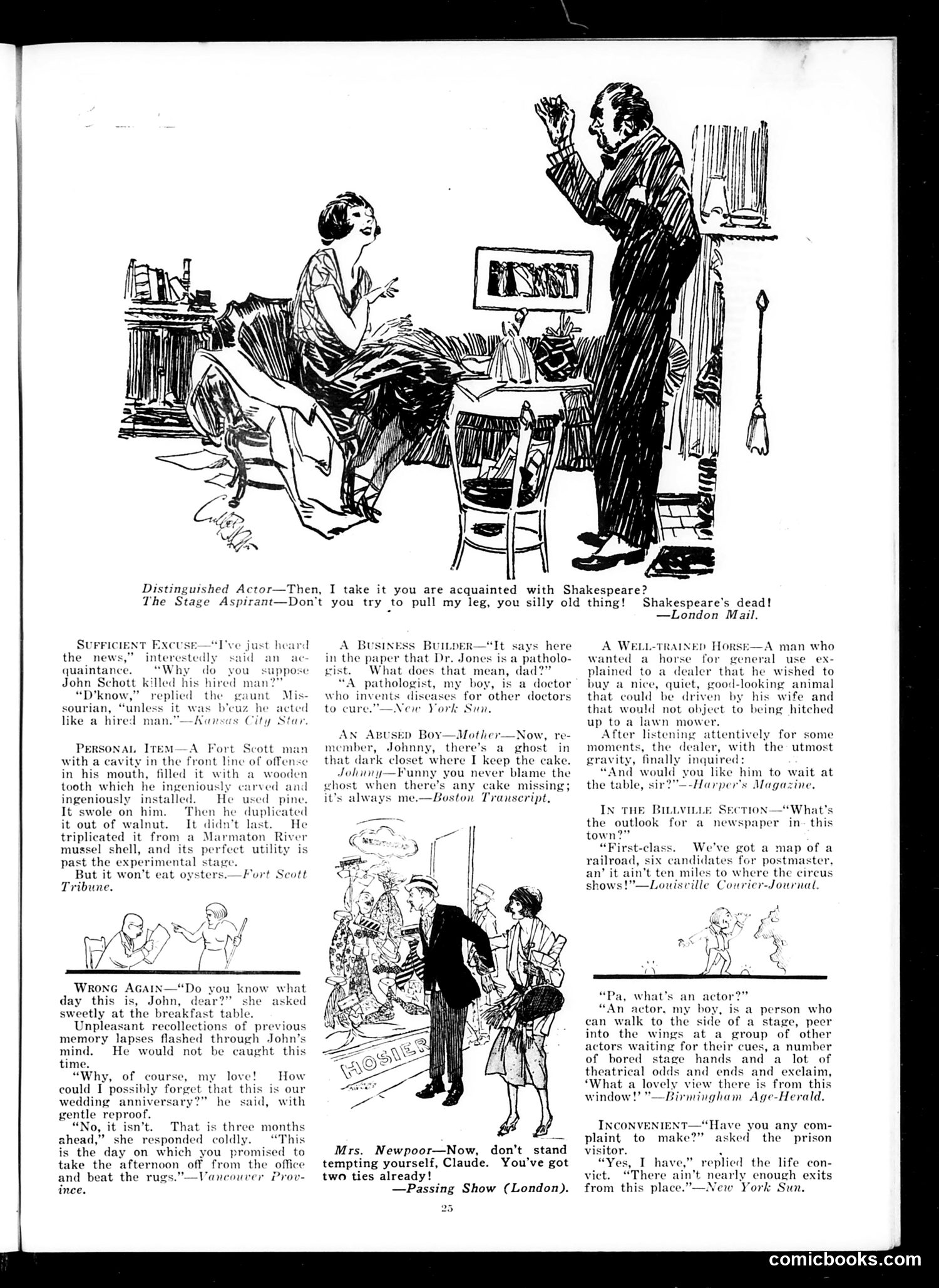
This page contains multiple brief comic anecdotes satirizing American social life and professions, typical of Judge's humor format. The top illustration depicts a theatrical exchange: a distinguished actor questions a stage aspirant about Shakespeare, who defensively rejects the query as "pulling my leg." The satire mocks aspiring actors' pretensions and ignorance. The surrounding text snippets ridicule various figures: a Fort Scott man with dental problems (absurdist humor), a husband caught forgetting his wedding anniversary, and professionals like pathologists and horse dealers presented through exaggerated scenarios. One anecdote defines "pathologist" sarcastically as "a doctor who invents diseases for other doctors to cure"—satirizing medical profession profiteering. A newspaper editor in Billville optimistically describes his town's prospects while listing a cemetery, postmaster candidates, and circus proximity—ironically suggesting small-town mediocrity. The final item features a prison convict complaining there "ain't nearly enough exits"—dark humor about incarceration. Throughout, the satire targets pretension, professional incompetence, and human folly with characteristic early-20th-century brevity and cynicism.
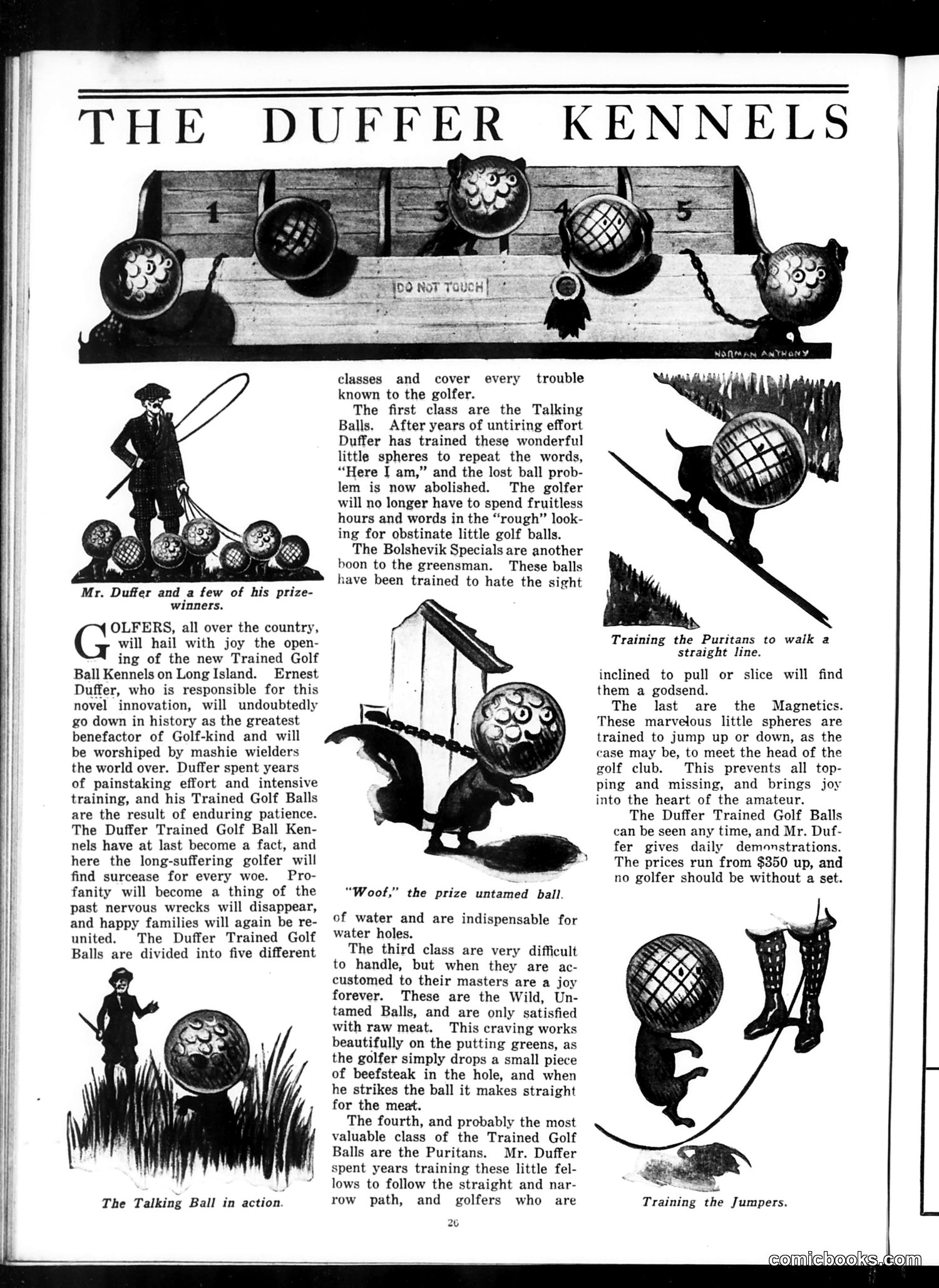
This is a humorous satirical piece mocking golf culture and the obsessive frustrations of golfers. The joke imagines a fictional inventor named Ernest Duffer who has created "trained golf balls" — marketed like dog kennels — each with absurd specialized abilities. The satire targets golfers' chronic complaints: losing balls in rough grass, water hazards, poor putting technique, and slicing. Each fictional ball class ridicules these problems with exaggerated solutions — "Talking Balls" that announce themselves, "Bolshevik Specials" that hate water, "Wild Untamed Balls" requiring raw meat, "Puritans" that follow straight paths, and "Magnetics" that jump to meet the club. The accompanying illustrations show Mr. Duffer training these imaginary balls like pets. The deeper satire mocks both the desperation of golfers willing to blame external factors rather than their own skill, and the period's tendency toward technological "solutions" to human problems. The $350+ price tag adds economic satire.
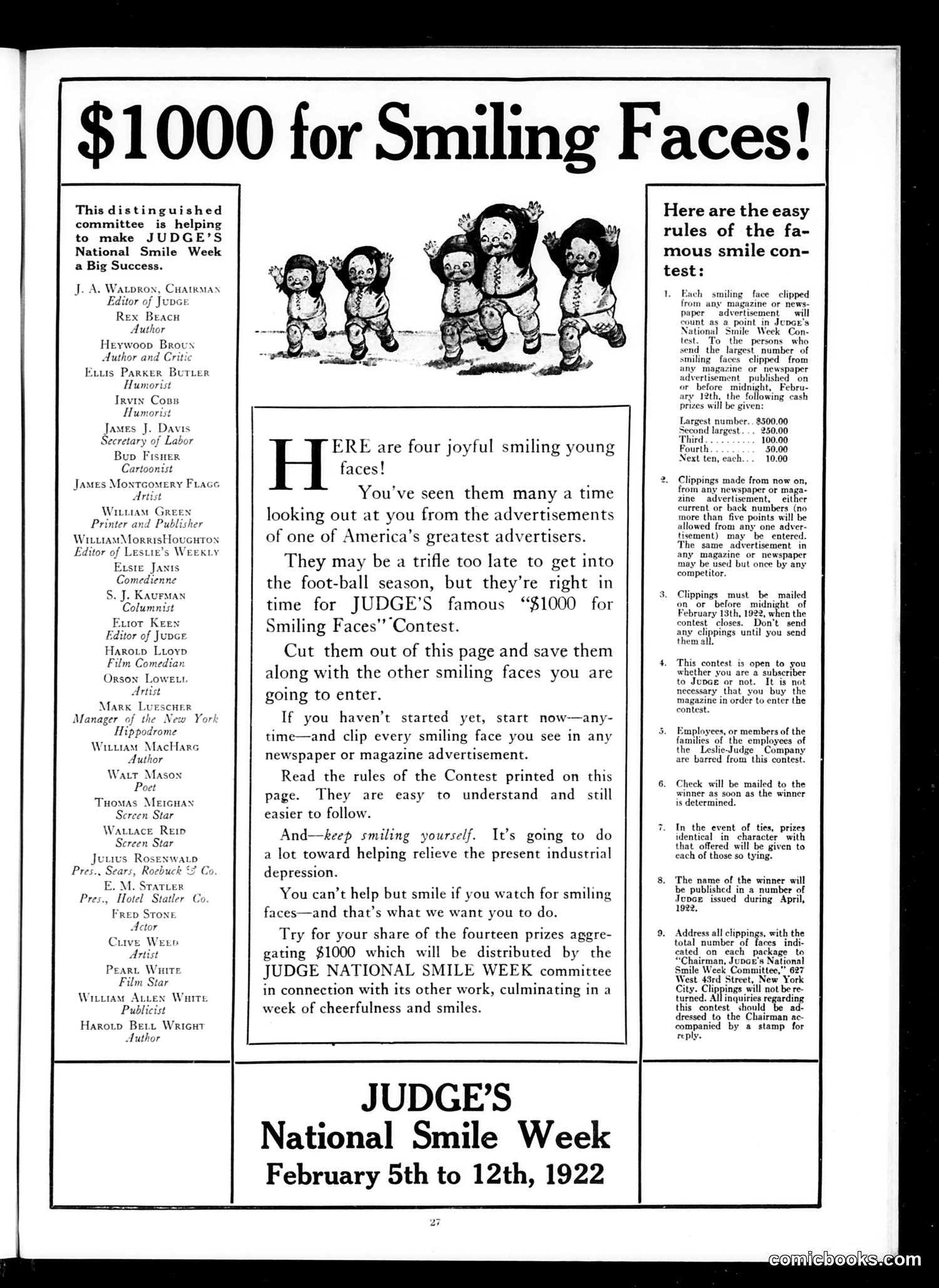
This page announces Judge magazine's promotional contest encouraging readers to collect smiling faces clipped from newspaper and magazine advertisements. The contest ran February 5-12, 1922, offering $1000 in prizes. The appeal is explicitly tied to economic conditions: participants are urged to "keep smiling yourself" as a way to "help relieve the present industrial depression"—referencing the post-WWI recession of 1920-1922. The page lists a distinguished committee of celebrities, editors, and business leaders (including Secretary of Labor James J. Davis) lending credibility to the campaign. Four cheerful cartoon children are featured as examples of the "smiling faces" to collect. The contest rules are straightforward: clip smiling advertisements, mail them in, largest collection wins cash prizes. For modern readers, this reflects an optimistic, pre-Depression-era belief that collective positive attitude-adjustment could improve economic conditions—a stark contrast to later, more cynical approaches to economic crisis.
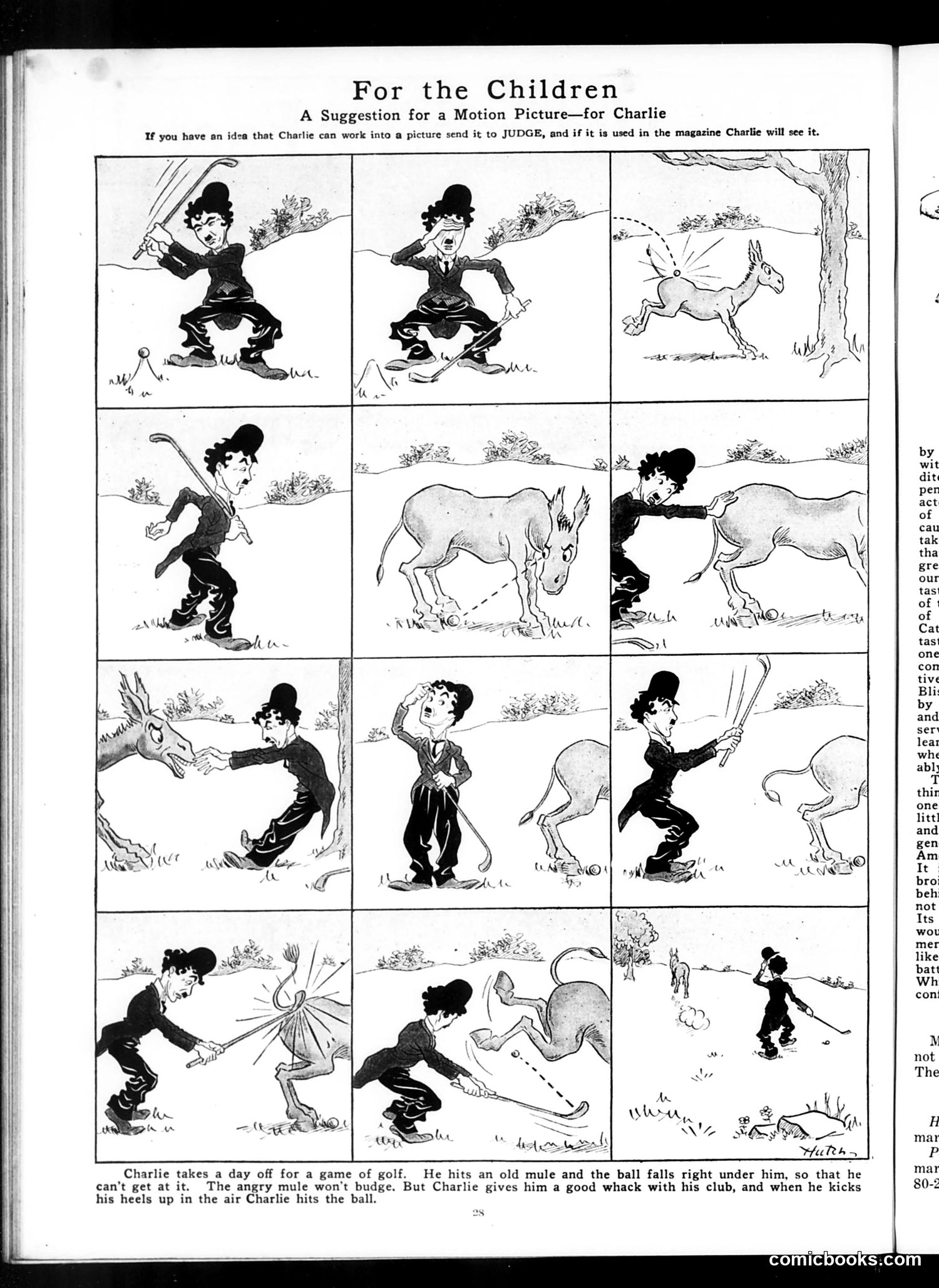
This is a comic strip proposing a silent film scenario for Charlie Chaplin (referred to as "Charlie"). The twelve-panel sequence depicts Chaplin attempting to play golf, but an old mule interferes: the animal stands over his ball, preventing access. After failed attempts to move the stubborn mule, Chaplin hits it with his golf club. When the mule kicks its heels up in the air in response, Chaplin seizes the moment to strike the ball. The humor relies on physical comedy typical of Chaplin's films—slapstick, improvisation, and the underdog triumphing through clever timing rather than brute force. Judge magazine invited readers to submit film ideas for Chaplin, positioning itself as a creative pipeline to Hollywood during the silent era. This reflects Chaplin's immense popularity in the 1910s-1920s.
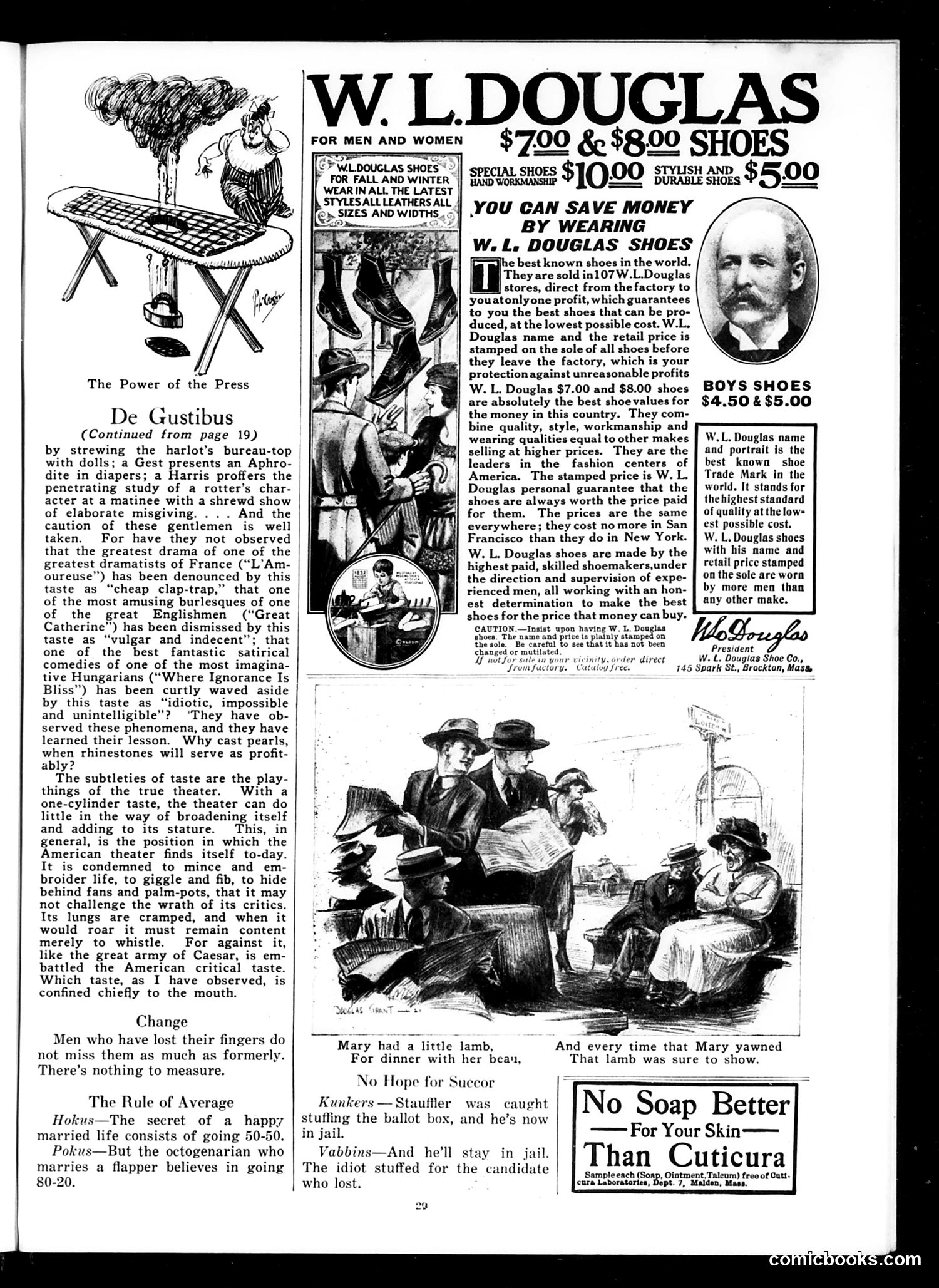
This page is primarily dominated by W.L. Douglas shoe advertising, but includes a theater criticism essay titled "The Power of the Press" (continued from page 19). The essay satirizes American theatrical taste as philistine and creatively restrictive. The author critiques critics who dismiss innovative plays—such as a French drama ("L'Amoureuse") and an English burlesque ("Great Catherine")—as cheap or vulgar. He argues that American theater is constrained by fearful deference to critical opinion, forcing playwrights to sanitize content rather than challenge audiences. The theater's "lungs are cramped," the essay concludes, as it merely "whistles" instead of roars against assembled critical taste that, ironically, operates "chiefly from the mouth"—meaning critics talk without substance. The satire targets both overly-cautious theater producers and shallow critics who stifle artistic ambition.
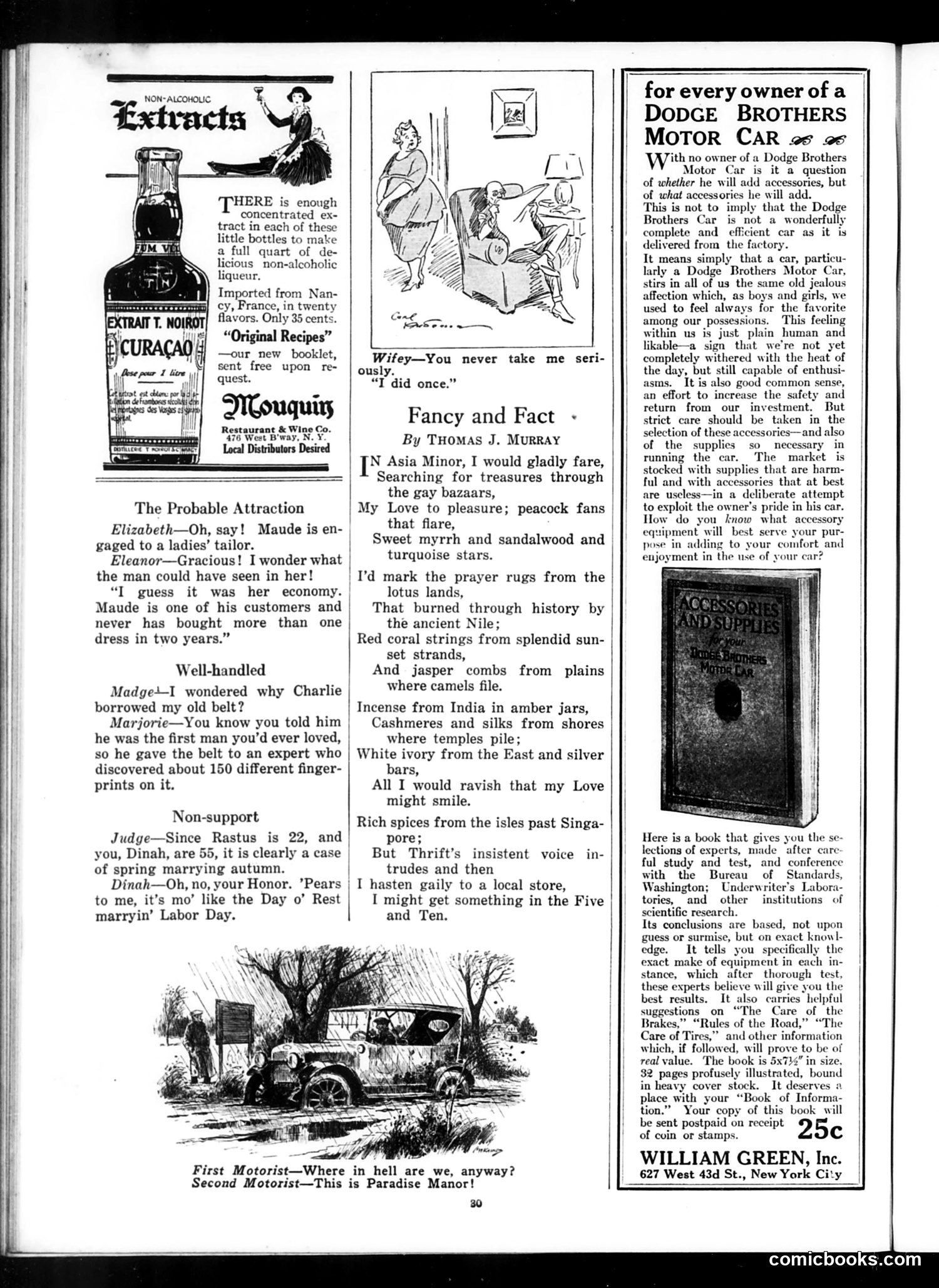
This page contains several humorous short jokes and advertisements typical of early 20th-century satirical magazines. **The cartoons** depict domestic situations: a couple where the wife complains her husband never takes her seriously (he responds he did once), and two lost motorists asking for directions, with one sarcastically calling their location "Paradise Manor." **The humor** relies on everyday domestic friction and the then-novel frustration of automobile travel—getting lost was apparently common enough to be relatable comedy. **The advertisements** include a non-alcoholic extract liqueur (likely marketed during Prohibition-era sensitivities) and a substantial Dodge Brothers Motor Car accessories guide promising expert-tested equipment recommendations. **Social context**: The "Non-support" joke references a Black couple with age-gap marriage, using period dialect ("mo' like"). The "Well-handled" joke's reference to 150 fingerprints on a borrowed belt is a crude innuendo about the woman's romantic history. The page reflects early automotive culture, Prohibition-era beverage marketing, and period attitudes toward gender and race.
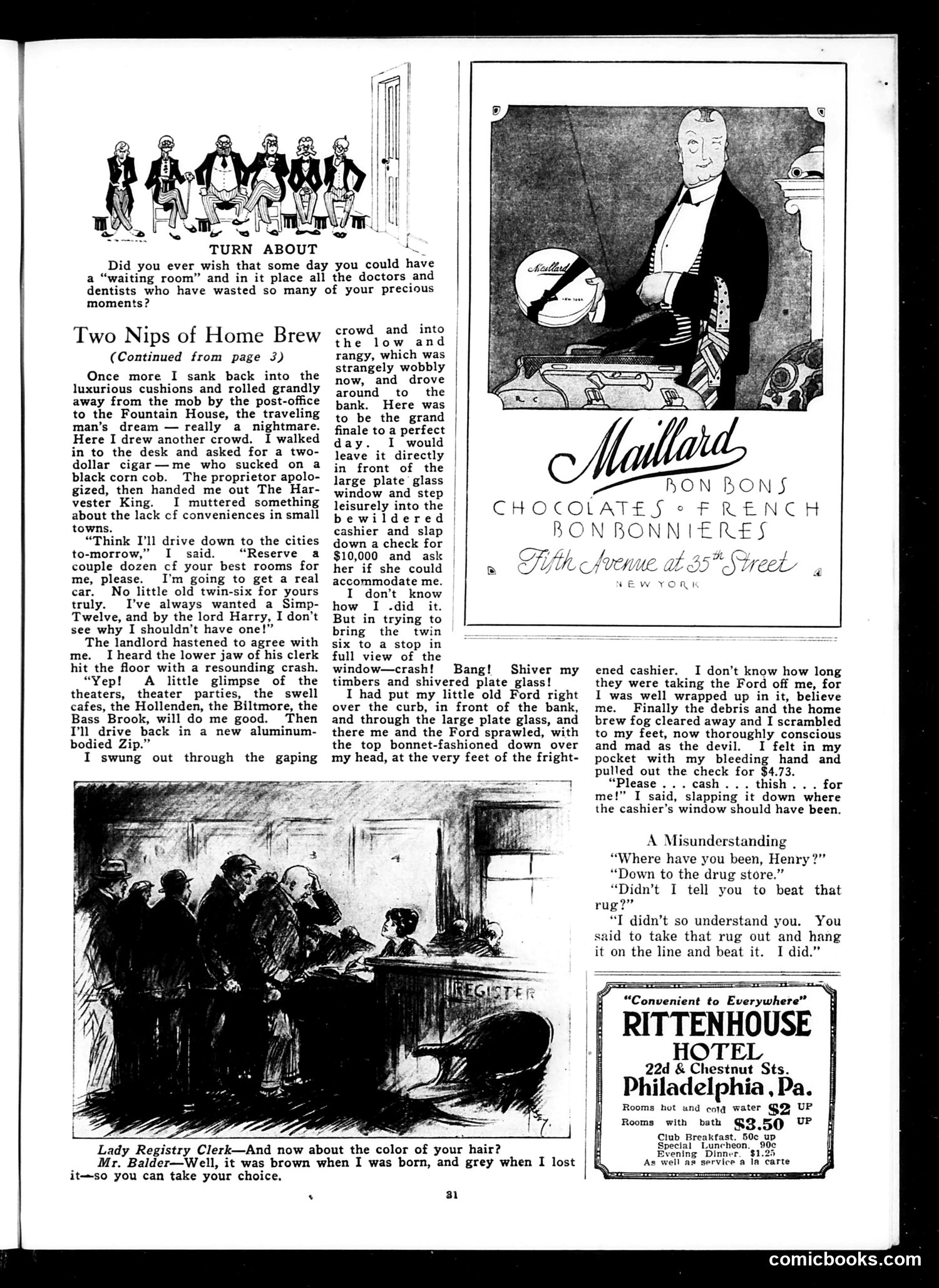
This page contains **three separate satirical pieces** from Judge magazine: 1. **"Turn About"** (top): A brief joke about the frustration of waiting rooms—suggesting doctors and dentists waste patients' time and should themselves experience the inconvenience they inflict. 2. **"Two Nips of Home Brew"** (main story): A con-man narrative where a traveling salesman pretends wealth to impress small-town people, bragging about buying expensive cars and depositing large checks. The joke: his old Ford crashes through a bank window, and when the dust clears, he can only cash a check for $4.73—exposing his deception. "Home brew" refers to his fabricated story. 3. **"A Misunderstanding"** (bottom): A domestic comedy where a husband literally interprets his wife's instructions too literally—she said "beat that rug," he beat it rather than hanging it first. The ads (Mallard Chocolates, Rittenhouse Hotel) are period commercial content. The page satirizes pretension, miscommunication, and small-town naïveté typical of early 20th-century American humor.
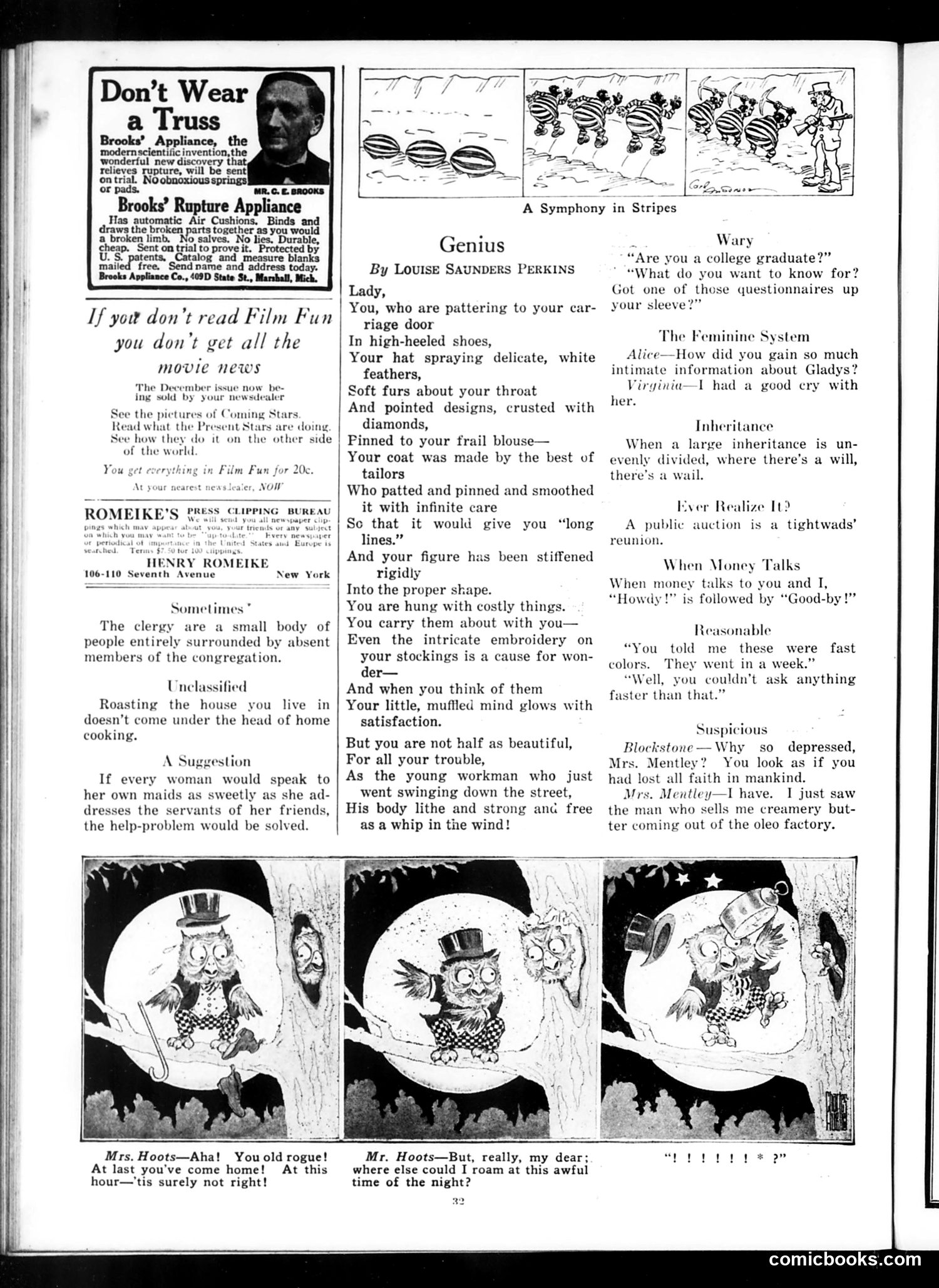
This page from *Judge* contains several distinct elements: **Advertisement**: Brooks' Rupture Appliance dominates the top left—a medical device marketed to treat hernias without traditional trusses, promising "no jous springs" (likely "no obnoxious springs"). **"A Symphony in Stripes"**: A four-panel comic strip showing what appears to be zebras multiplying or marching—the title suggests visual wordplay on animal patterns. **"Genius" Poem**: Louise Saunders Perkins critiques wealthy women's materialism. The poem contrasts an expensively dressed lady—laden with diamonds, furs, and elaborate clothing—unfavorably with a poor, physically free workman. The satire attacks aristocratic vanity and artificial beauty purchased through consumption. **Humor Shorts**: Brief jokes and observations mocking various social types: clergy with poor attendance, servant-treatment disparities, college graduates, inheritance disputes, and marital infidelity (the "Mr. and Mrs. Hoots" comic strip at bottom). **Overall tone**: Typical early-20th-century satirical magazine content mixing social commentary with light humor, targeting class pretension and domestic absurdities.
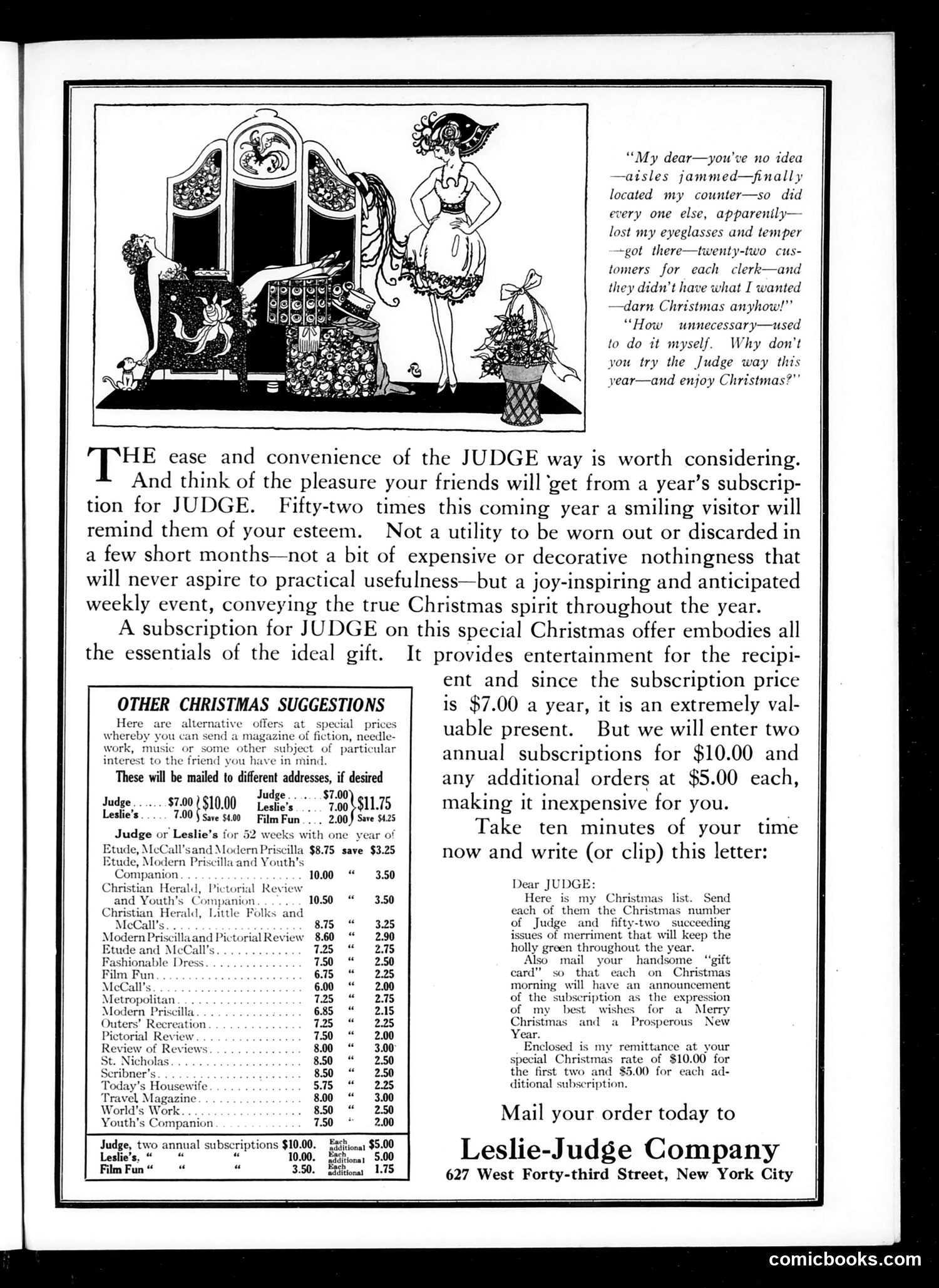
This is primarily a **magazine subscription advertisement**, not political satire. The cartoon depicts a frustrated woman complaining to a friend about chaotic Christmas shopping—crowded stores, overwhelmed clerks, lost eyeglasses, and unavailable merchandise. Her friend suggests she avoid this hassle by giving **Judge magazine subscriptions** as gifts instead. The ad's pitch: a weekly magazine delivered year-round is superior to typical Christmas gifts that wear out or get discarded. At $7.00 annually (or $10 for two subscriptions), it's portrayed as practical, entertaining, and a sustained reminder of the giver's esteem. The page includes an extensive list of alternative magazine options (Leslie's, McCall's, Modern Priscilla, etc.), all offered at special Christmas rates. **What a modern reader should know:** This reflects 1920s gift-giving culture and magazine popularity before television. The "Judge way" satirizes overconsumption and retail chaos—themes still relevant—by suggesting intellectual/entertainment subscriptions as superior to disposable goods.
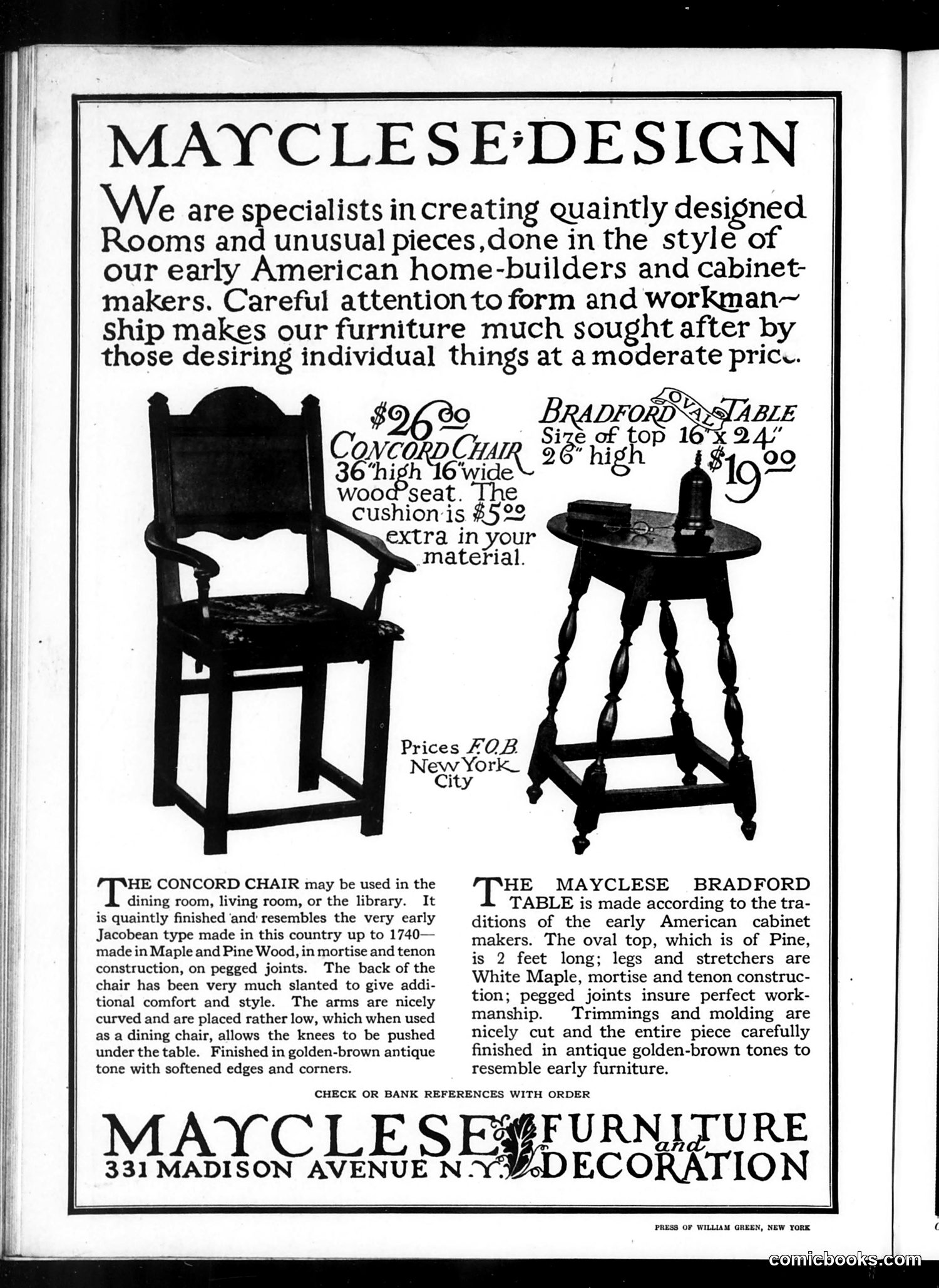
This page is **not a cartoon or satirical content**—it's a straightforward furniture advertisement from Mayclese Design, a New York company specializing in early American reproduction furniture. The ad promotes two pieces: a Concord Chair ($26.80) modeled after 1740s Jacobean designs, and a Bradford Table ($19.00), both marketed as authentic recreations of colonial American cabinetmaking. The text emphasizes "quaintly designed" pieces with careful craftsmanship at "moderate" prices for customers seeking "individual things." This reflects early 20th-century Colonial Revival aesthetics—a popular design movement celebrating American heritage through furniture that mimicked pre-revolutionary styles. The detailed specifications about wood types, construction methods, and finishes position these as quality reproductions rather than cheap imitations. The advertisement appears in Judge, a satirical magazine, but represents standard period advertising rather than editorial content with social commentary.